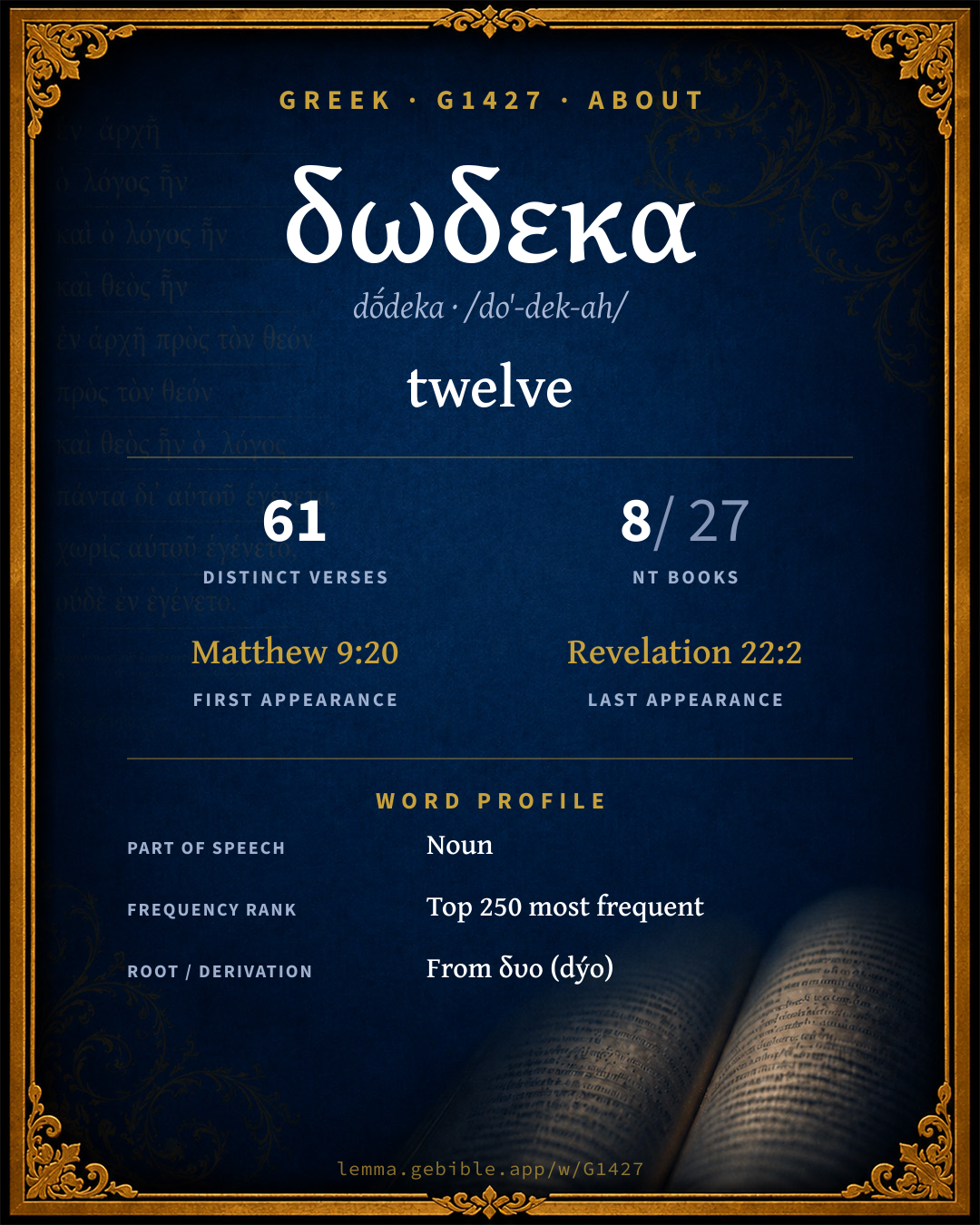
δώδεκα
twelve
Full lexicon entry — Thayer's Greek Lexicon
From Thayer's Greek Lexicon
Where this word appears
Every verse where G1427 appears — 61 distinct verses across 8 books. Click any verse to open its interlinear word-by-word view. Verse text shown in the World English Bible for context — . Each verse’s Greek form is shown with its reference; the English is not keyword-highlighted, since the data carries no word-level English alignment. Use “Compare translations” on any verse to read it across multiple English versions. This concordance covers the Greek New Testament; Septuagint (Greek Old Testament) occurrences of this word are not indexed here.
Matthew 12 verses
- Matthew 9:20 δώδεκα adj num indecl Behold, a woman who had an issue of blood for twelve years came behind him, and touched the tassels of his garment;
- Matthew 10:1 δώδεκα adj num indecl He called to himself his twelve disciples, and gave them authority over unclean spirits, to cast them out, and to heal every disease and every sickness.
- Matthew 10:2 δώδεκα adj num indecl Now the names of the twelve apostles are these. The first, Simon, who is called Peter; Andrew, his brother; James the son of Zebedee; John, his brother;
- Matthew 10:5 δώδεκα adj num indecl Jesus sent these twelve out, and charged them, saying, "Don't go among the Gentiles, and don't enter into any city of the Samaritans.
- Matthew 11:1 δώδεκα adj num indecl It happened that when Jesus had finished directing his twelve disciples, he departed from there to teach and preach in their cities.
- Matthew 14:20 δώδεκα adj num indecl They all ate, and were filled. They took up twelve baskets full of that which remained left over from the broken pieces.
- Matthew 19:28 δώδεκα δώδεκα adj num indecl adj num indecl Jesus said to them, "Most assuredly I tell you that you who have followed me, in the regeneration when the Son of Man will sit on the throne of his glory, you also will sit on twelve thrones, judging the twelve tribes of Israel.
- Matthew 20:17 δώδεκα adj num indecl As Jesus was going up to Jerusalem, he took the twelve disciples aside, and on the way he said to them,
- Matthew 26:14 δώδεκα adj num indecl Then one of the twelve, who was called Judas Iscariot, went to the chief priests,
- Matthew 26:20 δώδεκα adj num indecl Now when evening had come, he was reclining at the table with the twelve disciples.
- Matthew 26:47 δώδεκα adj num indecl While he was still speaking, behold, Judas, one of the twelve, came, and with him a great multitude with swords and clubs, from the chief priest and elders of the people.
- Matthew 26:53 δώδεκα adj num indecl Or do you think that I couldn't ask my Father, and he would even now send me more than twelve legions of angels?
Mark 15 verses
- Mark 3:14 δώδεκα adj num indecl He appointed twelve, that they might be with him, and that he might send them out to preach,
- Mark 3:16 δώδεκα adj num indecl Simon, to whom he gave the name Peter;
- Mark 4:10 δώδεκα adj num indecl When he was alone, those who were around him with the twelve asked him about the parables.
- Mark 5:25 δώδεκα adj num indecl A certain woman, who had an issue of blood for twelve years,
- Mark 5:42 δώδεκα adj num indecl Immediately the girl rose up, and walked, for she was twelve years old. They were amazed with great amazement.
- Mark 6:7 δώδεκα adj num indecl He called to himself the twelve, and began to send them out two by two; and he gave them authority over the unclean spirits.
- Mark 6:43 δώδεκα adj num indecl They took up twelve baskets full of broken pieces and also of the fish.
- Mark 8:19 δώδεκα adj num indecl When I broke the five loaves among the five thousand, how many baskets full of broken pieces did you take up?" They told him, "Twelve."
- Mark 9:35 δώδεκα adj num indecl He sat down, and called the twelve; and he said to them, "If any man wants to be first, he shall be last of all, and servant of all."
- Mark 10:32 δώδεκα adj num indecl They were on the way, going up to Jerusalem; and Jesus was going in front of them, and they were amazed; and those who followed were afraid. He again took the twelve, and began to tell them the things that were going to happen to him.
- Mark 11:11 δώδεκα adj num indecl Jesus entered into the temple in Jerusalem. When he had looked around at everything, it being now evening, he went out to Bethany with the twelve.
- Mark 14:10 δώδεκα adj num indecl Judas Iscariot, who was one of the twelve, went away to the chief priests, that he might deliver him to them.
- Mark 14:17 δώδεκα adj num indecl When it was evening he came with the twelve.
- Mark 14:20 δώδεκα adj num indecl He answered them, "It is one of the twelve, he who dips with me in the dish.
- Mark 14:43 δώδεκα adj num indecl Immediately, while he was still speaking, Judas, one of the twelve, came--and with him a multitude with swords and clubs, from the chief priests, the scribes, and the elders.
Luke 12 verses
- Luke 2:42 δώδεκα adj num indecl When he was twelve years old, they went up to Jerusalem according to the custom of the feast,
- Luke 6:13 δώδεκα adj num indecl When it was day, he called his disciples, and from them he chose twelve, whom he also named apostles:
- Luke 8:1 δώδεκα adj num indecl It happened soon afterwards, that he went about through cities and villages, preaching and bringing the good news of the Kingdom of God. With him were the twelve,
- Luke 8:42 δώδεκα adj num indecl for he had an only daughter, about twelve years of age, and she was dying. But as he went, the multitudes pressed against him.
- Luke 8:43 δώδεκα adj num indecl A woman who had a flow of blood for twelve years, who had spent all her living on physicians, and could not be healed by any,
- Luke 9:1 δώδεκα adj num indecl He called the twelve together, and gave them power and authority over all demons, and to cure diseases.
- Luke 9:12 δώδεκα adj num indecl The day began to wear away; and the twelve came, and said to him, "Send the multitude away, that they may go into the surrounding villages and farms, and lodge, and get food, for we are here in a deserted place."
- Luke 9:17 δώδεκα adj num indecl They ate, and were all filled. They gathered up twelve baskets of broken pieces that were left over.
- Luke 18:31 δώδεκα adj num indecl He took the twelve aside, and said to them, "Behold, we are going up to Jerusalem, and all the things that are written through the prophets concerning the Son of Man will be completed.
- Luke 22:3 δώδεκα adj num indecl Satan entered into Judas, who was surnamed Iscariot, who was numbered with the twelve.
- Luke 22:30 δώδεκα adj num indecl that you may eat and drink at my table in my Kingdom. You will sit on thrones, judging the twelve tribes of Israel."
- Luke 22:47 δώδεκα adj num indecl While he was still speaking, behold, a multitude, and he who was called Judas, one of the twelve, was leading them. He came near to Jesus to kiss him.
John 6 verses
- John 6:13 δώδεκα adj num indecl So they gathered them up, and filled twelve baskets with broken pieces from the five barley loaves, which were left over by those who had eaten.
- John 6:67 δώδεκα adj num indecl Jesus said therefore to the twelve, "You don't also want to go away, do you?"
- John 6:70 δώδεκα adj num indecl Jesus answered them, "Didn't I choose you, the twelve, and one of you is a devil?"
- John 6:71 δώδεκα adj num indecl Now he spoke of Judas, the son of Simon Iscariot, for it was he who would betray him, being one of the twelve.
- John 11:9 δώδεκα adj num indecl Jesus answered, "Aren't there twelve hours of daylight? If a man walks in the day, he doesn't stumble, because he sees the light of this world.
- John 20:24 δώδεκα adj num indecl But Thomas, one of the twelve, called Didymus, wasn't with them when Jesus came.
Acts 4 verses
- Acts 6:2 δώδεκα adj num indecl The twelve summoned the multitude of the disciples and said, "It is not appropriate for us to forsake the word of God and serve tables.
- Acts 7:8 δώδεκα adj num indecl He gave him the covenant of circumcision. So Abraham became the father of Isaac, and circumcised him the eighth day. Isaac became the father of Jacob, and Jacob became the father of the twelve patriarchs.
- Acts 19:7 δώδεκα adj num indecl They were about twelve men in all.
- Acts 24:11 δώδεκα adj num indecl seeing that you can recognize that it is not more than twelve days since I went up to worship at Jerusalem.
1 Corinthians 1 verse
James 1 verse
Revelation 10 verses
- Revelation 7:5 δώδεκα δώδεκα δώδεκα adj num indecl adj num indecl adj num indecl Of the tribe of Judah were sealed twelve thousand, Of the tribe of Reuben twelve thousand, Of the tribe of Gad twelve thousand,
- Revelation 7:6 δώδεκα δώδεκα δώδεκα adj num indecl adj num indecl adj num indecl Of the tribe of Asher twelve thousand, Of the tribe of Naphtali twelve thousand, Of the tribe of Manasseh twelve thousand,
- Revelation 7:7 δώδεκα δώδεκα δώδεκα adj num indecl adj num indecl adj num indecl Of the tribe of Simeon twelve thousand, Of the tribe of Levi twelve thousand, Of the tribe of Issachar twelve thousand,
- Revelation 7:8 δώδεκα δώδεκα δώδεκα adj num indecl adj num indecl adj num indecl Of the tribe of Zebulun twelve thousand, Of the tribe of Joseph twelve thousand, Of the tribe of Benjamin were sealed twelve thousand.
- Revelation 12:1 δώδεκα adj num indecl A great sign was seen in heaven: a woman clothed with the sun, and the moon under her feet, and on her head a crown of twelve stars.
- Revelation 21:12 δώδεκα δώδεκα δώδεκα adj num indecl adj num indecl adj num indecl having a great and high wall; having twelve gates, and at the gates twelve angels; and names written on them, which are the names of the twelve tribes of the children of Israel.
- Revelation 21:14 δώδεκα δώδεκα δώδεκα adj num indecl adj num indecl adj num indecl The wall of the city had twelve foundations, and on them twelve names of the twelve Apostles of the Lamb.
- Revelation 21:16 δώδεκα adj num indecl The city lies foursquare, and its length is as great as its breadth. He measured the city with the reed, Twelve thousand twelve stadia. Its length, breadth, and height are equal.
- Revelation 21:21 δώδεκα δώδεκα adj num indecl adj num indecl The twelve gates were twelve pearls. Each one of the gates was made of one pearl. The street of the city was pure gold, like transparent glass.
- Revelation 22:2 δώδεκα adj num indecl in the middle of its street. On this side of the river and on that was the tree of life, bearing twelve kinds of fruits, yielding its fruit every month. The leaves of the tree were for the healing of the nations.
About this entry
At a glance — auto-summarized from this page’s data, not written by a person. Every figure links to its source below. This summary describes the numbers; it doesn’t interpret them.
The Greek noun δωδεκα centers on the idea of “twelve.” Debuting at Matthew 9:20, it then recurs through the corpus. Spanning 61 verses in 8 books, it ranks among the moderately common words of the Greek New Testament. Mark dominates its distribution — 15 of 61 verses. Sharing its root, it stands alongside δυο, δευτερος and δις. For the data behind this summary, explore the sense tree and the renderings breakdown below.
Gloss history
Strong's 1890 vs modern scholarship
About this word
Strong's G1427 catalogs a Greek word from the Greek New Testament.
These counts are not copied from any lexicon or concordance. They are computed here, from the morphology-tagged Greek New Testament. What Lemma adds →
- 61
- distinct verses
- The word appears in 61 distinct verses.
- 8 / 27
- NT books
- The word appears in 8 of 27 New Testament books.
- #228
- by frequency
- Top 250 most frequent Greek words (rank 228 of 5,347 Greek words by occurrence).
View all 61 occurrences in the concordance →
By section of the New Testament
By traditional corpus
Conventional, traditional groupings — biblical authorship is debated, so this is a traditional corpus grouping, not an authorship claim. Some books belong to more than one corpus (Luke is in both the Gospels and the Lukan corpus, and so on), so these shares overlap and need not total 100%. Each figure is a share of the word’s 61 distinct verses.
- Gospels 45 verses · 74%
- Lukan (Luke–Acts) 16 verses · 26%
- Johannine 16 verses · 26%
- Revelation 10 verses · 16%
- Pauline corpus 1 verse · 2%
- General (Catholic) Epistles 1 verse · 2%
How translations render this word
Counts come from each version’s own published word-to-Strong’s tagging or interlinear alignment — an approximate guide to how each version renders this word, not a word-level alignment the data otherwise carries. Because each total is that version’s own tagged count, the per-version totals vary from one another and need not match the appearance or distinct-verse counts above. These counts may also differ from a printed concordance because Lemma counts each distinctly tagged rendering and does not collapse phrase taggings into a single head-word total. This is a fixed set of word-tagged versions (KJV, ASV, BSB, ULT) and does not change with the reading translation you choose elsewhere. Each version’s license is shown beside its name below (and on Sources).
- King James Version: Twelve 68×
- American Standard Version: Twelve 66×
- Berean Standard Bible: Twelve 58×, Twelve aside 2×
- unfoldingWord Literal Text: Twelve 26×
King James Version Public Domain
Renders G1427 across 72 tagged occurrences — most commonly:
Plus 4 renderings that appear only once — usually multi-word phrases or single function words the recovered tagging swept in, not distinct renderings.
American Standard Version Public Domain
Renders G1427 across 70 tagged occurrences — most commonly:
Plus 4 renderings that appear only once — usually multi-word phrases or single function words the recovered tagging swept in, not distinct renderings.
Berean Standard Bible Public Domain
Renders G1427 across 61 tagged occurrences — most commonly:
Plus 1 rendering that appears only once — usually multi-word phrases or single function words the recovered tagging swept in, not distinct renderings. Not rendered by a distinct English word in 14 further occurrences.
unfoldingWord Literal Text CC BY-SA 4.0
Renders G1427 across 27 tagged occurrences — most commonly:
Plus 1 rendering that appears only once — usually multi-word phrases or single function words the recovered tagging swept in, not distinct renderings. Not rendered by a distinct English word in 48 further occurrences.
Senses in Thayer's
The 1 sense Thayer's distinguishes for this word, in lexicon order (not ranked by frequency or importance). The full entry — with sub-senses — is in the Lexicon Entry tab.
- twelve
Word origin
Derived from δυο (dýo) (G1417) — two.
Same root — word family
Other Thayer's entries built from the same root as G1427, grouped by Strong’s listed origin. These share a root / origin per the lexicon — not necessarily a shared meaning. Each links to that word’s own entry.
Derives from
Shares the same root
Derived from this word
Compare all same-root words → Showing 4 of 6 — not the complete family. They share a root, not necessarily a meaning.
Septuagint usage
The same Greek word δωδεκα appears 84 times in the Greek Old Testament (Septuagint), across 72 verses in 17 books.
- 84
- LXX occurrences
- Tagged occurrences of this Greek word in the Septuagint.
- 72
- verses
- Distinct Septuagint verses containing this word.
- 17 / 39
- OT books
- The word appears in 17 of the 39 Old Testament books.
Sample Septuagint occurrences
- Genesis 5:8 δώδεκα
- Exodus 15:27 δώδεκα
- Leviticus 24:5 δώδεκα
- Numbers 1:44 δώδεκα
- Deuteronomy 1:23 δώδεκα
- Joshua 3:12 δώδεκα
- Judges 19:29 δώδεκα
- 2 Samuel 2:15 δώδεκα
- 1 Kings 2:12 δώδεκα
- 2 Kings 3:1 δώδεκα
- 2 Chronicles 1:14 δώδεκα
- Ezra 6:17 δώδεκα
Septuagint occurrences (same lexeme)
Every verse where the same Strong’s number (G1427) appears in the Greek Septuagint — showing the first 50 of 72. Verse text shown in the World English Bible for context; the Greek form is the matched word — the English is not keyword-highlighted.
- Genesis 5:8 δώδεκα All the days of Seth were nine hundred twelve years, then he died.
- Genesis 14:4 δώδεκα Twelve years they served Chedorlaomer, and in the thirteenth year, they rebelled.
- Genesis 17:20 δώδεκα As for Ishmael, I have heard you. Behold, I have blessed him, and will make him fruitful, and will multiply him exceedingly. He will become the father of twelve princes, and I will make him a great nation.
- Genesis 25:16 δώδεκα These are the sons of Ishmael, and these are their names, by their villages, and by their encampments: twelve princes, according to their nations.
- Genesis 35:22 δώδεκα It happened, while Israel lived in that land, that Reuben went and lay with Bilhah, his father's concubine, and Israel heard of it. Now the sons of Jacob were twelve.
- Genesis 42:13 δώδεκα They said, "We, your servants, are twelve brothers, the sons of one man in the land of Canaan; and, behold, the youngest is this day with our father, and one is no more."
- Genesis 42:32 δώδεκα We are twelve brothers, sons of our father; one is no more, and the youngest is this day with our father in the land of Canaan.'
- Genesis 49:28 δώδεκα All these are the twelve tribes of Israel, and this is what their father spoke to them and blessed them. He blessed everyone according to his blessing.
- Exodus 15:27 δώδεκα They came to Elim, where there were twelve springs of water, and seventy palm trees: and they encamped there by the waters.
- Exodus 24:4 δώδεκα Moses wrote all the words of Yahweh, and rose up early in the morning, and built an altar under the mountain, and twelve pillars for the twelve tribes of Israel.
- Exodus 36:21 δώδεκα Ten cubits was the length of a board, and a cubit and a half the breadth of each board.
- Leviticus 24:5 δώδεκα "You shall take fine flour, and bake twelve cakes of it: two tenth parts of an ephah shall be in one cake.
- Numbers 1:44 δώδεκα These are those who were numbered, whom Moses and Aaron numbered, and the princes of Israel, being twelve men: they were each one for his fathers' house.
- Numbers 7:2 δώδεκα that the princes of Israel, the heads of their fathers' houses, offered. These were the princes of the tribes. These are they who were over those who were numbered:
- Numbers 7:3 δώδεκα and they brought their offering before Yahweh, six covered wagons, and twelve oxen; a wagon for every two of the princes, and for each one an ox: and they presented them before the tabernacle.
- Numbers 7:84 δώδεκα This was the dedication of the altar, on the day when it was anointed, by the princes of Israel: twelve silver platters, twelve silver bowls, twelve golden ladles;
- Numbers 7:86 δώδεκα the twelve golden ladles, full of incense, weighing ten shekels apiece, after the shekel of the sanctuary; all the gold of the ladles weighed one hundred twenty shekels;
- Numbers 7:87 δώδεκα all the oxen for the burnt offering twelve bulls, the rams twelve, the male lambs a year old twelve, and their meal offering; and the male goats for a sin offering twelve;
- Numbers 17:17 δώδεκα
- Numbers 17:21 δώδεκα
- Numbers 29:17 δώδεκα On the second day [you shall offer] twelve young bulls, two rams, fourteen he-lambs a year old without blemish;
- Numbers 31:5 δώδεκα So there were delivered, out of the thousands of Israel, a thousand of every tribe, twelve thousand armed for war.
- Numbers 33:9 δώδεκα They traveled from Marah, and came to Elim: and in Elim were twelve springs of water, and seventy palm trees; and they encamped there.
- Deuteronomy 1:23 δώδεκα The thing pleased me well; and I took twelve men of you, one man for every tribe:
- Joshua 3:12 δώδεκα Now therefore take twelve men out of the tribes of Israel, for every tribe a man.
- Joshua 4:3 δώδεκα and command you them, saying, Take hence out of the midst of the Jordan, out of the place where the priests' feet stood firm, twelve stones, and carry them over with you, and lay them down in the lodging-place, where you shall lodge this night.
- Joshua 4:4 δώδεκα Then Joshua called the twelve men, whom he had prepared of the children of Israel, out of every tribe a man:
- Joshua 4:5 δώδεκα and Joshua said to them, Pass over before the ark of Yahweh your God into the midst of the Jordan, and take up every man of you a stone on his shoulder, according to the number of the tribes of the children of Israel;
- Joshua 4:8 δώδεκα The children of Israel did so as Joshua commanded, and took up twelve stones out of the midst of the Jordan, as Yahweh spoke to Joshua, according to the number of the tribes of the children of Israel; and they carried them over with them to the place where they lodged, and laid them down there.
- Joshua 4:9 δώδεκα Joshua set up twelve stones in the midst of the Jordan, in the place where the feet of the priests who bore the ark of the covenant stood: and they are there to this day.
- Joshua 4:20 δώδεκα Those twelve stones, which they took out of the Jordan, did Joshua set up in Gilgal.
- Joshua 8:25 δώδεκα All that fell that day, both of men and women, were twelve thousand, even all the men of Ai.
- Joshua 21:7 δώδεκα The children of Merari according to their families had out of the tribe of Reuben, and out of the tribe of Gad, and out of the tribe of Zebulun, twelve cities.
- Joshua 24:12 δώδεκα I sent the hornet before you, which drove them out from before you, even the two kings of the Amorites; not with your sword, nor with your bow.
- Judges 19:29 δώδεκα When he was come into his house, he took a knife, and laid hold on his concubine, and divided her, limb by limb, into twelve pieces, and sent her throughout all the borders of Israel.
- Judges 21:10 δώδεκα The congregation sent there twelve thousand men of the most valiant, and commanded them, saying, Go and strike the inhabitants of Jabesh Gilead with the edge of the sword, with the women and the little ones.
- 2 Samuel 2:15 δώδεκα Then they arose and went over by number: twelve for Benjamin, and for Ish-bosheth the son of Saul, and twelve of the servants of David.
- 2 Samuel 10:6 δώδεκα When the children of Ammon saw that they were become odious to David, the children of Ammon sent and hired the Syrians of Beth Rehob, and the Syrians of Zobah, twenty thousand footmen, and the king of Maacah with one thousand men, and the men of Tob twelve thousand men.
- 2 Samuel 17:1 δώδεκα Moreover Ahithophel said to Absalom, Let me now choose out twelve thousand men, and I will arise and pursue after David this night:
- 1 Kings 2:12 δώδεκα Solomon sat on the throne of David his father; and his kingdom was established greatly.
- 1 Kings 2:46 δώδεκα So the king commanded Benaiah the son of Jehoiada; and he went out, and fell on him, so that he died. The kingdom was established in the hand of Solomon.
- 1 Kings 4:7 δώδεκα Solomon had twelve officers over all Israel, who provided food for the king and his household: each man had to make provision for a month in the year.
- 1 Kings 7:13 δώδεκα King Solomon sent and fetched Hiram out of Tyre.
- 1 Kings 7:30 δώδεκα Every base had four brazen wheels, and axles of brass; and the four feet of it had supports: beneath the basin were the supports molten, with wreaths at the side of each.
- 1 Kings 10:20 δώδεκα Twelve lions stood there on the one side and on the other on the six steps: there was nothing like it made in any kingdom.
- 1 Kings 10:26 δώδεκα Solomon gathered together chariots and horsemen: and he had a thousand and four hundred chariots, and twelve thousand horsemen, that he bestowed in the chariot cities, and with the king at Jerusalem.
- 1 Kings 11:30 δώδεκα Ahijah laid hold of the new garment that was on him, and tore it in twelve pieces.
- 1 Kings 12:24 δώδεκα Thus says Yahweh, You shall not go up, nor fight against your brothers the children of Israel: return every man to his house; for this thing is of me. So they listened to the word of Yahweh, and returned and went their way, according to the word of Yahweh.
- 1 Kings 16:23 δώδεκα In the thirty-first year of Asa king of Judah began Omri to reign over Israel, [and reigned] twelve years: six years reigned he in Tirzah.
- 1 Kings 18:31 δώδεκα Elijah took twelve stones, according to the number of the tribes of the sons of Jacob, to whom the word of Yahweh came, saying, Israel shall be your name.
These are occurrences of the same Greek lexeme (G1427) in the Septuagint — not a translation of any one Hebrew word. The store carries no word-level Hebrew↔Greek alignment, so no Hebrew original is asserted here. Counts come from the recovered LXX Strong's tagging — high-frequency vocabulary is well covered, while rare or late forms may be untagged — so they reflect tagged occurrences and may slightly undercount.