Revelation 21:14

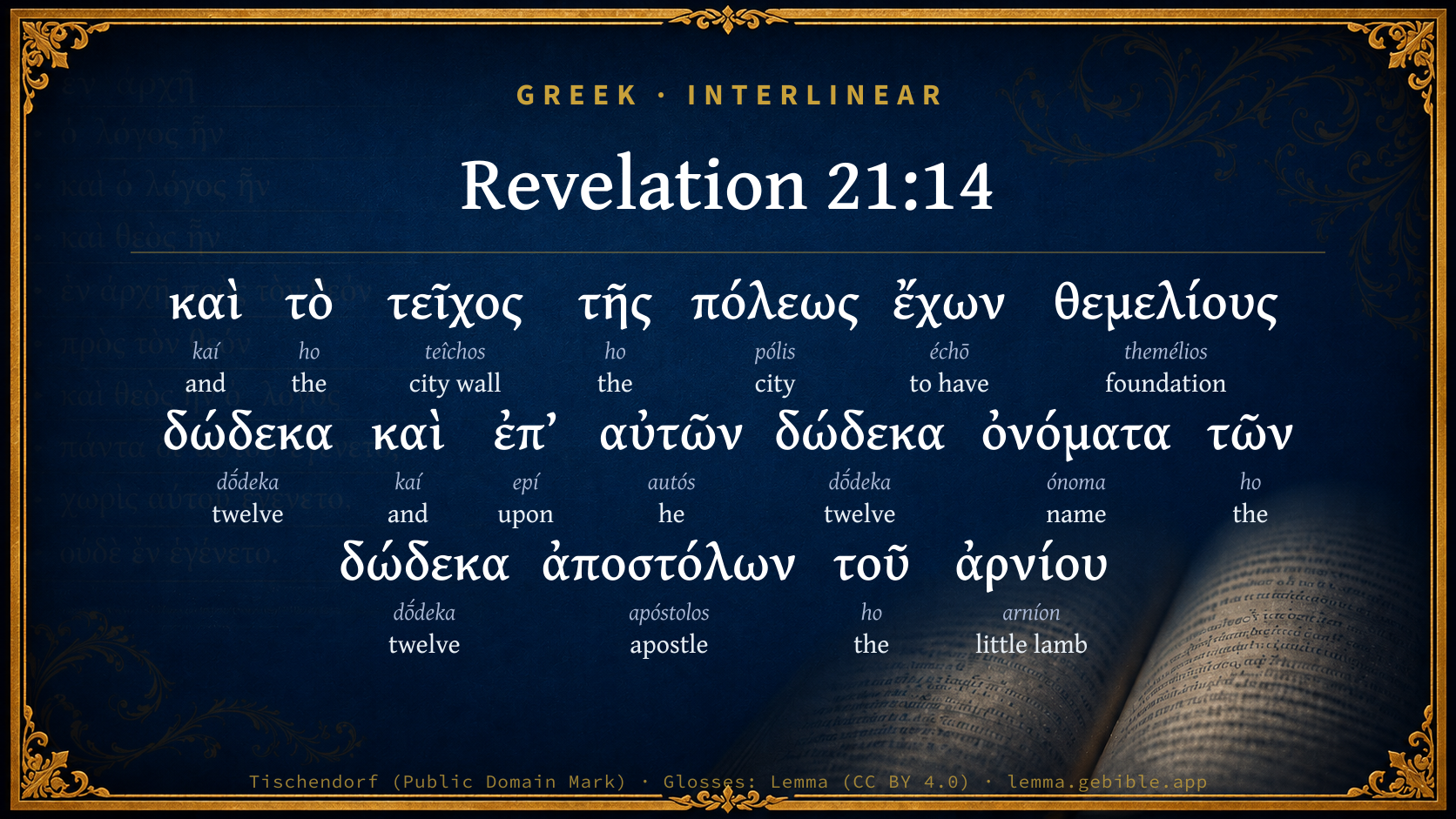
Greek (Tischendorf 8th ed.) Revelation 21:14 appears in the Greek New Testament. The text above is from the Tischendorf 8th edition. Each word links to its Strong’s number and a concise gloss. Click any word for its full Thayer’s Greek Lexicon entry.
Download image
Cite this verse

Revelation 21:14 (World English Bible). Public Domain. Lemma interlinear Bible study tool, https://lemma.gebible.app/v/revelation/21/14.

Show BibTeX & RIS
BibTeX
RIS
English Translation
The wall of the city had twelve foundations, and on them twelve names of the twelve Apostles of the Lamb.
World English Bible · Public Domain
Download a study sheet

One document with this verse’s original text, its word-by-word gloss line, the meaning frame, cross-references with their text, attributed commentary, and full source and license credits — printable, and it pastes into notes with its structure intact.

This verse Autodidact and up

Study sheet (.html) Plain text (.txt)

A passage Seminary Student

Up to 50 verses in one chapter. A passage sheet keeps up to 6 commentary sources and 12 cross-references per verse, in the order this page ranks them, and says so on the sheet whenever that leaves anything out. Ask for a single verse and you get the Autodidact verse sheet above.

Everything on this page stays free to read, with no account — the sheet is a download of what is already on screen, not access to it.

Want to remove ads? Support Godless Engineer
Compare translations 3

The same verse in 3 English versions, stacked beneath the original-language interlinear above. Click any original word for its lexicon entry.

Each is an independent rendering of the whole verse — the interlinear is not word-aligned to these translations.

Highlighted words mark where these versions differ — a whole-verse word diff, not a word-by-word alignment.

  • World English Bible Public Domain
    The wall of the city had twelve foundations, and on them twelve names of the twelve Apostles of the Lamb.
  • King James Version Public Domain
    And the wall of the city had twelve foundations, and in them the names of the twelve apostles of the Lamb.
  • unfoldingWord Literal Text CC BY-SA 4.0
    And the wall of the city had 12 foundations, and on them the 12 names of the 12 apostles of the Lamb.

unfoldingWord Literal Text — © unfoldingWord, licensed CC BY-SA 4.0. Word-aligned USFM3 via Door43 (git.door43.org/unfoldingWord/en_ult).

Versions to compare (up to 4)

3 of 4 selected

Show all 19 translations

Every available English version of this verse, each an independent rendering of the whole verse.

  • World English Bible Public Domain
    The wall of the city had twelve foundations, and on them twelve names of the twelve Apostles of the Lamb.
  • Berean Standard Bible Public Domain
    The wall of the city had twelve foundations bearing the names of the twelve apostles of the Lamb.
  • Majority Standard Bible Public Domain
    The wall of the city had twelve foundations bearing the names of the twelve apostles of the Lamb.
  • King James Version Public Domain
    And the wall of the city had twelve foundations, and in them the names of the twelve apostles of the Lamb.
  • American Standard Version (1901) Public Domain
    And the wall of the city had twelve foundations, and on them twelve names of the twelve apostles of the Lamb.
  • Revised Version (1885) Public Domain
    And the wall of the city had twelve foundations, and on them twelve names of the twelve apostles of the Lamb.
  • Geneva Bible (1599) Public Domain
    And the wall of the citie had twelue foundations, and in them the Names of the Lambes twelue Apostles.
  • Douay-Rheims (1899) Public Domain
    And the wall of the city had twelve foundations, and in them, the twelve names of the twelve apostles of the Lamb.
  • Young's Literal Translation Public Domain
    and the wall of the city had twelve foundations, and in them names of the twelve apostles of the Lamb.
  • Literal Standard Version CC BY-SA 4.0
    and the wall of the city had twelve foundations, and on them names of the twelve apostles of the Lamb.
  • Unlocked Literal Bible CC BY-SA 4.0
    The wall of the city had twelve foundations, and on them were the twelve names of the twelve apostles of the Lamb.
  • unfoldingWord Literal Text CC BY-SA 4.0
    And the wall of the city had 12 foundations, and on them the 12 names of the 12 apostles of the Lamb.
  • Darby Bible Public Domain
    And the wall of the city had twelve foundations, and on them twelve names of the twelve apostles of the Lamb.
  • World Messianic Bible Public Domain
    The wall of the city had twelve foundations, and on them twelve names of the twelve Emissaries of the Lamb.
  • Webster's Bible Public Domain
    And the wall of the city had twelve foundations, and on them the names of the twelve apostles of the Lamb.
  • Free Bible Version CC BY-SA 4.0
    The city wall had twelve foundations, and inscribed on them were the names of the twelve apostles of the Lamb.
  • Bible in Basic English Public Domain
    And the wall of the town had twelve bases, and on them the twelve names of the twelve Apostles of the Lamb.
  • Text-Critical English NT CC BY 4.0
    The wall of the city had twelve foundations, and on them were the twelve names of the twelve apostles of the Lamb.
  • Tyndale New Testament (1534) Public Domain
    and the wall of the cite had xii foundacions and in them the names of the lambes.xii. Apostles.

Literal Standard Version (2020), Covenant Press — licensed CC BY-SA 4.0. Text via the HelloAO Bible API (eBible.org). Unlocked Literal Bible (unfoldingWord) — licensed CC BY-SA 4.0. Text via the HelloAO Bible API (eBible.org). unfoldingWord Literal Text — © unfoldingWord, licensed CC BY-SA 4.0. Word-aligned USFM3 via Door43 (git.door43.org/unfoldingWord/en_ult). Free Bible Version, Dr. Jonathan Gallagher — licensed CC BY-SA 4.0. Text via the HelloAO Bible API (eBible.org).

Word by word

More ways to search: Search by grammar → Find every occurrence → Compare this word →

Practice this passage: Drill this verse → Learn its vocabulary →

τεῖχος
teîchos
G5038
“city wall”
Noun, Nominative, Singular, Neuter
Part of Speech
Noun
Case
Nominative
Number
Singular
Gender
Neuter
Full Thayer's Definition

Origin: akin to the base of G5088

TDNT: None

1. the wall around a city, town wall
  1. καὶ kaí G2532 “and” Conjunction
  2. τὸ ho G3588 “the” Article, Nominative, Singular, Neuter
  3. τῆς ho G3588 “the” Article, Genitive, Singular, Feminine
  4. πόλεως pólis G4172 “city” Noun, Genitive, Singular, Feminine
  5. ἔχων échō G2192 “to have” Verb, Present, Active, Participle, Nominative, Singular, Masculine
  6. θεμελίους themélios G2310 “foundation” Noun, Accusative, Plural, Masculine
  7. δώδεκα dṓdeka G1427 “twelve” Adjective, Numeral (indeclinable)
  8. καὶ kaí G2532 “and” Conjunction
  9. ἐπ’ epí G1909 “upon” Preposition
  10. αὐτῶν autós G846 “he” Personal pronoun, Genitive, Plural, Masculine
  11. δώδεκα dṓdeka G1427 “twelve” Adjective, Numeral (indeclinable)
  12. ὀνόματα ónoma G3686 “name” Noun, Accusative, Plural, Neuter
  13. τῶν ho G3588 “the” Article, Genitive, Plural, Masculine
  14. δώδεκα dṓdeka G1427 “twelve” Adjective, Numeral (indeclinable)
  15. ἀποστόλων apóstolos G652 “apostle” Noun, Genitive, Plural, Masculine
  16. τοῦ ho G3588 “the” Article, Genitive, Singular, Neuter
  17. ἀρνίου arníon G721 “little lamb” Noun, Genitive, Singular, Neuter

About this verse

These counts appear in no published source. They are computed here, from the morphology-tagged text and Lemma’s own curated glosses. What Lemma adds →

18
words
12
distinct lemmas
Revelation
section

Notable vocabulary

The rarest word here is τεῖχος city wall G5038 — appearing just 9 times in the whole Greek New Testament.

Shared distinctive vocabulary

τεῖχος city wall G5038 occurs in 9 verses of the Greek New Testament. Also found in:

Repetition

Words recur within this verse:

Cross-references

12

Topical passages linked to Revelation 21:14 in the Treasury of Scripture Knowledge — connected by theme and wording, ordered by reader-vote popularity; previews shown in the World English Bible.

  • Hebrews 11:10 For he looked for the city which has the foundations, whose builder and maker is God.
  • Ephesians 2:20 being built on the foundation of the apostles and prophets, Christ Jesus himself being the chief cornerstone;
  • Isaiah 54:11 you afflicted, tossed with tempest, and not comforted, behold, I will set your stones in beautiful colors, and lay your foundations with sapphires.
  • Revelation 21:19–21 The foundations of the city's wall were adorned with all kinds of precious stones. The first foundation was jasper; the second, sapphire; the third, chalcedony; the fourth, emerald;
  • Matthew 10:2–4 Now the names of the twelve apostles are these. The first, Simon, who is called Peter; Andrew, his brother; James the son of Zebedee; John, his brother;
  • Matthew 16:18 I also tell you that you are Peter, and on this rock I will build my assembly, and the gates of Hades will not prevail against it.
  • 1 Corinthians 3:10–11 According to the grace of God which was given to me, as a wise master builder I laid a foundation, and another builds on it. But let each man be careful how he builds on it.
  • Ephesians 3:5 which in other generations was not made known to the children of men, as it has now been revealed to his holy apostles and prophets in the Spirit;
  • Jude 1:17 But you, beloved, remember the words which have been spoken before by the apostles of our Lord Jesus Christ.
  • Revelation 18:20 Rejoice over her, O heaven, you saints, apostles, and prophets; for God has judged your judgment on her."
  • Galatians 2:9 and when they perceived the grace that was given to me, James and Cephas and John, they who were reputed to be pillars, gave to me and Barnabas the right hand of fellowship, that we should go to the Gentiles, and they to the circumcision.
  • Ephesians 4:11 He gave some to be apostles; and some, prophets; and some, evangelists; and some, shepherds and teachers;

Cross-references courtesy of OpenBible.info (CC BY 4.0).

Commentary

Notes on Revelation 21:14 from classic Christian and Jewish commentators (each source and its license shown beneath its notes). The classic Christian expositions comment on the surrounding passage and are grouped to its opening verse, so a note may address several verses; the Jewish commentaries on the Tanakh (Rashi and others) are per-verse, so they appear only where the commentator wrote on this verse.

Lemma curates 59 commentaries, every one of them public domain or Creative Commons licensed, each selected and text-cleaned for this edition rather than reprinted as found. About our sources →

The Biblical Illustrator

Joseph S. Exell

Rev_21:14

And the wall of the city had twelve foundations, and in them the names of the twelve apostles of the Lamb.

Names on the stones

The twelve apostles of the Lamb are for the most part obscure and hidden figures in the later gospel history. We have often wondered what became of them, and why the record of their toilsome, suffering lives was not preserved. We find them together on the day of Pentecost and a few subsequent days, and then persecution scatters them abroad, and their names, with one or two exceptions, appear no more. Paul, Peter, and John are the only members of the holy brotherhood whose services are honoured with historical recognition, and the rest ere passed over in silence. Tradition, indeed, partly fills up the blank, and imaginative works have elaborated romances to supply the place of history. But it is none the less true that of the labours of the great majority of the apostles there is no trustworthy record whatever. It may be that some of them suffered martyrdom at an early period of their ministry; some, perhaps, were prevented from achieving great success by imprisonment or banishment; while others, like Andrew, may have been men of unobtrusive and retiring nature, and withal of such inferior power, that the results of their labours were too insignificant to gain public notice. Be that as it may, at the very commencement of the Churchs history their names drop out. The names, which no human historian thought worth inscribing, are gathered together by Gods own hand, the dust swept from their obscurity, and stamped in jewelled letters on the foundations of the everlasting walls. The meanest and the humblest names are made equal to the greatest and most honoured.

I. Christ, the Master Builder, writes the name of His servants alongside His own. He takes care that those who have been willing to forget themselves for His sake shall be eternally remembered, and that if they have been in a very small degree companions in His patience, they shall be in a very large degree sharers in His kingdom. The jasper superstructure on which His name shines does not overshadow and obscure the meaner atones on which their names ere written. It rather illumines them by its more brilliant light, and makes the obscure names splendid. Because He lives, they live also. They have been co-labourers with Him in His humiliation, and they are joint-heirs with Him in His glory. Now the Ideal Church is in this respect quite unique. There is nothing like it in the works and fashion of this world. On the great buildings which men raise only one name is inscribed. The founder or architect is immortalised, the helpers sink into speedy oblivion. Christopher Wren, maya history, built St. Pauls Cathedral; Michael Angelo, St. Peters; and with superb disdain it sweeps all their co-labourers into the dust of forgetfulness. In every battle of the warrior it is the general alone who carries off the palm. And even in great moral and religious works the same rule holds. On the basement of the Reformation building we find only the names of Wycliffe, Huss, Luther, and one or two others. The rest, if they were ever written, have been worn away by the slow abrasion of time. Now were this rule carried out in the building of the Church, we should find no name on the foundation walls but Christs. For He was the designer, His throughout was the directing and inspiring mind. It is a city, as John tells us, not earth-built, but coming down out of heaven from God, prepared and adorned throughout by the Divine hand of its builder. His name, therefore, is alone worthy to be inscribed on its walls. But the Master casts aside human rules, and honours His servants after a fashion of His own.

II. The obscure and unrecorded work abides in deathless character, and reappears in immortal glory. When the work of faithful souls is too insignificant to attract the attention of human scribes, God takes the part of historian, and writes the record, not on melting wax or fading paper, but on everlasting stones; or rather, He makes the work live and tell its own tale. Each one of these disciples, whether obscure or renowned, has added one precious stone to the eternal building. Their sorrows and tears and secret prayers, their pleadings of love and self-forgetfulness, their charity and faith and patience, have been thrown into Gods alembic, into Gods refining furnace; and there comes forth in each case a precious stone, with the name of the worker inscribed on it, and it remains for ever a spectacle unto angels and unto men. It has taken its place as one of the never-to-be-forgotten facts; and heaven and earth shall pass away sooner than one jot or tittle of its glory shall be diminished. It is well that Christian workers of every kind should lay to heart this joyful lesson, and especially those who are ever complaining that they are labouring in vain, and spending their strength for nought. Such a thing is not possible in the holy building of Christ. No statistics have chronicled our exploits, no human praise has flattered our vanity--that is often all. But God writes success where men write failure. Heaven sees triumphs in what the world calls blanks. The only true history is that which God writes, and His history is made up for the most part of unrecorded facts. Here are the stones on which you laboured, which seemed like clay there, but are now sapphire and chalcedony, all beautiful and complete, the human marks in them made Divine, the lines of mingled light and darkness transfigured into perfect glow; and if you look on them carefully you will find that where you wrote only Christs name He has written yours. Most men are trying to write their own names.

III. In the ideal church the lowly and obscure workers have equal recognition with the great and renowned. The most unknown of the apostles are placed in line with the best known. No one would be surprised to find the name of Paul in the foundation stones. We should look for that writ in largest characters of gold. For we know that with mighty signs and wonders he preached the gospel from Illyricum unto Jerusalem, won great trophies for the Masters kingdom, and laid more stones upon the building than any other worker. But we should hardly look for the names of Andrew, and Thomas, and Philip, and Bartholomew, and the rest, or if we did we should expect to find them writ in letters so small and indistinct as to be scarcely legible. For the part which they took in the great building, if measured by visible results, was quite insignificant. James suffered martyrdom almost as soon as he had put his hand to the work. Andrew was too retiring to do great things. But our text shows that the Divine Master has a grand disdain of all these differences. The great and small, the known and unknown, are equally recognised. The world measures men by their visible triumphs. All history, says Carlyle, is at bottom the history of great men, and that means the history of men who have made most noise in the world, and achieved the greatest successes. It is natural, says Emerson, to believe in great men. The knowledge that in the city is a great man raises the credit of all the citizens; but enormous populations, if they be all beggars or all obscure, are disgusting--the more the worse. Our religion, says he, is the love and cherishing of these great men. And this is the best gospel that the world has for those of us who are obscure, who do our work in quiet places. But, thank God, the gospel of our Lord Jesus Christ is the gospel for common and obscure men. Its promises of honour are given to the humblest. All that Christ requires is that the one talent should be used as faithfully as the five; that being done, the honour at the end is equal. (J. G. Greenhough, M. A.)

Foundations of precious stones

By engraving upon the foundations the names of the twelve apostles of the Lamb, John emphasises that standpoint, from which we view these foundations as representing the life and power of the Christ as received and manifested by His redeemed people, of whom the twelve apostles are here representative. The Christ becomes the foundation of the city only as He enters in all the fulness of His power and glory into the lives of men. The Incarnation, the Atonement, and the Resurrection uphold and upraise a new world only as they are transformed into vital truth and living force in the waking heart of human life. These precious stones have a human setting, and the brightness of them should and can be found in the lives of men. In brief, they denote all those Diviner qualities and forces that enter into the life of man from the Christ of the Cross. Thus we are led, as we anticipated, to see that John views the foundations as an adequate cause for the production of the ideal city. It not only supports the city, but the city must spring forth from it. It already contains the Divine energies by which the New Jerusalem shall be erected. If these foundations are present there can be no difficulty in conceiving a time when the completed city shall stand--the joy of the earth.

1. The preciousness of the foundations is very emphatic. The most precious material things in the world are chosen to symbolise it. John is clear on the point that the ideal city cannot be raised except on foundations of the Divinest quality, on a base where mans deepest life enters into fellowship with the glory of God. When we apply this principle to modem schemes for the construction of an ideal social life, we find that they disastrously fail to stand the test. For what are the foundations on which many would raise the temple of human glory? They would raise it on the foundations of intellectual advance, of scientific achievement and progress, of industrial invention, of the growth of moral science and art, of the increase of material resources, and of political changes. Alas! the foundations are brass, iron, wood, hay, stubble. No temple of true glory can ever be raised on such a base. The poverty of the foundations would be repeated in an intenser degree in the poverty of the city. The ideal city can stand only on a base of precious stones.

2. Another thought that forces itself upon us is the vastness and comprehensiveness of the foundations of the city. Not only does this city rise like a living growth out of a Divine root, where the most precious forces are encentred, but the preciousness of its base is equalled by its incomparable immensity. I determined, said Paul, not to know anything among you save Jesus Christ and Him crucified. There are some that would call this a narrow sphere of action, but that is because they are blind, and cannot see the wonder of God. In Jesus Christ the fulness of the infinite stretches around us, beneath us, and above us. He that would see and feel the power of the immeasurable, let him come hither. There are those that would explain away the incarnation of God by calling it a beautiful fiction. And, having done this they desire to have credit for breadth! They reduce the unspeakable wonder of the Atonement to a human exemplification of heroic fortitude. And then they desire to pose as men of expansive views! Poor fools! Their little horizon has narrowed around them until they can touch it with their outstretched hands. The length, and breadth, and height, and depth of the world has disappeared for them. Their little foundation will not bear the weight of a single human soul, much less the city of Gods coming ages of glory.

3. The manifoldness and variety of the citys foundations are also set forth graphically in this picture. They are adorned with all manner of precious stones. Not only must there be room in the structure of the city of God for a host of variant types, but such variety must of necessity be present in order to give it perfection and fulness. One uniform monotony would be an eternal weariness. So on far-extending and diverse foundations a rich manifoldness of life is based, and tree lives of every mould shall be upreared on the citys twelve foundations.

4. Our last thought is the homogeneity of the citys foundations. They are far-extending and various, yet through it all they possess a common nature. They are all precious stones. They all pertain to that which is most precious--that is, to that which is Divinest in human life. John will have no admixture of the lower elements of life in the foundations of the city. The gospel of Jesus Christ will to orate no admixture of worldly wisdom or achievement. Such admixture would only destroy its power. Some very clever people have what they call an eclectic religion. They put together stray bits from different religions and call this a collection of treasures. Such a gathering of odds and ends can never be the foundation of the holy city. All that we need is found in Jesus Christ, and in the Jesus Christ whom the apostles proclaimed. (John Thomas, M. A.)

The Biblical Illustrator, edited by Joseph S. Exell (c. 1880s–1900s) — public domain. Text from a community e-Sword module.

Geneva Bible (1599)

Geneva Bible translators

That is, foundation stones, according to the number of the gates, as is showed verse 19.

Geneva Bible (1599) marginal notes — public domain. Text via Bolls.life.

Jamieson, Fausset & Brown

Robert Jamieson, A. R. Fausset & David Brown

twelve foundations--Joshua, the type of Jesus, chose twelve men out of the people, to carry twelve stones over the Jordan with them, as Jesus chose twelve apostles to be the twelve foundations of the heavenly city, of which He is Himself the Chief corner-stone. Peter is not the only apostolic rock on whose preaching Christ builds His Church. Christ Himself is the true foundation: the twelve are foundations only in regard to their apostolic testimony concerning Him. Though Paul was an apostle besides the twelve, yet the mystical number is retained, twelve representing the Church, namely thirty the divine number, multiplied by four, the world number.

in them the names, &c.--As architects often have their names inscribed on their great works, so the names of the apostles shall be held in everlasting remembrance. Vulgate reads, "in them." But A, B, Syriac, Coptic, and ANDREAS read, "upon them." These authorities also insert "twelve" before "names."

Jamieson, Fausset & Brown — Commentary Critical and Explanatory on the Whole Bible (1871) — public domain (CC PDM 1.0). Text via the HelloAO Bible API.

Adam Clarke's Commentary

Verse 14. The wall-had twelve foundations] Probably twelve stones, one of which served for a foundation or threshold to each gate; and on these were inscribed the names of the twelve apostles, to intimate that it was by the doctrine of the apostles that souls enter into the Church, and thence into the New Jerusalem.

Adam Clarke's Commentary on the Bible (1810–1826) — public domain. Text from a community e-Sword/MySword module.

Ellicott's Commentary for English Readers

(14) And the wall of the city had . . .—Or, rather, And the wall of the city having twelve foundations, and on them twelve names of the twelve Apostles of the Lamb. There were twelve large stones forming the basement of the wall, the names of the Apostles were inscribed on these. The whole Old and New Testament Church is represented in the appearance of the city; but the work of the Apostles receives its special recognition; it is on their teaching and witness for Christ that the great spiritual Jerusalem is built. There is complete harmony of thought here between St. Paul and St. John. St. Paul described the Church as built upon the foundation of the Apostles and Prophets, Jesus Christ Himself being the chief corner-stone (Eph_2:20). We may compare the same illustration used by our Lord (Mat_16:18) and afterwards by St. Peter (1Pe_2:4-6). The argument that St. John could not be the writer of the Apocalypse because he speaks of the Apostles (and so includes himself) as the foundation-stones of the celestial city, might be applied with equal wisdom against the Pauline authorship of the Epistle to the Ephesians; it is, moreover, a class of argument which betrays a tendency to confusion of thought, and to misapprehension of the meaning and value of symbols. Historically and doctrinally the Church of Christ is built upon the foundations here described; our creeds declare an acknowledgment of a catholic and apostolic Church. Note the recurrence of the name, the Lamb, to describe our Lord. He is still the Lamb; the writer lingers over the well and early known image. (Comp. Joh_1:29; Joh_1:36.)

A Bible Commentary for English Readers, edited by Charles John Ellicott (1878–1897) — public domain. Text from a community e-Sword module.

The Cambridge Bible for Schools and Colleges

gen. ed. J. J. S. Perowne

14. And the wall … twelve foundations] Probably each of the twelve sections into which the wall is divided by the gates rests on an enormous jewel, reaching from gate to gate. This symbolises the solidity as well as the beauty of the divine structure: and was itself symbolised by the enormous size of the stones used in the foundations of the earthly temple. See St Mar_13:1 and parallels. Had is literally having, a solecism like that of Rev_21:12.

twelve names of the twelve apostles] Expressing the same doctrine as St Paul in Eph_2:20, and (probably) our Lord in St Mat_16:18. It is absurd to suppose that there is any pointed insistance on the Apostles being only twelve, St Paul being excluded: to introduce thirteen or fourteen would have spoilt the symmetry characteristic of the whole vision. We might just as well say, that there ought to be thirteen gates for the thirteen tribes; counting Ephraim, Manasseh and Levi all as coordinate with the rest. Really, it is idle to ask whether the twelfth name was that of St Paul or St Matthias. St John does not notice his own name being written there, though of course it was (cf. St Luk_10:20); the Apostles are here mentioned in their collective and official, not in their individual character. (See on Rev_5:5.)

of the Lamb] His identity is taken for granted with the Jesus of the earthly ministry, as in Rev_14:1 with the Son of God.

The Cambridge Bible for Schools and Colleges (gen. ed. J. J. S. Perowne; Cambridge University Press, 1878–1918) — public domain. Text from a community e-Sword module.

John Gill's Exposition

And the wall of the city had twelve foundations,.... Christ is the one and only foundation of his church and people, of the covenant of grace, and of salvation; and of faith, hope, peace, and joy, and of eternal happiness, and so of this glorious state of the church; he will be the light and temple of it, the glory and safety of it; he will be all in all in it; but because he has been ministerially laid as the foundation, by the twelve apostles, for men to build their present and future happiness upon, therefore the foundations of the wall of salvation are said to be twelve; see Eph 2:20. Moreover, this may denote the firm and immovable state of the church at this time, it being a city which has foundations, or is well founded, Heb 11:10 with which compare Isa 14:32. Hence it follows,

and in them the names of the twelve apostles of the Lamb. The Alexandrian copy, Vulgate Latin, Syriac and Arabic versions, read, "the twelve names of the twelve apostles"; the allusion seems to be to the inscribing of the names of builders on stones laid in the foundation, in memory of them; and so these wise master builders will be had in everlasting remembrance.

John Gill's Exposition of the Whole Bible (1746–1763) — public domain (CC PDM 1.0). Text via the HelloAO Bible API.

Trapp's Complete Commentary

John Trapp

14 And the wall of the city had twelve foundations, and in them the names of the twelve apostles of the Lamb.

Ver. 14. And the wall] A wall the Church hath about it, and a well within it, Rev 21:6; "A garden enclosed is my sister, my spouse a spring shut up, a fountain sealed," Son 4:12. This wall of the Church hath twelve foundations, that is, Christ the only foundation, 1Co 3:11, laid by the twelve apostles; in whose names also the sum of Christian faith is made up in those twelve articles of the creed. Discessuri ab invicem Apostoli normam praedicationis in commune constituunt, saith Cyprian. (De Symbol. Apostol.) The apostles being to be severed into various countries to preach the gospel, agreed upon this as the sum and substance of their sermons. It was called Symbolum, a sign or badge, to distinguish Christians from unbelievers.

Had twelve foundations] Foundation is taken either for Christ, 1Co 3:11; Mat 16:16, or for the doctrine of the apostles teaching salvation only by Jesus Christ, as Eph 2:20, and here. The Papists have lately added twelve new articles raised out of the Council of Trent, to be believed by as many as shall be saved; as above hath been noted.

John Trapp, A Commentary or Exposition upon All the Books of the Old and New Testament (1647–1656) — public domain. Text from a community e-Sword module.

Albert Barnes' Notes on the Bible

And the wall of the city had twelve foundations - It is not said whether these foundations were twelve rows of stones placed one above another under the city, and extending round it, or whether they were twelve stones placed at intervals. The former would seem to be the most probable, as the latter would indicate comparative feebleness and liability to fall. Compare the notes on Rev 21:19.

And in them - In the foundation of stones. That is, the names of the apostles were cut or carved in them so as to be conspicuous.

The names of the twelve apostles of the Lamb - Of the Lamb of God; the Messiah. For an illustration of this passage, see the notes on Eph 2:20.

Albert Barnes' Notes on the Bible (1834–1885) — public domain. Text from a community e-Sword/MySword module.

Matthew Poole's English Annotations

And the wall of the city had twelve foundations; the ancient church of God was founded in twelve patriarchs, and twelve tribes; the gospel church in twelve apostles; Christ is the only foundation of both, 1Co 3:11, but he is the foundation upon which the church: is built. The twelve apostles are called the foundations per quoe or per quos, by which the gospel church had its beginning.

And in them the names of the twelve apostles of the Lamb; as workmen sometimes set their names upon foundation stones, by which it is made known who were they that builded the wall.

Matthew Poole's English Annotations on the Holy Bible (1683–1685) — public domain. Text from a community e-Sword/MySword module.

Whedon's Commentary on the Bible

Daniel D. Whedon

14. Had twelve strata of foundations—As the gates bore the twelve tribal names, these basal strata bear the twelve apostolic names.

Daniel D. Whedon (gen. ed.), Commentary on the Old and New Testaments (1874–1909) — public domain. Text from a community e-Sword module.

The Pulpit Commentary

And the wall of the city had twelve foundations, and in them the names of the twelve apostles of the Lamb; and on them twelve names, etc. (cf. Eph_2:20) The imagery is, of course, symbolical, and there can, therefore, be no question as to individual names of apostles, e.g. whether St. Matthias or St. Paul is the twelfth. Some writers have, without sufficient reason, brought forward this verse as indicating that the writer of the Apocalypse was not an apostle.

The Pulpit Commentary (1880–1919), ed. H.D.M. Spence-Jones & Joseph S. Exell — public domain. Text from a community e-Sword module.

John Wesley's Explanatory Notes

And the wall of the city had twelve foundations, and on them the names of the twelve apostles of the Lamb - Figuratively showing that the inhabitants of the city had built only on that faith which the apostles once delivered to the saints.

John Wesley, Explanatory Notes Upon the Whole Bible (1754–1765) — public domain. Text via the GEBible commentary corpus.

The People's New Testament

B. W. Johnson

14. The wall of the city had twelve foundations. The twelve apostles of the Lamb are foundations of the Church, Jesus Christ being the chief corner-stone.

B. W. Johnson's The People's New Testament with Notes (1889–1891) — public domain. Electronic text from the Christian Classics Ethereal Library (CCEL) ThML edition.

unfoldingWord translationNotes

Door43 World Missions Community

Lamb

This refers to Jesus. See how you translated this in Revelation 5:6.

translationWords

found

apostle

lamb

rod

gold

unfoldingWord translationNotes — © Distant Shores Media and the Door43 World Missions Community, licensed CC BY-SA 4.0. Source: git.door43.org/Door43/en_tn.

Expositor's Greek Testament

ed. W. Robertson Nicoll

ἔχων , another rough asyndeton. θεμελίους κ . τ . λ ., a symbolical and corporate expression for the historical origin of the church in the primitive circle of the disciples who adhered to Jesus ( cf. on Rev 22:19 ). It is not their names but their historical and apostolic position which is in the writer’s mind. The absence of Paul’s name is no more significant than the failure to emphasise that of Peter. For the objective and retrospective tone of the allusion, with its bearing on the question of the authorship, see Introd. § 8. Foundation-stones in an ancient building were invested with high, sacred significance. Here the twelve apostles correspond roughly to the twelve φύλαρχοι of the Mosaic period (Mat 19:28 , Clem. Rom. xlii. xliii.).

The Expositor's Greek Testament, edited by W. Robertson Nicoll (1897–1910) — public domain. Text from a community e-Sword module.

Cambridge Greek Testament for Schools and Colleges

14. ἔχων. א* omits, אc has ἔχον.

14. There is a little difficulty in harmonising this verse with Rev 21:19-20. Taking this verse by itself we should suppose the twelve foundations were twelve monoliths, far surpassing those used for the earthly temple (Mar 13:1 and parallels), each reaching from one gate to another, each bearing the name of a master-builder of Zion (cf. Nehemiah 3 passim). Taking Rev 21:19-20 by themselves we should naturally suppose that the twelve foundations were the twelve courses of stone nearest the ground and the eye, and therefore of the most precious materials; and this is supported by Isa 54:11, where the courses of the walls of Zion are to be picked out with antimony. It is possible to combine the two (at the expense of the splendour of the picture in Rev 21:19-20) by supposing that each monolith was a jewel.

ἔχων, though well attested is inexplicable if intentional; ἔχον would have the same construction as ἔχουσα in Rev 21:12.

δώδεκα ὀνόματα. Expressing the same doctrine as St Paul in Eph 2:20, and (probably) our Lord in St Mat 16:18. It is absurd to suppose that there is any pointed insistance on the Apostles being only twelve, St Paul being excluded: to introduce thirteen or fourteen would have spoilt the symmetry characteristic of the whole vision. We might just as well say, that there ought to be thirteen gates for the thirteen tribes; counting Ephraim, Manasseh and Levi all as coordinate with the rest. Really, it is idle to ask whether the twelfth name was that of St Paul or St Matthias. St John does not notice his own name being written there, though of course it was (cf. St Luk 10:20); the Apostles are here mentioned in their collective and official, not in their individual character. (See on Rev 5:5.)

τοῦ ἀρνίου. His identity is taken for granted with the Jesus of the earthly ministry, as in Rev 14:1 with the Son of God.

Cambridge Greek Testament for Schools and Colleges (Cambridge University Press, 1896; 21 vols, various authors incl. Carr, Maclear, Plummer, Farrar, Lumby, Moule, M. R. James, Simcox) — public domain. Text from a community e-Sword module.

Vincent's Word Studies in the New Testament

Marvin R. Vincent

Foundations [θεμελιους] . See on the kindred verb qemeliwsei shalt settle, 1Pe 5:10.

In them the names [εν αυτοις ονοματα] . The correct reading is ejp' aujtwn dwdeka ojnomata, on them twelve names.

Marvin R. Vincent, Word Studies in the New Testament (1887–1900) — public domain. Text from a community e-Sword/MySword module.

Lesson kit

Teaching starters — assembled from the data on this page, not authored interpretation. Every prompt links to the verse data it draws on. Edit before teaching.

Revelation, in the Revelation, opens this verse with 18 words (12 distinct Greek lemmas). Its most distinctive word is teîchos (“city wall”). A historical commentator’s framing appears above. Read the whole chapter for the surrounding context.

Discussion questions

  1. How does “city wall” (teîchos) shape what this verse is saying?
  2. How does Acts 9:25, which shares the word «city wall», read alongside this verse?
  3. What does the repetition of “twelve” (3× in this one verse) do in this verse?
  4. The translations on this page render this verse differently — a whole-verse word diff, not a word-by-word alignment. What might account for the different wordings?
  5. Compare how The Biblical Illustrator and Geneva Bible (1599) read this verse. Where do they agree or differ?

Things to notice

  • These translations choose different wording for 2 words in this verse.
  • “twelve” occurs 3× in this single verse.
  • 12 distinct Greek lemmas span 18 words in this verse.

Reading settings

Reading text

Shown beneath each verse's original-language words.

Old Testament
Old Testament edition

Read the OT as the Masoretic Hebrew (MT) or the Greek Septuagint (LXX).

English shown for the Greek Septuagint (in the Hebrew ↔ Greek comparison).

Comparing translations? Open the Compare panel on any verse page to stack up to four side by side.