
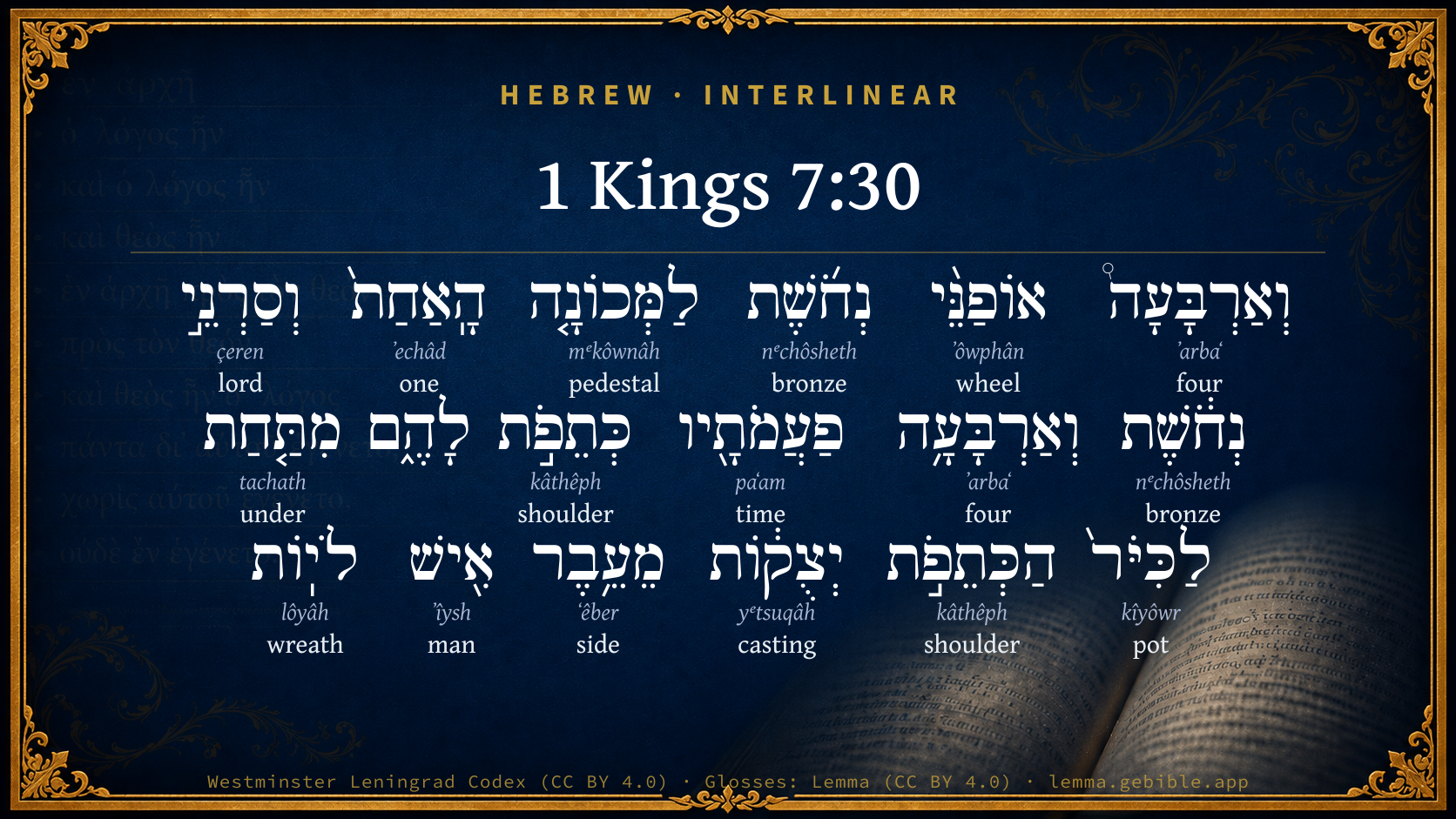
1 Kings 7:30

Hebrew (Westminster Leningrad Codex) 1 Kings 7:30 appears in the Hebrew Old Testament. The text above is from the Westminster Leningrad Codex. Each word links to its Strong’s number, a concise gloss, and parsing drawn from the Open Scriptures Hebrew Bible morphology. Click any word for its full Brown-Driver-Briggs (BDB) entry.
Download image
Cite this verse

1 Kings 7:30 (World English Bible). Public Domain. Lemma interlinear Bible study tool, https://lemma.gebible.app/v/1-kings/7/30.

Show BibTeX & RIS
BibTeX
RIS
English Translation
Every base had four brazen wheels, and axles of brass; and the four feet of it had supports: beneath the basin were the supports molten, with wreaths at the side of each.
World English Bible · Public Domain
Download a study sheet

One document with this verse’s original text, its word-by-word gloss line, the meaning frame, cross-references with their text, attributed commentary, and full source and license credits — printable, and it pastes into notes with its structure intact.

This verse Autodidact and up

Study sheet (.html) Plain text (.txt)

A passage Seminary Student

Up to 50 verses in one chapter. A passage sheet keeps up to 6 commentary sources and 12 cross-references per verse, in the order this page ranks them, and says so on the sheet whenever that leaves anything out. Ask for a single verse and you get the Autodidact verse sheet above.

Everything on this page stays free to read, with no account — the sheet is a download of what is already on screen, not access to it.

Want to remove ads? Support Godless Engineer
Compare translations 3

The same verse in 3 English versions, stacked beneath the original-language interlinear above. Click any original word for its lexicon entry.

Each is an independent rendering of the whole verse — the interlinear is not word-aligned to these translations.

Highlighted words mark where these versions differ — a whole-verse word diff, not a word-by-word alignment.

  • World English Bible Public Domain
    Every base had four brazen wheels, and axles of brass; and the four feet of it had supports: beneath the basin were the supports molten, with wreaths at the side of each.
  • King James Version Public Domain
    And every base had four brazen wheels, and plates of brass: and the four corners thereof had undersetters: under the laver were undersetters molten, at the side of every addition.
  • unfoldingWord Literal Text CC BY-SA 4.0
    And four wheels of bronze to one stand, and axles of bronze. And its four corners, shoulders to them, from below to the basin. The shoulders were cast on the side of each wreaths.

unfoldingWord Literal Text — © unfoldingWord, licensed CC BY-SA 4.0. Word-aligned USFM3 via Door43 (git.door43.org/unfoldingWord/en_ult).

Versions to compare (up to 4)

3 of 4 selected

Show all 18 translations

Every available English version of this verse, each an independent rendering of the whole verse.

  • World English Bible Public Domain
    Every base had four brazen wheels, and axles of brass; and the four feet of it had supports: beneath the basin were the supports molten, with wreaths at the side of each.
  • Berean Standard Bible Public Domain
    Each stand had four bronze wheels with bronze axles and a basin resting on four supports, with wreaths at each side.
  • Majority Standard Bible Public Domain
    Each stand had four bronze wheels with bronze axles and a basin resting on four supports, with wreaths at each side.
  • King James Version Public Domain
    And every base had four brazen wheels, and plates of brass: and the four corners thereof had undersetters: under the laver were undersetters molten, at the side of every addition.
  • American Standard Version (1901) Public Domain
    And every base had four brazen wheels, and axles of brass; and the four feet thereof had undersetters: beneath the laver were the undersetters molten, with wreaths at the side of each.
  • Revised Version (1885) Public Domain
    And every base had four brasen wheels, and axles of brass: and the four feet thereof had undersetters: beneath the laver were the undersetters molten, with wreaths at the side of each.
  • Geneva Bible (1599) Public Domain
    And euery base had foure brasen wheeles, and plates of brasse: and the foure corners had vndersetters: vnder the caldron were vndersetters molten at the side of euery addicion.
  • Douay-Rheims (1899) Public Domain
    And every base had four wheels, and axletrees of brass: and at the four sides were undersetters under the laver molten, looking one against another.
  • Young's Literal Translation Public Domain
    And four wheels of brass `are' to the one base, and axles of brass; and its four corners have shoulders -- under the laver `are' the molten shoulders, beside each addition.
  • Literal Standard Version CC BY-SA 4.0
    And four wheels of bronze [are] for the one base, and axles of bronze; and its four corners have shoulders—the molten shoulders [are] under the laver, beside each addition.
  • Unlocked Literal Bible CC BY-SA 4.0
    Every stand had four bronze wheels and axles, and its four corners had supports beneath for the basin. The supports were cast with wreaths on the side of each one.
  • unfoldingWord Literal Text CC BY-SA 4.0
    And four wheels of bronze to one stand, and axles of bronze. And its four corners, shoulders to them, from below to the basin. The shoulders were cast on the side of each wreaths.
  • Darby Bible Public Domain
    And every base had four wheels of brass, and axles of brass; and on its four corners were shoulder-pieces: under the laver were shoulder-pieces molten, behind every garland.
  • World Messianic Bible Public Domain
    Every base had four bronze wheels and axles of bronze; and its four feet had supports. The supports were cast beneath the basin, with wreaths at the side of each.
  • Webster's Bible Public Domain
    And every base had four brazen wheels, and plates of brass: and the four corners of it had undersetters: under the laver were undersetters molten, at the side of every addition.
  • Free Bible Version CC BY-SA 4.0
    Each cart had four bronze wheels with bronze axles. A basin rested on four supports that had decorative wreaths on each side.
  • Bible in Basic English Public Domain
    Every base had four wheels of brass, turning on brass rods, and their four angles had angle-plates under them; the angle-plates under the base were of metal, and there were ornaments at the side of every one.
  • JPS Tanakh (1917) Public Domain
    And every base had four brazen wheels, and axles of brass; and the four feet thereof had undersetters; beneath the laver were the undersetters molten, with wreaths at the side of each.

Literal Standard Version (2020), Covenant Press — licensed CC BY-SA 4.0. Text via the HelloAO Bible API (eBible.org). Unlocked Literal Bible (unfoldingWord) — licensed CC BY-SA 4.0. Text via the HelloAO Bible API (eBible.org). unfoldingWord Literal Text — © unfoldingWord, licensed CC BY-SA 4.0. Word-aligned USFM3 via Door43 (git.door43.org/unfoldingWord/en_ult). Free Bible Version, Dr. Jonathan Gallagher — licensed CC BY-SA 4.0. Text via the HelloAO Bible API (eBible.org).

Word by word

More ways to search: Search by grammar → Find every occurrence → Compare this word →

Practice this passage: Drill this verse → Learn its vocabulary →

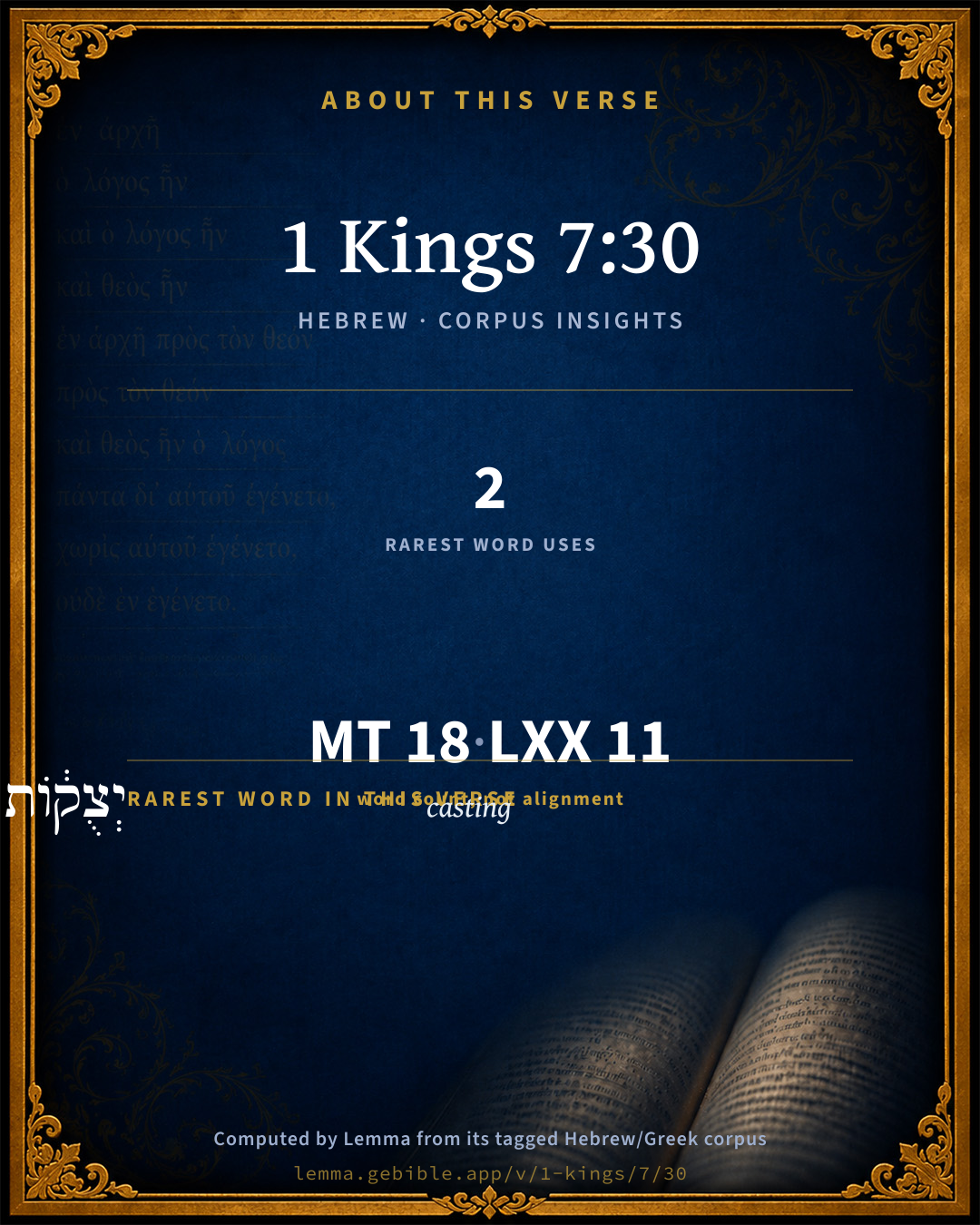
יְצֻק֔וֹת
yᵉtsuqâh
H3333
“casting”
Verb, Qal, Participle Passive, Feminine, Plural, Absolute
Part of Speech
Verb
Stem
Qal
Form
Participle Passive
Gender
Feminine
Number
Plural
State
Absolute
Full BDB Definition

Origin: passive participle of H3332

TWOT: 897a

a casting (of metal)
  1. וְאַרְבָּעָה֩ ʼarbaʻ H702 “and · four” Conjunction + Adjective, Cardinal number, Masculine, Singular, Absolute
  2. אוֹפַנֵּ֨י ʼôwphân H212 “wheels of” Noun, Common, Masculine, Plural, Construct
  3. נְחֹ֜שֶׁת nᵉchôsheth H5178 “bronze” Noun, Common, Feminine, Singular, Absolute
  4. לַמְּכוֹנָ֤ה mᵉkôwnâh H4350 “to/for the · pedestal” Preposition, Determined + Noun, Common, Feminine, Singular, Absolute
  5. הָֽאַחַת֙ ʼechâd H259 “the · one” Particle, Definite Article + Adjective, Cardinal number, Feminine, Singular, Absolute
  6. וְסַרְנֵ֣י çeren H5633 “and · lords of” Conjunction + Noun, Common, Masculine, Plural, Construct
  7. נְחֹ֔שֶׁת nᵉchôsheth H5178 “bronze” Noun, Common, Feminine, Singular, Absolute
  8. וְאַרְבָּעָ֥ה ʼarbaʻ H702 “and · four” Conjunction + Adjective, Cardinal number, Masculine, Singular, Absolute
  9. פַעֲמֹתָ֖יו paʻam H6471 “times · his” Noun, Common, Feminine, Plural, Construct + Suffix, Personal, 3rd Person, Masculine, Singular
  10. כְּתֵפֹ֣ת kâthêph H3802 “shoulders” Noun, Common, Feminine, Plural, Absolute
  11. מִתַּ֤חַת tachath H8478 “from · under” Preposition + Preposition
  12. לַכִּיֹּר֙ kîyôwr H3595 “to/for the · pot” Preposition, Determined + Noun, Common, Masculine, Singular, Absolute
  13. הַכְּתֵפֹ֣ת kâthêph H3802 “the · shoulders” Particle, Definite Article + Noun, Common, Feminine, Plural, Absolute
  14. מֵעֵ֥בֶר ʻêber H5676 “from · side of” Preposition + Noun, Common, Masculine, Singular, Construct
  15. אִ֖ישׁ ʼîysh H376 “man” Noun, Common, Masculine, Singular, Absolute
  16. לֹיֽוֹת lôyâh H3914 “wreaths” Noun, Common, Feminine, Plural, Absolute

About this verse

These counts appear in no published source. They are computed here, from the morphology-tagged text and Lemma’s own curated glosses. What Lemma adds →

18
words
14
distinct lemmas
Historical
section

Notable vocabulary

The rarest word here is יְצֻק֔וֹת casting H3333 — appearing just 2 times in the whole Hebrew Bible.

Shared distinctive vocabulary

יְצֻק֔וֹת casting H3333 occurs in 2 verses of the Hebrew Bible. Also found in:

Grammatical profile

  • 1 verb
  • 12 nouns
  • 3 adjectives
  • 2 prepositions

Verb forms

  • יְצֻק֔וֹת Qal · Participle Passive

Repetition

Words recur within this verse — often emphatic in Hebrew:

  • וְאַרְבָּעָה֩ four H702 ×2
  • נְחֹ֜שֶׁת bronze H5178 ×2
  • כְּתֵפֹ֣ת shoulder H3802 ×2

Hebrew & Septuagint length

In English translation the verse runs 32 words from the Hebrew and 26 from the Septuagint (LXX English) — closely comparable.

A rough comparison of the two English renderings, which tokenize alike — not a word-level alignment.

Word counts can differ between the Hebrew and the Greek without any difference in meaning — e.g. the Hebrew direct-object marker אֵת has no separate Greek word, and Greek often adds the article ὁ.

In the original languages it is 18 Hebrew tokens and 11 Greek tokens — but the two are counted differently (Hebrew bundles its prefixes and suffixes into one token; the Greek is in lemma form), so that isn’t a like-for-like length.

Cross-references

3

Topical passages linked to 1 Kings 7:30 in the Treasury of Scripture Knowledge — connected by theme and wording, ordered by reader-vote popularity; previews shown in the World English Bible.

  • Ezekiel 1:15–21 Now as I saw the living creatures, behold, one wheel on the earth beside the living creatures, for each of the four faces of it.
  • Ezekiel 3:13 [I heard] the noise of the wings of the living creatures as they touched one another, and the noise of the wheels beside them, even the noise of a great rushing.
  • Ezekiel 10:10–13 As for their appearance, they four had one likeness, as if a wheel have been within a wheel.

Cross-references courtesy of OpenBible.info (CC BY 4.0).

Hebrew and Greek witnesses Masoretic Hebrew ↔ Greek Septuagint

The same verse in the two great witnesses to the Old Testament, shown verse-for-verse.

These are two independent witnesses, not word-aligned to each other, and the Septuagint is shown in lemma (dictionary) form.

Hebrew 1 Kings 7:30 Masoretic · Westminster Leningrad Codex

וְאַרְבָּעָה֩ אוֹפַנֵּ֨י נְחֹ֜שֶׁת לַמְּכוֹנָ֤ה הָֽאַחַת֙ וְסַרְנֵ֣י נְחֹ֔שֶׁת וְאַרְבָּעָ֥ה פַעֲמֹתָ֖יו כְּתֵפֹ֣ת לָהֶ֑ם מִתַּ֤חַת לַכִּיֹּר֙ הַכְּתֵפֹ֣ת יְצֻק֔וֹת מֵעֵ֥בֶר אִ֖ישׁ לֹיֽוֹת

Every base had four brazen wheels, and axles of brass; and the four feet of it had supports: beneath the basin were the supports molten, with wreaths at the side of each.

World English Bible · Public Domain

Greek LXX 1 Kings 7:30 Septuagint · lemma form

καί ὁ θάλασσα εἷς καί ὁ βοῦς δώδεκα ὑποκάτω ὁ θάλασσα

And there were four brazen wheels to one base; and there were brazen bases, and their four sides answering to them, side pieces under the bases.

LXX2012 (modern English Septuagint) · Public Domain

Hebrew: Westminster Leningrad Codex (CC BY 4.0). Greek: Septuagint (public domain); English from LXX2012 (modern English Septuagint) (Public Domain). How the Septuagint differs from the Hebrew →

Targum (Aramaic paraphrase)

1

The Targum is the ancient Jewish Aramaic paraphrase of the Hebrew Scriptures — an interpretive translation, not the Hebrew text itself. Onkelos (literal) and Pseudo-Jonathan (expansive) render the Torah, and Jonathan the Prophets. Coverage is partial: where no permissively-licensed English translation exists for a verse, only the Aramaic is shown. This is verse-level text, not a word-by-word alignment to the Hebrew.

  1. Targum Jonathan Prophets (Joshua–Malachi)
    וְאַרְבְּעָה גַלְגַלֵי נְחָשָׁא לִבְסִיסָא חֲדָא וְנִסְרִין דִנְחַשׁ וְאַרְבַּע זִוְיָתֵיהּ כַּתְפִין לְהוֹן מִלְרַע לְכִיוֹרָא כַּתְפִין מַתְּכִין כִּכְבַשׁ עוֹבַד דִבּוּק:

    (no public-domain English translation for this verse)

    Targum Jonathan — Aramaic: “Mikraot Gedolot” (public domain). English: “Sefaria Community Translation” (CC0 1.0 (public-domain dedication)); “London "Chaldee Paraphrase," 1871” (public domain). Text via Sefaria.

Commentary

Notes on 1 Kings 7:30 from classic Christian and Jewish commentators (each source and its license shown beneath its notes). The classic Christian expositions comment on the surrounding passage and are grouped to its opening verse, so a note may address several verses; the Jewish commentaries on the Tanakh (Rashi and others) are per-verse, so they appear only where the commentator wrote on this verse.

Lemma curates 59 commentaries, every one of them public domain or Creative Commons licensed, each selected and text-cleaned for this edition rather than reprinted as found. About our sources →

Trapp's Complete Commentary

John Trapp

1Ki 7:30 And every base had four brasen wheels, and plates of brass: and the four corners thereof had undersetters: under the laver [were] undersetters molten, at the side of every addition.

Ver. 30. And every base had four brazen wheels.] To remove the laver from place to place, as occasion required.

John Trapp, A Commentary or Exposition upon All the Books of the Old and New Testament (1647–1656) — public domain. Text from a community e-Sword module.

Joseph Benson's Commentary

1Ki 7:30. Every base had four brazen wheels — Whereby the bases and lavers might be removed from place to place, as need required. Undersetters — Hebrew, shoulders; fitly so called, because they supported the lavers, that they should not fall from their bases, when the bases were removed, together with the lavers.

Joseph Benson's Commentary on the Old and New Testaments (1811–1818) — public domain. Text from a community e-Sword module.

Geneva Bible (1599)

Geneva Bible translators

Hebrew, shoulders.

Geneva Bible (1599) marginal notes — public domain. Text via Bolls.life.

The Cambridge Bible for Schools and Colleges

gen. ed. J. J. S. Perowne

30. and plates of brass] For ‘plates’ read axles.

and the four corners thereof had undersetters] The last word is that usually rendered ‘shoulders,’ (see R.V. margin), and the word translated ‘corners’ means rather (1) a footstep, (2) a foot. It is used Exo_25:12 for the corners (R.V. feet) of the ark, into which rings were to be fixed for the staves to pass through when it was carried about. This seems the more suitable rendering here also and it is a different word that is rendered ‘corners’ in 1Ki_7:34. The sense would then be ‘the four feet thereof had shoulder pieces’ i.e. attached to them. The purpose of these shoulders appears to have been for the axles to pass through on which the wheels were fixed. The next clause would then run ‘underneath the laver were the shoulders molten.’ But because of that expression some have thought that the ‘shoulder pieces’ rose upward from the top of the four feet, and were meant as stays on which the laver should rest.

at the side of every addition] The last word is the same which in the previous verse has been rendered ‘wreaths.’ And here that sense must also be given to it. Literally, ‘at the side of each one (were) wreaths’ or more idiomatically, (as R.V.) with wreaths at the side of each.

The Cambridge Bible for Schools and Colleges (gen. ed. J. J. S. Perowne; Cambridge University Press, 1878–1918) — public domain. Text from a community e-Sword module.

John Gill's Exposition

And the mouth of it within the chapiter, and above, was a cubit,.... On the lid of the base rose up a lesser base, called the chapiter, which was circular, like a coronet, as the word signifies, the inside of which was hollow, for the lower part of the layer to rest in; this ascended straight up half a cubit, and then widening, went up half a cubit more, and so in its whole height, as here a cubit; the circuit or circumference of which is called the mouth of the base, into which the feet of the layer were set, the measure of which is next given:

but the mouth thereof was round, after the work of the base, a cubit and an half; which was either the circumference or the diameter of it; one should think the latter:

and also upon the mouth of it were gravings, with their borders, four square, not round; though the mouth was round, the border of it was four square, which had figures engraved thereon, perhaps the same as on the other borders, lions, oxen, and cherubim.

John Gill's Exposition of the Whole Bible (1746–1763) — public domain (CC PDM 1.0). Text via the HelloAO Bible API.

Albert Barnes' Notes on the Bible

Plates of brass - Rather, “brazen axletrees.”

The “undersetters” (literally, “shoulders”) are conjectured to have been four brackets, or bars, proceeding from the four upper corners of the bases, and stretching upward to the outer rim of the laver, which thus rested partly upon them.

At the side of every addition - Rather, “each opposite garlands.” The laver was ornamented with a garland at the place where the support reached it.

Albert Barnes' Notes on the Bible (1834–1885) — public domain. Text from a community e-Sword/MySword module.

Matthew Poole's English Annotations

Four brazen wheels; whereby the bases and lavers might be carried from place to place, as need required.

Undersetters, Heb. shoulders; fitly so called, because they strongly supported the lavers, that they should not fall from their bases when the bases were removed together with the lavers.

Matthew Poole's English Annotations on the Holy Bible (1683–1685) — public domain. Text from a community e-Sword/MySword module.

Whedon's Commentary on the Bible

Daniel D. Whedon

30. Wheels — These served for convenience in moving the lavers and bases to and fro.

Plates of brass — Rather, axles. (d in figure.)

The four corners — Rather, the four feet, meaning, doubtless, the projecting bottoms of the bases at the places where feet or legs would naturally be. (o o in figure.)

Undersetters — Or, side-pieces, reaching down to the axles of the wheels and serving as stays or supports. (e e in figure.)

At the side of every addition — Better, beyond each were garlands. The meaning seems to be that the undersetters, or side-pieces, were cast so as to be underneath the laver and the engraved garlands mentioned in 1Ki_7:29.

Daniel D. Whedon (gen. ed.), Commentary on the Old and New Testaments (1874–1909) — public domain. Text from a community e-Sword module.

The Pulpit Commentary

And every base had four brazen wheels As the lavers were used for washing "such things as they offered for burnt offering", (2Ch_4:6) and consequently would require to be continually emptied and refilled, they must of necessity be moveable, so that they could be taken, now to the sea, or other reservoir, now to the altar, and plates Heb. axles of brass: and the four corners Heb. feet; signifies step, thence foot, and is here used of artificial feet. These were, no doubt, at the four corners, and served to raise the stand above the wheels, so that the foliage, etc., was not hidden thereof had undersetters Heb. shoulders. "The bearings of the axle" (Gesen.) must be meant. The bases had four feet, which apparently terminated in a sort of socket or fork, into which the axletrees were inserted): under the laver were under setters Heb. the shoulders molten or cast, at the side of every addition. Lit., opposite to a man (i.e., each) were wreaths. The explanation of Keil is that "from the feet., there ascended shoulder pieces, which ran along the outside of the chest and reached to the lower part of the basin, which was upon the lid of the chest, and, as shoulders, either supported or helped to support it." He thus understands the "shoulder" to extend from the foot, or axletree, to the bottom of the laver. But it seems quite as likely that these shoulders were within the stand; that they started from its upper corners, i.e., " from under the laver" (as in the Hebrew), passed down along its inner angles, and emerged below the stand may well have had no bottom in the shape of feet or forks, which rested on the axletrees, and supported both stand and laver. Over against this internal shoulder blade or support was placed externally a wreath. But Bahr despairs of arriving at any just and adequate understanding of this arrangement, and, in the absence of drawings, it is perhaps hopeless that we shall ever interpret the words with certainty.

The Pulpit Commentary (1880–1919), ed. H.D.M. Spence-Jones & Joseph S. Exell — public domain. Text from a community e-Sword module.

John Wesley's Explanatory Notes

Wheels - Whereby the bases and lavers might be removed from place to place as need required. Under-setters - Hebrew. shoulders; fitly so called, because they supported the lavers, that they should not fall from their bases, when the bases were removed together with the lavers.

John Wesley, Explanatory Notes Upon the Whole Bible (1754–1765) — public domain. Text via the GEBible commentary corpus.

unfoldingWord translationNotes

Door43 World Missions Community

four bronze wheels and axles

There was one axle for each pair of wheels. AT: "four bronze wheels and two axles" (See: Assumed Knowledge and Implicit Information and Numbers)

its four corners

"the four corners of each stand"

The supports were cast with wreaths

Each support was cast as one piece with the wreaths. This can be stated in active form. AT: "Huram cast the supports with spiral-shaped pieces" (See: Active or Passive)

a cubit and a half ... a cubit

A cubit is 46 centimeters. AT: "about 70 centimeters ... about 50 centimeters" (See: Biblical Distance)

a crown that rose up

Here the word "crown" refers to the circular piece at the top of the stand's opening that held the basin.

their panels were square

"the panels of the stands were square." This phrase returns to the description of the panels that began in 1 Kings 7:28-29.

unfoldingWord translationNotes — © Distant Shores Media and the Door43 World Missions Community, licensed CC BY-SA 4.0. Source: git.door43.org/Door43/en_tn.

Rashi

Rabbi Shlomo Yitzchaki (Rashi)

Four [copper] wheels. Two in the front and two in the back in the manner of large wagons.

And copper bars. [Targum] Yonoson rendered ונסרין דנחש, “boards of copper,” they are the upper boards against the frames.

Bars. [סרני means] the same as נסרים [=boards].

And its four corners. Of the base [=כן]which was above them [i.e., wheels].

Had shoulders. They protruded above the boards in the corners of the base. And under the basin which rested upon the base, the shoulders were molten. (Other texts: This teaches [us], that the shoulders came from the base in one pouring, and the shoulders supported the basin so that it should not fall down through the base.)

At the side of each were thin metal strips joined together. At the side of each of the shoulders was a joining of a decorated male and female. מעבר איש [=one to another] means the same as “איש אל אחיו [=one to another],” which is stated by the cherubim.

Rashi on the Tanakh — English translations: “The Judaica Press complete Tanach with Rashi, translated by A. J. Rosenberg” (CC BY 4.0); “Pentateuch with Rashi's commentary by M. Rosenbaum and A.M. Silbermann, 1929-1934” (public domain); “The Metsudah Tanach series, Lakewood, N.J” (CC BY 4.0); and “The Book of Joshua, Metsudah Publications, 1997” (CC BY 4.0). Text via Sefaria.

Lesson kit

Teaching starters — assembled from the data on this page, not authored interpretation. Every prompt links to the verse data it draws on. Edit before teaching.

1 Kings, in the Historical, opens this verse with 18 words (14 distinct Hebrew lemmas). Its most distinctive word is yᵉtsuqâh (“casting”). A historical commentator’s framing appears above. Read the whole chapter for the surrounding context.

Discussion questions

  1. What does “casting” (yᵉtsuqâh) contribute to the verse as a whole?
  2. How does 1 Kings 7:24, which shares the word «casting», read alongside this verse?
  3. What does the repetition of “four” (2× in this one verse) do in this verse?
  4. These translations render this verse differently. What is at stake in choosing one wording over another?
  5. «יְצֻק֔וֹת» is a Qal Participle Passive verb. How does that grammatical form shape the action described?
  6. Compare how Trapp's Complete Commentary and Joseph Benson's Commentary read this verse. Where do they agree or differ?

Things to notice

Reading settings

Reading text

Shown beneath each verse's original-language words.

Old Testament
Old Testament edition

Read the OT as the Masoretic Hebrew (MT) or the Greek Septuagint (LXX).

English shown for the Greek Septuagint (in the Hebrew ↔ Greek comparison).

Comparing translations? Open the Compare panel on any verse page to stack up to four side by side.