
Revelation 21:16

Greek (Tischendorf 8th ed.) Revelation 21:16 appears in the Greek New Testament. The text above is from the Tischendorf 8th edition. Each word links to its Strong’s number and a concise gloss. Click any word for its full Thayer’s Greek Lexicon entry.
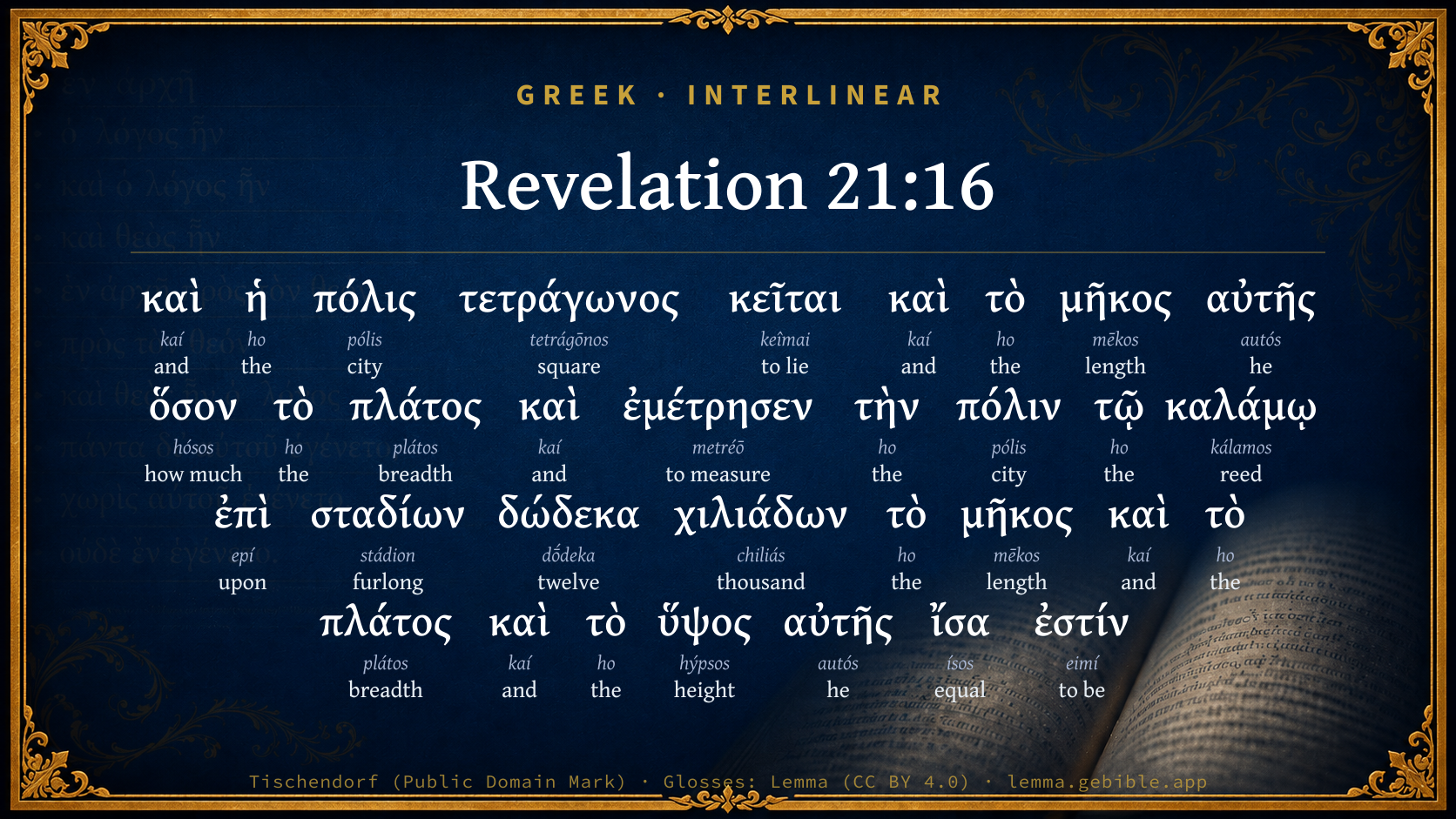
Download image
Cite this verse

Revelation 21:16 (World English Bible). Public Domain. Lemma interlinear Bible study tool, https://lemma.gebible.app/v/revelation/21/16.

Show BibTeX & RIS
BibTeX
RIS
English Translation
The city lies foursquare, and its length is as great as its breadth. He measured the city with the reed, Twelve thousand twelve stadia. Its length, breadth, and height are equal.
World English Bible · Public Domain
Highlights
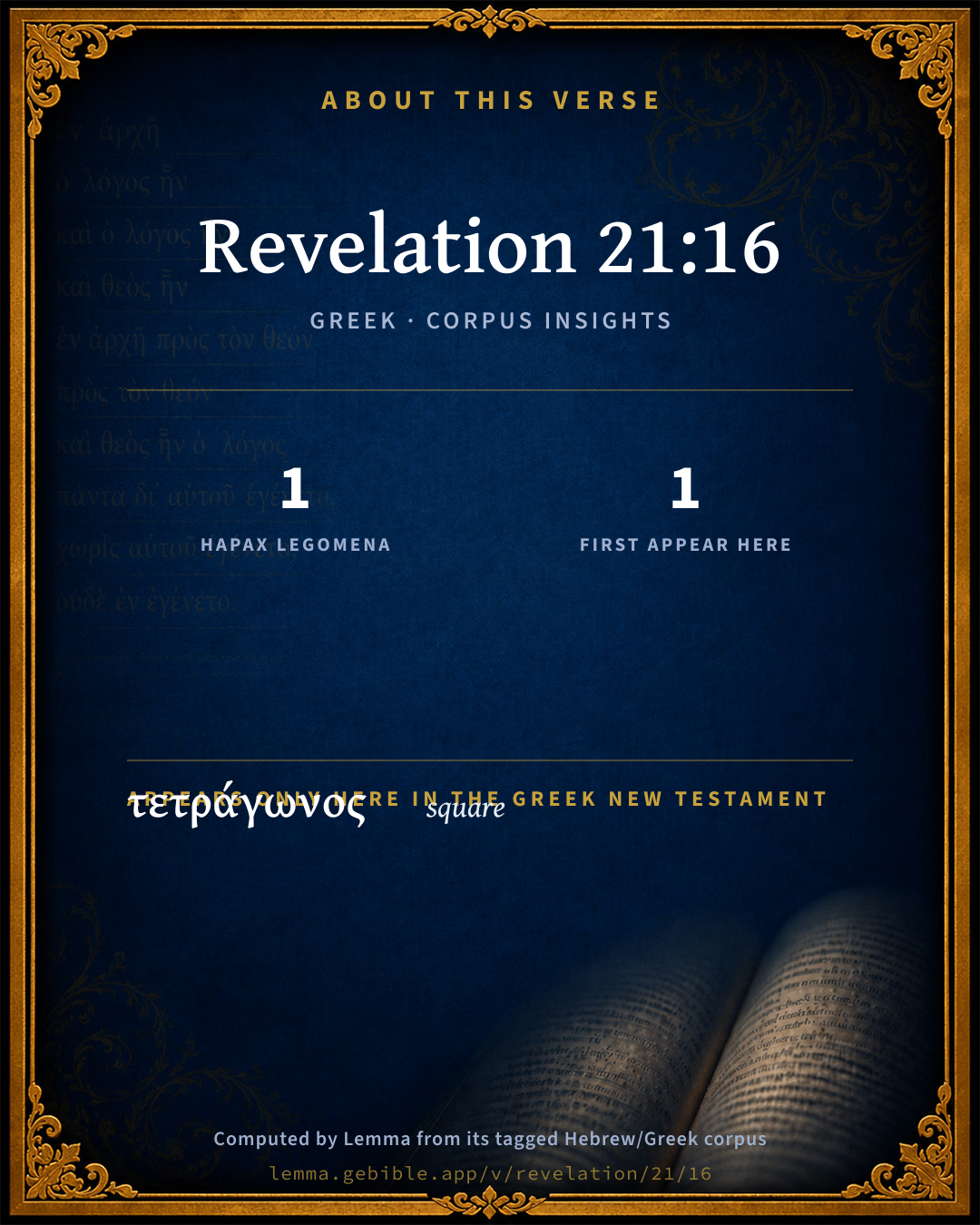
  • 1 hapax legomenon — only here in the Greek New Testament
  • 1 first appearance in the Greek New Testament
Full analysis ↓
Download a study sheet

One document with this verse’s original text, its word-by-word gloss line, the meaning frame, cross-references with their text, attributed commentary, and full source and license credits — printable, and it pastes into notes with its structure intact.

This verse Autodidact and up

Study sheet (.html) Plain text (.txt)

A passage Seminary Student

Up to 50 verses in one chapter. A passage sheet keeps up to 6 commentary sources and 12 cross-references per verse, in the order this page ranks them, and says so on the sheet whenever that leaves anything out. Ask for a single verse and you get the Autodidact verse sheet above.

Everything on this page stays free to read, with no account — the sheet is a download of what is already on screen, not access to it.

Want to remove ads? Support Godless Engineer
Compare translations 3

The same verse in 3 English versions, stacked beneath the original-language interlinear above. Click any original word for its lexicon entry.

Each is an independent rendering of the whole verse — the interlinear is not word-aligned to these translations.

Highlighted words mark where these versions differ — a whole-verse word diff, not a word-by-word alignment.

  • World English Bible Public Domain
    The city lies foursquare, and its length is as great as its breadth. He measured the city with the reed, Twelve thousand twelve stadia. Its length, breadth, and height are equal.
  • King James Version Public Domain
    And the city lieth foursquare, and the length is as large as the breadth: and he measured the city with the reed, twelve thousand furlongs. The length and the breadth and the height of it are equal.
  • unfoldingWord Literal Text CC BY-SA 4.0
    And the city is laid out square, and her length as much as the width. And he measured the city with the rod to 12,000 stadia: Her length and width and height are equal.

unfoldingWord Literal Text — © unfoldingWord, licensed CC BY-SA 4.0. Word-aligned USFM3 via Door43 (git.door43.org/unfoldingWord/en_ult).

Versions to compare (up to 4)

3 of 4 selected

Show all 19 translations

Every available English version of this verse, each an independent rendering of the whole verse.

  • World English Bible Public Domain
    The city lies foursquare, and its length is as great as its breadth. He measured the city with the reed, Twelve thousand twelve stadia. Its length, breadth, and height are equal.
  • Berean Standard Bible Public Domain
    The city lies foursquare, with its width the same as its length. And he measured the city with the rod, and all its dimensions were equal—12,000 stadia in length and width and height.
  • Majority Standard Bible Public Domain
    The city lies foursquare, with its width the same as its length. And he measured the city with the rod, and all its dimensions were equal—12,000 stadia in length and width and height.
  • King James Version Public Domain
    And the city lieth foursquare, and the length is as large as the breadth: and he measured the city with the reed, twelve thousand furlongs. The length and the breadth and the height of it are equal.
  • American Standard Version (1901) Public Domain
    And the city lieth foursquare, and the length thereof is as great as the breadth: and he measured the city with the reed, twelve thousand furlongs: the length and the breadth and the height thereof are equal.
  • Revised Version (1885) Public Domain
    And the city lieth foursquare, and the length thereof is as great as the breadth: and he measured the city with the reed, twelve thousand furlongs: the length and the breadth and the height thereof are equal.
  • Geneva Bible (1599) Public Domain
    And the citie laie foure square, and the length is as large as the bredth of it, and he measured the citie with the reede, twelue thousande furlongs: and the length, and the bredth, and the height of it are equall.
  • Douay-Rheims (1899) Public Domain
    And the city lieth in a foursquare, and the length thereof is as great as the breadth: and he measured the city with the golden reed for twelve thousand furlongs, and the length and the height and the breadth thereof are equal.
  • Young's Literal Translation Public Domain
    and the city lieth square, and the length of it is as great as the breadth; and he did measure the city with the reed -- furlongs twelve thousand; the length, and the breadth, and the height, of it are equal;
  • Literal Standard Version CC BY-SA 4.0
    and the city lies square, and the length of it is as great as the breadth; and he measured the city with the reed—twelve thousand stadia; the length, and the breadth, and the height of it are equal.
  • Unlocked Literal Bible CC BY-SA 4.0
    The city was laid out in a square; its length was the same as its width. He measured the city with the measuring rod, twelve thousand stadia in length (its length, width, and height were the same).
  • unfoldingWord Literal Text CC BY-SA 4.0
    And the city is laid out square, and her length as much as the width. And he measured the city with the rod to 12,000 stadia: Her length and width and height are equal.
  • Darby Bible Public Domain
    And the city lies four-square, and its length [is] as much as the breadth. And he measured the city with the reed -- twelve thousand stadia: the length and the breadth and height of it are equal.
  • World Messianic Bible Public Domain
    The city is square. Its length is as great as its width. He measured the city with the reed: twelve thousand twelve stadia. Its length, width, and height are equal.
  • Webster's Bible Public Domain
    And the city lieth foursquare, and the length is as large as the breadth: and he measured the city with the reed, twelve thousand furlongs. The length and the breadth and the hight of it are equal.
  • Free Bible Version CC BY-SA 4.0
    The city was square. The length was the same as the width. He measured the city with the rod, it was 12,000 furlongs. The length, width, and height were all the same.
  • Bible in Basic English Public Domain
    And the town is square, as wide as it is long; and he took the measure of the town with the rod, one thousand and five hundred miles: it is equally long and wide and high.
  • Text-Critical English NT CC BY 4.0
    The city is laid out as a square; its length is the same as its width. The angel measured the city with the rod and found it to be twelve thousand and twelve stadia. (The length, width, and height are all equal.)
  • Tyndale New Testament (1534) Public Domain
    And the cite was bylt iiii. square and the length was as large as the bredth of it and he measured the cite with the rede.xii M. fur longes: and the lenght and the bredth and the heyth of it were equall.

Literal Standard Version (2020), Covenant Press — licensed CC BY-SA 4.0. Text via the HelloAO Bible API (eBible.org). Unlocked Literal Bible (unfoldingWord) — licensed CC BY-SA 4.0. Text via the HelloAO Bible API (eBible.org). unfoldingWord Literal Text — © unfoldingWord, licensed CC BY-SA 4.0. Word-aligned USFM3 via Door43 (git.door43.org/unfoldingWord/en_ult). Free Bible Version, Dr. Jonathan Gallagher — licensed CC BY-SA 4.0. Text via the HelloAO Bible API (eBible.org).

Word by word

More ways to search: Search by grammar → Find every occurrence → Compare this word →

Practice this passage: Drill this verse → Learn its vocabulary →

τετράγωνος
tetrágōnos
G5068
“square”
Adjective, Nominative, Singular, Feminine
Part of Speech
Adjective
Case
Nominative
Number
Singular
Gender
Feminine
Full Thayer's Definition

Origin: from G5064 and G1137

TDNT: None

1. quadrangular, square
  1. καὶ kaí G2532 “and” Conjunction
  2. ἡ ho G3588 “the” Article, Nominative, Singular, Feminine
  3. πόλις pólis G4172 “city” Noun, Nominative, Singular, Feminine
  4. κεῖται keîmai G2749 “to lie” Verb, Present, Middle or Passive deponent, Indicative, 3rd person, Singular
  5. καὶ kaí G2532 “and” Conjunction
  6. τὸ ho G3588 “the” Article, Nominative, Singular, Neuter
  7. μῆκος mēkos G3372 “length” Noun, Nominative, Singular, Neuter
  8. αὐτῆς autós G846 “he” Personal pronoun, Genitive, Singular, Feminine
  9. ὅσον hósos G3745 “how much” Correlative pronoun, Nominative, Singular, Neuter
  10. τὸ ho G3588 “the” Article, Nominative, Singular, Neuter
  11. πλάτος plátos G4114 “breadth” Noun, Nominative, Singular, Neuter
  12. καὶ kaí G2532 “and” Conjunction
  13. ἐμέτρησεν metréō G3354 “to measure” Verb, Aorist, Active, Indicative, 3rd person, Singular
  14. τὴν ho G3588 “the” Article, Accusative, Singular, Feminine
  15. πόλιν pólis G4172 “city” Noun, Accusative, Singular, Feminine
  16. τῷ ho G3588 “the” Article, Dative, Singular, Masculine
  17. καλάμῳ kálamos G2563 “reed” Noun, Dative, Singular, Masculine
  18. ἐπὶ epí G1909 “upon” Preposition
  19. σταδίων stádion G4712 “furlong” Noun, Genitive, Plural, Masculine
  20. δώδεκα dṓdeka G1427 “twelve” Adjective, Numeral (indeclinable)
  21. χιλιάδων chiliás G5505 “thousand” Noun, Genitive, Plural, Feminine
  22. τὸ ho G3588 “the” Article, Nominative, Singular, Neuter
  23. μῆκος mēkos G3372 “length” Noun, Nominative, Singular, Neuter
  24. καὶ kaí G2532 “and” Conjunction
  25. τὸ ho G3588 “the” Article, Nominative, Singular, Neuter
  26. πλάτος plátos G4114 “breadth” Noun, Nominative, Singular, Neuter
  27. καὶ kaí G2532 “and” Conjunction
  28. τὸ ho G3588 “the” Article, Nominative, Singular, Neuter
  29. ὕψος hýpsos G5311 “height” Noun, Nominative, Singular, Neuter
  30. αὐτῆς autós G846 “he” Personal pronoun, Genitive, Singular, Feminine
  31. ἴσα ísos G2470 “equal” Adjective, Nominative, Plural, Neuter
  32. ἐστίν eimí G1510 “to be” Verb, Present, Active, Indicative, 3rd person, Singular

About this verse

These counts appear in no published source. They are computed here, from the morphology-tagged text and Lemma’s own curated glosses. What Lemma adds →

33
words
18
distinct lemmas
Revelation
section

Notable vocabulary

1 hapax legomenon — a word that appears only here in the entire Greek New Testament:

  • τετράγωνος square G5068

First appearance in Scripture

This word makes its first canonical appearance in the Greek New Testament here:

  • τετράγωνος square G5068

Shared distinctive vocabulary

μῆκος length G3372 occurs in 2 verses of the Greek New Testament. Also found in:
Repetition

Words recur within this verse:

  • πόλις city G4172 ×2
  • μῆκος length G3372 ×2
  • πλάτος breadth G4114 ×2
  • ἡ the G3588 ×8
  • καὶ and G2532 ×5
  • αὐτῆς he G846 ×2

Cross-references

2

Topical passages linked to Revelation 21:16 in the Treasury of Scripture Knowledge — connected by theme and wording, ordered by reader-vote popularity; previews shown in the World English Bible.

  • Ezekiel 48:8–20 By the border of Judah, from the east side to the west side, shall be the offering which you shall offer, twenty-five thousand [reeds] in breadth, and in length as one of the portions, from the east side to the west side: and the sanctuary shall be in the midst of it.
  • Ezekiel 48:35 It shall be eighteen thousand [reeds] round about: and the name of the city from that day shall be, Yahweh is there.

Cross-references courtesy of OpenBible.info (CC BY 4.0).

Where the printed editions differ

2 variants

Places in this verse where the major printed Greek editions disagree on the wording in a way that affects the translation — a comparison of editions, not a manuscript-by-manuscript collation. The editions are the modern critical texts (Nestlé-Aland 28/27, SBL, Westcott-Hort, Tregelles, Tyndale House) and the traditional texts behind the KJV (the Textus Receptus and the Byzantine/Majority text). It is not a claim about which reading is original.

  1. Extra text
    τοσοῦτόν ἐστίν

    “so great is”

    In TR Not in NA28NA27TynSBLWHTregByz

    τοσοῦτόν ἐστίν (tosouton estin) 'so great is' is only in traditional manuscripts (TR)

  2. Extra text
    δώδεκα,

    “twelve [was]”

    In Byz Not in NA28NA27TynSBLWHTregTR

    δώδεκα, (dōdeka) 'twelve [was]' is only in a few manuscripts (Byz)

Textual data: Translators Amalgamated Greek New Testament (STEPBible TAGNT) · CC BY 4.0.

Commentary

Notes on Revelation 21:16 from classic Christian and Jewish commentators (each source and its license shown beneath its notes). The classic Christian expositions comment on the surrounding passage and are grouped to its opening verse, so a note may address several verses; the Jewish commentaries on the Tanakh (Rashi and others) are per-verse, so they appear only where the commentator wrote on this verse.

Lemma curates 59 commentaries, every one of them public domain or Creative Commons licensed, each selected and text-cleaned for this edition rather than reprinted as found. About our sources →

Tyndale Open Study Notes

Tyndale Open Resources

21:16 The city is described as a perfect cube. Each dimension is 1,400 miles (Greek 12,000 stadia); the number 12,000 symbolically represents the people of God (see “Symbolic Numbers” Theme Note).

Tyndale Open Study Notes — © Tyndale Open Resources, licensed CC BY-SA 4.0. Text via the HelloAO Bible API.

Bengel's Gnomon

Johann Albrecht Bengel

Rev 21:16. [231] ἘΠῚ ΣΤΑΔΊΩΝ ΔΏΔΕΚΑ ΧΙΛΙΆΔΩΝ) Thus the Latin Translator reads; for he has, per stadia duodecim millia: but if he had read, ἐπὶ σταδίους δώδεκα χιλιάδας, he would have had to translate, per stadia, duodecim millium.[232] Stupendous magnitude! Alexandria is said by Josephus to have had a length of XXX. stadia, a breadth of not less than X. stadia. According to the same, the circuit of Jerusalem is defined by XXXIII. stadia; that of Thebes, according to Dicæarchus, by XLIII. stadia; that of Nineveh, according to Diodorus Siculus, by CCCC. stadia. Herodotus, in his first Book, says that Babylon had CXX. stadia in each side, and CCCCLXXX. stadia in its circuit, and that its wall was L. cubits thick and CC. cubits high. All the cities in the world are mere villages in comparison with the new Jerusalem. Ἐπὶ has here a distributive force, as in tactics, ἐφʼ ἑνὸς, ἐπὶ τεττάρων, ἐπʼ ὀκτὼ, singly, in parties of four [by fours], in parties of eight [by eights]. See Budœus Comm. Linguæ Gr. col. 881. And thus ἐπὶ is used in this verse, but not in the following, and signifies that 12,000 stadia [that is, more than 250 German miles at the least.—V. g.] is the extent of each side of the city, not of the whole circuit.

[231] 14. θεμελίους, foundations) One being placed beside another.—V. g.

[232] AB read σταδίους δώδεκα χιλιάδων. So Lachm. and Stephens’ Rec. Text, except that the latter has σταδίων; whereas Elzev. Rec. Text has σταδίους. h has “stadiorum duodecim millia:” Tisch. has δεκαδύο for δώδεκα.—E.

—ἀποστόλων, apostles) They, to wit, belonged to these, who had practised the craft of fishermen at the Lake of Gennesareth.—V. g.

Bengel's Gnomon of the New Testament — English translation (T&T Clark, Edinburgh, 1860) — public domain. Text from a community e-Sword module.

Geneva Bible (1599)

Geneva Bible translators

The measure and form most equal, in 2 verses.

A foursquared figure hath equal sides, and outright corners, and therefore the Greeks call by this name those things that are steady, and of continuance and perfect.

Geneva Bible (1599) marginal notes — public domain. Text via Bolls.life.

Jamieson, Fausset & Brown

Robert Jamieson, A. R. Fausset & David Brown

twelve thousand furlongs--literally, "to twelve thousand stadii": one thousand furlongs being the space between the several twelve gates. BENGEL makes the length of each side of the city to be twelve thousand stadii. The stupendous height, length, and breadth being exactly alike, imply its faultless symmetry, transcending in glory all our most glowing conceptions.

Jamieson, Fausset & Brown — Commentary Critical and Explanatory on the Whole Bible (1871) — public domain (CC PDM 1.0). Text via the HelloAO Bible API.

Adam Clarke's Commentary

Verse 16. The city lieth foursquare] Each side was equal, consequently the length and breadth were equal; and its height is here said to be equal to its length. It is hard to say how this should be understood. It cannot mean the height of the buildings, nor of the walls, for neither houses nor walls could be twelve thousand furlongs in height; some think this means the distance from the plain country to the place where the city stood. But what need is there of attempting to determine such measures in such a visionary representation? The quadrangular form intimates its perfection and stability, for the square figure was a figure of perfection among the Greeks; αντρ τετραγωνος, the square or cubical man, was, with them, a man of unsullied integrity, perfect in all things.

Adam Clarke's Commentary on the Bible (1810–1826) — public domain. Text from a community e-Sword/MySword module.

Ellicott's Commentary for English Readers

(16) And the city lieth foursquare . . .—The city is foursquare, because the length and breadth are equal; but it is added that the height also is equal to the length and breadth, the city thus presents the symbol of perfect symmetry; this is all that is needed. Many interpreters are nervously anxious about the monstrous appearance of a city whose walls measured three thousand stadii (the word rendered “furlongs” is properly stadii); but there is no need to be nervous about the symbols; the city is not designed, any more than the vision of Revelation 4, or the vision of Ezekiel (Ezekiel 1) to be represented by painting to the eye: the attempt to do so only ends in the production of grotesque and profane pictures. It is not needful, however, in this case to suppose the actual wall to have been 3,000 stadii in height; the city is placed on a hill, the foundations are upon the holy hill, and the deep strong mountain foundations may be included in the measurement. The main thought, however, is to realise the harmony and proportion of that community, in which broad and low and high will meet, and in which no truth will be exaggerated or distorted; in which no disproportioned adjustments will mar its social order; in which all those who are inbuilt as living stones will be measured, not by the false estimates of worldly thoughts (comp. Jas_2:4), but by the golden reed of the sanctuary.

A Bible Commentary for English Readers, edited by Charles John Ellicott (1878–1897) — public domain. Text from a community e-Sword module.

The Cambridge Bible for Schools and Colleges

gen. ed. J. J. S. Perowne

16. he measured the city] It is doubtful whether this is the measurement of the side of the square, or of the whole circumference. The twelve-fold measure is in favour of the former view: thus from each gate to the next would be 1000 furlongs; the outmost gate on each side being 500 from the angle.

with the reed] He has not, as in the parallel passages of Ezekiel and Zechariah, a line for the long measurements (like our “chains” and “poles”).

twelve thousand furlongs] The construction is peculiar, but the sense clear. The measure would be about 1378 English miles, making the City 344 miles square, according to the lower computation.

the length and the breadth and the height of it are equal] It seems inconsistent with the pictorial vividness of this book, to imagine that the City is described as forming a cube of over 300 miles each way; and we are told in the next verse that the wall was of a great but not unimaginable or disproportionate height. Yet no other interpretation has been proposed that seems fairly reconcileable with the words; and passages are quoted from the Rabbis, that seem to prove that this notion, of Jerusalem being elevated to an enormous height, did commend itself to Jewish habits of thought. Would it be admissible to suppose that the City, which almost certainly lies on a mountain, forms not a cube but a pyramid? The height of it, equal to one side of the base, may then be conceived to be measured along the slope, either at the angle, or at the centre of one side: the conception of vertical height is rather too abstruse to be looked for, and it could not be measured with the reed. The vertical height would on one view be about 2121 stadia, or 243 miles: on the other, about 2598 stadia, or 298 miles.

The Cambridge Bible for Schools and Colleges (gen. ed. J. J. S. Perowne; Cambridge University Press, 1878–1918) — public domain. Text from a community e-Sword module.

John Gill's Exposition

And the city lieth four square,.... To the four corners of the world, from whence its inhabitants come, and denotes the regularity, uniformity, perfection, and immovableness of it.

And the length is as large as the breadth; this church state will be all of a piece, perfect, entire, and wanting nothing.

And he measured the city with the reed, twelve thousand furlongs; or fifteen hundred miles; a monstrously large city indeed! such an one as never was upon earth; see Eze 48:35 and which shows, that this is not to be understood literally, but mystically; and intends the capaciousness of it, here being room enough for all the twelve tribes of Israel; that is, for all the elect of God; for as in Christ's Father's house, so in this kingdom state of his, there will be many mansions, or dwelling places, enough for all his people. This city will hold them all. The Jews (h) say of Jerusalem, that in time to come it shall be so enlarged, as to reach to the gates of Damascus, yea, to the throne of glory.

The length, and the breadth, and the height of it are equal. A perfectly uniform state! according to the Ethiopic version, it is in length twelve thousand furlongs, and every measure equal, so that it is so many furlongs in length, breadth, and height.

(h) Shirhashirim Rabba, fol. 24. 1.

John Gill's Exposition of the Whole Bible (1746–1763) — public domain (CC PDM 1.0). Text via the HelloAO Bible API.

Trapp's Complete Commentary

John Trapp

16 And the city lieth foursquare, and the length is as large as the breadth: and he measured the city with the reed, twelve thousand furlongs. The length and the breadth and the height of it are equal.

Ver. 16. And the city lieth four square] So was Babylon of old (as Herodotus describeth it), which yet was taken by Cyrus, Alexander, and various other enemies. Heaven also is taken, but by another kind of violence than by force of arms. The solid square whereby it is here set forth commends it to us: 1. For stable and unshaken, Heb 12:28. Immota manet, as it is said of Venice, which yet stands in the sea, and hath but one street that is not daily overflowed (the Venetian motto is, Nec fluctu nec flatu movetur). 2. For such as looketh every way to the four corners of the earth, as Constantinople did; which is therefore said to be a city fatally founded to command.

Twelve thousand furlongs] About 300 Dutch miles. Nineveh was nothing to this city for its large size; no more is Alcair, Scanderoon or Cambalu, which yet is said to be 28 miles in circuit, being the imperial seat of the great Cham of Tartary. Quinsay, in the same kingdom, is said to be of all cities in the world the greatest; in circuit a hundred miles about, as Paulus Venetus writeth, who himself dwelt therein about the year 1260. But our New Jerusalem is far larger; 12,000 furlongs (according to some) make 1500 miles; and yet he that shall imagine heaven to be no larger than so, shall be more worthy to be blamed than the workmen were that built Westminster Hall; which King William II, the founder, found great fault with, for being too little; saying it was fitter for a chamber than for a hall of a king of England; and therefore took a plot for one far more spacious to be added unto it. (Dan. Chron.)

John Trapp, A Commentary or Exposition upon All the Books of the Old and New Testament (1647–1656) — public domain. Text from a community e-Sword module.

Albert Barnes' Notes on the Bible

And the city lieth four-square - It was an exact square. That is, there was nothing irregular about it; there were no crooked walls; there was no jutting out, and no indentation in the walls, as if the city had been built at different times without a plan, and had been accommodated to circumstances. Most cities have been determined in their outline by the character of the ground - by hills, streams, or ravines; or have grown up by accretions, where one part has been joined to another, so that there is no regularity, and so that the original plan, if there was any, has been lost sight of. The New Jerusalem, on the contrary, had been built according to a plan of the utmost regularity, which had not been modified by the circumstances, or varied as the city grew. The idea here may be, that the church, as it will appear in its state of glory, will be in accordance with an eternal plan, and that the great original design will have been fully carried out.

And the length is as large as the breadth - The height also of the city was the same - so that it was an exact square.

And he measured the city with the reed, twelve thousand furlongs - As eight furlongs make a mile, the extent of the walls, therefore, must have been three hundred and seventy-five miles. Of course, this must preclude all idea of there being such a city literally in Palestine. This is clearly a figurative or symbolical representation; and the idea is, that the city was on the most magnificent scale, and with the largest proportions, and the description here is adopted merely to indicate this vastness, without any idea that it would be understood “literally.”

The length, and the breadth, and the height of it are equal - According to this representation, the height of the city, not of the walls (compare Rev 21:17), would be three hundred and seventy-five miles. Of course, this cannot be understood literally, and the very idea of a literal fulfillment of this shows the absurdity of that method of interpretation. The idea intended to be conveyed by this immense height would seem to be that it would contain countless numbers of inhabitants. It is true that such a structure has not existed, and that a city of such a height may seem to be out of all proportion; but we are to remember:

(a)That this is a “symbol”; and,

(b)That, considered as one mass or pile of buildings, it may not seem to be out of proportion. It is no uncommon thing that a house should be as high as it is long or broad.

The idea of vastness and of capacity is the main idea designed to be represented. The image before the mind is, that the numbers of the redeemed will be immense.

Albert Barnes' Notes on the Bible (1834–1885) — public domain. Text from a community e-Sword/MySword module.

Haydock's Catholic Bible Commentary

The city is situate four-square;[1] and by what follows, so as to be a perfect square, though everything that is quadrangular is not always a square, or perfect square. (Witham)

===============================

[BIBLIOGRAPHY]

In quadro, Greek: tetragonos, quadrangularis.

George Leo Haydock (1774–1849), Haydock's Catholic Family Bible and Commentary, 1859 edition — public domain. Excludes Psalms (Douay-Rheims chapter numbering differs from Protestant) and Deuterocanonical books (Catholic canon only).

Matthew Poole's English Annotations

The church militant, measured by the reed of the word, is unequal in its parts; some parts of it are purer than others; but in the new Jerusalem all parts shall be equal in perfection and purity, as all the sides of a thing four square are equal.

Matthew Poole's English Annotations on the Holy Bible (1683–1685) — public domain. Text from a community e-Sword/MySword module.

Whedon's Commentary on the Bible

Daniel D. Whedon

16. Twelve thousand furlongs measured the four sides, eight furlongs to the mile, so that its base was 375 miles square. And as breadth and height were equal, it was a cube. It was, therefore, about as truly a house as a city. That this double significance is intended is indicated, not only by its being a tabernacle, but by the fact, suggested by Wordsworth, that the Greek word for gate, πυλων, as properly signifies the door of a house.

Nor can we doubt that the structure is an intentional exemplification of the words given by this same St. John, “In my Father’s house are many mansions.” Alford makes an unnecessary attempt to relieve the city of its cubical shape by assuming that its height is increased by its position being on a height, (like old Jerusalem,) and the measurement being made to the ground. But the exactitude of the statement of the equality of the three dimensions, shows that the cubical form is intended. This house-city is a temple, although it has no temple in it. And so it is (beginning with the idea of a tabernacle) at once a city, a capital, a capitol, a temple, and a royal residence, a palace.

Daniel D. Whedon (gen. ed.), Commentary on the Old and New Testaments (1874–1909) — public domain. Text from a community e-Sword module.

The Pulpit Commentary

And the city lieth foursquare, and the length is as large as the breadth. The shape is doubtless typical of that which is complete and symmetrical, to which nothing is wanting to render the shape perfect. The word tetragwnov , "foursquare," is thus used by Greek philosophic writers. And he measured the city with the reed, twelve thousand furlongs. That is, in each direction. (On stadion , "furlong," see Rev_14:20) The number twelve thousand, which is the number of the sealed in each tribe, (Re 7) is typical of

(1) a large number,

(2) a complete number (see on ver. 12).

There seems to be in this description a designed reference to the literal Babylon (see Smith"s "Dictionary of the Bible," art. "Babylon"). The length and the breadth and the height of it are equal. The plain meaning seems to be that the city forms a vast cube, and this is typical of its perfect nature. The account given is that of a vision, and not of a reality, and therefore there is no need to attempt to reduce the enormous dimensions given here, as is done by some writers. The holy of holies was thus cubical in shape. (1Ki_6:20)

The Pulpit Commentary (1880–1919), ed. H.D.M. Spence-Jones & Joseph S. Exell — public domain. Text from a community e-Sword module.

The People's New Testament

B. W. Johnson

16. And the city lieth foursquare. It is regular and symmetrical. Twelve thousand furlongs. I suppose that these vast dimensions, a number twelve times one thousand, both favorite Hebrew numbers, are intended to indicate the vastness of the city, rather than its exact size.

B. W. Johnson's The People's New Testament with Notes (1889–1891) — public domain. Electronic text from the Christian Classics Ethereal Library (CCEL) ThML edition.

unfoldingWord translationNotes

Door43 World Missions Community

twelve thousand stadia

"12,000 stadia." You may convert this to modern measures. AT: "2,200 kilometers" (See: Numbers and Biblical Distance)

144 cubits

"one hundred forty-four cubits." You may convert this to modern measures. AT: "66 meters" (See: Numbers and Biblical Distance)

translationWords

rod

angel

unfoldingWord translationNotes — © Distant Shores Media and the Door43 World Missions Community, licensed CC BY-SA 4.0. Source: git.door43.org/Door43/en_tn.

Cambridge Greek Testament for Schools and Colleges

16. ἡ πόλις. א has αὐτῆς here instead of in the next clause which 1 omits.

ὄσον. Text. Rec[832] and Lach[833] add καὶ with A Primas[834][832] Rec. Textus Receptus as printed by Scrivener.

[833] Lachmann’s larger edition.

[834] Primasius, edited by Haussleiter.

σταδίων. Lach[835] Treg[836] W. H[837] marg. and Weiss read σταδίους with AB2.

[835] Lachmann’s larger edition.

[836] Tregelles.

[837] H. Westcott aud Hort.

χιλιάδων. B2 has καὶ χιλιάδων ιβʹ. Cf. Eze 48:35, κύκλωμα δέκα καὶ ὀκτὼ χιλιάδες.

16. ἐμέτρησεν τὴν πόλιν. It is doubtful whether this is the measurement of the side of the square, or of the whole circumference. The twelve-fold measure is in favour of the latter view: thus from each gate to the next would be 1000 furlongs; the outmost gate on each side being 500 from the angle.

τῷ καλάμῳ. He has not, as in the parallel passages of Ezekiel and Zechariah, a line for the long measurements (like our “chains” and “poles”).

ἐπὶ … χιλιάδων. The construction is peculiar, but the sense clear. The measure would be about 1378 English miles, making the City 344 miles squares, according to the lower computation.

τὸ μῆκος καὶ … ἴσα ἐστίν. It is always a question how far the symbols of this Book are to be turned into visible pictures. Some, like the two-edged sword, cf. Rev 1:16, Rev 19:15, would if so according to our notions be grotesque, so would a city forming a cube of over 300 miles each way. Oriental artists never shrink from representing what oriental writers describe. The cube was regarded as a perfect figure and the Holy of Holies conformed to it. Passages are quoted from the Rabbis and from St Justin, which seem to prove that this notion of Jerusalem being elevated to an enormous height did commend itself to Jewish habits of thought. On the other hand we are told that the wall of the city (if it is the height which is given) was of great but not of enormous or unimaginable dimensions. Possibly as the earthly city seems from some points to stand on a square of rock surrounded by ravines, it is meant that the heavenly city will realize the ideal to which the earthly tends and stand on the level summit of a cubical mountain. Possibly also it is built on the slopes of a pyramidal mountain: if so the height is measured by the reed along the side, the conceptions of vertical height would be too abstruse.

Cambridge Greek Testament for Schools and Colleges (Cambridge University Press, 1896; 21 vols, various authors incl. Carr, Maclear, Plummer, Farrar, Lumby, Moule, M. R. James, Simcox) — public domain. Text from a community e-Sword module.

Vincent's Word Studies in the New Testament

Marvin R. Vincent

Four square [τετραγωνος] . From tetra four and gwnia an angle. Only here in the New Testament. Compare Eze 48:16, 20.

Twelve - thousand furlongs [επι σταδιων δωδεκα χιλιαδων] .

Strictly, to the length of [επι] twelve, etc. For the collective term ciliadev thousands, see on ch. Rev 5:11. For furlongs see on ch. Rev 14:20. The twelve - thousand furlongs would be 1378. 97 English miles. Interpretations vary hopelessly. The description seems to be that of a vast cube, which may have been suggested by the Holy of Holies of the tabernacle, which was of that shape. 83 But opinions differ as to whether the twelve thousand furlongs are the measure of the four sides of the city taken together, in which ease each side will measure three thousand furlongs; or whether the twelve - thousand furlongs are intended to represent the length of each side. The former explanation is prompted by the desire to reduce the vast dimensions of the city. Another difficulty is raised about the height. Dusterdieck, for example, maintains that the houses were three - thousand stadia in height. The question arises whether the vertical surface of the cube includes the hill or rock on which the city was placed, a view to which Alford inclines. These are enough to show how utterly futile are attempts to reduce these symbolic visions to mathematical statement. Professor Milligan aptly remarks : "Nor is it of the smallest moment to reduce the enormous dimensions spoken of. No reduction brings them within the bounds of verisimilitude; and no effort in that direction is required. The idea is alone to be thought of."

Marvin R. Vincent, Word Studies in the New Testament (1887–1900) — public domain. Text from a community e-Sword/MySword module.

Lesson kit

Teaching starters — assembled from the data on this page, not authored interpretation. Every prompt links to the verse data it draws on. Edit before teaching.

Revelation, in the Revelation, opens this verse with 33 words (18 distinct Greek lemmas). Its most distinctive word is tetrágōnos (“square”). A historical commentator’s framing appears above. Read the whole chapter for the surrounding context.

Discussion questions

  1. The word tetrágōnos carries the sense “square.” How does it shape the verse?
  2. 1 word here appears nowhere else in the Greek New Testament. Why might the author reach for such rare wording?
  3. This is the first place “square” appears in Scripture (first appears here). What does its debut here establish?
  4. How does Ephesians 3:18, which shares the word «length», read alongside this verse?
  5. What does the repetition of “city” (2× in this one verse) do in this verse?
  6. The translations on this page render this verse differently — a whole-verse word diff, not a word-by-word alignment. What might account for the different wordings?
  7. Compare how Tyndale Open Study Notes and Bengel's Gnomon read this verse. Where do they agree or differ?

Things to notice

  • 1 word in this verse appears nowhere else in the Greek New Testament.
  • 1 word makes its first canonical appearance in Scripture here.
  • These translations choose different wording for 18 words in this verse.
  • “city” occurs 2× in this single verse.
  • 18 distinct Greek lemmas span 33 words in this verse.

Reading settings

Reading text

Shown beneath each verse's original-language words.

Old Testament
Old Testament edition

Read the OT as the Masoretic Hebrew (MT) or the Greek Septuagint (LXX).

English shown for the Greek Septuagint (in the Hebrew ↔ Greek comparison).

Comparing translations? Open the Compare panel on any verse page to stack up to four side by side.