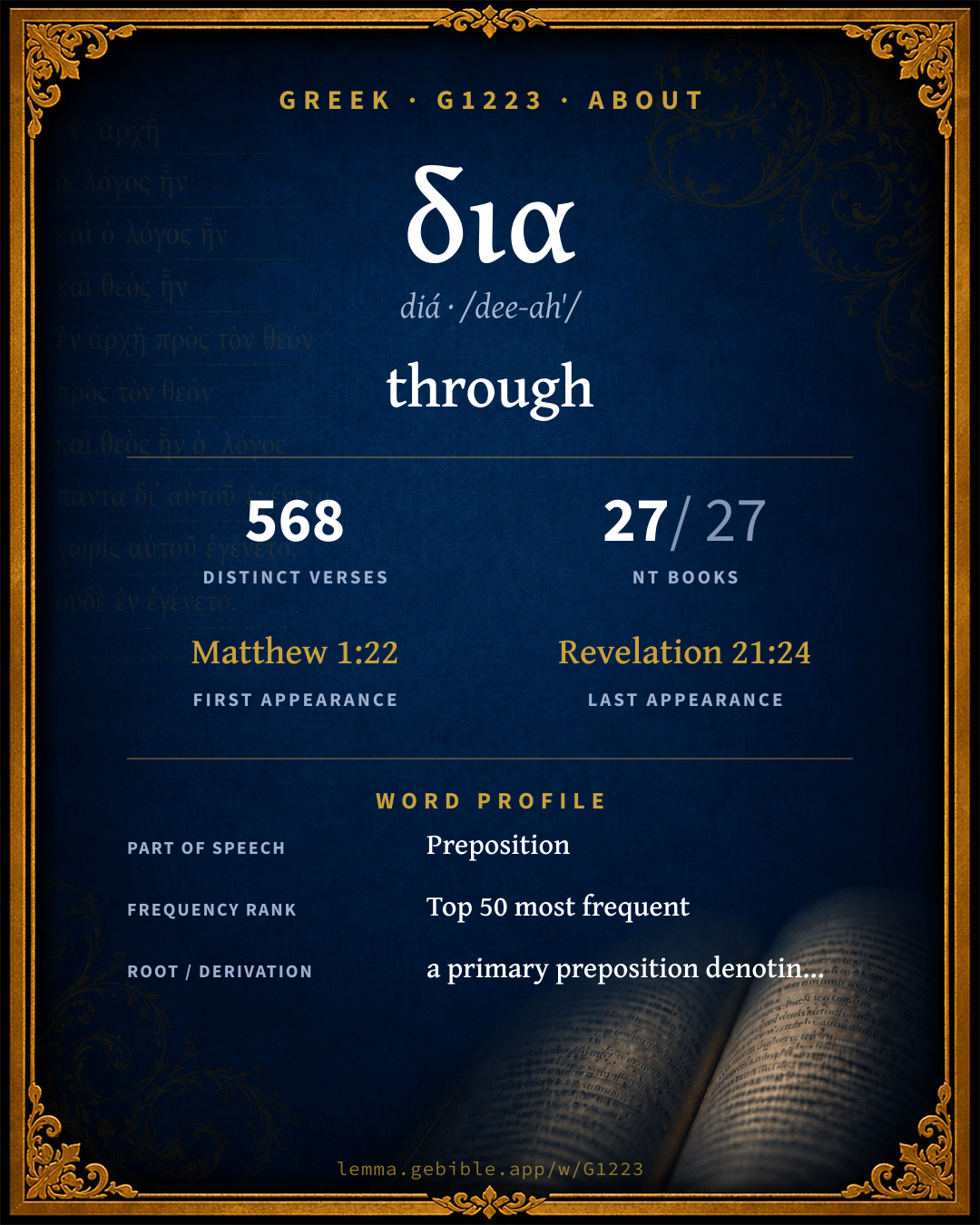
διά
through
Full lexicon entry — Thayer's Greek Lexicon
From Thayer's Greek Lexicon
Where this word appears
Grammar key — what these labels mean
Part of speech
- Preposition
- A relational word governing a noun in a particular case.
Every verse where G1223 appears in the Book of Luke — 31 distinct verses. Click any verse to open its interlinear word-by-word view. Verse text shown in the World English Bible for context — . Each verse’s Greek form is shown with its reference; the English is not keyword-highlighted, since the data carries no word-level English alignment. Use “Compare translations” on any verse to read it across multiple English versions. This concordance covers the Greek New Testament; Septuagint (Greek Old Testament) occurrences of this word are not indexed here.
Luke
- Luke 1:70 διὰ prep (As he spoke by the mouth of his holy prophets who have been from of old),
- Luke 1:78 διὰ prep Because of the tender mercy of our God, Whereby the dawn from on high will visit us,
- Luke 2:4 διὰ prep Joseph also went up from Galilee, out of the city of Nazareth, into Judea, to the city of David, which is called Bethlehem, because he was of the house and family of David;
- Luke 4:30 διὰ prep But he, passing through the midst of them, went his way.
- Luke 5:5 δι’ prep Simon answered him, "Master, we worked all night, and took nothing; but at your word I will let down the net."
- Luke 5:19 διὰ διὰ prep prep Not finding a way to bring him in because of the multitude, they went up to the housetop, and let him down through the tiles with his cot into the midst before Jesus.
- Luke 6:1 διὰ prep Now it happened on the second Sabbath after the first, that he was going through the grain fields. His disciples plucked the heads of grain, and ate, rubbing them in their hands.
- Luke 6:48 διὰ prep He is like a man building a house, who dug and went deep, and laid a foundation on the rock. When a flood arose, the stream broke against that house, and could not shake it, because it was founded on the rock.
- Luke 8:4 διὰ prep When a great multitude came together, and people from every city were coming to him, he spoke by a parable.
- Luke 8:6 διὰ prep Other seed fell on the rock, and as soon as it grew, it withered away, because it had no moisture.
- Luke 8:19 διὰ prep His mother and brothers came to him, and they could not come near him for the crowd.
- Luke 8:47 δι’ prep When the woman saw that she was not hidden, she came trembling, and falling down before him declared to him in the presence of all the people the reason why she had touched him, and how she was healed immediately.
- Luke 9:7 διὰ prep Now Herod the tetrarch heard of all that was done by him; and he was very perplexed, because it was said by some that John had risen from the dead,
- Luke 11:8 διὰ διά prep prep I tell you, although he will not rise and give it to him because he is his friend, yet because of his persistence, he will get up and give him as many as he needs.
- Luke 11:19 διὰ prep But if I cast out demons by Beelzebul, by whom do your children cast them out? Therefore will they be your judges.
- Luke 11:24 δι’ prep The unclean spirit, when he has gone out of the man, passes through dry places, seeking rest, and finding none, he says, 'I will turn back to my house from which I came out.'
- Luke 11:49 διὰ prep Therefore also the wisdom of God said, 'I will send to them prophets and apostles; and some of them they will kill and persecute,
- Luke 12:22 διὰ prep He said to his disciples, "Therefore I tell you, don't be anxious for your life, what you will eat, nor yet for your body, what you will wear.
- Luke 13:24 διὰ prep "Strive to enter in by the narrow door, for many, I tell you, will seek to enter in, and will not be able.
- Luke 14:20 διὰ prep "Another said, 'I have married a wife, and therefore I can't come.'
- Luke 17:1 δι’ prep He said to the disciples, "It is impossible that no occasions of stumbling should come, but woe to him through whom they come!
- Luke 17:11 διὰ prep It happened as he was on his way to Jerusalem, that he was passing along the borders of Samaria and Galilee.
- Luke 18:5 διά prep yet because this widow bothers me, I will defend her, or else she will wear me out by her continual coming.'"
- Luke 18:25 διὰ prep For it is easier for a camel to enter in through a needle's eye, than for a rich man to enter into the Kingdom of God."
- Luke 18:31 διὰ prep He took the twelve aside, and said to them, "Behold, we are going up to Jerusalem, and all the things that are written through the prophets concerning the Son of Man will be completed.
- Luke 19:11 διὰ prep As they heard these things, he went on and told a parable, because he was near Jerusalem, and they supposed that the Kingdom of God would be revealed immediately.
- Luke 21:17 διὰ prep You will be hated by all men for my name's sake.
- Luke 22:22 δι’ prep The Son of Man indeed goes, as it has been determined, but woe to that man through whom he is betrayed!"
- Luke 23:8 διὰ prep Now when Herod saw Jesus, he was exceedingly glad, for he had wanted to see him for a long time, because he had heard many things about him. He hoped to see some miracle done by him.
- Luke 23:19 διὰ prep one who was thrown into prison for a certain revolt in the city, and for murder.
- Luke 23:25 διὰ prep He released him who had been thrown into prison for insurrection and murder, for whom they asked, but he delivered Jesus up to their will.
About this entry
At a glance — auto-summarized from this page’s data, not written by a person. Every figure links to its source below. This summary describes the numbers; it doesn’t interpret them.
The Greek preposition δια centers on the idea of “through.” Where the King James Version says “by,” newer translations reach for “through” (Berean Standard Bible); the renderings breakdown has the detail. It appears 568 verses across 27 books of the Greek New Testament, among its most common vocabulary. Debuting at Matthew 1:22, it then recurs through the corpus. It shares a root with διαβαινω, διαβαλλω and διαβεβαιοομαι. Dig into 568-verse concordance and the renderings breakdown below.
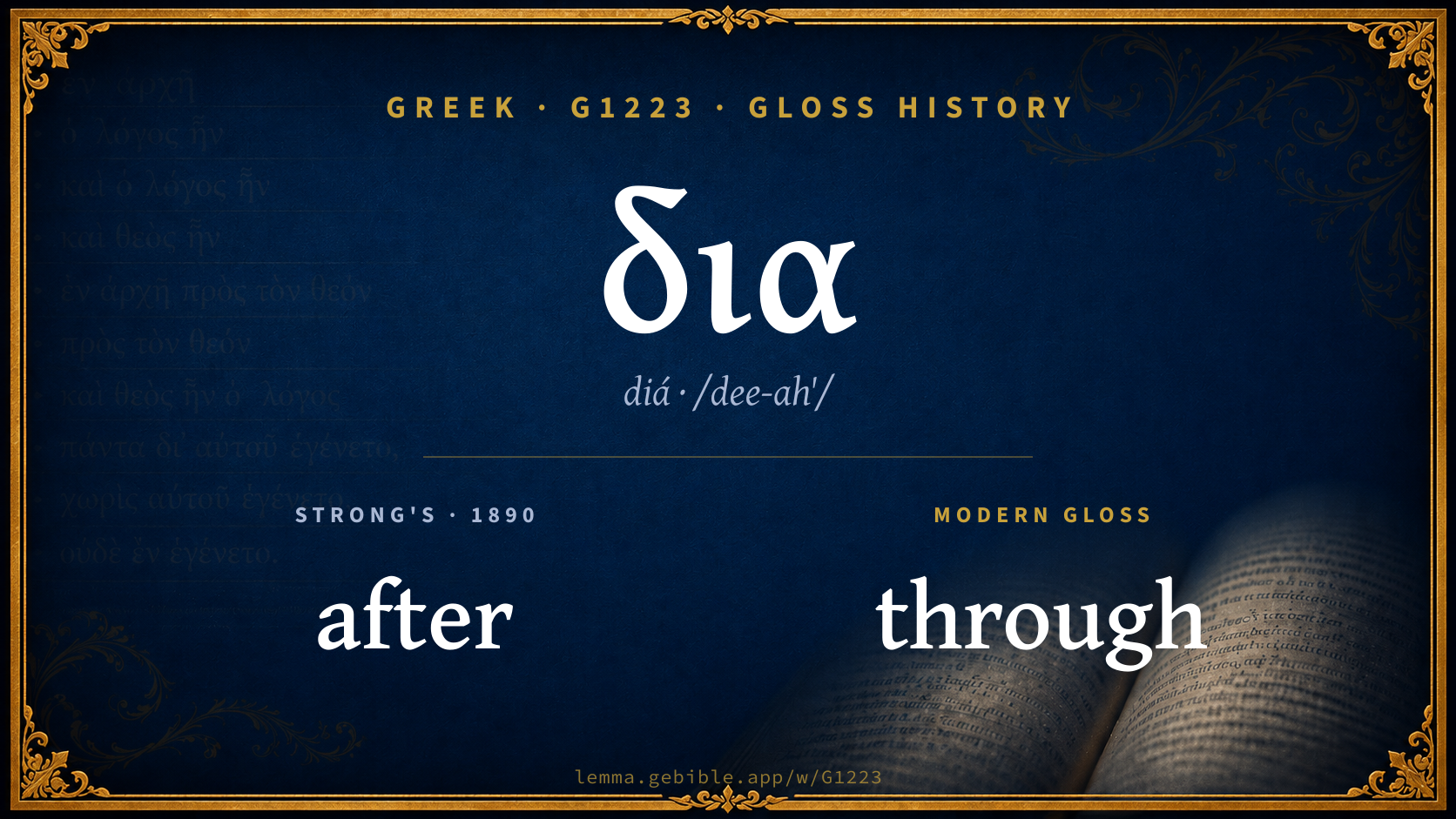
Gloss history
Strong's 1890 vs modern scholarship
About this word
Strong's G1223 catalogs a Greek word from the Greek New Testament.
These counts are not copied from any lexicon or concordance. They are computed here, from the morphology-tagged Greek New Testament. What Lemma adds →
- 568
- distinct verses
- The word appears in 568 distinct verses.
- 27 / 27
- NT books
- The word appears in 27 of 27 New Testament books.
- #32
- by frequency
- Top 50 most frequent Greek words (rank 32 of 5,347 Greek words by occurrence).
View all 568 occurrences in the concordance →
By section of the New Testament
By traditional corpus
Conventional, traditional groupings — biblical authorship is debated, so this is a traditional corpus grouping, not an authorship claim. Some books belong to more than one corpus (Luke is in both the Gospels and the Lukan corpus, and so on), so these shares overlap and need not total 100%. Each figure is a share of the word’s 568 distinct verses.
- Pauline corpus 239 verses · 42%
- Gospels 161 verses · 28%
- Lukan (Luke–Acts) 98 verses · 17%
- Johannine 73 verses · 13%
- Hebrews 51 verses · 9%
- General (Catholic) Epistles 36 verses · 6%
- Revelation 14 verses · 2%
How translations render this word
Counts come from each version’s own published word-to-Strong’s tagging or interlinear alignment — an approximate guide to how each version renders this word, not a word-level alignment the data otherwise carries. Because each total is that version’s own tagged count, the per-version totals vary from one another and need not match the appearance or distinct-verse counts above. These counts may also differ from a printed concordance because Lemma counts each distinctly tagged rendering and does not collapse phrase taggings into a single head-word total. This is a fixed set of word-tagged versions (KJV, ASV, BSB, ULT) and does not change with the reading translation you choose elsewhere. Each version’s license is shown beside its name below (and on Sources).
- King James Version: By 228×, For 100×, Through 91×
- American Standard Version: Through 217×, For 105×, By 96×
- Berean Standard Bible: Through 201×, By 82×, Of 64×
- unfoldingWord Literal Text: Through 287×, Of 139×, By 66×
King James Version Public Domain
Renders G1223 across 639 tagged occurrences — most commonly:
Plus other, less common renderings. Plus 32 renderings that appear only once — usually multi-word phrases or single function words the recovered tagging swept in, not distinct renderings. Not rendered by a distinct English word in 20 further occurrences.
American Standard Version Public Domain
Renders G1223 across 630 tagged occurrences — most commonly:
Plus other, less common renderings. Plus 46 renderings that appear only once — usually multi-word phrases or single function words the recovered tagging swept in, not distinct renderings. Not rendered by a distinct English word in 1 further occurrence.
Berean Standard Bible Public Domain
Renders G1223 across 607 tagged occurrences — most commonly:
Plus other, less common renderings. Plus 35 renderings that appear only once — usually multi-word phrases or single function words the recovered tagging swept in, not distinct renderings. Not rendered by a distinct English word in 42 further occurrences.
unfoldingWord Literal Text CC BY-SA 4.0
Renders G1223 across 694 tagged occurrences — most commonly:
Plus other, less common renderings. Plus 11 renderings that appear only once — usually multi-word phrases or single function words the recovered tagging swept in, not distinct renderings.
Senses in Thayer's
The 1 sense Thayer's distinguishes for this word, in lexicon order (not ranked by frequency or importance). The full entry — with sub-senses — is in the Lexicon Entry tab.
- through
Word origin
Origin: a primary preposition denoting the channel of an act
A primary preposition denoting the channel of an act; through (in very wide applications local causal or occasional). In composition it retains the same general import : - after always among at to avoid because of (that) briefly by for (cause)... fore from in by occasion of of by reason of for sake that thereby therefore X though through (-out) to wherefore with (-in). In composition it retains the same general import.
— Strong’s Exhaustive Concordance (1890), public domain.
Forms in the corpus
The 5 distinct written forms G1223 takes in the Greek New Testament, most frequent first — each parse links to that case’s occurrences in the concordance.
| Form | Parsing | Example | Uses |
|---|---|---|---|
| διὰ dià | Preposition | Matthew 1:22 | 477 |
| δι’ di | Preposition | Matthew 2:12 | 142 |
| Διὰ Dià | Preposition | Matthew 6:25 | 9 |
| διά diá | Preposition | Luke 11:8 | 3 |
| Δι’ Di | Preposition | 2 Timothy 1:6 | 2 |
Same root — word family
Other Thayer's entries built from the same root as G1223, grouped by Strong’s listed origin. These share a root / origin per the lexicon — not necessarily a shared meaning. Each links to that word’s own entry.
Derived from this word
- διαβαινω diabaínō G1224 to pass through
- διαβαλλω diabállō G1225 to slander
- διαβεβαιοομαι diabebaióomai G1226 to affirm strongly
- διαβλεπω diablépō G1227 to look through
- διαγγελλω diangéllō G1229 to proclaim
- διαγινομαι diagínomai G1230 to continue
- διαγινωσκω diaginṓskō G1231 to ascertain
- διαγογγυζω diagongýzō G1234 to murmur
- διαγρηγορεω diagrēgoréō G1235 to watch through
- διαγω diágō G1236 to lead through
- διαδεχομαι diadéchomai G1237 to receive in succession
- διαδημα diádēma G1238 diadem
- διαδιδωμι diadídōmi G1239 to distribute
- διαζωννυμι diazṓnnymi G1241 to gird around
- διαιρεω diairéō G1244 to divide
- διακαθαριζω diakatharízō G1245 to cleanse thoroughly
- διακατελεγχομαι diakatelénchomai G1246 to confute
- διακουομαι diakoúomai G1251 to hear fully
- διακρινω diakrínō G1252 to distinguish
- διακωλυω diakōlýō G1254 to hinder
- διαλαλεω dialaléō G1255 to converse
- διαλεγομαι dialégomai G1256 to discuss
- διαλειπω dialeípō G1257 to intermit
- διαλλασσω diallássō G1259 to reconcile
+63 more words derive from G1223 (not shown).
Compare all same-root words → Showing 4 of 88 — not the complete family. They share a root, not necessarily a meaning.
Septuagint usage
The same Greek word δια appears 1,023 times in the Greek Old Testament (Septuagint), across 929 verses in 36 books.
- 1,023
- LXX occurrences
- Tagged occurrences of this Greek word in the Septuagint.
- 929
- verses
- Distinct Septuagint verses containing this word.
- 36 / 39
- OT books
- The word appears in 36 of the 39 Old Testament books.
Sample Septuagint occurrences
- Genesis 3:5 δια
- Exodus 2:13 διά
- Leviticus 6:6 διά
- Numbers 3:12 δια
- Deuteronomy 1:22 διά
- Joshua 2:15 διά
- Judges 1:1 διά
- 1 Samuel 1:6 διά
- 2 Samuel 2:23 δια
- 1 Kings 1:6 διά
- 2 Kings 1:2 διά
- 1 Chronicles 11:3 διά
Septuagint occurrences (same lexeme)
Every verse where the same Strong’s number (G1223) appears in the Greek Septuagint — showing the first 50 of 929. Verse text shown in the World English Bible for context; the Greek form is the matched word — the English is not keyword-highlighted.
- Genesis 3:5 δια for God knows that in the day you eat it, your eyes will be opened, and you will be like God, knowing good and evil."
- Genesis 3:7 δια Both of their eyes were opened, and they knew that they were naked. They sewed fig leaves together, and made themselves aprons.
- Genesis 4:1 διά The man knew Eve his wife. She conceived, and gave birth to Cain, and said, "I have gotten a man with Yahweh's help."
- Genesis 5:29 δια and he named him Noah, saying, "This same will comfort us in our work and in the toil of our hands, because of the ground which Yahweh has cursed."
- Genesis 6:3 διά Yahweh said, "My Spirit will not strive with man forever, because he also is flesh; yet will his days be one hundred twenty years."
- Genesis 7:7 διά Noah went into the ark with his sons, his wife, and his sons' wives, because of the waters of the flood.
- Genesis 8:21 διά Yahweh smelled the sweet savor. Yahweh said in his heart, "I will not again curse the ground any more for man's sake, because the imagination of man's heart is evil from his youth; neither will I ever again strike everything living, as I have done.
- Genesis 10:9 διά He was a mighty hunter before Yahweh. Therefore it is said, "Like Nimrod, a mighty hunter before Yahweh."
- Genesis 11:9 διά Therefore the name of it was called Babel, because Yahweh confused the language of all the earth, there. From there, Yahweh scattered them abroad on the surface of all the earth.
- Genesis 12:13 διά Please say that you are my sister, that it may be well with me for your sake, and that my soul may live because of you."
- Genesis 12:16 διά He dealt well with Abram for her sake. He had sheep, and oxen, and male donkeys, and men-servants, and maid-servants, and female donkeys, and camels.
- Genesis 18:26 διά Yahweh said, "If I find in Sodom fifty righteous within the city, then I will spare all the place for their sake."
- Genesis 19:22 διά Hurry, escape there, for I can't do anything until you get there." Therefore the name of the city was called Zoar.
- Genesis 20:2 διά Abraham said about Sarah his wife, "She is my sister." Abimelech king of Gerar sent, and took Sarah.
- Genesis 21:31 διά Therefore he called that place Beersheba, because they both swore there.
- Genesis 22:12 διά He said, "Don't lay your hand on the boy, neither do anything to him. For now I know that you fear God, seeing you have not withheld your son, your only son, from me."
- Genesis 22:16 διά and said, "I have sworn by myself, says Yahweh, because you have done this thing, and have not withheld your son, your only son,
- Genesis 24:62 διά Isaac came from the way of Beer Lahai Roi. For he lived in the land of the South.
- Genesis 25:30 διά Esau said to Jacob, "Please feed me with that same red stew, for I am famished." Therefore his name was called Edom.
- Genesis 26:8 διά It happened, when he had been there a long time, that Abimelech king of the Philistines looked out at a window, and saw, and, behold, Isaac was caressing Rebekah, his wife.
- Genesis 26:9 διά Abimelech called Isaac, and said, "Behold, surely she is your wife. Why did you say, 'She is my sister?'" Isaac said to him, "Because I said, 'Lest I die because of her.'"
- Genesis 26:24 διά Yahweh appeared to him the same night, and said, "I am the God of Abraham your father. Don't be afraid, for I am with you, and will bless you, and multiply your seed for my servant Abraham's sake."
- Genesis 26:33 διά He called it Shibah. Therefore the name of the city is Beersheba to this day.
- Genesis 27:46 διά Rebekah said to Isaac, "I am weary of my life because of the daughters of Heth. If Jacob takes a wife of the daughters of Heth, such as these, of the daughters of the land, what good will my life do me?"
- Genesis 29:34 διά She conceived again, and bare a son. Said, "Now this time will my husband be joined to me, because I have borne him three sons." Therefore was his name called Levi.
- Genesis 29:35 διά She conceived again, and bare a son. She said, "This time will I praise Yahweh." Therefore she named him Judah. Then she stopped bearing.
- Genesis 30:6 διά Rachel said, "God has judged me, and has also heard my voice, and has given me a son." Therefore called she his name Dan.
- Genesis 30:35 διά That day, he removed the male goats that were streaked and spotted, and all the female goats that were speckled and spotted, every one that had white in it, and all the black ones among the sheep, and gave them into the hand of his sons.
- Genesis 31:48 διά Laban said, "This heap is witness between me and you this day." Therefore it was named Galeed
- Genesis 32:17 διά He commanded the foremost, saying, "When Esau, my brother, meets you, and asks you, saying, 'Whose are you? Where are you going? Whose are these before you?'
- Genesis 33:10 διά Jacob said, "Please, no, if I have now found favor in your sight, then receive my present at my hand, because I have seen your face, as one sees the face of God, and you were pleased with me.
- Genesis 33:17 διά Jacob traveled to Succoth, built himself a house, and made shelters for his cattle. Therefore the name of the place is called Succoth.
- Genesis 38:29 διά It happened, as he drew back his hand, that behold, his brother came out, and she said, "Why have you made a breach for yourself?" Therefore his name was called Perez.
- Genesis 39:4 διά Joseph found favor in his sight. He ministered to him, and he made him overseer over his house, and all that he had he put into his hand.
- Genesis 39:5 διά It happened from the time that he made him overseer in his house, and over all that he had, that Yahweh blessed the Egyptian's house for Joseph's sake; and the blessing of Yahweh was on all that he had, in the house and in the field.
- Genesis 39:8 διά But he refused, and said to his master's wife, "Behold, my master doesn't know what is with me in the house, and he has put all that he has into my hand.
- Genesis 39:9 διά He isn't greater in this house than I, neither has he kept back anything from me but you, because you are his wife. How then can I do this great wickedness, and sin against God?"
- Genesis 39:22 διά The keeper of the prison committed to Joseph's hand all the prisoners who were in the prison. Whatever they did there, he was the doer of it.
- Genesis 39:23 διά The keeper of the prison didn't look after anything that was under his hand, because Yahweh was with him; and that which he did, Yahweh made it prosper.
- Genesis 40:8 διά They said to him, "We have dreamed a dream, and there is no one who can interpret it." Joseph said to them, "Don't interpretations belong to God? Please tell it to me."
- Genesis 40:14 διά But remember me when it will be well with you, and show kindness, please, to me, and make mention of me to Pharaoh, and bring me out of this house.
- Genesis 43:18 διά The men were afraid, because they were brought to Joseph's house; and they said, "Because of the money that was returned in our sacks at the first time are we brought in; that he may seek occasion against us, and fall on us, and take us for bondservants, along with our donkeys."
- Genesis 47:22 διά Only he didn't buy the land of the priests, for the priests had a portion from Pharaoh, and ate their portion which Pharaoh gave them. That is why they didn't sell their land.
- Genesis 49:24 διά But his bow abode in strength, The arms of his hands were made strong, By the hands of the Mighty One of Jacob, (From there is the shepherd, the stone of Israel),
- Genesis 50:11 διά When the inhabitants of the land, the Canaanites, saw the mourning in the floor of Atad, they said, "This is a grievous mourning by the Egyptians." Therefore, the name of it was called Abel Mizraim, which is beyond the Jordan.
- Exodus 2:13 διά He went out the second day, and, behold, two men of the Hebrews were fighting with each other. He said to him who did the wrong, "Why do you strike your fellow?"
- Exodus 5:8 διά The number of the bricks, which they made before, you require from them. You shall not diminish anything of it, for they are idle; therefore they cry, saying, 'Let us go and sacrifice to our God.'
- Exodus 5:14 διά The officers of the children of Israel, whom Pharaoh's taskmasters had set over them, were beaten, and demanded, "Why haven't you fulfilled your quota both yesterday and today, in making brick as before?"
- Exodus 5:17 διά But he said, "You are idle! You are idle! Therefore you say, 'Let us go and sacrifice to Yahweh.'
- Exodus 5:22 διά Moses returned to Yahweh, and said, "Lord, why have you brought trouble on this people? Why is it that you have sent me?
These are occurrences of the same Greek lexeme (G1223) in the Septuagint — not a translation of any one Hebrew word. The store carries no word-level Hebrew↔Greek alignment, so no Hebrew original is asserted here. Counts come from the recovered LXX Strong's tagging — high-frequency vocabulary is well covered, while rare or late forms may be untagged — so they reflect tagged occurrences and may slightly undercount.