
Genesis 50:11

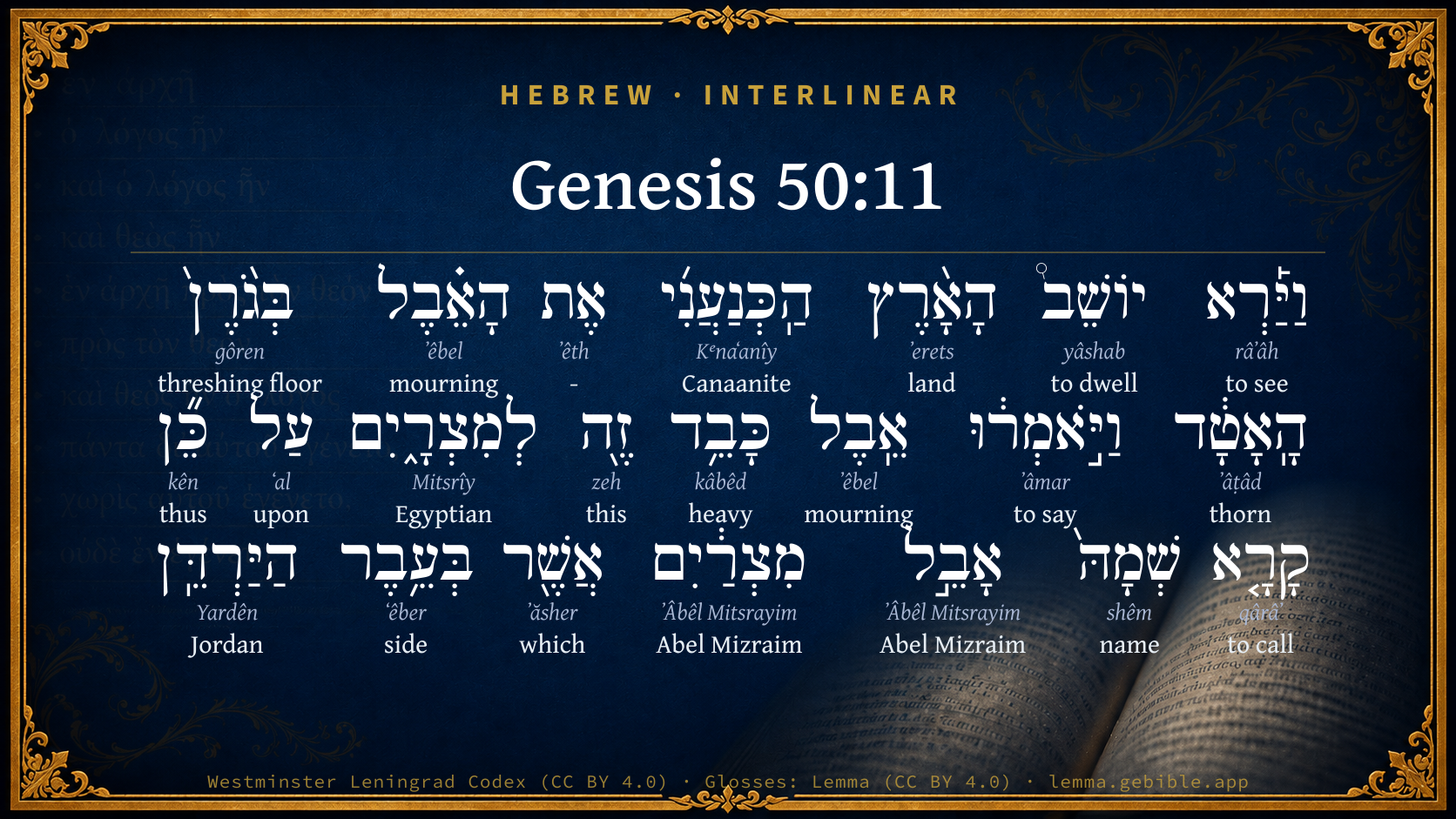
Hebrew (Westminster Leningrad Codex) Genesis 50:11 appears in the Hebrew Old Testament. The text above is from the Westminster Leningrad Codex. Each word links to its Strong’s number, a concise gloss, and parsing drawn from the Open Scriptures Hebrew Bible morphology. Click any word for its full Brown-Driver-Briggs (BDB) entry.
Download image
Cite this verse

Genesis 50:11 (World English Bible). Public Domain. Lemma interlinear Bible study tool, https://lemma.gebible.app/v/genesis/50/11.

Show BibTeX & RIS
BibTeX
RIS
English Translation
When the inhabitants of the land, the Canaanites, saw the mourning in the floor of Atad, they said, "This is a grievous mourning by the Egyptians." Therefore, the name of it was called Abel Mizraim, which is beyond the Jordan.
World English Bible · Public Domain
Highlights
  • 1 first appearance in the Hebrew Bible
Full analysis ↓
Download a study sheet

One document with this verse’s original text, its word-by-word gloss line, the meaning frame, cross-references with their text, attributed commentary, and full source and license credits — printable, and it pastes into notes with its structure intact.

This verse Autodidact and up

Study sheet (.html) Plain text (.txt)

A passage Seminary Student

Up to 50 verses in one chapter. A passage sheet keeps up to 6 commentary sources and 12 cross-references per verse, in the order this page ranks them, and says so on the sheet whenever that leaves anything out. Ask for a single verse and you get the Autodidact verse sheet above.

Everything on this page stays free to read, with no account — the sheet is a download of what is already on screen, not access to it.

Want to remove ads? Support Godless Engineer
Compare translations 3

The same verse in 3 English versions, stacked beneath the original-language interlinear above. Click any original word for its lexicon entry.

Each is an independent rendering of the whole verse — the interlinear is not word-aligned to these translations.

Highlighted words mark where these versions differ — a whole-verse word diff, not a word-by-word alignment.

  • World English Bible Public Domain
    When the inhabitants of the land, the Canaanites, saw the mourning in the floor of Atad, they said, "This is a grievous mourning by the Egyptians." Therefore, the name of it was called Abel Mizraim, which is beyond the Jordan.
  • King James Version Public Domain
    And when the inhabitants of the land, the Canaanites, saw the mourning in the floor of Atad, they said, This is a grievous mourning to the Egyptians: wherefore the name of it was called Abelmizraim, which is beyond Jordan.
  • unfoldingWord Literal Text CC BY-SA 4.0
    And the inhabitants of the land, the Canaanites, saw the mourning at the threshing floor of Atad, and they said, “This a heavy mourning for the Egyptians!” For that they called its name Abel Mizraim, which beyond the Jordan.

unfoldingWord Literal Text — © unfoldingWord, licensed CC BY-SA 4.0. Word-aligned USFM3 via Door43 (git.door43.org/unfoldingWord/en_ult).

Versions to compare (up to 4)

3 of 4 selected

Show all 18 translations

Every available English version of this verse, each an independent rendering of the whole verse.

  • World English Bible Public Domain
    When the inhabitants of the land, the Canaanites, saw the mourning in the floor of Atad, they said, "This is a grievous mourning by the Egyptians." Therefore, the name of it was called Abel Mizraim, which is beyond the Jordan.
  • Berean Standard Bible Public Domain
    When the Canaanites of the land saw the mourning at the threshing floor of Atad, they said, “This is a solemn ceremony of mourning by the Egyptians.” Thus the place across the Jordan is called Abel-mizraim.
  • Majority Standard Bible Public Domain
    When the Canaanites of the land saw the mourning at the threshing floor of Atad, they said, “This is a solemn ceremony of mourning by the Egyptians.” Thus the place across the Jordan is called Abel-mizraim.
  • King James Version Public Domain
    And when the inhabitants of the land, the Canaanites, saw the mourning in the floor of Atad, they said, This is a grievous mourning to the Egyptians: wherefore the name of it was called Abelmizraim, which is beyond Jordan.
  • American Standard Version (1901) Public Domain
    And when the inhabitants of the land, the Canaanites, saw the mourning in the floor of Atad, they said, This is a grievous mourning to the Egyptians: wherefore the name of it was called Abel-mizraim, which is beyond the Jordan.
  • Revised Version (1885) Public Domain
    And when the inhabitants of the land, the Canaanites, saw the mourning in the floor of Atad, they said, This is a grievous mourning to the Egyptians: wherefore the name of it was called Abel-mizraim, which is beyond Jordan.
  • Geneva Bible (1599) Public Domain
    And when the Canaanites the inhabitants of the lande sawe the mourning in Goren Atad, they sayde, This is a great mourning vnto the Egyptians: wherefore the name thereof was called Abel Mizraim, which is beyond Iorden.
  • Douay-Rheims (1899) Public Domain
    And when the inhabitants of Chanaan saw this, they said: This is a great mourning to the Egyptians. And there- fore the name of that place was called, The mourning of Egypt.
  • Young's Literal Translation Public Domain
    and the inhabitant of the land, the Canaanite, see the mourning in the threshing-floor of Atad, and say, `A grievous mourning `is' this to the Egyptians;' therefore hath `one' called its name `The mourning of the Egyptians,' which `is' beyond the Jordan.
  • Literal Standard Version CC BY-SA 4.0
    and the inhabitant of the land, the Canaanite, sees the mourning in the threshing-floor of Atad and says, “A grievous mourning [is] this to the Egyptians”; therefore [one] has called its name “The mourning of the Egyptians,” which [is] beyond the Jordan.
  • Unlocked Literal Bible CC BY-SA 4.0
    When the inhabitants of the land, the Canaanites, saw the mourning in the floor of Atad, they said, “This is a very sad occasion for the Egyptians.” That is why the place was called Abel Mizraim, which is beyond the Jordan.
  • unfoldingWord Literal Text CC BY-SA 4.0
    And the inhabitants of the land, the Canaanites, saw the mourning at the threshing floor of Atad, and they said, “This a heavy mourning for the Egyptians!” For that they called its name Abel Mizraim, which beyond the Jordan.
  • Darby Bible Public Domain
    And the inhabitants of the land, the Canaanites, saw the mourning at the threshing-floor of Atad, and they said, This is a grievous mourning of the Egyptians. Therefore the name of it was called Abel-Mizraim, which is beyond the Jordan.
  • World Messianic Bible Public Domain
    When the inhabitants of the land, the Canaanites, saw the mourning in the floor of Atad, they said, “This is a grievous mourning by the Egyptians.” Therefore its name was called Abel Mizraim, which is beyond the Jordan.
  • Webster's Bible Public Domain
    And when the inhabitants of the land, the Canaanites, saw the mourning in the floor of Atad, they said, This is a grievous mourning to the Egyptians: wherefore the name of it was called Abel-mizraim, which is beyond Jordan.
  • Free Bible Version CC BY-SA 4.0
    The Canaanites who lived there watched the ceremony of mourning at the threshing floor of Atad. They said, “This is a very sad time of mourning for the Egyptians,” so they renamed the place Abel-mizraim, which is on the other side of the Jordan.
  • Bible in Basic English Public Domain
    And when the people of the land, the people of Canaan, at the grain-floor of Atad, saw their grief, they said, Great is the grief of the Egyptians: so the place was named Abel-mizraim, on the other side of Jordan.
  • JPS Tanakh (1917) Public Domain
    And when the inhabitants of the land, the Canaanites, saw the mourning in the floor of Atad, they said: 'This is a grievous mourning to the Egyptians.' Wherefore the name of it was called Abel-mizraim, which is beyond the Jordan.

Literal Standard Version (2020), Covenant Press — licensed CC BY-SA 4.0. Text via the HelloAO Bible API (eBible.org). Unlocked Literal Bible (unfoldingWord) — licensed CC BY-SA 4.0. Text via the HelloAO Bible API (eBible.org). unfoldingWord Literal Text — © unfoldingWord, licensed CC BY-SA 4.0. Word-aligned USFM3 via Door43 (git.door43.org/unfoldingWord/en_ult). Free Bible Version, Dr. Jonathan Gallagher — licensed CC BY-SA 4.0. Text via the HelloAO Bible API (eBible.org).

Word by word

More ways to search: Search by grammar → Find every occurrence → Compare this word →

Practice this passage: Drill this verse → Learn its vocabulary →

אָבֵ֣ל
ʼÂbêl Mitsrayim
H67
“Abel Mizraim”
Noun, Proper
Part of Speech
Noun
Type
Proper
Full BDB Definition

Origin: from H58 and H4714

TWOT: None

Abel Mizraim = "meadow of Egypt" - a place east of the Jordan (perhaps " as fertile as Egypt" )
  1. וַיַּ֡רְא râʼâh H7200 “and · to see” Conjunction + Verb, Qal, Sequential Imperfect, 3rd Person, Masculine, Singular
  2. יוֹשֵׁב֩ yâshab H3427 “dwelling” Verb, Qal, Participle Active, Masculine, Singular, Construct
  3. הָאָ֨רֶץ ʼerets H776 “the · land” Particle, Definite Article + Noun, Common, Both, Singular, Absolute
  4. הַֽכְּנַעֲנִ֜י Kᵉnaʻanîy H3669 “the · Canaanite” Particle, Definite Article + Noun, Gentilic, Masculine, Singular, Absolute
  5. אֶת ʼêth H853 “-” Particle, Direct Object
  6. הָאֵ֗בֶל ʼêbel H60 “the · mourning” Particle, Definite Article + Noun, Common, Masculine, Singular, Absolute
  7. בְּגֹ֨רֶן֙ gôren H1637 “in/at · threshing floor of” Preposition + Noun, Common, Both, Singular, Construct
  8. הָֽאָטָ֔ד ʼâṭâd H329 “thorn” Noun, Proper
  9. וַיֹּ֣אמְר֔וּ ʼâmar H559 “and · to say” Conjunction + Verb, Qal, Sequential Imperfect, 3rd Person, Masculine, Plural
  10. אֵֽבֶל ʼêbel H60 “mourning” Noun, Common, Masculine, Singular, Absolute
  11. כָּבֵ֥ד kâbêd H3515 “heavy” Adjective, Adjective, Masculine, Singular, Absolute
  12. זֶ֖ה zeh H2088 “this” Pronoun, Demonstrative, Masculine, Singular
  13. לְמִצְרָ֑יִם Mitsrîy H4713 “to/for · Egyptian” Preposition + Noun, Proper
  14. עַל ʻal H5921 “upon” Preposition
  15. כֵּ֞ן kên H3651 “thus” Particle, Demonstrative
  16. קָרָ֤א qârâʼ H7121 “to call” Verb, Qal, Perfect, 3rd Person, Masculine, Singular
  17. שְׁמָהּ֙ shêm H8034 “name · her” Noun, Common, Masculine, Singular, Construct + Suffix, Personal, 3rd Person, Feminine, Singular
  18. מִצְרַ֔יִם ʼÂbêl Mitsrayim H67 “Abel Mizraim” Noun, Proper
  19. אֲשֶׁ֖ר ʼăsher H834 “which” Particle, Relative
  20. בְּעֵ֥בֶר ʻêber H5676 “in/at · side of” Preposition + Noun, Common, Masculine, Singular, Construct
  21. הַיַּרְדֵּֽן Yardên H3383 “the · Jordan” Particle, Definite Article + Noun, Proper

About this verse

These counts appear in no published source. They are computed here, from the morphology-tagged text and Lemma’s own curated glosses. What Lemma adds →

22
words
20
distinct lemmas
Pentateuch
section

Notable vocabulary

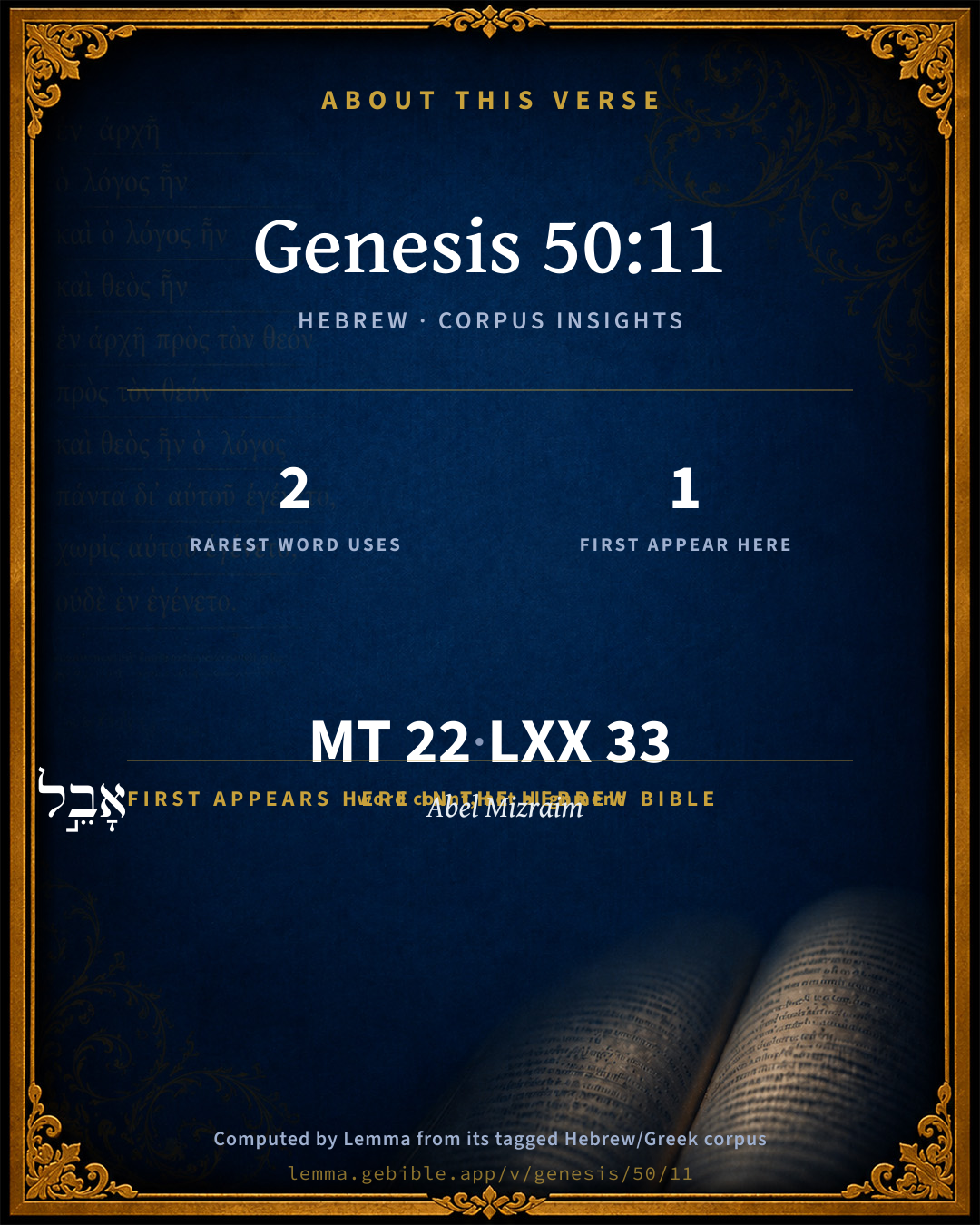
The rarest word here is אָבֵ֣ל Abel Mizraim H67 — appearing just 2 times in the whole Hebrew Bible.

First appearance in Scripture

This word makes its first canonical appearance in the Hebrew Bible here:

  • אָבֵ֣ל Abel Mizraim H67

Grammatical profile

  • 4 verbs
  • 12 nouns
  • 1 adjective
  • 1 pronoun
  • 1 preposition
  • 3 particles

Verb forms

  • וַיַּ֡רְא Qal · Sequential Imperfect
  • יוֹשֵׁב֩ Qal · Participle Active
  • וַיֹּ֣אמְר֔וּ Qal · Sequential Imperfect
  • קָרָ֤א Qal · Perfect

Repetition

Words recur within this verse — often emphatic in Hebrew:

  • הָאֵ֗בֶל mourning H60 ×2
  • אָבֵ֣ל Abel Mizraim H67 ×2

Hebrew & Septuagint length

In English translation the verse runs 40 words from the Hebrew and 39 from the Septuagint (LXX English) — closely comparable.

A rough comparison of the two English renderings, which tokenize alike — not a word-level alignment.

Word counts can differ between the Hebrew and the Greek without any difference in meaning — e.g. the Hebrew direct-object marker אֵת has no separate Greek word, and Greek often adds the article ὁ.

In the original languages it is 22 Hebrew tokens and 33 Greek tokens — but the two are counted differently (Hebrew bundles its prefixes and suffixes into one token; the Greek is in lemma form), so that isn’t a like-for-like length.

Cross-references

9

Topical passages linked to Genesis 50:11 in the Treasury of Scripture Knowledge — connected by theme and wording, ordered by reader-vote popularity; previews shown in the World English Bible.

  • Genesis 10:15–19 Canaan became the father of Sidon (his firstborn), Heth,
  • Genesis 24:6 Abraham said to him, "Beware that you don't bring my son there again.
  • Genesis 13:7 There was a strife between the herdsmen of Abram's cattle and the herdsmen of Lot's cattle: and the Canaanite and the Perizzite lived then in the land.
  • Genesis 34:30 Jacob said to Simeon and Levi, "You have troubled me, to make me odious to the inhabitants of the land, among the Canaanites and the Perizzites. I am few in number. They will gather themselves together against me and strike me, and I will be destroyed, I and my house."
  • Genesis 50:10 They came to the threshing floor of Atad, which is beyond the Jordan, and there they lamented with a very great and sore lamentation. He mourned for his father seven days.
  • Deuteronomy 3:25 Please let me go over and see the good land that is beyond the Jordan, that goodly mountain, and Lebanon.
  • Deuteronomy 3:27 Go up to the top of Pisgah, and lift up your eyes westward, and northward, and southward, and eastward, and see with your eyes: for you shall not go over this Jordan.
  • Deuteronomy 11:30 Aren't they beyond the Jordan, behind the way of the going down of the sun, in the land of the Canaanites who dwell in the Arabah, over against Gilgal, beside the oaks of Moreh?
  • 1 Samuel 6:18 and the golden mice, according to the number of all the cities of the Philistines belonging to the five lords, both of fortified cities and of country villages, even to the great stone, whereon they set down the ark of Yahweh, [which stone remains] to this day in the field of Joshua the Beth-shemite.

Cross-references courtesy of OpenBible.info (CC BY 4.0).

Hebrew and Greek witnesses Masoretic Hebrew ↔ Greek Septuagint

The same verse in the two great witnesses to the Old Testament, shown verse-for-verse.

These are two independent witnesses, not word-aligned to each other, and the Septuagint is shown in lemma (dictionary) form.

Hebrew Genesis 50:11 Masoretic · Westminster Leningrad Codex

וַיַּ֡רְא יוֹשֵׁב֩ הָאָ֨רֶץ הַֽכְּנַעֲנִ֜י אֶת הָאֵ֗בֶל בְּגֹ֨רֶן֙ הָֽאָטָ֔ד וַיֹּ֣אמְר֔וּ אֵֽבֶל כָּבֵ֥ד זֶ֖ה לְמִצְרָ֑יִם עַל כֵּ֞ן קָרָ֤א שְׁמָהּ֙ אָבֵ֣ל מִצְרַ֔יִם אֲשֶׁ֖ר בְּעֵ֥בֶר הַיַּרְדֵּֽן

When the inhabitants of the land, the Canaanites, saw the mourning in the floor of Atad, they said, "This is a grievous mourning by the Egyptians." Therefore, the name of it was called Abel Mizraim, which is beyond the Jordan.

World English Bible · Public Domain

Greek LXX Genesis 50:11 Septuagint · lemma form

καί ὁράω ὁ κάτοικος ὁ γῆ χανααν ὁ πένθος ἐν ἅλων αταδ καί εἶπον πένθος μέγας οὗτος εἰμί ὁ αἰγύπτιος διά οὗτος καλέω ὁ ὄνομα αὐτός πένθος αἴγυπτος ὅς εἰμί πέραν ὁ ἰορδάνης

And the inhabitants of the land of Chanaan saw the mourning at the floor of Atad, and said, This is a great mourning to the Egyptians; therefore he called its name, The mourning of Egypt, which is beyond Jordan.

LXX2012 (modern English Septuagint) · Public Domain

On this verse, The Cambridge Bible for Schools and Colleges discusses the Septuagint’s reading. Read the note in Commentary ↓

Hebrew: Westminster Leningrad Codex (CC BY 4.0). Greek: Septuagint (public domain); English from LXX2012 (modern English Septuagint) (Public Domain). How the Septuagint differs from the Hebrew →

Targum (Aramaic paraphrase)

2

The Targum is the ancient Jewish Aramaic paraphrase of the Hebrew Scriptures — an interpretive translation, not the Hebrew text itself. Onkelos (literal) and Pseudo-Jonathan (expansive) render the Torah, and Jonathan the Prophets. Coverage is partial: where no permissively-licensed English translation exists for a verse, only the Aramaic is shown. This is verse-level text, not a word-by-word alignment to the Hebrew.

  1. Targum Onkelos Torah (Genesis–Deuteronomy)
    וַחֲזָא יָתֵב אַרְעָא כְנַעֲנָאָה יָת אֶבְלָא בְּבֵית אִדְרֵי דְאָטָד וַאֲמָרוּ אָבֵל תַּקִּיף דֵּין לְמִצְרָאֵי עַל כֵּן קְרָא שְׁמַהּ אָבֵל מִצְרַיִם דִּי בְּעִבְרָא דְיַרְדְנָא

    (no public-domain English translation for this verse)

    Targum Onkelos — Aramaic: “Onkelos Genesis” (public domain); “Onkelos Exodus” (public domain); “Onkelos Leviticus” (public domain); “Onkelos Numbers” (public domain); “Onkelos Deuteronomy” (public domain). English: “Sefaria Community Translation” (CC0 1.0 (public-domain dedication)); “J.W. Etheridge. The Targums of Onkelos and Jonathan Ben Uzziel on the Pentateuch. London: Longmans, Green, 1862” (public domain). Text via Sefaria.

  2. Targum Pseudo-Jonathan Torah (Genesis–Deuteronomy)
    וַחֲמָא יַתְבֵי אַרְעָא כְּנַעֲנָאֵי אוּבְלָא בְּבֵית אִדְרֵי דְאָטָד וְשַׁרְיַין קְטוּרֵי חַרְצֵהוֹן בְּגִין אִיקַר דְיַעֲקב וַהֲווֹ מְחַוִין בִּידֵיהוֹן וְאָמְרִין אֵבֶל תַּקִיף דֵין לְמִצְרַיִם בְּגִין כֵּן קְרָא שְׁמָא דְאָתַר אָבֵל מִצְרַיִם דִי בְּעִיבְרָא דְיוֹרְדְנָא

    And the inhabitants of the land of Kenaan beheld the mourning at the threshing floor of Atad, and they loosed the girdles of their loins in honour of Jakob, and spread forth their hands, and said, This is a mighty mourning of the Mizraee. Therefore he called the name of the, place Abel Mizraim, which is on the other side of Jardena.

    Targum Pseudo-Jonathan — Aramaic: “Targum Jonathan on Genesis” (public domain); “Targum Jonathan on Exodus” (public domain); “Targum Jonathan on Leviticus” (public domain); “Targum Jonathan on Numbers” (public domain); “Targum Jonathan on Deuteronomy” (public domain). English: “The Targum of Jonathan ben Uzziel, trans. J. W. Etheridge, London, 1862” (public domain). Text via Sefaria.

Commentary

Notes on Genesis 50:11 from classic Christian and Jewish commentators (each source and its license shown beneath its notes). The classic Christian expositions comment on the surrounding passage and are grouped to its opening verse, so a note may address several verses; the Jewish commentaries on the Tanakh (Rashi and others) are per-verse, so they appear only where the commentator wrote on this verse.

Lemma curates 59 commentaries, every one of them public domain or Creative Commons licensed, each selected and text-cleaned for this edition rather than reprinted as found. About our sources →

Trapp's Complete Commentary

John Trapp

Gen 50:11 And when the inhabitants of the land, the Canaanites, saw the mourning in the floor of Atad, they said, This [is] a grievous mourning to the Egyptians: wherefore the name of it was called Abelmizraim, which [is] beyond Jordan.

Ver. 11. Abelmizraim, which is beyond Jordan.] A gracious providence of God, as Piscator well observeth, that for the confirmation of the Israelites’ faith, when they were to pass over Jordan, and afterwards, there should be a standing monument there of the transportation of Jacob’s body out of Egypt into Canaan, for burial’s sake. Thus, "all things work together for good to God’s beloved." {Rom 8:28}

John Trapp, A Commentary or Exposition upon All the Books of the Old and New Testament (1647–1656) — public domain. Text from a community e-Sword module.

Geneva Bible (1599)

Geneva Bible translators

Or, the lamentation of the Egyptians.

Geneva Bible (1599) marginal notes — public domain. Text via Bolls.life.

Ellicott's Commentary for English Readers

(11) Abel-mizraim.—There is here an example of that play upon words that is always dear to Orientals. The word for “mourning” is êbel, while abel means a meadow, and is often found prefixed to the names of towns. When the Versions were made no vowel points were as yet affixed to the Hebrew consonants, and they all read Ebel-mizraim, the mourning of Egypt. The Hebrew text alone, as at present pointed, has Abel-mizraim, the meadow of Egypt.

A Bible Commentary for English Readers, edited by Charles John Ellicott (1878–1897) — public domain. Text from a community e-Sword module.

The Cambridge Bible for Schools and Colleges

gen. ed. J. J. S. Perowne

11. Abel-mizraim] This was popularly rendered “Egypt mourns,” cf. LXX πένθος Αἰγύπτου; Lat. planctus Egypti, but its true meaning would be “the meadow of Egypt, or “of the Egyptians.” In all probability, this name recalled some incident in the days of the Egyptian sovereignty over Palestine; and, when that had faded out of recollection, the name was popularly connected with the traditional mourning of the Egyptians for Jacob, on account of the similarity in sound between ’âbêl = “field” and ’êbel = “mourning.” For other place-names beginning with Abel, cf. Abel-cheramim (Jdg_11:33), Abel of Beth-maacah (2Sa_20:15).

beyond Jordan] The place was identified by Jerome with “Beth-Hoglah,” the modern Ain Haglah, south of Jericho. But the identification rests on no proof. The mention of the trans-Jordanic region presents the same difficulty here as in Gen_50:10.

12, 13 (P). And his sons] The account of Jacob’s burial, according to P, is given in these two verses. They are quite distinct from the preceding narrative, and follow directly upon Gen_49:33. Observe that, in P, no Egyptians, but only Jacob’s sons, carried him to the burying-place of Machpelah.

The Cambridge Bible for Schools and Colleges (gen. ed. J. J. S. Perowne; Cambridge University Press, 1878–1918) — public domain. Text from a community e-Sword module.

John Gill's Exposition

And when the inhabitants of the land, the Canaanites,.... Who were at this time in the possession of the country where the threshingfloor of Atad was: when they

saw the mourning in the floor of Atad; for so large a company of people, and such a grand funeral procession, brought multitudes from all the neighbouring parts to see the sight; and when they observed the lamentation that was made, saw their mournful gestures and actions, and heard their doleful moan:

they said, this is a grievous mourning to the Egyptians; they concluded they must have lost some great man, to make such a lamentation for him:

wherefore the name of it was called Abelmizraim, which is beyond Jordan; they changed the name of the place, and gave it another upon this occasion, which signifies the mourning of Egypt or of the Egyptians, they being the principal persons that used the outward and more affecting tokens of mourning; though the whole company might be taken for Egyptians by the Canaanites, because they came out of Egypt.

John Gill's Exposition of the Whole Bible (1746–1763) — public domain (CC PDM 1.0). Text via the HelloAO Bible API.

Haydock's Catholic Bible Commentary

Mourning: Hebrew, "Ebel Mitsraim beyond the Jordan." On this occasion they fasted till the evening: perhaps they also cut their flesh and plucked their hair, according to the manners of the Egyptians, which customs (Leviticus xix. 28; Deuteronomy xiv. 1.) were prohibited to the Jews. (Tirinus)

George Leo Haydock (1774–1849), Haydock's Catholic Family Bible and Commentary, 1859 edition — public domain. Excludes Psalms (Douay-Rheims chapter numbering differs from Protestant) and Deuterocanonical books (Catholic canon only).

Whedon's Commentary on the Bible

Daniel D. Whedon

11. Abel-mizraim — That is, the mourning of the Egyptians. The Canaanites, who witnessed the unusual spectacle of lamentation, gave a new name to the place. They had never before seen such violence of mourning. Herodotus in describing the habits of the Egyptians observes, (Herod., 2:85,) that when a distinguished individual died the females of the family besmear their heads and faces with mud, and wander about beating themselves and exposing their breasts. The men, also, having their clothes girt about them, beat themselves and indulge in excessive lamentation. See also Wilkinson’s full account of Egyptian funeral rites, Ancient Egyptians, vol. ii, p. 366.

Daniel D. Whedon (gen. ed.), Commentary on the Old and New Testaments (1874–1909) — public domain. Text from a community e-Sword module.

The Pulpit Commentary

And when (literally, and) the inhabitants of the land, the Canaanites, saw the mourning in the floor of Atad, they (literally, and they) said, This is a grievous mourning to the Egyptians: wherefore the name of it was called Abel-mizraim,i.e. the meadow (lbea) of the Egyptians, with a play upon the word (lbae) mourning (Keil, Kurtz, Gerlach, Rosenm &c.), if indeed the word has not been punctuated wrongly lbea instead of lbae (Kalisch), which latter reading appears to have been followed by the ;LXX. (penqov Aijguptou) and the Vulgate (planctus Aegypti)which is beyond Jordan (vide supra).

The Pulpit Commentary (1880–1919), ed. H.D.M. Spence-Jones & Joseph S. Exell — public domain. Text from a community e-Sword module.

John Wesley's Explanatory Notes

The solemn mourning for Jacob gave a name to the place; Abel-mizraim - The mourning of the Egyptians: which served for a testimony against the next generation of the Egyptians, who oppressed the posterity of this Jacob, to whom their ancestors shewed such respect.

John Wesley, Explanatory Notes Upon the Whole Bible (1754–1765) — public domain. Text via the GEBible commentary corpus.

Lesson kit

Teaching starters — assembled from the data on this page, not authored interpretation. Every prompt links to the verse data it draws on. Edit before teaching.

Genesis, in the Pentateuch, opens this verse with 22 words (20 distinct Hebrew lemmas). Its most distinctive word is ʼÂbêl Mitsrayim (“Abel Mizraim”). A historical commentator’s framing appears above. Read the whole chapter for the surrounding context.

Discussion questions

  1. The word ʼÂbêl Mitsrayim carries the sense “Abel Mizraim.” How does it shape the verse?
  2. This is the first place “Abel Mizraim” appears in Scripture (first appears here). What does its debut here establish?
  3. How does Genesis 10:15–19, which shares this passage’s theme, read alongside this verse?
  4. What does the repetition of “mourning” (2× in this one verse) do in this verse?
  5. These translations render this verse differently. What is at stake in choosing one wording over another?
  6. «וַיַּ֡רְא» is a Qal Sequential Imperfect verb. How does that grammatical form shape the action described?
  7. Compare how Trapp's Complete Commentary and Geneva Bible (1599) read this verse. Where do they agree or differ?

Things to notice

Reading settings

Reading text

Shown beneath each verse's original-language words.

Old Testament
Old Testament edition

Read the OT as the Masoretic Hebrew (MT) or the Greek Septuagint (LXX).

English shown for the Greek Septuagint (in the Hebrew ↔ Greek comparison).

Comparing translations? Open the Compare panel on any verse page to stack up to four side by side.