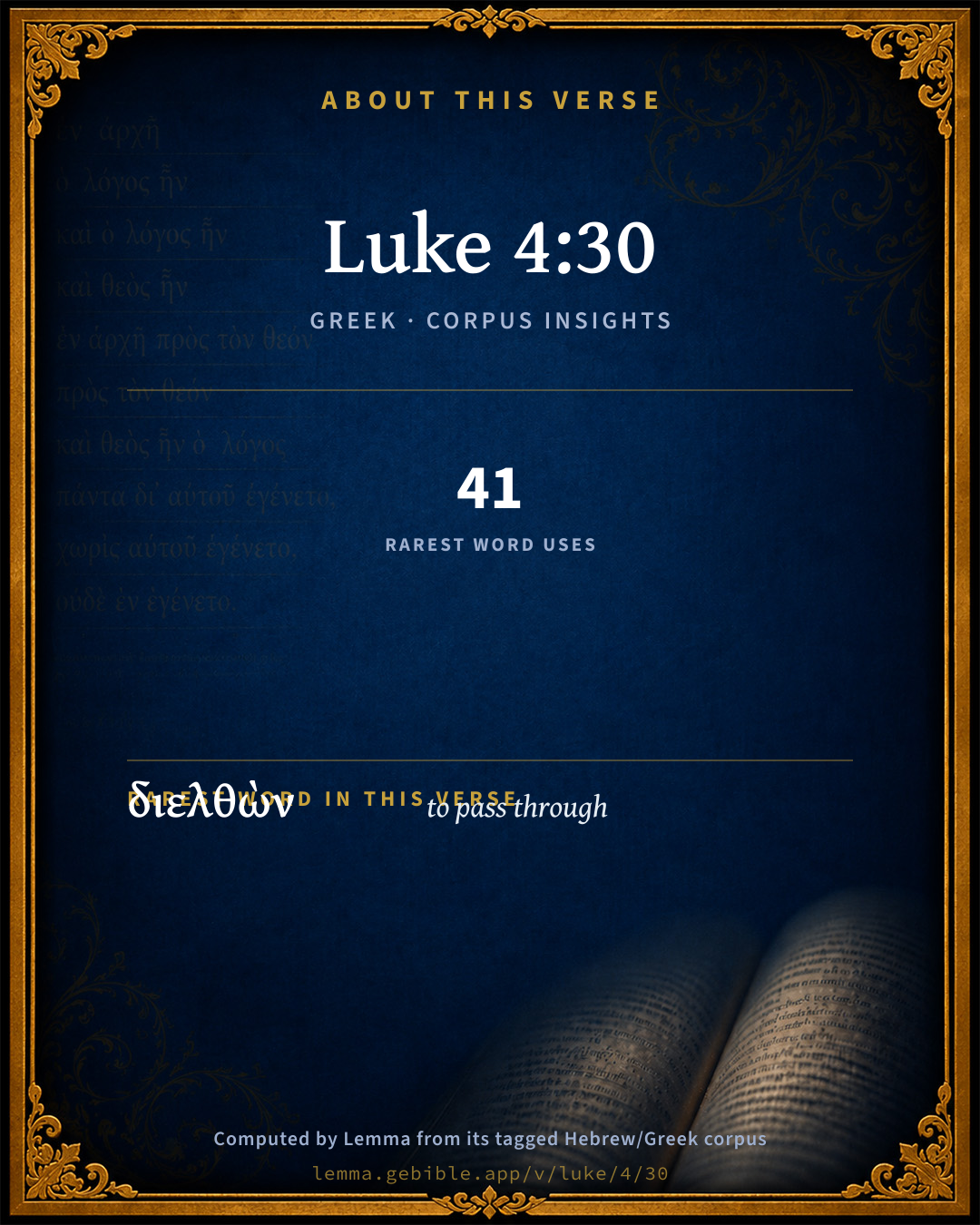
Luke 4:30

Greek (Tischendorf 8th ed.) Luke 4:30 appears in the Greek New Testament. The text above is from the Tischendorf 8th edition. Each word links to its Strong’s number and a concise gloss. Click any word for its full Thayer’s Greek Lexicon entry.
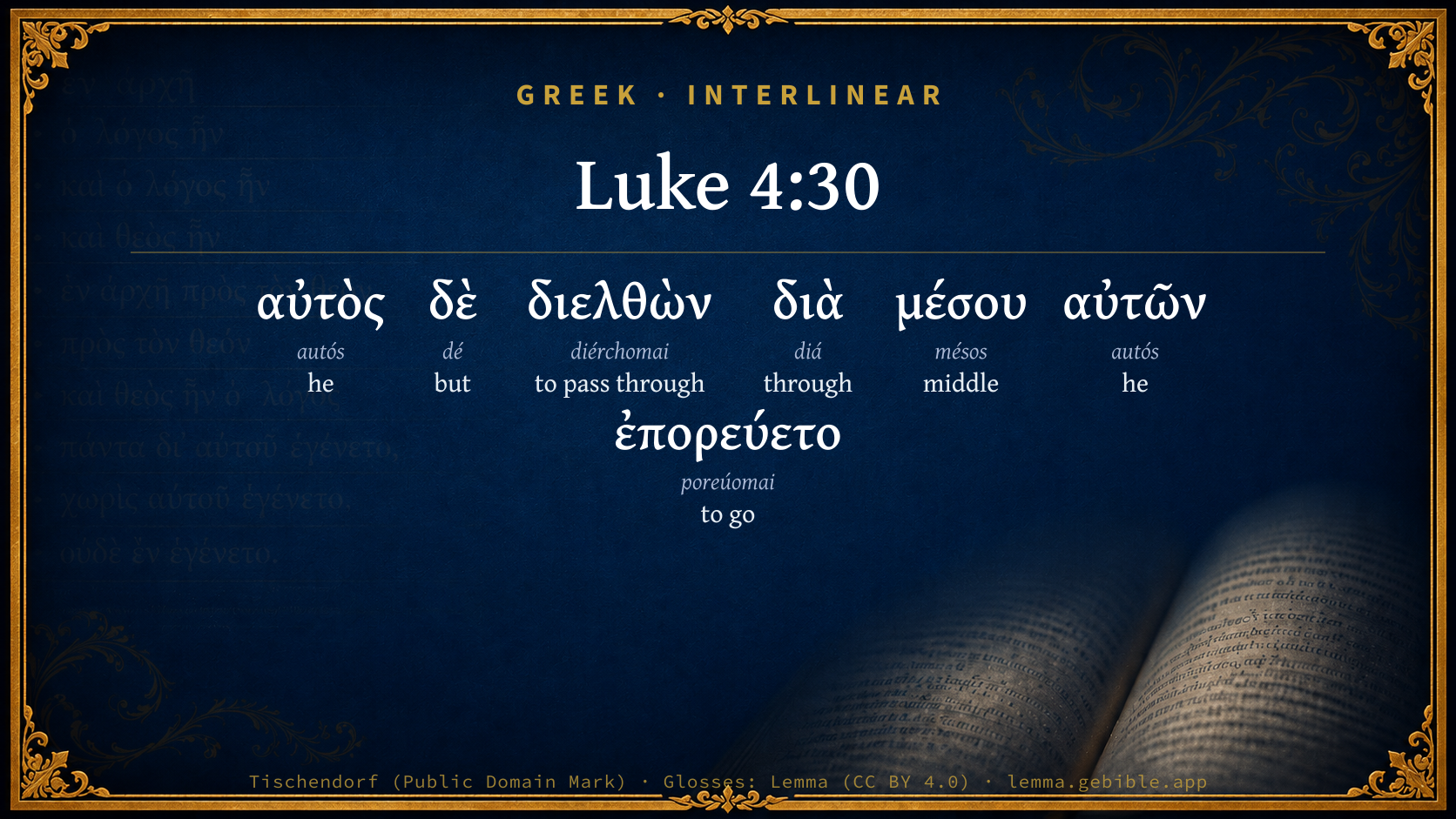
Download image
Cite this verse

Luke 4:30 (World English Bible). Public Domain. Lemma interlinear Bible study tool, https://lemma.gebible.app/v/luke/4/30.

Show BibTeX & RIS
BibTeX
RIS
English Translation
But he, passing through the midst of them, went his way.
World English Bible · Public Domain
Download a study sheet

One document with this verse’s original text, its word-by-word gloss line, the meaning frame, cross-references with their text, attributed commentary, and full source and license credits — printable, and it pastes into notes with its structure intact.

This verse Autodidact and up

Study sheet (.html) Plain text (.txt)

A passage Seminary Student

Up to 50 verses in one chapter. A passage sheet keeps up to 6 commentary sources and 12 cross-references per verse, in the order this page ranks them, and says so on the sheet whenever that leaves anything out. Ask for a single verse and you get the Autodidact verse sheet above.

Everything on this page stays free to read, with no account — the sheet is a download of what is already on screen, not access to it.

Want to remove ads? Support Godless Engineer
Compare translations 3

The same verse in 3 English versions, stacked beneath the original-language interlinear above. Click any original word for its lexicon entry.

Each is an independent rendering of the whole verse — the interlinear is not word-aligned to these translations.

Highlighted words mark where these versions differ — a whole-verse word diff, not a word-by-word alignment.

  • World English Bible Public Domain
    But he, passing through the midst of them, went his way.
  • King James Version Public Domain
    But he passing through the midst of them went his way,
  • unfoldingWord Literal Text CC BY-SA 4.0
    But he, passing through the midst of them, went on his way.

unfoldingWord Literal Text — © unfoldingWord, licensed CC BY-SA 4.0. Word-aligned USFM3 via Door43 (git.door43.org/unfoldingWord/en_ult).

Versions to compare (up to 4)

3 of 4 selected

Show all 19 translations

Every available English version of this verse, each an independent rendering of the whole verse.

  • World English Bible Public Domain
    But he, passing through the midst of them, went his way.
  • Berean Standard Bible Public Domain
    But Jesus passed through the crowd and went on His way.
  • Majority Standard Bible Public Domain
    But Jesus passed through the crowd and went on His way.
  • King James Version Public Domain
    But he passing through the midst of them went his way,
  • American Standard Version (1901) Public Domain
    But he passing through the midst of them went his way.
  • Revised Version (1885) Public Domain
    But he passing through the midst of them went his way.
  • Geneva Bible (1599) Public Domain
    But he passed through the middes of them, and went his way,
  • Douay-Rheims (1899) Public Domain
    But he passing through the midst of them, went his way.
  • Young's Literal Translation Public Domain
    and he, having gone through the midst of them, went away.
  • Literal Standard Version CC BY-SA 4.0
    and He, having gone through the midst of them, went away.
  • Unlocked Literal Bible CC BY-SA 4.0
    But he passed through the middle of them and he went to another place.
  • unfoldingWord Literal Text CC BY-SA 4.0
    But he, passing through the midst of them, went on his way.
  • Darby Bible Public Domain
    but *he*, passing through the midst of them, went his way,
  • World Messianic Bible Public Domain
    But he, passing through the middle of them, went his way.
  • Webster's Bible Public Domain
    But he passing through the midst of them, went away,
  • Free Bible Version CC BY-SA 4.0
    But he walked right through them and went on his way.
  • Bible in Basic English Public Domain
    But he came through them and went on his way.
  • Text-Critical English NT CC BY 4.0
    But Jesus passed through the crowd and went away.
  • Tyndale New Testament (1534) Public Domain
    But he went his waye even thorow the myddes of them:

Literal Standard Version (2020), Covenant Press — licensed CC BY-SA 4.0. Text via the HelloAO Bible API (eBible.org). Unlocked Literal Bible (unfoldingWord) — licensed CC BY-SA 4.0. Text via the HelloAO Bible API (eBible.org). unfoldingWord Literal Text — © unfoldingWord, licensed CC BY-SA 4.0. Word-aligned USFM3 via Door43 (git.door43.org/unfoldingWord/en_ult). Free Bible Version, Dr. Jonathan Gallagher — licensed CC BY-SA 4.0. Text via the HelloAO Bible API (eBible.org).

Word by word

More ways to search: Search by grammar → Find every occurrence → Compare this word →

Practice this passage: Drill this verse → Learn its vocabulary →

διελθὼν
diérchomai
G1330
“to pass through”
Verb, Aorist, Active, Participle, Nominative, Singular, Masculine
Part of Speech
Verb
Tense
Aorist
Voice
Active
Mood
Participle
Case
Nominative
Number
Singular
Gender
Masculine
Full Thayer's Definition

Origin: from G1223 and G2064

TDNT: 13:16,3

1. to go through, pass through a. to go, walk, journey, pass through a place b. to travel the road which leads through a place, go, pass, travel through a region 2. to go different places a. of people, to go abroad b. of a report, to spread, go abroad
  1. αὐτὸς autós G846 “he” Personal pronoun, Nominative, Singular, Masculine
  2. δὲ dé G1161 “but” Conjunction
  3. διὰ diá G1223 “through” Preposition
  4. μέσου mésos G3319 “middle” Adjective, Genitive, Singular, Neuter
  5. αὐτῶν autós G846 “he” Personal pronoun, Genitive, Plural, Masculine
  6. ἐπορεύετο poreúomai G4198 “to go” Verb, Imperfect, Middle or Passive deponent, Indicative, 3rd person, Singular

About this verse

These counts appear in no published source. They are computed here, from the morphology-tagged text and Lemma’s own curated glosses. What Lemma adds →

7
words
6
distinct lemmas
Gospels
section

Shared distinctive vocabulary

διελθὼν to pass through G1330 occurs in 40 verses of the Greek New Testament. Also found in:

Repetition

A word recurs within this verse:

  • αὐτὸς he G846 ×2

Cross-references

4

Topical passages linked to Luke 4:30 in the Treasury of Scripture Knowledge — connected by theme and wording, ordered by reader-vote popularity; previews shown in the World English Bible.

  • John 10:39 They sought again to seize him, and he went out of their hand.
  • John 8:59 Therefore they took up stones to throw at him, but Jesus was hidden, and went out of the temple, having gone through the midst of them, and so passed by.
  • John 18:6–7 When therefore he said to them, "I AM," they went backward, and fell to the ground.
  • Acts 12:18 Now as soon as it was day, there was no small stir among the soldiers about what had become of Peter.

Cross-references courtesy of OpenBible.info (CC BY 4.0).

Commentary

Notes on Luke 4:30 from classic Christian and Jewish commentators (each source and its license shown beneath its notes). The classic Christian expositions comment on the surrounding passage and are grouped to its opening verse, so a note may address several verses; the Jewish commentaries on the Tanakh (Rashi and others) are per-verse, so they appear only where the commentator wrote on this verse.

Lemma curates 59 commentaries, every one of them public domain or Creative Commons licensed, each selected and text-cleaned for this edition rather than reprinted as found. About our sources →

Tyndale Open Study Notes

Tyndale Open Resources

4:30 he passed right through the crowd: The main emphasis is on the sovereign majesty of Jesus. His time had not yet come (cp. John 7:30, 44; 8:20, 59). This attempt to kill Jesus anticipated his crucifixion, so his escape foreshadows his resurrection.

Tyndale Open Study Notes — © Tyndale Open Resources, licensed CC BY-SA 4.0. Text via the HelloAO Bible API.

Bengel's Gnomon

Johann Albrecht Bengel

Luk 4:30. Ἐπορεύετο, He went His way) unimpeded as before.

Bengel's Gnomon of the New Testament — English translation (T&T Clark, Edinburgh, 1860) — public domain. Text from a community e-Sword module.

Meyer's Critical & Exegetical Commentary

Heinrich August Wilhelm Meyer

Luk_4:30. Αὐτὸς δέ] But He, on His part, while they thus dealt with Him.

διὰ μέσου] emphatically: passed through the midst of them. According to Paulus, it was sufficient for this, that a man of the look and mien of Jesus should turn round with determination in the face of such a mobile vulgus. Comp. Lange, L. J. II. p. 548: an effect of His personal majesty; and III. p. 376: a mysterious something in His nature. Comp. Bleek. According to Schenkel, the whole attempt on the person of Jesus is only a later tradition. On the other hand, the old commentators have: φρουρούμενος τῇ ἡνωμένῃ αὐτῷ θεότητι, Euthymius Zigabenus; comp. Ambrosius, in addition to which it has been further supposed that He became invisible (Grotius and others). The latter view is altogether inappropriate, if only on account of διὰ μέσου αὐτ. But certainly there is implied a restraint of his enemies which was miraculous and dependent on the will of Jesus. It is otherwise in Joh_8:59 (ἐκρύβη). Why Jesus did not surrender Himself is rightly pointed out by Theophylact: οὐ τὸ παθεῖν φεύγων, ἀλλὰ τὸν καιρὸν ἀναμένων.

ἐπορεύετο] went on, that is to say, towards Capernaum, Luk_4:31, and therefore not back again to Nazareth as has been harmonistically pretended.

Meyer — Critical and Exegetical Commentary on the New Testament — English translation by Peter Christie, edited by Frederick Crombie (T&T Clark, 1880) — public domain. Text from a community e-Sword module.

Expositor's Greek Testament

ed. W. Robertson Nicoll

Luk 4:30 . αὐτὸς δὲ , but He , emphatic, suggesting a contrast: they infuriated, He calm and self-possessed. διελθὼν : no miracle intended, but only the marvel of the power always exerted by a tranquil spirit and firm will over human passions.

The Expositor's Greek Testament, edited by W. Robertson Nicoll (1897–1910) — public domain. Text from a community e-Sword module.

Jamieson, Fausset & Brown

Robert Jamieson, A. R. Fausset & David Brown

passing through the midst, &c.--evidently in a miraculous way, though perhaps quite noiselessly, leading them to wonder afterwards what spell could have come over them, that they allowed Him to escape. (Similar escapes, however, in times of persecution, are not unexampled.)

Jamieson, Fausset & Brown — Commentary Critical and Explanatory on the Whole Bible (1871) — public domain (CC PDM 1.0). Text via the HelloAO Bible API.

Adam Clarke's Commentary

Verse 30. Passing through the midst of them] Either he shut their eyes so that they could not see him; or he so overawed them by his power as to leave them no strength to perform their murderous purpose. The man Christ Jesus was immortal till his time came; and all his messengers are immortal till their work is done.

The following relation of a fact presents a scene something similar to what I suppose passed on this occasion: A missionary, who had been sent to a strange land to proclaim the Gospel of the kingdom of God, and who had passed through many hardships, and was often in danger of losing his life, through the persecutions excited against him, came to a place where he had often before, at no small risk, preached Christ crucified. About fifty people, who had received good impressions from the word of God, assembled: he began his discourse; and, after he had preached about thirty minutes, an outrageous mob surrounded the house, armed with different instruments of death, and breathing the most sanguinary purposes. Some that were within shut the door; and the missionary and his flock betook themselves to prayer. The mob assailed the house, and began to hurl stones against the walls, windows, and roof; and in a short time almost every tile was destroyed, and the roof nearly uncovered, and before they quitted the premises scarcely left one square inch of glass in the five windows by which the house was enlightened. While this was going forward, a person came with a pistol to the window opposite to the place where the preacher stood, (who was then exhorting his flock to be steady, to resign themselves to God, and trust in him,) presented it at him, and snapped it; but it only flashed in the pan! As the house was a wooden building, they began with crows and spades to undermine it, and take away its principal supports. The preacher then addressed his little flock to this effect: "These outrageous people seek not you, but me; if I continue in the house, they will soon pull it down, and we shall be all buried in its ruins; I will therefore, in the name of God, go out to them, and you will be safe." He then went towards the door; the poor people got round him, and entreated him not to venture out, as he might expect to be instantly massacred; he went calmly forward, opened the door, at which a whole volley of stones and dirt was that instant discharged; but he received no damage. The people were in crowds in all the space before the door, and filled the road for a considerable way, so that there was no room to pass or repass. As soon as the preacher made his appearance, the savages became instantly as silent and as still as night: he walked forward; and they divided to the right and to the left, leaving a passage of about four feet wide for himself and a young man who followed him, to walk in. He passed on through the whole crowd, not a soul of whom either lifted a hand, or spoke one word, till he and his companion had gained the uttermost skirts of the mob! The narrator, who was present on the occasion, goes on to say: "This was one of the most affecting spectacles I ever witnessed; an infuriated mob, without any visible cause, (for the preacher spoke not one word,) became in a moment as calm as lambs! They seemed struck with amazement bordering on stupefaction; they stared and stood speechless; and, after they had fallen back to right and left to leave him a free passage, they were as motionless as statues! They assembled with the full purpose to destroy the man who came to show them the way of salvation; but he, passing through the midst of them, went his way. Was not the God of missionaries in this work? The next Lord's day, the missionary went to the same place, and again proclaimed the Lamb of God, who taketh away the sin of the world!"

Adam Clarke's Commentary on the Bible (1810–1826) — public domain. Text from a community e-Sword/MySword module.

Ellicott's Commentary for English Readers

(30) He passing through the midst of them.—The words do not necessarily involve a directly supernatural deliverance, as though the multitude had been smitten with blindness, or our Lord had become invisible. We have no right to insert miracles in the Gospel records. Calmness, silence, the moral power of self-possessed righteousness have in themselves a power, often proved, to baffle the fury of an angry mob.

A Bible Commentary for English Readers, edited by Charles John Ellicott (1878–1897) — public domain. Text from a community e-Sword module.

The Cambridge Bible for Schools and Colleges

gen. ed. J. J. S. Perowne

30. passing through the midst of them] This is rather a mirabile than a miraculum, since no miracle is asserted or necessarily implied. The inherent majesty and dignity of our Lord’s calm ascendency, seem to have been sufficient on several occasions to overawe and cow His enemies; Joh_7:30; Joh_7:46; Joh_8:59; Joh_10:39-40; Joh_18:6 (see Psa_18:29; Psa_37:33).

went his way] Probably never to return again. Nazareth lies in a secluded valley out of the ordinary route between Gennesareth and Jerusalem. If after thirty sinless years among them they could reject Him, clearly they had not known the day of their visitation. It is the most striking illustration of St John’s sad comment, “He came unto His own possessions (τὰ ἴδια) and His own people (οἱ ἴδιοι) received Him not” (Joh_1:11).

The Cambridge Bible for Schools and Colleges (gen. ed. J. J. S. Perowne; Cambridge University Press, 1878–1918) — public domain. Text from a community e-Sword module.

John Gill's Exposition

But he passing through the midst of them,.... Either in so strong and powerful a manner, and with so much swiftness, that being once out of their hands, they could not lay hold on him again; or else he put on another form, or made himself invisible to them; or he held their eyes that they could not see him, or know him, as in Luk 24:16 however it was, he made use of, and showed his divine power; and which he did, because his time to die was not yet come, nor was he to die such a death: and this also shows, that when he did die, he laid down his life freely and voluntarily, since he could then have exerted his power, and delivered himself out of the hands of his enemies, as now: and

went his way; from Nazareth elsewhere; nor do we read of his returning there any more.

John Gill's Exposition of the Whole Bible (1746–1763) — public domain (CC PDM 1.0). Text via the HelloAO Bible API.

Trapp's Complete Commentary

John Trapp

30 But he passing through the midst of them went his way,

Ver. 30. But he passing, &c.] Like a second Samson; his own arm saved him. This might have convinced his adversaries, except they were mad with malice.

John Trapp, A Commentary or Exposition upon All the Books of the Old and New Testament (1647–1656) — public domain. Text from a community e-Sword module.

Albert Barnes' Notes on the Bible

Passing through the midst of, them, went his way - This escape was very remarkable. It is remarkable that he should escape out of their hands when their very object was to destroy him, and that he should escape in so peaceful a manner, without violence or conflict. A similar case is recorded in Joh 8:59. There are but two ways of accounting for this:

That “other Nazarenes,” who had not been present in the synagogue, heard what was doing and came to rescue him, and in the contest that rose between the two parties Jesus silently escaped. More probably that Jesus by divine power, by the force of a word or look, stilled their passions, arrested their purposes, and passed silently through them. That he “had” such a power over the spirits of people we learn from the occurrence in Gethsemane, when he said, “I am he; and they went backward and fell to the ground,” Joh 18:6.

Albert Barnes' Notes on the Bible (1834–1885) — public domain. Text from a community e-Sword/MySword module.

Haydock's Catholic Bible Commentary

Passing through the midst of them, went his way. Perhaps by making himself on a sudden invisible, or by striking them with blindness, or by changing their minds, and hearts, as he pleased. (Witham) --- All commentators observe on these words, that the evangelist wished to shew that Christ worked a miracle on this occasion, and by it proved his divinity. This is the opinion of Sts. Euthymius, Ambrose, and Thomas Aquinas. St. Ambrose says, we must observe that Christ did not suffer from necessity, but because he wished it. He was not taken by the Jews, but delivered up himself; at his own pleasure he is seized, and at his own pleasure he escapes; when he wills it, he is condemned; and when he wills it, he is freed. The most common opinion is, that he rendered himself invisible on this occasion; though others imagine that he changed their wills, or withheld their hands. (Maldonatus) --- When we observe the outrageous treatment Jesus Christ met with from the hands of the people of Nazareth, we are not surprised that he should shut up the fountain of his beneficence against them for their incredulity, and return to Capharnaum. (Haydock)

George Leo Haydock (1774–1849), Haydock's Catholic Family Bible and Commentary, 1859 edition — public domain. Excludes Psalms (Douay-Rheims chapter numbering differs from Protestant) and Deuterocanonical books (Catholic canon only).

Whedon's Commentary on the Bible

Daniel D. Whedon

30. Passing through the midst of them—Of course the mob was ahead of him. But at the moment in which he chose to escape, wonderful was the ease with which he passed through the crowd, who seem to have parted right and left, as if they meant to escort rather than to murder him. The question is raised whether this critical escape, and other similar instances, were miraculous, (Joh_8:59; Joh_18:6.) That they were not, the parallels of Caius Marius and others are adduced, where the awe of the person assailed has unmanned and defeated the assailants. But, perhaps, the clearest parallel to this present escape may be found in Stevens’s History of Methodism, vol. i, p. 195. Wesley, assailed by a Cornish mob, is nearly thrown to the ground, whence he would never have risen alive. Struck with a blow upon the chest, so that the blood gushes out of his mouth, he yet maintains a composure superior to pain, and perfect as if in the quiet of his study. Amid his utterance of prayer and their clamours for his life, a strange and sudden reaction takes place. A call is made for a fair hearing, and the very leader of the mob, awe-struck, becomes all at once his defender. And then, in language strongly reminding us (though it did not the historian himself) of the present scene, it is added, “The people fell back, as if by common consent, and led on through their open ranks by the champion of the rabble, he safely escaped to his lodgings.” Whether this was miraculous or not may be a question of degree, not of kind. Who can tell at what point the natural awe-inspiring power of great or sacred character rises to a supernatural amount?

Daniel D. Whedon (gen. ed.), Commentary on the Old and New Testaments (1874–1909) — public domain. Text from a community e-Sword module.

The Pulpit Commentary

But he passing through the midst of them went his way. Not necessarily a miracle. There is nothing hinted here that our Lord rendered himself invisible, or that he smote his enemies with a temporary blindness. He probably quietly overawed these angry men with his calm self-possession, so that they forbore their cruel purpose, and thus he passed through their midst, and left Nazareth as far as we know forever. The foregoing is probably the same visit very briefly alluded to by St. Matthew (Mat_13:54-58) and by St. Mark, (Mar_6:1-6) in both Gospels related in unchronological order. Most likely they were aware of the incident, but ignorant of the exact place it held among the early events of the Master"s life. St. Luke, who gives it with far greater detail, inserts it evidently in its right place. Is it not at least probable that St. Luke derived his accurate knowledge of this Nazareth incident from Mary, or from some of her intimate circle, from whom he procured the information which he embodied in the earlier chapters of his Gospel? She, and others of her friends, would be likely to have preserved some accurate memories of this painful visit of Jesus to his old home.

The Pulpit Commentary (1880–1919), ed. H.D.M. Spence-Jones & Joseph S. Exell — public domain. Text from a community e-Sword module.

John Wesley's Explanatory Notes

Passing through the midst of them - Perhaps invisibly; or perhaps they were overawed; so that though they saw, they could not touch him.

John Wesley, Explanatory Notes Upon the Whole Bible (1754–1765) — public domain. Text via the GEBible commentary corpus.

Cambridge Greek Testament for Schools and Colleges

30. διελθὼν διὰ μέσου αὐτῶν. This is rather a mirabile than a miraculum, since no miracle is asserted or necessarily implied. The inherent majesty and dignity of our Lord’s calm ascendency, seem to have been sufficient on several occasions to overawe and cow His enemies; Joh 7:30; Joh 7:46; Joh 8:59; Joh 10:39-40; Joh 18:6 (see Psa 18:29; Psa 37:33). He left them this proof of His ascendency. As Theophylact points out, this was οὐ τὸ παθεῖν φεύγων, ἀλλὰ τὸν καιρὸν ἀναμένων.

ἐπορεύετο. Probably never to return again. Nazareth lies in a secluded valley out of the ordinary route between Gennesareth and Jerusalem. If after thirty sinless years among them they could reject Him, clearly they had not known the day of their visitation. This incident furnishes the most striking illustration of St John’s sad comment, “He came unto His own possessions (τὰ ἴδια) and His own people (οἱ ἴδιοι) received Him not” (Joh 1:11).

Cambridge Greek Testament for Schools and Colleges (Cambridge University Press, 1896; 21 vols, various authors incl. Carr, Maclear, Plummer, Farrar, Lumby, Moule, M. R. James, Simcox) — public domain. Text from a community e-Sword module.

International Critical Commentary

30. αὐτὸς δὲ διελθὼν διὰ μέσου αὐτῶν ἐπορεύετο. “But He (in contrast to this attempt), after passing through the midst of them, went His way.” The addition of διὰ μέσου is for emphasis, and seems to imply that there was something miraculous in His passing through the very midst of those who were intending to slay Him, and seemed to have Him entirely in their power. They had asked for a miracle, and this was the miracle granted to them. Those who think that it was His determined look or personal majesty which saved Him, have to explain why this did not prevent them from casting Him out of the synagogue.1 It seems better with Mever and ancient commentators to understand a miracle dependent on the will of Jesus: comp. Joh 18:6; Dan 6:22; In. Joh 8:59 is different: then Jesus hid Himself before escaping. For διελθών see on 2:15.

ἐπορεύετο. Here used in its common signification of going on towards a goal: “He went His way” to Capernaum. And, so far as we know, He did not return to Nazareth. It had become a typical example of “His own people receiving Him not” (Joh 1:11); and apparently it had no other opportunity (but see Edersh. L. & T. 1. ch. xxvii.). If Mar 6:1-6 and Mat 13:53-58 refer to a different occasion, it probably preceded this. After the attempt on His life He would not be likely to return; and, if He did return, they could hardly, after this experience of Him, ask, “Whence has this man this wisdom?” or be astonished at His teaching.

Meyer (on Mat 13:53), Wieseler (Chron. Syn, iii. 2, Eng. tr. p. 258), Godet (l.c., Eng. tr. i. p. 240), Tischendorf (Synop. Evan. §§29, 54), and others distinguish the two occasions. If with Caspari (Chron. Int. § 100) we identify them, then Lk. is the more full and vivid, for the others omit the text of the discourse and the attempt to kill Him. In this case Strauss maybe right mi sup)sing that Lk. has placed the incident at the beginning of the ministry, although it took place later, because he saw how typical it was of the ministry as a whole (Leben Jesu, p. 121, 1864). That it was this attempt on His life which made Christ change His abode from Nazareth to Capernaurm is contradicted by ver. 16. “Where He had been brought up” implies that He had ceased to reside there: and from ver. 23 we infer that Capernaurn had already become His headquarters. Thither His Mother and brethren had also moved, while His sisters remained at Nazareth (Mat 13:56; Mar 6:3), very probably because they had married there.

International Critical Commentary — older volumes (1896–1929), various authors — public domain. Text from a community e-Sword module.

Lesson kit

Teaching starters — assembled from the data on this page, not authored interpretation. Every prompt links to the verse data it draws on. Edit before teaching.

Luke, in the Gospels, opens this verse with 7 words (6 distinct Greek lemmas). Its most distinctive word is diérchomai (“to pass through”). A historical commentator’s framing appears above. Read the whole chapter for the surrounding context.

Discussion questions

  1. The word diérchomai carries the sense “to pass through.” How does it shape the verse?
  2. Matthew 12:43 shares the word «to pass through» with this verse. How do the two illuminate each other?
  3. “he” occurs 2× in this one verse. What is the effect of the repetition?
  4. Reading how Tyndale Open Study Notes and Bengel's Gnomon read this verse, where do the two commentators agree and where do they part?

Things to notice

Reading settings

Reading text

Shown beneath each verse's original-language words.

Old Testament
Old Testament edition

Read the OT as the Masoretic Hebrew (MT) or the Greek Septuagint (LXX).

English shown for the Greek Septuagint (in the Hebrew ↔ Greek comparison).

Comparing translations? Open the Compare panel on any verse page to stack up to four side by side.