
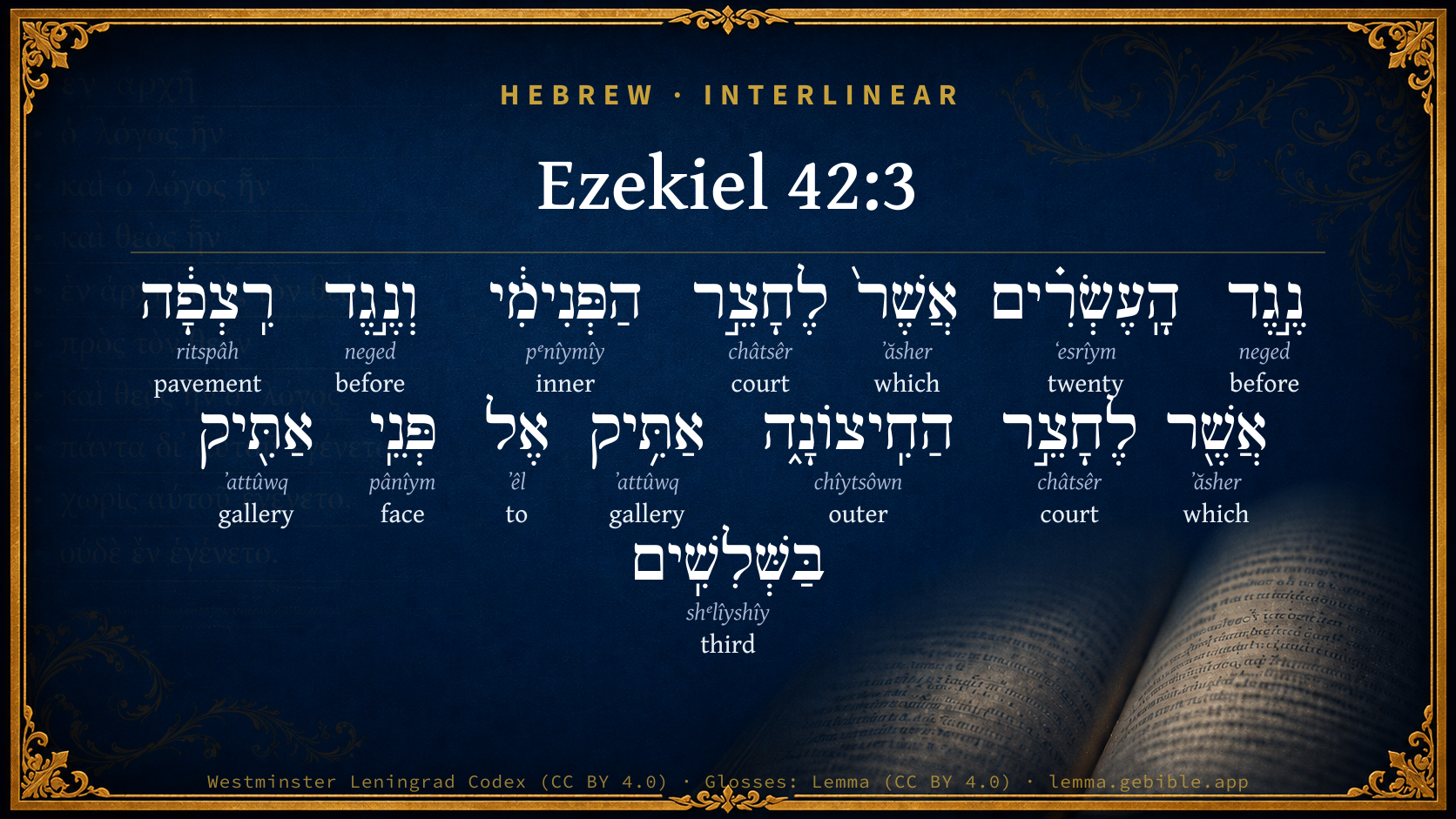
Ezekiel 42:3

Hebrew (Westminster Leningrad Codex) Ezekiel 42:3 appears in the Hebrew Old Testament. The text above is from the Westminster Leningrad Codex. Each word links to its Strong’s number, a concise gloss, and parsing drawn from the Open Scriptures Hebrew Bible morphology. Click any word for its full Brown-Driver-Briggs (BDB) entry.
Download image
Cite this verse

Ezekiel 42:3 (World English Bible). Public Domain. Lemma interlinear Bible study tool, https://lemma.gebible.app/v/ezekiel/42/3.

Show BibTeX & RIS
BibTeX
RIS
English Translation
Over against the twenty [cubits] which belonged to the inner court, and over against the pavement which belonged to the outer court, was gallery against gallery in the third story.
World English Bible · Public Domain
Download a study sheet

One document with this verse’s original text, its word-by-word gloss line, the meaning frame, cross-references with their text, attributed commentary, and full source and license credits — printable, and it pastes into notes with its structure intact.

This verse Autodidact and up

Study sheet (.html) Plain text (.txt)

A passage Seminary Student

Up to 50 verses in one chapter. A passage sheet keeps up to 6 commentary sources and 12 cross-references per verse, in the order this page ranks them, and says so on the sheet whenever that leaves anything out. Ask for a single verse and you get the Autodidact verse sheet above.

Everything on this page stays free to read, with no account — the sheet is a download of what is already on screen, not access to it.

Want to remove ads? Support Godless Engineer
Compare translations 3

The same verse in 3 English versions, stacked beneath the original-language interlinear above. Click any original word for its lexicon entry.

Each is an independent rendering of the whole verse — the interlinear is not word-aligned to these translations.

Highlighted words mark where these versions differ — a whole-verse word diff, not a word-by-word alignment.

  • World English Bible Public Domain
    Over against the twenty [cubits] which belonged to the inner court, and over against the pavement which belonged to the outer court, was gallery against gallery in the third story.
  • King James Version Public Domain
    Over against the twenty cubits which were for the inner court, and over against the pavement which was for the utter court, was gallery against gallery in three stories.
  • unfoldingWord Literal Text CC BY-SA 4.0
    Some of those rooms faced the inner courtyard and were twenty cubits away from the sanctuary. There were three levels of rooms, and the ones above looked down on the ones below and were open to them, having a walkway. Some of the rooms looked out onto the outer courtyard.

unfoldingWord Literal Text — © unfoldingWord, licensed CC BY-SA 4.0. Word-aligned USFM3 via Door43 (git.door43.org/unfoldingWord/en_ult).

Versions to compare (up to 4)

3 of 4 selected

Show all 18 translations

Every available English version of this verse, each an independent rendering of the whole verse.

  • World English Bible Public Domain
    Over against the twenty [cubits] which belonged to the inner court, and over against the pavement which belonged to the outer court, was gallery against gallery in the third story.
  • Berean Standard Bible Public Domain
    Gallery faced gallery in three levels opposite the twenty cubits that belonged to the inner court and opposite the pavement that belonged to the outer court.
  • Majority Standard Bible Public Domain
    Gallery faced gallery in three levels opposite the twenty cubits that belonged to the inner court and opposite the pavement that belonged to the outer court.
  • King James Version Public Domain
    Over against the twenty cubits which were for the inner court, and over against the pavement which was for the utter court, was gallery against gallery in three stories.
  • American Standard Version (1901) Public Domain
    Over against the twenty `cubits' which belonged to the inner court, and over against the pavement which belonged to the outer court, was gallery against gallery in the third story.
  • Revised Version (1885) Public Domain
    Over against the twenty cubits which belonged to the inner court, and over against the pavement which belonged to the outer court, was gallery against gallery in the third story.
  • Geneva Bible (1599) Public Domain
    Ouer against the twentie cubites which were for the inner court, and ouer against the pauement, which was for the vtter court, was chamber against chamber in three rowes.
  • Douay-Rheims (1899) Public Domain
    Over against the twenty cubits of the inner court, and over against the pavement of the outward court that was paved with stone, where there was a gallery joined to a triple gallery.
  • Young's Literal Translation Public Domain
    Over-against the twenty `cubits' that are to the inner court, and over-against the pavement that `is' to the outer court, `is' gallery over-against gallery, in the three `storeys'.
  • Literal Standard Version CC BY-SA 4.0
    Opposite the twenty [cubits] that are of the inner court, and opposite the pavement that [is] of the outer court, [is] gallery [with] face toward gallery, in the three [stories].
  • Unlocked Literal Bible CC BY-SA 4.0
    Some of those rooms faced the inner courtyard and were twenty cubits away from the sanctuary. There were three levels of rooms, and the ones above looked down on the ones below and were open to them, having a walkway. Some of the rooms looked out onto the outer courtyard.
  • unfoldingWord Literal Text CC BY-SA 4.0
    Some of those rooms faced the inner courtyard and were twenty cubits away from the sanctuary. There were three levels of rooms, and the ones above looked down on the ones below and were open to them, having a walkway. Some of the rooms looked out onto the outer courtyard.
  • Darby Bible Public Domain
    over against the twenty [cubits] that pertained to the inner court, and over against the pavement that pertained to the outer court; there was gallery against gallery in the third [story];
  • World Messianic Bible Public Domain
    Opposite the twenty cubits which belonged to the inner court, and opposite the pavement which belonged to the outer court, was gallery against gallery in the three stories.
  • Webster's Bible Public Domain
    Over against the twenty cubits which were for the inner court, and over against the pavement which was for the outer court, was gallery against gallery in three stories.
  • Free Bible Version CC BY-SA 4.0
    It had three floors of open halls on both sides, one facing the twenty-cubit area of the inner courtyard and one facing the pavement of the outer courtyard.
  • Bible in Basic English Public Domain
    Opposite the space of twenty cubits which was part of the inner square, and opposite the stone floor of the outer square. There were covered ways facing one another on the third floor.
  • JPS Tanakh (1917) Public Domain
    over against the twenty cubits which belonged to the inner court, and over against the pavement which belonged to the outer court; with gallery against gallery in three stories.

Literal Standard Version (2020), Covenant Press — licensed CC BY-SA 4.0. Text via the HelloAO Bible API (eBible.org). Unlocked Literal Bible (unfoldingWord) — licensed CC BY-SA 4.0. Text via the HelloAO Bible API (eBible.org). unfoldingWord Literal Text — © unfoldingWord, licensed CC BY-SA 4.0. Word-aligned USFM3 via Door43 (git.door43.org/unfoldingWord/en_ult). Free Bible Version, Dr. Jonathan Gallagher — licensed CC BY-SA 4.0. Text via the HelloAO Bible API (eBible.org).

Word by word

More ways to search: Search by grammar → Find every occurrence → Compare this word →

Practice this passage: Drill this verse → Learn its vocabulary →

אַתִּ֥יק
ʼattûwq
H862
“gallery”
Noun, Common, Masculine, Singular, Absolute
Part of Speech
Noun
Type
Common
Gender
Masculine
Number
Singular
State
Absolute
Full BDB Definition

Origin: from H5423 in the sense of decreasing

TWOT: 191a

gallery, porch
  1. נֶ֣גֶד neged H5048 “before” Preposition
  2. הָֽעֶשְׂרִ֗ים ʻesrîym H6242 “the · twenty” Particle, Definite Article + Adjective, Cardinal number, Both, Plural, Absolute
  3. אֲשֶׁר֙ ʼăsher H834 “which” Particle, Relative
  4. לֶחָצֵ֣ר châtsêr H2691 “to/for the · court” Preposition, Determined + Noun, Common, Both, Singular, Absolute
  5. הַפְּנִימִ֔י pᵉnîymîy H6442 “the · inner” Particle, Definite Article + Adjective, Adjective, Masculine, Singular, Absolute
  6. וְנֶ֣גֶד neged H5048 “and · before” Conjunction + Preposition
  7. רִֽצְפָ֔ה ritspâh H7531 “pavement” Noun, Common, Feminine, Singular, Absolute
  8. אֲשֶׁ֖ר ʼăsher H834 “which” Particle, Relative
  9. לֶחָצֵ֣ר châtsêr H2691 “to/for the · court” Preposition, Determined + Noun, Common, Both, Singular, Absolute
  10. הַחִֽיצוֹנָ֑ה chîytsôwn H2435 “the · outer” Particle, Definite Article + Adjective, Adjective, Feminine, Singular, Absolute
  11. אֶל ʼêl H413 “to” Preposition
  12. פְּנֵֽי pânîym H6440 “face(s) of” Noun, Common, Both, Plural, Construct
  13. אַתִּ֖יק ʼattûwq H862 “gallery” Noun, Common, Masculine, Singular, Absolute
  14. בַּשְּׁלִשִֽׁים shᵉlîyshîy H7992 “in/at the · third” Preposition, Determined + Adjective, Ordinal number, Masculine, Plural, Absolute

About this verse

These counts appear in no published source. They are computed here, from the morphology-tagged text and Lemma’s own curated glosses. What Lemma adds →

15
words
11
distinct lemmas
Prophets
section

Notable vocabulary

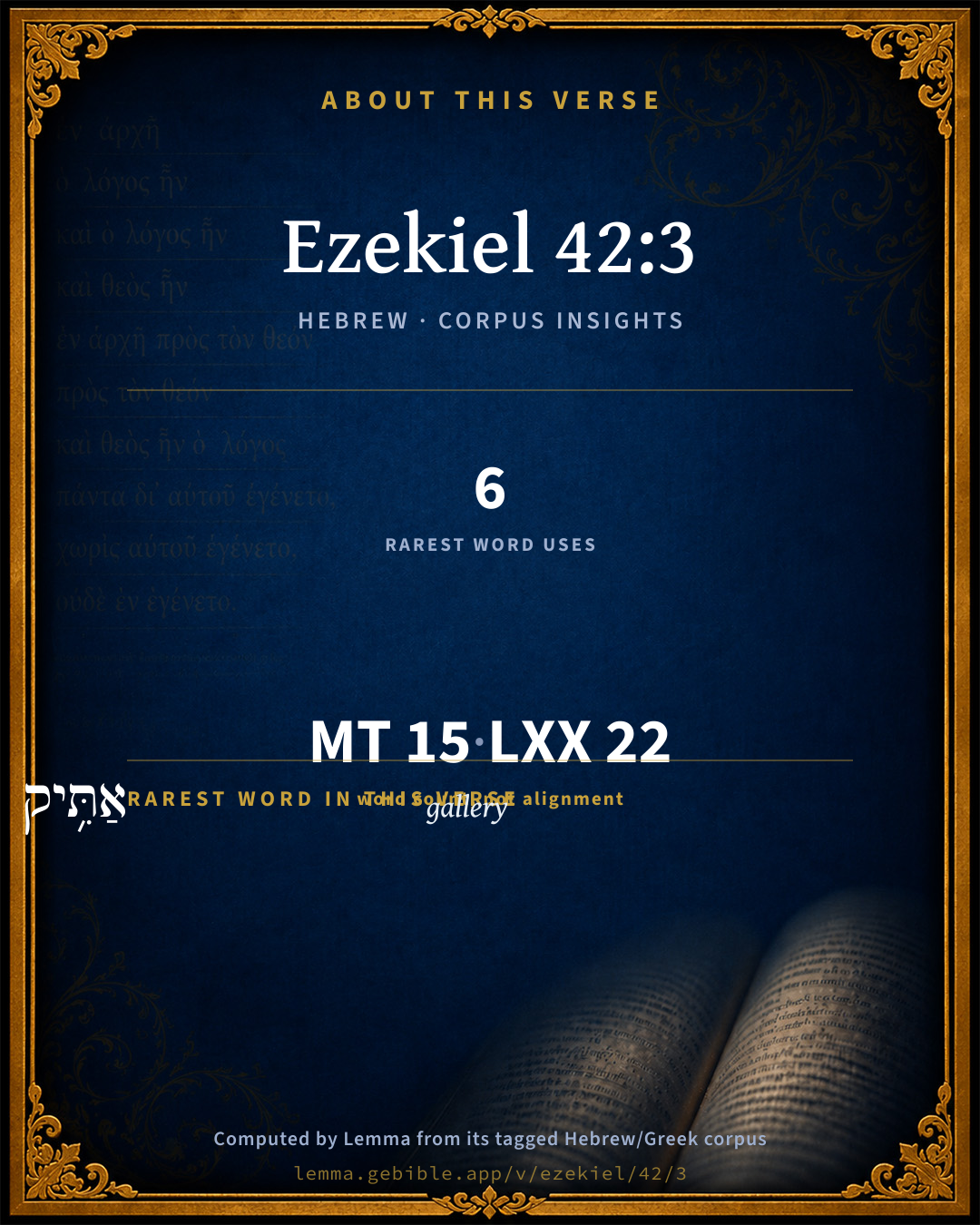
The rarest word here is אַתִּ֥יק gallery H862 — appearing just 6 times in the whole Hebrew Bible.

Shared distinctive vocabulary

אַתִּ֥יק gallery H862 occurs in 4 verses of the Hebrew Bible. Also found in:

Grammatical profile

  • 6 nouns
  • 4 adjectives
  • 3 prepositions
  • 2 particles

Repetition

Words recur within this verse — often emphatic in Hebrew:

  • נֶ֣גֶד before H5048 ×2
  • לֶחָצֵ֣ר court H2691 ×2
  • אַתִּ֥יק gallery H862 ×2
  • אֲשֶׁר֙ which H834 ×2

Hebrew & Septuagint length

In English translation the verse runs 30 words from the Hebrew and 25 from the Septuagint (LXX English) — closely comparable.

A rough comparison of the two English renderings, which tokenize alike — not a word-level alignment.

Word counts can differ between the Hebrew and the Greek without any difference in meaning — e.g. the Hebrew direct-object marker אֵת has no separate Greek word, and Greek often adds the article ὁ.

In the original languages it is 15 Hebrew tokens and 22 Greek tokens — but the two are counted differently (Hebrew bundles its prefixes and suffixes into one token; the Greek is in lemma form), so that isn’t a like-for-like length.

Cross-references

7

Topical passages linked to Ezekiel 42:3 in the Treasury of Scripture Knowledge — connected by theme and wording, ordered by reader-vote popularity; previews shown in the World English Bible.

  • Ezekiel 41:15–16 He measured the length of the building before the separate place which was at the back of it, and the galleries of it on the one side and on the other side, one hundred cubits; and the inner temple, and the porches of the court;
  • Ezekiel 41:10 Between the chambers was a breadth of twenty cubits round about the house on every side.
  • 2 Chronicles 7:3 All the children of Israel looked on, when the fire came down, and the glory of Yahweh was on the house; and they bowed themselves with their faces to the ground on the pavement, and worshiped, and gave thanks to Yahweh, [saying], For he is good; for his loving kindness endures for ever.
  • Song of Solomon 1:17 The beams of our house are cedars. Our rafters are firs. Beloved
  • Song of Solomon 7:5 Your head on you is like Carmel, The hair of your head like purple; The king is held captive in its tresses.
  • Ezekiel 40:17–18 Then brought he me into the outer court; and, behold, there were chambers and a pavement, made for the court round about: thirty chambers were on the pavement.
  • Ezekiel 42:5 Now the upper chambers were shorter; for the galleries took away from these, more than from the lower and the middle, in the building.

Cross-references courtesy of OpenBible.info (CC BY 4.0).

Hebrew and Greek witnesses Masoretic Hebrew ↔ Greek Septuagint

The same verse in the two great witnesses to the Old Testament, shown verse-for-verse.

These are two independent witnesses, not word-aligned to each other, and the Septuagint is shown in lemma (dictionary) form.

Hebrew Ezekiel 42:3 Masoretic · Westminster Leningrad Codex

נֶ֣גֶד הָֽעֶשְׂרִ֗ים אֲשֶׁר֙ לֶחָצֵ֣ר הַפְּנִימִ֔י וְנֶ֣גֶד רִֽצְפָ֔ה אֲשֶׁ֖ר לֶחָצֵ֣ר הַחִֽיצוֹנָ֑ה אַתִּ֥יק אֶל פְּנֵֽי אַתִּ֖יק בַּשְּׁלִשִֽׁים

Over against the twenty [cubits] which belonged to the inner court, and over against the pavement which belonged to the outer court, was gallery against gallery in the third story.

World English Bible · Public Domain

Greek LXX Ezekiel 42:3 Septuagint · lemma form

διαγράφω ὅς τρόπος ὁ πύλη ὁ αὐλή ὁ ἐσώτερος καί ὅς τρόπος ὁ περίστυλον ὁ αὐλή ὁ ἐξώτερος στιχίζω ἀντιπροσώπος στοά τρισσός

ornamented accordingly as the gates of the inner court, and arranged accordingly as the peristyles of the outer court, with triple porticos fronting one another.

LXX2012 (modern English Septuagint) · Public Domain

Hebrew: Westminster Leningrad Codex (CC BY 4.0). Greek: Septuagint (public domain); English from LXX2012 (modern English Septuagint) (Public Domain). How the Septuagint differs from the Hebrew →

Targum (Aramaic paraphrase)

1

The Targum is the ancient Jewish Aramaic paraphrase of the Hebrew Scriptures — an interpretive translation, not the Hebrew text itself. Onkelos (literal) and Pseudo-Jonathan (expansive) render the Torah, and Jonathan the Prophets. Coverage is partial: where no permissively-licensed English translation exists for a verse, only the Aramaic is shown. This is verse-level text, not a word-by-word alignment to the Hebrew.

  1. Targum Jonathan Prophets (Joshua–Malachi)
    לָקֳבֵל עַסְרִין דִלְדַרְתָּא גֵוַיְתָא וּקְבֵל דִלְצִפּוּנָא רִצְפָּתָא דִפְתִיחָא לְדַרְתָּא בְרַיְתָא זָוֵי לָקֳבֵל זָוֵי מְתַלְתִין:

    (no public-domain English translation for this verse)

    Targum Jonathan — Aramaic: “Mikraot Gedolot” (public domain). English: “Sefaria Community Translation” (CC0 1.0 (public-domain dedication)); “London "Chaldee Paraphrase," 1871” (public domain). Text via Sefaria.

Commentary

Notes on Ezekiel 42:3 from classic Christian and Jewish commentators (each source and its license shown beneath its notes). The classic Christian expositions comment on the surrounding passage and are grouped to its opening verse, so a note may address several verses; the Jewish commentaries on the Tanakh (Rashi and others) are per-verse, so they appear only where the commentator wrote on this verse.

Lemma curates 59 commentaries, every one of them public domain or Creative Commons licensed, each selected and text-cleaned for this edition rather than reprinted as found. About our sources →

The Cambridge Bible for Schools and Colleges

gen. ed. J. J. S. Perowne

3. The breadth of the block having been mentioned in Eze_42:2, Eze_42:3 adds in what directions this breadth extended or lay on either hand (N. and S.), viz. towards the 20 cubits of the separate place (Fig. 3, H) on the S., and toward the pavement running round the wall of the outer court (Eze_40:17) on the N. (cf. Eze_42:1), Fig. 3, B. The term “gallery” is obscure, but here it seems to mean a passage running round the chambers, in front of them, and so taking away from their area.

in three stories] More naturally: in the third story, lit. in the thirds, i.e. third chambers (Gen_6:16). What is meant by “gallery over against gallery” is rather obscure. Most naturally the galleries or gangways round the highest story would be supposed to lie towards the interior of both wings, i.e. on the “walk” of so cubits running between the wings (Fig. 3, O), because if they lay toward the outside of the wings respectively it is difficult to see how they could be said to lie “over against” or to face one another, for in that case both wings of the chambers in the third story would lie between them. It is altogether unnatural to suppose that by the second “gallery” any galleries in the chambers of the outer court on the one side, or any galleries in the structure of the house proper on the other, are referred to.

4–6 may be read: “And before the chambers was a walk of 10 cubits breadth inward, with a length of 100 cubits; and their doors were toward the north. 5 Now the upper chambers were shorter; for the galleries took away from them compared with the lower and middle (chambers) in room. 6 For they were in three stories, and they had not pillars like the pillars of those in the outer court; therefore” &c.

The Cambridge Bible for Schools and Colleges (gen. ed. J. J. S. Perowne; Cambridge University Press, 1878–1918) — public domain. Text from a community e-Sword module.

Trapp's Complete Commentary

John Trapp

Eze 42:3 Over against the twenty [cubits] which [were] for the inner court, and over against the pavement which [was] for the utter court, [was] gallery against gallery in three [stories].

Ver. 3. Which were for the inner court,] viz., Of the temple. This was a figure of the Church invisible, as the outward court, described in this chapter, was of the visible and external.

The pavement which was for the utter court.] Which might signify that those who would enter into heaven must keep themselves unspotted of the world, "undefiled in the way." {Psa 15:1-5 Psa 24:3-5}

John Trapp, A Commentary or Exposition upon All the Books of the Old and New Testament (1647–1656) — public domain. Text from a community e-Sword module.

The Biblical Illustrator

Joseph S. Exell

Eze_42:3-5

And before the chambers was a walk of ten cubits breadth inward.

Provision made in the temple for social intercourse

Before these chambers there were walks of five yards broad, in which those who had lodged in these chambers might meet for conversation, might walk and talk together for their mutual edification, might communicate their knowledge and experiences. For we are not to spend all our time between the church and the chamber, though a great deal of time may be spent to very good purpose in both. But man is made for society, and Christians for communion of saints, and the duties of that communion we must make conscience of. It is promised to Joshua, who was high priest in the second temple, that God will give him places to walk in among those that stand by (Zec_3:7). (M. Henry.)

.

The Biblical Illustrator, edited by Joseph S. Exell (c. 1880s–1900s) — public domain. Text from a community e-Sword module.

Tyndale Open Study Notes

Tyndale Open Resources

42:3-12 The rooms for the priests at the sides of the building to the rear of the sanctuary were three levels high so that the priests could enter at the top from the inner court (42:12) and emerge at the bottom in the outer court (42:9). These rooms were boundary spaces for activities that the priests had to perform on the way into and out of the inner court.

Tyndale Open Study Notes — © Tyndale Open Resources, licensed CC BY-SA 4.0. Text via the HelloAO Bible API.

Ellicott's Commentary for English Readers

(3) Over against the twenty.—See under Eze_42:1. This was the space of twenty cubits (I [Eze_40:44-49]) to the west of the western Temple chambers.

The pavement.—There is but one pavement mentioned in the outer court, that which ran along the inside of the wall. The chamber in question was opposite to the pavement on the north side, as it was opposite to the separate place, &c., on the south—i.e., its length was parallel to both, or east and west. “Utter” again means outer.

Gallery against gallery.—The expression is a difficult one in the original. “Against” is literally, unto the face of, or in front of, and stories is altogether wanting. The meaning seems to be that in each chamber building, on the north and on the south, there was a gallery in the third storey, so placed on the south side of the north building and the north side of the south building that they faced each other.

A Bible Commentary for English Readers, edited by Charles John Ellicott (1878–1897) — public domain. Text from a community e-Sword module.

John Gill's Exposition

Over against the twenty cubits which were for the inner court,.... Starckius thinks that the breadth of the chambers being fifty cubits, is here parted, and disposed of, and accounted for. The chambers were in two rows over against each other; that row which looked to the south, and so to the temple, was twenty cubits broad; and because it led to the temple, its court is called the inner court:

and over against the pavement which was for the utter court: or that row which was over against the pavement of the outward court, to the north, was also twenty cubits broad, which make forty; and the walk of ten cubits between them, Eze 42:4, account for the breadth of the fifty cubits:

was gallery against gallery in three stories; or, there was

post before post in three stories (u); each chamber had a post or pillar, so Jarchi; which distinguished or divided one from another, and ran up with the chambers three storey high; and as the chambers, so these posts in both rows answered to one another. These may denote the ministers of the Gospel, who are as pillars in the house of God, and churches of Christ; and every distinct church has its pillar or pastor, Pro 9:1.

(u) "postis ante postem in triplici", Starckius.

John Gill's Exposition of the Whole Bible (1746–1763) — public domain (CC PDM 1.0). Text via the HelloAO Bible API.

Albert Barnes' Notes on the Bible

These “chambers” (compare Eze 46:19) did not reach to the western wall; between it and them lay a court for cooking (M), probably forty cubits by thirty; such court with its approaches filled up the corner of fifty cubits square, as in the case of the kitchen-courts for the people. In these chambers were dining-rooms for the priests (see Eze 42:13), and baths, for no priest could enter upon his daily ministry without having first bathed. “The chambers” extended beyond “the separate place” to the wall of the temple-court, on the other side of which wall was the twenty cubits space. The “pavement” (H) was no doubt continued along the temple-wall, so that these priests’ chambers, like the thirty chambers, stood upon “a pavement,” and were, on the east side, “over against this pavement.”

Translate Eze 42:1-3, “Then he brought me forth into the outward court, the way toward the north, and he brought me to the chambers which were over against the separate place, and which were over against the building, toward the north along the front of the length of an hundred cubits, with the door by the north, and the breadth fifty cubits over against the twenty cubits which were in the inner court, and over against the pavement which was in the outward court, gallery upon gallery in three stories.”

Albert Barnes' Notes on the Bible (1834–1885) — public domain. Text from a community e-Sword/MySword module.

Haydock's Catholic Bible Commentary

Triple, one over another, (ver. 6.) or on a level with the priests’ court.

George Leo Haydock (1774–1849), Haydock's Catholic Family Bible and Commentary, 1859 edition — public domain. Excludes Psalms (Douay-Rheims chapter numbering differs from Protestant) and Deuterocanonical books (Catholic canon only).

Matthew Poole's English Annotations

The twenty cubits’ space of the inner court, or court of the temple, faced the south front of this row of chambers, their southern lights looked into this space, and to the north of the temple:

The pavement, which was in the priests’ court, and on the north side of this building, into which pavement the north windows looked.

Gallery against gallery; that is, a gallery on the south part toward the inner court, and a gallery toward the pavement northward, and between the backs of these galleries were chambers.

In three stories; either in height, or else in three ranks, as now placed, two galleries on the sides, and a chamber in the midst; or two rows of chambers, and one long gallery in the middle.

Matthew Poole's English Annotations on the Holy Bible (1683–1685) — public domain. Text from a community e-Sword/MySword module.

The Pulpit Commentary

Considerable difficulty attaches to the words of this verse. The twenty cubits which were for the inner court (better, the twenty which belonged to the inner court) have been taken by Kliefoth to signify the watchers" coils in the inner court, west of the north door, (Eze_40:40-46) and by Plumptre to indicate an inner area of twenty cubits square, round which the galleries in three stories ran. Both of these views, however, have this against them, that they are purely conjectural, the text Eze_40:40-46 saying nothing about twenty cubits in connection with the priests" chambers, and the text under review making no suggestion of an inner area of twenty cubits, but only of the already well-known "inner court." Hence the opinion of Ewald, Hengstenberg, Keil, Schroder, and Currey has most in its favor, that the "twenty" alongside of which the chamber now alluded to lay, meant the twenty cubits clear space which surrounded the temple on the south, west, and north sides, (see Eze_41:12-14) and which could properly be spoken of as "for the inner court," rather as "belonging to the inner court," since it was practically a continuation of the same. The pavement which was for (or, belonged to) the outer court, was manifestly that already described as running along the inside of the outer wall. (see Eze_40:17) If, as is likely, this pavement was continued along the north side of the inner court wall, then the priests" chambers must have stood upon it, and been over against it on the east side, as Currey explains; but the easier and more natural supposition is that adopted by Keil, that the second "over against" points to that which faced the chambers on the north, viz. the pavement, as the first marked their boundary on the south. Gallery against gallery. (see on Eze_41:15) In three stories; or, in the third story (Revised Version). Whether these galleries existed in each of three stories of the building, or only in the third, cannot be determined. If "in the thirds" occurs elsewhere only in Gen_6:16, to denote the chambers or rooms of the third story in the ark, as Smend observes, "the expression might also quite naturally signify three stories, one above another."

The Pulpit Commentary (1880–1919), ed. H.D.M. Spence-Jones & Joseph S. Exell — public domain. Text from a community e-Sword module.

John Wesley's Explanatory Notes

Against gallery - That is, a gallery on the south part toward the inner court, and a gallery toward the pavement north-ward, and between the backs of these galleries were chambers.

John Wesley, Explanatory Notes Upon the Whole Bible (1754–1765) — public domain. Text via the GEBible commentary corpus.

Rashi

Rabbi Shlomo Yitzchaki (Rashi)

Opposite the twenty of the Inner Court All this is [meant as] an indication of the location of the chambers [that were] beside the twenty [cubit] wide space of the Inner Court surrounding the House, as it is stated above (41:10): “And between the chambers was a [space] twenty cubits wide.”

and opposite the balcony of the Outer Court For [as] we stated above, the Court was encompassed by a surrounding balcony.

a pillar opposite a pillar [Heb. אַתִּיק,] I do not know what this is.

(Addendum A pillar opposite a pillar An אַתִּיק is a pillar, as Rashi explained [on] (41:15): “and the pillars (וְהָאַתִּיקִים) were around the three of them,” i.e., they surrounded the “upper chambers”, [and he calls them upper ones because they are at the top of the (Temple) Mount, as Rashi explained regarding (verse 9):] “And below these chambers.” And here is a running commentary [of these verses]:

[5] And the uppermost chambers which were at the height of the mountain - two of them were narrow i.e., they were not wide because the pillars would decrease them, for builders reinforce the work on their building by making pillars up to two thirds of the wall [which], from there on, slant to a point. Therefore, the third story was not narrow. This is what Scripture means (verse 6): “For they were three storied, and they did not have pillars”; they did not need to be strengthened as did the lower ones. “And they did not have pillars like the pillars of the courts,” i.e., the pillars of these chambers were not like all other pillars, insofar as other pillars are established beside walls for reinforcement, whereas these were [set] within the thickness of the wall, and protruded outward and inward. Therefore, they consumed part of the building.

[6] Therefore...were deprived Targum renders, דְּחִיקָן, were pressed, since they were in the thickness of the wall, protruding outward and inward, strengthening the chambers.

the lowest and middle stories...of ground space [Heb. מֵהָאָרֶץ, lit. from the ground] Toward the ground. This I found in the name of “a great oak.”)

three-storied [Heb. בַּשְּׁלִשִּׁים,] threefold, implying that those chambers were threefold - three, one over another; and the verses indicate this too, for [Scripture] states (verse 5): “And the uppermost chambers were narrow... more than the lowest stories and the middle stories.” But I could not understand, regarding these three verses, what the meaning of “for the ‘attikim’ consumed” is. What were those “attikim” and how did they consume parts of the upper stories and not any of the lowest and middle stories? And the explanation he gives for the matter, viz. that “they had no pillars” - I do not know how to understand it. (And I had no teacher or aid concerning this entire edifice; only as they showed me from heaven.)

Rashi on the Tanakh — English translations: “The Judaica Press complete Tanach with Rashi, translated by A. J. Rosenberg” (CC BY 4.0); “Pentateuch with Rashi's commentary by M. Rosenbaum and A.M. Silbermann, 1929-1934” (public domain); “The Metsudah Tanach series, Lakewood, N.J” (CC BY 4.0); and “The Book of Joshua, Metsudah Publications, 1997” (CC BY 4.0). Text via Sefaria.

Lesson kit

Teaching starters — assembled from the data on this page, not authored interpretation. Every prompt links to the verse data it draws on. Edit before teaching.

Ezekiel, in the Prophets, opens this verse with 15 words (11 distinct Hebrew lemmas). Its most distinctive word is ʼattûwq (“gallery”). A historical commentator’s framing appears above. Read the whole chapter for the surrounding context.

Discussion questions

  1. The word ʼattûwq carries the sense “gallery.” How does it shape the verse?
  2. Ezekiel 41:15 shares the word «gallery» with this verse. How do the two illuminate each other?
  3. “before” occurs 2× in this one verse. What is the effect of the repetition?
  4. These translations render this verse differently; the difference is in the English rendering, not the original. What questions does that raise?
  5. Reading how The Cambridge Bible for Schools and Colleges and Trapp's Complete Commentary read this verse, where do the two commentators agree and where do they part?

Things to notice

Reading settings

Reading text

Shown beneath each verse's original-language words.

Old Testament
Old Testament edition

Read the OT as the Masoretic Hebrew (MT) or the Greek Septuagint (LXX).

English shown for the Greek Septuagint (in the Hebrew ↔ Greek comparison).

Comparing translations? Open the Compare panel on any verse page to stack up to four side by side.