Judges 20:30

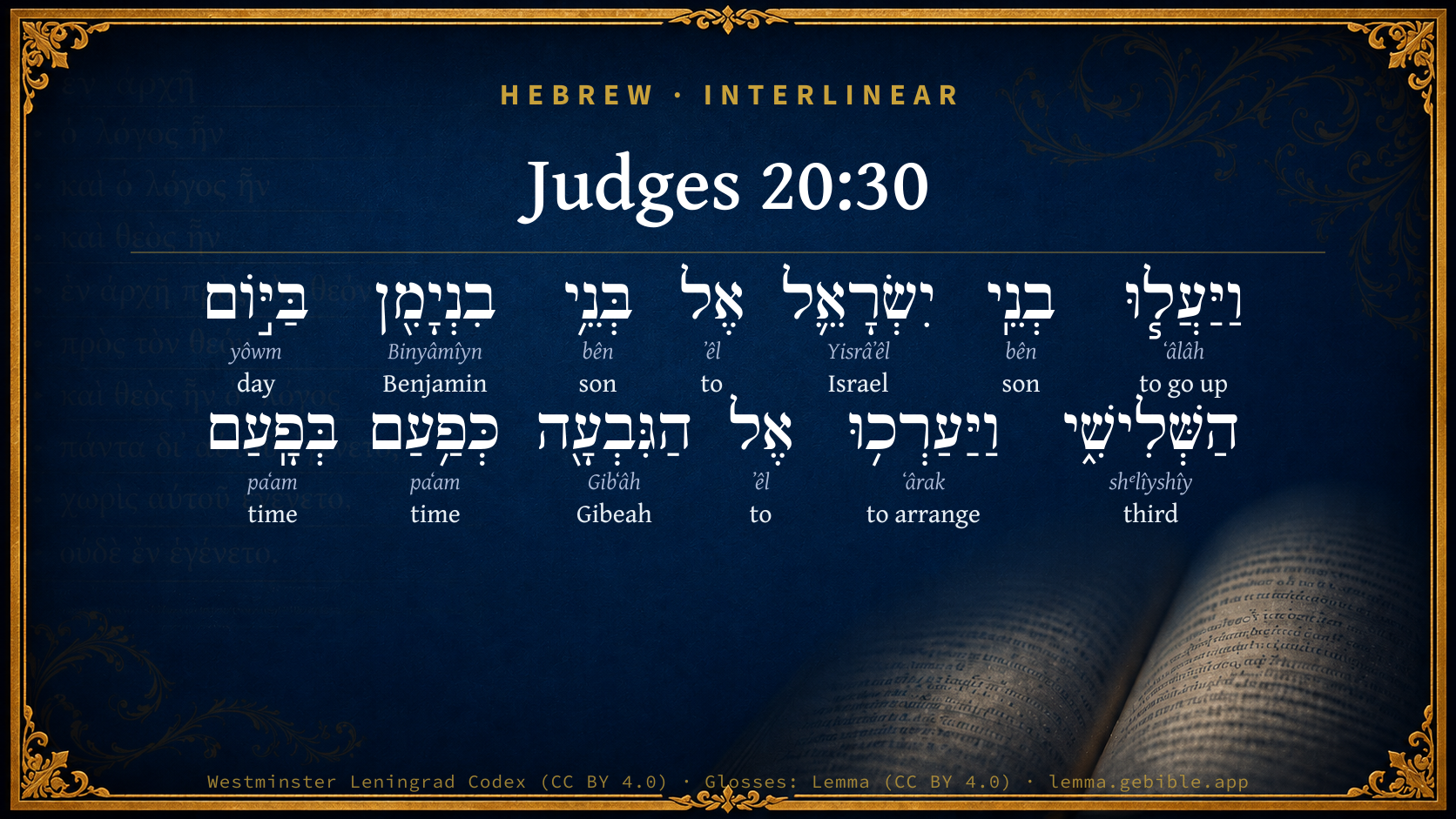
Hebrew (Westminster Leningrad Codex) Judges 20:30 appears in the Hebrew Old Testament. The text above is from the Westminster Leningrad Codex. Each word links to its Strong’s number, a concise gloss, and parsing drawn from the Open Scriptures Hebrew Bible morphology. Click any word for its full Brown-Driver-Briggs (BDB) entry.
Download image
Cite this verse

Judges 20:30 (World English Bible). Public Domain. Lemma interlinear Bible study tool, https://lemma.gebible.app/v/judges/20/30.

Show BibTeX & RIS
BibTeX
RIS
English Translation
The children of Israel went up against the children of Benjamin on the third day, and set themselves in array against Gibeah, as at other times.
World English Bible · Public Domain
Download a study sheet

One document with this verse’s original text, its word-by-word gloss line, the meaning frame, cross-references with their text, attributed commentary, and full source and license credits — printable, and it pastes into notes with its structure intact.

This verse Autodidact and up

Study sheet (.html) Plain text (.txt)

A passage Seminary Student

Up to 50 verses in one chapter. A passage sheet keeps up to 6 commentary sources and 12 cross-references per verse, in the order this page ranks them, and says so on the sheet whenever that leaves anything out. Ask for a single verse and you get the Autodidact verse sheet above.

Everything on this page stays free to read, with no account — the sheet is a download of what is already on screen, not access to it.

Want to remove ads? Support Godless Engineer
Compare translations 3

The same verse in 3 English versions, stacked beneath the original-language interlinear above. Click any original word for its lexicon entry.

Each is an independent rendering of the whole verse — the interlinear is not word-aligned to these translations.

Highlighted words mark where these versions differ — a whole-verse word diff, not a word-by-word alignment.

  • World English Bible Public Domain
    The children of Israel went up against the children of Benjamin on the third day, and set themselves in array against Gibeah, as at other times.
  • King James Version Public Domain
    And the children of Israel went up against the children of Benjamin on the third day, and put themselves in array against Gibeah, as at other times.
  • unfoldingWord Literal Text CC BY-SA 4.0
    And the sons of Israel went up against the sons of Benjamin on the third day, and they arrayed against Gibeah as time upon time.

unfoldingWord Literal Text — © unfoldingWord, licensed CC BY-SA 4.0. Word-aligned USFM3 via Door43 (git.door43.org/unfoldingWord/en_ult).

Versions to compare (up to 4)

3 of 4 selected

Show all 18 translations

Every available English version of this verse, each an independent rendering of the whole verse.

  • World English Bible Public Domain
    The children of Israel went up against the children of Benjamin on the third day, and set themselves in array against Gibeah, as at other times.
  • Berean Standard Bible Public Domain
    On the third day the Israelites went up against the Benjamites and arrayed themselves against Gibeah as they had done before.
  • Majority Standard Bible Public Domain
    On the third day the Israelites went up against the Benjamites and arrayed themselves against Gibeah as they had done before.
  • King James Version Public Domain
    And the children of Israel went up against the children of Benjamin on the third day, and put themselves in array against Gibeah, as at other times.
  • American Standard Version (1901) Public Domain
    And the children of Israel went up against the children of Benjamin on the third day, and set themselves in array against Gibeah, as at other times.
  • Revised Version (1885) Public Domain
    And the children of Israel went up against the children of Benjamin on the third day, and set themselves in array against Gibeah, as at other times.
  • Geneva Bible (1599) Public Domain
    And the children of Israel went vp against the children of Beniamin the third day, and put theselues in aray against Gibeah, as at other times.
  • Douay-Rheims (1899) Public Domain
    And they drew up their army against Benjamin the third time, as they had done the first and second.
  • Young's Literal Translation Public Domain
    and the sons of Israel go up against the sons of Benjamin, on the third day, and arrange themselves against Gibeah, as time by time.
  • Literal Standard Version CC BY-SA 4.0
    and the sons of Israel go up against the sons of Benjamin on the third day, and arrange themselves against Gibeah, as time by time.
  • Unlocked Literal Bible CC BY-SA 4.0
    The people of Israel fought against the people of Benjamin for the third day, and they formed their battle lines against Gibeah as they had done before.
  • unfoldingWord Literal Text CC BY-SA 4.0
    And the sons of Israel went up against the sons of Benjamin on the third day, and they arrayed against Gibeah as time upon time.
  • Darby Bible Public Domain
    And the people of Israel went up against the Benjaminites on the third day, and set themselves in array against Gib'e-ah, as at other times.
  • World Messianic Bible Public Domain
    The children of Israel went up against the children of Benjamin on the third day, and set themselves in array against Gibeah, as at other times.
  • Webster's Bible Public Domain
    And the children of Israel went up against the children of Benjamin on the third day, and put themselves in array against Gibeah, as at other times.
  • Free Bible Version CC BY-SA 4.0
    On the third day they took up the same positions they had as before.
  • Bible in Basic English Public Domain
    And the children of Israel went up against the children of Benjamin on the third day, and put themselves in fighting order against Gibeah as before.
  • JPS Tanakh (1917) Public Domain
    And the children of Israel went up against the children of Benjamin on the third day, and set themselves in array against Gibeah, as at other times.

Literal Standard Version (2020), Covenant Press — licensed CC BY-SA 4.0. Text via the HelloAO Bible API (eBible.org). Unlocked Literal Bible (unfoldingWord) — licensed CC BY-SA 4.0. Text via the HelloAO Bible API (eBible.org). unfoldingWord Literal Text — © unfoldingWord, licensed CC BY-SA 4.0. Word-aligned USFM3 via Door43 (git.door43.org/unfoldingWord/en_ult). Free Bible Version, Dr. Jonathan Gallagher — licensed CC BY-SA 4.0. Text via the HelloAO Bible API (eBible.org).

Word by word

More ways to search: Search by grammar → Find every occurrence → Compare this word →

Practice this passage: Drill this verse → Learn its vocabulary →

הַגִּבְעָ֖ה
Gibʻâh
H1390
“the · Gibeah”
Particle, Definite Article + Noun, Proper
Part of Speech
Particle + Noun
Type
Proper
Full BDB Definition

Origin: the same as H1389

TWOT: None

Gibeah = "hill" - a city in the mountain district of Judah - a city of Benjamin, birthplace of king Saul - a city in Kirjath-jearim of Ephraim
  1. וַיַּעֲל֧וּ ʻâlâh H5927 “and · to go up” Conjunction + Verb, Qal, Sequential Imperfect, 3rd Person, Masculine, Plural
  2. בְנֵֽי bên H1121 “sons of” Noun, Common, Masculine, Plural, Construct
  3. יִשְׂרָאֵ֛ל Yisrâʼêl H3478 “Israel” Noun, Proper
  4. אֶל ʼêl H413 “to” Preposition
  5. בְּנֵ֥י bên H1121 “sons of” Noun, Common, Masculine, Plural, Construct
  6. בִנְיָמִ֖ן Binyâmîyn H1144 “Benjamin” Noun, Proper
  7. בַּיּ֣וֹם yôwm H3117 “in/at the · day” Preposition, Determined + Noun, Common, Masculine, Singular, Absolute
  8. הַשְּׁלִישִׁ֑י shᵉlîyshîy H7992 “the · third” Particle, Definite Article + Adjective, Ordinal number, Masculine, Singular, Absolute
  9. וַיַּעַרְכ֥וּ ʻârak H6186 “and · to arrange” Conjunction + Verb, Qal, Sequential Imperfect, 3rd Person, Masculine, Plural
  10. אֶל ʼêl H413 “to” Preposition
  11. כְּפַ֥עַם paʻam H6471 “like/as · time” Preposition + Noun, Common, Feminine, Singular, Absolute
  12. בְּפָֽעַם paʻam H6471 “in/at · time” Preposition + Noun, Common, Feminine, Singular, Absolute

About this verse

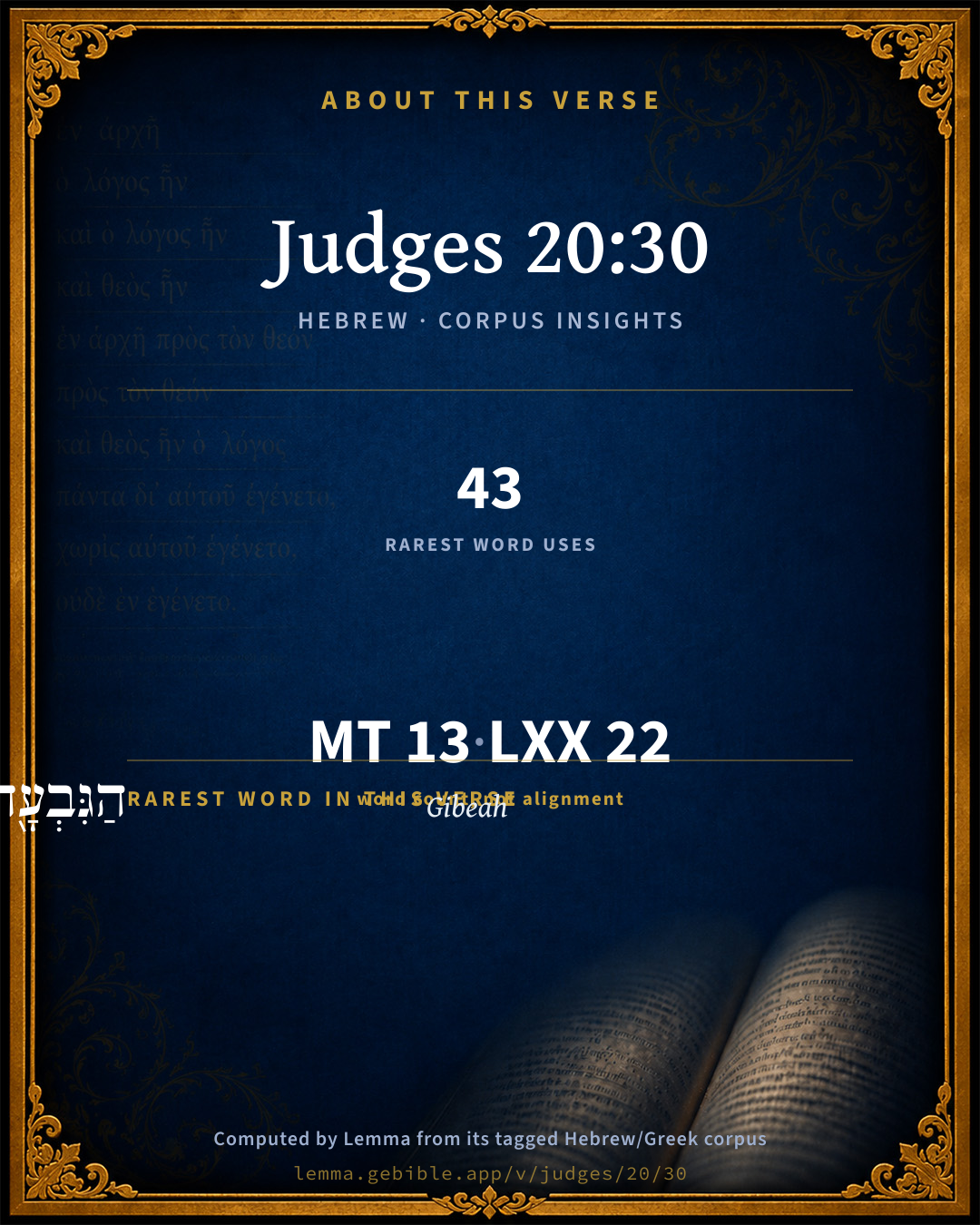
These counts appear in no published source. They are computed here, from the morphology-tagged text and Lemma’s own curated glosses. What Lemma adds →

13
words
10
distinct lemmas
Historical
section

Shared distinctive vocabulary

הַגִּבְעָ֖ה Gibeah H1390 occurs in 42 verses of the Hebrew Bible. Also found in:

Grammatical profile

  • 2 verbs
  • 8 nouns
  • 1 adjective
  • 2 prepositions

Verb forms

  • וַיַּעֲל֧וּ Qal · Sequential Imperfect
  • וַיַּעַרְכ֥וּ Qal · Sequential Imperfect

Repetition

Words recur within this verse — often emphatic in Hebrew:

  • בְנֵֽי son H1121 ×2
  • כְּפַ֥עַם time H6471 ×2
  • אֶל to H413 ×2

Hebrew & Septuagint length

In English translation the verse runs 26 words from the Hebrew and 23 from the Septuagint (LXX English) — closely comparable.

A rough comparison of the two English renderings, which tokenize alike — not a word-level alignment.

Word counts can differ between the Hebrew and the Greek without any difference in meaning — e.g. the Hebrew direct-object marker אֵת has no separate Greek word, and Greek often adds the article ὁ.

In the original languages it is 13 Hebrew tokens and 22 Greek tokens — but the two are counted differently (Hebrew bundles its prefixes and suffixes into one token; the Greek is in lemma form), so that isn’t a like-for-like length.

Hebrew and Greek witnesses Masoretic Hebrew ↔ Greek Septuagint

The same verse in the two great witnesses to the Old Testament, shown verse-for-verse.

These are two independent witnesses, not word-aligned to each other, and the Septuagint is shown in lemma (dictionary) form.

Hebrew Judges 20:30 Masoretic · Westminster Leningrad Codex

וַיַּעֲל֧וּ בְנֵֽי יִשְׂרָאֵ֛ל אֶל בְּנֵ֥י בִנְיָמִ֖ן בַּיּ֣וֹם הַשְּׁלִישִׁ֑י וַיַּעַרְכ֥וּ אֶל הַגִּבְעָ֖ה כְּפַ֥עַם בְּפָֽעַם

The children of Israel went up against the children of Benjamin on the third day, and set themselves in array against Gibeah, as at other times.

World English Bible · Public Domain

Greek LXX Judges 20:30 Septuagint · lemma form

καί ἀναβαίνω ὁ υἱός ἰσραήλ πρός υἱός βενιαμίν ἐν ὁ ἡμέρα ὁ τρίτος καί συνἅπτω πρός ὁ γαβαα ὡς ἅπαξ καί ἅπαξ

And the children of Israel went up against the children of Benjamin on the third day, and arrayed themselves against Gabaa as before.

LXX2012 (modern English Septuagint) · Public Domain

On this verse, John Gill's Exposition discusses the Septuagint’s reading. Read the note in Commentary ↓

Hebrew: Westminster Leningrad Codex (CC BY 4.0). Greek: Septuagint (public domain); English from LXX2012 (modern English Septuagint) (Public Domain). How the Septuagint differs from the Hebrew →

Targum (Aramaic paraphrase)

1

The Targum is the ancient Jewish Aramaic paraphrase of the Hebrew Scriptures — an interpretive translation, not the Hebrew text itself. Onkelos (literal) and Pseudo-Jonathan (expansive) render the Torah, and Jonathan the Prophets. Coverage is partial: where no permissively-licensed English translation exists for a verse, only the Aramaic is shown. This is verse-level text, not a word-by-word alignment to the Hebrew.

  1. Targum Jonathan Prophets (Joshua–Malachi)
    וּסְלִיקוּ בְנֵי יִשְׂרָאֵל לְוַת בְּנֵי בִנְיָמִין בְּיוֹמָא תְּלִיתָאָה וְסַדָרוּ קְרָבָא עַל גִבְעֲתָא כִּזְמַן בִּזְמָן:

    (no public-domain English translation for this verse)

    Targum Jonathan — Aramaic: “Mikraot Gedolot” (public domain). English: “Sefaria Community Translation” (CC0 1.0 (public-domain dedication)); “London "Chaldee Paraphrase," 1871” (public domain). Text via Sefaria.

Commentary

Notes on Judges 20:30 from classic Christian and Jewish commentators (each source and its license shown beneath its notes). The classic Christian expositions comment on the surrounding passage and are grouped to its opening verse, so a note may address several verses; the Jewish commentaries on the Tanakh (Rashi and others) are per-verse, so they appear only where the commentator wrote on this verse.

Lemma curates 59 commentaries, every one of them public domain or Creative Commons licensed, each selected and text-cleaned for this edition rather than reprinted as found. About our sources →

The Cambridge Bible for Schools and Colleges

gen. ed. J. J. S. Perowne

30. on the third day] The account of the battle becomes exceedingly confused. It seems to be rounded off at Jdg_20:35 in the usual way, with a statement of the result and numbers slain; but in Jdg_20:36 ff. we find the battle still in progress, and we go through the various incidents again. This repetition is due partly to the combination of the narratives A and B, and partly, it would seem, to the insertion of editorial expansions or glosses. In the main Jdg_20:30-36 a come from the later source B; and in the main 36b–47 may be assigned to the earlier source A. Details which appear to lie outside these two versions, or merely repeat phrases from them, may be regarded, provisionally, as later additions; see on Jdg_20:31; Jdg_20:37 b, Jdg_20:43, Jdg_20:44 b – Jdg_20:46.

The Cambridge Bible for Schools and Colleges (gen. ed. J. J. S. Perowne; Cambridge University Press, 1878–1918) — public domain. Text from a community e-Sword module.

Trapp's Complete Commentary

John Trapp

Jdg 20:30 And the children of Israel went up against the children of Benjamin on the third day, and put themselves in array against Gibeah, as at other times.

Ver. 30. And the children of Israel went up.] Though they had a promise, yet they neglected not to use the best means. God, they knew, was to be trusted, but not tempted; and this is the very difference between true faith and vain presumption.

John Trapp, A Commentary or Exposition upon All the Books of the Old and New Testament (1647–1656) — public domain. Text from a community e-Sword module.

John Gill's Exposition

And the children of Benjamin went out against the people,.... Sallied out of Gibeah upon them, where they had put themselves in array against them:

and were drawn away from the city; the Israelites retreating, and dissembling a flight, which drew the Benjaminites to pursue after them, by which means they were drawn off to a greater distance from the city of Gibeah:

and they began to smite the people, and kill as at other times; at the other two battles:

in the highways; where it seems two ways met:

of which one goeth up to the house of God; to Bethel, as the Targum (t); or rather to Shiloh, where the house or tabernacle of God was, and was two miles from Gibeah, as Bunting (u) says:

and the other to Gibeah in the field; so called, to distinguish it from the other Gibeah situated on an hill:

about thirty men of Israel; which were killed in this running fight; and it seems as if one part of the army of Israel took one road, and the other the other road, and so divided the army of the Benjaminites that pursued after them.

(t) So the Septuagint, and Noldius, p. 69. No. 345. (u) Travels, &c. p. 121.

John Gill's Exposition of the Whole Bible (1746–1763) — public domain (CC PDM 1.0). Text via the HelloAO Bible API.

Haydock's Catholic Bible Commentary

CHAPTER XX.

George Leo Haydock (1774–1849), Haydock's Catholic Family Bible and Commentary, 1859 edition — public domain. Excludes Psalms (Douay-Rheims chapter numbering differs from Protestant) and Deuterocanonical books (Catholic canon only).

Matthew Poole's English Annotations

The children of Israel, i.e. a considerable part of them, who were ordered to give the first onset, and then to counterfeit flight, to draw the Benjamites forth of their strong hold. See Jdg 20:32.

On the third day, to wit, after the second battle; for the first day after it they spent in perplexing thoughts, and going up to the house of the Lord; the second, in fasting and prayer there; and this third, in the fight. Or this is so called with respect unto the two several foregoing days of battle, and so this was the third day of battle.

Matthew Poole's English Annotations on the Holy Bible (1683–1685) — public domain. Text from a community e-Sword/MySword module.

The Pulpit Commentary

As at other times, or, this time as the other times. (see the same phrase, ver. 31,Jud_1:16:20 Num_24:20)

The Pulpit Commentary (1880–1919), ed. H.D.M. Spence-Jones & Joseph S. Exell — public domain. Text from a community e-Sword module.

John Wesley's Explanatory Notes

The children of Israel - That is, a considerable part of them, who were ordered to give the first onset, and then to counterfeit flight, to draw the Benjamites forth from their strong-hold. See ver. 32.

John Wesley, Explanatory Notes Upon the Whole Bible (1754–1765) — public domain. Text via the GEBible commentary corpus.

Lesson kit

Teaching starters — assembled from the data on this page, not authored interpretation. Every prompt links to the verse data it draws on. Edit before teaching.

Judges, in the Historical, opens this verse with 13 words (10 distinct Hebrew lemmas). Its most distinctive word is Gibʻâh (“Gibeah”). A historical commentator’s framing appears above. Read the whole chapter for the surrounding context.

Discussion questions

  1. The word Gibʻâh carries the sense “Gibeah.” How does it shape the verse?
  2. How does Joshua 15:57, which shares the word «Gibeah», read alongside this verse?
  3. What does the repetition of “son” (2× in this one verse) do in this verse?
  4. These translations render this verse differently; the difference is in the English rendering, not the original. What questions does that raise?
  5. «וַיַּעֲל֧וּ» is a Qal Sequential Imperfect verb. How does that grammatical form shape the action described?
  6. Compare how The Cambridge Bible for Schools and Colleges and Trapp's Complete Commentary read this verse. Where do they agree or differ?

Things to notice

Reading settings

Reading text

Shown beneath each verse's original-language words.

Old Testament
Old Testament edition

Read the OT as the Masoretic Hebrew (MT) or the Greek Septuagint (LXX).

English shown for the Greek Septuagint (in the Hebrew ↔ Greek comparison).

Comparing translations? Open the Compare panel on any verse page to stack up to four side by side.