1 Chronicles 26:11

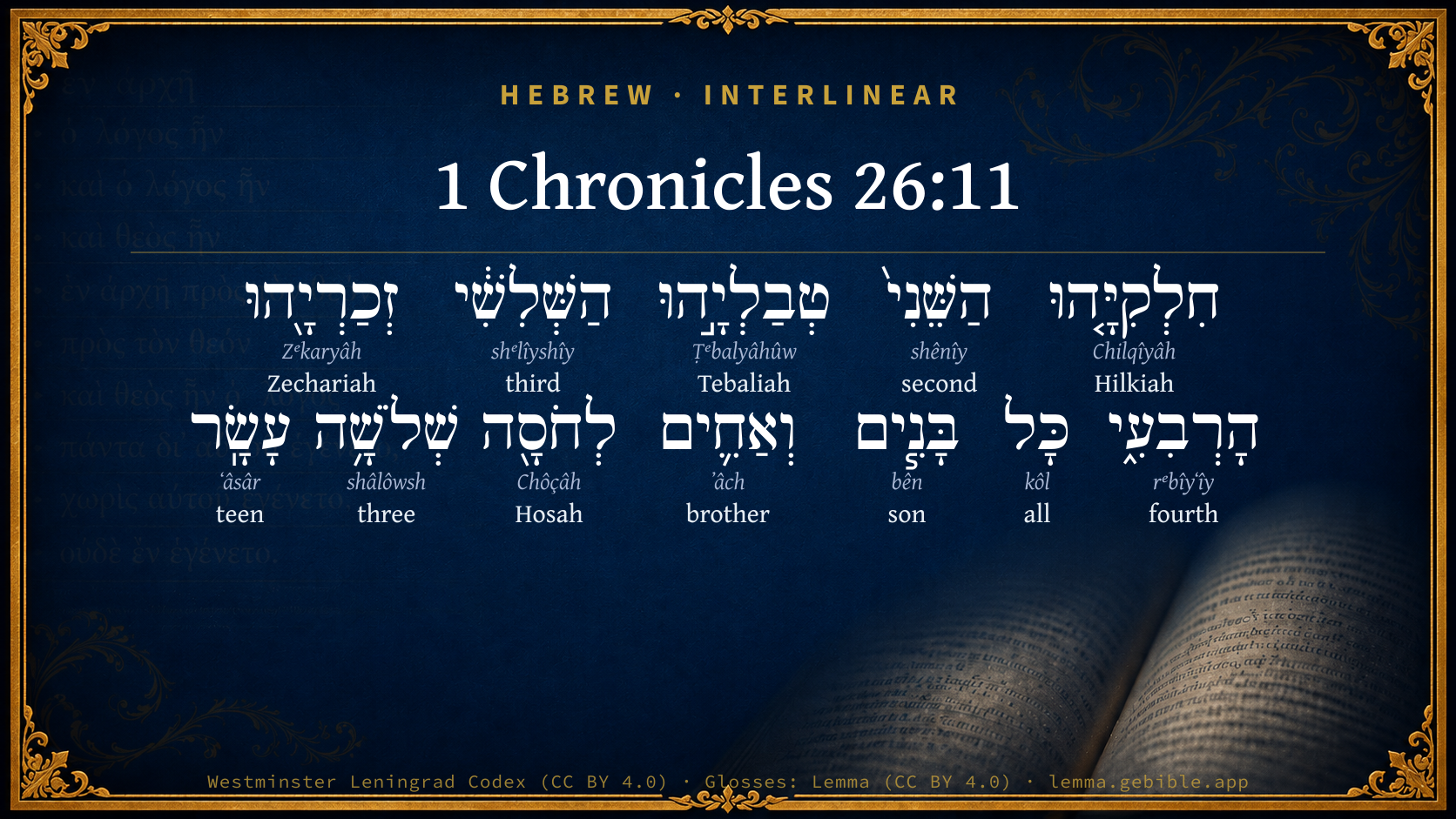
Hebrew (Westminster Leningrad Codex) 1 Chronicles 26:11 appears in the Hebrew Old Testament. The text above is from the Westminster Leningrad Codex. Each word links to its Strong’s number, a concise gloss, and parsing drawn from the Open Scriptures Hebrew Bible morphology. Click any word for its full Brown-Driver-Briggs (BDB) entry.
Download image
Cite this verse

1 Chronicles 26:11 (World English Bible). Public Domain. Lemma interlinear Bible study tool, https://lemma.gebible.app/v/1-chronicles/26/11.

Show BibTeX & RIS
BibTeX
RIS
English Translation
Hilkiah the second, Tebaliah the third, Zechariah the fourth: all the sons and brothers of Hosah were thirteen.
World English Bible · Public Domain
Highlights
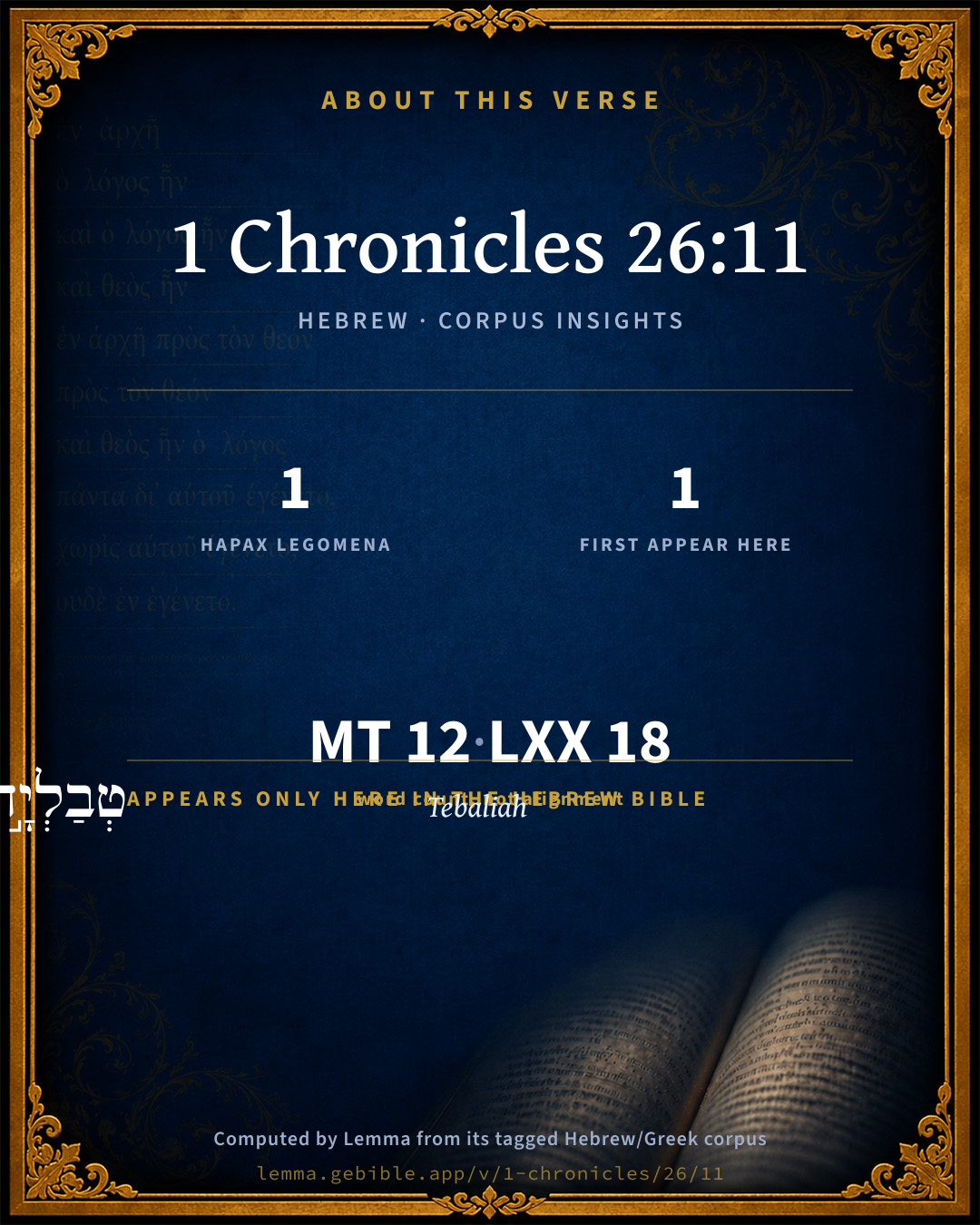
  • 1 hapax legomenon — only here in the Hebrew Bible
  • 1 first appearance in the Hebrew Bible
Full analysis ↓
Download a study sheet

One document with this verse’s original text, its word-by-word gloss line, the meaning frame, cross-references with their text, attributed commentary, and full source and license credits — printable, and it pastes into notes with its structure intact.

This verse Autodidact and up

Study sheet (.html) Plain text (.txt)

A passage Seminary Student

Up to 50 verses in one chapter. A passage sheet keeps up to 6 commentary sources and 12 cross-references per verse, in the order this page ranks them, and says so on the sheet whenever that leaves anything out. Ask for a single verse and you get the Autodidact verse sheet above.

Everything on this page stays free to read, with no account — the sheet is a download of what is already on screen, not access to it.

Want to remove ads? Support Godless Engineer
Compare translations 3

The same verse in 3 English versions, stacked beneath the original-language interlinear above. Click any original word for its lexicon entry.

Each is an independent rendering of the whole verse — the interlinear is not word-aligned to these translations.

Highlighted words mark where these versions differ — a whole-verse word diff, not a word-by-word alignment.

  • World English Bible Public Domain
    Hilkiah the second, Tebaliah the third, Zechariah the fourth: all the sons and brothers of Hosah were thirteen.
  • King James Version Public Domain
    Hilkiah the second, Tebaliah the third, Zechariah the fourth: all the sons and brethren of Hosah were thirteen.
  • unfoldingWord Literal Text CC BY-SA 4.0
    Hilkiah, the second; Tabaliah, the third; Zechariah, the fourth. All of the sons and brothers to Hosah 13.

unfoldingWord Literal Text — © unfoldingWord, licensed CC BY-SA 4.0. Word-aligned USFM3 via Door43 (git.door43.org/unfoldingWord/en_ult).

Versions to compare (up to 4)

3 of 4 selected

Show all 18 translations

Every available English version of this verse, each an independent rendering of the whole verse.

  • World English Bible Public Domain
    Hilkiah the second, Tebaliah the third, Zechariah the fourth: all the sons and brothers of Hosah were thirteen.
  • Berean Standard Bible Public Domain
    Hilkiah the second, Tebaliah the third, and Zechariah the fourth. The sons and brothers of Hosah numbered 13 in all.
  • Majority Standard Bible Public Domain
    Hilkiah the second, Tebaliah the third, and Zechariah the fourth. The sons and brothers of Hosah numbered 13 in all.
  • King James Version Public Domain
    Hilkiah the second, Tebaliah the third, Zechariah the fourth: all the sons and brethren of Hosah were thirteen.
  • American Standard Version (1901) Public Domain
    Hilkiah the second, Tebaliah the third, Zechariah the fourth: all the sons and brethren of Hosah were thirteen.
  • Revised Version (1885) Public Domain
    Hilkiah the second, Tebaliah the third, Zechariah the fourth: all the sons and brethren of Hosah were thirteen.
  • Geneva Bible (1599) Public Domain
    Helkiah the second, Tebaliah the third, and Zechariah the fourth: all the sonnes and the brethren of Hosa were thirteene.
  • Douay-Rheims (1899) Public Domain
    Helcias the second, Tabelias the third, Zacharias the fourth: all these the sons, and the brethren of Hosa, were thirteen.
  • Young's Literal Translation Public Domain
    Hilkiah the second, Tebaliah the third, Zechariah the fourth; all the sons and brethren of Hosah `are' thirteen.
  • Literal Standard Version CC BY-SA 4.0
    Hilkiah the second, Tebaliah the third, Zechariah the fourth; all the sons and brothers of Hosah—thirteen.
  • Unlocked Literal Bible CC BY-SA 4.0
    Hilkiah the second, Tabaliah the third, Zechariah the fourth. All of Hosah's sons and kinsmen were thirteen in number.
  • unfoldingWord Literal Text CC BY-SA 4.0
    Hilkiah, the second; Tabaliah, the third; Zechariah, the fourth. All of the sons and brothers to Hosah 13.
  • Darby Bible Public Domain
    Hilkijah the second, Tebaliah the third, Zechariah the fourth: all the sons and brethren of Hosah were thirteen.
  • World Messianic Bible Public Domain
    Hilkiah the second, Tebaliah the third, and Zechariah the fourth. All the sons and brothers of Hosah were thirteen.
  • Webster's Bible Public Domain
    Hilkiah the second, Tebaliah the third, Zechariah the fourth: all the sons and brethren of Hosah were thirteen.
  • Free Bible Version CC BY-SA 4.0
    His other sons included Hilkiah (second), Tebaliah (third), and Zechariah (fourth). The total of Hosah's sons and relatives was thirteen.
  • Bible in Basic English Public Domain
    Hilkiah the second, Tebaliah the third, Zechariah the fourth: Hosah had thirteen sons and brothers.
  • JPS Tanakh (1917) Public Domain
    Hilkiah the second, Tebaliah the third, Zechariah the fourth; all the sons and brethren of Hosah were thirteen.

Literal Standard Version (2020), Covenant Press — licensed CC BY-SA 4.0. Text via the HelloAO Bible API (eBible.org). Unlocked Literal Bible (unfoldingWord) — licensed CC BY-SA 4.0. Text via the HelloAO Bible API (eBible.org). unfoldingWord Literal Text — © unfoldingWord, licensed CC BY-SA 4.0. Word-aligned USFM3 via Door43 (git.door43.org/unfoldingWord/en_ult). Free Bible Version, Dr. Jonathan Gallagher — licensed CC BY-SA 4.0. Text via the HelloAO Bible API (eBible.org).

Word by word

More ways to search: Search by grammar → Find every occurrence → Compare this word →

Practice this passage: Drill this verse → Learn its vocabulary →

טְבַלְיָ֣הוּ
Ṭᵉbalyâhûw
H2882
“Tebaliah”
Noun, Proper
Part of Speech
Noun
Type
Proper
Full BDB Definition

Origin: from H2881 and H3050

TWOT: None

Tebaliah = "purified" - the 3rd son of Hosah of the children of Merari and temple gatekeeper
  1. חִלְקִיָּ֤הוּ Chilqîyâh H2518 “Hilkiah” Noun, Proper
  2. הַשֵּׁנִי֙ shênîy H8145 “the · second” Particle, Definite Article + Adjective, Ordinal number, Masculine, Singular, Absolute
  3. הַשְּׁלִשִׁ֔י shᵉlîyshîy H7992 “the · third” Particle, Definite Article + Adjective, Ordinal number, Masculine, Singular, Absolute
  4. זְכַרְיָ֖הוּ Zᵉkaryâh H2148 “Zechariah” Noun, Proper
  5. הָרְבִעִ֑י rᵉbîyʻîy H7243 “the · fourth” Particle, Definite Article + Adjective, Ordinal number, Masculine, Singular, Absolute
  6. כָּל kôl H3605 “all of” Noun, Common, Masculine, Singular, Construct
  7. בָּנִ֧ים bên H1121 “sons” Noun, Common, Masculine, Plural, Absolute
  8. וְאַחִ֛ים ʼâch H251 “and · brothers” Conjunction + Noun, Common, Masculine, Plural, Absolute
  9. לְחֹסָ֖ה Chôçâh H2621 “to/for · Hosah” Preposition + Noun, Proper
  10. שְׁלֹשָׁ֥ה shâlôwsh H7969 “three” Adjective, Cardinal number, Masculine, Singular, Absolute
  11. עָשָֽׂר ʻâsâr H6240 “teen” Adjective, Cardinal number, Masculine, Singular, Absolute

About this verse

These counts appear in no published source. They are computed here, from the morphology-tagged text and Lemma’s own curated glosses. What Lemma adds →

12
words
12
distinct lemmas
Historical
section

Notable vocabulary

1 hapax legomenon — a word that appears only here in the entire Hebrew Bible:

  • טְבַלְיָ֣הוּ Tebaliah H2882

First appearance in Scripture

This word makes its first canonical appearance in the Hebrew Bible here:

  • טְבַלְיָ֣הוּ Tebaliah H2882

Shared distinctive vocabulary

לְחֹסָ֖ה Hosah H2621 occurs in 5 verses of the Hebrew Bible. Also found in:

Grammatical profile

  • 7 nouns
  • 5 adjectives

Hebrew & Septuagint length

In English translation the verse runs 18 words from the Hebrew and 19 from the Septuagint (LXX English) — closely comparable.

A rough comparison of the two English renderings, which tokenize alike — not a word-level alignment.

Word counts can differ between the Hebrew and the Greek without any difference in meaning — e.g. the Hebrew direct-object marker אֵת has no separate Greek word, and Greek often adds the article ὁ.

In the original languages it is 12 Hebrew tokens and 18 Greek tokens — but the two are counted differently (Hebrew bundles its prefixes and suffixes into one token; the Greek is in lemma form), so that isn’t a like-for-like length.

Hebrew and Greek witnesses Masoretic Hebrew ↔ Greek Septuagint

The same verse in the two great witnesses to the Old Testament, shown verse-for-verse.

These are two independent witnesses, not word-aligned to each other, and the Septuagint is shown in lemma (dictionary) form.

Hebrew 1 Chronicles 26:11 Masoretic · Westminster Leningrad Codex

חִלְקִיָּ֤הוּ הַשֵּׁנִי֙ טְבַלְיָ֣הוּ הַשְּׁלִשִׁ֔י זְכַרְיָ֖הוּ הָרְבִעִ֑י כָּל בָּנִ֧ים וְאַחִ֛ים לְחֹסָ֖ה שְׁלֹשָׁ֥ה עָשָֽׂר

Hilkiah the second, Tebaliah the third, Zechariah the fourth: all the sons and brothers of Hosah were thirteen.

World English Bible · Public Domain

Greek LXX 1 Chronicles 26:11 Septuagint · lemma form

ὁ διαίρεσις ὁ δεύτερος ταβλαι ὁ τρίτος ζαχαριας ὁ τέταρτος πᾶς οὗτος υἱός καί ἀδελφός ὁ ωσα τρισκαίδεκα

Chelcias the second, Tablai the third, Zacharias the fourth: all these were the sons and brethren of Osa, thirteen.

LXX2012 (modern English Septuagint) · Public Domain

Hebrew: Westminster Leningrad Codex (CC BY 4.0). Greek: Septuagint (public domain); English from LXX2012 (modern English Septuagint) (Public Domain). How the Septuagint differs from the Hebrew →

Commentary

Notes on 1 Chronicles 26:11 from classic Christian and Jewish commentators (each source and its license shown beneath its notes). The classic Christian expositions comment on the surrounding passage and are grouped to its opening verse, so a note may address several verses; the Jewish commentaries on the Tanakh (Rashi and others) are per-verse, so they appear only where the commentator wrote on this verse.

Lemma curates 59 commentaries, every one of them public domain or Creative Commons licensed, each selected and text-cleaned for this edition rather than reprinted as found. About our sources →

Geneva Bible (1599)

Geneva Bible translators

Or, cousins.

Geneva Bible (1599) marginal notes — public domain. Text via Bolls.life.

John Gill's Exposition

And they cast lots,.... To determine at which gate each should stand, who at this gate, and who at the other, &c.

as well the small as the great, according to the house of their fathers, for every gate; meaning, not little ones and grown persons in a family, but the smaller and poorer families, and the larger and richer ones, had their places assigned them at the several gates, as the lot directed; they did not go according to the dignity and precedence of their families, but according to lot.

John Gill's Exposition of the Whole Bible (1746–1763) — public domain (CC PDM 1.0). Text via the HelloAO Bible API.

Keil & Delitzsch

C. F. Keil & F. Delitzsch

And they cast lots,.... To determine at which gate each should stand, who at this gate, and who at the other, &c.

as well the small as the great, according to the house of their fathers, for every gate; meaning, not little ones and grown persons in a family, but the smaller and poorer families, and the larger and richer ones, had their places assigned them at the several gates, as the lot directed; they did not go according to the dignity and precedence of their families, but according to lot.

Keil & Delitzsch — Biblical Commentary on the Old Testament (1861–1891) — public domain (CC PDM 1.0). Text via the HelloAO Bible API. (Old Testament only.)

Lesson kit

Teaching starters — assembled from the data on this page, not authored interpretation. Every prompt links to the verse data it draws on. Edit before teaching.

1 Chronicles, in the Historical, opens this verse with 12 words (12 distinct Hebrew lemmas). Its most distinctive word is Ṭᵉbalyâhûw (“Tebaliah”). A historical commentator’s framing appears above. Read the whole chapter for the surrounding context.

Discussion questions

  1. What does “Tebaliah” (Ṭᵉbalyâhûw) contribute to the verse as a whole?
  2. 1 word here appears nowhere else in the Hebrew Bible. Why might the author reach for such rare wording?
  3. This is the first place “Tebaliah” appears in Scripture (first appears here). What does its debut here establish?
  4. How does Joshua 19:29, which shares the word «Hosah», read alongside this verse?
  5. These translations render this verse differently; the difference is in the English rendering, not the original. What questions does that raise?
  6. Compare how Geneva Bible (1599) and John Gill's Exposition read this verse. Where do they agree or differ?

Things to notice

Reading settings

Reading text

Shown beneath each verse's original-language words.

Old Testament
Old Testament edition

Read the OT as the Masoretic Hebrew (MT) or the Greek Septuagint (LXX).

English shown for the Greek Septuagint (in the Hebrew ↔ Greek comparison).

Comparing translations? Open the Compare panel on any verse page to stack up to four side by side.