1 Kings 22:2

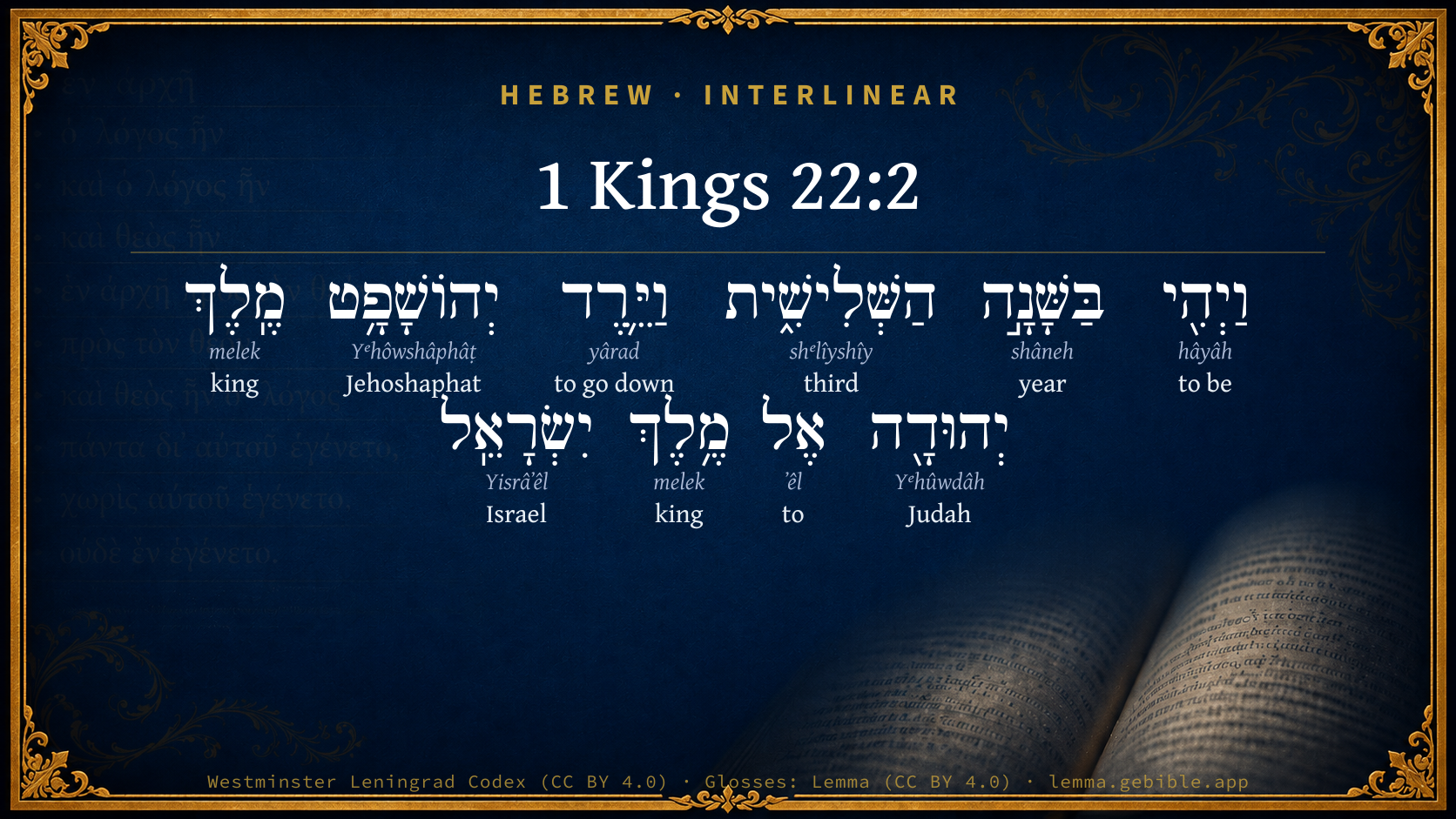
Hebrew (Westminster Leningrad Codex) 1 Kings 22:2 appears in the Hebrew Old Testament. The text above is from the Westminster Leningrad Codex. Each word links to its Strong’s number, a concise gloss, and parsing drawn from the Open Scriptures Hebrew Bible morphology. Click any word for its full Brown-Driver-Briggs (BDB) entry.
Download image
Cite this verse

1 Kings 22:2 (World English Bible). Public Domain. Lemma interlinear Bible study tool, https://lemma.gebible.app/v/1-kings/22/2.

Show BibTeX & RIS
BibTeX
RIS
English Translation
It happened in the third year, that Jehoshaphat the king of Judah came down to the king of Israel.
World English Bible · Public Domain
Download a study sheet

One document with this verse’s original text, its word-by-word gloss line, the meaning frame, cross-references with their text, attributed commentary, and full source and license credits — printable, and it pastes into notes with its structure intact.

This verse Autodidact and up

Study sheet (.html) Plain text (.txt)

A passage Seminary Student

Up to 50 verses in one chapter. A passage sheet keeps up to 6 commentary sources and 12 cross-references per verse, in the order this page ranks them, and says so on the sheet whenever that leaves anything out. Ask for a single verse and you get the Autodidact verse sheet above.

Everything on this page stays free to read, with no account — the sheet is a download of what is already on screen, not access to it.

Want to remove ads? Support Godless Engineer
Compare translations 3

The same verse in 3 English versions, stacked beneath the original-language interlinear above. Click any original word for its lexicon entry.

Each is an independent rendering of the whole verse — the interlinear is not word-aligned to these translations.

Highlighted words mark where these versions differ — a whole-verse word diff, not a word-by-word alignment.

  • World English Bible Public Domain
    It happened in the third year, that Jehoshaphat the king of Judah came down to the king of Israel.
  • King James Version Public Domain
    And it came to pass in the third year, that Jehoshaphat the king of Judah came down to the king of Israel.
  • unfoldingWord Literal Text CC BY-SA 4.0
    And it happened in the third year that Jehoshaphat, the king of Judah, went down to the king of Israel.

unfoldingWord Literal Text — © unfoldingWord, licensed CC BY-SA 4.0. Word-aligned USFM3 via Door43 (git.door43.org/unfoldingWord/en_ult).

Versions to compare (up to 4)

3 of 4 selected

Show all 18 translations

Every available English version of this verse, each an independent rendering of the whole verse.

  • World English Bible Public Domain
    It happened in the third year, that Jehoshaphat the king of Judah came down to the king of Israel.
  • Berean Standard Bible Public Domain
    However, in the third year, Jehoshaphat king of Judah went down to visit the king of Israel,
  • Majority Standard Bible Public Domain
    However, in the third year, Jehoshaphat king of Judah went down to visit the king of Israel,
  • King James Version Public Domain
    And it came to pass in the third year, that Jehoshaphat the king of Judah came down to the king of Israel.
  • American Standard Version (1901) Public Domain
    And it came to pass in the third year, that Jehoshaphat the king of Judah came down to the king of Israel.
  • Revised Version (1885) Public Domain
    And it came to pass in the third year, that Jehoshaphat the king of Judah came down to the king of Israel.
  • Geneva Bible (1599) Public Domain
    And in the third yeere did Iehoshaphat the King of Iudah come downe to ye King of Israel.
  • Douay-Rheims (1899) Public Domain
    And in the third year, Josaphat king of Juda came down to the king of Israel.
  • Young's Literal Translation Public Domain
    and it cometh to pass in the third year, that Jehoshaphat king of Judah cometh down unto the king of Israel,
  • Literal Standard Version CC BY-SA 4.0
    And it comes to pass in the third year, that Jehoshaphat king of Judah comes down to the king of Israel,
  • Unlocked Literal Bible CC BY-SA 4.0
    Then it came about that in the third year, Jehoshaphat the king of Judah went down to the king of Israel.
  • unfoldingWord Literal Text CC BY-SA 4.0
    And it happened in the third year that Jehoshaphat, the king of Judah, went down to the king of Israel.
  • Darby Bible Public Domain
    And it came to pass in the third year, that Jehoshaphat the king of Judah came down to the king of Israel.
  • World Messianic Bible Public Domain
    In the third year, Jehoshaphat the king of Judah came down to the king of Israel.
  • Webster's Bible Public Domain
    And it came to pass in the third year, that Jehoshaphat the king of Judah came down to the king of Israel.
  • Free Bible Version CC BY-SA 4.0
    But in the third year Jehoshaphat, king of Judah, went to visit the king of Israel.
  • Bible in Basic English Public Domain
    And it came about in the third year, that Jehoshaphat, king of Judah, came down to the king of Israel.
  • JPS Tanakh (1917) Public Domain
    And it came to pass in the third year, that Jehoshaphat the king of Judah came down to the king of Israel.

Literal Standard Version (2020), Covenant Press — licensed CC BY-SA 4.0. Text via the HelloAO Bible API (eBible.org). Unlocked Literal Bible (unfoldingWord) — licensed CC BY-SA 4.0. Text via the HelloAO Bible API (eBible.org). unfoldingWord Literal Text — © unfoldingWord, licensed CC BY-SA 4.0. Word-aligned USFM3 via Door43 (git.door43.org/unfoldingWord/en_ult). Free Bible Version, Dr. Jonathan Gallagher — licensed CC BY-SA 4.0. Text via the HelloAO Bible API (eBible.org).

Word by word

More ways to search: Search by grammar → Find every occurrence → Compare this word →

Practice this passage: Drill this verse → Learn its vocabulary →

יְהוֹשָׁפָ֥ט
Yᵉhôwshâphâṭ
H3092
“Jehoshaphat”
Noun, Proper
Part of Speech
Noun
Type
Proper
Full BDB Definition

Origin: from H3068 and H8199

TWOT: None

Jehoshaphat = "Jehovah has judged" - son of king Asa and himself king of Judah for 25 years; one of the best, most pious, and prosperous kings of Judah (noun proper masculine) - son of Nimshi and father of king Jehu of the northern kingdom of Israel (noun proper masculine) - son of Ahilud and chronicler under David and Solomon (noun proper masculine) - son of Paruah and one of the 12 commissary officers under Solomon (noun proper masculine) - a priest and trumpeter in the time of David (noun proper masculine) - symbolical name of a valley near Jerusalem which is the place of ultimate judgment; maybe the deep ravine which separates Jerusalem from the Mount of Olives through which the Kidron flowed (noun proper locative)
  1. וַיְהִ֖י hâyâh H1961 “and · to be” Conjunction + Verb, Qal, Sequential Imperfect, 3rd Person, Masculine, Singular
  2. בַּשָּׁנָ֣ה shâneh H8141 “in/at the · year” Preposition, Determined + Noun, Common, Feminine, Singular, Absolute
  3. הַשְּׁלִישִׁ֑ית shᵉlîyshîy H7992 “the · third” Particle, Definite Article + Adjective, Ordinal number, Feminine, Singular, Absolute
  4. וַיֵּ֛רֶד yârad H3381 “and · to go down” Conjunction + Verb, Qal, Sequential Imperfect, 3rd Person, Masculine, Singular
  5. מֶֽלֶךְ melek H4428 “king of” Noun, Common, Masculine, Singular, Construct
  6. יְהוּדָ֖ה Yᵉhûwdâh H3063 “Judah” Noun, Proper
  7. אֶל ʼêl H413 “to” Preposition
  8. מֶ֥לֶךְ melek H4428 “king of” Noun, Common, Masculine, Singular, Construct
  9. יִשְׂרָאֵֽל Yisrâʼêl H3478 “Israel” Noun, Proper

About this verse

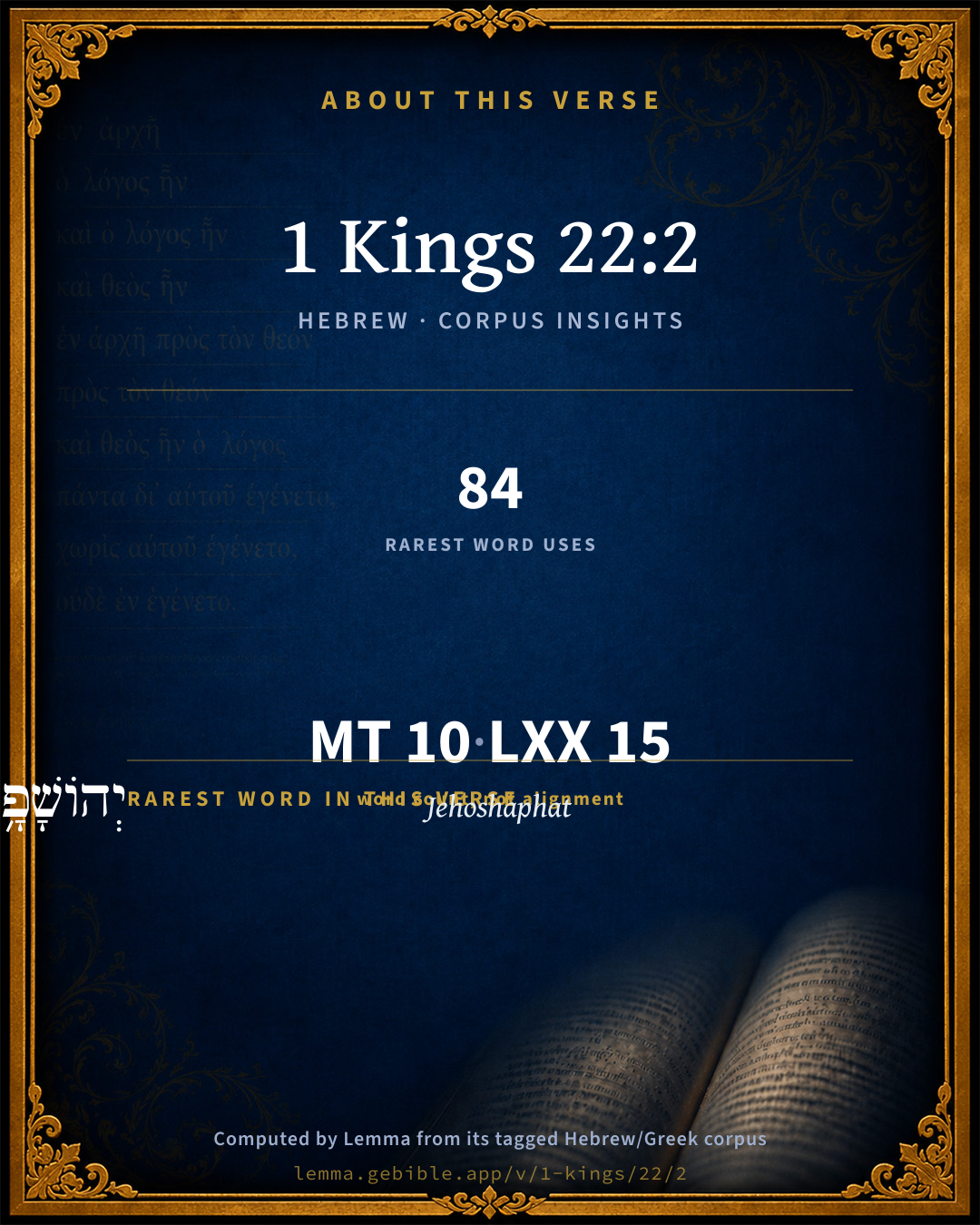
These counts appear in no published source. They are computed here, from the morphology-tagged text and Lemma’s own curated glosses. What Lemma adds →

10
words
9
distinct lemmas
Historical
section

Grammatical profile

  • 2 verbs
  • 6 nouns
  • 1 adjective
  • 1 preposition

Verb forms

  • וַיְהִ֖י Qal · Sequential Imperfect
  • וַיֵּ֛רֶד Qal · Sequential Imperfect

Repetition

A word recurs within this verse — often emphatic in Hebrew:

  • מֶֽלֶךְ king H4428 ×2

Hebrew & Septuagint length

In English translation the verse runs 19 words from the Hebrew and 21 from the Septuagint (LXX English) — closely comparable.

A rough comparison of the two English renderings, which tokenize alike — not a word-level alignment.

Word counts can differ between the Hebrew and the Greek without any difference in meaning — e.g. the Hebrew direct-object marker אֵת has no separate Greek word, and Greek often adds the article ὁ.

In the original languages it is 10 Hebrew tokens and 15 Greek tokens — but the two are counted differently (Hebrew bundles its prefixes and suffixes into one token; the Greek is in lemma form), so that isn’t a like-for-like length.

Cross-references

8

Topical passages linked to 1 Kings 22:2 in the Treasury of Scripture Knowledge — connected by theme and wording, ordered by reader-vote popularity; previews shown in the World English Bible.

  • 1 Kings 15:24 Asa slept with his fathers, and was buried with his fathers in the city of David his father; and Jehoshaphat his son reigned in his place.
  • 1 Kings 22:1 They continued three years without war between Syria and Israel.
  • 1 Kings 22:41 Jehoshaphat the son of Asa began to reign over Judah in the fourth year of Ahab king of Israel.
  • 1 Kings 22:44 Jehoshaphat made peace with the king of Israel.
  • 2 Kings 8:18 He walked in the way of the kings of Israel, as did the house of Ahab: for he had the daughter of Ahab as wife; and he did that which was evil in the sight of Yahweh.
  • 2 Chronicles 18:1–27 Now Jehoshaphat had riches and honor in abundance; and he joined affinity with Ahab.
  • Matthew 12:40 For as Jonah was three days and three nights in the belly of the whale, so will the Son of Man be three days and three nights in the heart of the earth.
  • Matthew 16:21 From that time, Jesus began to show his disciples that he must go to Jerusalem and suffer many things from the elders, chief priests, and scribes, and be killed, and the third day be raised up.

Cross-references courtesy of OpenBible.info (CC BY 4.0).

Hebrew and Greek witnesses Masoretic Hebrew ↔ Greek Septuagint

The same verse in the two great witnesses to the Old Testament, shown verse-for-verse.

These are two independent witnesses, not word-aligned to each other, and the Septuagint is shown in lemma (dictionary) form.

Hebrew 1 Kings 22:2 Masoretic · Westminster Leningrad Codex

וַיְהִ֖י בַּשָּׁנָ֣ה הַשְּׁלִישִׁ֑ית וַיֵּ֛רֶד יְהוֹשָׁפָ֥ט מֶֽלֶךְ יְהוּדָ֖ה אֶל מֶ֥לֶךְ יִשְׂרָאֵֽל

It happened in the third year, that Jehoshaphat the king of Judah came down to the king of Israel.

World English Bible · Public Domain

Greek LXX 1 Kings 22:2 Septuagint · lemma form

καί γίγνομαι ἐν ὁ ἐνιαυτός ὁ τρίτος καί καταβαίνω ιωσαφατ βασιλεύς ιουδα πρός βασιλεύς ἰσραήλ

And it came to pass in the third year, that Josaphat king of Juda went down to the king of Israel.

LXX2012 (modern English Septuagint) · Public Domain

Hebrew: Westminster Leningrad Codex (CC BY 4.0). Greek: Septuagint (public domain); English from LXX2012 (modern English Septuagint) (Public Domain). How the Septuagint differs from the Hebrew →

Targum (Aramaic paraphrase)

1

The Targum is the ancient Jewish Aramaic paraphrase of the Hebrew Scriptures — an interpretive translation, not the Hebrew text itself. Onkelos (literal) and Pseudo-Jonathan (expansive) render the Torah, and Jonathan the Prophets. Coverage is partial: where no permissively-licensed English translation exists for a verse, only the Aramaic is shown. This is verse-level text, not a word-by-word alignment to the Hebrew.

  1. Targum Jonathan Prophets (Joshua–Malachi)
    וַהֲוָה בְּשַׁתָּא תְּלִיתָאָה וּנְחַת יְהוֹשָׁפָט מֶלֶךְ שִׁבְטָא דְבֵית יְהוּדָה לְוַת מַלְכָּא דְיִשְׂרָאֵל:

    (no public-domain English translation for this verse)

    Targum Jonathan — Aramaic: “Mikraot Gedolot” (public domain). English: “Sefaria Community Translation” (CC0 1.0 (public-domain dedication)); “London "Chaldee Paraphrase," 1871” (public domain). Text via Sefaria.

Commentary

Notes on 1 Kings 22:2 from classic Christian and Jewish commentators (each source and its license shown beneath its notes). The classic Christian expositions comment on the surrounding passage and are grouped to its opening verse, so a note may address several verses; the Jewish commentaries on the Tanakh (Rashi and others) are per-verse, so they appear only where the commentator wrote on this verse.

Lemma curates 59 commentaries, every one of them public domain or Creative Commons licensed, each selected and text-cleaned for this edition rather than reprinted as found. About our sources →

Trapp's Complete Commentary

John Trapp

1Ki 22:2 And it came to pass in the third year, that Jehoshaphat the king of Judah came down to the king of Israel.

Ver. 2. Jehoshaphat came down to the king of Israel.] With whom he warred at first with good success: {2Ch 17:1-3} but afterwards, for some politic respect, as haply to withstand the growing greatness of the Syrian, an ill neighbour to them both, he contracted with Ahab affinity and amity, and here cometh down to give him a courtly visit, which had like to have cost him his life.

John Trapp, A Commentary or Exposition upon All the Books of the Old and New Testament (1647–1656) — public domain. Text from a community e-Sword module.

The Biblical Illustrator

Joseph S. Exell

1Ki_22:2-50

Jehoshaphat the King of Judah.

Character of Jehoshaphat

In Ahab we have an instance of a wicked man partially reclaimed, frequently arrested, but yet finally hardened in his iniquity. In Jehoshaphat, again, we have a still more affecting example. We see how a man, upright before God, and sincere in serving Him, may be betrayed into weak compliances; and how dangerous and melancholy the consequences of these compliances may be. The general uprightness of Jehoshaphat, his sincerity in serving God, is expressly acknowledged and commended by the prophet in the very act of condemning his sin (1Ki_22:3). The 17th chapter of Second Chronicles gives an account of his piety and zeal at the beginning of his reign, and before the event to which the prophet refers; and the 19th and 20th chapters prove the continuance of these excellent dispositions, even after that most sad and untoward occurrence. Such a prince, we might naturally imagine, opposed to all corruption in the worship of God, would be especially studious to keep himself and his people separate from the heathenism and idolatry of the adjoining kingdom of Israel. He could have no sympathy with the spirit which animated that kingdom under the auspices of the infamous Jezebel--no toleration for the abuses which prevailed after she had secured the open establishment of the very worst form of paganism. Yet, strange to tell, the besetting sin of this good man was a tendency to connect himself with idolaters. The single fault charged against this godly prince is his frequent alliance with his ungodly neighbours. Thus, in the first place, Jehoshaphat consented to a treaty of marriage, probably at the beginning of his reign (2Ch_17:1). He joined affinity with Ahab by marrying his son to Ahabs daughter (2Ki_8:18). This was the first overture towards an alliance. Then, secondly, Jehoshaphat twice joined in a league of war with the King of Israel; first, in the expedition against Syria which we have been considering; and again, shortly after an attack upon the Moabites (2Ki_3:7). Lastly, in the third place, Jehoshaphat consented, though reluctantly, in the close of his reign, to a commercial alliance of his people with the ten tribes. As to the sin itself with which Jehoshaphat is charged, and the probable reasons or motives of its commission,--we cannot suppose that, in forming an alliance with the ungodly, Jehoshaphat was actuated by fondness for the crime, or by complacency in the criminal. We must seek an explanation of his conduct rather in mistaken views of policy than in any considerable indifference to the honour of God, or any leaning to the defections of apostasy and idolatry. For this end, let us consider the relative situation of the two kingdoms of Judah and Israel, and the feelings which their respective kings, with their subjects, mutually cherished towards one another. The first effect of Jeroboams revolt with the ten tribes from the house of David, was a bitter and irreconcilable hostility between the two rival kingdoms of the ten, and of the two tribes. And, as if to widen and perpetuate the breach, each party in turn had recourse to the expedient of calling in foreign aid against the other. At the instigation probably of Jeroboam, Shishak, King of Egypt, who had formerly been his patron and protector, invaded Judah. And again, by way of retaliation, the King of Judah soon after invited the Syrians to ravage the territory of the hostile kingdom of Israel (2Ch_16:1-14.). In course of time, however, when a generation or two passed away, something like a change, or a tendency to approximation, began to appear. The feelings of hostility had in some degree subsided, the memory of former union had revived, and the idea might again not unnaturally suggest itself to a wise and patriotic statesman, of consolidating once more into a powerful empire communities which, although recently estranged, had yet a common origin, a common history, a common name, and, till lately, a common faith,--whose old recollections and associations were all in common. The manifest folly, too, of exposing themselves, by intestine division, to foreign invasion, and even employing foreigners against each other, might prompt the desire of bringing the kingdoms to act harmoniously together, whether in peace or in war. Such might very reasonably be the views of an able, enlightened, and conscientious sovereign, pursuing simply, in a sense, the good of his country; and such, probably, were the views of Jehoshaphat. His favourite aim and design seems to have been, to conciliate the king and people of Israel; at least, he was always ready to listen to any proposals of conciliation. Nay, we may believe that this good man proposed, by the course which he adopted, to leaven them with the spirit of a better faith, and ultimately bring them back again to the legitimate dominion of the house of David, and the pure worship of the God of their fathers. If so, his object was certainly not unlawful; but in the pursuit of it, he was tempted to an unlawful compromise of principle. In his anxiety to pacify, to conciliate, and to reclaim, he was tempted to go a little too far,--even to the sacrificing of his own high integrity, and the apparent countenancing of other mens iniquities. And is not this the very sin of many good and serious Christians, who manifest to the world, its follies and its vices, a certain mild and tolerant spirit, and are disposed to treat the men of the world with a sort of easy and indulgent complacency; justifying or excusing such concessions to themselves by the fond persuasion, that they are but seeking, or at least that they are promoting, the worlds reformation? No doubt, it is your duty to conciliate all men, if you can; but there is such a thing as conciliating, and conciliating, and conciliating, till you conciliate away all the distinctive characteristics of your faith.

1. Thus, as to the first point, Jehoshaphat, when he consented to an alliance with the King of Israel, no doubt contemplated the possibility of doing him some good. Such was his hope. How in point of fact was it realised? He has descended from his footing of unquestioned and uncompromised integrity, and involved himself irretrievably in the very course he should be rebuking. And so it must ever be. The very first step a good man takes from the eminence on which he stands apart, as the friend of God and the unflinching enemy of all ungodliness in the world, he compromises his authority, his influence, his right and power of bold remonstrance and unsparing testimony against the corrupt lusts and the angry passions of men. He gives up the point of principle, and as to any resistance that he may make in details, men see not what there is left to fight for. Is not this the natural, the necessary result of such a conciliatory course? If you condescend to flatter men in their vanities, will they listen to you when you gravely reprehend their sins? No; they will laugh you to scorn. If you countenance them in the beginning of their excess, will they patiently bear your authoritative denunciation of its end? No; they will contemptuously reject it as a fond folly, or indignantly resent it as an insult. If you go with them one mile, may they not almost expect you to go two?--at least, you have no right to take it very much amiss if they go the two miles themselves.

2. But, in the second place, Jehoshaphat not only failed to arrest Ahab in his sinful course--he was himself involved in its sinfulness. Instead of reclaiming this wicked prince, he was himself betrayed into a participation in his wickedness he joined him in his unholy expedition. And be sure, we say to all professing Christians, that you too, if you try thus artfully to gain the advantage over the world, will find the world too much for you. For Satan, the god of this world, is far more than a match for you in this game of craft, and compromise, and conciliation. Beware how you step out of your own proper sphere, as a separate and peculiar people. Then go not along with them at all--no, not a single step: for a single step implies tampering, in so far, with your religious and conscientious scruples; and when these are once weakly or wilfully compromised, Satans battle is gained. The rest is all a question of time and of degree. Stand fast, then, in your liberty. All things are lawful unto you, but all things are not expedient. Be not yourselves brought under the power of any; and consider what may edify the Church and glorify God (1Co_6:12; 1Co_10:23), Stand fast in your integrity.

3. For, thirdly, see what hazard Jehoshaphat ran. Not only did he sin with Ahab, but he was on the point of perishing with him in his sin. The King of Judah was saved himself, as by fire; but his ally, his confederate, was lost. And had he no hand, had he no concern, in the loss? Had he honestly remonstrated with him? Had he fearlessly protested against him, and sharply rebuked and withstood him? Oh! such wounds would have been kind and precious. But he had been too merciful; he had been pitiful, falsely pitiful,--what a thought is this, that, in making flattering advances to sinners, and dealing smoothly with their sins, you not only endanger your own peace, but you accelerate and promote their ruin! You may save yourselves by tardy yet, timely repentance; you may extricate yourselves ere it be too late;--but can you save, can you extricate those whom your example has encouraged, or your presence has authorised? (R. S. Candlish, D. D.)

The King of Israel.--

The character of Ahab

I. The kings wilful purpose (verses 1-6). Ahabs purpose is announced in the beginning of the chapter. We find him, after three years of peace, preparing to attack the Syrians. The Syrian king, whom Ahab had treated with such ill-timed lenity, and with whom he had made so sinful a compromise, has, as might have been anticipated, failed to fulfil the: stipulated terms of ransom, and to restore the cities of Israel. Ahab, provoked at his own simplicity in having suffered so favourable an opportunity to slip, through his fond trust in the honour of a perfidious prince, and stung by the recollection of the prophets rebuke, conceives the design of retrieving his error, and compelling the fulfilment of the treaty, on the faith of which he had been weakly persuaded to liberate the enemy whom God had doomed. In this Ahab acts under the impulse of resentment and ambition. He burns with the desire of avenging a personal wrong and insult, rather than of fulfilling the decree of God. Had he consulted the will of God, he must have seen and felt that it was now too late for him to take the step proposed. He had let the time go past. When God gave him victory, and assured him of power over his enemy, then he should have used his opportunity. This he had failed to do; and for his failure he had been reproved by God, and warned by the prophet that his people and his life were forfeited. Certainly Ahab should have been the very last person to think of rousing and provoking the very foe who, by the Divine sentence and by his own compromise, had gained so sad and signal an advantage over him. But instead of following so wise a course, Ahab blindly rushes into the opposite extreme from his former fault; and because before he has been blamed for not going far enough, with God on his side, he is provoked to go too far now, though God has declared against him. He is not without his reasons, and they are very plausible reasons, to justify the step proposed.

1. In the first place, it is in itself an act of patriotism and of piety; at least it looks very like it, and may easily be so represented.

2. Secondly, it has received the countenance of a friend (verse 4). And that friend is not a wicked man, but one fearing God, and acknowledged by God as righteous.

3. And, thirdly, it has obtained the sanction of four hundred prophets (verse 6). And these are not prophets of Baal. Looking, then, at the act itself as an act of patriotic and pious zeal, encouraged by the consent of his friend and the concurrence of the prophets, Ahab, we may think, might well be misled. And we might pity and excuse him too, as one misled, did we not see him so willing to be so. Is he not all the while deceiving himself, and that too almost wilfully and consciously? O beware, ye pilgrims in an evil world, ye soldiers in an arduous fight, beware of your own rash wilfulness, of the weakness of compliant friends, and of the flattering counsels of evil men and seducers, who in the last times--in the last and critical stage of individual experience, as well as of the worlds history--are sure to wax worse and worse! There is no design, no device, no desire of your hearts, which you may not find some specious arguments to justify, some friends to countenance, ay, and some prophets, too, to sanction.

II. The Lords gracious opposition (verses 7-23). The King of Israel is satisfied with the oracular answer of the prophets. Not so, however, the King of Judah. He suspects something wrong, missing probably among the four hundred some one of whom he has heard. This Micaiah is supposed to be the prophet who reproved Ahab formerly, on the occasion of his compromise with the Syrian king; and it was probably his boldness on that occasion that caused him to be imprisoned. And is not this the spirit in which good advice is too often asked, and the word of God consulted,--when it is too late,--when a mans mind is already all but made up? You go when your conscience will not otherwise let you alone, or when the remonstrances of pious friends trouble you; you go to some man of God, to God Himself, by prayer and the searching of His word:--for what? what is it that you want?--light for duty, however self-denying? or light to justify your doubtful course? He stands before the princes, undaunted by their royal state. First of all, he rebukes the prejudice of Ahab, by seeming to flatter it (verse 15). The irony conveys a cutting reproof, and a merited one; and with this the holy prophet might have left the prince to believe his own and his flatterers lie. But the mercy of God and the sin of Ahab are to be yet more signally brought out. Even to the last, in judgment God remembers mercy. The very scene of judgment which the prophet discloses does not imply any fixed and irrevocable design of wrath against Ahab;--with such a design, indeed, the disclosure of the scene would be incompatible and inconsistent. The sentence of final infatuation does not come without previous intimation. However you may be deceived, or maybe deceiving yourselves, is there not a voice of truth, or a prophetic warning, which you feel might keep you right--if you wore but willing to be kept right?

III. The issue of the contest (verses 29-38). And here, in the first place, let the expedient by which Ahab consults his own safety be observed. For he does not feel entirely comfortable and secure; he cannot rid himself of the uneasy apprehension which the prophets word has suggested. There is danger. Ahab, knowing the hazard, cunningly proposes to resign the post of honour to his ally: And the King of Israel said unto Jehoshaphat, I will disguise myself, and enter into the battle; but put thou on thy robes. And the King of Israel disguised himself, and went into the battle (verse 30). And what are we to expect but that, false to his God, a man will be false to his friend also. Let none trust the fidelity of him who is not faithful to his best, his kindest, his most generous benefactor,--his Saviour, his God. Consult your own conscience.

1. Beware of the beginning of Ahabs evil course-his fatal compromise with the enemy of his peace. See that you enter into no terms with any sin, and that you be not hardened through its deceitfulness. When God in Christ gives you the victory, delivering you from condemnation by His free grace, and upholding you by His free Spirit; when, justified and accepted in the Beloved, you see every sin of yours prostrate beneath your feet, stripped of all its power to slay or to enslave you--be sure that you make thorough work in following out the advantage you have gained--that you listen to no plausible proposals of concession--that you suffer no iniquity to escape--that you mortify every lust.

2. Beware of provoking a slumbering foe. If there be any enemy of your peace to whom, by former compliances or concessions, you have given an advantage over you, beware of invading his territories again. Be on your guard against the very first beginnings of evil--of any evil especially that you have ever, in all your past lives, tolerated, or flattered or fondled in your bosoms, when you should have been nailing it, without pity, to your Saviours cross.

3. Beware of the deceitfulness of sin. The wiles of the devil are not unknown to you. In a doubtful case, where you are hesitating, it is easy for him to insinuate and suggest reasons enough to make the worse appear the better cause. Generally you may detect his sophistry by its complex character. Truth is simple; the word of God is plain.

4. Beware of being hardened through the deceitfulness of sin. Beware of a judicial hardening of your hearts, or of your being given over to believe a lie. (R. S. Candlish, D. D.)

The Biblical Illustrator, edited by Joseph S. Exell (c. 1880s–1900s) — public domain. Text from a community e-Sword module.

Joseph Benson's Commentary

1Ki 22:2. The king of Judah came down to the king of Israel — Having now, as he supposed, made a firm peace with him, by the alliance contracted between Jehoram his son, and Athaliah, Ahab’s daughter, 2Ki 8:18; 2Ch 18:1. It is strange that so good a man would be so closely connected with a king revolted, from the worship of God! But he appears to have been of to easy a temper, which betrayed him to many inconveniences.

Joseph Benson's Commentary on the Old and New Testaments (1811–1818) — public domain. Text from a community e-Sword module.

Tyndale Open Study Notes

Tyndale Open Resources

22:2-4 Jehoshaphat and Ahab were in-laws by the marriage of Ahab’s daughter Athaliah to Jehoshaphat’s son Jehoram (2 Kgs 8:25-26). However cordial Jehoshaphat may have intended his visit to be, he quickly became involved in Ahab’s plan to occupy Ramoth-gilead. The Assyrian menace prevented Ahab from taking control of this key area that dominated the eastern end of the Plain of Jezreel. Now it needed to be taken by force, and Jehoshaphat placed his troops and horses at Ahab’s disposal.

Tyndale Open Study Notes — © Tyndale Open Resources, licensed CC BY-SA 4.0. Text via the HelloAO Bible API.

Geneva Bible (1599)

Geneva Bible translators

To see and visit him.

Geneva Bible (1599) marginal notes — public domain. Text via Bolls.life.

Jamieson, Fausset & Brown

Robert Jamieson, A. R. Fausset & David Brown

Jehoshaphat the king of Judah came down to the king of Israel--It was singular that a friendly league between the sovereigns of Israel and Judah should, for the first time, have been formed by princes of such opposite characters--the one pious, the other wicked. Neither this league nor the matrimonial alliance by which the union of the royal families was more closely cemented, met the Lord's approval (Ch2 19:2). It led, however, to a visit by Jehoshaphat, whose reception in Samaria was distinguished by the most lavish hospitality (Ch2 18:2). The opportunity of this visit was taken advantage of, to push an object on which Ahab's heart was much set.

Jamieson, Fausset & Brown — Commentary Critical and Explanatory on the Whole Bible (1871) — public domain (CC PDM 1.0). Text via the HelloAO Bible API.

Ellicott's Commentary for English Readers

(2) Jehoshaphat the king of Judah came down.—The fuller account of the Chronicles (2 Chronicles 17) notices that the early part of his reign had been marked by a continuance or increase of the prosperity of Asa; but (1Ki_18:1) adds, in significant connection, he “ had riches and honour in abundance, and joined affinity with Ahab,” so that this prosperity was, at any rate in part, dependent on a change of policy from enmity to alliance, with apparently some measure of dependence, dangerous alike spiritually and politically, but probably thought to be a necessity. The visit of Jehoshaphat (2Ch_18:2) was one of festivity, of which Ahab took advantage.

A Bible Commentary for English Readers, edited by Charles John Ellicott (1878–1897) — public domain. Text from a community e-Sword module.

The Cambridge Bible for Schools and Colleges

gen. ed. J. J. S. Perowne

2. Jehoshaphat … came down to the king of Israel] The writer speaks as though Jerusalem was still regarded as the capital-city of the whole nation. To leave it and go elsewhere was ‘to go down.’

The Chronicler and Josephus connect this visit with the mention of Jehoshaphat’s ‘affinity with’ Ahab. Jehoram, Jehoshaphat’s son had married Ahab’s daughter, Athaliah. And after this event the king of Judah paid his visit to Samaria. The reception is described in Chronicles as a scene of great profusion, and Josephus speaks of troops (στρατὸς) which accompanied Jehoshaphat. Probably the subject of the war against Syria had been discussed before the meeting of the two kings. The Chronicler says ‘Ahab persuaded Jehoshaphat to go up with him to Ramoth-gilead.’

The Cambridge Bible for Schools and Colleges (gen. ed. J. J. S. Perowne; Cambridge University Press, 1878–1918) — public domain. Text from a community e-Sword module.

John Gill's Exposition

(And the king of Israel said unto his servants,.... His nobles, those of his privy council, his ministers of state; or "had said" (n), some little time before Jehoshaphat came:

know ye that Ramoth in Gilead is ours a city of refuge beyond Jordan, in the tribe of Gad, and so of course must belong to the kingdom of Israel, of which see Jos 20:8.

and we be still, and take it not out of the hand of the king of Syria?) neither demand it, nor take any measures to oblige him to deliver it up; representing it as a great omission, and as a piece of negligence and slothfulness, or cowardice.

(n) "et dixerat", Junius & Tremellius.

John Gill's Exposition of the Whole Bible (1746–1763) — public domain (CC PDM 1.0). Text via the HelloAO Bible API.

Albert Barnes' Notes on the Bible

This visit indicates an entire change in the relations which we have hitherto found subsisting between the kingdoms of Israel and Judah. The common danger to which the two kingdoms were exposed from the growing power of Syria had probably induced them to forget their differences. Jehoshaphat’s eldest son, Jehoram, was married to Athaliah, the daughter of Ahab: but apparently the bond between the two families had not hitherto led to any very close intimacy, much less to any joint military expeditions. Jehoshaphat seems to have taken no part in the former Syrian wars of Ahab, nor did he join in the great league against the Assyrians (1Ki 22:1 note). His visit now was probably one of mere friendliness, without any political object. Ahab, however, turned the visit to political advantage. From this time until the displacement of Ahab’s dynasty by Jehu, very intimate relations subsisted between the two kingdoms (1Ki 22:49; 2Ki 3:7; 2Ki 8:28-29; 2Ch 20:36, etc.).

Albert Barnes' Notes on the Bible (1834–1885) — public domain. Text from a community e-Sword/MySword module.

Haydock's Catholic Bible Commentary

Josaphat. It is wonderful that a prince of so great piety, should be on terms of such strict friendship with a most wicked king. God did not approve of it; and the event was unfortunate, 2 Paralipomenon xx. 37. Achab received the king of Juda with extraordinary magnificence, 2 Paralipomenon xviii. 2. It is thought that (Calmet) the latter had married his daughter, (Grotius) or rather (Haydock) he had taken Athalia for his son Joram, 2 Paralipomenon xviii. 1. (Tirinus) (Menochius)

George Leo Haydock (1774–1849), Haydock's Catholic Family Bible and Commentary, 1859 edition — public domain. Excludes Psalms (Douay-Rheims chapter numbering differs from Protestant) and Deuterocanonical books (Catholic canon only).

Matthew Poole's English Annotations

Having now, as he supposed, made a firm peace with Ahab by the alliance contracted between Jehoram his son, and Athaliah, Ahab’s daughter; of which see 2Ki 8:18; 2Ch 18:1.

Matthew Poole's English Annotations on the Holy Bible (1683–1685) — public domain. Text from a community e-Sword/MySword module.

Whedon's Commentary on the Bible

Daniel D. Whedon

2. Came down — From Jerusalem to Samaria. From every part of the Holy Land Jerusalem was spoken of as up. Compare the parallel passage in 2 Chronicles 18. “This visit,” observes Rawlinson, “indicates an entire change in the relations which we have hitherto found subsisting between the kingdoms of Israel and Judah. It is probable that the common danger to which the two kingdoms were exposed from the growing power of Syria had induced them to forget their differences, and, remembering their common origin, to join together in a close alliance.”

Daniel D. Whedon (gen. ed.), Commentary on the Old and New Testaments (1874–1909) — public domain. Text from a community e-Sword module.

The Pulpit Commentary

And it came to pass in the third year Of the peace; not after the death of Naboth, as Stanley, that Jehoshaphat the king of Judah came down The journey to Jerusalem being invariably described as a "going up," one from Jerusalem to the provinces would naturally be spoken of as a "going down" to the king of Israel. For aught that appears, this was the first time that the monarchs of the sister kingdoms had met, except in battle, since the disruption, though the marriage of Jehoram, son of Jehoshaphat, with Athaliah, the daughter of Ahab and Jezebel, had taken place some years before this date. (2Ch_18:1, 2Ch_18:2) It is probable that it was the growing power of Syria had led to this affinity and alliance.

The Pulpit Commentary (1880–1919), ed. H.D.M. Spence-Jones & Joseph S. Exell — public domain. Text from a community e-Sword module.

John Wesley's Explanatory Notes

Came down, &c. - It is strange, that so good a man would be so closely connected with a king revolted from the worship of God! But he appears to have been of too easy a temper, which betrayed him to many inconveniencies.

John Wesley, Explanatory Notes Upon the Whole Bible (1754–1765) — public domain. Text via the GEBible commentary corpus.

Rashi

Rabbi Shlomo Yitzchaki (Rashi)

In the third year. Since he had released Ben-Hadad.

Rashi on the Tanakh — English translations: “The Judaica Press complete Tanach with Rashi, translated by A. J. Rosenberg” (CC BY 4.0); “Pentateuch with Rashi's commentary by M. Rosenbaum and A.M. Silbermann, 1929-1934” (public domain); “The Metsudah Tanach series, Lakewood, N.J” (CC BY 4.0); and “The Book of Joshua, Metsudah Publications, 1997” (CC BY 4.0). Text via Sefaria.

Lesson kit

Teaching starters — assembled from the data on this page, not authored interpretation. Every prompt links to the verse data it draws on. Edit before teaching.

1 Kings, in the Historical, opens this verse with 10 words (9 distinct Hebrew lemmas). Its most distinctive word is Yᵉhôwshâphâṭ (“Jehoshaphat”). A historical commentator’s framing appears above. Read the whole chapter for the surrounding context.

Discussion questions

  1. How does “Jehoshaphat” (Yᵉhôwshâphâṭ) shape what this verse is saying?
  2. How does 1 Kings 15:24, which shares this passage’s theme, read alongside this verse?
  3. What does the repetition of “king” (2× in this one verse) do in this verse?
  4. These translations render this verse differently. What is at stake in choosing one wording over another?
  5. «וַיְהִ֖י» is a Qal Sequential Imperfect verb. How does that grammatical form shape the action described?
  6. Compare how Trapp's Complete Commentary and The Biblical Illustrator read this verse. Where do they agree or differ?

Things to notice

Reading settings

Reading text

Shown beneath each verse's original-language words.

Old Testament
Old Testament edition

Read the OT as the Masoretic Hebrew (MT) or the Greek Septuagint (LXX).

English shown for the Greek Septuagint (in the Hebrew ↔ Greek comparison).

Comparing translations? Open the Compare panel on any verse page to stack up to four side by side.