
Jeremiah 48:34

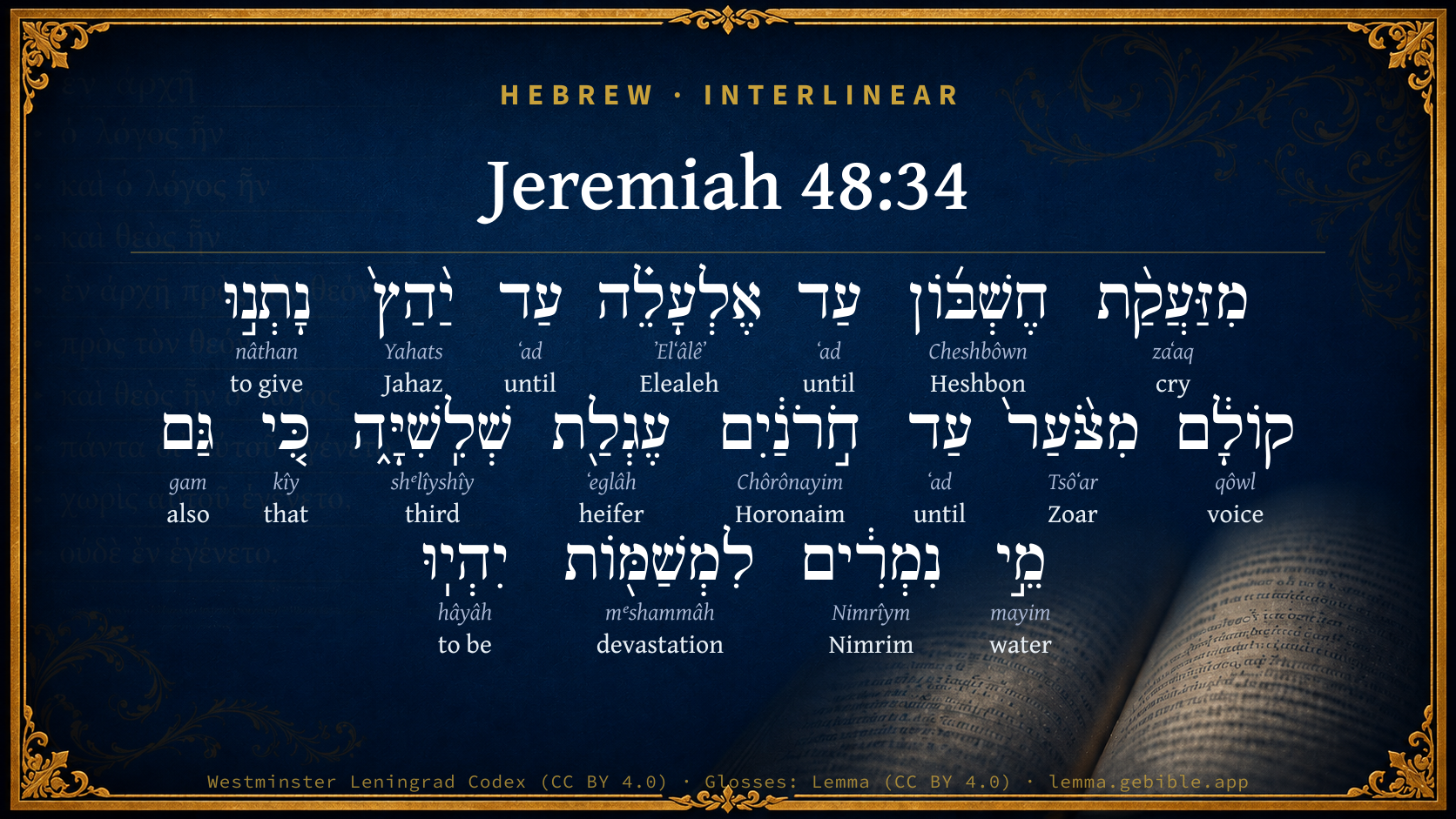
Hebrew (Westminster Leningrad Codex) Jeremiah 48:34 appears in the Hebrew Old Testament. The text above is from the Westminster Leningrad Codex. Each word links to its Strong’s number, a concise gloss, and parsing drawn from the Open Scriptures Hebrew Bible morphology. Click any word for its full Brown-Driver-Briggs (BDB) entry.
Download image
Cite this verse

Jeremiah 48:34 (World English Bible). Public Domain. Lemma interlinear Bible study tool, https://lemma.gebible.app/v/jeremiah/48/34.

Show BibTeX & RIS
BibTeX
RIS
English Translation
From the cry of Heshbon even to Elealeh, even to Jahaz have they uttered their voice, from Zoar even to Horonaim, to Eglath Shelishiyah: for the waters of Nimrim also shall become desolate.
World English Bible · Public Domain
Download a study sheet

One document with this verse’s original text, its word-by-word gloss line, the meaning frame, cross-references with their text, attributed commentary, and full source and license credits — printable, and it pastes into notes with its structure intact.

This verse Autodidact and up

Study sheet (.html) Plain text (.txt)

A passage Seminary Student

Up to 50 verses in one chapter. A passage sheet keeps up to 6 commentary sources and 12 cross-references per verse, in the order this page ranks them, and says so on the sheet whenever that leaves anything out. Ask for a single verse and you get the Autodidact verse sheet above.

Everything on this page stays free to read, with no account — the sheet is a download of what is already on screen, not access to it.

Want to remove ads? Support Godless Engineer
Compare translations 3

The same verse in 3 English versions, stacked beneath the original-language interlinear above. Click any original word for its lexicon entry.

Each is an independent rendering of the whole verse — the interlinear is not word-aligned to these translations.

Highlighted words mark where these versions differ — a whole-verse word diff, not a word-by-word alignment.

  • World English Bible Public Domain
    From the cry of Heshbon even to Elealeh, even to Jahaz have they uttered their voice, from Zoar even to Horonaim, to Eglath Shelishiyah: for the waters of Nimrim also shall become desolate.
  • King James Version Public Domain
    From the cry of Heshbon even unto Elealeh, and even unto Jahaz, have they uttered their voice, from Zoar even unto Horonaim, as an heifer of three years old: for the waters also of Nimrim shall be desolate.
  • unfoldingWord Literal Text CC BY-SA 4.0
    From the shouts at Heshbon as far as Elealeh, their sound is heard at Jahaz, from Zoar to Horonaim and Eglath Shelishiyah, since even the waters of Nimrim have dried up.

unfoldingWord Literal Text — © unfoldingWord, licensed CC BY-SA 4.0. Word-aligned USFM3 via Door43 (git.door43.org/unfoldingWord/en_ult).

Versions to compare (up to 4)

3 of 4 selected

Show all 18 translations

Every available English version of this verse, each an independent rendering of the whole verse.

  • World English Bible Public Domain
    From the cry of Heshbon even to Elealeh, even to Jahaz have they uttered their voice, from Zoar even to Horonaim, to Eglath Shelishiyah: for the waters of Nimrim also shall become desolate.
  • Berean Standard Bible Public Domain
    There is a cry from Heshbon to Elealeh; they raise their voices to Jahaz, from Zoar to Horonaim and Eglath-shelishiyah; for even the waters of Nimrim have dried up.
  • Majority Standard Bible Public Domain
    There is a cry from Heshbon to Elealeh; they raise their voices to Jahaz, from Zoar to Horonaim and Eglath-shelishiyah; for even the waters of Nimrim have dried up.
  • King James Version Public Domain
    From the cry of Heshbon even unto Elealeh, and even unto Jahaz, have they uttered their voice, from Zoar even unto Horonaim, as an heifer of three years old: for the waters also of Nimrim shall be desolate.
  • American Standard Version (1901) Public Domain
    From the cry of Heshbon even unto Elealeh, even unto Jahaz have they uttered their voice, from Zoar even unto Horonaim, to Eglath-shelishiyah: for the waters of Nimrim also shall become desolate.
  • Revised Version (1885) Public Domain
    From the cry of Heshbon even unto Elealeh, even unto Jahaz have they uttered their voice, from Zoar even unto Horonaim, to Eglath-shelishiyah: for the waters of Nimrim also shall become desolate.
  • Geneva Bible (1599) Public Domain
    From the cry of Heshbon vnto Elaleh and vnto Iahaz haue they made their noyse from Zoar vnto Horonaim, ye heiffer of three yere old shall go lowing: for ye waters also of Nimrim shalbe wasted.
  • Douay-Rheims (1899) Public Domain
    From the cry of Hesebon even to Eleale, and to Jasa, they have uttered their voice: from Segor to Oronaim, as a heifer of three years old: the waters also of Nemrim shall be very bad.
  • Young's Literal Translation Public Domain
    Because of the cry of Heshbon unto Elealeh, Unto Jahaz they have given their voice, From Zoar unto Horonaim, A heifer of the third `year', For even waters of Nimrim become desolations.
  • Literal Standard Version CC BY-SA 4.0
    Because of the cry of Heshbon to Elealeh, || They have given their voice to Jahaz, || From Zoar to Horonaim, || A heifer of the third [year], || For even [the] waters of Nimrim become desolations.
  • Unlocked Literal Bible CC BY-SA 4.0
    From the shouts at Heshbon as far as Elealeh, their sound is heard at Jahaz, from Zoar to Horonaim and Eglath Shelishiyah, since even the waters of Nimrim have dried up.
  • unfoldingWord Literal Text CC BY-SA 4.0
    From the shouts at Heshbon as far as Elealeh, their sound is heard at Jahaz, from Zoar to Horonaim and Eglath Shelishiyah, since even the waters of Nimrim have dried up.
  • Darby Bible Public Domain
    Because of the cry from Heshbon, unto Elaleh, unto Jahaz have they uttered their voice, from Zoar unto Horonaim, [unto] Eglath-shelishijah: for even the waters of Nimrim shall become desolations.
  • World Messianic Bible Public Domain
    From the cry of Heshbon even to Elealeh, even to Jahaz they have uttered their voice, from Zoar even to Horonaim, to Eglath Shelishiyah; for the waters of Nimrim will also become desolate.
  • Webster's Bible Public Domain
    From the cry of Heshbon even to Elealeh, and even to Jahaz, have they uttered their voice, from Zoar even to Horonaim, as a heifer of three years old: for the waters also of Nimrim shall be desolate.
  • Free Bible Version CC BY-SA 4.0
    Cries for help reach from Heshbon to Elealeh and all the way to Jahaz. They're shouting out from Zoar to Horonaim and Eglath-shelishiyah, for even the water in the Nimrim Brook has dried up.
  • Bible in Basic English Public Domain
    The cry of Heshbon comes even to Elealeh; to Jahaz their voice is sounding; from Zoar even to Horonaim and to Eglath-shelishiyah: for the waters of Nimrim will become dry.
  • JPS Tanakh (1917) Public Domain
    From the cry of Heshbon even unto Elealeh, even unto Jahaz have they uttered their voice, from Zoar even unto Horonaim, a heifer of three years old; for the Waters of Nimrim also shall be desolate.

Literal Standard Version (2020), Covenant Press — licensed CC BY-SA 4.0. Text via the HelloAO Bible API (eBible.org). Unlocked Literal Bible (unfoldingWord) — licensed CC BY-SA 4.0. Text via the HelloAO Bible API (eBible.org). unfoldingWord Literal Text — © unfoldingWord, licensed CC BY-SA 4.0. Word-aligned USFM3 via Door43 (git.door43.org/unfoldingWord/en_ult). Free Bible Version, Dr. Jonathan Gallagher — licensed CC BY-SA 4.0. Text via the HelloAO Bible API (eBible.org).

Word by word

More ways to search: Search by grammar → Find every occurrence → Compare this word →

Practice this passage: Drill this verse → Learn its vocabulary →

נִמְרִ֔ים
Nimrîym
H5249
“Nimrim”
Noun, Proper
Part of Speech
Noun
Type
Proper
Full BDB Definition

Origin: corresponding to H5247

TWOT: None

Nimrim = "limpid" or " pure" - a stream or brook in the territory of Moab
  1. מִזַּעֲקַ֨ת zaʻaq H2201 “from · cry of” Preposition + Noun, Common, Feminine, Singular, Construct
  2. חֶשְׁבּ֜וֹן Cheshbôwn H2809 “Heshbon” Noun, Proper
  3. עַד ʻad H5704 “until” Preposition
  4. אֶלְעָלֵ֗ה ʼElʻâlêʼ H500 “Elealeh” Noun, Proper
  5. עַד ʻad H5704 “until” Preposition
  6. יַ֨הַץ֙ Yahats H3096 “Jahaz” Noun, Proper
  7. נָתְנ֣וּ nâthan H5414 “to give” Verb, Qal, Perfect, 3rd Person, Common, Plural
  8. קוֹלָ֔ם qôwl H6963 “voice · their” Noun, Common, Masculine, Singular, Construct + Suffix, Personal, 3rd Person, Masculine, Plural
  9. מִצֹּ֨עַר֙ Tsôʻar H6820 “from · Zoar” Preposition + Noun, Proper
  10. עַד ʻad H5704 “until” Preposition
  11. חֹ֣רֹנַ֔יִם Chôrônayim H2773 “Horonaim” Noun, Proper
  12. עֶגְלַ֖ת ʻeglâh H5697 “heifer” Noun, Proper
  13. שְׁלִֽשִׁיָּ֑ה shᵉlîyshîy H7992 “third” Noun, Proper
  14. כִּ֚י kîy H3588 “that” Conjunction
  15. גַּם gam H1571 “also” Particle, Accusative
  16. מֵ֣י mayim H4325 “water(s) of” Noun, Common, Masculine, Plural, Construct
  17. לִמְשַׁמּ֖וֹת mᵉshammâh H4923 “to/for · devastations” Preposition + Noun, Common, Feminine, Plural, Absolute
  18. יִהְיֽוּ hâyâh H1961 “to be” Verb, Qal, Imperfect, 3rd Person, Masculine, Plural

About this verse

These counts appear in no published source. They are computed here, from the morphology-tagged text and Lemma’s own curated glosses. What Lemma adds →

19
words
17
distinct lemmas
Prophets
section

Notable vocabulary

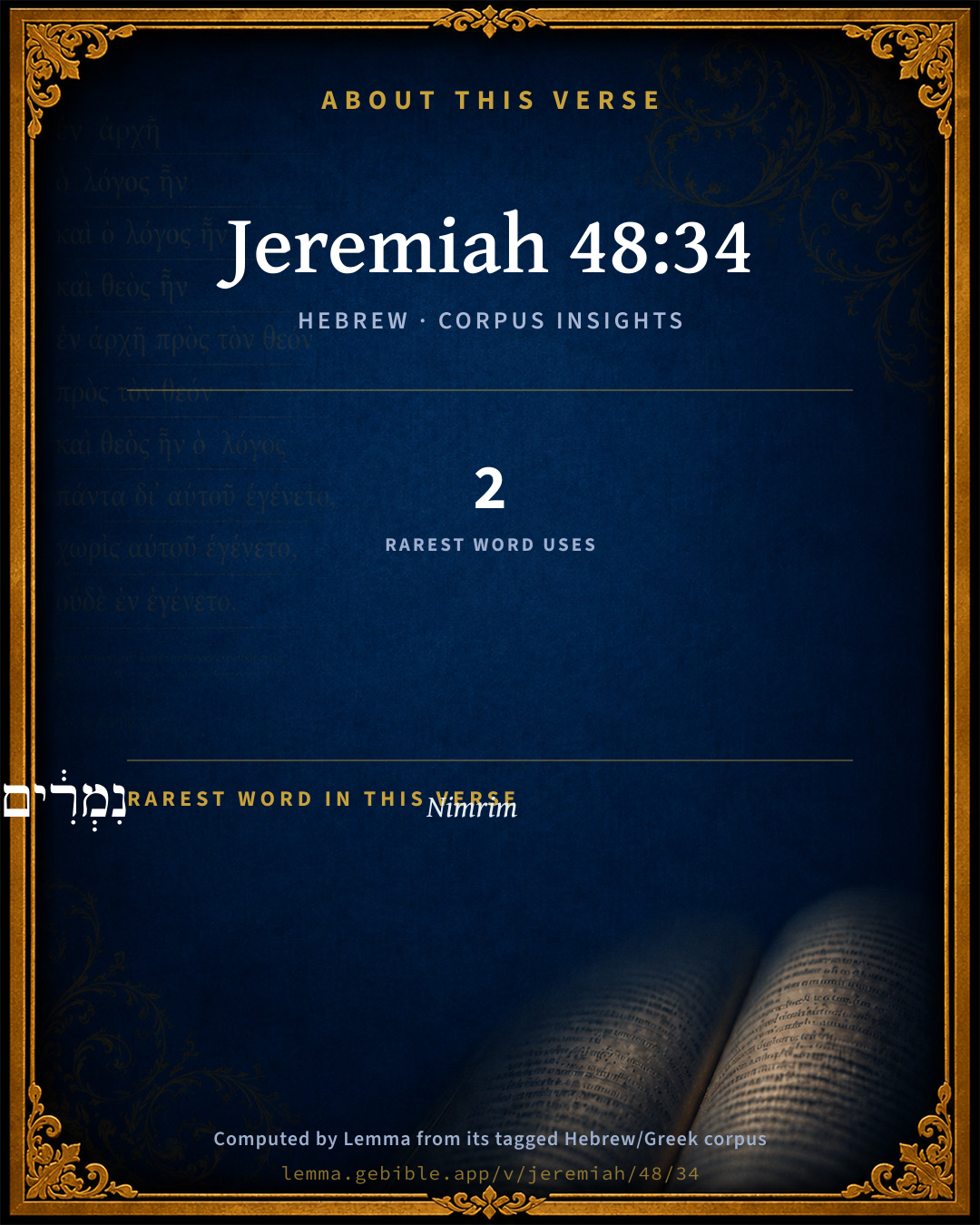
The rarest word here is נִמְרִ֔ים Nimrim H5249 — appearing just 2 times in the whole Hebrew Bible.

Shared distinctive vocabulary

נִמְרִ֔ים Nimrim H5249 occurs in 2 verses of the Hebrew Bible. Also found in:

Grammatical profile

  • 2 verbs
  • 12 nouns
  • 3 prepositions
  • 1 conjunction
  • 1 particle

Verb forms

  • נָתְנ֣וּ Qal · Perfect
  • יִהְיֽוּ Qal · Imperfect

Repetition

A word recurs within this verse — often emphatic in Hebrew:

Cross-references

7

Topical passages linked to Jeremiah 48:34 in the Treasury of Scripture Knowledge — connected by theme and wording, ordered by reader-vote popularity; previews shown in the World English Bible.

  • Isaiah 15:4–6 Heshbon cries out, and Elealeh; their voice is heard even to Jahaz: therefore the armed men of Moab cry aloud; his soul trembles within him.
  • Numbers 32:3 Ataroth, and Dibon, and Jazer, and Nimrah, and Heshbon, and Elealeh, and Sebam, and Nebo, and Beon,
  • Genesis 13:10 Lot lifted up his eyes, and saw all the plain of the Jordan, that it was well watered every where, before Yahweh destroyed Sodom and Gomorrah, like the garden of Yahweh, like the land of Egypt, as you go to Zoar.
  • Numbers 32:36–37 and Beth Nimrah, and Beth Haran: fortified cities, and folds for sheep.
  • Deuteronomy 34:3 and the South, and the Plain of the valley of Jericho the city of palm trees, to Zoar.
  • Jeremiah 48:2–3 The praise of Moab is no more; in Heshbon they have devised evil against her: Come, and let us cut her off from being a nation. You also, Madmen, shall be brought to silence: the sword shall pursue you.
  • Jeremiah 48:5 For by the ascent of Luhith with continual weeping shall they go up; for at the descent of Horonaim they have heard the distress of the cry of destruction.

Cross-references courtesy of OpenBible.info (CC BY 4.0).

Hebrew and Greek witnesses Masoretic Hebrew ↔ Greek Septuagint

The same verse in the two great witnesses to the Old Testament, shown verse-for-verse.

These are two independent witnesses, not word-aligned to each other, and the Septuagint is shown in lemma (dictionary) form.

Hebrew Jeremiah 48:34 Masoretic · Westminster Leningrad Codex

מִזַּעֲקַ֨ת חֶשְׁבּ֜וֹן עַד אֶלְעָלֵ֗ה עַד יַ֨הַץ֙ נָתְנ֣וּ קוֹלָ֔ם מִצֹּ֨עַר֙ עַד חֹ֣רֹנַ֔יִם עֶגְלַ֖ת שְׁלִֽשִׁיָּ֑ה כִּ֚י גַּם מֵ֣י נִמְרִ֔ים לִמְשַׁמּ֖וֹת יִהְיֽוּ

From the cry of Heshbon even to Elealeh, even to Jahaz have they uttered their voice, from Zoar even to Horonaim, to Eglath Shelishiyah: for the waters of Nimrim also shall become desolate.

World English Bible · Public Domain

Greek LXX Structure differs

In the Septuagint, Jeremiah is about an eighth shorter than the Hebrew and arranges its material differently — the Oracles Against the Nations (Hebrew chapters 46–51) appear in the middle of the Greek book, after 25:13. Because the chapter and verse boundaries do not line up, a verse-for-verse comparison with the Hebrew is not shown.

A verse-for-verse comparison isn’t shown here because the chapters and verses don’t line up. Switch to the LXX edition with the MT / LXX toggle above to read the Greek directly.

On this verse, Keil & Delitzsch discusses the Septuagint’s reading. Read the note in Commentary ↓

Hebrew: Westminster Leningrad Codex (CC BY 4.0). Greek: Septuagint (public domain); English from a public-domain English Septuagint. How the Septuagint differs from the Hebrew →

Targum (Aramaic paraphrase)

1

The Targum is the ancient Jewish Aramaic paraphrase of the Hebrew Scriptures — an interpretive translation, not the Hebrew text itself. Onkelos (literal) and Pseudo-Jonathan (expansive) render the Torah, and Jonathan the Prophets. Coverage is partial: where no permissively-licensed English translation exists for a verse, only the Aramaic is shown. This is verse-level text, not a word-by-word alignment to the Hebrew.

  1. Targum Jonathan Prophets (Joshua–Malachi)
    מִצִוְחַת חֶשְׁבּוֹן עַד אֶלְעָלֵה עַד יַהַץ אִשְׁתְּמַע קָלְהוֹן מִצוֹעַר עַד חוֹרוֹנַיִם עֶגְלַת תַּלְתִּית רַבְּתָא אֲרֵי אַף מֵי נְמָרִים לְצָדוּ יְהוֹן:

    (no public-domain English translation for this verse)

    Targum Jonathan — Aramaic: “Mikraot Gedolot” (public domain). English: “Sefaria Community Translation” (CC0 1.0 (public-domain dedication)); “London "Chaldee Paraphrase," 1871” (public domain). Text via Sefaria.

Commentary

Notes on Jeremiah 48:34 from classic Christian and Jewish commentators (each source and its license shown beneath its notes). The classic Christian expositions comment on the surrounding passage and are grouped to its opening verse, so a note may address several verses; the Jewish commentaries on the Tanakh (Rashi and others) are per-verse, so they appear only where the commentator wrote on this verse.

Lemma curates 59 commentaries, every one of them public domain or Creative Commons licensed, each selected and text-cleaned for this edition rather than reprinted as found. About our sources →

Trapp's Complete Commentary

John Trapp

Jer 48:34 From the cry of Heshbon [even] unto Elealeh, [and even] unto Jahaz, have they uttered their voice, from Zoar [even] unto Horonaim, [as] an heifer of three years old: for the waters also of Nimrim shall be desolate.

Ver. 34. From Heshbon even unto Elealeh.] See Isa 15:4-5; Isa 15:9.

As a heifer of three years old.] Which at that age beginneth to low after the bull.

John Trapp, A Commentary or Exposition upon All the Books of the Old and New Testament (1647–1656) — public domain. Text from a community e-Sword module.

Joseph Benson's Commentary

Jer 48:34-39. From the cry of Heshbon — When Heshbon was taken by the enemy, the cry of the inhabitants reached as far as Elealeh and Jahaz: the same was likewise heard from Zoar to Horonaim. As a heifer of three years old — The meaning undoubtedly is, that the cry of Moab, beginning at Heshbon, was continued on from city to city, till the whole country resounded as with the lowing of a cow that runs from place to place in search of her calf that has been taken from her. An image singularly expressive: see notes on Isa 15:4-6. I will cause to cease in Moab him that offereth in the high places — For an explanation of this and the next verse, see notes on Isa 16:11-12. For every head shall be bald, &c. — This and all the other expressions of this verse signify the greatness of the affliction, intimated by the manner of mourning, which is such as was used in the greatest calamities: compare Isa 15:3. I have broken Moab like a vessel wherein is no pleasure — As earthen vessels, if they are not fit for the use for which they were designed, are broken to pieces without any concern or regret, so as never to be repaired; thus have I broken Moab, saith the Lord. They shall howl, saying, How is it broken down! — Hebrew, חתה, broken to pieces, as the same word is twice rendered Jer 50:2. The prophet persists in his allusion to the breaking of an earthen vessel.

Joseph Benson's Commentary on the Old and New Testaments (1811–1818) — public domain. Text from a community e-Sword module.

Keil & Delitzsch

C. F. Keil & F. Delitzsch

Jer 48:34 is based on Isa 15:4-6. "From the cry of Heshbon is heard the echo as far as Elealeh and Jahaz," or "from Heshbon to Elealeh and Jahaz is heard a cry, and from Zoar to Horonaim." Heshbon and Elealeh are only about two miles distant from each other; their ruins are still visible under the names of Hesbn (Husban, see on Jer 48:2) and El Al (see on Num 32:37). They were both built on hills; Elealeh in particular was situated on the summit of a hill whence the whole of the southern Belka may be seen (Burckhardt, p. 365), so that a shout thence emitted could be heard at a great distance, even as far as Jahaz, which is pretty far off to the south-west from Heshbon (see on Jer 48:21). The words "from Zoar to Horonaim" also depend on "they uttered their voice." Both places lay in the south of the land; see on Jer 48:3 and Jer 48:4. The wailing resounds not merely on the north, but also on the south of the Arnon. There is much dispute as to the meaning of עגלת שׁלישׁיּה, which is here mentioned after Horonaim, but in Isa 15:5 in connection with, or after Zoar. To take the expression as an appellative, juvenca tertii anni (lxx, Vulgate, Targum, Gesenius, etc.), would perhaps be suitable, if it were an apposition to Moab, in which case we might compare with it passages like Jer 46:20; Jer 50:11; but this does not accord with its position after Horonaim and Zoar, for we have no analogy for the comparison of cities or fortresses with a juvenca tertii anni, h. e. indomita jugoque non assueta; and it cannot even be proved that Zoar and Horonaim were fortresses of Moab. Hence we take 'עגלת שׁ as the proper name of a place, "the third Eglath;" this is the view of Rosenmller, Drechsler, and Dietrich (in Merx' Archiv. i. S. 342ff.). The main reason for this view, is, that there would be no use for an addition being made, by way of apposition, to a place which is mentioned as the limit of the Moabites' flight, or that reached by their wailing. The parallelism of the clauses argues in favour of its being a proper name; for, on this view of it, three towns are named in both members, the first one, as the starting-point of the cry of wailing, the other two as points up to which it is heard. The preposition עד, which is omitted, may be supplied from the parallel member, as in Isa 15:8. Regarding the position of Eglath Shelishijah, it is evident from the context of both passages that we must look for it on the southern frontier of Moab. It is implied in the epithet "the third" that there were three places (villages), not far from one another, all bearing the same name. Dietrich (S. 344f.) has adduced several analogous cases of towns in the country to the east of the Jordan, - two, and sometimes even three, towns of the same name, which are distinguished from each other by numerals. "The waters of Nimrim also shall become desolations," because the enemy fill up the springs with earth. Nimrim is not the place called נמרה or בּית נמרה mentioned in Num 32:3, Num 32:36; Jos 13:27, whose ruins lie on the way from Szalt to Jericho, in the Wady Shaib, on the east side of the Jordan (see on Num 32:36), for this lies much too far to the north to be the place mentioned here. The context points to a place in the south, in Moab proper. where Burckhardt (p. 355), Seetzen (Reisen, ii. S. 354), and de Saulcy (Voyage, i. 283, ii. 52) have indicated a stream fed by a spring, called Moiet Numre (i.e., brook Nimrah), in the country at the south end of the Dead Sea, and in that wady a mass of ruins called Numre (the Nimmery of Seetzen, iii. 18).

Keil & Delitzsch — Biblical Commentary on the Old Testament (1861–1891) — public domain (CC PDM 1.0). Text via the HelloAO Bible API. (Old Testament only.)

Tyndale Open Study Notes

Tyndale Open Resources

48:34-39 These verses describe the effects of the Lord’s judgment on the Moabite people. • The Moabite towns listed here were located along the small rivers that flow from the east into the Dead Sea.

Tyndale Open Study Notes — © Tyndale Open Resources, licensed CC BY-SA 4.0. Text via the HelloAO Bible API.

Geneva Bible (1599)

Geneva Bible translators

Read Isa. 15:5.

Geneva Bible (1599) marginal notes — public domain. Text via Bolls.life.

Jamieson, Fausset & Brown

Robert Jamieson, A. R. Fausset & David Brown

From the cry of Heshbon, &c.--Those who fly from Heshbon on its capture shall continue the cry even as far as Elealeh . . . . There will be continued cries in all quarters, from one end to the other, everywhere slaughter and wasting.

as an heifer of three years old--Moab heretofore not having known foreign yoke, and in its full strength, is compared to an heifer of three years old, never yet yoked, nor as yet worn out with many birth-givings (compare Note, see on Isa 15:5).

waters . . . of Nimrim--that is, the well-watered and therefore luxuriant pastures of Nimrim.

desolate--The Hebrew is stronger: not merely shall be "desolate," but desolation itself multiplied: plural, "desolations." The most fertile tracts shall be dried up.

Jamieson, Fausset & Brown — Commentary Critical and Explanatory on the Whole Bible (1871) — public domain (CC PDM 1.0). Text via the HelloAO Bible API.

Adam Clarke's Commentary

Verse 34. As a heifer of three years old] Which runs lowing from place to place in search of her calf, which is lost or taken from her.

Adam Clarke's Commentary on the Bible (1810–1826) — public domain. Text from a community e-Sword/MySword module.

John Calvin's Commentaries

He continues the same subject; and by many and various expressions confirms the same thing, in order that the faithful might know that the destruction of the Moabites was really foretold, and that they might feel more assured that God announced nothing but what he would presently execute.

At the cry of Heshbon even to Elealeh they shall send forth their voice. He means, as before, that there would be continued cryings and howlings sounding forth from every part, and spreading through every region. He then adds, From Zoar to Horonaim We must bear in mind the situations of these cities; but we may suppose that the Prophet chose those cities which were opposite to each other. Then from one corner to the other continual crying would be heard, because there would be everywhere desolation and ruin. And then he comes to another part, from one city even to another there would be a similar cry. In short, he shews that no part in the whole land of Moab would be in a quiet state and free from miseries. This is the meaning.

But he compares the whole land of Moab, or the city Horonaim, to an heifer three years old, on account of its lasciviousness. Some restrict the comparison to the city Horonaim, for they read the words in apposition, “to Heronaim, an heifer three years old,” putting the last words in the accusative case: but others read them apart, “an heifer three years old” is Moab. And I prefer this construction, because he afterwards adds another city, even Nimrim. As, however, it is a matter of no great moment, I will not contend with any one who may take the other view. Whether then it be one city or the whole country, it is compared to an heifer three years old, because that nation had long luxuriated in its own pleasures. Now, an heifer three years old, as it is well known, frisks and leaps, because it knows not what it is to fear the yoke; and then it is not worn out, as the case is with cows, who are weakened by having often brought forth young; and further, the milk that is taken from them exhausts their strength. But all heifer three years old is in her rigor and prime. In short, the Prophet intimates that the Moabites lived well, and as it were unrestrained, for they had long exulted in their abundance; and as they had plenty of wine and bread, they gave themselves up to luxury.

He then adds, Surely even the waters of Nimrim shall be a desolation Some think Nimrim to have been a city, and it is elsewhere called Nimra. Its waters are also mentioned by Isaiah, as the brooks of the willows. We may hence conclude that these waters were perpetual and flowed continually. But the Prophet speaks metaphorically as before, for the meaning is, that nothing would be so safe in the land of Moab as not to be destroyed, that nothing would be so fruitful as not to be dried up. Then by the waters of Nimrim he means the abundance which was in the whole country. For the Chaldeans did not dry up that river or those lakes, for it is certainly unknown whether there was a river there or a lake. But it is probable that there was there abundance of waters, which were not dried up by the coming of an hostile army; but, as I have said, he shews by these figurative expressions that the whole land of Moab would be laid waste. It follows —

John Calvin's Commentaries (1540-1563) — public domain. Text from the Calvin Translation Society English edition (1840s-50s) via the Christian Classics Ethereal Library (ccel.org). Calvin's coverage is partial (roughly two-thirds of the Bible); uncommented books and verses are honest gaps, never fabricated. The 19th-century editor's footnotes and remarks are omitted so the notes are faithfully Calvin's own voice.

Ellicott's Commentary for English Readers

(34) From the cry of Heshbon . . .—Elealeh (now El-Al) and Heshbon (now Hesbân) were about two miles apart. The panic-cry of the one city was echoed in the other; it reached even to Jahaz (see Note on Jer_48:21), to the south-west of Heshbon.

From Zoar even unto Horonaim . . .—Both names represent the south district of Moab. In the “heifer of three years old” (see Isa_15:5) many critics find simply a proper name, “the third Eglath,” and conjecture that it was either one of three towns having the same name, or part of a tripolis or tripartite city, the other two members of which were Zoar and Horonaim. Nothing is known, however, of any town so constituted, and the epithet of the “third-year heifer,” i.e., a heifer not brought under the yoke, would be a suitable name enough for either Zoar or Horonaim, as a virgin fortress, as yet untaken by the foe. (Comp. Hos_4:16; Hos_10:11.)

The waters also of Nimrim shall be desolate.—Recent travellers, Seetzen and De Saulcy, have found a brook Nimrah, with a mass of ruins near it, near the southern extremity of the Dead Sea. The Nimrah of Num_32:3; Num_32:36; Josh. 14:27, is probably too far to the north. Tristram (Land of Israel, p. 54) identifies it with the Wady-Shaib near the fords of the Jordan, and possibly with the Bethabara of Joh_1:28.

A Bible Commentary for English Readers, edited by Charles John Ellicott (1878–1897) — public domain. Text from a community e-Sword module.

The Cambridge Bible for Schools and Colleges

gen. ed. J. J. S. Perowne

34. Abbreviated from Isa_15:4-6. The first words need emendation; “How criest thou, O H. and El.” (Gi.), or “Crying are H. and El.” (Du.). Elealeh according to Conder (HBD.) was about a mile N. of Heshbon. For the other towns see notes above.

Eglath-shelishiyah] mg. much less suitably, as an heifer of three years old. The Hebrew apparently means the third Eglath, i.e. as distinct from two other neighbouring Eglaths. Pe. compares “the three Strettons which are close together, Little Stretton, Church Stretton, and All Stretton.”

Nimrim] probably the modern Wady Numeirah at the S.E. end of the Dead Sea.

desolate] lit. desolations. The sources of water-supply shall be cut off. Cp. 2Ki_3:25.

The Cambridge Bible for Schools and Colleges (gen. ed. J. J. S. Perowne; Cambridge University Press, 1878–1918) — public domain. Text from a community e-Sword module.

John Gill's Exposition

Moreover I will cause to cease in Moab, saith the Lord, him that offereth in the high places,.... A burnt offering there; that is, the priest, who shall be taken and carried captive, Jer 48:7; even everyone of them; so that there will not be one left to otter sacrifice:

and him that burneth incense to his gods: Chemosh, and others, the Moabites worshipped: this suggests that idolatry was one of the sins for which they were punished; and as all places and all sorts of persons should suffer in this calamity, so likewise idolatrous places, priests, and worshippers.

John Gill's Exposition of the Whole Bible (1746–1763) — public domain (CC PDM 1.0). Text via the HelloAO Bible API.

Albert Barnes' Notes on the Bible

The meaning is that, taking up the lamentation of Heshbon, the Moabites break forth into a wail, heard as far as Elealeh, scarcely two miles distant Num 32:37, but thence spreading over the land to towns on the southern and southwestern borders of the land.

An heifer of three years old - Applied in Isa 15:5 to Zoar, but here to Horonaim. Some take “an heifer” as a proper name, and render it: “Eglah for the third part” (compare Isa 19:24). Zoar, Horonaim, and Eglah formed a tripolis, or confederacy of three towns, and Eglah might therefore be put after either one or the other.

Nimrim - Probably the Wady-en-Nemeirah at the southeastern end of the Dead Sea.

Albert Barnes' Notes on the Bible (1834–1885) — public domain. Text from a community e-Sword/MySword module.

Haydock's Catholic Bible Commentary

As a. Literally, "the heifer;" a title of Oronaim, which was proud and ungovernable. (Haydock) --- Hebrew also, "from Agelah to Salisa; the," &c. --- Bad; abandoned, Isaias xv. 6. (Calmet)

George Leo Haydock (1774–1849), Haydock's Catholic Family Bible and Commentary, 1859 edition — public domain. Excludes Psalms (Douay-Rheims chapter numbering differs from Protestant) and Deuterocanonical books (Catholic canon only).

Matthew Poole's English Annotations

An heifer of three years old. See Isa 15:5.

Heshbon, and

Elealeh, and

Jahaz, and

Zoar, and

Horonaim, were all cities of Moab, who are here all threatened with ruin; with the country about Nimrim; which Nimrim is mentioned no where in Scripture but here, and in Isa 15:6; nor are interpreters well agreed, whether in this place it be the name of a river, or a lake, or a city. The sense is, the whole country of Moab shall be destroyed, the cry shall reach from one part of the country to another, either the cry of the inhabitants, or of their enemies pursuing them with a great noise.

Matthew Poole's English Annotations on the Holy Bible (1683–1685) — public domain. Text from a community e-Sword/MySword module.

Whedon's Commentary on the Bible

Daniel D. Whedon

34. Heshbon… unto Elealeh — This verse is based on Isa_15:4. Heshbon and Elealeh are about two miles distant from each other. Their ruins are still visible. It is not impossible that a shout of wailing on one height may be heard on the other, and yet this supposition is not necessary to the understanding of the passage.

As a heifer of three years old — The force of this comparison is not very evident. If it embraced not a single locality, but Moab as a whole, it would be more intelligible as suggesting a land which had never been brought under the yoke, subjugated. Keil regards the original as a proper name, and translates from Zoar as far as Horonaim and the third Eglath. He explains the ordinal on the theory that there were three places of the same name which were distinguished. This, though conjectural, may be accepted as not without value.

Waters… of Nimrim — This “Nimrim” cannot be the Nimrah of Num_32:3; Num_32:36, and Jos_13:27, for they must be too far north for this verse. It must be some well watered district of Moab.

Daniel D. Whedon (gen. ed.), Commentary on the Old and New Testaments (1874–1909) — public domain. Text from a community e-Sword module.

The Pulpit Commentary

Based on Isa_15:4-6. The cry of one town echoes to another, and is taken up afresh by its terrified inhabitants. Heshbon and Elealeh lay on eminences but a short distance apart, so that the shrill cry of lamentation would be heard far away in the southeast at Jahaz. Zoar and Horonaim both lay in the southern half of Moah (see on vers. 3, 4). A heifer of three years old. If this is the right rendering, the phrase is descriptive of Horonaim, which may, in the time of Jeremiah, have been a "virgin fortress." But the phrase, thus understood, comes in very oddly, and in the parallel passage in Isaiah it stands, not after Horonaim, hut after Zoar; it hardly seems likely that there were two Gibraltars in Moab. Another rendering (Ewald, Keil) is, "(to) the third Eglath." This involves an allusion to the fact that there were other places in Moab called Egiath or Eglah, which has been rendered highly probable by Gesenius. The waters also of Nimrhn. Canon Tristram speaks of the "plenteous brooks gushing from the lofty hills into the Ghor-en-Numeira." Consul Wetzstein, however, says that nature appears there under so unspeakably gloomy an aspect, that the identification is impossible. He proposes a site in the Wady So"eb, about fourteen miles east of the Jordan, which with its luxuriant meadows, covered with the flocks of the Bedouin, is probably suitable to the passages in Isaiah and Jeremiah (Excursus it. in Delitzsch"s "Jesaja," 4th edit., pp. 572, 573). So also Seetzen, who remarks that the lower part of this wady is still called Nahr Nimrin. In Jos_13:27 a place called Beth nimrah is mentioned as situated in the valley (i.e. the Jordan valley); no doubt this was in the wady referred to by the prophets. "The valley" seems to have been sometimes used in a wider signification, so as to include lateral valleys like that of Nimrim. The antiquity of the name is shown by its occurrence in the Annals of Thothmos III, who penetrated into the heart of Palestine, and, in the temple of Karnak, enumerates the cities which he conquered. From before B.C. 1600 to nearly A.D. 1900 this secluded valley has borne precisely the same name!

The Pulpit Commentary (1880–1919), ed. H.D.M. Spence-Jones & Joseph S. Exell — public domain. Text from a community e-Sword module.

unfoldingWord translationNotes

Door43 World Missions Community

Heshbon

Translate the name of this city as you did in Jeremiah 48:2. (See: How to Translate Names)

Elealeh ... Jahaz ... Zoar ... Horonaim ... Eglath Shelishiyah

These are names of other cities in Moab. (See: How to Translate Names)

Nimrim

This is the name of a stream or river near the Dead Sea. (See: How to Translate Names)

this is Yahweh's declaration

Yahweh speaks of himself by name to express the certainty of what he is declaring. See how you translated this in Jeremiah 1:8. AT: "this is what Yahweh has declared" or "this is what I, Yahweh, have declared" (See: First, Second, or Third Person)

translationWords

water

sacrifice

high place

incense

false god

unfoldingWord translationNotes — © Distant Shores Media and the Door43 World Missions Community, licensed CC BY-SA 4.0. Source: git.door43.org/Door43/en_tn.

Rashi

Rabbi Shlomo Yitzchaki (Rashi)

O third born heifer Heb. עגלת שלישיה, mighty province.

Rashi on the Tanakh — English translations: “The Judaica Press complete Tanach with Rashi, translated by A. J. Rosenberg” (CC BY 4.0); “Pentateuch with Rashi's commentary by M. Rosenbaum and A.M. Silbermann, 1929-1934” (public domain); “The Metsudah Tanach series, Lakewood, N.J” (CC BY 4.0); and “The Book of Joshua, Metsudah Publications, 1997” (CC BY 4.0). Text via Sefaria.

Lesson kit

Teaching starters — assembled from the data on this page, not authored interpretation. Every prompt links to the verse data it draws on. Edit before teaching.

Jeremiah, in the Prophets, opens this verse with 19 words (17 distinct Hebrew lemmas). Its most distinctive word is Nimrîym (“Nimrim”). A historical commentator’s framing appears above. Read the whole chapter for the surrounding context.

Discussion questions

  1. The word Nimrîym carries the sense “Nimrim.” How does it shape the verse?
  2. Isaiah 15:6 shares the word «Nimrim» with this verse. How do the two illuminate each other?
  3. “until” occurs 3× in this one verse. What is the effect of the repetition?
  4. The translations on this page render this verse differently — a whole-verse word diff, not a word-by-word alignment. What might account for the different wordings?
  5. The verb «נָתְנ֣וּ» is Qal Perfect. How does its form color the action?
  6. Reading how Trapp's Complete Commentary and Joseph Benson's Commentary read this verse, where do the two commentators agree and where do they part?

Things to notice

Reading settings

Reading text

Shown beneath each verse's original-language words.

Old Testament
Old Testament edition

Read the OT as the Masoretic Hebrew (MT) or the Greek Septuagint (LXX).

English shown for the Greek Septuagint (in the Hebrew ↔ Greek comparison).

Comparing translations? Open the Compare panel on any verse page to stack up to four side by side.