Zechariah 6:3

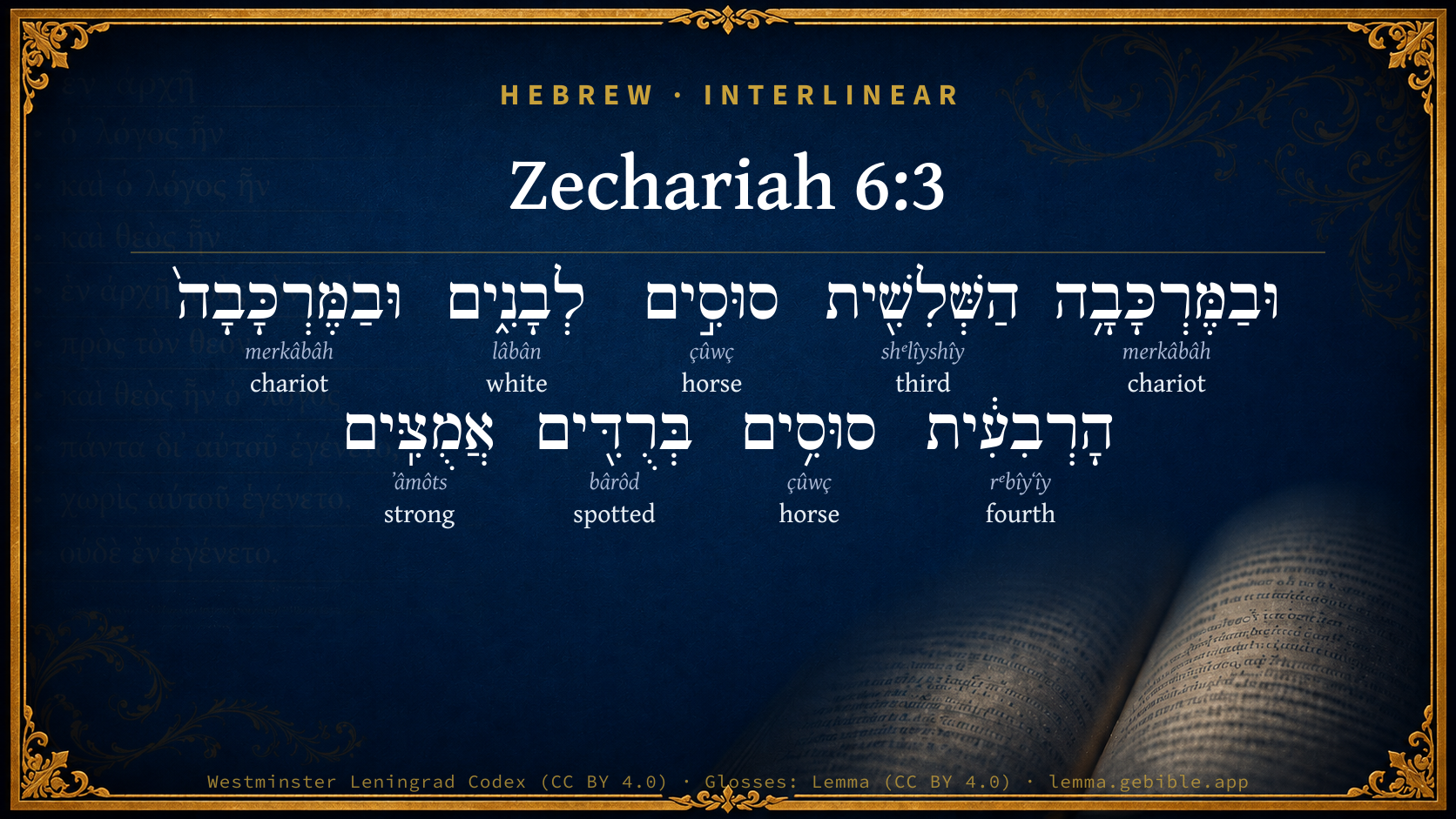
Hebrew (Westminster Leningrad Codex) Zechariah 6:3 appears in the Hebrew Old Testament. The text above is from the Westminster Leningrad Codex. Each word links to its Strong’s number, a concise gloss, and parsing drawn from the Open Scriptures Hebrew Bible morphology. Click any word for its full Brown-Driver-Briggs (BDB) entry.
Download image
Cite this verse

Zechariah 6:3 (World English Bible). Public Domain. Lemma interlinear Bible study tool, https://lemma.gebible.app/v/zechariah/6/3.

Show BibTeX & RIS
BibTeX
RIS
English Translation
in the third chariot white horses; and in the fourth chariot dappled horses, all of them powerful.
World English Bible · Public Domain
Highlights
  • 1 first appearance in the Hebrew Bible
Full analysis ↓
Download a study sheet

One document with this verse’s original text, its word-by-word gloss line, the meaning frame, cross-references with their text, attributed commentary, and full source and license credits — printable, and it pastes into notes with its structure intact.

This verse Autodidact and up

Study sheet (.html) Plain text (.txt)

A passage Seminary Student

Up to 50 verses in one chapter. A passage sheet keeps up to 6 commentary sources and 12 cross-references per verse, in the order this page ranks them, and says so on the sheet whenever that leaves anything out. Ask for a single verse and you get the Autodidact verse sheet above.

Everything on this page stays free to read, with no account — the sheet is a download of what is already on screen, not access to it.

Want to remove ads? Support Godless Engineer
Compare translations 3

The same verse in 3 English versions, stacked beneath the original-language interlinear above. Click any original word for its lexicon entry.

Each is an independent rendering of the whole verse — the interlinear is not word-aligned to these translations.

Highlighted words mark where these versions differ — a whole-verse word diff, not a word-by-word alignment.

  • World English Bible Public Domain
    in the third chariot white horses; and in the fourth chariot dappled horses, all of them powerful.
  • King James Version Public Domain
    And in the third chariot white horses; and in the fourth chariot grisled and bay horses.
  • unfoldingWord Literal Text CC BY-SA 4.0
    and in the third chariot white horses, and in the fourth chariot spotted, strong horses.

unfoldingWord Literal Text — © unfoldingWord, licensed CC BY-SA 4.0. Word-aligned USFM3 via Door43 (git.door43.org/unfoldingWord/en_ult).

Versions to compare (up to 4)

3 of 4 selected

Show all 18 translations

Every available English version of this verse, each an independent rendering of the whole verse.

  • World English Bible Public Domain
    in the third chariot white horses; and in the fourth chariot dappled horses, all of them powerful.
  • Berean Standard Bible Public Domain
    the third white horses, and the fourth dappled horses—all of them strong.
  • Majority Standard Bible Public Domain
    the third white horses, and the fourth dappled horses—all of them strong.
  • King James Version Public Domain
    And in the third chariot white horses; and in the fourth chariot grisled and bay horses.
  • American Standard Version (1901) Public Domain
    and in the third chariot white horses; and in the fourth chariot grizzled strong horses.
  • Revised Version (1885) Public Domain
    and in the third chariot white horses; and in the fourth chariot grisled bay horses.
  • Geneva Bible (1599) Public Domain
    And in the thirde charet white horses, and in the fourth charet, horses of diuers colours, and reddish.
  • Douay-Rheims (1899) Public Domain
    And in the third chariot white horses, and in the fourth chariot grisled horses, and strong ones.
  • Young's Literal Translation Public Domain
    and in the third chariot white horses, and in the fourth chariot strong grisled horses.
  • Literal Standard Version CC BY-SA 4.0
    and in the third chariot white horses, and in the fourth chariot strong spotted horses.
  • Unlocked Literal Bible CC BY-SA 4.0
    the third chariot had white horses, and the fourth chariot had spotted gray horses.
  • unfoldingWord Literal Text CC BY-SA 4.0
    and in the third chariot white horses, and in the fourth chariot spotted, strong horses.
  • Darby Bible Public Domain
    and in the third chariot white horses; and in the fourth chariot grisled, strong horses.
  • World Messianic Bible Public Domain
    In the third chariot were white horses. In the fourth chariot were dappled horses, all of them powerful.
  • Webster's Bible Public Domain
    And in the third chariot white horses; and in the fourth chariot grizzled and bay horses.
  • Free Bible Version CC BY-SA 4.0
    the third by white horses, and the fourth by dappled grey horses—all of them strong horses.
  • Bible in Basic English Public Domain
    And in the third, white horses; and in the fourth, horses of mixed colour.
  • JPS Tanakh (1917) Public Domain
    and in the third chariot white horses; and in the fourth chariot grizzled bay horses.

Literal Standard Version (2020), Covenant Press — licensed CC BY-SA 4.0. Text via the HelloAO Bible API (eBible.org). Unlocked Literal Bible (unfoldingWord) — licensed CC BY-SA 4.0. Text via the HelloAO Bible API (eBible.org). unfoldingWord Literal Text — © unfoldingWord, licensed CC BY-SA 4.0. Word-aligned USFM3 via Door43 (git.door43.org/unfoldingWord/en_ult). Free Bible Version, Dr. Jonathan Gallagher — licensed CC BY-SA 4.0. Text via the HelloAO Bible API (eBible.org).

Word by word

More ways to search: Search by grammar → Find every occurrence → Compare this word →

Practice this passage: Drill this verse → Learn its vocabulary →

אֲמֻצִּֽים
ʼâmôts
H554
“strong”
Adjective, Adjective, Masculine, Plural, Absolute
Part of Speech
Adjective
Type
Adjective
Gender
Masculine
Number
Plural
State
Absolute
Full BDB Definition

Origin: probably from H553

TWOT: 117c

strong - bay, dappled, piebald (of colour)
  1. וּבַמֶּרְכָּבָ֥ה merkâbâh H4818 “and · in/at the · chariot” Conjunction + Preposition, Determined + Noun, Common, Feminine, Singular, Absolute
  2. הַשְּׁלִשִׁ֖ית shᵉlîyshîy H7992 “the · third” Particle, Definite Article + Adjective, Ordinal number, Feminine, Singular, Absolute
  3. סוּסִ֣ים çûwç H5483 “horses” Noun, Common, Masculine, Plural, Absolute
  4. לְבָנִ֑ים lâbân H3836 “white” Adjective, Adjective, Masculine, Plural, Absolute
  5. וּבַמֶּרְכָּבָה֙ merkâbâh H4818 “and · in/at the · chariot” Conjunction + Preposition, Determined + Noun, Common, Feminine, Singular, Absolute
  6. הָרְבִעִ֔ית rᵉbîyʻîy H7243 “the · fourth” Particle, Definite Article + Adjective, Ordinal number, Feminine, Singular, Absolute
  7. סוּסִ֥ים çûwç H5483 “horses” Noun, Common, Masculine, Plural, Absolute
  8. בְּרֻדִּ֖ים bârôd H1261 “spotted” Adjective, Adjective, Masculine, Plural, Absolute

About this verse

These counts appear in no published source. They are computed here, from the morphology-tagged text and Lemma’s own curated glosses. What Lemma adds →

9
words
7
distinct lemmas
Prophets
section

Notable vocabulary

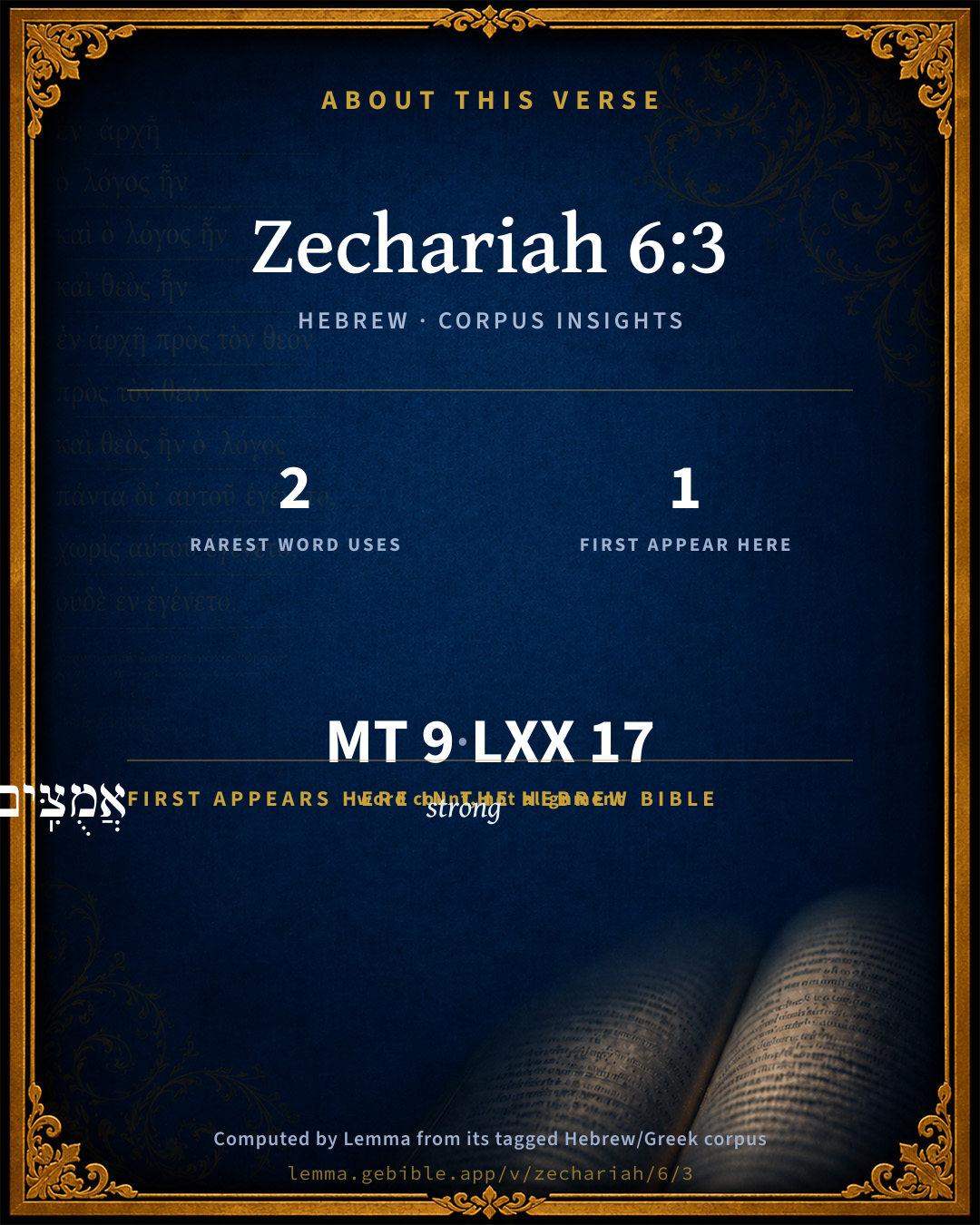
The rarest word here is אֲמֻצִּֽים strong H554 — appearing just 2 times in the whole Hebrew Bible.

First appearance in Scripture

This word makes its first canonical appearance in the Hebrew Bible here:

  • אֲמֻצִּֽים strong H554

Shared distinctive vocabulary

אֲמֻצִּֽים strong H554 occurs in 2 verses of the Hebrew Bible. Also found in:

Grammatical profile

  • 4 nouns
  • 5 adjectives

Repetition

Words recur within this verse — often emphatic in Hebrew:

  • וּבַמֶּרְכָּבָ֥ה chariot H4818 ×2
  • סוּסִ֣ים horse H5483 ×2

Hebrew & Septuagint length

In English translation the verse runs 17 words from the Hebrew and 16 from the Septuagint (LXX English) — closely comparable.

A rough comparison of the two English renderings, which tokenize alike — not a word-level alignment.

Word counts can differ between the Hebrew and the Greek without any difference in meaning — e.g. the Hebrew direct-object marker אֵת has no separate Greek word, and Greek often adds the article ὁ.

In the original languages it is 9 Hebrew tokens and 17 Greek tokens — but the two are counted differently (Hebrew bundles its prefixes and suffixes into one token; the Greek is in lemma form), so that isn’t a like-for-like length.

Cross-references

8

Topical passages linked to Zechariah 6:3 in the Treasury of Scripture Knowledge — connected by theme and wording, ordered by reader-vote popularity; previews shown in the World English Bible.

  • Revelation 6:2 And behold, a white horse, and he who sat on it had a bow. A crown was given to him, and he came forth conquering, and to conquer.
  • Revelation 6:8 And behold, a pale horse, and he who sat on it, his name was Death. Hades followed with him. Authority over one fourth of the earth, to kill with the sword, with famine, with death, and by the wild animals of the earth was given to him.
  • Zechariah 1:8 "I had a vision in the night, and, behold, a man riding on a red horse, and he stood among the myrtle trees that were in a ravine; and behind him there were red, brown, and white horses.
  • Daniel 2:33 its legs of iron, its feet part of iron, and part of clay.
  • Daniel 2:40–41 The fourth kingdom shall be strong as iron, because iron breaks in pieces and subdues all things; and as iron that crushes all these, shall it break in pieces and crush.
  • Revelation 19:11 I saw the heaven opened, and behold, a white horse, and he who sat on it is called Faithful and True. In righteousness he judges and makes war.
  • Revelation 20:11 I saw a great white throne, and him who sat on it, from whose face the earth and the heaven fled away. There was found no place for them.
  • Zechariah 6:6–7 The one with the black horses goes out toward the north country; and the white went out after them; and the dappled went forth toward the south country."

Cross-references courtesy of OpenBible.info (CC BY 4.0).

Hebrew and Greek witnesses Masoretic Hebrew ↔ Greek Septuagint

The same verse in the two great witnesses to the Old Testament, shown verse-for-verse.

These are two independent witnesses, not word-aligned to each other, and the Septuagint is shown in lemma (dictionary) form.

Hebrew Zechariah 6:3 Masoretic · Westminster Leningrad Codex

וּבַמֶּרְכָּבָ֥ה הַשְּׁלִשִׁ֖ית סוּסִ֣ים לְבָנִ֑ים וּבַמֶּרְכָּבָה֙ הָרְבִעִ֔ית סוּסִ֥ים בְּרֻדִּ֖ים אֲמֻצִּֽים

in the third chariot white horses; and in the fourth chariot dappled horses, all of them powerful.

World English Bible · Public Domain

Greek LXX Zechariah 6:3 Septuagint · lemma form

καί ἐν ὁ ἅρμα ὁ τρίτος ἵππος λευκός καί ἐν ὁ ἅρμα ὁ τέταρτος ἵππος ποικίλος ψαρός

and in the third chariot white horses; and in the fourth chariot piebald and ash-colored horses.

LXX2012 (modern English Septuagint) · Public Domain

On this verse, Jamieson, Fausset & Brown discusses the Septuagint’s reading. Read the note in Commentary ↓

Hebrew: Westminster Leningrad Codex (CC BY 4.0). Greek: Septuagint (public domain); English from LXX2012 (modern English Septuagint) (Public Domain). How the Septuagint differs from the Hebrew →

Targum (Aramaic paraphrase)

1

The Targum is the ancient Jewish Aramaic paraphrase of the Hebrew Scriptures — an interpretive translation, not the Hebrew text itself. Onkelos (literal) and Pseudo-Jonathan (expansive) render the Torah, and Jonathan the Prophets. Coverage is partial: where no permissively-licensed English translation exists for a verse, only the Aramaic is shown. This is verse-level text, not a word-by-word alignment to the Hebrew.

  1. Targum Jonathan Prophets (Joshua–Malachi)
    וּבִרְתִיכָא תְלִיתָאָה סוּסְוָן חַוָרִין וּבִרְתִיכָא רְבִיעֲתָא סוּסְוָן פַּצִיחִין קִטְמָנִין:

    (no public-domain English translation for this verse)

    Targum Jonathan — Aramaic: “Mikraot Gedolot” (public domain). English: “Sefaria Community Translation” (CC0 1.0 (public-domain dedication)); “London "Chaldee Paraphrase," 1871” (public domain). Text via Sefaria.

Commentary

Notes on Zechariah 6:3 from classic Christian and Jewish commentators (each source and its license shown beneath its notes). The classic Christian expositions comment on the surrounding passage and are grouped to its opening verse, so a note may address several verses; the Jewish commentaries on the Tanakh (Rashi and others) are per-verse, so they appear only where the commentator wrote on this verse.

Lemma curates 59 commentaries, every one of them public domain or Creative Commons licensed, each selected and text-cleaned for this edition rather than reprinted as found. About our sources →

Geneva Bible (1599)

Geneva Bible translators

Which signified, that God would sometimes give his Church rest, and pour his plagues upon their enemies, as he did in destroying Nineveh and Babylon, and others their enemies.

These represented their state under the Persians, which restored them to liberty.

Geneva Bible (1599) marginal notes — public domain. Text via Bolls.life.

Jamieson, Fausset & Brown

Robert Jamieson, A. R. Fausset & David Brown

white--implying joy and victory [CALVIN].

grizzled--piebald. Implying a mixed dispensation, partly prosperity, partly adversity. All four dispensations, though various in character to the Gentile nation, portended alike good to God's people.

bay--rather, "strong" or "fleet"; so Vulgate [GESENIUS]. The horses have this epithet, whose part it was to "walk to and fro through the earth" (Zac 6:7). However, the Septuagint and Chaldee agree with English Version in referring the Hebrew to color, not strength.

Jamieson, Fausset & Brown — Commentary Critical and Explanatory on the Whole Bible (1871) — public domain (CC PDM 1.0). Text via the HelloAO Bible API.

Adam Clarke's Commentary

Verse 3. The third chariot white horses] The empire of the Greeks, founded by Alexander the Great, which destroyed the empire of the Persians.

The fourth chariot grisled and bay horses.] That is party-coloured horses; or with horses, some grisled and some bay. The empire of the Romans or of the Greeks. The Greeks divided after the death of Alexander; one part pointing out the Lagidae, who attacked and subdued Egypt; and the other, the Seleucidae, who subdued Syria under Seleucus.

Adam Clarke's Commentary on the Bible (1810–1826) — public domain. Text from a community e-Sword/MySword module.

John Calvin's Commentaries

As to the last chariot, the Prophet says, that it went forth toward the south, and then it went elsewhere, and even through the whole world, for God had so permitted.

Now as to the meaning of this Prophecy nothing will remain obscure, if we hold these elements of truth — that all events are designated by the chariots, or all the revolutions which take place in the world — and that the blind power of fortune does not rule, as fools imagine, but that God thus openly makes known to us his own counsel. And why the horses are said to have been, some red, some black, some white, and some somewhat red, the plain answer is this — because God had sent forth his chariots over Judea, which was full of blood: by this then is meant the red color. But he shows also, that their enemies would have their time, and this had been in part fulfilled; for God had ridden over them with his chariots, having driven his wheels over their land when Nineveh was overthrown. And though the Spirit had not simply a reference to the Assyrians or the Chaldeans, as though he meant by the black color to designate the wars carried on among then, but rather the calamities brought by them on the Jews, yet I consider the black color to mean in general the terrible disturbances which took place through the whole of the least; and the Jews could not expect anything agreeable from that quarter, for shortly after a heavier weight fell on their heads. But in the third place the Prophet adds, that there were white horses, that is, when the time was accomplished in which God intended to deliver his Church.

But he says, that the chariots not only went forth to the East, or to Babylon; but he says, that they also ran through the south, and then visited the whole world. That we may more fully understand this, we must regard the design of the Prophet. He meant here, no doubt, to bring some comfort to the Jews, that they might not succumb under their evils, however sharply God might chastise them. And Zechariah sets before them here two things — first, that no part of the earth, or no country, would be exempt from God’s judgments, for his chariots would pass through all lands; and secondly, that though the chariots of God, terrible in their appearance on account of the black and red color, had visited Judea as well as the north, yet the time had already come in which God, having been pacified, would change the state of things; and therefore, in the third place, he sets before them another color; for God’s chariot had been sent forth through Judea, and then God’s vengeance had visited Nineveh, and afterwards Babylon: only this had rested, because it had been already in part fulfilled, for God had removed the darkness and brought sunshine to the Jews, and that from Chaldea, inasmuch as the Persian, who then possessed the empire, had begun to treat the Jews with kindness. It now follows —

John Calvin's Commentaries (1540-1563) — public domain. Text from the Calvin Translation Society English edition (1840s-50s) via the Christian Classics Ethereal Library (ccel.org). Calvin's coverage is partial (roughly two-thirds of the Bible); uncommented books and verses are honest gaps, never fabricated. The 19th-century editor's footnotes and remarks are omitted so the notes are faithfully Calvin's own voice.

Ellicott's Commentary for English Readers

(3) For grisled and bay, read only the first word, grey, as in Zec_1:8. It is necessary (with the Syriac Version) to make this conjectural emendation, because (as the Hebrew text now stands), in this verse the “grisled and bay horses” are spoken of as identical, while in Zec_6:6-7 they are distinguished from one another; and, moreover, the “red horses” are not mentioned again. LXX., ποικίλοι ψαροί.

A Bible Commentary for English Readers, edited by Charles John Ellicott (1878–1897) — public domain. Text from a community e-Sword module.

The Cambridge Bible for Schools and Colleges

gen. ed. J. J. S. Perowne

3. grisled and bay] Rather, spotted and active, or strong, as in margin of A. V. and R. V. They were spotted, perhaps with white spots on a dark ground, “sparsis pellibus albo dixit” (Virgil, Ec. ii. 41); comp. Gen_31:10; Gen_31:12. In addition to the mention of their distinguishing colour, they are said here to be active, and again in Zec_6:7, where the reason for this characteristic being mentioned appears in the request which they make.

The Cambridge Bible for Schools and Colleges (gen. ed. J. J. S. Perowne; Cambridge University Press, 1878–1918) — public domain. Text from a community e-Sword module.

John Gill's Exposition

And in the third chariot white horses,.... Which, as referring to Gospel preachers, may denote the purity of their lives and doctrines, and their conquests and victories over the souls of men by the ministry of the word; and, as applicable to angels, may express the purity of their nature and actions, the joyful messages they bring to the heirs of salvation, and their victories over the evil angels; but, as respecting the monarchies, point at the Grecians, and the conquests of Alexander, and his mildness and gentleness to the Jews: white horses were used in triumphs, in token of victory (t); see Rev 6:2 and they have been reckoned the swiftest in running; and by the "oneirocritics", to see them in a dream or vision is a good omen (u); and so it was accounted with the Jews (w); all which suits very well with Alexander, who was famous for his victories over many nations: and who, with great velocity, overran them, and as soon conquered them, and was kind and beneficent to the Jewish nation:

and in the fourth chariot grisled and bay horses: signifying either the diversity of gifts in the ministers of the Gospel; or the different employment and services of angels; or rather the Romans are meant, who were collected out of various nations, and consisted of different people, and had dvarious forms of government, and emperors of different dispositions to the Jews; and particularly as two colours are assigned to these, it may respect the division of their kingdom into Pagan and Papal, as is predicted in Dan 2:41. Kimchi thinks the "bay horses" design the kingdom of the Ishmaelites, or Turks, a strong and powerful people; as some think the word used signifies (x); rather the Goths and Vandals; see Zac 6:7. The word for "grisled" is by the Targum rendered "spotted" or "speckled"; and comes from one which signifies "hail"; and so denotes such coloured horses as are spotted with white spots, like hailstones (y), upon another colour, as black or red; and is by the Septuagint, and others, rendered "various" (z), of divers colours: and the other word for "bay" is rendered by them "starling coloured"; the colour of the starling, which is a black bird, with white spots; and so were a fit emblem of the Goths, Huns, &c. who were of various nations, and had various laws, customs, and usages; though some think by these two are meant the successors of Alexander, the Lagidae and the Seleucidae, put together, because of their intermarriages with one another, as well as succeeding Alexander: the former by the "grisled", who went and settled in the south country in Egypt, Zac 6:6 whose first king was Ptolemy Lagus, from whence is the name, and who is the king of the south in Dan 11:5 and the latter by the "bay" or "ash coloured", as the Targum; the kings of Syria hiding deep their counsels, as under ashes, particularly Antiochus, as Grotius observes; and sometimes making war on one nation, and sometimes on another; and both of them in their turns falling upon the Jews suddenly, and with great violence, like hailstones, and making sad devastations among them, reducing them to ashes; but then this sense shuts out the Romans, the fourth monarchy, from having any place in this vision, which cannot be admitted; since these four chariots answer to the four sorts of metal in Nebuchadnezzar's image, and to the four beasts in Daniel's vision. So the Jewish writers (a) say, the red horses are the kingdom of Babylon, which shed much blood in Israel; this is the head of gold: the black horses, the kingdom of the Persians and Medes, like to a bear, who made black the faces of Israel, by the decrees of Haman: the white horses, the kingdom of Grecia, who made white the faces of Israel by reproaches: the horses grisled and bay the fourth kingdom, which decreed various decrees, different from one another: and these four chariots went out from between two mountains, from between the kingdoms of Judah and Israel, which dwell between two countries, that beyond Jordan, and the land of Israel; and they went out between them, and carried them captive; and these kingdoms are called mountains of brass, because strong as brass, and hearkened not to the words of the prophets.

(t) Aurel. Victor de Viris Ilustrib. c. 26. in Furio Camillo, & Plutarchus in Camillo. (u) Bochart, ut supra, (Hierozoic par. 1. l. 2. c. 7.) col. 105, 106. (w) T. Bab. Sanhedrin, fol. 93. 1. (x) "fortes", V. L. Pagninus, Montanus, Drusius; "robusti", Piscator, Tarnovius, Gussetius, Stockius, p. 74. "validi", Burkius; so Kimchi; and the Jews in Pesikta apud Yalkut in loc. (y) "grandinate", Montanus, Cocceius, Burkius; "grandiue gut. tati", Junius & Tremellius, Piscator, Tarnovius, De Dieu, Pembellus. (z) Sept.; "varii", Pagninus. (a) In Pesikta Rabbati apud Yalkut in loc.

John Gill's Exposition of the Whole Bible (1746–1763) — public domain (CC PDM 1.0). Text via the HelloAO Bible API.

Haydock's Catholic Bible Commentary

Strong; (Protestants marginal note) the text has "bay." (Haydock) --- Some Greek copies read erroneously, red. (St. Jerome) --- Others have, variegated, as ver. 7. (Haydock)

George Leo Haydock (1774–1849), Haydock's Catholic Family Bible and Commentary, 1859 edition — public domain. Excludes Psalms (Douay-Rheims chapter numbering differs from Protestant) and Deuterocanonical books (Catholic canon only).

Matthew Poole's English Annotations

White horses; joyful and prosperous affairs: see Zec 1:8.

Grisled and bay; state of affairs mixed of good and bad: see Zec 1:8.

Matthew Poole's English Annotations on the Holy Bible (1683–1685) — public domain. Text from a community e-Sword/MySword module.

John Wesley's Explanatory Notes

White horses - Signifying joyful and prosperous affairs, chap. i, 8. Grisled - A mixt state of affairs.

John Wesley, Explanatory Notes Upon the Whole Bible (1754–1765) — public domain. Text via the GEBible commentary corpus.

Rashi

Rabbi Shlomo Yitzchaki (Rashi)

white To cause Persia to mount, and Persia built the Temple.

spotted They are spotted. [Their function is] to cause Greece to mount, [as Greece] oppressed Israel with various kinds of decrees

ash- colored to cause Edom and Ishmael to mount, but I do not know the expression אֲמֻצִּים. Jonathan rendered: ash-colored.

Rashi on the Tanakh — English translations: “The Judaica Press complete Tanach with Rashi, translated by A. J. Rosenberg” (CC BY 4.0); “Pentateuch with Rashi's commentary by M. Rosenbaum and A.M. Silbermann, 1929-1934” (public domain); “The Metsudah Tanach series, Lakewood, N.J” (CC BY 4.0); and “The Book of Joshua, Metsudah Publications, 1997” (CC BY 4.0). Text via Sefaria.

Lesson kit

Teaching starters — assembled from the data on this page, not authored interpretation. Every prompt links to the verse data it draws on. Edit before teaching.

Zechariah, in the Prophets, opens this verse with 9 words (7 distinct Hebrew lemmas). Its most distinctive word is ʼâmôts (“strong”). A historical commentator’s framing appears above. Read the whole chapter for the surrounding context.

Discussion questions

  1. The word ʼâmôts carries the sense “strong.” How does it shape the verse?
  2. The word “strong” first appears here in Scripture. What is being introduced at this debut?
  3. Zechariah 6:7 shares the word «strong» with this verse. How do the two illuminate each other?
  4. “chariot” occurs 2× in this one verse. What is the effect of the repetition?
  5. These translations render this verse differently. What is at stake in choosing one wording over another?
  6. Reading how Geneva Bible (1599) and Jamieson, Fausset & Brown read this verse, where do the two commentators agree and where do they part?

Things to notice

Reading settings

Reading text

Shown beneath each verse's original-language words.

Old Testament
Old Testament edition

Read the OT as the Masoretic Hebrew (MT) or the Greek Septuagint (LXX).

English shown for the Greek Septuagint (in the Hebrew ↔ Greek comparison).

Comparing translations? Open the Compare panel on any verse page to stack up to four side by side.