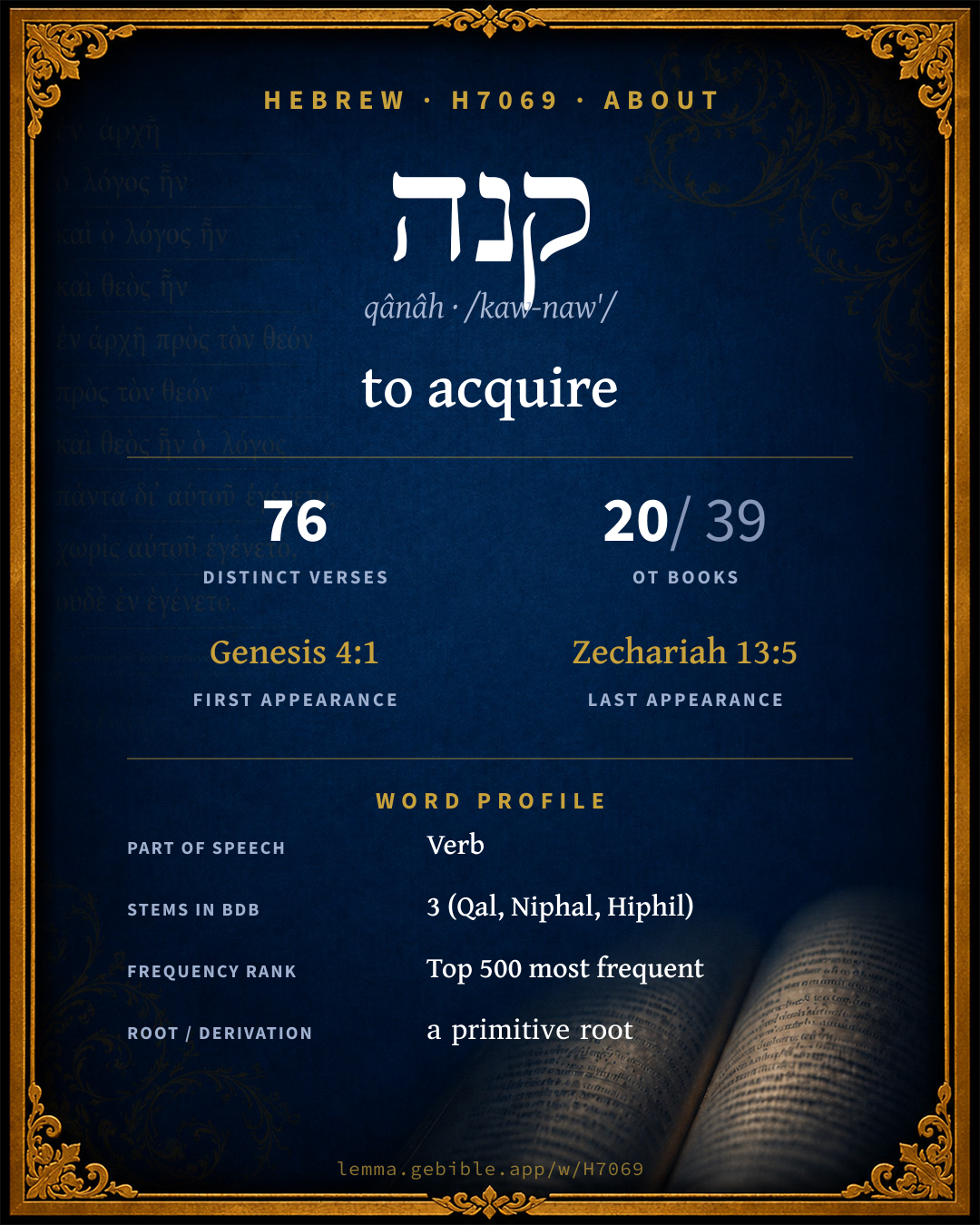
קָנָה
to acquire
‘to acquire’ is one of 3 main senses fuller range ↓
Full lexicon entry — Brown-Driver-Briggs (BDB)
From Brown-Driver-Briggs (BDB)
Where this word appears
See every Qal verb in the Hebrew Bible →
Grammar key — what these labels mean
Part of speech
- Verb
- An action or state-of-being word.
Stem
- Qal
- The basic, simple active stem — the plain form of the verb (“he wrote”). Here: ‘get’
- Niphal
- Usually the simple passive or reflexive of the Qal (“he was written”). Here: ‘be bought’
- Hiphil
- The causative active stem (“he caused / brought about”).
Form
- Imperative
- A direct command (“write!”).
- Infinitive Construct
- A bound verbal noun, frequently with prepositions (“to write / in writing”).
- Perfect
- A completed action or state — Hebrew marks aspect (completeness) more than strict tense (“he wrote”).
- Sequential Imperfect
- An imperfect with prefixed waw — the standard past-narrative form (waw-consecutive imperfect).
- Participle Active
- A verbal adjective expressing ongoing or characteristic action (“writing / one who writes”).
- Infinitive Absolute
- An unbound verbal noun, often intensifying or standing in for a finite verb.
- Imperfect
- An incomplete, ongoing, or future action (“he will / would write”).
- Sequential Perfect
- A perfect with prefixed waw continuing a preceding imperfect or command (waw-consecutive perfect).
State
- Absolute
- The independent form of a noun, not bound to a following word.
- Construct
- A noun bound to a following noun in a possessive / “of” relationship (the construct chain).
Person
- 2nd Person
- The one addressed (“you”).
- 1st Person
- The speaker (“I / we”).
- 3rd Person
- The one spoken about (“he / she / it / they”).
Gender
- Masculine
- Grammatically masculine.
- Common
- Either gender — not distinguished for this form.
- Feminine
- Grammatically feminine.
Number
- Singular
- One.
- Plural
- More than one (in Hebrew, generally three or more).
Grammatical forms 23 distinct
- Verb, Qal, Imperative, 2nd Person, Masculine, Singular 12 times (14%)
- Verb, Qal, Infinitive Construct 11 times (13%)
- Verb, Qal, Perfect, 3rd Person, Masculine, Singular 9 times (10%)
- Verb, Qal, Participle Active, Masculine, Singular, Absolute 8 times (9%)
- Verb, Qal, Perfect, 1st Person, Common, Singular 6 times (7%)
- Verb, Qal, Perfect, 2nd Person, Masculine, Singular 6 times (7%)
- Verb, Qal, Sequential Imperfect, 3rd Person, Masculine, Singular 5 times (6%)
- Verb, Qal, Participle Active, Masculine, Singular, Construct 4 times (5%)
+15 more forms (25 occurrences)
Parsed forms decoded from the imported morphology (morphhb / Westminster Leningrad Codex — WLC text public domain, morphhb tagging CC BY 4.0), counted across 86 parsed occurrences — not distinct verses.
Every verse where H7069 appears — 76 distinct verses across 20 books. Click any verse to open its interlinear word-by-word view. Verse text shown in the World English Bible for context — . Each verse’s Hebrew form is shown with its reference; the English is not keyword-highlighted, since the data carries no word-level English alignment. Use “Compare translations” on any verse to read it across multiple English versions. This concordance covers the Hebrew Bible; Septuagint (Greek Old Testament) occurrences are not indexed here.
Genesis 12 verses
- Genesis 4:1 קָנִ֥יתִי Qal pf 1cs The man knew Eve his wife. She conceived, and gave birth to Cain, and said, "I have gotten a man with Yahweh's help."
- Genesis 14:19 קֹנֵ֖ה Qal ptcp.act ms cs He blessed him, and said, "Blessed be Abram of God Most High, possessor of heaven and earth:
- Genesis 14:22 קֹנֵ֖ה Qal ptcp.act ms cs Abram said to the king of Sodom, "I have lifted up my hand to Yahweh, God Most High, possessor of heaven and earth,
- Genesis 25:10 קָנָ֥ה Qal pf 3ms the field which Abraham purchased of the children of Heth. There was Abraham buried, with Sarah his wife.
- Genesis 33:19 וַ/יִּ֜קֶן conj + Qal wimpf 3ms He bought the parcel of ground, where he had spread his tent, at the hand of the children of Hamor, Shechem's father, for one hundred pieces of money.
- Genesis 39:1 וַ/יִּקְנֵ֡/הוּ conj + Qal wimpf 3ms + sfx pers 3ms Joseph was brought down to Egypt. Potiphar, an officer of Pharaoh's, the captain of the guard, an Egyptian, bought him from the hand of the Ishmaelites that had brought him down there.
- Genesis 47:19 קְנֵֽה Qal impv 2ms Why should we die before your eyes, both we and our land? Buy us and our land for bread, and we and our land will be servants to Pharaoh. Give us seed, that we may live, and not die, and that the land won't be desolate."
- Genesis 47:20 וַ/יִּ֨קֶן conj + Qal wimpf 3ms So Joseph bought all the land of Egypt for Pharaoh, for the Egyptians sold every man his field, because the famine was severe on them, and the land became Pharaoh's.
- Genesis 47:22 קָנָ֑ה Qal pf 3ms Only he didn't buy the land of the priests, for the priests had a portion from Pharaoh, and ate their portion which Pharaoh gave them. That is why they didn't sell their land.
- Genesis 47:23 קָנִ֨יתִי Qal pf 1cs Then Joseph said to the people, "Behold, I have bought you and your land today for Pharaoh. Behold, here is seed for you, and you shall sow the land.
- Genesis 49:30 קָנָ֨ה Qal pf 3ms in the cave that is in the field of Machpelah, which is before Mamre, in the land of Canaan, which Abraham bought with the field from Ephron the Hittite as a burial place.
- Genesis 50:13 קָנָה֩ Qal pf 3ms for his sons carried him into the land of Canaan, and buried him in the cave of the field of Machpelah, which Abraham bought with the field, for a possession of a burying-place, from Ephron the Hittite, before Mamre.
Exodus 2 verses
- Exodus 15:16 קָנִֽיתָ Qal pf 2ms Terror and dread falls on them. By the greatness of your arm they are as still as a stone; Until your people pass over, Yahweh, Until the people pass over who you have purchased.
- Exodus 21:2 תִקְנֶה֙ Qal impf 2ms If you buy a Hebrew servant, he shall serve six years and in the seventh he shall go out free without paying anything.
Leviticus 9 verses
- Leviticus 22:11 יִקְנֶ֥ה Qal impf 3ms But if a priest buys a slave, purchased by his money, he shall eat of it; and such as are born in his house, they shall eat of his bread.
- Leviticus 25:14 קָנֹ֖ה Qal inf.abs "'If you sell anything to your neighbor, or buy from your neighbor, you shall not wrong one another.
- Leviticus 25:15 תִּקְנֶ֖ה Qal impf 2ms According to the number of years after the Jubilee you shall buy from your neighbor. According to the number of years of the crops he shall sell to you.
- Leviticus 25:28 הַ/קֹּנֶ֣ה ptcl def.art + Qal ptcp.act ms But if he isn't able to get it back for himself, then what he has sold shall remain in the hand of him who has bought it until the Year of Jubilee: and in the Jubilee it shall be released, and he shall return to his propery.
- Leviticus 25:30 לַ/קֹּנֶ֥ה prep det + Qal ptcp.act ms If it isn't redeemed within the space of a full year, then the house that is in the walled city shall be made sure in perpetuity to him who bought it, throughout his generations. It shall not be released in the Jubilee.
- Leviticus 25:44 תִּקְנ֖וּ Qal impf 2mp "'As for your male and your female slaves, whom you may have; of the nations that are around you, from them you may buy male and female slaves.
- Leviticus 25:45 תִּקְנ֔וּ Qal impf 2mp Moreover of the children of the strangers who sojourn among you, of them you may buy, and of their families who are with you, which they have conceived in your land; and they will be your property.
- Leviticus 25:50 קֹנֵ֔/הוּ Qal ptcp.act ms cs + sfx pers 3ms He shall reckon with him who bought him from the year that he sold himself to him to the Year of Jubilee: and the price of his sale shall be according to the number of years; according to the time of a hired servant shall he be with him.
- Leviticus 27:24 קָנָ֖/הוּ Qal pf 3ms + sfx pers 3ms In the Year of Jubilee the field shall return to him from whom it was bought, even to him to whom the possession of the land belongs.
Deuteronomy 2 verses
- Deuteronomy 28:68 קֹנֶֽה Qal ptcp.act ms Yahweh will bring you into Egypt again with ships, by the way of which I said to you, You shall see it no more again: and there you shall sell yourselves to your enemies for bondservants and for bondmaids, and no man shall buy you.
- Deuteronomy 32:6 קָּנֶ֔/ךָ Qal pf 3ms + sfx pers 2ms Do you thus requite Yahweh, Foolish people and unwise? Isn't he your father who has bought you? He has made you, and established you.
Joshua 1 verse
Ruth 5 verses
- Ruth 4:4 קְ֠נֵה Qal impv 2ms I thought to disclose it to you, saying, Buy it before those who sit here, and before the elders of my people. If you will redeem it, redeem it: but if you will not redeem it, then tell me, that I may know; for there is none to redeem it besides you; and I am after you. He said, I will redeem it.
- Ruth 4:5 קְנוֹתְ/ךָ֥ קניתי קָנִ֔יתָה Qal inf.cs + sfx pers 2ms Qal pf 1cs Qal pf 2ms Then said Boaz, What day you buy the field of the hand of Naomi, you must buy it also of Ruth the Moabitess, the wife of the dead, to raise up the name of the dead on his inheritance.
- Ruth 4:8 קְנֵה Qal impv 2ms So the near kinsman said to Boaz, Buy it for yourself. He drew off his shoe.
- Ruth 4:9 קָנִ֨יתִי֙ Qal pf 1cs Boaz said to the elders, and to all the people, You are witnesses this day, that I have bought all that was Elimelech's, and all that was Chilion's and Mahlon's, of the hand of Naomi.
- Ruth 4:10 קָנִ֧יתִי Qal pf 1cs Moreover Ruth the Moabitess, the wife of Mahlon, have I purchased to be my wife, to raise up the name of the dead on his inheritance, that the name of the dead not be cut off from among his brothers, and from the gate of his place: you are witnesses this day.
2 Samuel 3 verses
- 2 Samuel 12:3 קָנָ֔ה Qal pf 3ms but the poor man had nothing, except one little ewe lamb, which he had bought and raised. It grew up together with him, and with his children. It ate of his own food, drank of his own cup, and lay in his bosom, and was to him like a daughter.
- 2 Samuel 24:21 לִ/קְנ֧וֹת prep + Qal inf.cs Araunah said, Why is my lord the king come to his servant? David said, To buy the threshing floor of you, to build an altar to Yahweh, that the plague may be stayed from the people.
- 2 Samuel 24:24 קָנ֨וֹ אֶקְנֶ֤ה וַ/יִּ֨קֶן Qal inf.abs Qal impf 1cs conj + Qal wimpf 3ms The king said to Araunah, No; but I will most assuredly buy it of you at a price. Neither will I offer burnt-offerings to Yahweh my God which cost me nothing. So David bought the threshing floor and the oxen for fifty shekels of silver.
1 Kings 1 verse
2 Kings 2 verses
- 2 Kings 12:12 וְ/לִ/קְנ֤וֹת conj + prep + Qal inf.cs and to the masons and the stone cutters, and for buying timber and hewn stone to repair the breaches of the house of Yahweh, and for all that was laid out for the house to repair it.
- 2 Kings 22:6 וְ/לִ/קְנ֤וֹת conj + prep + Qal inf.cs to the carpenters, and to the builders, and to the masons, and for buying timber and hewn stone to repair the house.
1 Chronicles 1 verse
2 Chronicles 1 verse
Nehemiah 2 verses
- Nehemiah 5:8 קָ֠נִינוּ Qal pf 1cp I said to them, We after our ability have redeemed our brothers the Jews, that were sold to the nations; and would you even sell your brothers, and should they be sold to us? Then held they their peace, and found never a word.
- Nehemiah 5:16 קָנִ֑ינוּ Qal pf 1cp Yes, also I continued in the work of this wall, neither bought we any land: and all my servants were gathered there to the work.
Psalms 3 verses
- Psalms 74:2 קָ֘נִ֤יתָ Qal pf 2ms Remember your congregation, which you purchased of old, Which you have redeemed to be the tribe of your inheritance; Mount Zion, in which you have lived.
- Psalms 78:54 קָנְתָ֥ה Qal pf 3fs He brought them to the border of his sanctuary, To this mountain, which his right hand had taken.
- Psalms 139:13 קָנִ֣יתָ Qal pf 2ms For you formed my inmost being. You knit me together in my mother's womb.
Proverbs 11 verses
- Proverbs 1:5 יִקְנֶֽה Qal impf 3ms That the wise man may hear, and increase in learning; That the man of understanding may attain to sound counsel:
- Proverbs 4:5 קְנֵ֣ה קְנֵ֣ה Qal impv 2ms Qal impv 2ms Get wisdom. Get understanding. Don't forget, neither swerve from the words of my mouth.
- Proverbs 4:7 קְנֵ֣ה קְנֵ֣ה Qal impv 2ms Qal impv 2ms Wisdom is supreme. Get wisdom. Yes, though it costs all your possessions, get understanding.
- Proverbs 8:22 קָ֭נָ/נִי Qal pf 3ms + sfx pers 1cs "Yahweh possessed me in the beginning of his work, Before his deeds of old.
- Proverbs 15:32 ק֣וֹנֶה Qal ptcp.act ms He who refuses correction despises his own soul, But he who listens to reproof gets understanding.
- Proverbs 16:16 קְֽנֹה וּ/קְנ֥וֹת Qal inf.cs conj + Qal inf.cs How much better it is to get wisdom than gold! Yes, to get understanding is to be chosen rather than silver.
- Proverbs 17:16 לִ/קְנ֖וֹת prep + Qal inf.cs Why is there money in the hand of a fool to buy wisdom, Seeing he has no understanding?
- Proverbs 18:15 יִקְנֶה Qal impf 3ms The heart of the discerning gets knowledge. The ear of the wise seeks knowledge.
- Proverbs 19:8 קֹֽנֶה Qal ptcp.act ms He who gets wisdom loves his own soul. He who keeps understanding shall find good.
- Proverbs 20:14 הַ/קּוֹנֶ֑ה ptcl def.art + Qal ptcp.act ms "It's no good, it's no good," says the buyer; But when he is gone his way, then he boasts.
- Proverbs 23:23 קְ֭נֵה Qal impv 2ms Buy the truth, and don't sell it: Get wisdom, discipline, and understanding.
Ecclesiastes 1 verse
Isaiah 4 verses
- Isaiah 1:3 קֹנֵ֔/הוּ Qal ptcp.act ms cs + sfx pers 3ms The ox knows his owner, And the donkey his master's crib; But Israel doesn't know, My people don't consider.
- Isaiah 11:11 לִ/קְנ֖וֹת prep + Qal inf.cs It shall happen in that day, that the Lord will set his hand again the second time to recover the remnant of his people, who shall remain, from Assyria, and from Egypt, and from Pathros, and from Cush, and from Elam, and from Shinar, and from Hamath, and from the islands of the sea.
- Isaiah 24:2 כַּ/קּוֹנֶה֙ prep det + Qal ptcp.act ms It shall be, as with the people, so with the priest; as with the servant, so with his master; as with the maid, so with her mistress; as with the buyer, so with the seller; as with the creditor, so with the debtor; as with the taker of interest, so with the giver of interest to him.
- Isaiah 43:24 קָנִ֨יתָ Qal pf 2ms You have bought me no sweet cane with money, neither have you filled me with the fat of your sacrifices; but you have burdened me with your sins, you have wearied me with your iniquities.
Jeremiah 11 verses
- Jeremiah 13:1 וְ/קָנִ֤יתָ conj + Qal wpf 2ms Thus says Yahweh to me, Go, and buy you a linen belt, and put it on your loins, and don't put it in water.
- Jeremiah 13:2 וָ/אֶקְנֶ֥ה conj + Qal wimpf 1cs So I bought a belt according to the word of Yahweh, and put it on my loins.
- Jeremiah 13:4 קָנִ֖יתָ Qal pf 2ms Take the belt that you have bought, which is on your loins, and arise, go to the Euphrates, and hide it there in a cleft of the rock.
- Jeremiah 19:1 וְ/קָנִ֥יתָ conj + Qal wpf 2ms Thus said Yahweh, Go, and buy a potter's earthen bottle, and [take] of the elders of the people, and of the elders of the priests;
- Jeremiah 32:7 קְנֵ֣ה לִ/קְנֽוֹת Qal impv 2ms prep + Qal inf.cs Behold, Hanamel the son of Shallum your uncle shall come to you, saying, Buy you my field that is in Anathoth; for the right of redemption is yours to buy it.
- Jeremiah 32:8 קְנֵ֣ה קְנֵה Qal impv 2ms Qal impv 2ms So Hanamel my uncle's son came to me in the court of the guard according to the word of Yahweh, and said to me, Please buy my field that is in Anathoth, which is in the land of Benjamin; for the right of inheritance is yours, and the redemption is yours; buy it for yourself. Then I knew that this was the word of Yahweh.
- Jeremiah 32:9 וָֽ/אֶקְנֶה֙ conj + Qal wimpf 1cs I bought the field that was in Anathoth of Hanamel my uncle's son, and weighed him the money, even seventeen shekels of silver.
- Jeremiah 32:15 יִקָּנ֥וּ Niphal impf 3mp For thus says Yahweh of Hosts, the God of Israel: Houses and fields and vineyards shall yet again be bought in this land.
- Jeremiah 32:25 קְנֵֽה Qal impv 2ms You have said to me, Lord Yahweh, Buy you the field for money, and call witnesses; whereas the city is given into the hand of the Chaldeans.
- Jeremiah 32:43 וְ/נִקְנָ֥ה conj + Niphal wpf 3ms Fields shall be bought in this land, about which you say, It is desolate, without man or animal; it is given into the hand of the Chaldeans.
- Jeremiah 32:44 יִקְנ֗וּ Qal impf 3mp Men shall buy fields for money, and subscribe the deeds, and seal them, and call witnesses, in the land of Benjamin, and in the places about Jerusalem, and in the cities of Judah, and in the cities of the hill-country, and in the cities of the lowland, and in the cities of the South: for I will cause their captivity to return, says Yahweh.
Ezekiel 2 verses
- Ezekiel 7:12 הַ/קּוֹנֶה֙ ptcl def.art + Qal ptcp.act ms The time is come, the day draws near: don't let the buyer rejoice, nor the seller mourn; for wrath is on all the multitude of it.
- Ezekiel 8:3 הַ/מַּקְנֶֽה ptcl def.art + Hiphil ptcp.act ms He put forth the form of a hand, and took me by a lock of my head; and the Spirit lifted me up between earth and the sky, and brought me in the visions of God to Jerusalem, to the door of the gate of the inner [court] that looks toward the north; where was the seat of the image of jealousy, which provokes to jealousy.
Amos 1 verse
Zechariah 2 verses
- Zechariah 11:5 קֹנֵי/הֶ֤ן Qal ptcp.act mp cs + sfx pers 3fp Their buyers slaughter them, and go unpunished. Those who sell them say, 'Blessed be Yahweh, for I am rich;' and their own shepherds don't pity them.
- Zechariah 13:5 הִקְנַ֥/נִי Hiphil pf 3ms + sfx pers 1cs but he will say, 'I am no prophet, I am a tiller of the ground; for I have been made a bondservant from my youth.'
About this entry
At a glance — auto-summarized from this page’s data, not written by a person. Every figure links to its source below. This summary describes the numbers; it doesn’t interpret them.
At its core, קנה (qânâh) means “to acquire.” Its earliest occurrence is Genesis 4:1. It turns up in 76 verses across 20 books, a moderately common footprint. Different stems carry different senses — BDB groups them under 3 stems, among them Qal and Niphal. It shares a root with מקנה, קנא and קנה. For the data behind this summary, explore the sense tree and the renderings breakdown below.
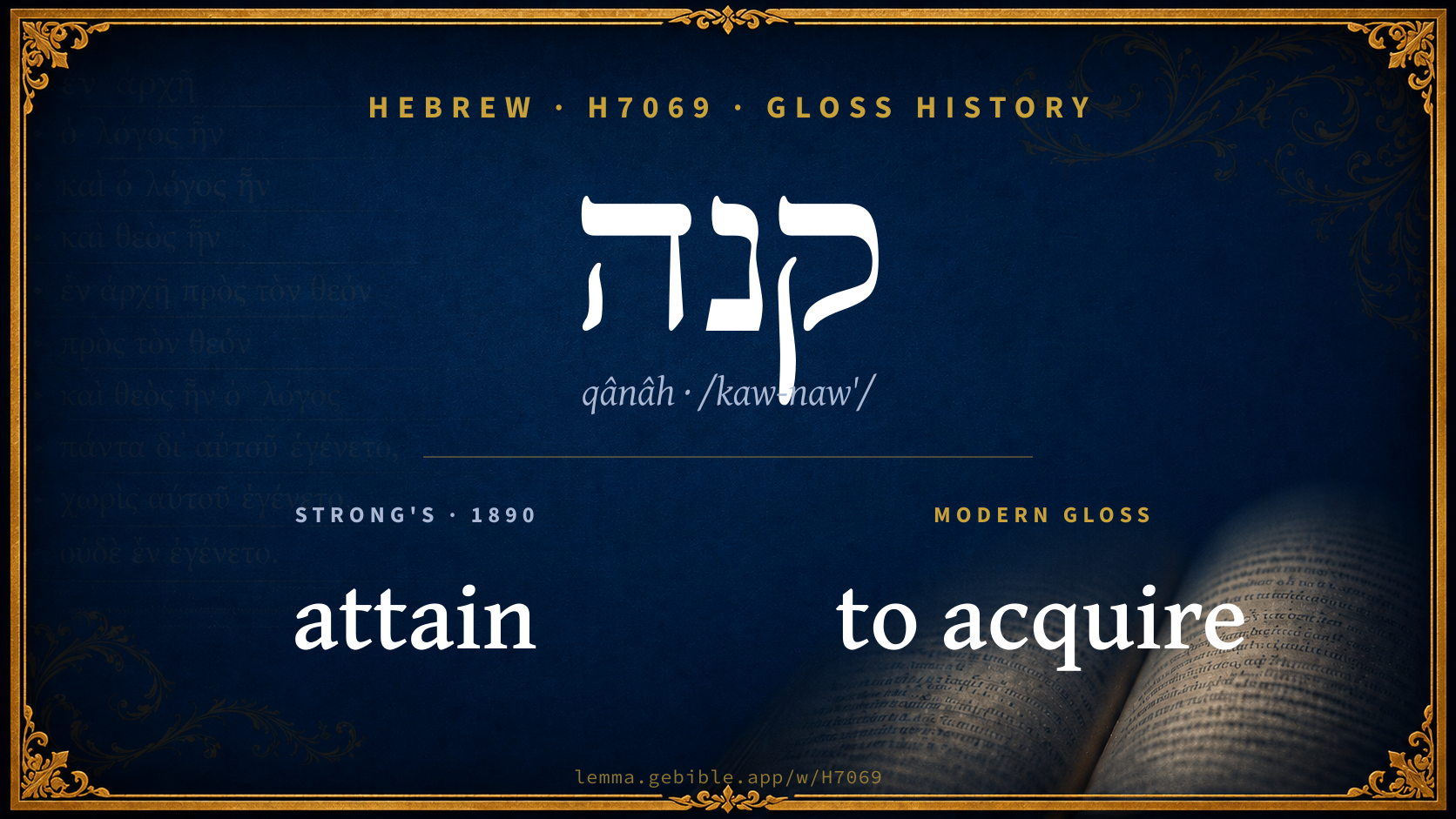
Gloss history
Strong's 1890 vs modern scholarship
About this word
Strong's H7069 catalogs a Hebrew word from the Hebrew Old Testament.
These counts are not copied from any lexicon or concordance. They are computed here, from the morphology-tagged Hebrew Old Testament. What Lemma adds →
- 76
- distinct verses
- The word appears in 76 distinct verses.
- 20 / 39
- OT books
- The word appears in 20 of 39 Old Testament books.
- #475
- by frequency
- Top 500 most frequent Hebrew words (rank 475 of 8,640 Hebrew words by occurrence).
View all 76 occurrences in the concordance →
By section of the Old Testament
By traditional corpus
Conventional, traditional groupings — biblical authorship is debated, so this is a traditional corpus grouping, not an authorship claim. Each share is this word’s portion of its verses in that division of the Hebrew canon. Each figure is a share of the word’s 76 distinct verses.
- Prophets (Nevi'im) 27 verses · 36%
- Torah (Pentateuch) 25 verses · 33%
- Writings (Ketuvim) 24 verses · 32%
How translations render this word
Counts come from each version’s own published word-to-Strong’s tagging or interlinear alignment — an approximate guide to how each version renders this word, not a word-level alignment the data otherwise carries. Because each total is that version’s own tagged count, the per-version totals vary from one another and need not match the appearance or distinct-verse counts above. These counts may also differ from a printed concordance because Lemma counts each distinctly tagged rendering and does not collapse phrase taggings into a single head-word total. This is a fixed set of word-tagged versions (KJV, ASV, BSB, ULT) and does not change with the reading translation you choose elsewhere. Each version’s license is shown beside its name below (and on Sources).
BDB lists this Strong’s number as 2 distinct words (homographs). Each count above pools all of them and is not split by sense — see the Senses section below. A low-frequency rendering may belong to a different one of those words, not the primary meaning.
- King James Version†: Buy 13×, Bought 9×, Get 6×
- American Standard Version†: Bought 9×, Buy 8×, I bought 3×
- Berean Standard Bible†: Buy 9×, Acquire 5×, Buyer 3×
- unfoldingWord Literal Text†: Buy 12×, Acquire 10×, Bought 4×
King James Version Public Domain
Renders H7069 across 84† tagged occurrences — most commonly:
Plus 42 renderings that appear only once — usually multi-word phrases or single function words the recovered tagging swept in, not distinct renderings.
American Standard Version Public Domain
Renders H7069 across 84† tagged occurrences — most commonly:
Plus other, less common renderings. Plus 42 renderings that appear only once — usually multi-word phrases or single function words the recovered tagging swept in, not distinct renderings.
Berean Standard Bible Public Domain
Renders H7069 across 82† tagged occurrences — most commonly:
Plus other, less common renderings. Plus 44 renderings that appear only once — usually multi-word phrases or single function words the recovered tagging swept in, not distinct renderings. Not rendered by a distinct English word in 2 further occurrences.
unfoldingWord Literal Text CC BY-SA 4.0
Renders H7069 across 88† tagged occurrences — most commonly:
Plus 41 renderings that appear only once — usually multi-word phrases or single function words the recovered tagging swept in, not distinct renderings.
11 senses and sub-senses in the full BDB
Hebrew verbs can shift meaning by stem (binyan): Qal is the basic action, Niphal is often passive or reflexive, Piel often intensifies or makes it factitive, and Hiphil is typically causative. The senses below are grouped under the stem BDB assigns to each.
What do BDB’s symbols mean?
BDB uses these scholarly abbreviations:
| Symbol | Meaning |
|---|---|
| 𝔊 | the Septuagint (the ancient Greek translation, LXX) |
| 𝔙 | the Vulgate (the Latin translation) |
| 𝔖 | the Syriac version (the Peshitta) |
| 𝔗 | the Targum (the Aramaic translation) |
| ψ | the Psalms |
| √ | root (the underlying root or stem) |
| ‖ | parallel passage (a synonymous or contrasted parallel) |
| † | the dagger: every passage where the word occurs is cited |
The 11 senses and sub-senses the full Brown-Driver-Briggs lexicon distinguishes for this word, in lexicon order (not ranked by frequency), with BDB’s own verbatim wording and sub-sense lettering. Shown in Hebrew script with BDB’s own scholarly abbreviations. The condensed entry is in the Lexicon Entry tab. See also the Forms in the corpus table below.
קנה I get, acquire (NH = BH
Qal
- Pf. 3 ms. ק׳ Gn 25:10 +; sf. קָנֶ֑ךָ Dt 32:6, קָנָהוּ Lv 27:24; 3 fs. קָֽנְתָה ψ 78:54; 2 ms. קָנִיתָ Ex 15:16 +, etc.; Impf. 3 ms. יִקְנֶה Lv 22:11 +, וַיִּ֫קֶן Gn 33:19 +, etc.; Imv. ms. קְנֵה Gn 47:19 +; Inf. abs. קָנֹה Lv 25:14 1 Ch 21:24, קָנוֹ 2 S 24:24; cstr. קְנֹה Pr 16:16, קְנוֹת Pr 16:16 +, etc.; Pt. קֹנֶה Dt 28:68, קוֹנֶה Pr 15:32 +, etc.;— e.g. Genesis 25:10
- 1. get, acquire (all poet.):
- a. of God as originating, creating, קֹנֵה שָׁמַיִם וָאָרֶץ Gn 14:19, 22, Dt 32:6 (Isr.), ψ 139:13 (כִּלְיֹתָ֑י); Pr 8:22 (חכמה q.v.). e.g. Genesis 14:19
- b. of God as victoriously redeeming his people Ex 15:16; Is 11:11 ψ 74:2 (‖ גָּאַל); obj. הַר־זֶה 78:54. e.g. Exodus 15:16
- c. of Eve, acquiring, קַיִן, אֶת־י׳ (i.e. with the help of), Gn 4:1 (J). e.g. Genesis 4:1
- d. of acquiring wisdom, knowledge (only Pr): Pr 1:5; 4:5(×2), 7(×2); 15:32; 16:16(×2); 17:16; 18:15; 19:8; 23:23. e.g. Proverbs 1:5
- 2. elsewhere buy Ex 21:2 (E), Gn 47:20, 22 (J), 50:13 (P), Lv 27:24 (P), Dt 28:68; Is 24:2; Je 13:1; Ez 7:12 Pr 20:14 +; קֹנֶה owner, as purchaser Lv 25:30 (P); Is 1:3; Zc 11:5 +. e.g. Exodus 21:2
Niphal
- be bought: Pf. 3 ms. נִקְנָה Je 32:43; Impf. 3 mpl. יִקָּנוּ v 15. e.g. Jeremiah 32:43
Hiphil
- Pf. 3 ms. sf. אָדָם הִקְנַנִי Zc 13:5; AV makes denom. of מִקְנֶה cattle; Thes RV MartiKau Buhl caused (one) to purchase me, i.e. made me a bondman; אֲדָמָה קִנְיָנִי.—Pt. מַקְנֶה v. קנא. e.g. Zechariah 13:5
קנה II
- 1. of wady between Ephr. and Manass., נַחַל ק׳ Jos 16:8; 17:9 (both P), Κα(ρα)να, Καναι, etc.; identif. by RobBR iii. 135 with Wady Kânah, S. and SW. of Nablûs, cf. BuhlGeogr. 101, 105. e.g. Joshua 16:8
- 2. loc. in Asher, 19:28, Καν(θ)α(ν), etc.; prob. Ḳâna, SE. from Tyre RobBR ii. 455 f. Buhl 229, Egyptian Kaʾnô WMMAs. u. Eur. 181, and perhaps TelAm. Ḳanû.
Senses from the full Brown-Driver-Briggs lexicon (Brown, Driver, Briggs; Oxford 1906 — public domain), digitized via Sefaria, supplemented by the OpenScriptures HebrewLexicon (CC BY 4.0). Full attribution on Sources.
Word origin
vb. get, acquire (NH = BH; Ph. (Pun.) מקנא, property [in cattle]; Assyrian ḳanû, gain, acquire, MeissnSuppl. 85; Arabic قَنَا (و, ى) acquire, procure; Sab. קני acquire, possess, CIS iv, no. 89, 5, 6, קני n. property id. ib. no. 3, 8, 29, 3; Ethiopic ቀነየ: acquire, subjugate; Aramaic קְנָא, ܩܢܳܐ, acquire);—
— Brown-Driver-Briggs (Oxford 1906, public domain), digitized via Sefaria, supplemented by the OpenScriptures HebrewLexicon (CC BY 4.0). See Sources.
Origin: a primitive root
Jastrow Dictionary
A second Hebrew/Aramaic lexicon for comparison, covering Aramaic and post-biblical (Talmudic, Targumic, Midrashic) usage that the biblical-Hebrew BDB does not. Matched by lemma rather than by Strong’s number, so a lemma may carry more than one Jastrow headword (shown separately below), and the entries cover usage well beyond the Bible.
קָנָה
- , v. קני II
קִנָּה
- =
- 1. = קֵן nest;
- 2. (קָנַן) affirmation, oath, vow. ק׳ מאי ק׳ של תרנגולין … לשון דקונם מיבעי if a person used the word ḳinnah to introduce a vow, how is it? did he mean a nest of chickens (in which case there would be no vow), or has it the meaning of confirmation like ḳonam? It remains doubtful.
קָנֶה
- calamus, reed; anything resembling a reed, branch of a candlestick; windpipe &c. Cant. R. to I, 6 (legend about the origin of Rome) ירד … ק׳ גדול וכ׳ Michael the archangel came down and planted a large reed in the sea &c. Taan. 20ᵃ לעולם … רך כק׳ וכ׳ man must at all times be yielding like a reed and not unbending like a cedar, v. קוֹלְמוֹס. Tosef. Sabb. XII (XIII), 14 ק׳ של מנורה the branch of a candlestick; Sabb. 47ᵃ קְנֵה מנורה; Y. ib. XII, 13ᶜ קְנֵי. Ib. ק׳ של ציידין a part of the composite pole which the hunters use (to reach the nests); Bab. l. c. קְ׳ סיידין of the whitewashers; Tosef. l. c. ציידין (Var. ס׳). Ker. 5ᵃ קְנֵה בשם sweet calamus. Kel. XVII, 16 קְ׳ מאזניים the beam of the balance. Ib. ק׳ של עני וכ׳ the poor man’s cane which has a receptacle for water.—דחה בק׳, v. דָּחָה.—Ber. 61ᵃ bot. ק׳ מוציא קול the windpipe produces sound. Ḥull. 21ᵇ; Zeb. 65ᵇ עד שמגיע … לק׳ until he reaches (with his nail) the gullet or the windpipe. Ḥull. 28ᵇ (in Chald. dict.) נבדקיה לק׳ וכ׳ let him examine the windpipe and cut it &c. Men. XI, 6 עשרים … כחצי ק׳ חלול twenty-eight staves shaped like a segment of a hollow reed; a. fr.—Ohol. I, 8 ק׳ = קְנֵה זרוע forearm.—קְנֵה שפה, v. קָמָה.—הושיט בק׳ [to hold forth on a cane,] to treat lightly, consider unimportant. Num. R. s. 8 end דבר … והושיטו לו בק׳ (not והושיטה) something for which that ancestor prostrated himself in prayer (Gen. XXVIII, 20) …, and now comes this man (Aquila) and holds it up to contempt!; Yalk. Gen. 123; Gen. R. s. 70. Ib. את מושיטו לזה בק׳ dost thou make it appear contemptible to this man?; Koh. R. to VII, 8.—Pl. קָנִים, קָנִין. Men. l. c. Ib. סידור ק׳ the arrangement of the staves between the cakes of the show-bread. Kel. XVII, 17, a. fr. מחצלת ק׳ a reed mat. Ex. R. s. 35 (ref. to Ps. LXVIII, 31) חיה הדרה בין הק׳ the beast that dwells among the reeds (Rome, v. Cant. R. to I, 6, quoted above). Gen. R. s. 1 עשיר … לק׳ he is a rich man and needs no reeds (for his house); הרי הוא צריך לקְנֵי המדה he still needs the measuring rods; a. fr. e.g. Genesis 28:20
קָנֶה ²
- ch., v. קָנֵי
קני
- (cmp. Arab. ḳana) to be hot.
- (b. h.)
- 1. to be jealous; to envy. Lam. R. introd. (R. Joḥ. 1) לא קִנֵּאתִי בה I was not jealous of her; מפני מה קִנֵּאתָ לע"ז וכ׳ why art thou jealous of an idol in which there is no reality?; a. e.—Esp. ק׳ לאשתו to suspect one’s wife of unbecoming conduct; to accuse of faithlessness; to warn one’s wife. Sot. I, 1 המְקַנֵּא … מקנא לה על פי שנים he who suspects his wife … must bring charges against her based on a warning given in the presence of two witnesses. Ib. 2 כיצד מקנא לה אומר לה בפני שנים אל תדברי וכ׳ how must he warn her? If he says before two witnesses, do not speak (associate) with that man, and she does so, she is still permitted to him for marital life &c. Tosef. ib. I, 1 [read:] המקנא לאשתו מקנא על פי עד אחד וכ׳ (ed. Zuck. המְקַנֶּה, Var. מקנה) he who wants to proceed against his wife, must bring charges based on a statement of warning by one witness or on his own statement; Sot. 2ᵇ. Ib. 2ᵃ אסור לקַנְּאוֹת it is forbidden to warn one’s wife (in the presence of witnesses). Ib. 3ᵃ מותר לק׳ it is permitted &c. M. Kat. 18ᵇ (ref. to Ps. CVI, 16) שכל … קי׳ לאשתו ממשה every one of them warned his wife in jealousy of Moses. Num. R. s. 9 ע"י איש הוא מקנה אותה וכ׳ he may bring charges on the ground of suspicious conduct towards a man (human being) but not &c. Ib. בית רין מְקַנְּאִין להם וכ׳ (some ed. מְקַנִּין) the court takes proceedings in their (the husbands’) behalf &c.; a. fr. e.g. Psalms 106:16
- 2. to arouse jealousy; to provoke. Meg. 15ᵇ קִנְּאַתּוּ במלך וכ׳ she (by inviting Haman) aroused against him the jealousy of the king and the jealousy of the (other) princes. Num. R. l. c. שהיא מְקַנְּאָה להקב"ה וכ׳ for she provokes the Lord and her husband; a. e.
- to be jealous; to be incensed. Men. 109ᵇ נ׳ בו … בשמעי אחיו Onias was jealous of his brother Shimei. Snh. 105ᵇ בכל אדם מִתְקַנֵּא וכ׳ a man is envious of all except his son and his pupil. Meg. 13ᵃ מִתְקַנְּאָה, v. יָרֵךְ. Ab. Zar. 54ᵇ מפני מה מתקנא בעובדיה וכ׳ why is he jealous of (incensed against) those who worship it (the idol), and is not jealous of (takes no revenge on) itself? Meg. 19ᵃ מה … שנ׳ בכל וכ׳ what reason had Haman to take revenge on all the Jews?; a. fr.
A Dictionary of the Targumim, the Talmud Babli and Yerushalmi, and the Midrashic Literature (Marcus Jastrow; London, Luzac, 1903) — Public Domain. Digitized via Sefaria. Digitized via Sefaria. Full attribution on Sources.
Forms in the corpus
The 72 distinct written forms H7069 takes in the Hebrew Bible, most frequent first — each parse links to that stem’s occurrences in the concordance. Hebrew forms include their vowel points and cantillation, so a single lemma takes many written forms.
The 60 most common forms are shown; 12 rarer forms follow in the full concordance.
Same root — word family
Other BDB entries built from the same root as H7069, grouped by Strong’s listed origin. These share a root / origin per the lexicon — not necessarily a shared meaning. Each links to that word’s own entry.
Derived from this word
- מקנה miqneh H4735 cattle
- קנא qᵉnâʼ H7066 to acquire
- קנה qâneh H7070 reed
- קנין qinyân H7075 acquisition
Proper names from this root
People and places named from this root — a name, not an additional meaning of the word.
Compare all same-root words → Showing 4 of 6 — not the complete family. 1 of the same-root words is a proper name (a person or place). They share a root, not necessarily a meaning.
Septuagint verse parallels
This word appears in 69 verses that also exist in the Greek Old Testament (Septuagint), out of the 76 Hebrew verses it occurs in. You can read those verses in Greek by switching the Old Testament edition to the Septuagint.
Read these verses in the Septuagint
- Genesis 4:1
- Exodus 15:16
- Leviticus 22:11
- Deuteronomy 28:68
- Joshua 24:32
- Ruth 4:4
- 2 Samuel 12:3
- 1 Kings 16:24
- 2 Kings 12:12
- 1 Chronicles 21:24
- 2 Chronicles 34:11
- Psalms 74:2
This is a verse-level parallel only — the same verses exist in both the Hebrew and Greek Old Testaments. No word-level Hebrew↔Greek correspondence is claimed: the data carries no such alignment, so no Greek word is shown as this Hebrew word’s translation. Coverage is not total — the Septuagint omits the deuterocanon and renumbers the Psalms, so some Hebrew verses have no direct Greek parallel.