
Psalms 139:13

Hebrew (Westminster Leningrad Codex) Psalms 139:13 appears in the Hebrew Old Testament. The text above is from the Westminster Leningrad Codex. Each word links to its Strong’s number, a concise gloss, and parsing drawn from the Open Scriptures Hebrew Bible morphology. Click any word for its full Brown-Driver-Briggs (BDB) entry.
Download image
Cite this verse

Psalms 139:13 (World English Bible). Public Domain. Lemma interlinear Bible study tool, https://lemma.gebible.app/v/psalms/139/13.

Show BibTeX & RIS
BibTeX
RIS
English Translation
For you formed my inmost being. You knit me together in my mother's womb.
World English Bible · Public Domain
Download a study sheet

One document with this verse’s original text, its word-by-word gloss line, the meaning frame, cross-references with their text, attributed commentary, and full source and license credits — printable, and it pastes into notes with its structure intact.

This verse Autodidact and up

Study sheet (.html) Plain text (.txt)

A passage Seminary Student

Up to 50 verses in one chapter. A passage sheet keeps up to 6 commentary sources and 12 cross-references per verse, in the order this page ranks them, and says so on the sheet whenever that leaves anything out. Ask for a single verse and you get the Autodidact verse sheet above.

Everything on this page stays free to read, with no account — the sheet is a download of what is already on screen, not access to it.

Want to remove ads? Support Godless Engineer
Compare translations 3

The same verse in 3 English versions, stacked beneath the original-language interlinear above. Click any original word for its lexicon entry.

Each is an independent rendering of the whole verse — the interlinear is not word-aligned to these translations.

Highlighted words mark where these versions differ — a whole-verse word diff, not a word-by-word alignment.

  • World English Bible Public Domain
    For you formed my inmost being. You knit me together in my mother's womb.
  • King James Version Public Domain
    For thou hast possessed my reins: thou hast covered me in my mother's womb.
  • unfoldingWord Literal Text CC BY-SA 4.0
    For you, you created my kidneys; you knit me together in the womb of my mother.

unfoldingWord Literal Text — © unfoldingWord, licensed CC BY-SA 4.0. Word-aligned USFM3 via Door43 (git.door43.org/unfoldingWord/en_ult).

Versions to compare (up to 4)

3 of 4 selected

Show all 17 translations

Every available English version of this verse, each an independent rendering of the whole verse.

  • World English Bible Public Domain
    For you formed my inmost being. You knit me together in my mother's womb.
  • Berean Standard Bible Public Domain
    For You formed my inmost being; You knit me together in my mother’s womb.
  • Majority Standard Bible Public Domain
    For You formed my inmost being; You knit me together in my mother’s womb.
  • King James Version Public Domain
    For thou hast possessed my reins: thou hast covered me in my mother's womb.
  • American Standard Version (1901) Public Domain
    For thou didst form my inward parts: Thou didst cover me in my mother's womb.
  • Revised Version (1885) Public Domain
    For thou hast possessed my reins: thou hast covered me in my mother’s womb.
  • Geneva Bible (1599) Public Domain
    For thou hast possessed my reines: thou hast couered me in my mothers wombe.
  • Young's Literal Translation Public Domain
    For Thou -- Thou hast possessed my reins, Thou dost cover me in my mother's belly.
  • Literal Standard Version CC BY-SA 4.0
    For You have possessed my reins, || You cover me in my mother’s belly.
  • Unlocked Literal Bible CC BY-SA 4.0
    You formed my inner parts; you formed me in my mother's womb.
  • unfoldingWord Literal Text CC BY-SA 4.0
    For you, you created my kidneys; you knit me together in the womb of my mother.
  • Darby Bible Public Domain
    For thou hast possessed my reins; thou didst cover me in my mother's womb.
  • World Messianic Bible Public Domain
    For you formed my inmost being. You knit me together in my mother’s womb.
  • Webster's Bible Public Domain
    For thou hast possessed my reins: thou hast covered me in my mother's womb.
  • Free Bible Version CC BY-SA 4.0
    You made me from the inside out, shaping me in my mother's womb.
  • Bible in Basic English Public Domain
    My flesh was made by you, and my parts joined together in my mother's body.
  • JPS Tanakh (1917) Public Domain
    For Thou hast made my reins; Thou hast knit me together in my mother's womb.

Literal Standard Version (2020), Covenant Press — licensed CC BY-SA 4.0. Text via the HelloAO Bible API (eBible.org). Unlocked Literal Bible (unfoldingWord) — licensed CC BY-SA 4.0. Text via the HelloAO Bible API (eBible.org). unfoldingWord Literal Text — © unfoldingWord, licensed CC BY-SA 4.0. Word-aligned USFM3 via Door43 (git.door43.org/unfoldingWord/en_ult). Free Bible Version, Dr. Jonathan Gallagher — licensed CC BY-SA 4.0. Text via the HelloAO Bible API (eBible.org).

Word by word

More ways to search: Search by grammar → Find every occurrence → Compare this word →

Practice this passage: Drill this verse → Learn its vocabulary →

תְּ֝סֻכֵּ֗נִי
çâkak
H5526
“to cover · me”
Verb, Qal, Imperfect, 2nd Person, Masculine, Singular + Suffix, Personal, 1st Person, Common, Singular
Part of Speech
Verb
Stem
Qal
Form
Imperfect
Person
2nd Person
Gender
Masculine
Number
Singular
Full BDB Definition

Origin: a primitive root

TWOT: 1475 , 1492 , 2259 , 2260

(Qal) to hedge, fence about, shut in - to block, overshadow, screen, stop the approach, shut off, cover - (Qal) - to screen, cover - to cover oneself - protector (participle) - (Hiphil) - to screen, cover - to cover, defecate (euphemism) - (Qal) to cover, lay over - to weave together - (Qal) to weave together - (Pilpel) to weave, weave together
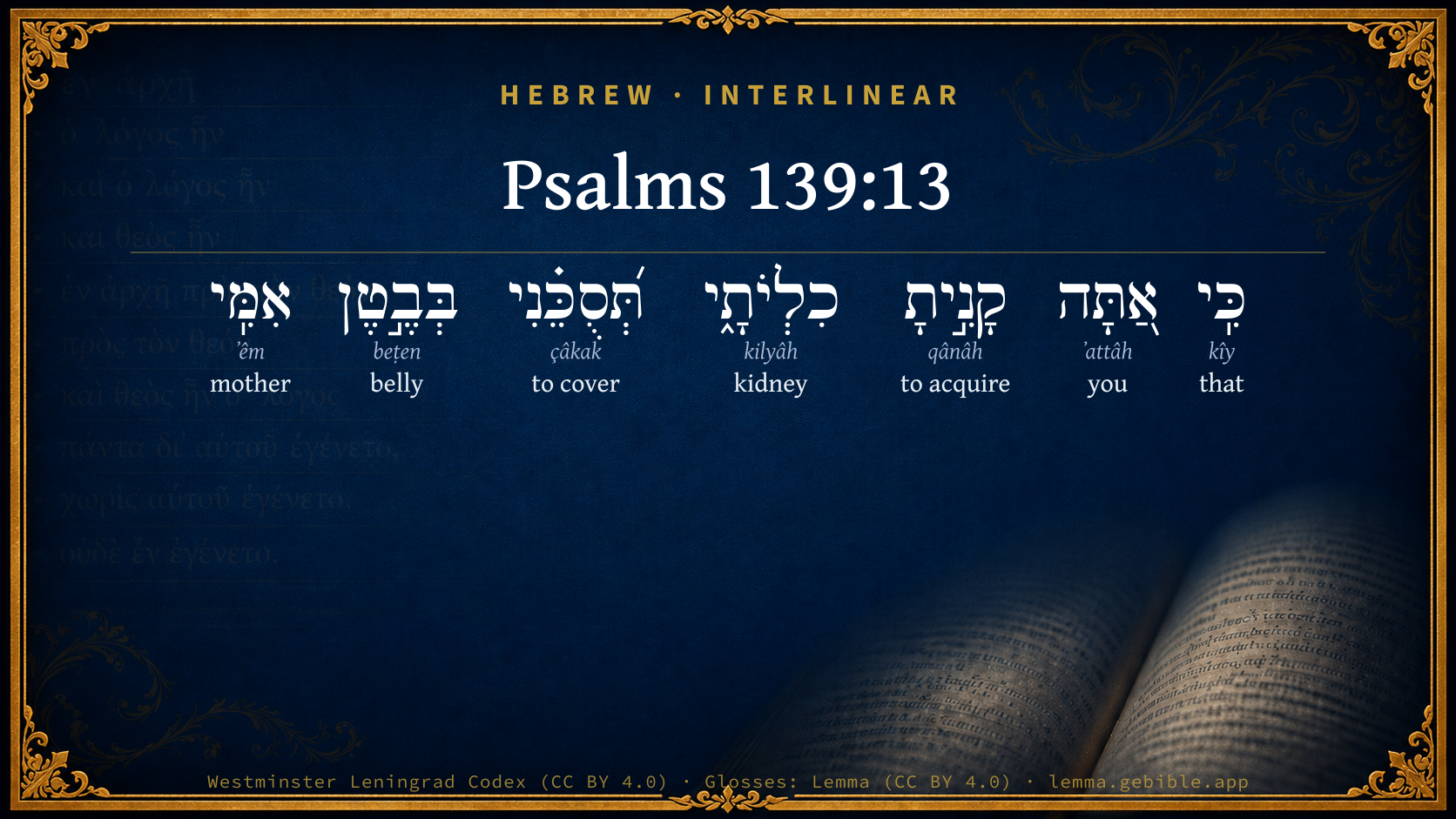
  1. כִּֽי kîy H3588 “that” Conjunction
  2. אַ֭תָּה ʼattâh H859 “you” Pronoun, Personal, 2nd Person, Masculine, Singular
  3. קָנִ֣יתָ qânâh H7069 “to acquire” Verb, Qal, Perfect, 2nd Person, Masculine, Singular
  4. כִלְיֹתָ֑י kilyâh H3629 “kidneys · my” Noun, Common, Feminine, Plural, Construct + Suffix, Personal, 1st Person, Common, Singular
  5. בְּבֶ֣טֶן beṭen H990 “in/at · belly of” Preposition + Noun, Common, Feminine, Singular, Construct
  6. אִמִּֽי ʼêm H517 “mother · my” Noun, Common, Feminine, Singular, Construct + Suffix, Personal, 1st Person, Common, Singular

About this verse

These counts appear in no published source. They are computed here, from the morphology-tagged text and Lemma’s own curated glosses. What Lemma adds →

7
words
7
distinct lemmas
Wisdom
section

Notable vocabulary

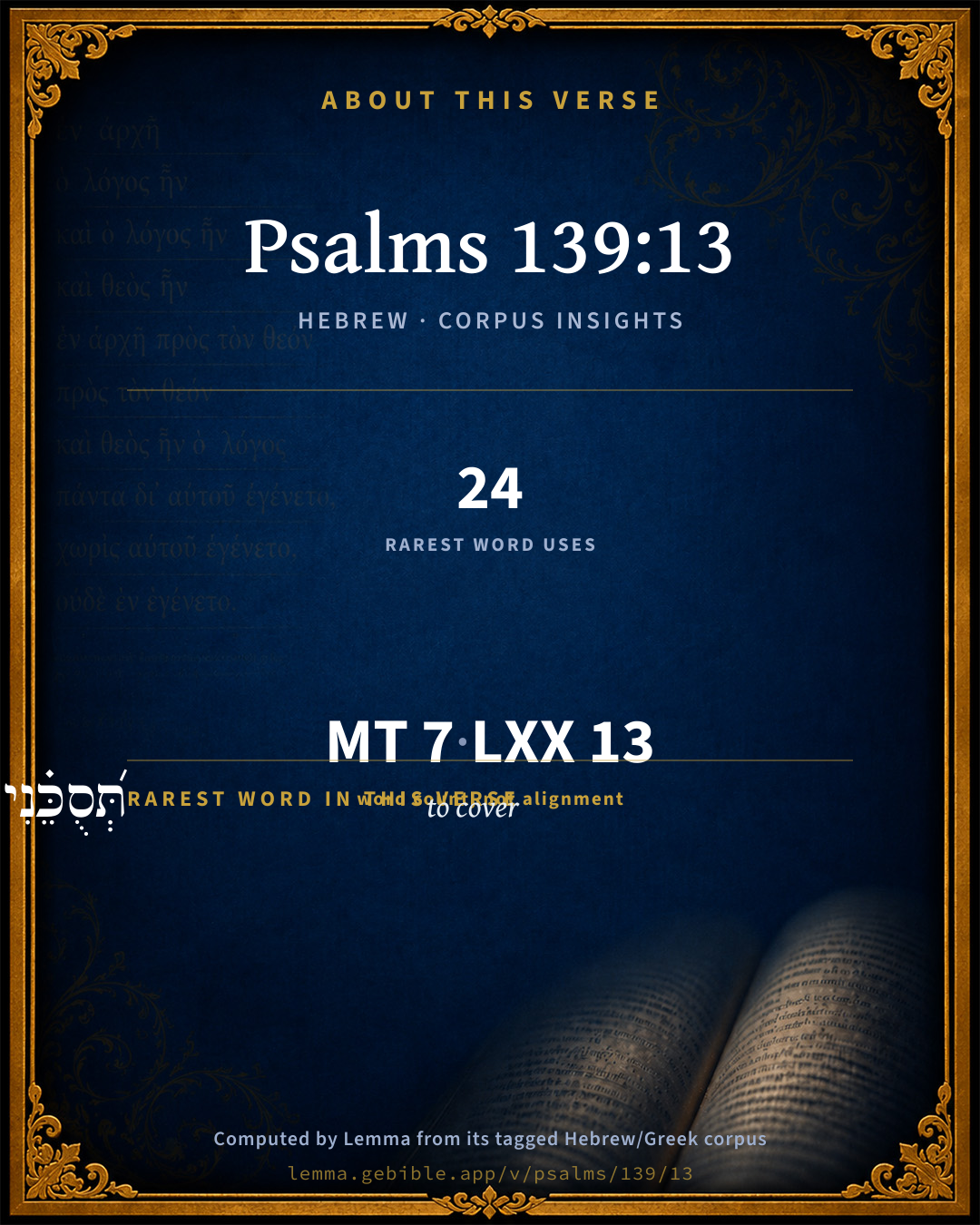
The rarest word here is תְּ֝סֻכֵּ֗נִי to cover H5526 — appearing just 24 times in the whole Hebrew Bible.

Shared distinctive vocabulary

תְּ֝סֻכֵּ֗נִי to cover H5526 occurs in 24 verses of the Hebrew Bible. Also found in:

Grammatical profile

  • 2 verbs
  • 3 nouns
  • 1 pronoun
  • 1 conjunction

Verb forms

  • קָנִ֣יתָ Qal · Perfect
  • תְּ֝סֻכֵּ֗נִי Qal · Imperfect

Hebrew & Septuagint length

In English translation the verse runs 14 words from the Hebrew and 16 from the Septuagint (LXX English) — closely comparable.

A rough comparison of the two English renderings, which tokenize alike — not a word-level alignment.

Word counts can differ between the Hebrew and the Greek without any difference in meaning — e.g. the Hebrew direct-object marker אֵת has no separate Greek word, and Greek often adds the article ὁ.

In the original languages it is 7 Hebrew tokens and 13 Greek tokens — but the two are counted differently (Hebrew bundles its prefixes and suffixes into one token; the Greek is in lemma form), so that isn’t a like-for-like length.

Cross-references

8

Topical passages linked to Psalms 139:13 in the Treasury of Scripture Knowledge — connected by theme and wording, ordered by reader-vote popularity; previews shown in the World English Bible.

  • Jeremiah 1:5 Before I formed you in the belly I knew you, and before you came forth out of the womb I sanctified you; I have appointed you a prophet to the nations.
  • Psalms 119:73 Your hands have made me and formed me. Give me understanding, that I may learn your commandments.
  • Isaiah 44:2 Thus says Yahweh who made you, and formed you from the womb, who will help you: Don't be afraid, Jacob my servant; and you, Jeshurun, whom I have chosen.
  • Job 31:15 Didn't he who made me in the womb make him? Didn't one fashion us in the womb?
  • Job 10:9–12 Remember, I beg you, that you have fashioned me as clay. Will you bring me into dust again?
  • Psalms 71:6 I have relied on you from the womb. You are he who took me out of my mother's womb. I will always praise you.
  • Psalms 22:9–10 But you brought me out of the womb. You made me trust at my mother's breasts.
  • Isaiah 46:3 Listen to me, house of Jacob, and all the remnant of the house of Israel, that have been borne [by me] from their birth, that have been carried from the womb;

Cross-references courtesy of OpenBible.info (CC BY 4.0).

Hebrew and Greek witnesses Masoretic Hebrew ↔ Greek Septuagint

The same verse in the two great witnesses to the Old Testament, shown verse-for-verse.

You’re reading Greek Psalm 138 (Hebrew Psalm 139). The Septuagint counts the superscription, so verse numbers can differ from the Hebrew — chapter-level alignment, not verse-by-verse. Numbering follows Rahlfs.

These are two independent witnesses, not word-aligned to each other, and the Septuagint is shown in lemma (dictionary) form.

Hebrew Psalms 139:13 Masoretic · Westminster Leningrad Codex

כִּֽי אַ֭תָּה קָנִ֣יתָ כִלְיֹתָ֑י תְּ֝סֻכֵּ֗נִי בְּבֶ֣טֶן אִמִּֽי

For you formed my inmost being. You knit me together in my mother's womb.

World English Bible · Public Domain

Greek LXX Greek Psalm 138:13 Septuagint · lemma form

ὅτι σύ κτάομαι ὁ νεφρός ἐγώ κύριος ἀντιλαμβάνω ἐγώ ἐκ γαστήρ μήτηρ ἐγώ

For you, O Lord, have possessed my reins; you have helped me from my mother's womb.

LXX2012 (modern English Septuagint) · Public Domain

On this verse, Keil & Delitzsch discusses the Septuagint’s reading. Read the note in Commentary ↓

Hebrew: Westminster Leningrad Codex (CC BY 4.0). Greek: Septuagint (public domain); English from LXX2012 (modern English Septuagint) (Public Domain). How the Septuagint differs from the Hebrew →

Commentary

Notes on Psalms 139:13 from classic Christian and Jewish commentators (each source and its license shown beneath its notes). The classic Christian expositions comment on the surrounding passage and are grouped to its opening verse, so a note may address several verses; the Jewish commentaries on the Tanakh (Rashi and others) are per-verse, so they appear only where the commentator wrote on this verse.

Lemma curates 59 commentaries, every one of them public domain or Creative Commons licensed, each selected and text-cleaned for this edition rather than reprinted as found. About our sources →

The Cambridge Bible for Schools and Colleges

gen. ed. J. J. S. Perowne

13. For it was thou that didst form my reins] Thou is emphatic. The connexion of thought expressed by for is not obvious; but it appears to give a reason for the intimate knowledge of which the preceding verses have spoken. ‘Thou knowest me, for Thou didst create me.’ Psa_139:14 will then be a parenthetical exclamation of adoring wonder. The transposition of Psa_139:13-14, proposed by some critics, removes the difficulty and gives a clearer connexion of thought, but poetry does not bind itself by forms of logic.

my reins] The inmost seat of the emotions, which God ‘tries’ (Psa_7:9).

thou hast covered me] Better, thou didst knit me together, with bones and sinews. Cp. Job_10:8-11.

13–18. God must know the Psalmist perfectly, for He ordered the first beginnings of his life, and foresaw all his destiny.

The Cambridge Bible for Schools and Colleges (gen. ed. J. J. S. Perowne; Cambridge University Press, 1878–1918) — public domain. Text from a community e-Sword module.

Trapp's Complete Commentary

John Trapp

Psa 139:13 For thou hast possessed my reins: thou hast covered me in my mother’s womb.

Ver. 13. For thou hast possessed my reins] The seat of mine affections. Thoughts kindle affections, and these cause thoughts to boil; they are causes one of another, and both well known to God. For who possesseth lands or houses, but he knoweth the right title and rooms thereof? saith an expositor.

Thou hast covered me in my mother’s womb] But not from thine all-piercing eyes, though in so dark a place, and wrapt up in secundines .

John Trapp, A Commentary or Exposition upon All the Books of the Old and New Testament (1647–1656) — public domain. Text from a community e-Sword module.

The Biblical Illustrator

Joseph S. Exell

Psa_139:13-18

For Thou hast possessed my reins: Thou hast covered me in my mothers womb.

God as the Creator of man

I. He created man, who is a wonder to mans self (verses 13, 14).

II. He created man, who comes by the process of evolution (verses 15, 16). The oak is not less a Divine creation because it came out of the acorn, nor the acorn a less Divine production because it is composed of various substances of the earth: and man is not less the creation of God because he came by a process of evolution.

III. He created man, who appears by a Divine plan (verse 16). Everything in the universe, from the smallest to the largest, is constructed on a fixed and unalterable type. In truth, the whole creation existed in His mind in archetype millions of years before it took its present form. In Thy book, metaphorically, God is represented as having written a book; it is the book of an architect, full of plans. There are the plans of worlds and systems that have all been and are no more. The plans of all that now exist, and the plans of all that are yet to appear.

1. Because God works by method, we should study all His works as revelations of Himself.

2. Conformity to His methods should be the supreme aim of all our activities. Whatever we do out of keeping with His plans will come to ruin, and involve us in distress.

IV. He created man, who is capable of appreciating his thoughts (verses 17,18). Gods thoughts are indeed absolutely precious. They are original, all comprehensive without succession, infinitely beneficent, immutable, and essentially holy. (Homilist.)

The Biblical Illustrator, edited by Joseph S. Exell (c. 1880s–1900s) — public domain. Text from a community e-Sword module.

Joseph Benson's Commentary

Psa 139:13. Thou hast possessed — Or, thou dost possess, my reins — The most inward and hidden part of my body, supposed also to be the seat of men’s lusts and passions: thou dwellest in them, thou art the owner and governor of them, and therefore must needs know them. My most secret thoughts and intentions, and the innermost recesses of my soul, are subject to thy control. Thou hast covered me in my mother’s womb — With skin and flesh, as it is expressed Job 10:11. Dr. Waterland renders this verse, Thou hast formed my reins; thou hast compacted me.

Joseph Benson's Commentary on the Old and New Testaments (1811–1818) — public domain. Text from a community e-Sword module.

J. A. Alexander on Psalms

Joseph Addison Alexander

13. (Psa 139:13) For thou possessest my reins; thou coverest me in my mother's womb. The meaning of the first clause seems to be: thou hast in thy power and at thy control the very seat of my strongest sensibilities, my pains and plea- sures; and this subjection is coeval with my being, for even before birth I was under thy protection and command, as I am now. The sense of weaving, which is given to the last verb by some modern writers, rests on a mere etymological deduction, and has no foundation either in tradition or in usage. The for at the beginning of this verse marks the transition from the fact of God's omniscience to its origin or reason in his creative character and rights. As a logical particle, the for relates, not to the immediately preceding verse, but to the whole preceding context. God is omnipresent and omniscent, for he is the maker of the universe.

Joseph Addison Alexander, The Psalms Translated and Explained (1850) — public domain. Text from a community e-Sword module.

Tyndale Open Study Notes

Tyndale Open Resources

139:13 The delicate, inner parts of the body include a person’s very being. • Even when hidden in his mother’s womb, the psalmist was guided by the Lord.

Tyndale Open Study Notes — © Tyndale Open Resources, licensed CC BY-SA 4.0. Text via the HelloAO Bible API.

Geneva Bible (1599)

Geneva Bible translators

Thou hast made me in all parts, and therefore must needs know me.

Geneva Bible (1599) marginal notes — public domain. Text via Bolls.life.

Adam Clarke's Commentary

Verse 13. Thou hast possessed my reins] As the Hebrews believed that the reins were the first part of the human fetus that is formed, it may here mean, thou hast laid the foundation of my being.

Adam Clarke's Commentary on the Bible (1810–1826) — public domain. Text from a community e-Sword/MySword module.

John Calvin's Commentaries

13. For thou hast possessed my reins Apparently he prosecutes the same subject, though he carries it out somewhat farther, declaring that we need not be surprised at God’s knowledge of the most secret thoughts of men, since he formed their hearts and their reins. He thus represents God as sitting king in the very reins of man, as the center of his jurisdiction, and shows it ought to be no ground of wonder that all the windings and recesses of our hearts are known to him who, when we were inclosed in our mother’s womb, saw us as clearly and perfectly as if we had stood before him in the light of mid-day. This may let us know the design with which David proceeds to speak of man’s original formation, its scope is the same in the verse which follows, where, with some ambiguity in the terms employed, it is sufficiently clear and obvious that David means that he had been fashioned in a manner wonderful, and calculated to excite both fear and admiration, “Fearfully and wonderfully made Never was so terse and expressive a description of the physical conformation of man given by any human being. So fearfully are we made, that there is not an action or gesture of our bodies, which does not, apparently, endanger some muscle, vein, or sinew, the rupture of which would destroy either life or health. We are so wonderfully made, that our organization infinitely surpasses, in skill, contrivance, design, and adaptation of means to ends, the most curious and complicated piece of mechanism, not only ever executed ‘by art and man’s device, but ever conceived by the human imagination.” — Warner.

John Calvin's Commentaries (1540-1563) — public domain. Text from the Calvin Translation Society English edition (1840s-50s) via the Christian Classics Ethereal Library (ccel.org). Calvin's coverage is partial (roughly two-thirds of the Bible); uncommented books and verses are honest gaps, never fabricated. The 19th-century editor's footnotes and remarks are omitted so the notes are faithfully Calvin's own voice.

Ellicott's Commentary for English Readers

(13) For . . .—The mystery of birth regarded as one of the greatest mysteries (see Ecc_11:5), is a proof of God’s omniscience.

Possessed.—The context seems to require formed, fashioned, as, according to Gesenius, in Deu_32:6, (Authorised Version “bought”) (Comp. Gen_14:19, where maker should be read for possessor.)

For “reins” see Psa_16:7.

Covered me.—Most critics render here didst weave me. (Comp. Job_10:11.) But the usual sense of the word cover or protect, suits equally well. The prime thought is that every birth is a divine creation.

A Bible Commentary for English Readers, edited by Charles John Ellicott (1878–1897) — public domain. Text from a community e-Sword module.

John Gill's Exposition

I will praise thee; for I am fearfully and wonderfully made,.... the formation of man is not of himself, nor of his parents, but of God, and is very wonderful in all its parts; it has been matter of astonishment to many Heathens, as Galen and others, who have, with any carefulness, examined the structure and texture of the human body, the exact symmetry and just proportion of all its parts, their position and usefulness; holy every bone, muscle, artery, nerve and fibre, are nicely framed and placed to answer their designed end; particularly the eye and ear, the exquisite make of them for sight and sound, have filled the most diligent inquirers into nature with amazement and wonder, and are a full proof of the wisdom and knowledge of God; see Psa 94:9; no man has cause to reproach his parents, nor blame the Former of all things for making him thus, but on the contrary should praise the Lord, as David did, who has given him life and breath, and all things; or own and confess (l), as the word may be rendered, that he is in various surprising instances a wonder of nature; see Isa 45:9. R. Moses in Aben Ezra thinks David is speaking of the first father, or the first Adam; who was wonderfully made of the dust of the earth, and had a living soul breathed into him; was made after the image of God, holy and upright: but rather he speaks of Christ, the second Adam, his antitype, who as man is a creature of God's make, and was wonderfully made, even of a virgin, without the use and knowledge of man; is the stone cut out of the mountain without hands, the tabernacle which God pitched and not man; was produced by the power of the Holy Ghost, was born without sin, which no man is, and united personally to the Son of God, and is the great mystery of godliness; and his name is justly called Wonderful, Isa 9:6. Cocceius interprets this passage of God's separating act of David, and so of others in election; which is a wonderful setting apart of than for himself, as the word is used Psa 4:3; it is the effect of amazing love, and to be ascribed to the sovereignty of God, and the unsearchable riches of his grace; but this seems not to be intended here, though it is a marvellous act, as all the works of God are, as follows; rather, since the word may be rendered, "I am wonderfully separated" (m), it may be interpreted of his being separated in his mother's womb from the rest of the mass and matter of her blood, and formed from thence; which was done in a secret, unknown, and marvellous way and manner;

marvellous are thy works; of creation, providence, sustentation of all creatures, the government of the world, the redemption of mankind, the work of grace and conversion, the perseverance of the saints, and their eternal salvation;

and that my soul knoweth right well: having diligently sought them out, and having such a distinct knowledge of them as to be capable of talking of them, and of showing them to others, and pointing out the wonders, beauties, and excellencies of them; see Psa 111:2; however, he well and perfectly knew, or knew so much of them that they were very wonderful and amazing: some connect the word rendered "right well", which signifies "greatly", or "exceedingly", not with his knowledge, but with the marvellous works known; and take the sense to be, that he knew them to be greatly or exceedingly wonderful; so R. Moses in Aben Ezra, Kimchi, and Ben Melech.

(l) "confitebor tibi", V. L. Pagninus, Montanus; "confiteor", Tigurine version, Cocceius, Michaelis. (m) "tremendis modis separatus sum", Cocceius; so Gussetius, p. 676, 677.

John Gill's Exposition of the Whole Bible (1746–1763) — public domain (CC PDM 1.0). Text via the HelloAO Bible API.

Albert Barnes' Notes on the Bible

For thou hast possessed my reins - The word here rendered “possessed” means properly to “set upright,” to “erect,” and hence, the derivative of the verb is applied to a cane or reed, as being erect. Then the word means to found, to create, Gen 14:19, Gen 14:22 - as the heavens and the earth; and then, to get, to gain, to purchase, etc. Here the word seems to be used in its original sense, to make, create, etc. The idea is, not as in our translation, that God “possessed” or “owned” them but that he had “made” them, and that, “therefore,” he knew all about them. The word “reins” means literally the “kidneys;” and then, it comes to denote the inward part, the mind, the soul, the seat of the desires, affections, and passions. Jer 11:20. See Psa 7:9, note; Job 19:27, note. The meaning here is, that God had made him; that the innermost recesses of his being had been constituted as they are by God; and that, “therefore,” he must be able to see all that there is in the very depths of the soul, however it may be hidden from the eye of man.

Thou hast covered me in my mother’s womb - The word here rendered “cover” means properly to interweave; to weave; to knit together, and the literal translation would be, “Thou hast “woven” me in my mother’s womb, meaning that God had put his parts together, as one who weaves cloth, or who makes a basket. So it is rendered by DeWette and by Gesenius (Lexicon). The original word has, however, also the idea of protecting, as in a booth or hut, woven or knit together - to wit, of boughs and branches. The former signification best suits the connection; and then the sense would be, that as God had made him - as he had formed his members, and united them in a bodily frame and form before he was born - he must be able to understand all his thoughts and feelings. As he was not concealed from God before he saw the light, so he could not be anywhere.

Albert Barnes' Notes on the Bible (1834–1885) — public domain. Text from a community e-Sword/MySword module.

Matthew Poole's English Annotations

Thou hast possessed; or, thou dost possess; thou dwellest in them, thou art the Owner and Governor of them, and therefore must needs know them. Or,

thou hast formed, as some of the ancients and others render it.

My reins; the most inward and hidden part of the body, supposed also to be the seat of men’s lusts and passions.

Thou hast covered me; either,

1. With that covering called the after-birth, wherein the infant is wrapped and preserved in the womb by the wonderful care of Divine Providence. Or,

2. With skin and flesh, as it is expressed, Job 10:11.

Matthew Poole's English Annotations on the Holy Bible (1683–1685) — public domain. Text from a community e-Sword/MySword module.

The Treasury of David

Charles H. Spurgeon

Ver. 13. For thou hast possessed my reins. Thou art the owner of my inmost parts and passions: not the indweller and observer only, but the acknowledged lord and possessor of my most secret self. The word "reins" signifies the kidneys, which by the Hebrews were supposed to be the seat of the desires and longings; but perhaps it indicates here the most hidden and vital portion of the man; this God doth not only inspect, and visit, but it is his own; he is as much at home there as a landlord on his own estate, or a proprietor in his own house.

Thou hast covered me in my mother's womb. There I lay hidden covered by thee. Before I could know thee, or aught else, thou hadst a care for me, and didst hide me away as a treasure till thou shouldest see fit to bring me to the light. Thus the Psalmist describes the intimacy which God had with him. In his most secret parthis reins, and in his most secret conditionyet unborn, he was under the control and guardianship of God.

Ver. 13. Thou hast possessed my reins. From the sensitiveness to pain of this part of the body, it was regarded by the Hebrews as the seat of sensation and feeling, as also of desire and longing (Ps 72:21 Job 16:13 19:27). It is sometimes used of the inner nature generally (Ps 16:7 Jer 20:12), and specially of the judgment or direction of reason (Jer 11:20 12:2). William Lindsay Alexander, in Kitto's Cyclopaedia.

Ver. 13. Thou hast possessed my reins. The reins are made specially prominent in order to mark them, the seat of the most tender, most secret emotions, as the work of him who trieth the heart and the reins. Franz Delitzsch.

Ver. 13. Thou hast covered me in my mother's womb. The word here rendered cover means properly to interweave; to weave; to knit together, and the literal translation would be, "Thou hast woven me in my mother's womb", meaning that God had put his parts together, as one who weaves cloth, or who makes a basket. So it is rendered by De Wette and by Gesenius (Lex.). The original word has, however, also the idea of protecting, as in a booth or hut, woven or knit together, to wit, of boughs and branches. The former signification best suits the connection; and then the sense would be, that as God had made him as he had formed his members, and united them in a bodily frame and form before he was bornhe must be able to understand all his thoughts and feelings. As he was not concealed from God before he saw the light, so he could not be anywhere. Albert Barnes.

Psalms 139:14*

Charles H. Spurgeon's The Treasury of David (1869–1885) — public domain. Psalms only. Text from a community e-Sword/MySword module.

Whedon's Commentary on the Bible

Daniel D. Whedon

13, 14. From God in universal space and material nature, the psalmist returns to contemplate God, in his own mysterious origin and personal being. The creative power and wisdom of God, operating according to his absolute knowledge of the formative atoms and occult laws of embryonic life, are a further mystery, and a ground of praise and thanksgiving.

Possessed—The Hebrew will bear the meaning “formed;” it may also indicate possession and control.

Reins—In Hebrew psychology, the soul or mind, as it relates to the power of acutest sensibility.

Covered—It is more common, modernly, to translate the word woven, thou hast interweaved me, that is, with bones, sinews, nerves, muscles, vascular ducts, etc. But it is better here to take the usual rendering, “covered,” that is, sheltered, protected, which suits the idea of the extreme delicacy of the parts, as in Psa_140:7. See on Psa_139:15.

Fearfully… wonderfully made—The Niphal participial form of the word “fearfully” usually takes the sense of terrible, dreadful. Psa_45:4; Psa_65:5. There is no such word as wonderful or made in the original. The Hebrew word simply means, distinguished, equal to favoured, honoured. “I will praise thee, for I am fearfully distinguished,” namely, by my rank of being, and this amazing care and contrivance of God in my origination.

Daniel D. Whedon (gen. ed.), Commentary on the Old and New Testaments (1874–1909) — public domain. Text from a community e-Sword module.

The Pulpit Commentary

For thou hast possessed my reins. Thou knowest me and seest me always, because thou madest me. Thy omniscience and thy omnipresence both rest upon thine omnipotence. Thou hast covered me (rather, woven me) in my mother"s womb. (comp. Job_10:11)

Vers. 13, 14. The mystery of being is with God.

The expression translated, "hast covered me," really is, "thou weavest me," as boughs are woven into a hedge. The "reins" may denote the sensational and emotional part of the human being. It is not possible to deal with the detailed expressions of this psalm in a public ministry. Reticence in regard to the human origin and birth, and in regard to the inner mysteries of bodily life, is characteristic of our times. Eastern people are still accustomed to talk freely of such matters; and conversation was much less delicate at the time our Bible was translated. It must suffice for us to set before our minds the great truth concerning God which is thus illustrated.

I THE DESIGN OF A HUMAN BEING IS THE THOUGHT OF GOD, Here we may be met by the doctrine of evolution, which teaches that the bodily organization of man is a development out of some lower forms of life. But this in no way affects our position. It does not say that man is an accident made without any design; it only explains to us what the design was; it unfolds for us the particular method in which the Divine design was out-wrought and accomplished. Because God"s design took ages to complete, it did not cease to be God"s design. God thought a man. But a man is much more than a body. Man is not the fulfillment of God"s design until God has got him into his image, breathed into him the breath of life, and even requickened him with a spiritual life. But what a thought that design of God was! It embraced all the complicated and delicate organs of man"s frame, all the subtle relations of body and mind, and all the varying response which body and mind must ever make to surrounding circumstances. A man designs a house or a machine, and his work is within limits that can be grasped. God designs a man, and the complications are beyond us; we can only wonder and adore.

II THE WORKING OUT OF HIS DESIGN IS IN THE HANDS OF GOD. A man may give his design into the hands of a fellow man, and entrust him with the duty of working it out. God can never trust his design to anybody; for there is nobody who could understand or grasp it. He must work it out himself. And to us the great glory of the complex story of humanity is this humanity is God"s thought and God"s purpose, and that thought and purpose God himself is working out. R.T.

The Pulpit Commentary (1880–1919), ed. H.D.M. Spence-Jones & Joseph S. Exell — public domain. Text from a community e-Sword module.

Keil & Delitzsch

C. F. Keil & F. Delitzsch

The fact that man is manifest to God even to the very bottom of his nature, and in every place, is now confirmed from the origin of man. The development of the child in the womb was looked upon by the Israelitish Chokma as one of the greatest mysteries, Ecc 11:5; and here the poet praises this coming into being as a marvellous work of the omniscient and omnipresent omnipotence of God. קנה here signifies condere; and סכך not: to cover, protect, as in Psa 140:8; Job 40:22, prop. to cover with network, to hedge in, but: to plait, interweave, viz., with bones, sinews, and veins, like שׂכך in Job 10:11. The reins are made specially prominent in order to mark the, the seat of the tenderest, most secret emotions, as the work of Him who trieth the heart and the reins. The προσευχή becomes in Psa 139:14 the εὐχαριστία: I give thanks unto Thee that I have wonderfully come into being under fearful circumstances, i.e., circumstances exciting a shudder, viz., of astonishment (נוראות as in Psa 65:6). נפלה (= נפלא) is the passive to הפלה, Psa 4:4; Psa 17:7. Hitzig regards נפליתה (Thou hast shown Thyself wonderful), after the lxx, Syriac, Vulgate, and Jerome, as the only correct reading; but the thought which is thereby gained comes indeed to be expressed in the following line, Psa 139:14, which sinks down into tautology in connection with this reading. `otsem (collectively equivalent to עצמים, Ecc 11:5) is the bones, the skeleton, and, starting from that idea, more generally the state of being as a sum-total of elements of being. אשׁר, without being necessarily a conjunction (Ew. 333, a), attaches itself to the suffix of עצמי. רקּם, "to be worked in different colours, or also embroidered," of the system of veins ramifying the body, and of the variegated colouring of its individual members, more particularly of the inward parts; perhaps, however, more generally with a retrospective conception of the colours of the outline following the undeveloped beginning, and of the forming of the members and of the organism in general.

(Note: In the Talmud the egg of a bird or of a reptile is called מרקּמת, when the outlines of the developed embryo are visible in it; and likewise the mole (mola), when traces of human; organization can be discerned in it.)

The mother's womb is here called not merely סתר (cf. Aeschylus' Eumenides, 665: ἐν σκοτοισι νηδύος τεθραμμένη, and the designation of the place where the foetus is formed as "a threefold darkness' in the Koran, Sur. xxxix. 8), the ē of which is retained here in pause (vid., Bttcher, Lehrbuch, 298), but by a bolder appellation תּחתּיּות ארץ, the lowest parts of the earth, i.e., the interior of the earth (vid., on Psa 63:10) as being the secret laboratory of the earthly origin, with the same retrospective reference to the first formation of the human body out of the dust of the earth, as when Job says, Job 1:21 : "naked came I out of my mother's womb, and naked shall I return thither" - שׁמּה, viz., εἰς τὴν γῆν τὴν μητέρα πάντων, Sir. 40:1. The interior of Hades is also called בּטן שׁאול in Jon 2:2, Sir. 51:5. According to the view of Scripture the mode of Adam's creation is repeated in the formation of every man, Job 33:6, cf. Job 33:4. The earth was the mother's womb of Adam, and the mother's womb out of which the child of Adam comes forth is the earth out of which it is taken.

Psa 139:16

The embryo folded up in the shape of an egg is here called גּלם, from גּלם, to roll or wrap together (cf. glomus, a ball), in the Talmud said of any kind of unshapen mass (lxx ἀκατέργαστον, Symmachus ἀμόρφωτον) and raw material, e.g., of the wood or metal that is to be formed into a vessel (Chullin 25a, to which Saadia has already referred).

(Note: Epiphanius, Haer, xxx. 31, says the Hebrew γολμη signifies the peeled grains of spelt or wheat before they are mixed up and backed, the still raw (only bruised) flour-grains - a signification that can now no longer be supported by examples.)

As to the rest, compare similar retrospective glances into the embryonic state in Job 10:8-12, 2 Macc. 7:22f. (Psychology, S. 209ff., tr. pp. 247f.). On the words in libro tuo Bellarmine makes the following correct observation: quia habes apud te exemplaria sive ideas omnium, quomodo pictor vel sculptor scit ex informi materia quid futurum sit, quia videt exemplar. The signification of the future יכּתבוּ is regulated by ראוּ, and becomes, as relating to the synchronous past, scribebantur. The days יצּרוּ, which were already formed, are the subject. It is usually rendered: "the days which had first to be formed." If יצּרוּ could be equivalent to ייצּרוּ, it would be to be preferred; but this rejection of the praeform. fut. is only allowed in the fut. Piel of the verbs Pe Jod, and that after a Waw convertens, e.g., ויּבּשׁ = וייבּשׁ, Nah 1:4 (cf. Caspari on Oba 1:11).

(Note: But outside the Old Testament it also occurs in the Pual, though as a wrong use of the word; vide my Anekdota (1841), S. 372f.)

Accordingly, assuming the original character of the לא in a negative signification, it is to be rendered: The days which were (already) formed, and there was not one among them, i.e., when none among them had as yet become a reality. The suffix of כּלּם points to the succeeding ימים, to which יצּרוּ is appended as an attributive clause; ולא אחד בּהם is subordinated to this יצּרוּ: cum non or nondum (Job 22:16) unus inter eos = unus eorum (Exo 14:28) esset. But the expression (instead of ועוד לא היה or טרם יהיה) remains doubtful, and it becomes a question whether the Ker ולו (vid., on Psa 100:3), which stands side by side with the Chethb ולא (which the lxx, Aquila, Symmachus, Theodotion, the Targum, Syriac, Jerome, and Saadia follow), is not to be preferred. This ולו, referred to גלמי, gives the acceptable meaning: and for it (viz., its birth) one among them (these days), without our needing to make any change in the proposed exposition down to יצרו. We decide in favour of this, because this ולו אחד בהם does not, as ולא אחד בהם, make one feel to miss any היה, and because the ולי which begins Psa 139:17 connects itself to it by way of continuation. The accentuation has failed to discern the reference of כלם to the following ימים, inasmuch as it places Olewejored against יכתבו. Hupfeld follows this accentuation, referring כלם back to גלמי as a coil of days of one's life; and Hitzig does the same, referring it to the embryos. But the precedence of the relative pronoun occurs in other instances also,

(Note: The Hebrew poet, says Gesenius (Lehrgebude, S. 739f.), sometimes uses the pronoun before the thing to which it referred has even been spoken of. This phenomenon belongs to the Hebrew style generally, vid., my Anekdota (1841), S. 382.)

and is devoid of all harshness, especially in connection with כּלּם, which directly signifies altogether (e.g., Isa 43:14).

It is the confession of the omniscience that is united with the omnipotence of God, which the poet here gives utterance to with reference to himself, just as Jahve says with reference to Jeremiah, Jer 1:5. Among the days which were preformed in the idea of God (cf. on יצרו, Isa 22:11; Isa 37:26) there was also one, says the poet, for the embryonic beginning of my life. The divine knowledge embraces the beginning, development, and completion of all things (Psychology, S. 37ff., tr. pp. 46ff.). The knowledge of the thoughts of God which are written in the book of creation and revelation is the poet's cherished possession, and to ponder over them is his favourite pursuit: they are precious to him, יקרוּ (after Psa 36:8), not: difficult of comprehension (schwerbegreiflich, Maurer, Olshausen), after Dan 2:11, which would surely have been expressed by עמקוּ (Psa 92:6), more readily: very weighty (schwergewichtig, Hitzig), but better according to the prevailing Hebrew usage: highly valued (schwergewerthet), cara.

(Note: It should be noted that the radical idea of the verb, viz., being heavy (German schwer), is retained in all these renderings. - Tr.)

"Their sums" are powerful, prodigious (Psa 40:6), and cannot be brought to a summa summarum. If he desires to count them (fut. hypothet. as in Psa 91:7; Job 20:24), they prove themselves to be more than the sand with its grains, that is to say, innumerable. He falls asleep over the pondering upon them, wearied out; and when he wakes up, he is still with God, i.e., still ever absorbed in the contemplation of the Unsearchable One, which even the sleep of fatigue could not entirely interrupt. Ewald explains it somewhat differently: if I am lost in the stream of thoughts and images, and recover myself from this state of reverie, yet I am still ever with Thee, without coming to an end. But it could only perhaps be interpreted thus if it were העירותי or התעוררתּי. Hofmann's interpretation is altogether different: I will count them, the more numerous than the sand, when I awake and am continually with Thee, viz., in the other world, after the awaking from the sleep of death. This is at once impossible, because הקיצתי cannot here, according to its position, be a perf. hypotheticum. Also in connection with this interpretation עוד would be an inappropriate expression for "continually," since the word only has the sense of the continual duration of an action or a state already existing; here of one that has not even been closed and broken off by sleep. He has not done; waking and dreaming and waking up, he is carried away by that endless, and yet also endlessly attractive, pursuit, the most fitting occupation of one who is awake, and the sweetest (cf. Jer 31:26) of one who is asleep and dreaming.

Keil & Delitzsch — Biblical Commentary on the Old Testament (1861–1891) — public domain (CC PDM 1.0). Text via the HelloAO Bible API. (Old Testament only.)

Kretzmann's Popular Commentary

Paul E. Kretzmann

David now describes the creative power and providence of God and adds a prayer extolling the Lord and appealing for a just trial.

v. 13. For Thou hast possessed my reins, that is, formed, framed, fashioned the organs of his body in creation; Thou hast covered me in my mother’s womb, that is, plaited or weaved the body before birth, as the bones, sinews, and flesh took shape.

v. 14. I will praise Thee, for I am fearfully and wonderfully made, in a manner which produces awe and reverence at the miracle of creation. Marvelous are Thy works, those of creation in general, and that my soul knoweth right well, being impressed with these miracles on every hand.

v. 15. My substance, that is, the bones, the framework of the body, was not hid from Thee when I was made in secret and curiously wrought in the lowest parts of the earth, literally, "wrought in various colors," on account of the veining of the body and the different colors of its various organs and parts, the reference to God’s creative act in the case of each human being including a reference to the original creation of man out of the dust of the earth.

v. 16. Thine eyes did see my substance, yet being unperfect, while he was still in the form of an embryo, and in Thy book all my members were written, or rather, all the days of his life, which in continuance were fashioned, when as yet there was none of them, that is, among the days planned in God’s counsel there was also one which was destined for the creation of David, in other words, beginning, development, and completion of all creatures take place according to God’s creative counsel. The contemplation of this power of God, as revealed in the act of God’s creation of man, fills the poet’s heart with adoring praise.

v. 17. How precious also are Thy thoughts unto me, O God! weighty, important, full of deep significance. How great is the sum of them, how overpowering in their total amount! the human mind being unable to grasp their great number and meaning.

v. 18. If I should count them, attempting to keep account of them, they are more in number than the sand, innumerable for a mere human being. When I awake, having fallen asleep in the futile attempt to form an adequate picture of their number, I am still with Thee, still engaged in the contemplation of God, the incomprehensible, still thinking about His counsels and dealings.

v. 19. Surely Thou wilt slay the wicked, O God, to whom the believer’s faith in the Lord is a source of mockery; depart from me therefore, ye bloody men, those whose consciences are burdened with blood-guilt.

v. 20. For they speak against Thee wickedly, having evil designs in their hearts, and Thine enemies take Thy name in vain, speaking of Him, mentioning Him, with craftiness and deceit, such enmity against God always resulting in sins and crimes of every kind.

v. 21. Do not I hate them, O Lord, rather, "Should not I hate those," that hate Thee? And am not I grieved with those that rise up against Thee? abhorring the adversaries of Jehovah with perfection of hatred.

v. 22. I hate them with perfect hatred, with the very extremity of abhorrence, but without personal bitterness or self-exaltation; I count them mine enemies; for those whom God considers His adversaries must be so considered by His believers.

v. 23. Search me, O God, and know my heart, to prevent all deception of self; try me and know my thoughts, testing them out for their sincerity;

v. 24. and see if there be any wicked way in me, literally, "a way of grief," namely, that leading to punishment for sins committed, and lead me in the way everlasting, that agreeing with His will, the way of righteousness, which endures forever, for that is the desire of all believers.

Paul E. Kretzmann, Popular Commentary of the Bible (1921–1924) — public domain. Text from a community e-Sword module.

unfoldingWord translationNotes

Door43 World Missions Community

You formed my inner parts

"Inner parts" refers to the interior organs of a person, but here the expression probably stands for the entire body. AT: "You made my entire body (See: Synecdoche)

My soul knows this very well

Here "soul" probably refers to the psalmist's innermost ability to be certain about God's love and guidance. The translator may, however, treat "soul" here as metonymy for the psalmist's mind and heart. AT: "I know this with all my heart" (See: Metonymy)

translationWords

womb

soul

unfoldingWord translationNotes — © Distant Shores Media and the Door43 World Missions Community, licensed CC BY-SA 4.0. Source: git.door43.org/Door43/en_tn.

Rashi

Rabbi Shlomo Yitzchaki (Rashi)

For You created my reins which think all my thoughts.

You covered me Heb. תסכני, [equivalent to] תסוֹככני.

Rashi on the Tanakh — English translations: “The Judaica Press complete Tanach with Rashi, translated by A. J. Rosenberg” (CC BY 4.0); “Pentateuch with Rashi's commentary by M. Rosenbaum and A.M. Silbermann, 1929-1934” (public domain); “The Metsudah Tanach series, Lakewood, N.J” (CC BY 4.0); and “The Book of Joshua, Metsudah Publications, 1997” (CC BY 4.0). Text via Sefaria.

Lesson kit

Teaching starters — assembled from the data on this page, not authored interpretation. Every prompt links to the verse data it draws on. Edit before teaching.

Psalms, in the Wisdom, opens this verse with 7 words (7 distinct Hebrew lemmas). Its most distinctive word is çâkak (“to cover”). A historical commentator’s framing appears above. Read the whole chapter for the surrounding context.

Discussion questions

  1. How does “to cover” (çâkak) shape what this verse is saying?
  2. How does Exodus 25:20, which shares the word «to cover», read alongside this verse?
  3. These translations render this verse differently. What is at stake in choosing one wording over another?
  4. «קָנִ֣יתָ» is a Qal Perfect verb. How does that grammatical form shape the action described?
  5. Compare how The Cambridge Bible for Schools and Colleges and Trapp's Complete Commentary read this verse. Where do they agree or differ?

Things to notice

Reading settings

Reading text

Shown beneath each verse's original-language words.

Old Testament
Old Testament edition

Read the OT as the Masoretic Hebrew (MT) or the Greek Septuagint (LXX).

English shown for the Greek Septuagint (in the Hebrew ↔ Greek comparison).

Comparing translations? Open the Compare panel on any verse page to stack up to four side by side.