Jeremiah 13:4

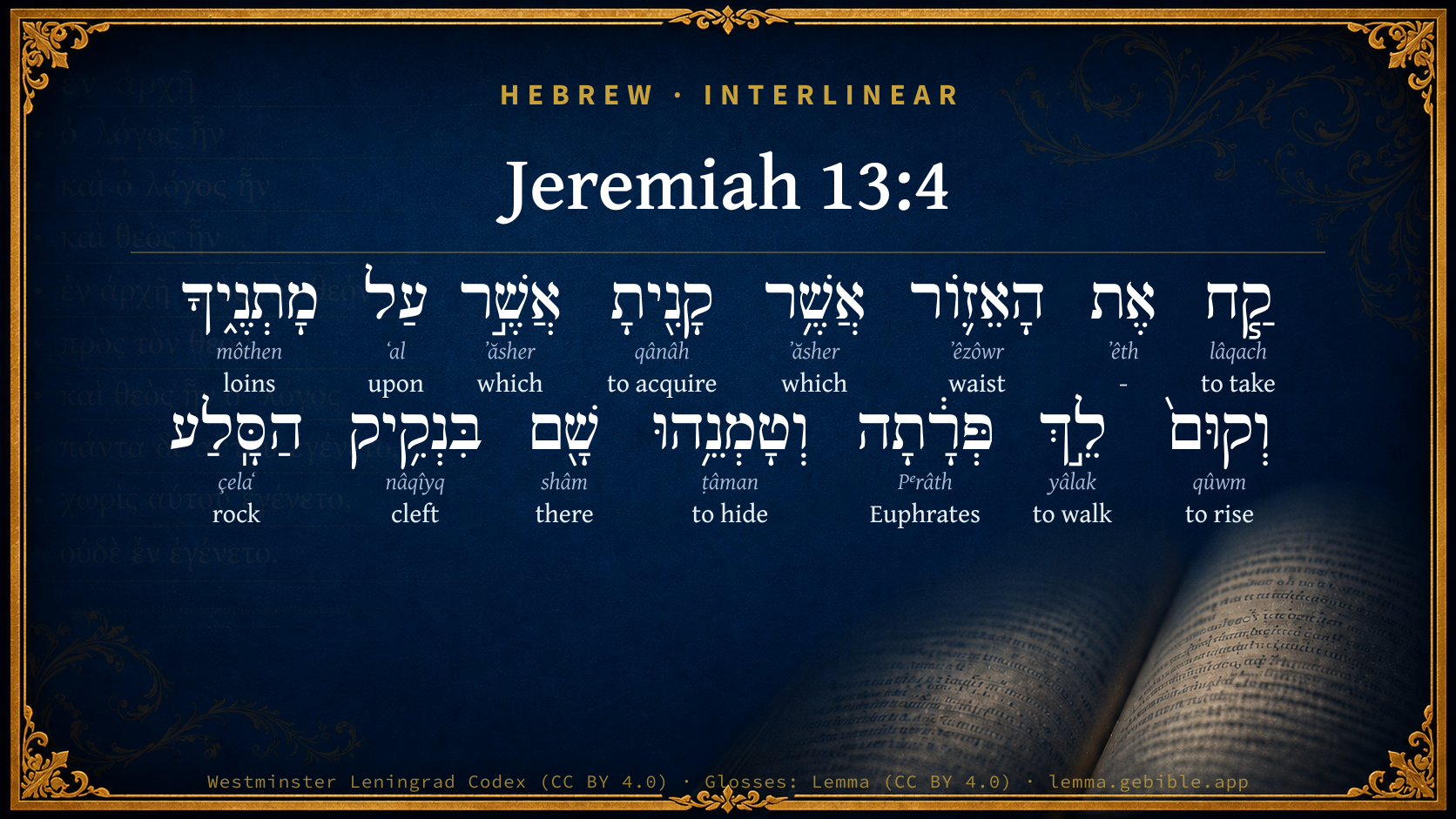
Hebrew (Westminster Leningrad Codex) Jeremiah 13:4 appears in the Hebrew Old Testament. The text above is from the Westminster Leningrad Codex. Each word links to its Strong’s number, a concise gloss, and parsing drawn from the Open Scriptures Hebrew Bible morphology. Click any word for its full Brown-Driver-Briggs (BDB) entry.
Download image
Cite this verse

Jeremiah 13:4 (World English Bible). Public Domain. Lemma interlinear Bible study tool, https://lemma.gebible.app/v/jeremiah/13/4.

Show BibTeX & RIS
BibTeX
RIS
English Translation
Take the belt that you have bought, which is on your loins, and arise, go to the Euphrates, and hide it there in a cleft of the rock.
World English Bible · Public Domain
Download a study sheet

One document with this verse’s original text, its word-by-word gloss line, the meaning frame, cross-references with their text, attributed commentary, and full source and license credits — printable, and it pastes into notes with its structure intact.

This verse Autodidact and up

Study sheet (.html) Plain text (.txt)

A passage Seminary Student

Up to 50 verses in one chapter. A passage sheet keeps up to 6 commentary sources and 12 cross-references per verse, in the order this page ranks them, and says so on the sheet whenever that leaves anything out. Ask for a single verse and you get the Autodidact verse sheet above.

Everything on this page stays free to read, with no account — the sheet is a download of what is already on screen, not access to it.

Want to remove ads? Support Godless Engineer
Compare translations 3

The same verse in 3 English versions, stacked beneath the original-language interlinear above. Click any original word for its lexicon entry.

Each is an independent rendering of the whole verse — the interlinear is not word-aligned to these translations.

Highlighted words mark where these versions differ — a whole-verse word diff, not a word-by-word alignment.

  • World English Bible Public Domain
    Take the belt that you have bought, which is on your loins, and arise, go to the Euphrates, and hide it there in a cleft of the rock.
  • King James Version Public Domain
    Take the girdle that thou hast got, which is upon thy loins, and arise, go to Euphrates, and hide it there in a hole of the rock.
  • unfoldingWord Literal Text CC BY-SA 4.0
    “Take the loincloth that you bought, that around your loins, and arise, go to Perath and hide it there in a cleft of the rock.”

unfoldingWord Literal Text — © unfoldingWord, licensed CC BY-SA 4.0. Word-aligned USFM3 via Door43 (git.door43.org/unfoldingWord/en_ult).

Versions to compare (up to 4)

3 of 4 selected

Show all 18 translations

Every available English version of this verse, each an independent rendering of the whole verse.

  • World English Bible Public Domain
    Take the belt that you have bought, which is on your loins, and arise, go to the Euphrates, and hide it there in a cleft of the rock.
  • Berean Standard Bible Public Domain
    “Take the loincloth that you bought and are wearing, and go at once to Perath and hide it there in a crevice of the rocks.”
  • Majority Standard Bible Public Domain
    “Take the loincloth that you bought and are wearing, and go at once to Perath and hide it there in a crevice of the rocks.”
  • King James Version Public Domain
    Take the girdle that thou hast got, which is upon thy loins, and arise, go to Euphrates, and hide it there in a hole of the rock.
  • American Standard Version (1901) Public Domain
    Take the girdle that thou hast bought, which is upon thy loins, and arise, go to the Euphrates, and hide it there in a cleft of the rock.
  • Revised Version (1885) Public Domain
    Take the girdle that thou hast bought, which is upon thy loins, and arise, go to Euphrates, and hide it there in a hole of the rock.
  • Geneva Bible (1599) Public Domain
    Take the girdle that thou hast bought, which is vpon thy loynes, and arise, goe towarde Perath, and hide it there in the cleft of the rocke.
  • Douay-Rheims (1899) Public Domain
    Take the girdle which thou hast got, which is about thy loins, and arise, and go to the Euphrates, and hide it there in a hole of the rock.
  • Young's Literal Translation Public Domain
    `Take the girdle that thou hast got, that `is' on thy loins, and rise, go to Phrat, and hide it there in a hole of the rock;
  • Literal Standard Version CC BY-SA 4.0
    “Take the girdle that you have acquired, that [is] on your loins, and rise, go to the Euphrates, and hide it there in a hole of the rock”;
  • Unlocked Literal Bible CC BY-SA 4.0
    “Take the undergarment that you purchased that is around your waist, get up and go now to Perath. Hide it there in a rock crevice.”
  • unfoldingWord Literal Text CC BY-SA 4.0
    “Take the loincloth that you bought, that around your loins, and arise, go to Perath and hide it there in a cleft of the rock.”
  • Darby Bible Public Domain
    Take the girdle that thou hast bought, which is upon thy loins, and arise, go to the Euphrates, and hide it there in a hole of the rock.
  • World Messianic Bible Public Domain
    “Take the belt that you have bought, which is on your waist, and arise, go to the Euphrates, and hide it there in a cleft of the rock.”
  • Webster's Bible Public Domain
    Take the girdle that thou hast procured, which is upon thy loins, and arise, go to Euphrates, and hide it there in a hole of the rock.
  • Free Bible Version CC BY-SA 4.0
    Take the loincloth that you bought and put on, and go immediately to the River Perath and hide it there in a hole among the rocks.
  • Bible in Basic English Public Domain
    Take the band which you got for a price, which is round your body, and go to Parah and put it in a secret place there in a hole of the rock.
  • JPS Tanakh (1917) Public Domain
    'Take the girdle that thou hast gotten, which is upon thy loins, and arise, go to Perath, and hide it there in a cleft of the rock.'

Literal Standard Version (2020), Covenant Press — licensed CC BY-SA 4.0. Text via the HelloAO Bible API (eBible.org). Unlocked Literal Bible (unfoldingWord) — licensed CC BY-SA 4.0. Text via the HelloAO Bible API (eBible.org). unfoldingWord Literal Text — © unfoldingWord, licensed CC BY-SA 4.0. Word-aligned USFM3 via Door43 (git.door43.org/unfoldingWord/en_ult). Free Bible Version, Dr. Jonathan Gallagher — licensed CC BY-SA 4.0. Text via the HelloAO Bible API (eBible.org).

Word by word

More ways to search: Search by grammar → Find every occurrence → Compare this word →

Practice this passage: Drill this verse → Learn its vocabulary →

בִּנְקִ֥יק
nâqîyq
H5357
“in/at · cleft of”
Preposition + Noun, Common, Masculine, Singular, Construct
Part of Speech
Preposition + Noun
Type
Common
Gender
Masculine
Number
Singular
State
Construct
Full BDB Definition

Origin: from an unused root meaning to bore

TWOT: 1417a

cleft (of a rock)
  1. קַ֧ח lâqach H3947 “take” Verb, Qal, Imperative, 2nd Person, Masculine, Singular
  2. אֶת ʼêth H853 “-” Particle, Direct Object
  3. הָאֵז֛וֹר ʼêzôwr H232 “the · waist” Particle, Definite Article + Noun, Common, Masculine, Singular, Absolute
  4. אֲשֶׁ֥ר ʼăsher H834 “which” Particle, Relative
  5. קָנִ֖יתָ qânâh H7069 “to acquire” Verb, Qal, Perfect, 2nd Person, Masculine, Singular
  6. אֲשֶׁ֣ר ʼăsher H834 “which” Particle, Relative
  7. עַל ʻal H5921 “upon” Preposition
  8. מָתְנֶ֑יךָ môthen H4975 “loins · your” Noun, Common, Masculine, Dual, Construct + Suffix, Personal, 2nd Person, Masculine, Singular
  9. וְקוּם֙ qûwm H6965 “and · rise” Conjunction + Verb, Qal, Imperative, 2nd Person, Masculine, Singular
  10. לֵ֣ךְ yâlak H3212 “walk” Verb, Qal, Imperative, 2nd Person, Masculine, Singular
  11. פְּרָ֔תָה Pᵉrâth H6578 “Euphrates · toward” Noun, Proper + Suffix, Demonstrative
  12. וְטָמְנֵ֥הוּ ṭâman H2934 “and · hide · him” Conjunction + Verb, Qal, Imperative, 2nd Person, Masculine, Singular + Suffix, Personal, 3rd Person, Masculine, Singular
  13. שָׁ֖ם shâm H8033 “there” Adverb
  14. הַסָּֽלַע çelaʻ H5553 “the · rock” Particle, Definite Article + Noun, Common, Masculine, Singular, Absolute

About this verse

These counts appear in no published source. They are computed here, from the morphology-tagged text and Lemma’s own curated glosses. What Lemma adds →

15
words
14
distinct lemmas
Prophets
section

Notable vocabulary

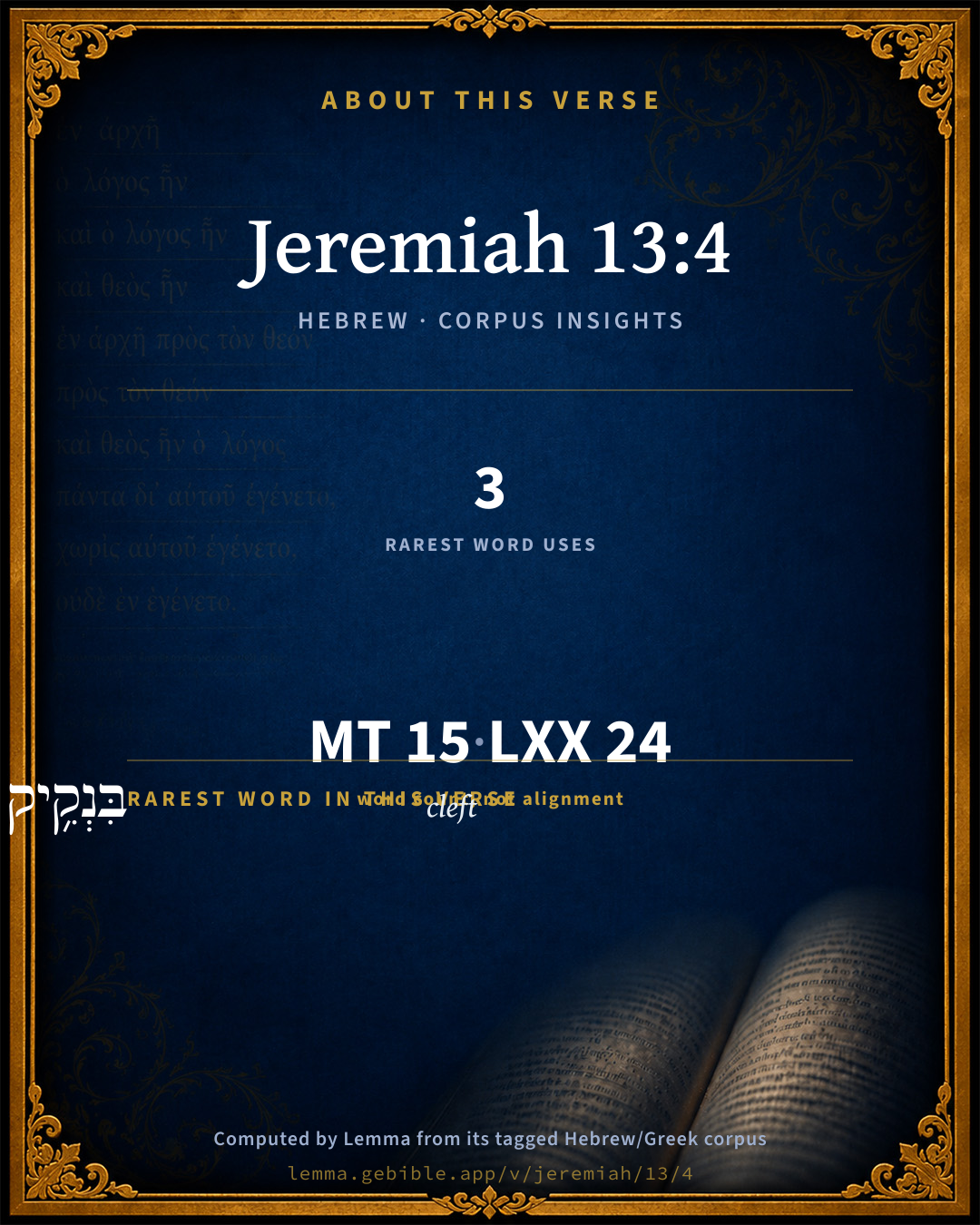
The rarest word here is בִּנְקִ֥יק cleft H5357 — appearing just 3 times in the whole Hebrew Bible.

Shared distinctive vocabulary

בִּנְקִ֥יק cleft H5357 occurs in 3 verses of the Hebrew Bible. Also found in:

Grammatical profile

  • 5 verbs
  • 5 nouns
  • 1 preposition
  • 1 adverb
  • 3 particles

Verb forms

  • קַ֧ח Qal · Imperative
  • קָנִ֖יתָ Qal · Perfect
  • וְקוּם֙ Qal · Imperative
  • לֵ֣ךְ Qal · Imperative
  • וְטָמְנֵ֥הוּ Qal · Imperative

Repetition

A word recurs within this verse — often emphatic in Hebrew:

  • אֲשֶׁ֥ר which H834 ×2

Hebrew & Septuagint length

In the original languages it is 15 Hebrew tokens and 24 Greek tokens — but the two are counted differently (Hebrew bundles its prefixes and suffixes into one token; the Greek is in lemma form), so that isn’t a like-for-like length.

Cross-references

3

Topical passages linked to Jeremiah 13:4 in the Treasury of Scripture Knowledge — connected by theme and wording, ordered by reader-vote popularity; previews shown in the World English Bible.

  • Psalms 137:1 By the rivers of Babylon, there we sat down. Yes, we wept, when we remembered Zion.
  • Jeremiah 51:63–64 It shall be, when you have made an end of reading this book, that you shall bind a stone to it, and cast it into the midst of the Euphrates:
  • Micah 4:10 Be in pain, and labor to bring forth, daughter of Zion, Like a woman in travail; For now you will go forth out of the city, And will dwell in the field, And will come even to Babylon. There you will be rescued. There Yahweh will redeem you from the hand of your enemies.

Cross-references courtesy of OpenBible.info (CC BY 4.0).

Hebrew and Greek witnesses Masoretic Hebrew ↔ Greek Septuagint

The same verse in the two great witnesses to the Old Testament, shown verse-for-verse.

These are two independent witnesses, not word-aligned to each other, and the Septuagint is shown in lemma (dictionary) form.

Hebrew Jeremiah 13:4 Masoretic · Westminster Leningrad Codex

קַ֧ח אֶת הָאֵז֛וֹר אֲשֶׁ֥ר קָנִ֖יתָ אֲשֶׁ֣ר עַל מָתְנֶ֑יךָ וְקוּם֙ לֵ֣ךְ פְּרָ֔תָה וְטָמְנֵ֥הוּ שָׁ֖ם בִּנְקִ֥יק הַסָּֽלַע

Take the belt that you have bought, which is on your loins, and arise, go to the Euphrates, and hide it there in a cleft of the rock.

World English Bible · Public Domain

Greek LXX Structure differs

In the Septuagint, Jeremiah is about an eighth shorter than the Hebrew and arranges its material differently — the Oracles Against the Nations (Hebrew chapters 46–51) appear in the middle of the Greek book, after 25:13. Because the chapter and verse boundaries do not line up, a verse-for-verse comparison with the Hebrew is not shown.

A verse-for-verse comparison isn’t shown here because the chapters and verses don’t line up. Switch to the LXX edition with the MT / LXX toggle above to read the Greek directly.

Hebrew: Westminster Leningrad Codex (CC BY 4.0). Greek: Septuagint (public domain); English from a public-domain English Septuagint. How the Septuagint differs from the Hebrew →

Targum (Aramaic paraphrase)

1

The Targum is the ancient Jewish Aramaic paraphrase of the Hebrew Scriptures — an interpretive translation, not the Hebrew text itself. Onkelos (literal) and Pseudo-Jonathan (expansive) render the Torah, and Jonathan the Prophets. Coverage is partial: where no permissively-licensed English translation exists for a verse, only the Aramaic is shown. This is verse-level text, not a word-by-word alignment to the Hebrew.

  1. Targum Jonathan Prophets (Joshua–Malachi)
    סַב יַת זַרְזָא דִי זְבִינְתָּא דִי עַל חֲרָצָךְ וְקוּם אֱזֵיל לִפְרָת וּטְמַרְהִי תַמָן בִּשְׁעִיעוּת כֵּיף גְלֵי:

    (no public-domain English translation for this verse)

    Targum Jonathan — Aramaic: “Mikraot Gedolot” (public domain). English: “Sefaria Community Translation” (CC0 1.0 (public-domain dedication)); “London "Chaldee Paraphrase," 1871” (public domain). Text via Sefaria.

Commentary

Notes on Jeremiah 13:4 from classic Christian and Jewish commentators (each source and its license shown beneath its notes). The classic Christian expositions comment on the surrounding passage and are grouped to its opening verse, so a note may address several verses; the Jewish commentaries on the Tanakh (Rashi and others) are per-verse, so they appear only where the commentator wrote on this verse.

Lemma curates 59 commentaries, every one of them public domain or Creative Commons licensed, each selected and text-cleaned for this edition rather than reprinted as found. About our sources →

Trapp's Complete Commentary

John Trapp

Jer 13:4 Take the girdle that thou hast got, which [is] upon thy loins, and arise, go to Euphrates, and hide it there in a hole of the rock.

Ver. 4. Arise, go to Euphrates.] A river which ran by Babylon, six hundred and fourscore miles from Jerusalem. The prophet’s journey therefore thither seemeth to have been but visional, as was Isaiah’s going barefoot, Hosea’s marriage with a whore, Ezekiel’s lying on one side three hundred and ninety days together; his journey from Chaldea to Jerusalem. {Eze 8:3-4}

John Trapp, A Commentary or Exposition upon All the Books of the Old and New Testament (1647–1656) — public domain. Text from a community e-Sword module.

Joseph Benson's Commentary

Jer 13:4. Arise, go to Euphrates — God commanded the prophet to go and hide the girdle on the bank of the Euphrates, to signify that the Jews should be carried captive over that river, called the waters of Babylon, Psa 137:1. In the margin of our ancient English Bibles, it is observed, that, “because this river Perath, or Euphrates, was far from Jerusalem, it is evident that this was done in a vision.” And the generality of the best commentators have been of this opinion; it not being probable that the prophet should have been sent twice upon a journey of such considerable length and difficulty, to the very great loss of his time, merely upon the errands here mentioned, namely, to carry the girdle to the Euphrates, and to fetch it back, when, it seems, every purpose would have been answered altogether as well if the transaction had been represented in vision. Several things, it must be observed, are related in Scripture as actually done, which yet were certainly only performed in visions. One instance we have Jer 25:15-29, where Jeremiah is commanded to take a cup of wine in his hand, and to cause several kings and nations, there enumerated, to drink of it: for it would be a perfect absurdity to believe that he actually went round to all those kings and nations, and made them drink of the contents of his cup. And yet he makes no more distinction in this latter case, than in that now before us, between mental and bodily action. Another remarkable instance we have Gen 15:5, where the text says, that God brought Abraham forth abroad, and bid him tell the stars; and yet it appears, by a subsequent verse, that the sun was not then gone down. Indeed, in all these cases, and in many more that might be mentioned of a similar kind, it made no difference as to the end God had in view, whether the transactions related were visionary or real; for either way they served equally to represent the events which it was God’s pleasure to make known. See Lowth and Blaney.

Joseph Benson's Commentary on the Old and New Testaments (1811–1818) — public domain. Text from a community e-Sword module.

Geneva Bible (1599)

Geneva Bible translators

Because this river Perath or Euphrates was far from Jerusalem, it is evident that this was a vision, whereby was signified that the Jews should pass over Euphrates to be captives in Babylon, and there for length of time should seem to be rotten, although they were joined to the Lord before as a girdle about a man.

Geneva Bible (1599) marginal notes — public domain. Text via Bolls.life.

Jamieson, Fausset & Brown

Robert Jamieson, A. R. Fausset & David Brown

Euphrates--In order to support the view that Jeremiah's act was outward, HENDERSON considers that the Hebrew Phrath here is Ephratha, the original name of Beth-lehem, six miles south of Jerusalem, a journey easy to be made by Jeremiah. The non-addition of the word "river," which usually precedes Phrath, when meaning Euphrates, favors this view. But I prefer English Version. The Euphrates is specified as being near Babylon, the Jews future place of exile.

hole--typical of the prisons in which the Jews were to be confined.

the rock--some well-known rock. A sterile region, such as was that to which the Jews were led away (compare Isa 7:19) [GROTIUS].

Jamieson, Fausset & Brown — Commentary Critical and Explanatory on the Whole Bible (1871) — public domain (CC PDM 1.0). Text via the HelloAO Bible API.

Adam Clarke's Commentary

Verse 4. Go to Euphrates, and hide it there] Intending to point out, by this distant place, the country into which they were to be carried away captive.

Adam Clarke's Commentary on the Bible (1810–1826) — public domain. Text from a community e-Sword/MySword module.

Ellicott's Commentary for English Readers

(4) Go to Euphrates.—The Hebrew word Phrath is the same as that which, everywhere else in the O.T., is rendered by the Greek name for the river, Euphrates. It has been suggested (1) that the word means “river” generally, or “rushing water,” applied by way of pre-eminence to the “great river” and therefore that it may have been used here in its general sense; and (2) that it may stand here for Ephratah, or Bethlehem, as the scene of Jeremiah’s symbolic actions, the place being chosen on account of its suggestive likeness to Euphrates. These conjectures, however, have no other basis than the assumed improbability of a double journey of two hundred and fifty miles, and this, as has been shown, can hardly be weighed as a serious element in the question. In Jeremiah 51 there can be no doubt that the writer means Euphrates. It may be noted, too, as a coincidence confirming this view, that Jeremiah appears as personally known to Nebuchadnezzar in Jer_39:11. Those who make Ephratah the scene of what is here recorded, point to the caves and clefts in the rocky region between Bethlehem and the Dead Sea as agreeing with the description. On the other hand, the form Prath is nowhere found as substituted for the familiar Ephratah.

A hole of the rock.—Better, cleft. In the lower part of its course the Euphrates flows through an alluvial plain, and the words point therefore to some part of its upper course above Pylæ, where its course is through a valley more or less rocky.

A Bible Commentary for English Readers, edited by Charles John Ellicott (1878–1897) — public domain. Text from a community e-Sword module.

The Cambridge Bible for Schools and Colleges

gen. ed. J. J. S. Perowne

4. hide it there] in such a way that moisture should have full access to it.

the rock] If an actual visit to the Euphrates is meant, the part referred to “cannot be anywhere near Babylon, where there are no ‘rocks,’ or rather ‘crags’—but in the upper part of its course, above Carchemish, or even above Samosata, where it still flows between rocky sides.” Dr.

The Cambridge Bible for Schools and Colleges (gen. ed. J. J. S. Perowne; Cambridge University Press, 1878–1918) — public domain. Text from a community e-Sword module.

John Gill's Exposition

Take the girdle which thou hast got, which is upon thy loins,.... Either he is bid to take it off his loins, on which it was; or to go with it on them; seeing the taking it off does not seem absolutely necessary; and go with it to the place directed to in the following words:

and arise, go to Euphrates, and hide it there in a hole of the rock; by the river side, where the waters, coming and going, would reach and wet it, and it drying again, would rot the sooner. This signifies the carrying of the Jews captive to Babylon, by which city the river Euphrates ran, and the obscure state and condition they would be in there; and where all their pride and glory would be marred, as afterwards declared.

John Gill's Exposition of the Whole Bible (1746–1763) — public domain (CC PDM 1.0). Text via the HelloAO Bible API.

Albert Barnes' Notes on the Bible

In a hole of the rock - “In a cleft of the rock.” As there are no fissured rocks in Babylonia, the place where Jeremiah hid the girdle must have been somewhere in the upper part of the river.

Albert Barnes' Notes on the Bible (1834–1885) — public domain. Text from a community e-Sword/MySword module.

Haydock's Catholic Bible Commentary

Euphrates, above 150 leagues distant. Some think this was only to be done in spirit: but it is generally supposed that the prophet made this long journey twice. Bochart suggests that Euphrates (Hebrew Peratha) may be put for Ephrata, or Bethlehem, as the first syllable is often cut off. (Calmet) --- Yet a journey to the Euphrates would represent more strikingly the destination of the people; and it would not be difficult for God to convey Jeremias thither in a short time, if requisite, as he sent Habacuc through the air to carry a dinner to Daniel; (xiv. 32.) though this supposition is not here necessary, as the labour to which Jeremias was repeatedly exposed, might shew the people their manifold transgressions and captivities. (Haydock) --- Such prophetic actions make a deeper impression than words, Hebrews i. The ingratitude of the people is here described, to chap. xxi. (Worthington)

George Leo Haydock (1774–1849), Haydock's Catholic Family Bible and Commentary, 1859 edition — public domain. Excludes Psalms (Douay-Rheims chapter numbering differs from Protestant) and Deuterocanonical books (Catholic canon only).

Matthew Poole's English Annotations

God having commanded the prophet to procure such a girdle as was before mentioned, and to tie it upon his loins, he a second time comes to him, and commandeth him to take this girdle, and carry it to Euphrates. This was one of the four great rivers that the river out of the garden of Eden divided itself into, Gen 2:10,14. It was the border of the Promised Land, Gen 15:18; Deu 1:7; 11:24; 1Ch 5:9. Reuben’s lot was bounded by it. The prophet was commanded to hide his girdle in the

hole of a

rock in that river. But why there? Were there not other places nearer where the prophet might have hid it? It is judged by some that this command was also to signify unto them that they should be carried out of their own borders into captivity; or rather, that they had corrupted, and were become rotten, by doing after the fashions and manners of the heathens, who lived on the other side of Euphrates always, but having (a hundred years before this) captivated the ten tribes, lived also on this side of it.

Matthew Poole's English Annotations on the Holy Bible (1683–1685) — public domain. Text from a community e-Sword/MySword module.

Whedon's Commentary on the Bible

Daniel D. Whedon

4. Euphrates — The future scene of the captivity. In most other places in the Bible (Jer_51:63; 2Ch_35:20, and perhaps Gen_2:14, being the only exceptions) this name is associated with Nahar, (נהר,) hence some have conjectured that the name is here used in a special sense. For instance, some have conjectured that it is used for Ephrath — Bethlehem, with the first weak letter omitted, so that the command would be, Go to Bethlehem. But this is violent and without warrant, and misses the significance of the locality. Ewald conjectures that the word is from the Arabic for water-fissure; “a view,” says Keil, “requiring no serious refutation.”

Daniel D. Whedon (gen. ed.), Commentary on the Old and New Testaments (1874–1909) — public domain. Text from a community e-Sword module.

The Pulpit Commentary

Vers. 4-6. After Jeremiah has worn the apron for some time, he is directed to take it to Prath, and hide it there in a cleft (not "hole") of the rock. A long interval elapses, and he is commanded to make a second journey to the same place, and fetch away the apron. What does this Prath mean? It is by no means easy to decide. Hardly "the Euphrates,

(1) because the common prefix, "the river," is wanting, though in so extraordinary a narrative it was peculiarly needed;

(2) because of the length of the journey to Babylonia, which has ex hyp. to be made twice; and

(3) because the Euphrates is not a rocky river. Ewald suggested that "some wet place near Jerusalem" probably had the name of Prath, and indicates a valley and spring called Forah, about six English miles north-east of Jerusalem. Mr. Birch appears to have hit independently on the same spot, which he identifies with the Parah of Jos_18:23, about three miles north-east of Anatbeth, and describes as a picturesque gorge between savage rocks, with a copious stream (Quarterly Statement of the Palestine Exploration Fund, October, 1880, p. 236). This combination, however, involves an emendation of the text (P"rath into Parah)logically it involves this, as Mr. Birch has seen; Ewald"s comparison of the Arabic furat, sweet water, seems inconsistent with his reference to Parah for which there does not seem to be sufficient necessity; and it is better to adopt the view of the great old French Protestant scholar, Bochart, that P"rath is a shortened form of Ephrath, i.e. at once Bethlehem and the district in which Bethlehem lay. (see 1Ch_2:50 1Ch_4:4; and perhaps Psa_132:6) It need hardly be said that the limestone hills of this region afforded abundance of secluded rocks. There may, of course, be at the same time an allusion to the ordinary meaning of Prath, viz. Euphrates, on the analogy of the allusion in Isa_27:12. Those who hold the view here rejected, that Prath is equivalent to the Euphrates, sometimes suppose that the narrative is a parable or symbolical fiction, such as Luther, Calvin, and others find in Hos_1:3, the thing signified being in this case the carrying captive of the people to Babylon; and this seems the best way of making this interpretation plausible.

The Pulpit Commentary (1880–1919), ed. H.D.M. Spence-Jones & Joseph S. Exell — public domain. Text from a community e-Sword module.

Lesson kit

Teaching starters — assembled from the data on this page, not authored interpretation. Every prompt links to the verse data it draws on. Edit before teaching.

Jeremiah, in the Prophets, opens this verse with 15 words (14 distinct Hebrew lemmas). Its most distinctive word is nâqîyq (“cleft”). A historical commentator’s framing appears above. Read the whole chapter for the surrounding context.

Discussion questions

  1. The word nâqîyq carries the sense “cleft.” How does it shape the verse?
  2. How does Isaiah 7:19, which shares the word «cleft», read alongside this verse?
  3. What does the repetition of “which” (2× in this one verse) do in this verse?
  4. The translations on this page render this verse differently — a whole-verse word diff, not a word-by-word alignment. What might account for the different wordings?
  5. «קַ֧ח» is a Qal Imperative verb. How does that grammatical form shape the action described?
  6. Compare how Trapp's Complete Commentary and Joseph Benson's Commentary read this verse. Where do they agree or differ?

Things to notice

Reading settings

Reading text

Shown beneath each verse's original-language words.

Old Testament
Old Testament edition

Read the OT as the Masoretic Hebrew (MT) or the Greek Septuagint (LXX).

English shown for the Greek Septuagint (in the Hebrew ↔ Greek comparison).

Comparing translations? Open the Compare panel on any verse page to stack up to four side by side.