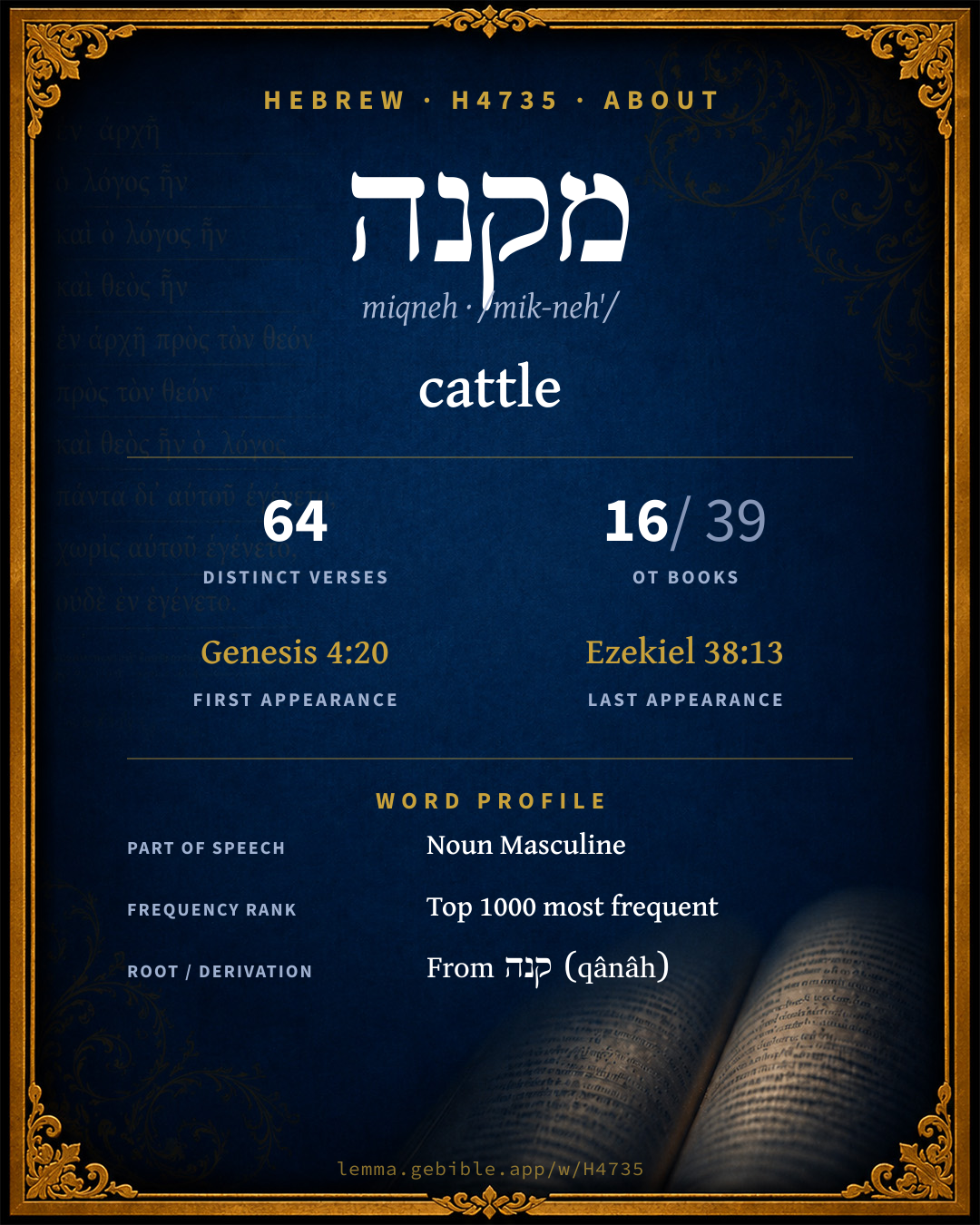
מִקְנֶה
cattle
‘cattle’ is one of 2 main senses fuller range ↓
Full lexicon entry — Brown-Driver-Briggs (BDB)
From Brown-Driver-Briggs (BDB)
Where this word appears
See every Construct-state word in the Hebrew Bible →
Grammar key — what these labels mean
Part of speech
- Noun
- A naming word — a person, place, thing, or idea.
Noun type
- Common
- A common noun — a general class of person, place, or thing (“king,” “city,” “water”), not a specific name.
State
- Absolute
- The independent form of a noun, not bound to a following word.
- Construct
- A noun bound to a following noun in a possessive / “of” relationship (the construct chain).
Gender
- Masculine
- Grammatically masculine.
Number
- Singular
- One.
- Plural
- More than one (in Hebrew, generally three or more).
Grammatical forms
- Noun, Common, Masculine, Singular, Construct 44 times (58%)
- Noun, Common, Masculine, Singular, Absolute 23 times (30%)
- Noun, Common, Masculine, Plural, Construct 9 times (12%)
Parsed forms decoded from the imported morphology (morphhb / Westminster Leningrad Codex — WLC text public domain, morphhb tagging CC BY 4.0), counted across 76 parsed occurrences — not distinct verses.
Every verse where H4735 appears — 64 distinct verses across 16 books. Click any verse to open its interlinear word-by-word view. Verse text shown in the World English Bible for context — . Each verse’s Hebrew form is shown with its reference; the English is not keyword-highlighted, since the data carries no word-level English alignment. Use “Compare translations” on any verse to read it across multiple English versions. This concordance covers the Hebrew Bible; Septuagint (Greek Old Testament) occurrences are not indexed here.
Genesis 21 verses
- Genesis 4:20 וּ/מִקְנֶֽה conj + n c ms Adah gave birth to Jabal, who was the father of those who dwell in tents and have cattle.
- Genesis 13:2 בַּ/מִּקְנֶ֕ה prep det + n c ms Abram was very rich in cattle, in silver, and in gold.
- Genesis 13:7 מִקְנֵֽה מִקְנֵה n c ms cs n c ms cs There was a strife between the herdsmen of Abram's cattle and the herdsmen of Lot's cattle: and the Canaanite and the Perizzite lived then in the land.
- Genesis 26:14 מִקְנֵה וּ/מִקְנֵ֣ה n c ms cs conj + n c ms cs He had possessions of flocks, possessions of herds, and a great household. The Philistines envied him.
- Genesis 29:7 הַ/מִּקְנֶ֑ה ptcl def.art + n c ms He said, "Behold, it is still the middle of the day, not time to gather the cattle together. Water the sheep, and go and feed them."
- Genesis 30:29 מִקְנְ/ךָ֖ n c ms cs + sfx pers 2ms He said to him, "You know how I have served you, and how your cattle have fared with me.
- Genesis 31:9 מִקְנֵ֥ה n c ms cs Thus God has taken away the cattle of your father, and given them to me.
- Genesis 31:18 מִקְנֵ֗/הוּ מִקְנֵה֙ n c ms cs + sfx pers 3ms n c ms cs and he carried away all his cattle, and all his substance which he had gathered, the cattle of his getting, which he had gathered in Paddan Aram, to go to Isaac his father to the land of Canaan.
- Genesis 33:17 וּ/לְ/מִקְנֵ֨/הוּ֙ conj + prep + n c ms cs + sfx pers 3ms Jacob traveled to Succoth, built himself a house, and made shelters for his cattle. Therefore the name of the place is called Succoth.
- Genesis 34:5 מִקְנֵ֖/הוּ n c ms cs + sfx pers 3ms Now Jacob heard that he had defiled Dinah, his daughter; and his sons were with his cattle in the field. Jacob held his peace until they came.
- Genesis 34:23 מִקְנֵ/הֶ֤ם n c ms cs + sfx pers 3mp Won't their cattle and their substance and all their animals be ours? Only let us give our consent to them, and they will dwell with us."
- Genesis 36:6 מִקְנֵ֣/הוּ n c ms cs + sfx pers 3ms Esau took his wives, his sons, his daughters, and all the members of his household, with his cattle, all his animals, and all his possessions, which he had gathered in the land of Canaan, and went into a land away from his brother Jacob.
- Genesis 36:7 מִקְנֵי/הֶֽם n c ms cs + sfx pers 3mp For their substance was too great for them to dwell together, and the land of their travels couldn't bear them because of their cattle.
- Genesis 46:6 מִקְנֵי/הֶ֗ם n c ms cs + sfx pers 3mp They took their cattle, and their goods, which they had gotten in the land of Canaan, and came into Egypt-- Jacob, and all his seed with him,
- Genesis 46:32 מִקְנֶ֖ה n c ms These men are shepherds, for they have been keepers of cattle, and they have brought their flocks, and their herds, and all that they have.'
- Genesis 46:34 מִקְנֶ֜ה n c ms that you shall say, 'Your servants have been keepers of cattle from our youth even until now, both we, and our fathers:' that you may dwell in the land of Goshen; for every shepherd is an abomination to the Egyptians."
- Genesis 47:6 מִקְנֶ֖ה n c ms The land of Egypt is before you. Make your father and your brothers dwell in the best of the land. Let them dwell in the land of Goshen. If you know any able men among them, then put them in charge of my cattle."
- Genesis 47:16 מִקְנֵי/כֶ֔ם בְּ/מִקְנֵי/כֶ֑ם n c mp cs + sfx pers 2mp prep + n c mp cs + sfx pers 2ms Joseph said, "Give your cattle; and I will give you food for your cattle, if money fails."
- Genesis 47:17 מִקְנֵי/הֶם֮ וּ/בְ/מִקְנֵ֥ה וּ/בְ/מִקְנֵ֥ה מִקְנֵ/הֶ֔ם n c mp cs + sfx pers 3mp conj + prep + n c ms cs conj + prep + n c ms cs n c ms cs + sfx pers 3mp They brought their cattle to Joseph, and Joseph gave them bread in exchange for the horses, and for the flocks, and for the herds, and for the donkeys: and he fed them with bread in exchange for all their cattle for that year.
- Genesis 47:18 וּ/מִקְנֵ֥ה conj + n c ms cs When that year was ended, they came to him the second year, and said to him, "We will not hide from my lord how our money is all spent, and the herds of cattle are my lord's. There is nothing left in the sight of my lord, but our bodies, and our lands.
- Genesis 49:32 מִקְנֵ֧ה n c ms cs the field and the cave that is therein, which was purchased from the children of Heth."
Exodus 11 verses
- Exodus 9:3 בְּ/מִקְנְ/ךָ֙ prep + n c ms cs + sfx pers 2ms behold, the hand of Yahweh is on your cattle which are in the field, on the horses, on the donkeys, on the camels, on the herds, and on the flocks with a very grievous pestilence.
- Exodus 9:4 מִקְנֵ֣ה מִקְנֵ֣ה n c ms cs n c ms cs Yahweh will make a distinction between the cattle of Israel and the cattle of Egypt; and there shall nothing die of all that belongs to the children of Israel."'"
- Exodus 9:6 מִקְנֵ֣ה וּ/מִ/מִּקְנֵ֥ה n c ms cs conj + prep + n c ms cs Yahweh did that thing on the next day; and all the cattle of Egypt died, but of the cattle of the children of Israel, not one died.
- Exodus 9:7 מִ/מִּקְנֵ֥ה prep + n c ms cs Pharaoh sent, and, behold, there was not so much as one of the cattle of the Israelites dead. But the heart of Pharaoh was stubborn, and he didn't let the people go.
- Exodus 9:19 מִקְנְ/ךָ֔ n c ms cs + sfx pers 2ms Now therefore command that all of your cattle and all that you have in the field be brought into shelter. Every man and animal that is found in the field, and isn't brought home, the hail shall come down on them, and they shall die."'"
- Exodus 9:20 מִקְנֵ֖/הוּ n c ms cs + sfx pers 3ms Those who feared the word of Yahweh among the servants of Pharaoh made their servants and their cattle flee into the houses.
- Exodus 9:21 מִקְנֵ֖/הוּ n c ms cs + sfx pers 3ms Whoever didn't regard the word of Yahweh left his servants and his cattle in the field.
- Exodus 10:26 מִקְנֵ֜/נוּ n c ms cs + sfx pers 1cp Our cattle also shall go with us. There shall not a hoof be left behind, for of it we must take to serve Yahweh our God; and we don't know with what we must serve Yahweh, until we come there."
- Exodus 12:38 מִקְנֶ֖ה n c ms A mixed multitude went up also with them, with flocks, herds, and even very much cattle.
- Exodus 17:3 מִקְנַ֖/י n c mp cs + sfx pers 1cs The people were thirsty for water there; and the people murmured against Moses, and said, "Why have you brought us up out of Egypt, to kill us, our children, and our livestock with thirst?"
- Exodus 34:19 מִקְנְ/ךָ֙ n c ms cs + sfx pers 2ms All that opens the womb is mine; and all your cattle that is male, the firstborn of cow and sheep.
Numbers 6 verses
- Numbers 20:19 וּ/מִקְנַ֔/י conj + n c mp cs + sfx pers 1cs The children of Israel said to him, We will go up by the highway; and if we drink of your water, I and my cattle, then will I give the price of it: let me only, without [doing] anything [else], pass through on my feet.
- Numbers 31:9 מִקְנֵ/הֶ֛ם n c ms cs + sfx pers 3mp The children of Israel took captive the women of Midian and their little ones; and all their cattle, and all their flocks, and all their goods, they took for a prey.
- Numbers 32:1 וּ/מִקְנֶ֣ה מִקְנֶֽה conj + n c ms n c ms Now the children of Reuben and the children of Gad had a very great multitude of cattle: and when they saw the land of Jazer, and the land of Gilead, that behold, the place was a place for cattle;
- Numbers 32:4 מִקְנֶ֖ה מִקְנֶֽה n c ms n c ms the land which Yahweh struck before the congregation of Israel, is a land for cattle; and your servants have cattle.
- Numbers 32:16 לְ/מִקְנֵ֖/נוּ prep + n c ms cs + sfx pers 1cp They came near to him, and said, We will build sheepfolds here for our cattle, and cities for our little ones:
- Numbers 32:26 מִקְנֵ֖/נוּ n c ms cs + sfx pers 1cp Our little ones, our wives, our flocks, and all our cattle, shall be there in the cities of Gilead;
Deuteronomy 1 verse
Joshua 3 verses
- Joshua 1:14 וּ/מִקְנֵי/כֶם֒ conj + n c mp cs + sfx pers 2mp Your wives, your little ones, and your cattle, shall abide in the land which Moses gave you beyond the Jordan; but you shall pass over before your brothers armed, all the mighty men of valor, and shall help them;
- Joshua 14:4 לְ/מִקְנֵי/הֶ֖ם prep + n c mp cs + sfx pers 3mp For the children of Joseph were two tribes, Manasseh and Ephraim: and they gave no portion to the Levites in the land, save cities to dwell in, with the suburbs of it for their cattle and for their substance.
- Joshua 22:8 וּ/בְ/מִקְנֶ֣ה conj + prep + n c ms and spoke to them, saying, Return with much wealth to your tents, and with very much cattle, with silver, and with gold, and with brass, and with iron, and with very much clothing: divide the spoil of your enemies with your brothers.
Judges 2 verses
- Judges 6:5 וּ/מִקְנֵי/הֶ֨ם conj + n c mp cs + sfx pers 3mp For they came up with their cattle and their tents; they came in as locusts for multitude; both they and their camels were without number: and they came into the land to destroy it.
- Judges 18:21 הַ/מִּקְנֶ֛ה ptcl def.art + n c ms So they turned and departed, and put the little ones and the cattle and the goods before them.
1 Samuel 2 verses
- 1 Samuel 23:5 מִקְנֵי/הֶ֔ם n c ms cs + sfx pers 3mp David and his men went to Keilah, and fought with the Philistines, and brought away their cattle, and killed them with a great slaughter. So David saved the inhabitants of Keilah.
- 1 Samuel 30:20 הַ/מִּקְנֶ֣ה ptcl def.art + n c ms David took all the flocks and the herds, [which] they drove before those [other] cattle, and said, This is David's spoil.
2 Kings 1 verse
1 Chronicles 4 verses
- 1 Chronicles 5:9 מִקְנֵי/הֶ֛ם n c ms cs + sfx pers 3mp and eastward he lived even to the entrance of the wilderness from the river Euphrates, because their cattle were multiplied in the land of Gilead.
- 1 Chronicles 5:21 מִקְנֵי/הֶ֗ם n c ms cs + sfx pers 3mp They took away their cattle; of their camels fifty thousand, and of sheep two hundred fifty thousand, and of donkeys two thousand, and of men one hundred thousand.
- 1 Chronicles 7:21 מִקְנֵי/הֶֽם n c ms cs + sfx pers 3mp and Zabad his son, and Shuthelah his son, and Ezer, and Elead, whom the men of Gath who were born in the land killed, because they came down to take away their cattle.
- 1 Chronicles 28:1 וּ/מִקְנֶה֩ conj + n c ms David assembled all the princes of Israel, the princes of the tribes, and the captains of the companies who served the king by division, and the captains of thousands, and the captains of hundreds, and the rulers over all the substance and possessions of the king and of his sons, with the officers, and the mighty men, even all the mighty men of valor, to Jerusalem.
2 Chronicles 3 verses
- 2 Chronicles 14:15 מִקְנֶ֖ה n c ms They struck also the tents of cattle, and carried away sheep in abundance, and camels, and returned to Jerusalem.
- 2 Chronicles 26:10 מִקְנֶה n c ms He built towers in the wilderness, and hewed out many cisterns, for he had much cattle; in the lowland also, and in the plain: [and he had] farmers and vineyard keepers in the mountains and in the fruitful fields; for he loved farming.
- 2 Chronicles 32:29 וּ/מִקְנֵה conj + n c ms cs Moreover he provided him cities, and possessions of flocks and herds in abundance; for God had given him very much substance.
Job 3 verses
- Job 1:3 מִ֠קְנֵ/הוּ n c ms cs + sfx pers 3ms His possessions also were seven thousand sheep, three thousand camels, five hundred yoke of oxen, five hundred she-donkeys, and a very great household; so that this man was the greatest of all the children of the east.
- Job 1:10 וּ/מִקְנֵ֖/הוּ conj + n c ms cs + sfx pers 3ms Haven't you made a hedge around him, and around his house, and around all that he has, on every side? You have blessed the work of his hands, and his substance is increased in the land.
- Job 36:33 מִ֝קְנֶ֗ה n c ms The noise of it tells about him, And the cattle also concerning the storm that comes up.
Psalms 1 verse
Ecclesiastes 1 verse
Isaiah 1 verse
Jeremiah 2 verses
- Jeremiah 9:10 מִקְנֶ֑ה n c ms For the mountains will I take up a weeping and wailing, and for the pastures of the wilderness a lamentation, because they are burned up, so that none passes through; neither can men hear the voice of the cattle; both the birds of the sky and the animals are fled, they are gone.
- Jeremiah 49:32 מִקְנֵי/הֶם֙ n c ms cs + sfx pers 3mp Their camels shall be a booty, and the multitude of their cattle a spoil: and I will scatter to all winds those who have the corners [of their hair] cut off; and I will bring their calamity from every side of them, says Yahweh.
Ezekiel 2 verses
- Ezekiel 38:12 מִקְנֶ֣ה n c ms to take the spoil and to take the prey; to turn your hand against the waste places that are [now] inhabited, and against the people who are gathered out of the nations, who have gotten cattle and goods, who dwell in the middle of the earth.
- Ezekiel 38:13 מִקְנֶ֣ה n c ms Sheba, and Dedan, and the merchants of Tarshish, with all the young lions of it, shall tell you, Are you come to take the spoil? have you assembled your company to take the prey? to carry away silver and gold, to take away cattle and goods, to take great spoil?
About this entry
At a glance — auto-summarized from this page’s data, not written by a person. Every figure links to its source below. This summary describes the numbers; it doesn’t interpret them.
מקנה — transliterated miqneh — is a Hebrew noun carrying the sense “cattle.” Its English rendering has broadened — “cattle” classically, “livestock” (Berean Standard Bible) in modern versions; see the renderings breakdown. The Hebrew Bible uses it across 64 verses — moderately common. More than a third of its appearances fall in Genesis. It is not a single-sense word — see its full sense range. Each statement above links to its evidence; the full detail follows below.
Gloss history
Strong's 1890 vs modern scholarship
About this word
Strong's H4735 catalogs a Hebrew word from the Hebrew Old Testament.
These counts are not copied from any lexicon or concordance. They are computed here, from the morphology-tagged Hebrew Old Testament. What Lemma adds →
- 64
- distinct verses
- The word appears in 64 distinct verses.
- 16 / 39
- OT books
- The word appears in 16 of 39 Old Testament books.
- #523
- by frequency
- Top 1000 most frequent Hebrew words (rank 523 of 8,640 Hebrew words by occurrence).
View all 64 occurrences in the concordance →
By section of the Old Testament
By traditional corpus
Conventional, traditional groupings — biblical authorship is debated, so this is a traditional corpus grouping, not an authorship claim. Each share is this word’s portion of its verses in that division of the Hebrew canon. Each figure is a share of the word’s 64 distinct verses.
- Torah (Pentateuch) 39 verses · 61%
- Prophets (Nevi'im) 13 verses · 20%
- Writings (Ketuvim) 12 verses · 19%
How translations render this word
Counts come from each version’s own published word-to-Strong’s tagging or interlinear alignment — an approximate guide to how each version renders this word, not a word-level alignment the data otherwise carries. Because each total is that version’s own tagged count, the per-version totals vary from one another and need not match the appearance or distinct-verse counts above. These counts may also differ from a printed concordance because Lemma counts each distinctly tagged rendering and does not collapse phrase taggings into a single head-word total. This is a fixed set of word-tagged versions (KJV, ASV, BSB, ULT) and does not change with the reading translation you choose elsewhere. Each version’s license is shown beside its name below (and on Sources).
- King James Version: Cattle 45×, Flocks 2×, Have cattle 2×
- American Standard Version: Cattle 40×, Possessions 4×, 's cattle 2×
- Berean Standard Bible: Livestock 41×, Cattle 6×, Flocks 3×
- unfoldingWord Literal Text: Livestock 46×, Cattle 9×, Livestock of 6×
King James Version Public Domain
Renders H4735 across 75 tagged occurrences — most commonly:
Plus 20 renderings that appear only once — usually multi-word phrases or single function words the recovered tagging swept in, not distinct renderings.
American Standard Version Public Domain
Renders H4735 across 75 tagged occurrences — most commonly:
Plus 23 renderings that appear only once — usually multi-word phrases or single function words the recovered tagging swept in, not distinct renderings.
Berean Standard Bible Public Domain
Renders H4735 across 69 tagged occurrences — most commonly:
Plus 17 renderings that appear only once — usually multi-word phrases or single function words the recovered tagging swept in, not distinct renderings. Not rendered by a distinct English word in 6 further occurrences.
unfoldingWord Literal Text CC BY-SA 4.0
Renders H4735 across 77 tagged occurrences — most commonly:
Plus 9 renderings that appear only once — usually multi-word phrases or single function words the recovered tagging swept in, not distinct renderings.
Senses in the full BDB
What do BDB’s symbols mean?
BDB uses these scholarly abbreviations:
| Symbol | Meaning |
|---|---|
| 𝔊 | the Septuagint (the ancient Greek translation, LXX) |
| 𝔙 | the Vulgate (the Latin translation) |
| 𝔖 | the Syriac version (the Peshitta) |
| 𝔗 | the Targum (the Aramaic translation) |
| ψ | the Psalms |
| √ | root (the underlying root or stem) |
| ‖ | parallel passage (a synonymous or contrasted parallel) |
| † | the dagger: every passage where the word occurs is cited |
The 2 senses and sub-senses the full Brown-Driver-Briggs lexicon distinguishes for this word, in lexicon order (not ranked by frequency), with BDB’s own verbatim wording and sub-sense lettering. Shown in Hebrew script with BDB’s own scholarly abbreviations. The condensed entry is in the Lexicon Entry tab. See also the Forms in the corpus table below.
- 1. cattle in gen., including cows, sheep, horses, asses, camels (any or all of them), as purchasable domestic animals, Gn 47:16(×2), 17(×2); Ex 9:3 + (J), 10:26 (E), Dt 3:19 (not in P), Jb 1:3 ψ 78:48 Je 9:9; 1 Ch 5:12 +; so prob. ישֵׁב אֹהֶל וּמִקְנֶה Gn 4:20 (J) of nomads, מִקְנֵה הַבְּהֵמָה Gn 47:18 (J). e.g. Genesis 47:16
- 2. specif. of cows, sheep, and goats in herds and flocks Gn 13:2 (J), 31:9 (E), v 18 36:7; 46:6 Nu 32:1 (all P), Is 30:23 +; אַנְשֵׁי מ׳ Gn 46:32, 34 (J), שָׂרֵי מ׳ Gn 47:6 (P), cf. 1 Ch 28:1; רֹעֵי מ׳ Gn 13:7(×2) (J); disting. from בְּהֵמָה Nu 31:9 (P), 32:26; 2 K 3:17; from קנין Jos 14:4 (P); Ez 38:12, 13; from both Gn 34:23; 36:6 (P); מ׳ צאן ובקר 2 Ch 32:29 מ׳ בקר וצאן Ec 2:7; מ׳ צאן ומ׳ בקר Gn 26:14; 47:17 (J); sheep only Gn 29:7 (J); Nu 32:16 (E).—מִקְנֵה הַשָּׂדֶה Gn 49:32 (P) read מִקְנַת; מִקְנֶת אַף על עוֹלֶה Jb 36:33 read מַקְנֶה (Hiph. Pt.), or מְקַנֶּה (Pi. Pt.) metapl. from קנא, Hi Bö Di Du; 1 S 30:20 del. הַמּ׳ 𝔊 We Dr al., v. especially HPS. e.g. Genesis 13:2
Senses from the full Brown-Driver-Briggs lexicon (Brown, Driver, Briggs; Oxford 1906 — public domain), digitized via Sefaria, supplemented by the OpenScriptures HebrewLexicon (CC BY 4.0). Full attribution on Sources.
Word origin
n.m. Ex 10:26 cattle;—abs. מ׳ Gn 46:32 +; cstr. מִקְנֵה Gn 13:7 +; sf. מִקְנֵהוּ Gn 3:18 +, מִקְנֶיךָ Is 30:23 (Ges§ 93 ss), etc.; pl. sf. (but v. Köii. 112 f.) מִקְנַי Ex 17:3 +, מִקְנֵיכֶם Gn 47:16 +, etc.;—
— Brown-Driver-Briggs (Oxford 1906, public domain), digitized via Sefaria, supplemented by the OpenScriptures HebrewLexicon (CC BY 4.0). See Sources.
Derived from קנה (qânâh) (H7069) — to acquire.
Jastrow Dictionary
A second Hebrew/Aramaic lexicon for comparison, covering Aramaic and post-biblical (Talmudic, Targumic, Midrashic) usage that the biblical-Hebrew BDB does not. Matched by lemma rather than by Strong’s number, so a lemma may carry more than one Jastrow headword (shown separately below), and the entries cover usage well beyond the Bible.
מִקְנֶה
- property, esp. cattle. Num. R. s. 22 היה להם מ׳ גדול they had a large stock of cattle; a. e.
A Dictionary of the Targumim, the Talmud Babli and Yerushalmi, and the Midrashic Literature (Marcus Jastrow; London, Luzac, 1903) — Public Domain. Digitized via Sefaria. Digitized via Sefaria. Full attribution on Sources.
Forms in the corpus
The 62 distinct written forms H4735 takes in the Hebrew Bible, most frequent first — each parse links to that state’s occurrences in the concordance. Hebrew forms include their vowel points and cantillation, so a single lemma takes many written forms.
The 60 most common forms are shown; 2 rarer forms follow in the full concordance.
Same root — word family
Other BDB entries built from the same root as H4735, grouped by Strong’s listed origin. These share a root / origin per the lexicon — not necessarily a shared meaning. Each links to that word’s own entry.
Derives from
Shares the same root
Derived from this word
Proper names from this root
People and places named from this root — a name, not an additional meaning of the word.
Compare all same-root words → Showing 4 of 8 — not the complete family. 2 of the same-root words are proper names (people or places). They share a root, not necessarily a meaning.
Septuagint verse parallels
This word appears in 61 verses that also exist in the Greek Old Testament (Septuagint), out of the 64 Hebrew verses it occurs in. You can read those verses in Greek by switching the Old Testament edition to the Septuagint.
Read these verses in the Septuagint
- Genesis 4:20
- Exodus 9:3
- Numbers 20:19
- Deuteronomy 3:19
- Joshua 1:14
- Judges 6:5
- 1 Samuel 23:5
- 2 Kings 3:17
- 1 Chronicles 5:9
- 2 Chronicles 26:10
- Job 1:3
- Ecclesiastes 2:7
This is a verse-level parallel only — the same verses exist in both the Hebrew and Greek Old Testaments. No word-level Hebrew↔Greek correspondence is claimed: the data carries no such alignment, so no Greek word is shown as this Hebrew word’s translation. Coverage is not total — the Septuagint omits the deuterocanon and renumbers the Psalms, so some Hebrew verses have no direct Greek parallel.