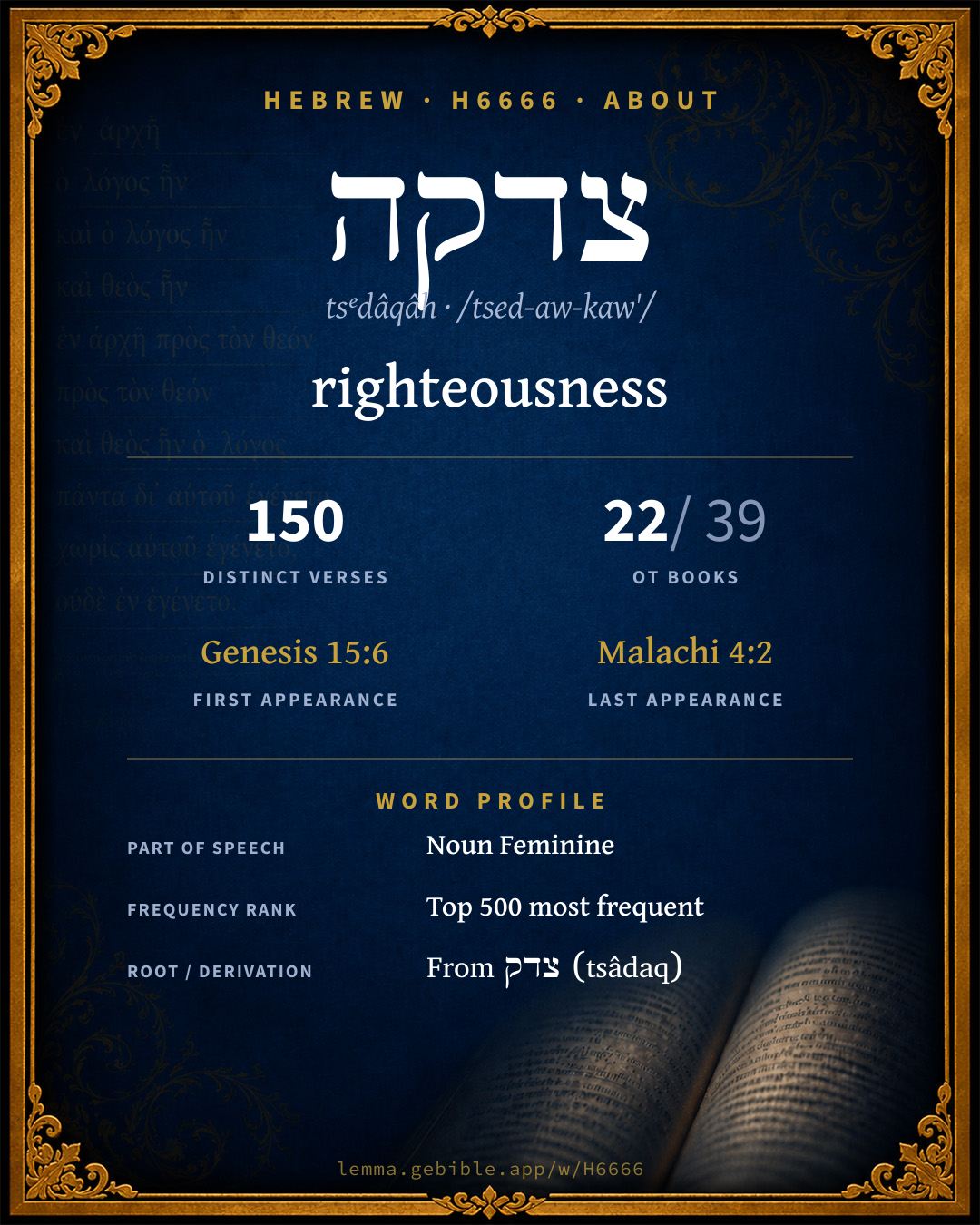
צְדָקָה
righteousness
‘righteousness’ is one of 8 main senses fuller range ↓
Full lexicon entry — Brown-Driver-Briggs (BDB)
From Brown-Driver-Briggs (BDB)
Where this word appears
See every Construct-state word in the Hebrew Bible →
Grammar key — what these labels mean
Part of speech
- Noun
- A naming word — a person, place, thing, or idea.
Noun type
- Common
- A common noun — a general class of person, place, or thing (“king,” “city,” “water”), not a specific name.
State
- Absolute
- The independent form of a noun, not bound to a following word.
- Construct
- A noun bound to a following noun in a possessive / “of” relationship (the construct chain).
Gender
- Feminine
- Grammatically feminine.
Number
- Singular
- One.
- Plural
- More than one (in Hebrew, generally three or more).
Every verse where H6666 appears in the Book of Ezekiel — 18 distinct verses. Click any verse to open its interlinear word-by-word view. Verse text shown in the World English Bible for context — . Each verse’s Hebrew form is shown with its reference; the English is not keyword-highlighted, since the data carries no word-level English alignment. Use “Compare translations” on any verse to read it across multiple English versions. This concordance covers the Hebrew Bible; Septuagint (Greek Old Testament) occurrences are not indexed here.
Ezekiel
- Ezekiel 3:20 צִדְקֹתָ/ו֙ n c fp cs + sfx pers 3ms Again, when a righteous man does turn from his righteousness, and commit iniquity, and I lay a stumbling block before him, he shall die: because you have not given him warning, he shall die in his sin, and his righteous deeds which he has done shall not be remembered; but his blood will I require at your hand.
- Ezekiel 14:14 בְ/צִדְקָתָ/ם֙ prep + n c fs cs + sfx pers 3mp though these three men, Noah, Daniel, and Job, were in it, they should deliver but their own souls by their righteousness, says the Lord Yahweh.
- Ezekiel 14:20 בְ/צִדְקָתָ֖/ם prep + n c fs cs + sfx pers 3mp though Noah, Daniel, and Job, were in it, as I live, says the Lord Yahweh, they should deliver neither son nor daughter; they should but deliver their own souls by their righteousness.
- Ezekiel 18:5 וּ/צְדָקָֽה conj + n c fs But if a man is just, and does that which is lawful and right,
- Ezekiel 18:19 וּ/צְדָקָ֣ה conj + n c fs Yet say you, Why does not the son bear the iniquity of the father? when the son has done that which is lawful and right, and has kept all my statutes, and has done them, he shall surely live.
- Ezekiel 18:20 צִדְקַ֤ת n c fs cs The soul who sins, he shall die: the son shall not bear the iniquity of the father, neither shall the father bear the iniquity of the son; the righteousness of the righteous shall be on him, and the wickedness of the wicked shall be on him.
- Ezekiel 18:21 וּ/צְדָקָ֑ה conj + n c fs But if the wicked turn from all his sins that he has committed, and keep all my statutes, and do that which is lawful and right, he shall surely live, he shall not die.
- Ezekiel 18:22 בְּ/צִדְקָת֥/וֹ prep + n c fs cs + sfx pers 3ms None of his transgressions that he has committed shall be remembered against him: in his righteousness that he has done he shall live.
- Ezekiel 18:24 מִ/צִּדְקָת/וֹ֙ צדקת/ו צִדְקֹתָ֤י/ו prep + n c fs cs + sfx pers 3ms n c fs cs + sfx pers 3ms n c fp cs + sfx pers 3ms But when the righteous turns away from his righteousness, and commits iniquity, and does according to all the abominations that the wicked man does, shall he live? None of his righteous deeds that he has done shall be remembered: in his trespass that he has trespassed, and in his sin that he has sinned, in them shall he die.
- Ezekiel 18:26 מִ/צִּדְקָת֛/וֹ prep + n c fs cs + sfx pers 3ms When the righteous man turns away from his righteousness, and commits iniquity, and dies therein; in his iniquity that he has done shall he die.
- Ezekiel 18:27 וּ/צְדָקָ֑ה conj + n c fs Again, when the wicked man turns away from his wickedness that he has committed, and does that which is lawful and right, he shall save his soul alive.
- Ezekiel 33:12 צִדְקַ֣ת n c fs cs You, son of man, tell the children of your people, The righteousness of the righteous shall not deliver him in the day of his disobedience; and as for the wickedness of the wicked, he shall not fall thereby in the day that he turns from his wickedness; neither shall he who is righteous be able to live thereby in the day that he sins.
- Ezekiel 33:13 צִדְקָת֖/וֹ צדקת/ו צִדְקֹתָי/ו֙ n c fs cs + sfx pers 3ms n c fs cs + sfx pers 3ms n c fp cs + sfx pers 3ms When I tell the righteous, that he shall surely live; if he trust to his righteousness, and commit iniquity, none of his righteous deeds shall be remembered; but in his iniquity that he has committed, therein shall he die.
- Ezekiel 33:14 וּ/צְדָקָֽה conj + n c fs Again, when I say to the wicked, You shall surely die; if he turn from his sin, and do that which is lawful and right;
- Ezekiel 33:16 וּ/צְדָקָ֛ה conj + n c fs None of his sins that he has committed shall be remembered against him: he has done that which is lawful and right; he shall surely live.
- Ezekiel 33:18 מִ/צִּדְקָת֖/וֹ prep + n c fs cs + sfx pers 3ms When the righteous turns from his righteousness, and commits iniquity, he shall even die therein.
- Ezekiel 33:19 וּ/צְדָקָ֑ה conj + n c fs When the wicked turns from his wickedness, and does that which is lawful and right, he shall live thereby.
- Ezekiel 45:9 וּ/צְדָקָ֖ה conj + n c fs Thus says the Lord Yahweh: Let it suffice you, princes of Israel: remove violence and spoil, and execute justice and righteousness; dispossessing my people, says the Lord Yahweh.
About this entry
At a glance — auto-summarized from this page’s data, not written by a person. Every figure links to its source below. This summary describes the numbers; it doesn’t interpret them.
“righteousness” is the headline sense of the Hebrew noun צדקה (tsᵉdâqâh). Carrying more than one sense, it rewards its full sense range. It appears 150 verses across 22 books of the Hebrew Bible, among its common vocabulary. Scripture first uses it in Genesis 15:6. It shares a root with צדק, צדיק and צדק. See the sense tree, 150-verse concordance, and the renderings breakdown below.
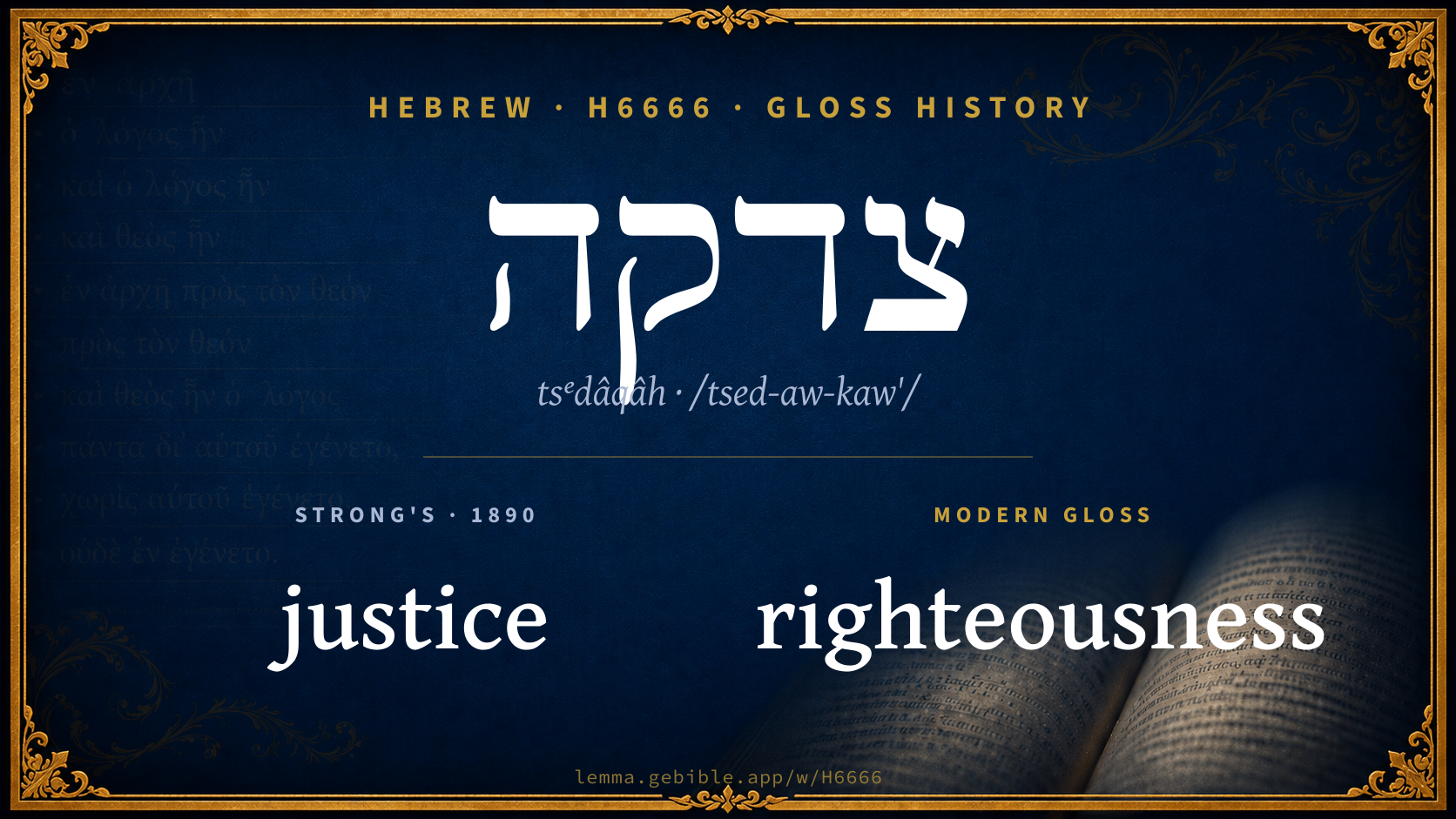
Gloss history
Strong's 1890 vs modern scholarship
About this word
Strong's H6666 catalogs a Hebrew word from the Hebrew Old Testament.
These counts are not copied from any lexicon or concordance. They are computed here, from the morphology-tagged Hebrew Old Testament. What Lemma adds →
- 150
- distinct verses
- The word appears in 150 distinct verses.
- 22 / 39
- OT books
- The word appears in 22 of 39 Old Testament books.
- #288
- by frequency
- Top 500 most frequent Hebrew words (rank 288 of 8,640 Hebrew words by occurrence).
View all 150 occurrences in the concordance →
By section of the Old Testament
By traditional corpus
Conventional, traditional groupings — biblical authorship is debated, so this is a traditional corpus grouping, not an authorship claim. Each share is this word’s portion of its verses in that division of the Hebrew canon. Each figure is a share of the word’s 150 distinct verses.
- Prophets (Nevi'im) 79 verses · 53%
- Writings (Ketuvim) 62 verses · 41%
- Torah (Pentateuch) 9 verses · 6%
How translations render this word
Counts come from each version’s own published word-to-Strong’s tagging or interlinear alignment — an approximate guide to how each version renders this word, not a word-level alignment the data otherwise carries. Because each total is that version’s own tagged count, the per-version totals vary from one another and need not match the appearance or distinct-verse counts above. These counts may also differ from a printed concordance because Lemma counts each distinctly tagged rendering and does not collapse phrase taggings into a single head-word total. This is a fixed set of word-tagged versions (KJV, ASV, BSB, ULT) and does not change with the reading translation you choose elsewhere. Each version’s license is shown beside its name below (and on Sources).
- King James Version: Righteousness 105×, Justice 14×, Right 9×
- American Standard Version: Righteousness 109×, Right 9×, Justice 3×
- Berean Standard Bible: Righteousness 111×, Right 9×, Righteous acts 7×
- unfoldingWord Literal Text: Righteousness 128×, And 5×, Right 3×
King James Version Public Domain
Renders H6666 across 157 tagged occurrences — most commonly:
Plus 21 renderings that appear only once — usually multi-word phrases or single function words the recovered tagging swept in, not distinct renderings.
American Standard Version Public Domain
Renders H6666 across 159 tagged occurrences — most commonly:
Plus 19 renderings that appear only once — usually multi-word phrases or single function words the recovered tagging swept in, not distinct renderings.
Berean Standard Bible Public Domain
Renders H6666 across 157 tagged occurrences — most commonly:
Plus 12 renderings that appear only once — usually multi-word phrases or single function words the recovered tagging swept in, not distinct renderings.
unfoldingWord Literal Text CC BY-SA 4.0
Renders H6666 across 161 tagged occurrences — most commonly:
Plus 11 renderings that appear only once — usually multi-word phrases or single function words the recovered tagging swept in, not distinct renderings.
14 senses and sub-senses in the full BDB
What do BDB’s symbols mean?
BDB uses these scholarly abbreviations:
| Symbol | Meaning |
|---|---|
| 𝔊 | the Septuagint (the ancient Greek translation, LXX) |
| 𝔙 | the Vulgate (the Latin translation) |
| 𝔖 | the Syriac version (the Peshitta) |
| 𝔗 | the Targum (the Aramaic translation) |
| ψ | the Psalms |
| √ | root (the underlying root or stem) |
| ‖ | parallel passage (a synonymous or contrasted parallel) |
| † | the dagger: every passage where the word occurs is cited |
The 14 senses and sub-senses the full Brown-Driver-Briggs lexicon distinguishes for this word, in lexicon order (not ranked by frequency), with BDB’s own verbatim wording and sub-sense lettering. Shown in Hebrew script with BDB’s own scholarly abbreviations. The condensed entry is in the Lexicon Entry tab. See also the Forms in the corpus table below.
- 1. righteousness, in government:
- a. of judge, ruler, king: ‖ משׁפט Is 5:7; 9:6; Am 5:7; 6:12; משׁפט וצ׳ 2 S 8:15, עשׂה D. executed justice and righteousness = 1 Ch 18:14, cf. 1 K 10:9 = 2 Ch 9:8, Je 22:3, 15; 33:15 Ez 45:9; בּצ׳ יִכּוֹן כִּסֵּא Pr 16:12, cf. Is 54:14; עֲבֹדַת הצ׳, מַעֲשֵׂה הצ׳ Is 32:17, cf. v 16; נֹגְשַׂיִךְ צ׳ Is 60:17. e.g. Isaiah 5:7
- b. of law, ‖ משׁפטים, צִדְקַת י׳ Dt 33:21. e.g. Deuteronomy 33:21
- c. of Davidic king, Messiah, ‖ משׁפט, ψ 72:1, 3; Is 9:6; Je 23:5; 33:15. e.g. Psalms 72:1
- 2. God’s attribute as sovereign ψ 36:7; 71:19; in government, עשׂה משׁפט וצ׳ 99:4; Je 9:23; administering justice Jb 37:23; punishment Is 1:27; 5:16; 10:22; 28:17; Dn 9:7; vindication of his people Mi 7:9. e.g. Psalms 36:7
- 3. righteousness, in a case or cause, בצדקתי החזקתי Jb 27:6 on my righteousness I hold fast; מה ישׁ לי עוד צ׳ 2 S 19:29 what right have I yet? (cf. Ne 2:20); of God, הגיד צ׳ Is 57:12 (iron.); השׁיב צ׳ 1 S 26:23; Jb 33:26; כּצ׳, השׁיב 2 S 22:25, גמל v 21, נתן 1 K 8:32 = 2 Ch 6:23. e.g. Job 27:6
- 4. righteousness = truthfulness, באמת ובצ׳ Is 48:1; Zc 8:8; in word Is 45:23; 63:1, oath Je 4:2. e.g. Isaiah 48:1
- 5. righteousness, as ethically right: Gn 30:33 (J) Dt 6:25; Is 33:5; 48:18; Ez 14:14, 20; Pr 10:2; 11:4, 5, 18, 19 + 17 times, + צִדְקַת (ה)צַדִּיק(ים) Is 5:23; Ez 18:20; 33:12; צ׳ ישׁרים Pr 11:6; אֹרַח צ׳ 8:20; 12:28; דֶּרֶךְ צ׳ 16:31; עשׂה צ׳ do righteousness ψ 106:3; Is 56:1; 58:2; Ez 18:22; עשׂה משׁפט וצ׳ Ez 18:5 + 6 times Ez; עשׂה צ׳ ומשׁפט Gn 18:19 (J) Pr 21:3; רדף צ׳ Pr 15:9; 21:21; הלך באמת ובצ׳ 1 K 3:6; חשׁב לוֹ (ל)צ׳ Gn 15:6 (JE) imputed to him (for) righteousness, ψ 106:31; צ׳ וָחֶסֶד Pr 21:21(×2) (del. 𝔊 AB Toy). e.g. Genesis 30:33
- 6. righteousness as vindicated, justification, salvation, etc. (cf. צֶדֶק 6):
- a. of God, ‖ יֶשַׁע, תְּשׁוּעָה, יְשׁוּעָה Is 45:8; 46:13; 51:6 + 7 times Is 2; ‖ בְּרָכָה ψ 24:6; ‖ נַחֲלָה Is 54:17; ‖ חֶסֶד ψ 36:11; 103:17; שֶׁמֶשׁ צ׳ Mal 3:20 sun of righteousness (with healing); בִּצ׳, י׳ delivers, guides, exalts his people ψ 5:9; 31:2; 71:2; 89:17; 119:40; 143:1, 11; אַל־יָבֹאוּ בְּצִדְקָתֶ֑ךָ 69:28 (of wicked); as acc. after verbs of declaring, etc., his saving (delivering) righteousness 22:32; 40:11; 51:16; 71:15, 16, 24; 98:2; 145:7; also יִוָּדַע צ׳ 88:13; צ׳ עֹמֶדֶת לָעַד his righteousness endureth for ever 111:3 cf. 119:142. e.g. Isaiah 45:8
- b. of people, = prosperity, ‖ הון, עשׁר Pr 8:18; מוֹרֶה לצ׳ early rain for prosperity Jo 2:23. e.g. Proverbs 8:18
- 7. pl. righteous acts:
- a. of God Ju 5:11(×2); 1 S 12:7; Mi 6:5; vindication of right ψ 103:6; redemptive Is 45:24; Dn 9:16. e.g. Judges 5:11
- b. of man’s moral conduct Is 64:5; Je 51:10, also prob. Ez 3:20; 18:24; 33:13 (Kt sg.) ψ 11:7 (? gloss), Dn 9:18; as adv. acc., הֹלֵךְ צְדָקוֹת Is 33:15. e.g. Isaiah 64:5
Senses from the full Brown-Driver-Briggs lexicon (Brown, Driver, Briggs; Oxford 1906 — public domain), digitized via Sefaria, supplemented by the OpenScriptures HebrewLexicon (CC BY 4.0). Full attribution on Sources.
Word origin
n.f. righteousness;—abs. צ׳ Gn 15:6 + 81 times; cstr. צִדְקַת Dt 33:21 + 5 times; sf. צִדְקָתִי Gn 30:33 +, etc.; pl. צְדָקוֹת Is 33:15 + 3 times; cstr. צִדְקוֹת Ju 5:11 +; sf. צִדְקֹתֶיךָ Dn 9:16, etc.;—
— Brown-Driver-Briggs (Oxford 1906, public domain), digitized via Sefaria, supplemented by the OpenScriptures HebrewLexicon (CC BY 4.0). See Sources.
Derived from צדק (tsâdaq) (H6663) — to be righteous.
Jastrow Dictionary
A second Hebrew/Aramaic lexicon for comparison, covering Aramaic and post-biblical (Talmudic, Targumic, Midrashic) usage that the biblical-Hebrew BDB does not. Matched by lemma rather than by Strong’s number, so a lemma may carry more than one Jastrow headword (shown separately below), and the entries cover usage well beyond the Bible.
צְדָקָה
- preced. wds.) purity, righteousness, equity, liberality, esp. almsgiving. Deut. R. s. 5 (ref. to Prov. XXI, 3) הקרבנות … והצ׳ והדין מכפרין וכ׳ sacrifices effect atonement only for the involuntary sinner, but righteousness (or charity) and justice atone for &c. Pes. 87ᵇ, v. פָּזַר. Tosef. Dem. III, 17, v. גַּבָּיי. Sabb. 118ᵇ גבאי צ׳ collectors of public charity; מחלקי צ׳ distributors of charity, v. חֵלֶק. Succ. 49ᵇ גדולה ג"ח יותר מן הצ׳ deeds of love are worth more than almsgiving; ib. צ׳ בממונו ג"ח וכ׳ charity is done at the mere sacrifice of money, deeds of love are performed with one’s money and with one’s person; צ׳ לעניים ג"ח וכ׳ almsgiving is only for the poor, deeds of love for the poor and the rich. B. Bath. 10ᵇ (ref. to Prov. XIV, 34) כשם … צ׳ מכפרת וכ׳ as the sin-offering brings atonement for Israel, so charity is a means of atonement for the nations. Gen. R. s. 49 (ref. to Gen. XVIII, 19) מתחלה צ׳ ולבסוף משפט (not צדק) first charity (undiscriminating hospitality), and then justice; a. fr.—Pl. צְרָקוֹת. B. Bath. 10ᵃ (ref. to Prov. XI, 4, a. X, 2) שתי צ׳ הללו למה why two verses saying the same thing about charity? Treat. Der. Er. ch. II מחלקי צ׳, v. supra. Ruth R. to III, 3 וסכת זו מצוות וצ׳ ‘anoint thyself’ (ib.), that means with good deeds and charitable acts; a. e. e.g. Proverbs 21:3
צְדָקָה ²
- ch., v. צִדְקְתָא
A Dictionary of the Targumim, the Talmud Babli and Yerushalmi, and the Midrashic Literature (Marcus Jastrow; London, Luzac, 1903) — Public Domain. Digitized via Sefaria. Digitized via Sefaria. Full attribution on Sources.
Forms in the corpus
The 87 distinct written forms H6666 takes in the Hebrew Bible, most frequent first — each parse links to that state’s occurrences in the concordance. Hebrew forms include their vowel points and cantillation, so a single lemma takes many written forms.
The 60 most common forms are shown; 27 rarer forms follow in the full concordance.
Same root — word family
Other BDB entries built from the same root as H6666, grouped by Strong’s listed origin. These share a root / origin per the lexicon — not necessarily a shared meaning. Each links to that word’s own entry.
Derives from
Shares the same root
Derived from this word
Proper names from this root
People and places named from this root — a name, not an additional meaning of the word.
Compare all same-root words → Showing 4 of 6 — not the complete family. 1 of the same-root words is a proper name (a person or place). They share a root, not necessarily a meaning.
Septuagint verse parallels
This word appears in 140 verses that also exist in the Greek Old Testament (Septuagint), out of the 150 Hebrew verses it occurs in. You can read those verses in Greek by switching the Old Testament edition to the Septuagint.
Read these verses in the Septuagint
- Genesis 15:6
- Deuteronomy 6:25
- Judges 5:11
- 1 Samuel 12:7
- 2 Samuel 8:15
- 1 Kings 3:6
- 1 Chronicles 18:14
- 2 Chronicles 6:23
- Job 27:6
- Psalms 5:8
- Proverbs 8:18
- Isaiah 1:27
This is a verse-level parallel only — the same verses exist in both the Hebrew and Greek Old Testaments. No word-level Hebrew↔Greek correspondence is claimed: the data carries no such alignment, so no Greek word is shown as this Hebrew word’s translation. Coverage is not total — the Septuagint omits the deuterocanon and renumbers the Psalms, so some Hebrew verses have no direct Greek parallel.