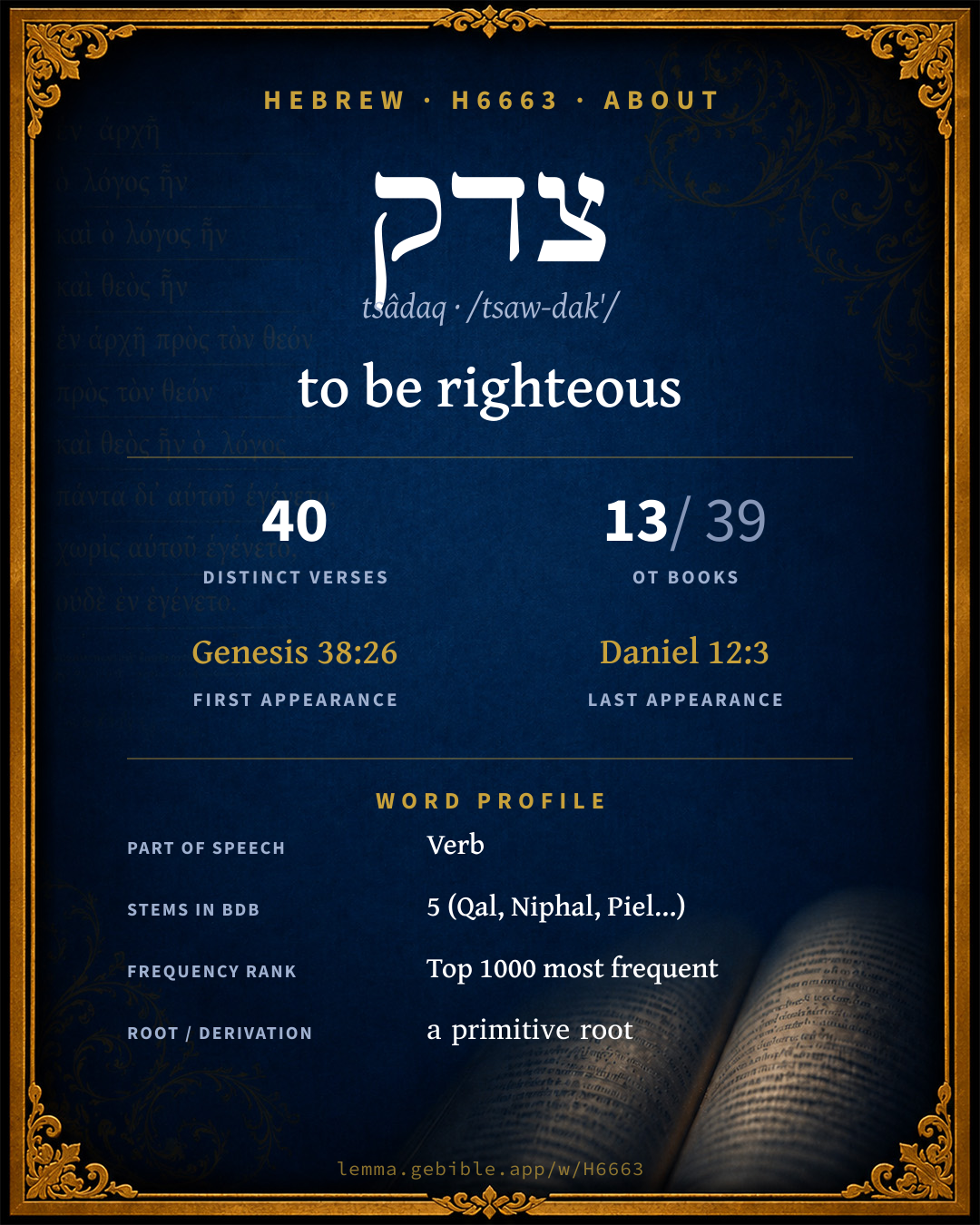
צָדֵק
to be righteous
‘to be righteous’ is one of 4 main senses fuller range ↓
Full lexicon entry — Brown-Driver-Briggs (BDB)
From Brown-Driver-Briggs (BDB)
Where this word appears
See every Qal verb in the Hebrew Bible →
Grammar key — what these labels mean
Part of speech
- Verb
- An action or state-of-being word.
Stem
- Qal
- The basic, simple active stem — the plain form of the verb (“he wrote”). Here: ‘have a just cause’
- Hiphil
- The causative active stem (“he caused / brought about”). Here: ‘do justice’
- Niphal
- Usually the simple passive or reflexive of the Qal (“he was written”).
- Piel
- An intensive or resultative active stem.
- Hithpael
- The reflexive or reciprocal stem (the subject acts on itself).
Form
- Imperfect
- An incomplete, ongoing, or future action (“he will / would write”).
- Infinitive Construct
- A bound verbal noun, frequently with prepositions (“to write / in writing”).
- Perfect
- A completed action or state — Hebrew marks aspect (completeness) more than strict tense (“he wrote”).
- Sequential Perfect
- A perfect with prefixed waw continuing a preceding imperfect or command (waw-consecutive perfect).
- Participle Active
- A verbal adjective expressing ongoing or characteristic action (“writing / one who writes”).
- Sequential Imperfect
- An imperfect with prefixed waw — the standard past-narrative form (waw-consecutive imperfect).
- Imperative
- A direct command (“write!”).
State
- Construct
- A noun bound to a following noun in a possessive / “of” relationship (the construct chain).
- Absolute
- The independent form of a noun, not bound to a following word.
Person
- 3rd Person
- The one spoken about (“he / she / it / they”).
- 2nd Person
- The one addressed (“you”).
- 1st Person
- The speaker (“I / we”).
Gender
- Masculine
- Grammatically masculine.
- Common
- Either gender — not distinguished for this form.
- Feminine
- Grammatically feminine.
Number
- Singular
- One.
- Plural
- More than one (in Hebrew, generally three or more).
Grammatical forms 24 distinct
- Verb, Qal, Imperfect, 3rd Person, Masculine, Singular 6 times (15%)
- Verb, Qal, Imperfect, 2nd Person, Masculine, Singular 4 times (10%)
- Verb, Piel, Infinitive Construct 3 times (7%)
- Verb, Hiphil, Infinitive Construct 2 times (5%)
- Verb, Hiphil, Imperfect, 1st Person, Common, Singular 2 times (5%)
- Verb, Qal, Imperfect, 1st Person, Common, Singular 2 times (5%)
- Verb, Qal, Perfect, 1st Person, Common, Singular 2 times (5%)
- Verb, Qal, Perfect, 2nd Person, Masculine, Singular 2 times (5%)
+16 more forms (18 occurrences)
Parsed forms decoded from the imported morphology (morphhb / Westminster Leningrad Codex — WLC text public domain, morphhb tagging CC BY 4.0), counted across 41 parsed occurrences — not distinct verses.
Every verse where H6663 appears — 40 distinct verses across 13 books. Click any verse to open its interlinear word-by-word view. Verse text shown in the World English Bible for context — . Each verse’s Hebrew form is shown with its reference; the English is not keyword-highlighted, since the data carries no word-level English alignment. Use “Compare translations” on any verse to read it across multiple English versions. This concordance covers the Hebrew Bible; Septuagint (Greek Old Testament) occurrences are not indexed here.
Genesis 2 verses
- Genesis 38:26 צָֽדְקָ֣ה Qal pf 3fs Judah acknowledged them, and said, "She is more righteous than I, because I didn't give her to Shelah, my son." He knew her again no more.
- Genesis 44:16 נִּצְטַדָּ֑ק Hithpael impf 1cp Judah said, "What will we tell my lord? What will we speak? Or how will we clear ourselves? God has found out the iniquity of your servants. Behold, we are my lord's bondservants, both we, and he also in whose hand the cup is found."
Exodus 1 verse
Deuteronomy 1 verse
2 Samuel 1 verse
1 Kings 1 verse
2 Chronicles 1 verse
Job 17 verses
- Job 4:17 יִצְדָּ֑ק Qal impf 3ms 'Shall mortal man be more just than God? Shall a man be more pure than his Maker?
- Job 9:2 יִּצְדַּ֖ק Qal impf 3ms "Truly I know that it is so, But how can man be just with God?
- Job 9:15 צָ֭דַקְתִּי Qal pf 1cs Whom, though I were righteous, yet would I not answer. I would make supplication to my judge.
- Job 9:20 אֶ֭צְדָּק Qal impf 1cs Though I am righteous, my own mouth shall condemn me. Though I am blameless, it shall prove me perverse.
- Job 10:15 וְ֭/צָדַקְתִּי conj + Qal wpf 1cs If I am wicked, woe to me. If I am righteous, I still shall not lift up my head, Being filled with disgrace, And conscious of my affliction.
- Job 11:2 יִצְדָּֽק Qal impf 3ms "Shouldn't the multitude of words be answered? Should a man full of talk be justified?
- Job 13:18 אֶצְדָּֽק Qal impf 1cs See now, I have set my cause in order. I know that I am righteous.
- Job 15:14 יִ֝צְדַּ֗ק Qal impf 3ms What is man, that he should be clean? He who is born of a woman, that he should be righteous?
- Job 22:3 תִצְדָּ֑ק Qal impf 2ms Is it any pleasure to the Almighty, that you are righteous? Or does it benefit him, that you make your ways perfect?
- Job 25:4 יִּצְדַּ֣ק Qal impf 3ms How then can man be just with God? Or how can he who is born of a woman be clean?
- Job 27:5 אַצְדִּ֪יק Hiphil impf 1cs Far be it from me that I should justify you. Until I die I will not put away my integrity from me.
- Job 32:2 צַדְּק֥/וֹ Piel inf.cs + sfx pers 3ms Then the wrath of Elihu the son of Barachel, the Buzite, of the family of Ram, was kindled against Job. His wrath was kindled because he justified himself rather than God.
- Job 33:12 צָדַ֣קְתָּ Qal pf 2ms "Behold, I will answer you. In this you are not just; For God is greater than man.
- Job 33:32 צַדְּקֶֽ/ךָּ Piel inf.cs + sfx pers 2ms If you have anything to say, answer me: Speak, for I desire to justify you.
- Job 34:5 צָדַ֑קְתִּי Qal pf 1cs For Job has said, 'I am righteous, God has taken away my right:
- Job 35:7 צָ֭דַקְתָּ Qal pf 2ms If you are righteous, what do you give him? Or what does he receive from your hand?
- Job 40:8 תִּצְדָּֽק Qal impf 2ms Will you even annul my judgment? Will you condemn me, that you may be justified?
Psalms 4 verses
- Psalms 19:9 צָֽדְק֥וּ Qal pf 3cp The fear of Yahweh is clean, enduring forever. Yahweh's ordinances are true, and righteous altogether.
- Psalms 51:4 תִּצְדַּ֥ק Qal impf 2ms Against you, and you only, have I sinned, And done that which is evil in your sight; That you may be proved right when you speak, And justified when you judge.
- Psalms 82:3 הַצְדִּֽיקוּ Hiphil impv 2mp "Defend the weak, the poor, and the fatherless. Maintain the rights of the poor and oppressed.
- Psalms 143:2 יִצְדַּ֖ק Qal impf 3ms Don't enter into judgment with your servant, For in your sight no man living is righteous.
Proverbs 1 verse
Isaiah 6 verses
- Isaiah 5:23 מַצְדִּיקֵ֥י Hiphil ptcp.act mp cs Who acquit the guilty for a bribe, But deny justice for the innocent!
- Isaiah 43:9 וְ/יִצְדָּ֔קוּ conj + Qal impf 3mp Let all the nations be gathered together, and let the peoples be assembled: who among them can declare this, and show us former things? let them bring their witnesses, that they may be justified; or let them hear, and say, It is truth.
- Isaiah 43:26 תִּצְדָּֽק Qal impf 2ms Put me in remembrance; let us plead together: set you forth [your cause], that you may be justified.
- Isaiah 45:25 יִצְדְּק֥וּ Qal impf 3mp In Yahweh shall all the seed of Israel be justified, and shall glory.
- Isaiah 50:8 מַצְדִּיקִ֔/י Hiphil ptcp.act ms cs + sfx pers 1cs He is near who justifies me; who will bring charges against me? Let us stand up together: who is my adversary? Let him come near to me.
- Isaiah 53:11 יַצְדִּ֥יק Hiphil impf 3ms He shall see of the travail of his soul, [and] shall be satisfied: by the knowledge of himself shall my righteous servant justify many; and he shall bear their iniquities.
Jeremiah 1 verse
Ezekiel 2 verses
- Ezekiel 16:51 וַ/תְּצַדְּקִי֙ conj + Piel wimpf 2fs Neither has Samaria committed half of your sins; but you have multiplied your abominations more than they, and have justified your sisters by all your abominations which you have done.
- Ezekiel 16:52 תִּצְדַּ֣קְנָה בְּ/צַדֶּקְתֵּ֖/ךְ Qal impf 3fp prep + Piel inf.cs + sfx pers 2fs You also, bear you your own shame, in that you have given judgment for your sisters; through your sins that you have committed more abominable than they, they are more righteous that you: yes, be also confounded, and bear your shame, in that you have justified your sisters.
Daniel 2 verses
- Daniel 8:14 וְ/נִצְדַּ֖ק conj + Niphal wpf 3ms He said to me, To two thousand and three hundred evenings [and] mornings; then shall the sanctuary be cleansed.
- Daniel 12:3 וּ/מַצְדִּיקֵי֙ conj + Hiphil ptcp.act mp cs Those who are wise shall shine as the brightness of the expanse; and those who turn many to righteousness as the stars forever and ever.
About this entry
At a glance — auto-summarized from this page’s data, not written by a person. Every figure links to its source below. This summary describes the numbers; it doesn’t interpret them.
The Hebrew verb צדק centers on the idea of “to be righteous.” Read the stem: it spans 5 stems, including Qal and Niphal. Spanning 40 verses in 13 books, it ranks among the moderately common words of the Hebrew Bible. Job dominates its distribution — 17 of 40 verses. Its earliest occurrence is Genesis 38:26. For the data behind this summary, explore the sense tree and the renderings breakdown below.
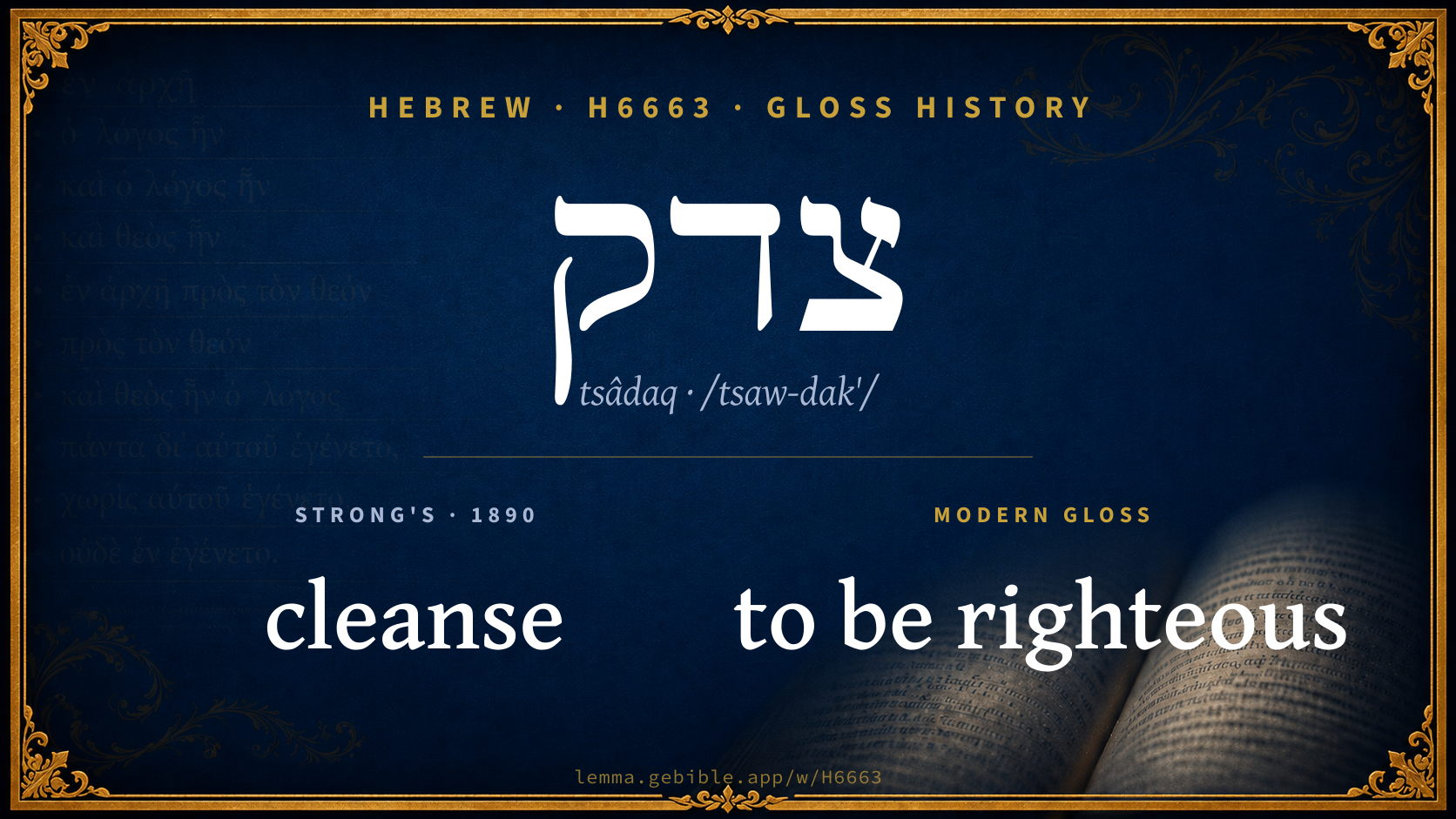
Gloss history
Strong's 1890 vs modern scholarship
About this word
Strong's H6663 catalogs a Hebrew word from the Hebrew Old Testament.
These counts are not copied from any lexicon or concordance. They are computed here, from the morphology-tagged Hebrew Old Testament. What Lemma adds →
- 40
- distinct verses
- The word appears in 40 distinct verses.
- 13 / 39
- OT books
- The word appears in 13 of 39 Old Testament books.
- #891
- by frequency
- Top 1000 most frequent Hebrew words (rank 891 of 8,640 Hebrew words by occurrence).
View all 40 occurrences in the concordance →
By section of the Old Testament
By traditional corpus
Conventional, traditional groupings — biblical authorship is debated, so this is a traditional corpus grouping, not an authorship claim. Each share is this word’s portion of its verses in that division of the Hebrew canon. Each figure is a share of the word’s 40 distinct verses.
- Writings (Ketuvim) 25 verses · 63%
- Prophets (Nevi'im) 11 verses · 28%
- Torah (Pentateuch) 4 verses · 10%
How translations render this word
Counts come from each version’s own published word-to-Strong’s tagging or interlinear alignment — an approximate guide to how each version renders this word, not a word-level alignment the data otherwise carries. Because each total is that version’s own tagged count, the per-version totals vary from one another and need not match the appearance or distinct-verse counts above. These counts may also differ from a printed concordance because Lemma counts each distinctly tagged rendering and does not collapse phrase taggings into a single head-word total. This is a fixed set of word-tagged versions (KJV, ASV, BSB, ULT) and does not change with the reading translation you choose elsewhere. Each version’s license is shown beside its name below (and on Sources).
- King James Version: Be justified 4×, Justify 3×, Justifying 2×
- American Standard Version: Be justified 2×, Justify 2×, Justifying 2×
- Berean Standard Bible: Justifying 3×, Acquit 2×, Appear righteous 2×
- unfoldingWord Literal Text: Righteous 8×, Will 3×, Be 2×
King James Version Public Domain
Renders H6663 across 41 tagged occurrences — most commonly:
Plus 32 renderings that appear only once — usually multi-word phrases or single function words the recovered tagging swept in, not distinct renderings.
American Standard Version Public Domain
Renders H6663 across 40 tagged occurrences — most commonly:
Plus 32 renderings that appear only once — usually multi-word phrases or single function words the recovered tagging swept in, not distinct renderings.
Berean Standard Bible Public Domain
Renders H6663 across 41 tagged occurrences — most commonly:
Plus 30 renderings that appear only once — usually multi-word phrases or single function words the recovered tagging swept in, not distinct renderings.
unfoldingWord Literal Text CC BY-SA 4.0
Renders H6663 across 59 tagged occurrences — most commonly:
Plus 36 renderings that appear only once — usually multi-word phrases or single function words the recovered tagging swept in, not distinct renderings.
13 senses and sub-senses in the full BDB
Hebrew verbs can shift meaning by stem (binyan): Qal is the basic action, Niphal is often passive or reflexive, Piel often intensifies or makes it factitive, and Hiphil is typically causative. The senses below are grouped under the stem BDB assigns to each. This entry also uses Hithpael (reflexive or reciprocal).
What do BDB’s symbols mean?
BDB uses these scholarly abbreviations:
| Symbol | Meaning |
|---|---|
| 𝔊 | the Septuagint (the ancient Greek translation, LXX) |
| 𝔙 | the Vulgate (the Latin translation) |
| 𝔖 | the Syriac version (the Peshitta) |
| 𝔗 | the Targum (the Aramaic translation) |
| ψ | the Psalms |
| √ | root (the underlying root or stem) |
| ‖ | parallel passage (a synonymous or contrasted parallel) |
| † | the dagger: every passage where the word occurs is cited |
The 13 senses and sub-senses the full Brown-Driver-Briggs lexicon distinguishes for this word, in lexicon order (not ranked by frequency), with BDB’s own verbatim wording and sub-sense lettering. Shown in Hebrew script with BDB’s own scholarly abbreviations. The condensed entry is in the Lexicon Entry tab. See also the Forms in the corpus table below.
Qal
- Pf. 3 fs. צָֽדְקָה Gn 38:26; 2 ms. צָדַקְתָּ Jb 33:12; 35:7, etc.; Impf. 3 ms. יִצְדַּק Jb 9:2 +; יִצְדָּ֑ק Jb 4:17; 11:2; 3 fpl. תִּצְדַּקְנָה Ez 16:52 (𝔊 Co תְּצַדְּקִין, not Berthol Toy Krae), etc.;— e.g. Genesis 38:26
- 1. have a just cause, be in the right, Jb 9:15, 20; 13:18; 34:5; in complaint Jb 33:12; c. מִן pers. Gn 38:26 (J; of Tamar). e.g. Job 9:15
- 2. be justified, in one’s plea Jb 11:2; c. עִם (man with God) 9:2; 25:4; בי׳ Is 45:25; by witnesses 43:9; by acquittal ψ 143:2; Is 43:26; by condemnation of opponent Jb 40:8. e.g. Job 11:2
- 3. be just: of God, in his government, in charging with sin ψ 51:6; of מִשְׁפְּטֵי־י׳ 19:10. e.g. Psalms 51:6
- 4. be just, righteous, in conduct and character: of men Jb 10:15; 15:14; 22:3; 35:7, c. מִן comp., Jb 4:17 (more than God; Dr at God’s hand, מִן 2 d), Ez 16:52 (Pi.). e.g. Job 10:15
Niphal
- Pf. 3 ms. וְנִצְדַּק קֹדֶשׁ consec. Dn 8:14 the holy place shall be put right, in a right condition (Marti Kau Buhl SS; Bev Dr Marti Comm. be justified, its cause vindicated). e.g. Daniel 8:14
Piel
- Pf. 3 fs. צִדְּקָה Je 3:11; Impf. 2 fs. תְּצַדְּקִי Ez 16:51; Inf. cstr. sf. צַדְּקֶ֑ךָּ Jb 33:32; צַדֶּקְתֵּךְ (Ges§ 52 p) Ez 16:52; צַדְּקוֹ Jb 32:2;—justify: עַל צַדְּקוֹ נַפְשׁוֹ מֵאֱלֹהִים Jb 32:2 because he justified himself rather than God (cf. Qal 1); make to appear righteous Je 3:11; Ez 16:51, 52 (all c. מִן comp.); חָפַצְתִּי צַדְּקֶ֑ךָּ Jb 33:32 I desire to justify thee (in thy plea, cf. Qal 2). e.g. Jeremiah 3:11
Hiphil
- Pf. 1 s. sf. הִצְדַּקְתִּיו 2 S 15:4; 3 mpl. הִצְדִּיקוּ Dt 25:1; Impf. 3 ms. יַצְדִּיק Is 53:11; 1 s. אַצְדִּיק Ex 23:7; Jb 27:5; Inf. cstr. הַצְדִּיק 1 K 8:32 = 2 Ch 6:23; Imv. mpl. הַצְדִּיקוּ ψ 82:3; Pt. מַצְדִּיק Pr 17:15, etc.;— e.g. 2 Samuel 15:4
- 1. do justice, in administering law 2 S 15:4 ψ 82:3. e.g. 2 Samuel 15:4
- 2. declare righteous, justify, c. acc. (ה)צַדִּיק Dt 25:1; 1 K 8:32 = 2 Ch 6:23; רָשָׁע Ex 23:7 (E) Is 5:23; Pr 17:15; justify accusers, by recognizing charge as just Jb 27:5. e.g. Deuteronomy 25:1
- 3. justify, vindicate the cause of, save, c. acc., Is 50:8 (of God), c. לְ of obj. Is 53:11 (of servant of י׳). e.g. Isaiah 50:8
- 4. make righteous, turn to righteousness, Dn 12:3, cf. Aboth 5:26, 27 Bev. e.g. Daniel 12:3
Hithpael
- Impf. 1 pl. נִצְטַדָּ֑ק Gn 44:16 (J) how shall we justify ourselves, clear ourselves, from suspicion? e.g. Genesis 44:16
Senses from the full Brown-Driver-Briggs lexicon (Brown, Driver, Briggs; Oxford 1906 — public domain), digitized via Sefaria, supplemented by the OpenScriptures HebrewLexicon (CC BY 4.0). Full attribution on Sources.
Word origin
vb. denom. be just, righteous;—
— Brown-Driver-Briggs (Oxford 1906, public domain), digitized via Sefaria, supplemented by the OpenScriptures HebrewLexicon (CC BY 4.0). See Sources.
Origin: a primitive root
Jastrow Dictionary
A second Hebrew/Aramaic lexicon for comparison, covering Aramaic and post-biblical (Talmudic, Targumic, Midrashic) usage that the biblical-Hebrew BDB does not. Matched by lemma rather than by Strong’s number, so a lemma may carry more than one Jastrow headword (shown separately below), and the entries cover usage well beyond the Bible.
צָדַק
- [to be clear, pure, sincere,] to be right, true, just; to be cleared. Y. Snh. IV, 22ᵇ top יכול אם צ׳ בדינך יִצְדַּק בדיני you may think, if he (the guilty) is cleared in thy court, he will also be cleared in my (God’s) court.
- 1. (cmp. (cmp. זכה) to act in favor of a person; to be liberal. B. Bath. 88ᵇ (ref. to Deut. XXV, 15) צַדֵּק משלך ותן לו be liberal with what is thine own and give it to him, i.e. add overweight and overmeasure (גֵּירוּמִים); Ḥull. 134ᵃ (ref. to the poor man’s share). Num. R. s. 2 (ref. to ואתן צדק Job XXVI, 3) צי׳ עמהם שלא וכ׳ the Lord dealt kindly with them in not changing their arrangements. e.g. Deuteronomy 25:15
- 2. to justify, declare or consider a person right; to defend. Gen. R. s. 49 (ref. to Ps. XLV, 8) אהבת לצַדֵּק את בריותי וכ׳ thou (Abraham) lovest to defend my creatures, and hatest to condemn them. Y. Snh. IV, beg. 22ᵃ צַדְּקֵיהוּ consider him to be right (a true witness), opp. חקריהו cross-examine him; Deut. R. s. 5.—Esp. צ׳ את הדין to justify God’s judgment, to submit to divine dispensation as just, to punishment as deserved. Sifra Sh’mini, introd. כיון ששמע אהרן כך צ׳ … ושתק when Aaron heard this, he submitted to divine judgment and kept his peace (Lev. X, 3). Ib. אברהם צי׳ עליו וכ׳ Abraham resigned himself to God’s will, for we read (Gen. XVIII, 27), ‘I am dust and ashes’. Ib. צִידְּקוּ עליהם וכ׳ they resigned themselves &c. Y. Sot. VIII, 22ᶜ bot. צ̇ד̇ק̇יהו שצ̇יר̇ק̇ עליו וכ׳. Shallum was surnamed Zedekiah (justifier of God), because he justified God’s judgment upon him. Ab. Zar. 18ᵃ בשעה שיצאו … צידקו עליהם וכ׳ all three of them, when they were taken out for execution, resigned themselves &c. (reciting an appropriate Bible verse); a. fr.—Part. pass. מְצוּדָּק; pl. מְצוּדָּקִים. Mekh. Mishp., s. 20 (ref. to Ex. XXIII, 8) שונא דברים המצ׳ וכ׳ he will hate the justified words (the exhortations to justice) spoken at Sinai; Yalk. Ex. 353 (not דברי). e.g. Psalms 45:8
- 1. to justify, clear, declare to be right; to make virtuous. Snh. 10ᵃ (ref. to Deut. XXV, 1) עדים שהרשיעו את הצדיק ואתו … והִצְדִּיקוּ וכ׳ when witnesses denounced an innocent man, and other witnesses came and justified him that was right, and thus exposed those (first witnesses) as wicked men; Macc. 2ᵇ. Gen. R. s. 21 (ref. to Ps. XVI, 5) לכשיקיץ … אני מַצְדִּיקוֹ מאותה גזרה when he that is created in thine (Adam’s) image shall awake (when the Messiah comes) …, then I shall clear him from this decree (of expulsion from Eden). Lev. R. s. 4, beg. (ref. to Koh. III, 16) מקום שהִצְדַּקְתִּים וכ׳ there where I made them virtuous and called them divine beings …, there they acted wickedly &c. Gen. R. s. 43 (ref. to Gen. XIV, 18) המקום הזה מַצְדִּיק וכ׳ this place (Salem-Jerusalem) makes its inhabitants righteous.—ה׳ עליו את הדין to deal strictly with. Taan. 8ᵃ כל המצדיק … מַצְדִּיקִין עליו את הדין וכ׳ he who makes himself righteous here below (who strives for righteousness) is judged righteously (strictly dealt with) in the judgment above (cmp. Yeb. 121ᵇ quot. s. v. דִּקְדֵּק). Hor. 11ᵇ (play on צדקיהו) אמר לו יה יַצְדִּיק עליך וכ׳ he (Nebuchadnezzar) said to him, Yah shall deal strictly with thee, if thou wilt rebel against me; a. fr. e.g. Deuteronomy 25:1
- 2. to treat with צְדָקָה, to be liberal towards. Y. Peah IV, end 18ᶜ (alluding to Ps. LXXXII, 3) עני ורש הַצְדִּיקוּהוּ במתנותיו (not ועשיר) treat the poor and needy liberally as regards the gifts belonging to him (v. Ḥull. 134ᵃ quot. supra).—3) ה׳ את הדין to submit to divine judgment, be resigned (v. supra). Sifra l. c. למודים צדיקים שמַצְדִּיקִים וכ׳ the righteous are wont to resign themselves to the will of God. Taan. 11ᵃ מצדיק עליו וכ׳ he acknowledges the justice of the verdict and says, you have judged me rightly &c. Ber. 19ᵃ והוא עומד ומצדיק וכ׳ he (the mourner) stands up and declares the judgment to be just &c.; a. fr.—Part. pass. מוּצְדָּק justified, lawfully qualified. Gitt. 86ᵃ (in a Chaldaic formula of sale of a slave) מ׳ לעבדו, v. עַבְדּוּתָא. e.g. Psalms 82:3
- to justify one’s self, excuse one’s self. Gen. R. s. 92 (ref. to Gen. XLIV, 16) מה נִצְטַּדָּק בדינה how can we justify ourselves for what we have done in the case of Dinah (that we killed the Shechemites)? &c.; Yalk. ib. 150. e.g. Genesis 44:16
צְדַק
- , to be clear, just. Targ. Ps. XIX, 10 צְדִיקוּ Ms. (ed. זכיאו).
- to justify, do justice to. Ib. LXXXII, 3.—א׳ דינא to acknowledge the justice of divine judgment. Taan. 22ᵇ דקא מַצְדִּיק דינא אנפשיה וכ׳ Ms. M. (ed. מצדיק עליה וכ׳) that he acknowledged the justice of God’s decree over him, saying (Lam. I, 18) &c. e.g. Lamentations 1:18
צֶדֶק
- 1. (b. h.; preced.) righteousness, justice, equity; virtue. Ḥag. 12ᵇ, v. עֲרָבוֹת I. Yalk. Deut. 907 (ref. to Deut. XVI, 9) אין יוצא ידי עולמו עד שיורה צ׳ בהוראתו he (that takes bribes) will not finish his days before he will prove that his (wrong) decision was right; Sifré Deut. 144 עד שיורוהו (corr. acc.). Midr. Till. to Ps. LVIII ed. Bub. ולא הודה בצִדְקוֹ של דוד he would not confess that David was right. Ib. בצ׳ רדפתם אחרי did you pursue me justly? או בצ׳ שפטתם אותי or did you judge me in righteousness?; a. fr.—מְשִׁיחַ צֶ׳ the true Messiah (Jer. XXIII, 6). Pesik. R. s. 37 אפרים מ׳ צִדְקִי Ephraim, my (the Lord’s) true Messiah. Ib. מ׳ צִדְקֵינוּ our true Messiah; a. fr. e.g. Deuteronomy 16:9
- 2. Tsedeḳ, the planet Jupiter. Sabb. 156ᵃ, v. צַדְקָן. Ib. 156ᵇ top דקאי צ׳ במערב because Ts. stands in the west (thy planet is declining). Gen. R. s. 43 (ref. to Is. XLI, 2) מזל צ׳ היה מאיר לו the planet Ts. shone on his (Abraham’s) way; a. fr. e.g. Isaiah 41:2
A Dictionary of the Targumim, the Talmud Babli and Yerushalmi, and the Midrashic Literature (Marcus Jastrow; London, Luzac, 1903) — Public Domain. Digitized via Sefaria. Digitized via Sefaria. Full attribution on Sources.
Forms in the corpus
The 39 distinct written forms H6663 takes in the Hebrew Bible, most frequent first — each parse links to that stem’s occurrences in the concordance. Hebrew forms include their vowel points and cantillation, so a single lemma takes many written forms.
Same root — word family
Other BDB entries built from the same root as H6663, grouped by Strong’s listed origin. These share a root / origin per the lexicon — not necessarily a shared meaning. Each links to that word’s own entry.
Derived from this word
Proper names from this root
People and places named from this root — a name, not an additional meaning of the word.
Compare all same-root words → Showing 4 of 5 — not the complete family. 1 of the same-root words is a proper name (a person or place). They share a root, not necessarily a meaning.
Septuagint verse parallels
This word appears in 40 verses that also exist in the Greek Old Testament (Septuagint), out of the 40 Hebrew verses it occurs in. You can read those verses in Greek by switching the Old Testament edition to the Septuagint.
Read these verses in the Septuagint
- Genesis 38:26
- Exodus 23:7
- Deuteronomy 25:1
- 2 Samuel 15:4
- 1 Kings 8:32
- 2 Chronicles 6:23
- Job 4:17
- Psalms 19:9
- Proverbs 17:15
- Isaiah 5:23
- Jeremiah 3:11
- Ezekiel 16:51
This is a verse-level parallel only — the same verses exist in both the Hebrew and Greek Old Testaments. No word-level Hebrew↔Greek correspondence is claimed: the data carries no such alignment, so no Greek word is shown as this Hebrew word’s translation. Coverage is not total — the Septuagint omits the deuterocanon and renumbers the Psalms, so some Hebrew verses have no direct Greek parallel.