
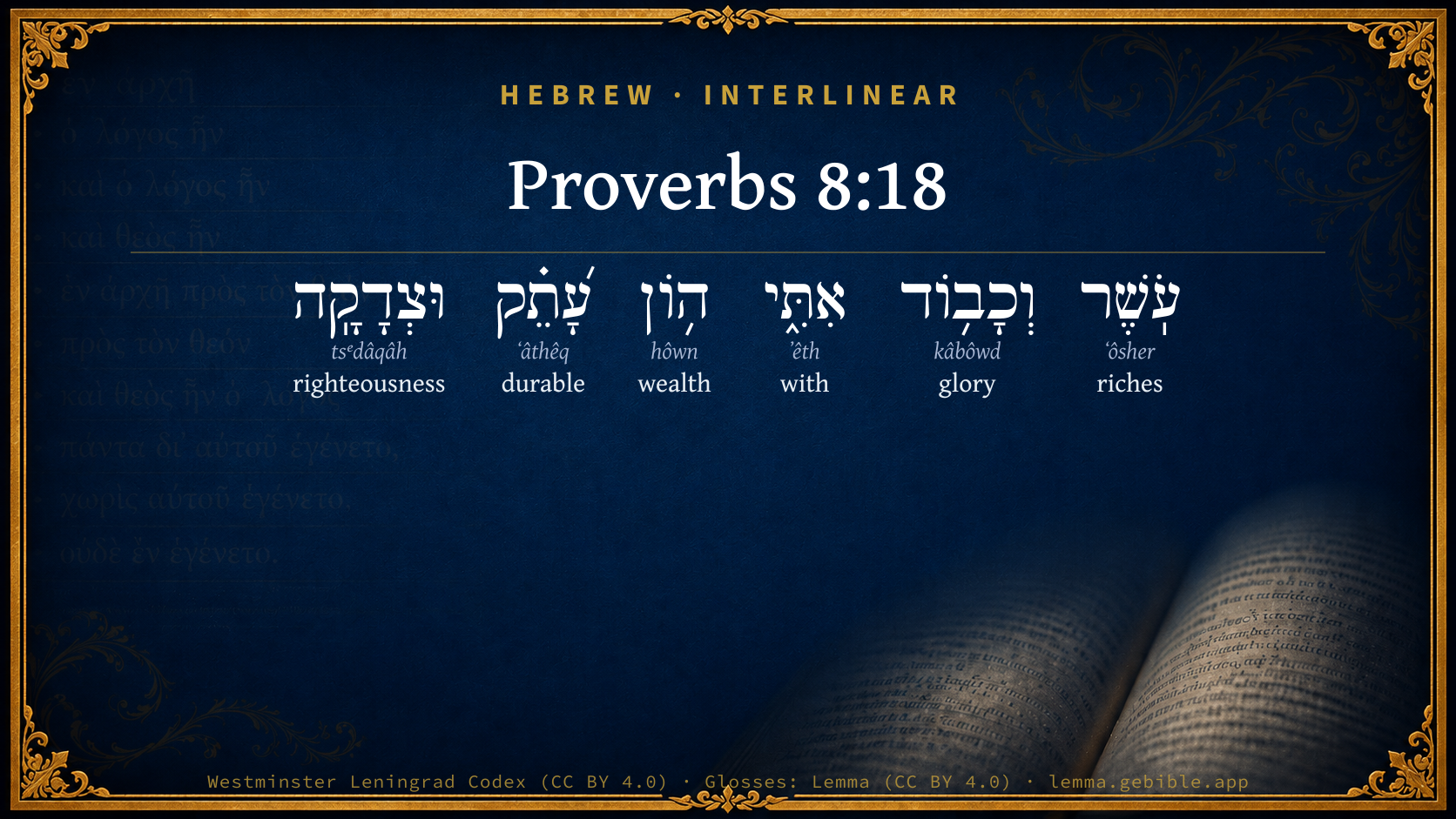
Proverbs 8:18

Hebrew (Westminster Leningrad Codex) Proverbs 8:18 appears in the Hebrew Old Testament. The text above is from the Westminster Leningrad Codex. Each word links to its Strong’s number, a concise gloss, and parsing drawn from the Open Scriptures Hebrew Bible morphology. Click any word for its full Brown-Driver-Briggs (BDB) entry.
Download image
Cite this verse

Proverbs 8:18 (World English Bible). Public Domain. Lemma interlinear Bible study tool, https://lemma.gebible.app/v/proverbs/8/18.

Show BibTeX & RIS
BibTeX
RIS
English Translation
With me are riches, honor, Enduring wealth, and prosperity.
World English Bible · Public Domain
Highlights
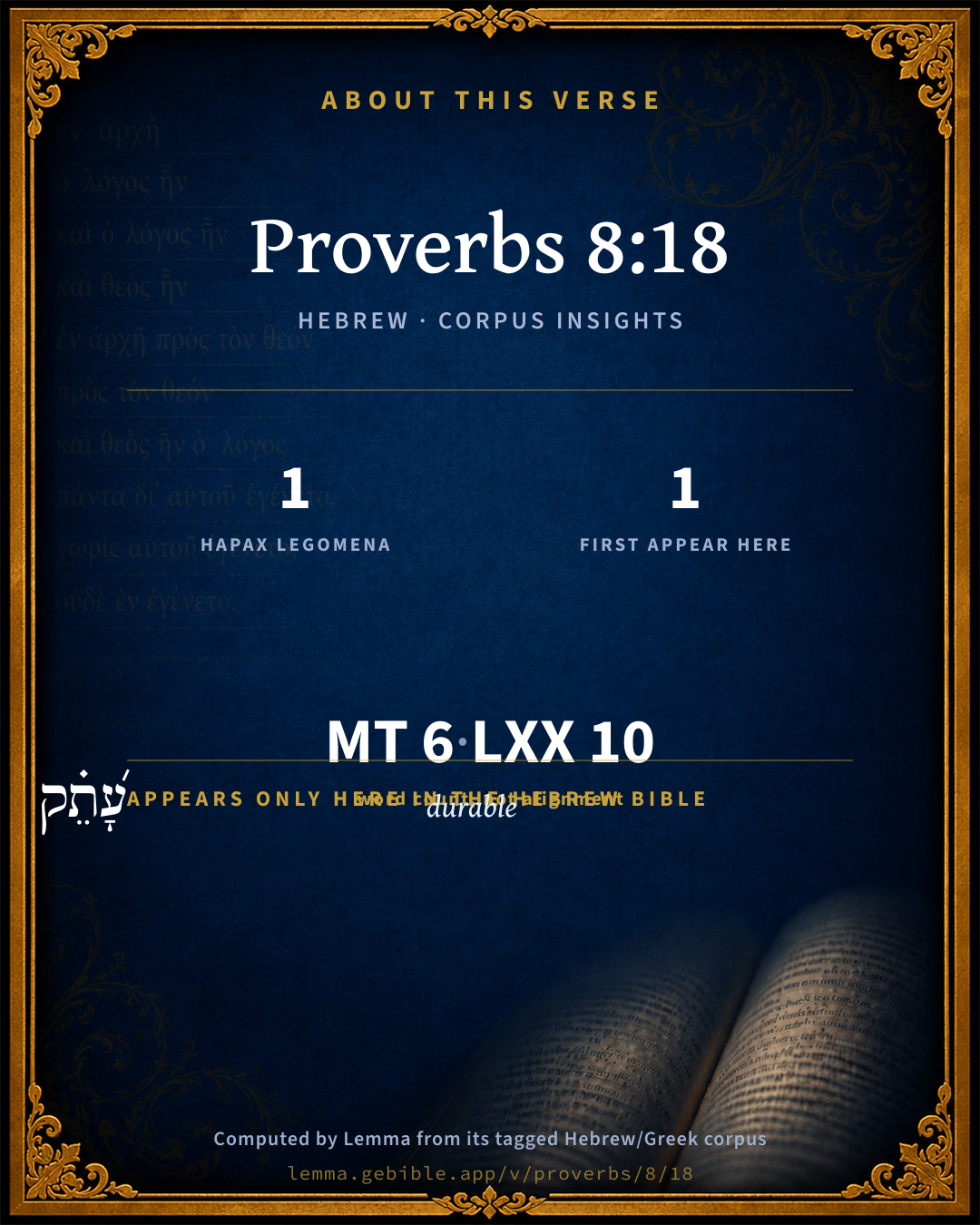
  • 1 hapax legomenon — only here in the Hebrew Bible
  • 1 first appearance in the Hebrew Bible
Full analysis ↓
Download a study sheet

One document with this verse’s original text, its word-by-word gloss line, the meaning frame, cross-references with their text, attributed commentary, and full source and license credits — printable, and it pastes into notes with its structure intact.

This verse Autodidact and up

Study sheet (.html) Plain text (.txt)

A passage Seminary Student

Up to 50 verses in one chapter. A passage sheet keeps up to 6 commentary sources and 12 cross-references per verse, in the order this page ranks them, and says so on the sheet whenever that leaves anything out. Ask for a single verse and you get the Autodidact verse sheet above.

Everything on this page stays free to read, with no account — the sheet is a download of what is already on screen, not access to it.

Want to remove ads? Support Godless Engineer
Compare translations 3

The same verse in 3 English versions, stacked beneath the original-language interlinear above. Click any original word for its lexicon entry.

Each is an independent rendering of the whole verse — the interlinear is not word-aligned to these translations.

Highlighted words mark where these versions differ — a whole-verse word diff, not a word-by-word alignment.

  • World English Bible Public Domain
    With me are riches, honor, Enduring wealth, and prosperity.
  • King James Version Public Domain
    Riches and honour are with me; yea, durable riches and righteousness.
  • unfoldingWord Literal Text CC BY-SA 4.0
    Riches and honor with me, lasting wealth and righteousness.

unfoldingWord Literal Text — © unfoldingWord, licensed CC BY-SA 4.0. Word-aligned USFM3 via Door43 (git.door43.org/unfoldingWord/en_ult).

Versions to compare (up to 4)

3 of 4 selected

Show all 18 translations

Every available English version of this verse, each an independent rendering of the whole verse.

  • World English Bible Public Domain
    With me are riches, honor, Enduring wealth, and prosperity.
  • Berean Standard Bible Public Domain
    With me are riches and honor, enduring wealth and righteousness.
  • Majority Standard Bible Public Domain
    With me are riches and honor, enduring wealth and righteousness.
  • King James Version Public Domain
    Riches and honour are with me; yea, durable riches and righteousness.
  • American Standard Version (1901) Public Domain
    Riches and honor are with me; `Yea', durable wealth and righteousness.
  • Revised Version (1885) Public Domain
    Riches and honour are with me; yea, durable riches and righteousness.
  • Geneva Bible (1599) Public Domain
    Riches and honour are with me: euen durable riches and righteousnesse.
  • Douay-Rheims (1899) Public Domain
    With me are riches and glory, glorious riches and justice.
  • Young's Literal Translation Public Domain
    Wealth and honour `are' with me, Lasting substance and righteousness.
  • Literal Standard Version CC BY-SA 4.0
    Wealth and honor [are] with me, || Lasting substance and righteousness.
  • Unlocked Literal Bible CC BY-SA 4.0
    With me are riches and honor, lasting wealth and righteousness.
  • unfoldingWord Literal Text CC BY-SA 4.0
    Riches and honor with me, lasting wealth and righteousness.
  • Darby Bible Public Domain
    Riches and honour are with me; durable wealth and righteousness.
  • World Messianic Bible Public Domain
    With me are riches, honor, enduring wealth, and prosperity.
  • Webster's Bible Public Domain
    Riches and honor are with me; durable riches and righteousness.
  • Free Bible Version CC BY-SA 4.0
    With me go riches and honor, lasting wealth and prosperity.
  • Bible in Basic English Public Domain
    Wealth and honour are in my hands, even wealth without equal and righteousness.
  • JPS Tanakh (1917) Public Domain
    Riches and honour are with me; yea, enduring riches and righteousness.

Literal Standard Version (2020), Covenant Press — licensed CC BY-SA 4.0. Text via the HelloAO Bible API (eBible.org). Unlocked Literal Bible (unfoldingWord) — licensed CC BY-SA 4.0. Text via the HelloAO Bible API (eBible.org). unfoldingWord Literal Text — © unfoldingWord, licensed CC BY-SA 4.0. Word-aligned USFM3 via Door43 (git.door43.org/unfoldingWord/en_ult). Free Bible Version, Dr. Jonathan Gallagher — licensed CC BY-SA 4.0. Text via the HelloAO Bible API (eBible.org).

Word by word

More ways to search: Search by grammar → Find every occurrence → Compare this word →

Practice this passage: Drill this verse → Learn its vocabulary →

About this verse

These counts appear in no published source. They are computed here, from the morphology-tagged text and Lemma’s own curated glosses. What Lemma adds →

6
words
6
distinct lemmas
Wisdom
section

Notable vocabulary

1 hapax legomenon — a word that appears only here in the entire Hebrew Bible:

  • עָ֝תֵ֗ק durable H6276

First appearance in Scripture

This word makes its first canonical appearance in the Hebrew Bible here:

  • עָ֝תֵ֗ק durable H6276

Shared distinctive vocabulary

ה֥וֹן wealth H1952 occurs in 26 verses of the Hebrew Bible. Also found in:

Grammatical profile

  • 4 nouns
  • 1 adjective
  • 1 preposition

Hebrew & Septuagint length

In English translation the verse runs 9 words from the Hebrew and 11 from the Septuagint (LXX English) — closely comparable.

A rough comparison of the two English renderings, which tokenize alike — not a word-level alignment.

Word counts can differ between the Hebrew and the Greek without any difference in meaning — e.g. the Hebrew direct-object marker אֵת has no separate Greek word, and Greek often adds the article ὁ.

In the original languages it is 6 Hebrew tokens and 10 Greek tokens — but the two are counted differently (Hebrew bundles its prefixes and suffixes into one token; the Greek is in lemma form), so that isn’t a like-for-like length.

Cross-references

20

Topical passages linked to Proverbs 8:18 in the Treasury of Scripture Knowledge — connected by theme and wording, ordered by reader-vote popularity; previews shown in the World English Bible.

  • Proverbs 3:16 Length of days is in her right hand. In her left hand are riches and honor.
  • Matthew 6:33 But seek first God's Kingdom, and his righteousness; and all these things will be given to you as well.
  • Luke 16:11–12 If therefore you have not been faithful in the unrighteous mammon, who will commit to your trust the true riches?
  • Philippians 4:19 My God will supply every need of yours according to his riches in glory in Christ Jesus.
  • Ephesians 3:8 To me, the very least of all saints, was this grace given, to preach to the Gentiles the unsearchable riches of Christ,
  • Revelation 3:18 I counsel you to buy from me gold refined by fire, that you may become rich; and white garments, that you may clothe yourself, and that the shame of your nakedness may not be revealed; and eye salve to anoint your eyes, that you may see.
  • Proverbs 4:7–9 Wisdom is supreme. Get wisdom. Yes, though it costs all your possessions, get understanding.
  • Ecclesiastes 5:14–16 Those riches perish by misfortune, and if he has fathered a son, there is nothing in his hand.
  • Matthew 6:19–20 "Don't lay up treasures for yourselves on the earth, where moth and rust consume, and where thieves break through and steal;
  • Luke 10:42 but one thing is needed. Mary has chosen the good part, which will not be taken away from her."
  • Luke 12:20–21 "But God said to him, 'You foolish one, tonight your soul is required of you. The things which you have prepared--whose will they be?'
  • Luke 12:33 Sell that which you have, and give gifts to the needy. Make for yourselves purses which don't grow old, a treasure in the heavens that doesn't fail, where no thief approaches, neither moth destroys.
  • 2 Corinthians 6:10 as sorrowful, yet always rejoicing; as poor, yet making many rich; as having nothing, and yet possessing all things.
  • Philippians 3:8–9 Yes most assuredly, and I count all things to be loss for the excellency of the knowledge of Christ Jesus, my Lord, for whom I suffered the loss of all things, and count them nothing but refuse, that I may gain Christ
  • 1 Timothy 6:17–19 Charge those who are rich in this present world that they not be haughty, nor have their hope set on the uncertainty of riches, but on the living God, who richly provides us with everything to enjoy;
  • Psalms 36:6 Your righteousness is like the mountains of God. Your judgments are like a great deep. Yahweh, you preserve man and animal.
  • Psalms 112:3 Wealth and riches are in his house. His righteousness endures forever.
  • Proverbs 11:4 Riches don't profit in the day of wrath, But righteousness delivers from death.
  • James 2:5 Listen, my beloved brothers. Didn't God choose those who are poor in this world to be rich in faith, and heirs of the Kingdom which he promised to those who love him?
  • James 5:1–3 Come now, you rich, weep and howl for your miseries that are coming on you.

Cross-references courtesy of OpenBible.info (CC BY 4.0).

Hebrew and Greek witnesses Masoretic Hebrew ↔ Greek Septuagint

The same verse in the two great witnesses to the Old Testament, shown verse-for-verse.

These are two independent witnesses, not word-aligned to each other, and the Septuagint is shown in lemma (dictionary) form.

Hebrew Proverbs 8:18 Masoretic · Westminster Leningrad Codex

עֹֽשֶׁר וְכָב֥וֹד אִתִּ֑י ה֥וֹן עָ֝תֵ֗ק וּצְדָקָֽה

With me are riches, honor, Enduring wealth, and prosperity.

World English Bible · Public Domain

Greek LXX Proverbs 8:18 Septuagint · lemma form

πλοῦτος καί δόξα ἐγώ ὑποἄρχω καί κτῆσις πολύς καί δικαιοσύνη

Wealth and glory belong to me; yes, abundant possessions and righteousness.

LXX2012 (modern English Septuagint) · Public Domain

On this verse, The Pulpit Commentary discusses the Septuagint’s reading. Read the note in Commentary ↓

Hebrew: Westminster Leningrad Codex (CC BY 4.0). Greek: Septuagint (public domain); English from LXX2012 (modern English Septuagint) (Public Domain). How the Septuagint differs from the Hebrew →

Commentary

Notes on Proverbs 8:18 from classic Christian and Jewish commentators (each source and its license shown beneath its notes). The classic Christian expositions comment on the surrounding passage and are grouped to its opening verse, so a note may address several verses; the Jewish commentaries on the Tanakh (Rashi and others) are per-verse, so they appear only where the commentator wrote on this verse.

Lemma curates 59 commentaries, every one of them public domain or Creative Commons licensed, each selected and text-cleaned for this edition rather than reprinted as found. About our sources →

Trapp's Complete Commentary

John Trapp

Pro 8:18 Riches and honour [are] with me; [yea], durable riches and righteousness.

Ver. 18. Riches and honour are with me.] I come not unaccompanied, but bring with me that which is well worth having. The muses, though Jupiter’s daughters, and well deserving, yet are said to have had no suitors, because they had no portions. Our Henry VIII, when he died, gave his two daughters, Mary and Elizabeth, but ten thousand pounds apiece. {a} But this lady is largely endowed, and yet - such is men’s dulness - she is put to solicit suitors, by setting forth her great wealth. {See Trapp on "Mat 6:33"}

{a} England’s Elisabeth.

John Trapp, A Commentary or Exposition upon All the Books of the Old and New Testament (1647–1656) — public domain. Text from a community e-Sword module.

The Biblical Illustrator

Joseph S. Exell

Pro_8:18

Riches and honour are with Me; yea, durable riches and righteousness.

On gaining and using riches

Whatever is true and substantial happiness even in this life has a necessary dependence upon morality and religion. Wealth and riches are but heavy encumbrances and unprofitable lumber if they are not made use of to reward the good, to excite the diligent, and to relieve the oppressed. But that religion should be the path that leads to wealth and substance, and that to be good is the way to become rich, seems to be a paradox contrary to the sentiments of mankind. Piety may indeed comfort us in our wants, and support us in our affictions; but that it should be the best factor to gain them and store them up is an assertion so opposite to the persuasion of men that it seems like the wild affirmation of one who would defend a novelty.

I. Piety is the most effectual means to obtain riches.

1. Riches are the gift of God, not the goods of fortune. If there is a wise and provident Governor of the world, the success of all human enterprises depends upon His disposition of things. If the men of virtue and piety are the favourites of the Almighty, they may expect bounties as the signs of His love; if they be His faithful servants, as rewards of their fidelity.

2. See what piety is, examine it in itself and in its consequences, and we shall find it to be naturally productive of riches and plenty. Piety is the habitual practice of moral and Divine virtues, each one of which has a tendency to enrich its followers, e.g., industry, temperance, humility, brotherly love, liberality, and charity.

3. Credit and reputation in the world have a very great dependence upon honesty and an upright life, and they are things absolutely necessary for the promotion of our health and worldly interest. The only solid foundation of a good name is piety and virtue.

4. Piety and virtue direct to the use of those methods which are honest and lawful. The most honest means are always the sweetest.

II. The securing of riches or making them durable. This may be considered in a double respect--

1. In relation to ourselves.

2. In relation to posterity. Whatever is got by means that are repugnant to piety is not to be kept, but must be parted with. All vices have a natural tendency to impoverish mankind. It is well to note that the efficacy of piety is not bounded here; it reaches beyond the grave, and entails its blessings on future generations. The generation of the faithful shall be blessed. (William Hayley, M. A.)

The Biblical Illustrator, edited by Joseph S. Exell (c. 1880s–1900s) — public domain. Text from a community e-Sword module.

Geneva Bible (1599)

Geneva Bible translators

Signifying that he chiefly meaneth the spiritual treasures and heavenly riches.

Geneva Bible (1599) marginal notes — public domain. Text via Bolls.life.

Jamieson, Fausset & Brown

Robert Jamieson, A. R. Fausset & David Brown

durable riches . . . righteousness--Such are the "riches," enduring sources of happiness in moral possessions (compare Pro 3:16).

Jamieson, Fausset & Brown — Commentary Critical and Explanatory on the Whole Bible (1871) — public domain (CC PDM 1.0). Text via the HelloAO Bible API.

Adam Clarke's Commentary

Verse 18. Riches and honour are with me] Often the wise, prudent, and discreet man arrives literally to riches and honour; but this is not always the case. But there are other riches of which he never fails; and these seem to be what Solomon has particularly in view, durable riches and righteousness; the treasure deposited by God in earthen vessels.

Adam Clarke's Commentary on the Bible (1810–1826) — public domain. Text from a community e-Sword/MySword module.

Ellicott's Commentary for English Readers

(18) Riches and honour are with me.—“If this passage is taken in a material sense, Psa_112:3 and the promises in the Pentateuch of wealth as the reward of obedience might be compared with it. But doubtless the “true riches” (Luk_16:11) are here alluded to, the consciousness of possessing God’s honour and favour, called in Eph_3:8 the “unsearchable riches of Christ.”

A Bible Commentary for English Readers, edited by Charles John Ellicott (1878–1897) — public domain. Text from a community e-Sword module.

The Cambridge Bible for Schools and Colleges

gen. ed. J. J. S. Perowne

18. durable] Or, ancient, R.V. marg. The word, of which the root meaning is to grow old, in the sense of continuance, may look backward to what has already grown old and is ancient, or forward to what is abiding, and therefore will grow old. The rendering durable has the advantage of combining both these references.

Dean Plumptre adopts the latter view: “The special idea conveyed is that of a treasure piled up for many years, ancient wealth. Comp. the Greek maxim, ἀρχαιοπλούτων δεσποτῶν πολλὴ χάρις, Aesch. Agam. 1043.”

and righteousness] A double contrast is implied: (1) Wisdom bestows temporal wealth and prosperity, which because it is procured by righteousness (comp. Pro_8:20-21) is durable, unlike “the wealth of the sinner” (“the unrighteous mammon,” Luk_16:9), which passes to another (Pro_11:22). And (2) instead of “that which is not,” “the riches which certainly make themselves wings, like an eagle that flieth towards heaven” (Pro_23:5), Wisdom bestows “the true riches” (Luk_16:11), the wealth which is “our own” (ib. Pro_8:12), inseparable from us and a partaker of our immortality.

The Cambridge Bible for Schools and Colleges (gen. ed. J. J. S. Perowne; Cambridge University Press, 1878–1918) — public domain. Text from a community e-Sword module.

John Gill's Exposition

Riches and honour are with me,.... By "riches" are meant not the riches of Christ's person, the perfections of his nature, his works, and his vast empire over all creatures, and the revenues arising from thence, which though durable, yet not communicable; not temporal riches, which, though with him, and at his dispose, yet these, at least a large share of them, and in common, is not given to his people, nor are they durable; but the riches of grace, redeeming, justifying, pardoning, and sanctifying grace, are intended, and the riches of glory in another world: and so "honour" designs not that which he has as a divine Person, or as Mediator, which is incommunicable; much less temporal honour, for though this is with him and from him, as appears Pro 8:15; yet it is not usually given to his followers, who are not the great and noble, but generally reckoned the offscouring of all things; nor is such honour durable; but the honour he gives his people lies in their being espoused to him, in being the sons of God through him, in being made by him kings and priests unto God, and in reigning with him here and for ever;

yea, durable riches and righteousness; which last some understand as another adjunct and epithet of riches, and represent them in opposition to mammon of unrighteousness, or to riches either ill-gotten or ill-managed; and expresses another property of Christ's riches of grace and glory, as being what are come by in a way of righteousness into his hands, and are distributed faithfully by him; though rather it respects a distinct thing which is with Christ, and in his hands to give, even his justifying righteousness, consisting of his active and passive obedience, which he has wrought out, is in him, and given by him to his people; and is what is called the righteousness of God and of faith; which secures from condemnation and entitles to eternal life; and is an everlasting one, as durable as his riches are, which are his fulness that ever continues with him: pardon is "simul" and "semel" (g), and for ever; sanctifying grace, as faith, hope, and love, always abide; and about the riches of glory there can be no doubt of the permanency of them; and the same may be said of honour both here and hereafter.

(g) "At once" and "once for all".

John Gill's Exposition of the Whole Bible (1746–1763) — public domain (CC PDM 1.0). Text via the HelloAO Bible API.

Albert Barnes' Notes on the Bible

Durable riches - i. e., Treasure piled up for many years; ancient wealth.

Albert Barnes' Notes on the Bible (1834–1885) — public domain. Text from a community e-Sword/MySword module.

Haydock's Catholic Bible Commentary

Glorious. Literally, "proud." (Haydock) --- But here it only means great, Isaias ix 15., and lxi. 6. Riches too commonly nourish pride, and it is very rare to see them joined with justice. (Calmet)

George Leo Haydock (1774–1849), Haydock's Catholic Family Bible and Commentary, 1859 edition — public domain. Excludes Psalms (Douay-Rheims chapter numbering differs from Protestant) and Deuterocanonical books (Catholic canon only).

Matthew Poole's English Annotations

Which he mentions here, either,

1. As the best and surest way to get and to keep riches; for estates unjustly gotten quickly vanish, as is manifest both from Scripture and from common observation. Or,

2. To signify that this wisdom gives both worldly and spiritual or heavenly blessings together to its followers, whereas God gives riches alone to ungodly men, and they are to expect no other portion.

Matthew Poole's English Annotations on the Holy Bible (1683–1685) — public domain. Text from a community e-Sword/MySword module.

Whedon's Commentary on the Bible

Daniel D. Whedon

18. As a motive to such loving and seeking, she assures them that those things which men desire most are in her keeping, and she bestows them upon her votaries.

Durable riches — הון עתק, (hon ‘hathek,) antique or transmitted wealth, that which passes down from generation to generation of those who love her; honours, dignities, possessions, descending to children and children’s children. “Increasing riches.” — Zockler. Ill-gotten gains are seldom thus transmitted; but these are durable, because, says Patrick, “they are not gotten either by oppression or niggardice;” for I teach men to do justly, and to love mercy.

And righteousness — צדקה. Some think the word means here the fruits of righteousness — prosperity. It sometimes has this sense. We may suggest virtue, that is, this wealth, obtained in accordance with the principles of divine wisdom, shall descend to posterity accompanied by virtue or piety. Inherited wealth is generally a corrupter of virtue and a curse. The lovers of wisdom have the promise that it shall not be so with theirs.

Daniel D. Whedon (gen. ed.), Commentary on the Old and New Testaments (1874–1909) — public domain. Text from a community e-Sword module.

The Pulpit Commentary

Riches and honour are with me. (see Pro_3:16) Wisdom has these things in her possession to bestow on whom she will, as God gave them to Solomon in reward of his petition for wisdom. (1Ki_3:13) Durable riches and righteousness. Things often regarded as incompatible. Durable, qte (athek), occurs only here, (but see Isa_23:18) and means "old," "venerable," "long accumulated;" hence firm and lasting. Righteousness is the last reward that Wisdom bestows, without which, indeed, all material blessings would be nothing worth. Wealth obtained in a right way, and rightly used, is durable and stable. This was especially true under a temporal dispensation. We Christians, however, look not for reward in uncertain riches, but in God"s favour here and happiness in another world. The Septuagint, "Possession of many things, and righteousness." What is denoted by "righteousness" is further explained in the following verses, 19-21.

The Pulpit Commentary (1880–1919), ed. H.D.M. Spence-Jones & Joseph S. Exell — public domain. Text from a community e-Sword module.

Bridges on Proverbs

Charles Bridges

What a treasure do early seekers find! This fading world is too poor a portion. (Psa 17:14-15 .) Theirs are durable riches of eternity (Mat 6:19-20 . Luk 10:42 . Rev 3:18 ); the honour of "reigning" as kings "in life" (Rom 5:17 ; Rom 8:17 . Rev 1:6 ); a righteousness, in which they are accepted with God, and conformed to his image. (Rom 3:22 ; Rom 13:14 . Eph 4:24 .) Is not this fruit and revenue better than choice silver? (Pro 8:10-11 ; Pro 3:14-15 . Ecc 7:12 .) And then, when our way is shut up, how valuable is Wisdom’s counsel! (Pro 3:6 ; Pro 4:11-12 ; Pro 6:22 . Isa 48:17 ; Isa 49:10 ) so carefully leading in the midst of the paths; ’at a distance from the extreme’†1 on either side of the narrow way. The sober-minded Christian is equally remote from formal service and enthusiastic delusion. His apprehensions of truth are alike distinguished from the dryness of system, and from lose unconnected principles. The intelligent and spiritually-minded Churchman is alike separate from exclusiveness or idolatry on the one side, and from indiscriminate Christianity on the other. He values highly his Scriptural ordinances; yet he neither mistakes them for the substance of the gospel, nor does he substitute self-willed effervescence in their room. This is the Via Media — Christian unity, consistency, and fruitfulness. Here also is substance — things that have a being, in contrast with "things that have not" (Pro 23:5 . Psa 39:6 . 1Co 7:31 ); solid realities (Isa 29:8, contrasted with Isa 55:2 ); "faith substantiating things hoped for." (Heb 11:1 .) Sin pardoned: the Father smiling acceptance; the Comforter witnessing our peace; a new molding of our mind and spirit. Here is no yawning vacuum, but a grand object to give interest to life, to fill up every vacancy in the heart — ’perfect happiness’†2 All that we could add from the world would only make us poorer, by diminishing that enjoyment of God, for the loss of which there is no compensation. There is one point — only one — in the universe, where we can look up, and cry with the saintly Martyn — ’With thee there is no disappointment.’†3

Now contrast the portion in this life — of the men of this world. Mark how the word of God pictures it — a fashion (1Co 7:31 ) — a dream (Psa 73:20 ) — a nonentity (Pro 23:5 . Amo 6:13 ) — a lie. (Jon 2:8 .) Thus men are spread over the world, "feeding upon ashes, a deceived heart turning them aside." (Isa 44:20 .) The inlet of their misery is, that they walk in a vain shadow, and "therefore they are disquieted in vain." The child of God finds substance in "returning to his" true "rest. Now Lord, what wait I for? my hope is in thee." (Psa 39:6-7 .)

But how does he come to his portion? Has he any part in deserving it? Far from it. Free grace, not free will, is the procuring cause. It is an inheritance, now indeed "obtained," while "the earnest" is in hand (Eph 1:11 ); but to be fully enjoyed at the great consummation-day. Then, indeed, what here he promises will he fully make good. His joyous welcome "to them on his right hand" will indeed be causing them that love him to inherit substance (Heb 10:34 ) — eternal, unfading. (Mat 25:34 .) Even now from his royal bounty does he fill their treasures. But what will be the burst of joy at that day — what the unbounded delight throughout eternity, when, endowing them with such a royal — yea — Divine bounty, the glorious Giver shall proclaim — I will fill their treasures! (1Pe 1:4-5 .) And the countless throng of the redeemed shall unite in the testimony — One Christ hath abundantly filled us all!

Footnotes:

†1 Scott. Pro 4:25-27 . See Bunyan’s fine description of the middle path.

†2 Cartwright.

†3 Journals, vol. ii. 130.

Charles Bridges, An Exposition of the Book of Proverbs (1846) — public domain. Text from a community e-Sword module.

Lesson kit

Teaching starters — assembled from the data on this page, not authored interpretation. Every prompt links to the verse data it draws on. Edit before teaching.

Proverbs, in the Wisdom, opens this verse with 6 words (6 distinct Hebrew lemmas). Its most distinctive word is ʻâthêq (“durable”). A historical commentator’s framing appears above. Read the whole chapter for the surrounding context.

Discussion questions

  1. What does “durable” (ʻâthêq) contribute to the verse as a whole?
  2. This verse holds 1 word here found nowhere else in the Hebrew Bible. What might the rare word draw attention to?
  3. The word “durable” first appears here in Scripture. What is being introduced at this debut?
  4. Psalms 44:12 shares the word «wealth» with this verse. How do the two illuminate each other?
  5. The translations on this page render this verse differently — a whole-verse word diff, not a word-by-word alignment. What might account for the different wordings?
  6. Reading how Trapp's Complete Commentary and The Biblical Illustrator read this verse, where do the two commentators agree and where do they part?

Things to notice

Reading settings

Reading text

Shown beneath each verse's original-language words.

Old Testament
Old Testament edition

Read the OT as the Masoretic Hebrew (MT) or the Greek Septuagint (LXX).

English shown for the Greek Septuagint (in the Hebrew ↔ Greek comparison).

Comparing translations? Open the Compare panel on any verse page to stack up to four side by side.