
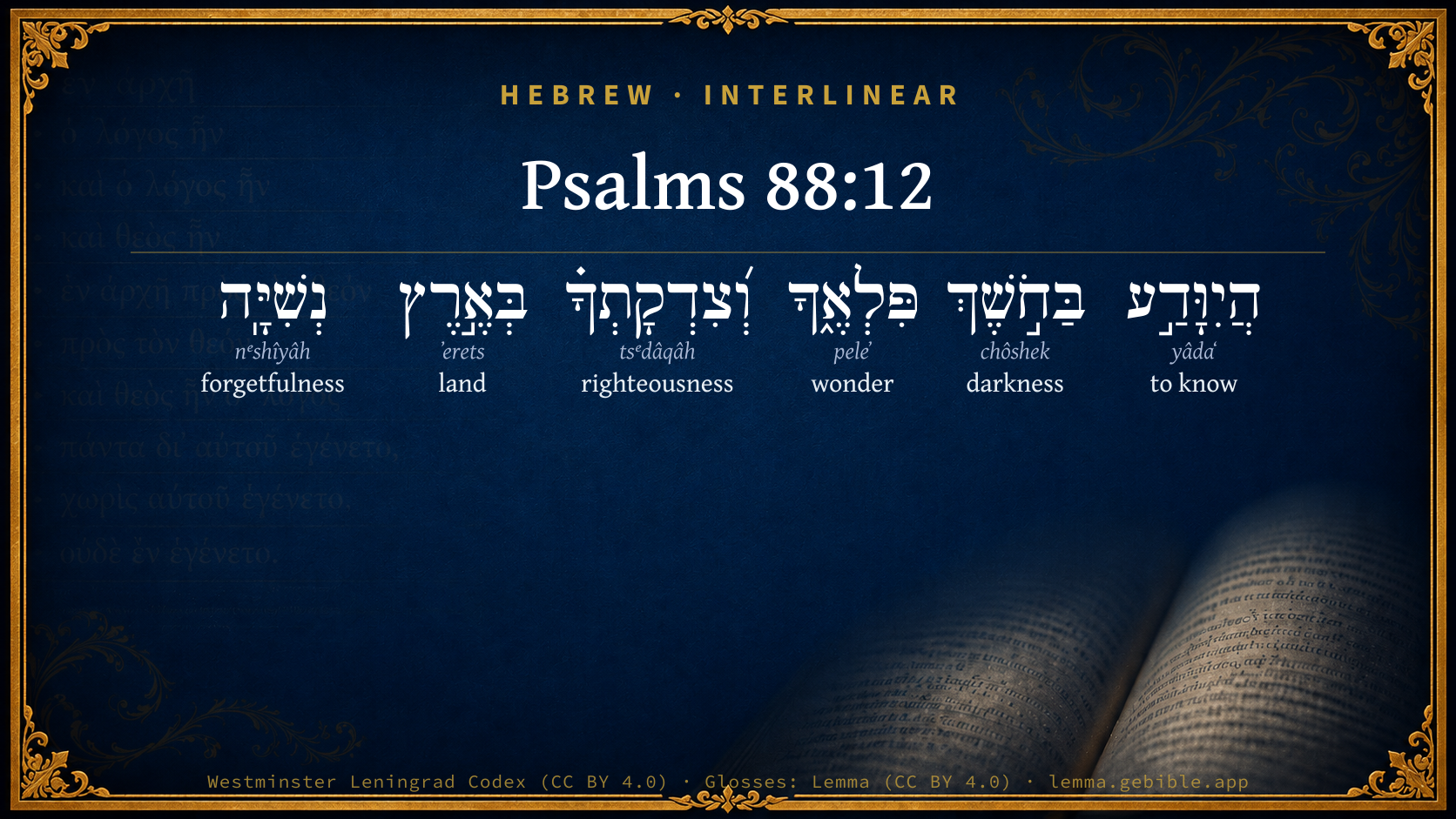
Psalms 88:12

Hebrew (Westminster Leningrad Codex) Psalms 88:12 appears in the Hebrew Old Testament. The text above is from the Westminster Leningrad Codex. Each word links to its Strong’s number, a concise gloss, and parsing drawn from the Open Scriptures Hebrew Bible morphology. Click any word for its full Brown-Driver-Briggs (BDB) entry.
Download image
Cite this verse

Psalms 88:12 (World English Bible). Public Domain. Lemma interlinear Bible study tool, https://lemma.gebible.app/v/psalms/88/12.

Show BibTeX & RIS
BibTeX
RIS
English Translation
Are your wonders made known in the dark? Or your righteousness in the land of forgetfulness?
World English Bible · Public Domain
Highlights
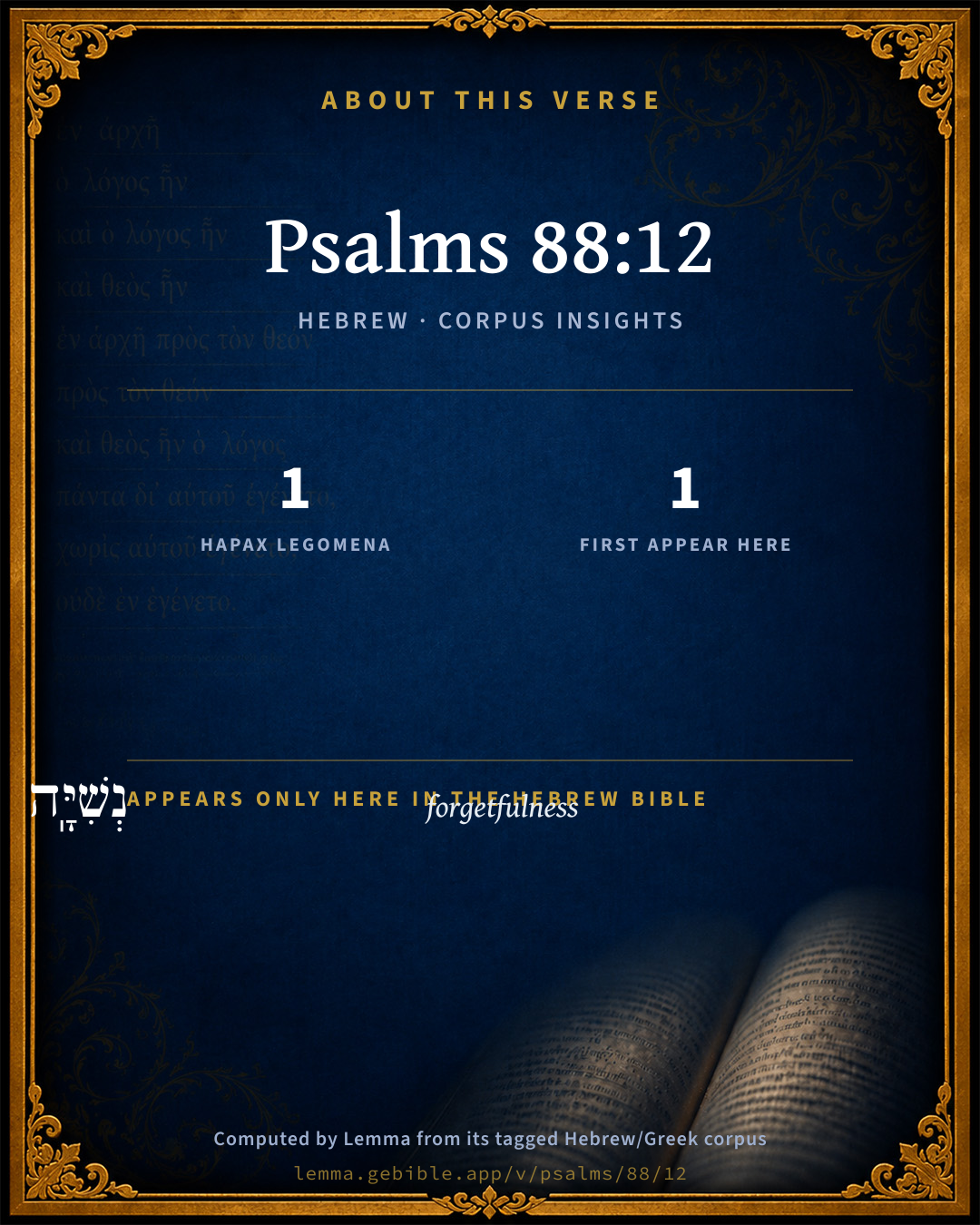
  • 1 hapax legomenon — only here in the Hebrew Bible
  • 1 first appearance in the Hebrew Bible
Full analysis ↓
Download a study sheet

One document with this verse’s original text, its word-by-word gloss line, the meaning frame, cross-references with their text, attributed commentary, and full source and license credits — printable, and it pastes into notes with its structure intact.

This verse Autodidact and up

Study sheet (.html) Plain text (.txt)

A passage Seminary Student

Up to 50 verses in one chapter. A passage sheet keeps up to 6 commentary sources and 12 cross-references per verse, in the order this page ranks them, and says so on the sheet whenever that leaves anything out. Ask for a single verse and you get the Autodidact verse sheet above.

Everything on this page stays free to read, with no account — the sheet is a download of what is already on screen, not access to it.

Want to remove ads? Support Godless Engineer
Compare translations 3

The same verse in 3 English versions, stacked beneath the original-language interlinear above. Click any original word for its lexicon entry.

Each is an independent rendering of the whole verse — the interlinear is not word-aligned to these translations.

Highlighted words mark where these versions differ — a whole-verse word diff, not a word-by-word alignment.

  • World English Bible Public Domain
    Are your wonders made known in the dark? Or your righteousness in the land of forgetfulness?
  • King James Version Public Domain
    Shall thy wonders be known in the dark? and thy righteousness in the land of forgetfulness?
  • unfoldingWord Literal Text CC BY-SA 4.0
    Will your wonder be known in the darkness, or your righteousness, in the land of forgetfulness?

unfoldingWord Literal Text — © unfoldingWord, licensed CC BY-SA 4.0. Word-aligned USFM3 via Door43 (git.door43.org/unfoldingWord/en_ult).

Versions to compare (up to 4)

3 of 4 selected

Show all 18 translations

Every available English version of this verse, each an independent rendering of the whole verse.

  • World English Bible Public Domain
    Are your wonders made known in the dark? Or your righteousness in the land of forgetfulness?
  • Berean Standard Bible Public Domain
    Will Your wonders be known in the darkness, or Your righteousness in the land of oblivion?
  • Majority Standard Bible Public Domain
    Will Your wonders be known in the darkness, or Your righteousness in the land of oblivion?
  • King James Version Public Domain
    Shall thy wonders be known in the dark? and thy righteousness in the land of forgetfulness?
  • American Standard Version (1901) Public Domain
    Shall thy wonders be known in the dark? And thy righteousness in the land of forgetfulness?
  • Revised Version (1885) Public Domain
    Shall thy wonders be known in the dark? and thy righteousness in the land of forgetfulness?
  • Geneva Bible (1599) Public Domain
    Shall thy wonderous workes be knowen in the darke? and thy righteousnes in the land of obliuion?
  • Douay-Rheims (1899) Public Domain
    Shall any one in the sepulchre declare thy mercy: and thy truth in destruction?
  • Young's Literal Translation Public Domain
    Are Thy wonders known in the darkness? And Thy righteousness in the land of forgetfulness?
  • Literal Standard Version CC BY-SA 4.0
    Are Your wonders known in the darkness? And Your righteousness in the land of forgetfulness?
  • Unlocked Literal Bible CC BY-SA 4.0
    Will your wonderful deeds be known in the darkness, or your righteousness in the place of forgetfulness?
  • unfoldingWord Literal Text CC BY-SA 4.0
    Will your wonder be known in the darkness, or your righteousness, in the land of forgetfulness?
  • Darby Bible Public Domain
    Shall thy wonders be known in the dark? and thy righteousness in the land of forgetfulness?
  • World Messianic Bible Public Domain
    Are your wonders made known in the dark? Or your righteousness in the land of forgetfulness?
  • Webster's Bible Public Domain
    \\88:11\\Shall thy loving-kindness be declared in the grave? or thy faithfulness in destruction?
  • Free Bible Version CC BY-SA 4.0
    Are the wonderful things you do known in the darkness? Is your goodness known in the land of forgetfulness?
  • Bible in Basic English Public Domain
    May there be knowledge of your wonders in the dark? or of your righteousness where memory is dead?
  • JPS Tanakh (1917) Public Domain
    (88-13) Shall Thy wonders be known in the dark? and Thy righteousness in the land of forgetfulness?

Literal Standard Version (2020), Covenant Press — licensed CC BY-SA 4.0. Text via the HelloAO Bible API (eBible.org). Unlocked Literal Bible (unfoldingWord) — licensed CC BY-SA 4.0. Text via the HelloAO Bible API (eBible.org). unfoldingWord Literal Text — © unfoldingWord, licensed CC BY-SA 4.0. Word-aligned USFM3 via Door43 (git.door43.org/unfoldingWord/en_ult). Free Bible Version, Dr. Jonathan Gallagher — licensed CC BY-SA 4.0. Text via the HelloAO Bible API (eBible.org).

Word by word

More ways to search: Search by grammar → Find every occurrence → Compare this word →

Practice this passage: Drill this verse → Learn its vocabulary →

About this verse

These counts appear in no published source. They are computed here, from the morphology-tagged text and Lemma’s own curated glosses. What Lemma adds →

6
words
6
distinct lemmas
Wisdom
section

Notable vocabulary

1 hapax legomenon — a word that appears only here in the entire Hebrew Bible:

  • נְשִׁיָּֽה forgetfulness H5388

First appearance in Scripture

This word makes its first canonical appearance in the Hebrew Bible here:

  • נְשִׁיָּֽה forgetfulness H5388

Shared distinctive vocabulary

פִּלְאֶ֑ךָ wonder H6382 occurs in 13 verses of the Hebrew Bible. Also found in:

Grammatical profile

  • 1 verb
  • 5 nouns

Verb forms

  • הֲיִוָּדַ֣ע Niphal · Imperfect

Hebrew & Septuagint length

In English translation the verse runs 16 words from the Hebrew and 14 from the Septuagint (LXX English) — closely comparable.

A rough comparison of the two English renderings, which tokenize alike — not a word-level alignment.

Word counts can differ between the Hebrew and the Greek without any difference in meaning — e.g. the Hebrew direct-object marker אֵת has no separate Greek word, and Greek often adds the article ὁ.

Cross-references

10

Topical passages linked to Psalms 88:12 in the Treasury of Scripture Knowledge — connected by theme and wording, ordered by reader-vote popularity; previews shown in the World English Bible.

  • Ecclesiastes 9:5 For the living know that they will die, but the dead don't know anything, neither do they have any more a reward; for the memory of them is forgotten.
  • Matthew 8:12 but the children of the Kingdom will be thrown out into the outer darkness. There will be weeping and the gnashing of teeth."
  • Job 10:21–22 Before I go where I shall not return from, To the land of darkness and of the shadow of death;
  • Psalms 31:12 I am forgotten from their hearts like a dead man. I am like broken pottery.
  • Psalms 88:5 Set apart among the dead, Like the slain who lie in the grave, Whom you remember no more. They are cut off from your hand.
  • Psalms 143:3 For the enemy pursues my soul. He has struck my life down to the ground. He has made me live in dark places, as those who have been long dead.
  • Ecclesiastes 2:16 For of the wise man, even as of the fool, there is no memory for ever, seeing that in the days to come all will have been long forgotten. Indeed, the wise man must die just like the fool!
  • Ecclesiastes 8:10 So I saw the wicked buried. Indeed they came also from holiness. They went and were forgotten in the city where they did this. This also is vanity.
  • Isaiah 8:22 and they shall look to the earth, and see, distress and darkness, the gloom of anguish; and into thick darkness [they shall be] driven away.
  • Jude 1:13 wild waves of the sea, foaming out their own shame; wandering stars, for whom the blackness of darkness has been reserved forever.

Cross-references courtesy of OpenBible.info (CC BY 4.0).

Hebrew and Greek witnesses Masoretic Hebrew ↔ Greek Septuagint

The same verse in the two great witnesses to the Old Testament, shown verse-for-verse.

You’re reading Greek Psalm 87 (Hebrew Psalm 88). The Septuagint counts the superscription, so verse numbers can differ from the Hebrew — chapter-level alignment, not verse-by-verse. Numbering follows Rahlfs.

These are two independent witnesses, not word-aligned to each other, and the Septuagint is shown in lemma (dictionary) form.

Hebrew Psalms 88:12 Masoretic · Westminster Leningrad Codex

הֲיִוָּדַ֣ע בַּחֹ֣שֶׁךְ פִּלְאֶ֑ךָ וְ֝צִדְקָתְךָ֗ בְּאֶ֣רֶץ נְשִׁיָּֽה

Are your wonders made known in the dark? Or your righteousness in the land of forgetfulness?

World English Bible · Public Domain

Greek LXX Greek Psalm 87:12 Septuagint · lemma form

μή διαἡγέομαι τις ἐν τάφος ὁ ἔλεος σύ καί ὁ ἀλήθεια σύ ἐν ὁ ἀπώλεια

Shall your wonders be known in darkness? and your righteousness in a forgotten land?

LXX2012 (modern English Septuagint) · Public Domain

Hebrew: Westminster Leningrad Codex (CC BY 4.0). Greek: Septuagint (public domain); English from LXX2012 (modern English Septuagint) (Public Domain). How the Septuagint differs from the Hebrew →

Commentary

Notes on Psalms 88:12 from classic Christian and Jewish commentators (each source and its license shown beneath its notes). The classic Christian expositions comment on the surrounding passage and are grouped to its opening verse, so a note may address several verses; the Jewish commentaries on the Tanakh (Rashi and others) are per-verse, so they appear only where the commentator wrote on this verse.

Lemma curates 59 commentaries, every one of them public domain or Creative Commons licensed, each selected and text-cleaned for this edition rather than reprinted as found. About our sources →

Trapp's Complete Commentary

John Trapp

Psa 88:12 Shall thy wonders be known in the dark? and thy righteousness in the land of forgetfulness?

Ver. 12. In the land of forgetfulness] So the state and place of the dead is called; and why: {See Trapp on "Psa 88:5"}

John Trapp, A Commentary or Exposition upon All the Books of the Old and New Testament (1647–1656) — public domain. Text from a community e-Sword module.

J. A. Alexander on Psalms

Joseph Addison Alexander

13. (Psa 88:12) Shall thy wonders be known in the dark, and thy righteousness in the land of forgetfulness? These are varied metaphorical descriptions of the state of death, considered negatively as the privation or the opposite of life. Darkness is here opposed to the light of life or of the living, Psa 56:13). The land of forgetfulness, where men forget, Ecc 9:5-6; Ecc 9:10, and are forgotten, Psa 31:12.

Joseph Addison Alexander, The Psalms Translated and Explained (1850) — public domain. Text from a community e-Sword module.

Geneva Bible (1599)

Geneva Bible translators

That is, in the grave, where only the body lieth without all sense and remembrance.

Geneva Bible (1599) marginal notes — public domain. Text via Bolls.life.

Adam Clarke's Commentary

Verse 12. The land of forgetfulness?] The place of separate spirits, or the invisible world. The heathens had some notion of this state. They feigned a river in the invisible world, called Lethe, ληθη, which signifies oblivion, and that those who drank of it remembered no more any thing relative to their former state.

----------Animae, quibus altera fato

Corpora debentur, lethaei ad fluminis undam

Securos latices et longa oblivia potant.

VIRG. AEn. vi. 713.

To all those souls who round the river wait

New mortal bodies are decreed by fate;

To yon dark stream the gliding ghosts repair,

And quaff deep draughts of long oblivion there.

Adam Clarke's Commentary on the Bible (1810–1826) — public domain. Text from a community e-Sword/MySword module.

The Cambridge Bible for Schools and Colleges

gen. ed. J. J. S. Perowne

12. Nay, God’s wonders will not even be known in Darkness, nor His righteousness, His faithfulness to His covenant (Psa_71:2, and often), in the land of Oblivion: where men neither remember God (Psa_6:5) nor are remembered by Him (Psa_88:5); where thought feeling and action are at an end. See Ecc_9:5-6; Ecc_9:10; and even in Sir_17:27-28, Bar_2:17, we hear the echo of Isa_38:18 f.

The Cambridge Bible for Schools and Colleges (gen. ed. J. J. S. Perowne; Cambridge University Press, 1878–1918) — public domain. Text from a community e-Sword module.

John Gill's Exposition

Shall thy wonders be known in the dark?.... A description of the grave again; see Job 10:21, The sense may be, should he continue in the dark and silent grave, how would the wonders of the grace of God, of electing, redeeming, justifying, pardoning, and adopting grace, be made known; the wonders of Christ's person and offices, and the wondrous things, and doctrines of the Gospel, relating thereunto? as the glory of these would be eclipsed, there would be none to publish them:

and thy righteousness in the land of forgetfulness? the grave, where the dead lie, who, having lost all sense of things, forget what were done in this world, and they themselves are quickly forgotten by the living; and had Christ continued in this state, and had not risen again to our justification, how would his justifying righteousness have been revealed, as it is from faith to faith in the Gospel, which is therefore called the word and ministration of righteousness?

John Gill's Exposition of the Whole Bible (1746–1763) — public domain (CC PDM 1.0). Text via the HelloAO Bible API.

Albert Barnes' Notes on the Bible

Shall thy wonders be known in the dark? - In the dark world; in “the land of darkness and the shadow of death; a land of darkness, as darkness itself, and where the light is as darkness.” Job 10:21-22. “And thy righteousness.” The justice of thy character; or, the ways in which thou dost maintain and manifest thy righteous character.

In the land of forgetfulness - Of oblivion; where the memory has decayed, and where the remembrance of former things is blotted out. This is a part of the general description, illustrating the ideas then entertained of the state of the dead; that they would be weak and feeble; that they could see nothing; that even the memory would fail, and the recollection of former things pass from the mind. All these are images of the grave as it appears to man when he has not the clear and full light of revelation; and the grave is all this - a dark and cheerless abode - all abode of fearfulness and gloom - when the light of the great truths of the Gospel is not suffered to fall upon it. That the psalmist dreaded this is clear, for he had not yet the full light of revealed truth in regard to the grave, and it seemed to him to be a gloomy abode. That people without the Gospel ought to dread it, is clear, for when the grave is not illuminated with Christian truth and hope, it is a place from which man by nature shrinks back, and it is not wonderful that a wicked man dreads to die.

Albert Barnes' Notes on the Bible (1834–1885) — public domain. Text from a community e-Sword/MySword module.

Matthew Poole's English Annotations

In the dark; in the grave, which is called the land of darkness, Job 10:21,22.

In the land of forgetfulness; in the grave; so called, either, first, Actively, because there men forget and neglect all the concerns of this life, being indeed but dead carcasses without any sense or remembrance. Or rather, secondly, Passively, because there men are forgotten not only by men, as is noted, Job 24:20; Psa 31:12, but by God himself, as he complained, Psa 88:5.

Matthew Poole's English Annotations on the Holy Bible (1683–1685) — public domain. Text from a community e-Sword/MySword module.

The Treasury of David

Charles H. Spurgeon

Ver. 12. Shall thy wonders be known in the dark? If not here permitted to prove their goodness of Jehovah, how could the singer do so in the land of darkness and death shade? Could his tongue, when turned into a clod, alarm the dull cold ear of death? Is not a living dog better than a dead lion, and a living believer of more value to the cause of God on earth than all the departed put together?

And thy righteousness in the land of forgetfulness? What shall be told concerning thee in the regions of oblivion? Where memory and love are lost, and men are alike unknowing and unknown, forgetful and forgotten, what witness to the divine holiness can be borne? The whole argument amounts to thisif the believer dies unblessed, how will God's honour be preserved? Who will bear witness to his truth and righteousness?

Ver. 12. Wilt thou show thy righteousness in the land of forgetfulness? where I have forgotten thee, where I turned aside from thee, where I have let slip out of my memory all thy previous dealings with meand shall thy righteousness be manifested even there? Wilt thou prove thine equity in showing forth mercy, because for me a sacrifice has been offered, thy righteousness running parallel with the atoning stream of Christ's blood? When I have forgotten thee and forsaken thee, and turned my back upon thee, can thy righteousness be there manifested? What! righteousness running side by side with mercy! and righteousness still preserving all its unbending strictness, because this very backsliding of heart, this very forgetfulness of soul, this very alienation of affection, this very turning my back upon thee, have all been atoned for; and righteousness can be still shown "in the land of forgetfulness", because all my sins committed in the land of forgetfulness have been atoned for by redeeming blood! J.C. Philpot.

Psalms 88:13*

Charles H. Spurgeon's The Treasury of David (1869–1885) — public domain. Psalms only. Text from a community e-Sword/MySword module.

Whedon's Commentary on the Bible

Daniel D. Whedon

12. The dark—Same as “grave.” So αδης, hades, (answering everywhere to שׁאול, sheol,) is compounded of α, privative, (not,) and ειδω, (to see,) not to see, unseen, and means the world I do not see, the unseen world. The same is called darkness in the text.

Land of forgetfulness—So called because the dead, after a few generations, are generally forgotten from the records of the living. This is true to fact in all ages with the masses of mankind. And is not death, in its physical aspect, still viewed, under the Christian religion, in the same chilling and gloomy light? Even the Saviour said: “The night cometh, when no man can work.” Joh_9:4. To the instincts of our nature death must ever be saddening and abhorrent. Its terrors are swallowed up only through faith and hope in the infinite “beyond”—a moral victory over what is still, per se, an unchanged natural evil. “The psalter would be incomplete without expressions of the sadness which comes with the prospect of death.”—Bishop Alexander. Without this a great moral lesson would be lost, and the Bible would be untrue to itself and to nature.

Daniel D. Whedon (gen. ed.), Commentary on the Old and New Testaments (1874–1909) — public domain. Text from a community e-Sword module.

The Pulpit Commentary

Shall thy wonders be known in the dark? (compare above, ver. 10). And thy righteousness in the land of forgetfulness? "The land of forgetfulness," or "of oblivion," is another name for Hades, or Sheol not that there are supposed to be no memories of the past in it, (Isa_14:16, Isa_14:17) but that all is faint and shadowy there, consciousness but a half-consciousness, remembrance but a half-remembrance.

The Pulpit Commentary (1880–1919), ed. H.D.M. Spence-Jones & Joseph S. Exell — public domain. Text from a community e-Sword module.

John Wesley's Explanatory Notes

Forgetfulness - In the grave, where men are forgotten by their nearest relations.

John Wesley, Explanatory Notes Upon the Whole Bible (1754–1765) — public domain. Text via the GEBible commentary corpus.

Rashi

Rabbi Shlomo Yitzchaki (Rashi)

Will Your kindness be told in the grave if we die in the hands of our enemies, will we be able to recite Your praise in the grave?

Rashi on the Tanakh — English translations: “The Judaica Press complete Tanach with Rashi, translated by A. J. Rosenberg” (CC BY 4.0); “Pentateuch with Rashi's commentary by M. Rosenbaum and A.M. Silbermann, 1929-1934” (public domain); “The Metsudah Tanach series, Lakewood, N.J” (CC BY 4.0); and “The Book of Joshua, Metsudah Publications, 1997” (CC BY 4.0). Text via Sefaria.

Lesson kit

Teaching starters — assembled from the data on this page, not authored interpretation. Every prompt links to the verse data it draws on. Edit before teaching.

Psalms, in the Wisdom, opens this verse with 6 words (6 distinct Hebrew lemmas). Its most distinctive word is nᵉshîyâh (“forgetfulness”). A historical commentator’s framing appears above. Read the whole chapter for the surrounding context.

Discussion questions

  1. How does “forgetfulness” (nᵉshîyâh) shape what this verse is saying?
  2. 1 word here appears nowhere else in the Hebrew Bible. Why might the author reach for such rare wording?
  3. This is the first place “forgetfulness” appears in Scripture (first appears here). What does its debut here establish?
  4. How does Exodus 15:11, which shares the word «wonder», read alongside this verse?
  5. These translations render this verse differently. What is at stake in choosing one wording over another?
  6. «הֲיִוָּדַ֣ע» is a Niphal Imperfect verb. How does that grammatical form shape the action described?
  7. Compare how Trapp's Complete Commentary and J. A. Alexander on Psalms read this verse. Where do they agree or differ?

Things to notice

  • 1 word in this verse appears nowhere else in the Hebrew Bible.
  • 1 word makes its first canonical appearance in Scripture here.
  • These translations choose different wording for 7 words in this verse.
  • 6 distinct Hebrew lemmas span 6 words in this verse.

Reading settings

Reading text

Shown beneath each verse's original-language words.

Old Testament
Old Testament edition

Read the OT as the Masoretic Hebrew (MT) or the Greek Septuagint (LXX).

English shown for the Greek Septuagint (in the Hebrew ↔ Greek comparison).

Comparing translations? Open the Compare panel on any verse page to stack up to four side by side.