Job 33:26

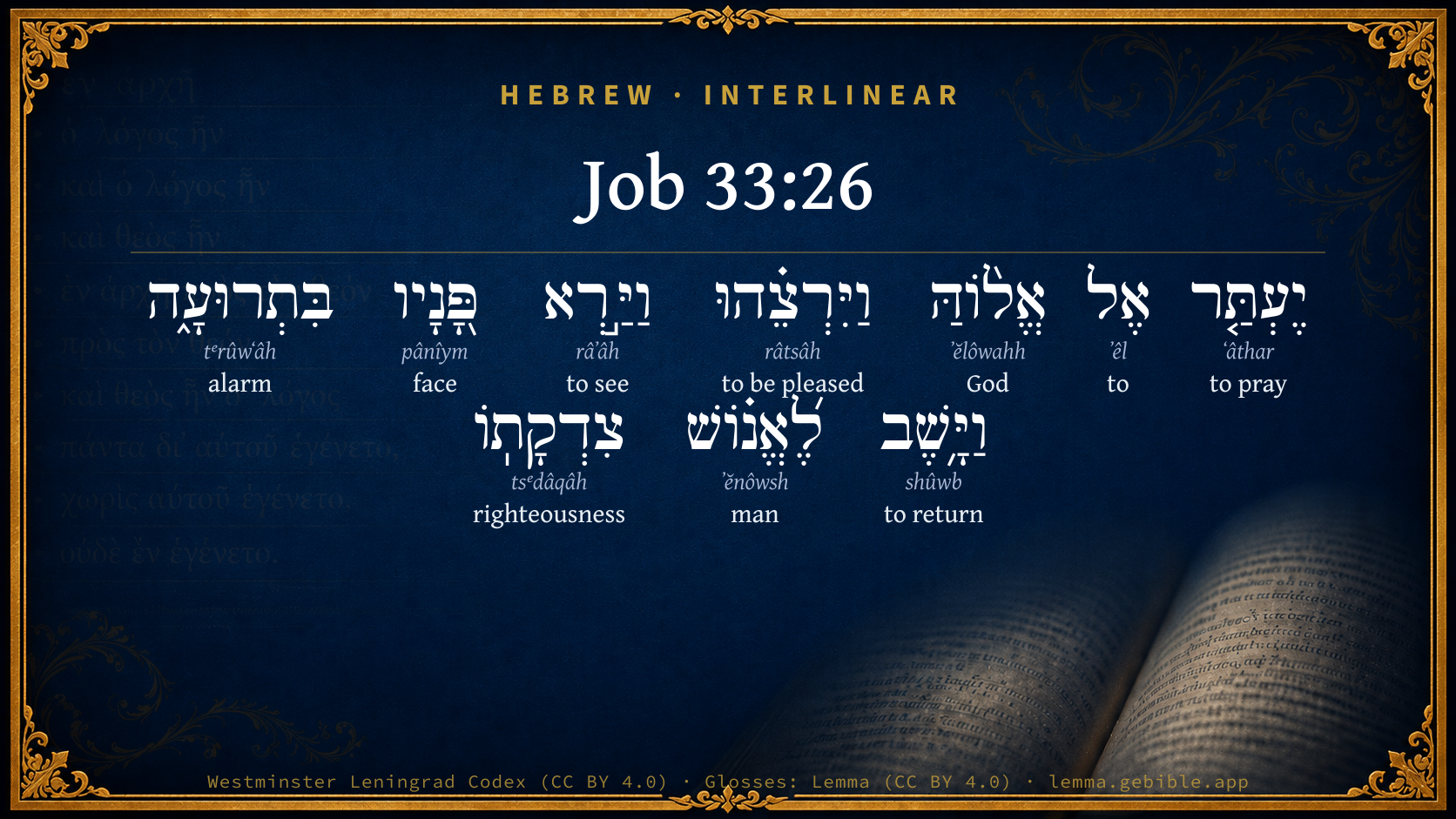
Hebrew (Westminster Leningrad Codex) Job 33:26 appears in the Hebrew Old Testament. The text above is from the Westminster Leningrad Codex. Each word links to its Strong’s number, a concise gloss, and parsing drawn from the Open Scriptures Hebrew Bible morphology. Click any word for its full Brown-Driver-Briggs (BDB) entry.
Download image
Cite this verse

Job 33:26 (World English Bible). Public Domain. Lemma interlinear Bible study tool, https://lemma.gebible.app/v/job/33/26.

Show BibTeX & RIS
BibTeX
RIS
English Translation
He prays to God, and he is favorable to him, So that he sees his face with joy: He restores to man his righteousness.
World English Bible · Public Domain
Download a study sheet

One document with this verse’s original text, its word-by-word gloss line, the meaning frame, cross-references with their text, attributed commentary, and full source and license credits — printable, and it pastes into notes with its structure intact.

This verse Autodidact and up

Study sheet (.html) Plain text (.txt)

A passage Seminary Student

Up to 50 verses in one chapter. A passage sheet keeps up to 6 commentary sources and 12 cross-references per verse, in the order this page ranks them, and says so on the sheet whenever that leaves anything out. Ask for a single verse and you get the Autodidact verse sheet above.

Everything on this page stays free to read, with no account — the sheet is a download of what is already on screen, not access to it.

Want to remove ads? Support Godless Engineer
Compare translations 3

The same verse in 3 English versions, stacked beneath the original-language interlinear above. Click any original word for its lexicon entry.

Each is an independent rendering of the whole verse — the interlinear is not word-aligned to these translations.

Highlighted words mark where these versions differ — a whole-verse word diff, not a word-by-word alignment.

  • World English Bible Public Domain
    He prays to God, and he is favorable to him, So that he sees his face with joy: He restores to man his righteousness.
  • King James Version Public Domain
    He shall pray unto God, and he will be favourable unto him: and he shall see his face with joy: for he will render unto man his righteousness.
  • unfoldingWord Literal Text CC BY-SA 4.0
    He will pray to God, and he will accept him, and he will see his face with joy, and he will restore to the man his righteousness.

unfoldingWord Literal Text — © unfoldingWord, licensed CC BY-SA 4.0. Word-aligned USFM3 via Door43 (git.door43.org/unfoldingWord/en_ult).

Versions to compare (up to 4)

3 of 4 selected

Show all 18 translations

Every available English version of this verse, each an independent rendering of the whole verse.

  • World English Bible Public Domain
    He prays to God, and he is favorable to him, So that he sees his face with joy: He restores to man his righteousness.
  • Berean Standard Bible Public Domain
    He prays to God and finds favor; he sees God’s face and shouts for joy, and God restores His righteousness to that man.
  • Majority Standard Bible Public Domain
    He prays to God and finds favor; he sees God’s face and shouts for joy, and God restores His righteousness to that man.
  • King James Version Public Domain
    He shall pray unto God, and he will be favourable unto him: and he shall see his face with joy: for he will render unto man his righteousness.
  • American Standard Version (1901) Public Domain
    He prayeth unto God, and he is favorable unto him, So that he seeth his face with joy: And he restoreth unto man his righteousness.
  • Revised Version (1885) Public Domain
    He prayeth unto God, and he is favourable unto him; so that he seeth his face with joy: and he restoreth unto man his righteousness.
  • Geneva Bible (1599) Public Domain
    He shall pray vnto God, and he will be fauourable vnto him, and he shall see his face with ioy: for he will render vnto man his righteousnes.
  • Douay-Rheims (1899) Public Domain
    He shall pray to God, and he will be gracious to him: and he shall see his face with joy, and he will render to man his justice.
  • Young's Literal Translation Public Domain
    He maketh supplication unto God, And He accepteth him. And he seeth His face with shouting, And He returneth to man His righteousness.
  • Literal Standard Version CC BY-SA 4.0
    He makes supplication to God, || And He accepts him. And he sees His face with shouting, || And He returns to man His righteousness.
  • Unlocked Literal Bible CC BY-SA 4.0
    He will pray to God, and God will be kind to him, so that he sees God's face with joy. God will give the person his triumph.
  • unfoldingWord Literal Text CC BY-SA 4.0
    He will pray to God, and he will accept him, and he will see his face with joy, and he will restore to the man his righteousness.
  • Darby Bible Public Domain
    He shall pray unto +God, and he will receive him with favour; and he shall see his face with shoutings, and he will render unto man his righteousness.
  • World Messianic Bible Public Domain
    He prays to God, and he is favorable to him, so that he sees his face with joy. He restores to man his righteousness.
  • Webster's Bible Public Domain
    He shall pray to God, and he will be favorable to him: and he shall see his face with joy: for he will render to man his righteousness.
  • Free Bible Version CC BY-SA 4.0
    They will pray to God, and he will accept them; they come into God's presence with joy, and he will set things right for them.
  • Bible in Basic English Public Domain
    He makes his prayer to God, and he has mercy on him; he sees God's face with cries of joy; he gives news of his righteousness to men;
  • JPS Tanakh (1917) Public Domain
    He prayeth unto God, and He is favourable unto him; so that he seeth His face with joy; and He restoreth unto man his righteousness.

Literal Standard Version (2020), Covenant Press — licensed CC BY-SA 4.0. Text via the HelloAO Bible API (eBible.org). Unlocked Literal Bible (unfoldingWord) — licensed CC BY-SA 4.0. Text via the HelloAO Bible API (eBible.org). unfoldingWord Literal Text — © unfoldingWord, licensed CC BY-SA 4.0. Word-aligned USFM3 via Door43 (git.door43.org/unfoldingWord/en_ult). Free Bible Version, Dr. Jonathan Gallagher — licensed CC BY-SA 4.0. Text via the HelloAO Bible API (eBible.org).

Word by word

More ways to search: Search by grammar → Find every occurrence → Compare this word →

Practice this passage: Drill this verse → Learn its vocabulary →

יֶעְתַּ֤ר
ʻâthar
H6279
“to pray”
Verb, Qal, Imperfect, 3rd Person, Masculine, Singular
Part of Speech
Verb
Stem
Qal
Form
Imperfect
Person
3rd Person
Gender
Masculine
Number
Singular
Full BDB Definition

Origin: a primitive root [rather denominative from H6281 ]

TWOT: 1722

to pray, entreat, supplicate - (Qal) to pray, entreat - (Niphal) to be supplicated, be entreated - (Hiphil) to make supplication, plead
  1. אֶל ʼêl H413 “to” Preposition
  2. אֱל֨וֹהַּ ʼĕlôwahh H433 “God” Noun, Common, Masculine, Singular, Absolute
  3. וַיִּרְצֵ֗הוּ râtsâh H7521 “and · to be pleased · him” Conjunction + Verb, Qal, Sequential Imperfect, 3rd Person, Masculine, Singular + Suffix, Personal, 3rd Person, Masculine, Singular
  4. וַיַּ֣רְא râʼâh H7200 “and · to see” Conjunction + Verb, Qal, Sequential Imperfect, 3rd Person, Masculine, Singular
  5. פָּ֭נָיו pânîym H6440 “face(s) · his” Noun, Common, Both, Plural, Construct + Suffix, Personal, 3rd Person, Masculine, Singular
  6. בִּתְרוּעָ֑ה tᵉrûwʻâh H8643 “in/at · alarm” Preposition + Noun, Common, Feminine, Singular, Absolute
  7. וַיָּ֥שֶׁב shûwb H7725 “and · to return” Conjunction + Verb, Hiphil, Sequential Imperfect, 3rd Person, Masculine, Singular
  8. לֶ֝אֱנ֗וֹשׁ ʼĕnôwsh H582 “to/for · man” Preposition + Noun, Common, Masculine, Singular, Absolute
  9. צִדְקָתֽוֹ tsᵉdâqâh H6666 “righteousness · his” Noun, Common, Feminine, Singular, Construct + Suffix, Personal, 3rd Person, Masculine, Singular

About this verse

These counts appear in no published source. They are computed here, from the morphology-tagged text and Lemma’s own curated glosses. What Lemma adds →

10
words
10
distinct lemmas
Wisdom
section

Notable vocabulary

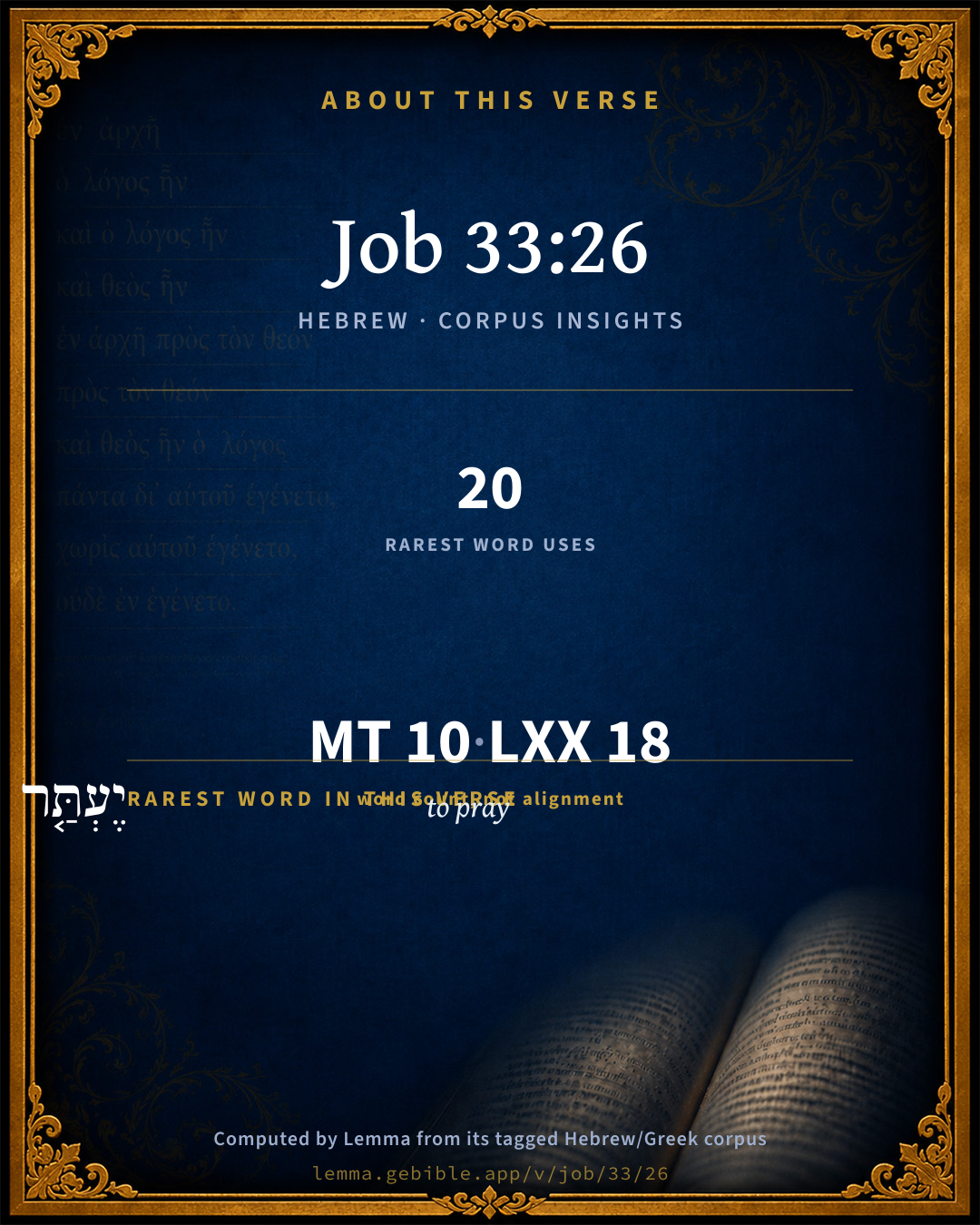
The rarest word here is יֶעְתַּ֤ר to pray H6279 — appearing just 20 times in the whole Hebrew Bible.

Shared distinctive vocabulary

יֶעְתַּ֤ר to pray H6279 occurs in 19 verses of the Hebrew Bible. Also found in:

Grammatical profile

  • 4 verbs
  • 5 nouns
  • 1 preposition

Verb forms

  • יֶעְתַּ֤ר Qal · Imperfect
  • וַיִּרְצֵ֗הוּ Qal · Sequential Imperfect
  • וַיַּ֣רְא Qal · Sequential Imperfect
  • וַיָּ֥שֶׁב Hiphil · Sequential Imperfect

Hebrew & Septuagint length

In English translation the verse runs 24 words from the Hebrew and 36 from the Septuagint (LXX English) — the Septuagint runs noticeably longer here. See the side-by-side →

A rough comparison of the two English renderings, which tokenize alike — not a word-level alignment.

Word counts can differ between the Hebrew and the Greek without any difference in meaning — e.g. the Hebrew direct-object marker אֵת has no separate Greek word, and Greek often adds the article ὁ.

In the original languages it is 10 Hebrew tokens and 18 Greek tokens — but the two are counted differently (Hebrew bundles its prefixes and suffixes into one token; the Greek is in lemma form), so that isn’t a like-for-like length.

Cross-references

32

Topical passages linked to Job 33:26 in the Treasury of Scripture Knowledge — connected by theme and wording, ordered by reader-vote popularity; previews shown in the World English Bible.

  • Psalms 50:15 Call on me in the day of trouble. I will deliver you, and you will honor me."
  • Psalms 30:5 For his anger is but for a moment; His favor is for a lifetime. Weeping may stay for the night, But joy comes in the morning.
  • Acts 2:28 You made known to me the ways of life. You will make me full of gladness with your presence.'
  • Acts 9:11 The Lord said to him, "Arise, and go to the street which is called Straight, and inquire in the house of Judas for one named Saul, a man of Tarsus. For behold, he is praying,
  • Isaiah 30:19 For the people shall dwell in Zion at Jerusalem; you shall weep no more; he will surely be gracious to you at the voice of your cry; when he shall hear, he will answer you.
  • Psalms 91:15 He will call on me, and I will answer him. I will be with him in trouble. I will deliver him, and honor him.
  • Jeremiah 33:3 Call to me, and I will answer you, and will show you great things, and difficult, which you don't know.
  • Hebrews 11:26 accounting the reproach of Christ greater riches than the treasures of Egypt; for he looked to the reward.
  • Jude 1:24 Now to him who is able to keep them from stumbling, and to present you faultless before the presence of his glory in great joy,
  • Numbers 6:25–26 Yahweh make his face to shine on you, And be gracious to you.
  • 1 Samuel 26:23 Yahweh will render to every man his righteousness and his faithfulness; because Yahweh delivered you into my hand today, and I wouldn't put forth my hand against Yahweh's anointed.
  • 2 Kings 20:2–5 Then he turned his face to the wall, and prayed to Yahweh, saying,
  • Psalms 67:1 May God be merciful to us, bless us, And cause his face to shine on us. Selah.
  • Psalms 116:1–6 I love Yahweh, because he listens to my voice, And my cries for mercy.
  • Proverbs 24:12 If you say, "Behold, we didn't know this;" Doesn't he who weighs the hearts consider it? He who keeps your soul, doesn't he know it? Shall he not render to every man according to his work?
  • Jonah 2:2–7 He said, "I called because of my affliction to Yahweh. He answered me. Out of the belly of Sheol I cried. You heard my voice.
  • Matthew 10:41–42 He who receives a prophet in the name of a prophet will receive a prophet's reward: and he who receives a righteous man in the name of a righteous man will receive a righteous man's reward.
  • 2 Chronicles 33:12–13 When he was in distress, he begged Yahweh his God, and humbled himself greatly before the God of his fathers.
  • 2 Chronicles 33:19 His prayer also, and how [God] was entreated of him, and all his sin and his trespass, and the places in which he built high places, and set up the Asherim and the engraved images, before he humbled himself: behold, they are written in the history of Hozai.
  • Job 22:26–27 For then shall you delight yourself in the Almighty, And shall lift up your face to God.
  • Job 34:11 For the work of a man will he render to him, And cause every man to find according to his ways.
  • Job 34:28 So that they caused the cry of the poor to come to him, He heard the cry of the afflicted.
  • Job 42:8–9 Now therefore, take to yourselves seven bulls and seven rams, and go to my servant Job, and offer up for yourselves a burnt offering; and my servant Job shall pray for you, for I will accept him, that I not deal with you according to your folly. For you have not spoken of me the thing that is right, as my servant Job has."
  • Psalms 4:6–7 Many say, "Who will show us any good?" Yahweh, let the light of your face shine on us.
  • Psalms 6:1–9 Yahweh, don't rebuke me in your anger, Neither discipline me in your wrath.
  • Psalms 16:11 You will show me the path of life. In your presence is fullness of joy. In your right hand there are pleasures forevermore.
  • Psalms 18:20 Yahweh has rewarded me according to my righteousness. According to the cleanness of my hands has he recompensed me.
  • Psalms 28:1–2 To you, Yahweh, I call. My rock, don't be deaf to me; Lest, if you are silent to me, I would become like those who go down into the pit.
  • Psalms 28:6 Blessed be Yahweh, Because he has heard the voice of my petitions.
  • Psalms 30:7–11 You, Yahweh, when you favored me, made my mountain to stand strong. But when you hid your face, I was troubled.
  • Psalms 41:8–11 "An evil disease," they say, "has afflicted him. Now that he lies he shall rise up no more."
  • Psalms 62:12 Also to you, Lord, belongs loving kindness, For you reward every man according to his work.

Cross-references courtesy of OpenBible.info (CC BY 4.0).

Hebrew and Greek witnesses Masoretic Hebrew ↔ Greek Septuagint

The same verse in the two great witnesses to the Old Testament, shown verse-for-verse.

Here the Septuagint runs noticeably longer than the Hebrew — LXX2012 (modern English Septuagint) 36 words vs World English Bible 24. A rough length comparison of the two English translations, not a word-level alignment — read both below.

These are two independent witnesses, not word-aligned to each other, and the Septuagint is shown in lemma (dictionary) form.

Hebrew Job 33:26 Masoretic · Westminster Leningrad Codex

יֶעְתַּ֤ר אֶל אֱל֨וֹהַּ וַיִּרְצֵ֗הוּ וַיַּ֣רְא פָּ֭נָיו בִּתְרוּעָ֑ה וַיָּ֥שֶׁב לֶ֝אֱנ֗וֹשׁ צִדְקָתֽוֹ

He prays to God, and he is favorable to him, So that he sees his face with joy: He restores to man his righteousness.

World English Bible · Public Domain

Greek LXX Job 33:26 Septuagint · lemma form

εὔχομαι δέ πρός κύριος καί δεκτός αὐτός εἰμί εἰςἔρχομαι δέ πρόσωπον καθαρός σύν ἐξηγορία ἀποδίδωμι δέ ἄνθρωπος δικαιοσύνη

And he shall pray to the Lord, and his prayer shall be accepted of him; he shall enter with a cheerful countenance, with a full expression of praise: for he will render to men their due.

LXX2012 (modern English Septuagint) · Public Domain

Hebrew: Westminster Leningrad Codex (CC BY 4.0). Greek: Septuagint (public domain); English from LXX2012 (modern English Septuagint) (Public Domain). How the Septuagint differs from the Hebrew →

Commentary

Notes on Job 33:26 from classic Christian and Jewish commentators (each source and its license shown beneath its notes). The classic Christian expositions comment on the surrounding passage and are grouped to its opening verse, so a note may address several verses; the Jewish commentaries on the Tanakh (Rashi and others) are per-verse, so they appear only where the commentator wrote on this verse.

Lemma curates 59 commentaries, every one of them public domain or Creative Commons licensed, each selected and text-cleaned for this edition rather than reprinted as found. About our sources →

Trapp's Complete Commentary

John Trapp

Job 33:26 He shall pray unto God, and he will be favourable unto him: and he shall see his face with joy: for he will render unto man his righteousness.

Ver. 26. He shall pray unto God, and he will be favourable unto him] All former unkindnesses notwithstanding. God will cast his sins into the bottom of the sea, and be as propitious to the poor sinner now reconciled, recovered, and making request, as if he had never been offended by him. Amongst men, Reconciliationes sunt vulpinae amicitiae, Reconciliations are for the most part fox like friendships; and there is little trust to them. Not so between God and men; witness Peter, of whom Christ thought no whit the worse for his threefold denial of him, when once he wept bitterly, and prayed for pardon. Go, tell the disciples and Peter, that I am risen, Mar 16:7. If any man want wisdom, or any other good thing else, let him ask it of God, who giveth unto all men liberally, and hitteth no man in the teeth, either with his present weaknesses or by past wickednesses, Jas 2:5. Imo plus est propemodum a vitiis se revocasse, quam vitia ipsa nescivisse, saith a Father. Penitence is in a manner as good as innocence (Ambros. in Psa.).

He shall see his face with joy] Or, God shall make him to see his face with joy, Ostendet ei faciem suam in iubilo, even with joyful acclamation, when he shall find himself possessed of God’s kingdom, which consisteth in righteousness and peace, and joy in the Holy Ghost; which Chrysostom rightly calleth ουρανον προ ουρανου, heaven beforehand.

For he will render unto man his righteousness] Which he had lost by falling into sin, as Eze 18:24. Understand it of degrees and measures for true grace cannot wholly be lost. Or, he will render unto him now in Christ that righteousness he lost in Adam, he will fully and freely justify him, and sweetly seal him up to the day of redemption, Rursus eum in album iustorum et plorum referet (Lav.); the former falling out shall be but a renewing of love; as it was between Christ and his spouse, Son 5:1-16; Son 6:1-13

John Trapp, A Commentary or Exposition upon All the Books of the Old and New Testament (1647–1656) — public domain. Text from a community e-Sword module.

Tyndale Open Study Notes

Tyndale Open Resources

33:26 God will receive him with joy: Cp. Num 6:24-26; Ps 67:1; Acts 2:28; Jude 1:24.

Tyndale Open Study Notes — © Tyndale Open Resources, licensed CC BY-SA 4.0. Text via the HelloAO Bible API.

Geneva Bible (1599)

Geneva Bible translators

God will forgive his sins, and accept him as just.

Geneva Bible (1599) marginal notes — public domain. Text via Bolls.life.

Jamieson, Fausset & Brown

Robert Jamieson, A. R. Fausset & David Brown

Job shall no longer pray to God, as he complains, in vain (Job 23:3, Job 23:8-9). True especially to the redeemed in Jesus Christ (Joh 16:23-27).

he--Job.

shall see his face--or, God shall make Job to see His face [MAURER]. God shall no longer "hide His face" (Job 13:24). True to the believer now (Joh 14:21-22); eternally (Psa 17:15; Joh 17:24).

his--God's

righteousness--God will again make the restored Job no longer ("I perverted . . . right," Job 33:27) doubt God's justice, but to justify Him in His dealings. The penitent justifies God (Psa 51:4). So the believer is made to see God's righteousness in Jesus Christ (Isa 45:24; Isa 46:13).

Jamieson, Fausset & Brown — Commentary Critical and Explanatory on the Whole Bible (1871) — public domain (CC PDM 1.0). Text via the HelloAO Bible API.

Adam Clarke's Commentary

Verse 26. He shall pray unto God] Being now adopted into the heavenly family, and become a new creature, he shall have the spirit of prayer, which is indeed the very breath and language of the new or spiritual life.

He will be favourable unto him] He shall manifest his good will to him; he shall live under the influences of Divine grace.

He shall see his face with joy] He shall know that God is reconciled to him; and this shall fill him with joy, בתרועה bithruah, with exultation: for, "being justified by faith, he has peace with God, through our Lord Jesus Christ, by whom he has received the atonement; and REJOICES in the hope of the glory of God."

He will render unto man his righteousness.] So good and gracious is the Lord, that by his grace he will enable this convert to live to his glory, to bring forth all the fruits of the Spirit, and then reward him for the work, as if it were done by his own might.

Adam Clarke's Commentary on the Bible (1810–1826) — public domain. Text from a community e-Sword/MySword module.

Ellicott's Commentary for English Readers

(26) He will be favourable unto him.—Very beautiful is this description of the restoration of the penitent sinner and his recovery from sickness. He shall thankfully resort unto the house of God with joy, for that He has rewarded him according to his righteousness, which was the fruit of faith (Gen_15:6; Psa_32:1-2).

A Bible Commentary for English Readers, edited by Charles John Ellicott (1878–1897) — public domain. Text from a community e-Sword module.

The Cambridge Bible for Schools and Colleges

gen. ed. J. J. S. Perowne

26. His restoration to the fellowship of God with its joy.

for he will render] Rather, and he restoreth unto man his righteousness. God restores to him his righteous standing before Him with its joys, regards him again as righteous, and admits him to all the blessings of righteousness. The clause generalizes the ideas of the rest of the verse.

The Cambridge Bible for Schools and Colleges (gen. ed. J. J. S. Perowne; Cambridge University Press, 1878–1918) — public domain. Text from a community e-Sword module.

John Gill's Exposition

He shall pray unto God,.... As the former verse expresses the condition of the body of the man recovered from sickness, this the frame of his soul, and the spiritual blessings enjoyed by him: some understand this of his praying in the time of his affliction, and consider it as one means of his recovery; and indeed a time of affliction is a time for prayer; and which brings a good man to it, who in health and prosperity has been negligent of it; such an one will make his application to God for deliverance, and not to the creature; and it is his mercy and privilege he has a God to pray unto, who can and will help him. But according to the course and connection of the words, it seems rather to respect what the good man would do, and the frame he would be in upon his recovery; who would entreat the Lord to make him thankful the mercy received, and accept of his thanksgiving for the same; that his affliction might appear to be sanctified unto him, and that he is much the better for it, more holy and more humble; and that he would manifest his pardoning grace to him for all the sins and transgressions he had been guilty of, his murmurings and repinings, and everything else during his affliction; and that he may make use of his health and strength given him in the service of God, and for the glory of his name;

and he will be favourable to him; which, if understood of the time of affliction, it may be interpreted of his laying no more on him than he will enable him to bear, and supporting him under it; of granting his gracious presence in it, and of his taking notice of him, visiting him, knowing, owning, and choosing him in the furnace of affliction, and manifesting his care unto him; and of the deliverance of him out of it. But if it respects the man as recovered out of affliction, it denotes further discoveries of the special care and favour of God to him, which are very enlivening and refreshing, strengthening and supporting; and of his gracious acceptance of his person, and of his sacrifices of prayer, praise, and thanksgiving, through Christ the Mediator and messenger of the covenant;

and he shall see his face with joy: that is, either God who is favourable to him, he looks with a smiling countenance upon the man now recovered, who before seemed to look upon him with frowns in his countenance, there being a change in the outward dispensations of his providence towards him, though none in his heart: his countenance beholds the upright with pleasure, whether they see it or not; he looks upon his people in Christ with the utmost complacency and delight, and particularly when they come to him in the exercise of grace, with their prayers, praises, and thanksgivings. Or the man recovered from illness, God being favourable to him, he beholds the face of God with joy, who perhaps had hid it from him in his affliction, which caused trouble; but now showing his face and favour, it causes joy and exultation, even a jubilee in his soul. He beholds him in Christ as the God of grace and peace; and through him can come to him, and look him in the face with comfort and pleasure, as nothing is more delightful to him than the light of his countenance;

for he will render unto man his righteousness: not the sick man recovered render to another man what is his right and due, or what he may have wronged him of; for which being reproved by the affliction, and convicted of, is desirous of making restitution: but God, who will render, return, or restore to the man recovered his righteousness, which is the foundation of his joy; not render to him according to his own righteousness, as the Targum, which would be but a poor recompense if strictly given; nor restore to him the righteousness he lost in Adam, which is but a creature righteousness; but the righteousness of Christ, as Mr. Broughton, which is the good man's or the believer's in Christ, because wrought out for him, imputed to him, and bestowed as a free gift on him. Now though this righteousness can never be lost, being an everlasting one, yet a sense of interest in it may, which is returned, restored, and rendered to a man, when that righteousness is afresh revealed to him from faith to faith; the consequence of which is peace and comfort, joy and triumph.

John Gill's Exposition of the Whole Bible (1746–1763) — public domain (CC PDM 1.0). Text via the HelloAO Bible API.

Albert Barnes' Notes on the Bible

He shall pray unto God ... - That is, when he fully understands the design of affliction; and when his mind is brought to a proper state of penitence for his past conduct, then he will find God merciful and ready to show him kindness.

And he shall see his face with joy - The face of God. That is, he shall be able to look up to him with peace and comfort. This language is similar to that which is so frequently employed in the Scriptures, in which God is said to lift upon us the light of his countenance. The meaning here is, that the afflicted man would be again permitted to look by faith on God, being reconciled to him, and would see in his face no indication of displeasure.

For he will render unto man his righteousness - He will deal with him in justice and equity. When he sees evidence of penitence, he will treat him accordingly; and if in the afflicted man he discerns true piety, he will regard and treat him as his friend. The meaning is, that if there is in the sufferer any sincere love to God, he will not be indifferent to it, but will treat him as possessing it. This is still true, and universally true. If there is in the heart of one who is afflicted any real piety, God will not treat him as an impenitent sinner, but will manifest his mercy to him, and show to him the favors which he confers only on his friends.

Albert Barnes' Notes on the Bible (1834–1885) — public domain. Text from a community e-Sword/MySword module.

Haydock's Catholic Bible Commentary

And he. It is ambiguous whether this refer to God or to man. (Calmet) --- But both shall see each other with joy. The penitent will be restored to as much favour as if he had never sinned. (Haydock)

George Leo Haydock (1774–1849), Haydock's Catholic Family Bible and Commentary, 1859 edition — public domain. Excludes Psalms (Douay-Rheims chapter numbering differs from Protestant) and Deuterocanonical books (Catholic canon only).

Matthew Poole's English Annotations

He; either,

1. The messenger; or rather,

2. The sick man.

Shall pray unto God; being engaged and encouraged to do so, either by the aforesaid gracious message, or by his miraculous recovery through God’s goodness.

He will be favourable unto him, in hearing and answering his prayers, which before he seemed to neglect.

He shall see his face with joy; either,

1. God will look upon the man with a smiling or well-pleased countenance; whereas before he either hid his face from him, or frowned upon him. Or,

2. The man shall then be imboldened and encouraged to look God in the face with comfort and joy; which before he was, not without cause, afraid to do; but now he shall find that God is reconciled to him by the blessed effects of it, both in his body and in his conscience.

His righteousness, i.e. according to his righteousness, or the fruit of his righteousness; as on the contrary, iniquity is oft put for the punishment of iniquity. The sense is, he will deal with him as with one reconciled to him through the Mediator, and sincerely repenting of and turning from his former sins unto the serious practice of righteousness and true holiness, and therefore must needs be favourable to him, as he hath declared and engaged himself to be in such cases.

Matthew Poole's English Annotations on the Holy Bible (1683–1685) — public domain. Text from a community e-Sword/MySword module.

Whedon's Commentary on the Bible

Daniel D. Whedon

26. Pray unto God — Referring to habitual prayer after pardon. “In this description of the renovation which the man experiences, it is everywhere assumed that he has taken the right way announced to him by the mediating angel.” — Delitzsch.

Joy — Shouts of joy. (Furst.) The experience of the redeemed man is of the most joyous description. He beholds God’s face reconciled.

His righteousness — St. Gregory’s comment is exceedingly happy: “It is called our righteousness, not because it is ours from ourselves, but because it is made ours from the divine bounty, as we say in the Lord’s prayer, ‘Give us this day our daily bread.’ See; we both call it ours and yet pray for it to be given us. For it becomes ours when we receive it; but yet it is God’s, who gives it.”

Daniel D. Whedon (gen. ed.), Commentary on the Old and New Testaments (1874–1909) — public domain. Text from a community e-Sword module.

The Pulpit Commentary

He shall pray unto God, and he (i.e. God) will be favourable unto him, Being restored to God"s favour, he will once more be able to address him in "effectual fervent prayer," and obtain whatever he desires of him. And he shall see his face with joy. God"s face shall no longer be a terror to him, but he shall look upon it with joy and gladness. For he (i.e. God), will render unto man his righteousness. That is, will both account and make him righteous both justify and sanctify him.

The Pulpit Commentary (1880–1919), ed. H.D.M. Spence-Jones & Joseph S. Exell — public domain. Text from a community e-Sword module.

John Wesley's Explanatory Notes

Render - He will deal with him as with one reconciled to him through the mediator, and turning from sin to righteousness.

John Wesley, Explanatory Notes Upon the Whole Bible (1754–1765) — public domain. Text via the GEBible commentary corpus.

Lesson kit

Teaching starters — assembled from the data on this page, not authored interpretation. Every prompt links to the verse data it draws on. Edit before teaching.

Job, in the Wisdom, opens this verse with 10 words (10 distinct Hebrew lemmas). Its most distinctive word is ʻâthar (“to pray”). The Greek Septuagint runs longer here. A historical commentator’s framing appears above. Read the whole chapter for the surrounding context.

Discussion questions

  1. The word ʻâthar carries the sense “to pray.” How does it shape the verse?
  2. How does Genesis 25:21, which shares the word «to pray», read alongside this verse?
  3. The Septuagint runs longer here than the Hebrew. What might account for the difference?
  4. These translations render this verse differently. What is at stake in choosing one wording over another?
  5. «יֶעְתַּ֤ר» is a Qal Imperfect verb. How does that grammatical form shape the action described?
  6. Compare how Trapp's Complete Commentary and Tyndale Open Study Notes read this verse. Where do they agree or differ?

Things to notice

Reading settings

Reading text

Shown beneath each verse's original-language words.

Old Testament
Old Testament edition

Read the OT as the Masoretic Hebrew (MT) or the Greek Septuagint (LXX).

English shown for the Greek Septuagint (in the Hebrew ↔ Greek comparison).

Comparing translations? Open the Compare panel on any verse page to stack up to four side by side.