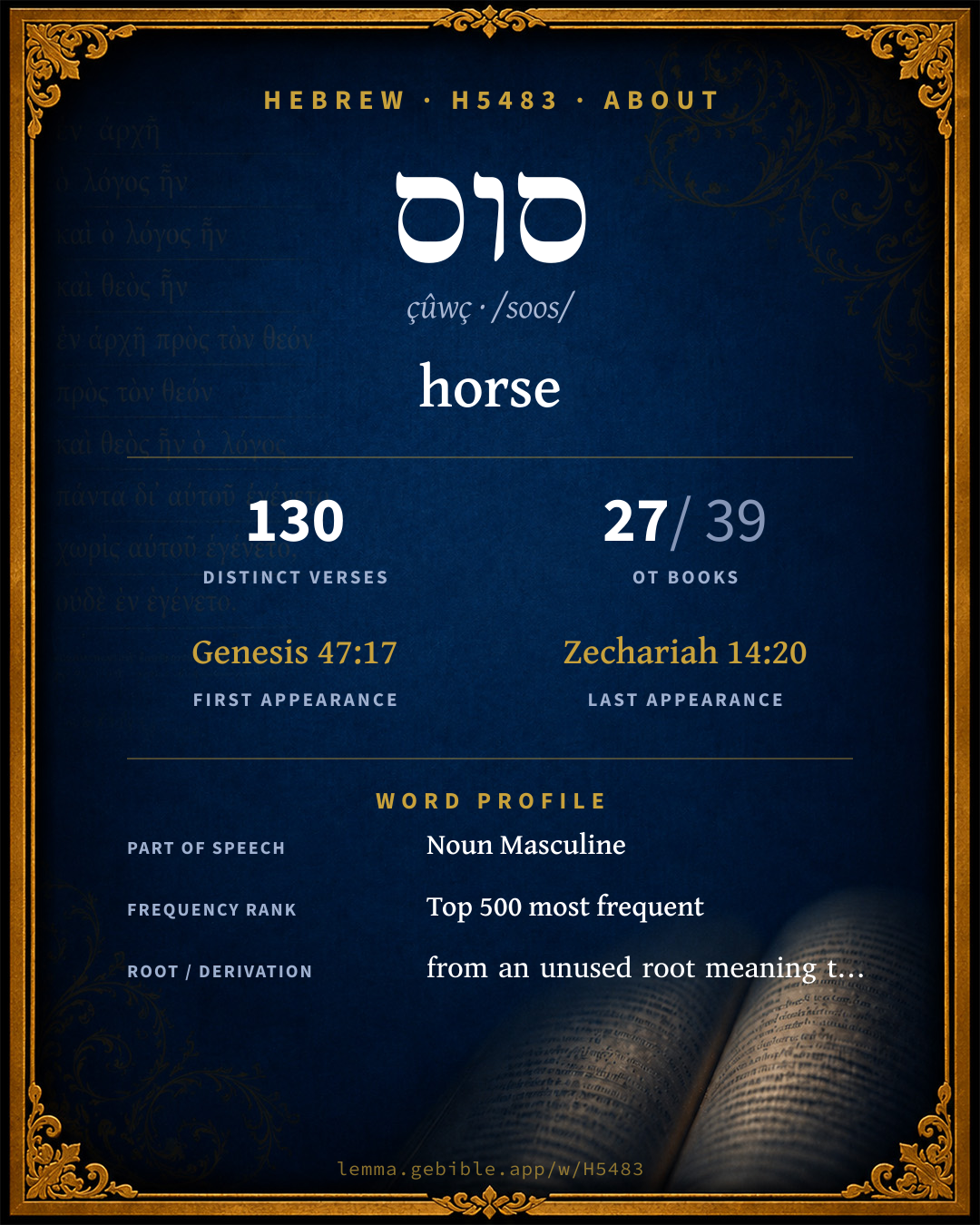
סוּס
horse
‘horse’ is one of 2 main senses fuller range ↓
Full lexicon entry — Brown-Driver-Briggs (BDB)
From Brown-Driver-Briggs (BDB)
Where this word appears
See every Absolute-state word in the Hebrew Bible →
Grammar key — what these labels mean
Part of speech
- Noun
- A naming word — a person, place, thing, or idea.
Noun type
- Common
- A common noun — a general class of person, place, or thing (“king,” “city,” “water”), not a specific name.
State
- Absolute
- The independent form of a noun, not bound to a following word.
- Construct
- A noun bound to a following noun in a possessive / “of” relationship (the construct chain).
Gender
- Masculine
- Grammatically masculine.
Number
- Plural
- More than one (in Hebrew, generally three or more).
- Singular
- One.
Every verse where H5483 appears in the Book of 2 Kings — 19 distinct verses. Click any verse to open its interlinear word-by-word view. Verse text shown in the World English Bible for context — . Each verse’s Hebrew form is shown with its reference; the English is not keyword-highlighted, since the data carries no word-level English alignment. Use “Compare translations” on any verse to read it across multiple English versions. This concordance covers the Hebrew Bible; Septuagint (Greek Old Testament) occurrences are not indexed here.
2 Kings
- 2 Kings 2:11 וְ/ס֣וּסֵי conj + n c mp cs It happened, as they still went on, and talked, that behold, [there appeared] a chariot of fire, and horses of fire, which parted them both apart; and Elijah went up by a whirlwind into heaven.
- 2 Kings 3:7 כְּ/סוּסַ֥/י כְּ/סוּסֶֽי/ךָ prep + n c mp cs + sfx pers 1cs prep + n c mp cs + sfx pers 2ms He went and sent to Jehoshaphat the king of Judah, saying, The king of Moab has rebelled against me: will you go with me against Moab to battle? He said, I will go up: I am as you are, my people as your people, my horses as your horses.
- 2 Kings 5:9 ב/סוס/ו בְּ/סוּסָ֣י/ו prep + n c mp cs + sfx pers 3ms prep + n c mp cs + sfx pers 3ms So Naaman came with his horses and with his chariots, and stood at the door of the house of Elisha.
- 2 Kings 6:14 סוּסִ֥ים n c mp Therefore sent he there horses, and chariots, and a great host: and they came by night, and surrounded the city.
- 2 Kings 6:15 וְ/ס֣וּס conj + n c ms When the servant of the man of God was risen early, and gone forth, behold, a host with horses and chariots was round about the city. His servant said to him, Alas, my master! how shall we do?
- 2 Kings 6:17 סוּסִ֥ים n c mp Elisha prayed, and said, Yahweh, Please open his eyes, that he may see. Yahweh opened the eyes of the young man; and he saw: and, behold, the mountain was full of horses and chariots of fire round about Elisha.
- 2 Kings 7:6 ס֔וּס n c ms For the Lord had made the host of the Syrians to hear a noise of chariots, and a noise of horses, even the noise of a great host: and they said one to another, Behold, the king of Israel has hired against us the kings of the Hittites, and the kings of the Egyptians, to come on us.
- 2 Kings 7:7 סֽוּסֵי/הֶם֙ n c mp cs + sfx pers 3mp Therefore they arose and fled in the twilight, and left their tents, and their horses, and their donkeys, even the camp as it was, and fled for their life.
- 2 Kings 7:10 הַ/סּ֤וּס ptcl def.art + n c ms So they came and called to the porter of the city; and they told them, saying, We came to the camp of the Syrians, and, behold, there was no man there, neither voice of man, but the horses tied, and the donkeys tied, and the tents as they were.
- 2 Kings 7:13 הַ/סּוּסִים֮ ptcl def.art + n c mp One of his servants answered, Please let some take five of the horses that remain, which are left in the city (behold, they are as all the multitude of Israel who are left in it; behold, they are as all the multitude of Israel who are consumed); and let us send and see.
- 2 Kings 7:14 סוּסִ֑ים n c mp They took therefore two chariots with horses; and the king sent after the host of the Syrians, saying, Go and see.
- 2 Kings 9:18 הַ/סּ֜וּס ptcl def.art + n c ms So there went one on horseback to meet him, and said, Thus says the king, Is it peace? Jehu said, What have you to do with peace? turn you behind me. The watchman told, saying, The messenger came to them, but he isn't coming back.
- 2 Kings 9:19 סוּס֮ n c ms Then he sent out a second on horseback, who came to them, and said, Thus says the king, Is it peace? Jehu answered, What have you to do with peace? turn you behind me.
- 2 Kings 9:33 הַ/סּוּסִ֖ים ptcl def.art + n c mp He said, Throw her down. So they threw her down; and some of her blood was sprinkled on the wall, and on the horses: and he trod her under foot.
- 2 Kings 10:2 וְ/הַ/סּוּסִ֔ים conj + ptcl def.art + n c mp Now as soon as this letter comes to you, seeing your master's sons are with you, and there are with you chariots and horses, a fortified city also, and armor;
- 2 Kings 11:16 הַ/סּוּסִ֖ים ptcl def.art + n c mp So they made way for her; and she went by the way of the horses' entry to the king's house: and there was she slain.
- 2 Kings 14:20 הַ/סּוּסִ֑ים ptcl def.art + n c mp They brought him on horses; and he was buried at Jerusalem with his fathers in the city of David.
- 2 Kings 18:23 סוּסִ֔ים n c mp Now therefore, Please give pledges to my master the king of Assyria, and I will give you two thousand horses, if you are able on your part to set riders on them.
- 2 Kings 23:11 הַ/סּוּסִ֗ים ptcl def.art + n c mp He took away the horses that the kings of Judah had given to the sun, at the entrance of the house of Yahweh, by the chamber of Nathan-melech the chamberlain, which was in the precincts; and he burned the chariots of the sun with fire.
About this entry
At a glance — auto-summarized from this page’s data, not written by a person. Every figure links to its source below. This summary describes the numbers; it doesn’t interpret them.
At its core, סוס (çûwç) means “horse.” Scripture first uses it in Genesis 47:17. It turns up in 130 verses across 27 books, a common footprint. Carrying more than one sense, it rewards its full sense range. It shares a root with סוסה, סס and סוסי. Dig into 130-verse concordance and the renderings breakdown below.
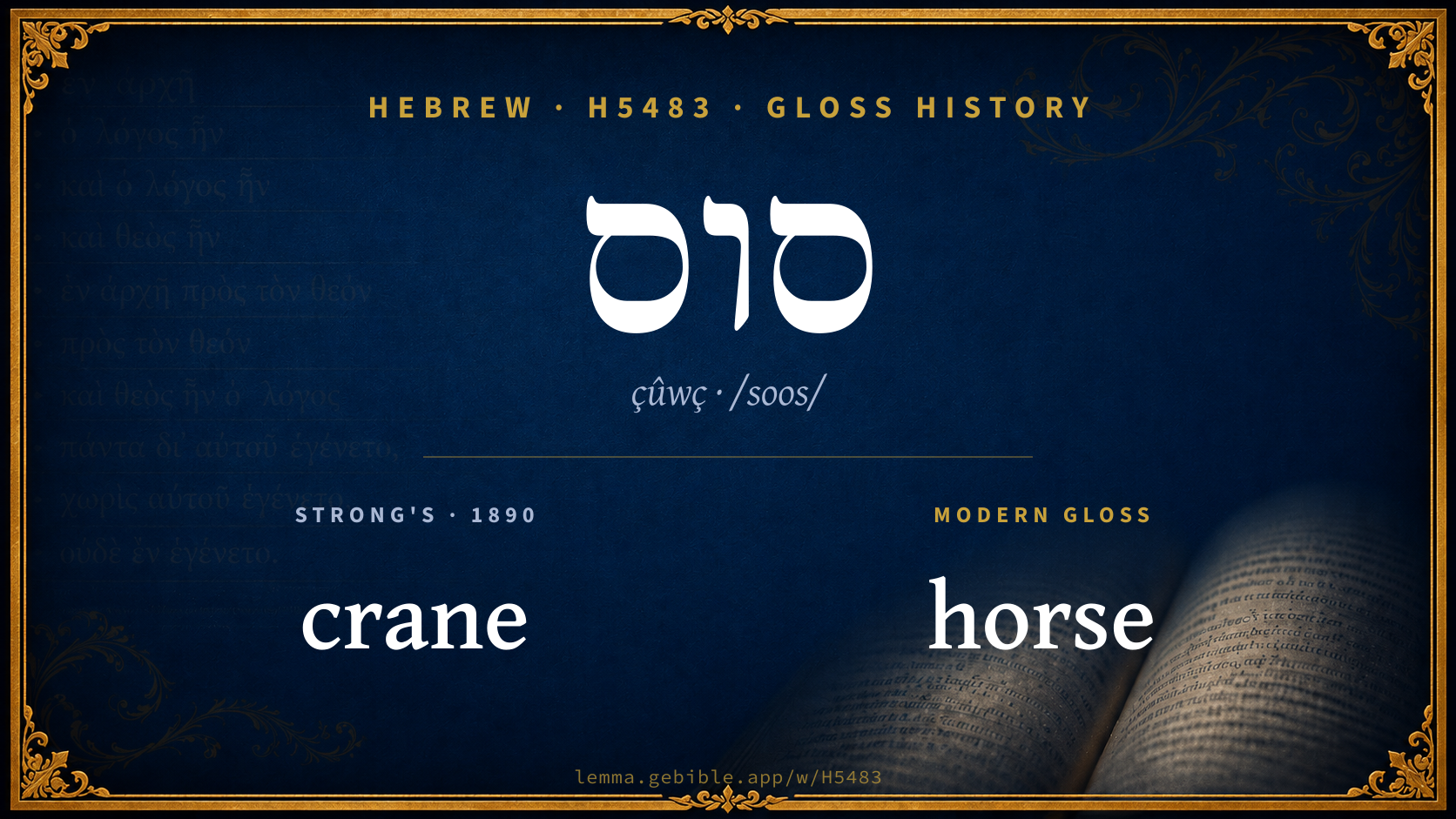
Gloss history
Strong's 1890 vs modern scholarship
About this word
Strong's H5483 catalogs a Hebrew word from the Hebrew Old Testament.
These counts are not copied from any lexicon or concordance. They are computed here, from the morphology-tagged Hebrew Old Testament. What Lemma adds →
- 130
- distinct verses
- The word appears in 130 distinct verses.
- 27 / 39
- OT books
- The word appears in 27 of 39 Old Testament books.
- #318
- by frequency
- Top 500 most frequent Hebrew words (rank 318 of 8,640 Hebrew words by occurrence).
View all 130 occurrences in the concordance →
By section of the Old Testament
By traditional corpus
Conventional, traditional groupings — biblical authorship is debated, so this is a traditional corpus grouping, not an authorship claim. Each share is this word’s portion of its verses in that division of the Hebrew canon. Each figure is a share of the word’s 130 distinct verses.
- Prophets (Nevi'im) 95 verses · 73%
- Writings (Ketuvim) 24 verses · 18%
- Torah (Pentateuch) 11 verses · 8%
How translations render this word
Counts come from each version’s own published word-to-Strong’s tagging or interlinear alignment — an approximate guide to how each version renders this word, not a word-level alignment the data otherwise carries. Because each total is that version’s own tagged count, the per-version totals vary from one another and need not match the appearance or distinct-verse counts above. These counts may also differ from a printed concordance because Lemma counts each distinctly tagged rendering and does not collapse phrase taggings into a single head-word total. This is a fixed set of word-tagged versions (KJV, ASV, BSB, ULT) and does not change with the reading translation you choose elsewhere. Each version’s license is shown beside its name below (and on Sources).
BDB lists this Strong’s number as 3 distinct words (homographs). Each count above pools all of them and is not split by sense — see the Senses section below. A low-frequency rendering may belong to a different one of those words, not the primary meaning.
- King James Version†: Horses 86×, Horse 31×, Every horse 2×
- American Standard Version†: Horses 76×, Horse 29×, All of them riding upon horses 2×
- Berean Standard Bible†: Horses 90×, Horse 25×, Horseback 2×
- unfoldingWord Literal Text†: Horses 74×, Horse 38×, Were 4×
King James Version Public Domain
Renders H5483 across 137† tagged occurrences — most commonly:
Plus 14 renderings that appear only once — usually multi-word phrases or single function words the recovered tagging swept in, not distinct renderings. Not rendered by a distinct English word in 3 further occurrences.
American Standard Version Public Domain
Renders H5483 across 137† tagged occurrences — most commonly:
Plus 24 renderings that appear only once — usually multi-word phrases or single function words the recovered tagging swept in, not distinct renderings.
Berean Standard Bible Public Domain
Renders H5483 across 135† tagged occurrences — most commonly:
Plus 12 renderings that appear only once — usually multi-word phrases or single function words the recovered tagging swept in, not distinct renderings. Not rendered by a distinct English word in 4 further occurrences.
unfoldingWord Literal Text CC BY-SA 4.0
Renders H5483 across 143† tagged occurrences — most commonly:
Plus 17 renderings that appear only once — usually multi-word phrases or single function words the recovered tagging swept in, not distinct renderings.
Senses in the full BDB
What do BDB’s symbols mean?
BDB uses these scholarly abbreviations:
| Symbol | Meaning |
|---|---|
| 𝔊 | the Septuagint (the ancient Greek translation, LXX) |
| 𝔙 | the Vulgate (the Latin translation) |
| 𝔖 | the Syriac version (the Peshitta) |
| 𝔗 | the Targum (the Aramaic translation) |
| ψ | the Psalms |
| √ | root (the underlying root or stem) |
| ‖ | parallel passage (a synonymous or contrasted parallel) |
| † | the dagger: every passage where the word occurs is cited |
The 3 senses and sub-senses the full Brown-Driver-Briggs lexicon distinguishes for this word, in lexicon order (not ranked by frequency), with BDB’s own verbatim wording and sub-sense lettering. Shown in Hebrew script with BDB’s own scholarly abbreviations. The condensed entry is in the Lexicon Entry tab. See also the Forms in the corpus table below.
סוס I [m.] swallow or swift (cypselus, TristrFFP 82 ff.) (𝔗 סוּסְיָא Is 38
סוס II
- 1. non-Isr.; chariot-horses of Canaanites Ju 5:22 (cf. v 28 4:3, 13; עִקְבֵי ס׳; ס׳ coll., as often), Jos 11:4, 6, 9 (JE); horses as property of Egyptians Gn 47:17; Ex 9:3 (both J), cf. Zc 14:15; merchandise of Tyre Ez 27:14; chariot-horses of Egypt [cf. Hom Il. ix. 384], Ex 14:9, 23 (P), 15:1, 21 (poem), v 19 (P; on all v. Di), Dt 11:4; Is 31:1, 3; Je 46:4, 9; Ez 17:15; of Aram 1 K 20:1 + 11 times K (1 K 20:20 ridden, for flight), Assyr. Is 5:28 + 3 times, Chaldeans Je 4:13 + 6 times; other nations Na 3:2; Je 50:42 + 5 times; as ridden 1 K 20:20 (v. supr.), Je 8:23; Ez 38:4, 15 + 13 times (late). e.g. Judges 5:22
- 2. in Isr.; chariot-horses of Absalom 2 S 15:1, especially of Sol., and later, 1 K 5:6, 8; 10:25, 28, 29, and ‖ Chr; 18:5 and (as war-equipment) 22:4 2 K 3:7; 9:33; 10:2 Pr 21:31; סוּסֵי אֵשׁ 2 K 2:11 (Elijah), cf. 6:17; consecr. to sun 2 K 23:11 (cf. RSSem. 275; 2nd ed. 293); sign of luxury and apostasy Am 4:10; Ho 1:7; 1:4 Is 2:7 Mi 5:9 Zc 9:10, cf. Dt 17:6, 16, but v. Zc 14:20; in vision Zc 6:2(×2), 3(×2), 6; ridden 2 K 9:18, 19; 18:23 = Is 36:8, Am 2:15 + 4 times Is Je; in vision Zc 1:8(×2); שַׁעַר הַסּ׳ Je 31:40; Ne 3:28, cf. 2 K 11:16 = 2 Ch 23:15; property of returned exiles Ezr 2:66 = Ne 7:68 van d. H. (om. Mass. Baer Ginsb q.v.); description of horse Jb 39:19; in various sim. and fig. Am 6:12; Je 5:8; 8:6; 12:5; Ez 23:20; Is 63:13; Jo 2:4; Pr 27:3 ψ 32:9; 147:10. e.g. 2 Samuel 15:1
- 3. chariot-horses of י׳ Hb 3:15 (fig. of clouds), cf. Zc 10:3.—Cf. also חֲצַר סוּסִים, and פָּרָשׁ, רֶכֶשׁ. e.g. Habakkuk 3:15
Senses from the full Brown-Driver-Briggs lexicon (Brown, Driver, Briggs; Oxford 1906 — public domain), digitized via Sefaria, supplemented by the OpenScriptures HebrewLexicon (CC BY 4.0). Full attribution on Sources.
Word origin
I. n.[m.] swallow or swift (cypselus, TristrFFP 82 ff.) (𝔗 סוּסְיָא Is 38:14);—as twittering Is 38:14 (in sim.); 𝔊 χελιδών, 𝔙 pullus hirundinis; so Je 8:7 Kt (Qr סִיס wrongly; perhaps to distinguish from foll., so Gie), 𝔊 id., 𝔙 hirundo.
II. n.m. Ex 15:1 horse (NH סוּס, סוּסָה, Aramaic סוּסְיָא, ܣܽܘܣܝܳܐ, Mand. סוסיא, Sin. id., Lzb 328; Assyrian sisû (sîsû?) DlHWB 506; Tel Am. su-u[su] WklTA. 191, 24; prob. foreign word cf. NöM 147 Erman Ägypten 649; Eng. tr. 490);—ס׳ abs. 1 K 20:20 +; cstr. Ex 15:19 +; pl. סוּסִים Gn 47:17 +, סֻסִים 2 S 15:1; cstr. סוּסֵי 2 K 2:11; sf. סוּסַי 1 K 22:4; 2 K 3:7, סוּסֶיךָ Mi 5:9 + 4 times, סוּסָיו Is 5:28 +, סוּסֵיכֶם Am 4:10, סוּסֵיהֶם Jos 11:6 +;—horse:
I. Je 8:7 Qr v. I. סוּס.
— Brown-Driver-Briggs (Oxford 1906, public domain), digitized via Sefaria, supplemented by the OpenScriptures HebrewLexicon (CC BY 4.0). See Sources.
Origin: from an unused root meaning to skip (properly, for joy)
Jastrow Dictionary
A second Hebrew/Aramaic lexicon for comparison, covering Aramaic and post-biblical (Talmudic, Targumic, Midrashic) usage that the biblical-Hebrew BDB does not. Matched by lemma rather than by Strong’s number, so a lemma may carry more than one Jastrow headword (shown separately below), and the entries cover usage well beyond the Bible.
סוּס
- to be bright, glad, v. שׂוּשׂ.
סוּס ²
- v. Nöld. Mand. Gr. p. 147) horse. Pes. 113ᵇ. Succ. 26ᵇ שינת הס׳ the (short) sleep of the horse, v. נִשְׁמָא. Cant. R. to VIII, 9 אם ראית ס׳ פרסי וכ׳ when thou seest the Persian horse (Parthian cavalry) tied &c. Snh. II, 5 על סוּסוֹ on the king’s horse; a. fr.—[Gen. R. s. 95, end הס׳ לקבלי (read: לקבלך) the horse is before thee (has been surrendered), v. בּוּצְלָא.]—Pl. סוּסִים, סוּסִין. Snh. II, 4. Ib. 21ᵇ ס׳ הבטלנין, v. בַּטְלָן; a. fr.—Cant. R. to I, 9 ס׳ נקבות mares.—Fem. סוּסָה. Ib. Pirké d’R. El. ch. XLII; סוּסְיָא.—Pl. סוּסְיוֹת. Ex. R. s. 23, end ס׳ נקבות, v. supra.
A Dictionary of the Targumim, the Talmud Babli and Yerushalmi, and the Midrashic Literature (Marcus Jastrow; London, Luzac, 1903) — Public Domain. Digitized via Sefaria. Digitized via Sefaria. Full attribution on Sources.
Forms in the corpus
The 84 distinct written forms H5483 takes in the Hebrew Bible, most frequent first — each parse links to that state’s occurrences in the concordance. Hebrew forms include their vowel points and cantillation, so a single lemma takes many written forms.
The 60 most common forms are shown; 24 rarer forms follow in the full concordance.
Same root — word family
Other BDB entries built from the same root as H5483, grouped by Strong’s listed origin. These share a root / origin per the lexicon — not necessarily a shared meaning. Each links to that word’s own entry.
Derived from this word
Proper names from this root
People and places named from this root — a name, not an additional meaning of the word.
Compare all same-root words → 1 of the same-root words is a proper name (a person or place). They share a root, not necessarily a meaning.
Septuagint verse parallels
This word appears in 123 verses that also exist in the Greek Old Testament (Septuagint), out of the 130 Hebrew verses it occurs in. You can read those verses in Greek by switching the Old Testament edition to the Septuagint.
Read these verses in the Septuagint
- Genesis 47:17
- Exodus 9:3
- Deuteronomy 11:4
- Joshua 11:4
- Judges 5:22
- 2 Samuel 15:1
- 1 Kings 10:25
- 2 Kings 2:11
- 2 Chronicles 1:16
- Ezra 2:66
- Esther 6:8
- Job 39:18
This is a verse-level parallel only — the same verses exist in both the Hebrew and Greek Old Testaments. No word-level Hebrew↔Greek correspondence is claimed: the data carries no such alignment, so no Greek word is shown as this Hebrew word’s translation. Coverage is not total — the Septuagint omits the deuterocanon and renumbers the Psalms, so some Hebrew verses have no direct Greek parallel.