
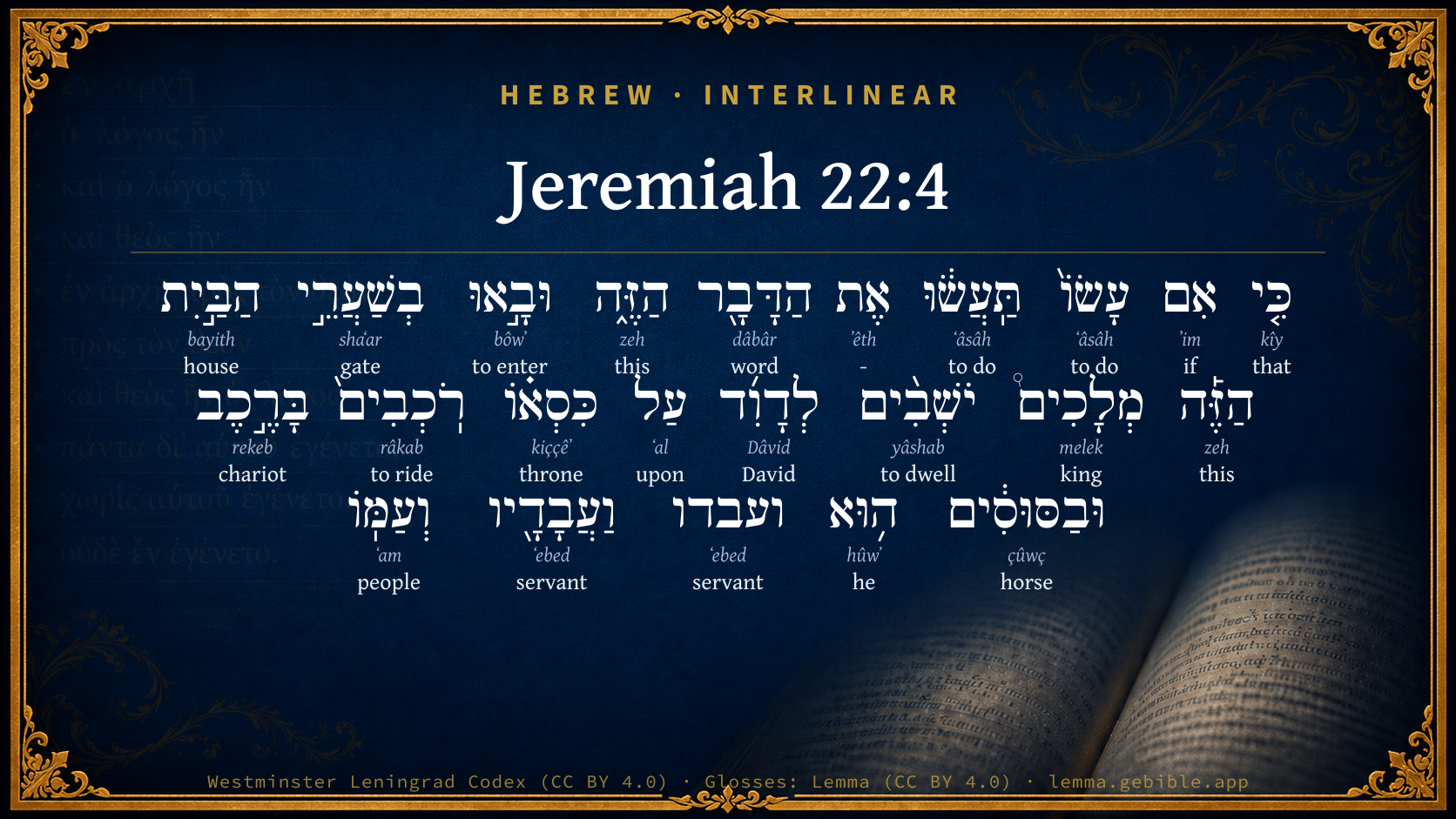
Jeremiah 22:4

Hebrew (Westminster Leningrad Codex) Jeremiah 22:4 appears in the Hebrew Old Testament. The text above is from the Westminster Leningrad Codex. Each word links to its Strong’s number, a concise gloss, and parsing drawn from the Open Scriptures Hebrew Bible morphology. Click any word for its full Brown-Driver-Briggs (BDB) entry.
Download image
Cite this verse

Jeremiah 22:4 (World English Bible). Public Domain. Lemma interlinear Bible study tool, https://lemma.gebible.app/v/jeremiah/22/4.

Show BibTeX & RIS
BibTeX
RIS
English Translation
For if you do this thing indeed, then shall there enter in by the gates of this house kings sitting on the throne of David, riding in chariots and on horses, he, and his servants, and his people.
World English Bible · Public Domain
Download a study sheet

One document with this verse’s original text, its word-by-word gloss line, the meaning frame, cross-references with their text, attributed commentary, and full source and license credits — printable, and it pastes into notes with its structure intact.

This verse Autodidact and up

Study sheet (.html) Plain text (.txt)

A passage Seminary Student

Up to 50 verses in one chapter. A passage sheet keeps up to 6 commentary sources and 12 cross-references per verse, in the order this page ranks them, and says so on the sheet whenever that leaves anything out. Ask for a single verse and you get the Autodidact verse sheet above.

Everything on this page stays free to read, with no account — the sheet is a download of what is already on screen, not access to it.

Want to remove ads? Support Godless Engineer
Compare translations 3

The same verse in 3 English versions, stacked beneath the original-language interlinear above. Click any original word for its lexicon entry.

Each is an independent rendering of the whole verse — the interlinear is not word-aligned to these translations.

Highlighted words mark where these versions differ — a whole-verse word diff, not a word-by-word alignment.

  • World English Bible Public Domain
    For if you do this thing indeed, then shall there enter in by the gates of this house kings sitting on the throne of David, riding in chariots and on horses, he, and his servants, and his people.
  • King James Version Public Domain
    For if ye do this thing indeed, then shall there enter in by the gates of this house kings sitting upon the throne of David, riding in chariots and on horses, he, and his servants, and his people.
  • unfoldingWord Literal Text CC BY-SA 4.0
    For if doing you do this word, then kings sitting for David on his throne will enter through the gates of this house, riding in the chariot and on horses, he and his servants and his people.

unfoldingWord Literal Text — © unfoldingWord, licensed CC BY-SA 4.0. Word-aligned USFM3 via Door43 (git.door43.org/unfoldingWord/en_ult).

Versions to compare (up to 4)

3 of 4 selected

Show all 18 translations

Every available English version of this verse, each an independent rendering of the whole verse.

  • World English Bible Public Domain
    For if you do this thing indeed, then shall there enter in by the gates of this house kings sitting on the throne of David, riding in chariots and on horses, he, and his servants, and his people.
  • Berean Standard Bible Public Domain
    For if you will indeed carry out these commands, then kings who sit on David’s throne will enter through the gates of this palace riding on chariots and horses—they and their officials and their people.
  • Majority Standard Bible Public Domain
    For if you will indeed carry out these commands, then kings who sit on David’s throne will enter through the gates of this palace riding on chariots and horses—they and their officials and their people.
  • King James Version Public Domain
    For if ye do this thing indeed, then shall there enter in by the gates of this house kings sitting upon the throne of David, riding in chariots and on horses, he, and his servants, and his people.
  • American Standard Version (1901) Public Domain
    For if ye do this thing indeed, then shall there enter in by the gates of this house kings sitting upon the throne of David, riding in chariots and on horses, he, and his servants, and his people.
  • Revised Version (1885) Public Domain
    For if ye do this thing indeed, then shall there enter in by the gates of this house kings sitting upon the throne of David, riding in chariots and on horses, he, and his servants, and his people.
  • Geneva Bible (1599) Public Domain
    For if ye do this thing, then shall the kings sitting vpon the throne of Dauid enter in by the gates of this House, and ride vpon charets, and vpon horses, both he and his seruants and his people.
  • Douay-Rheims (1899) Public Domain
    For if you will do this thing indeed, then shall there enter in by the gates of this house, kings of the race of David sitting upon his throne, and riding in chariots and on horses, they and their servants, and their people.
  • Young's Literal Translation Public Domain
    For, if ye certainly do this thing, Then come in by the gates of this house Have kings sitting for David on his throne, Riding on chariot, and on horses, He, and his servants, and his people.
  • Literal Standard Version CC BY-SA 4.0
    For if you certainly do this thing, || Then kings sitting for David on his throne || Have come in by the gates of this house, || Riding on chariot, and on horses, || He, and his servants, and his people.
  • Unlocked Literal Bible CC BY-SA 4.0
    For if you truly do these things, then kings sitting on David's throne will enter the gates of this house riding in a chariot and on horses, he, his servants, and his people!
  • unfoldingWord Literal Text CC BY-SA 4.0
    For if doing you do this word, then kings sitting for David on his throne will enter through the gates of this house, riding in the chariot and on horses, he and his servants and his people.
  • Darby Bible Public Domain
    For if ye do this thing indeed, then shall there enter in through the gates of this house kings sitting in the place of David upon his throne, riding in chariots and on horses, -- he, and his servants, and his people.
  • World Messianic Bible Public Domain
    For if you do this thing indeed, then kings sitting on David’s throne will enter in by the gates of this house, riding in chariots and on horses—they, their servants, and their people.
  • Webster's Bible Public Domain
    For if ye do this thing indeed, then shall there enter, by the gates of this house, kings sitting upon the throne of David, riding in chariots and on horses, he, and his servants, and his people.
  • Free Bible Version CC BY-SA 4.0
    If you will honestly do what I tell you, then kings who sit on David's throne will ride on chariots and horses with their officials through the gates of this palace. They'll be accompanied by the people of Judah and those living in Jerusalem.
  • Bible in Basic English Public Domain
    For if you truly do this, then there will come in through the doors of this house kings seated on the seat of David, going in carriages and on horseback, he and his servants and his people
  • JPS Tanakh (1917) Public Domain
    For if ye do this thing indeed, then shall there enter in by the gates of this house kings sitting upon the throne of David, riding in chariots and on horses, he, and his servants, and his people.

Literal Standard Version (2020), Covenant Press — licensed CC BY-SA 4.0. Text via the HelloAO Bible API (eBible.org). Unlocked Literal Bible (unfoldingWord) — licensed CC BY-SA 4.0. Text via the HelloAO Bible API (eBible.org). unfoldingWord Literal Text — © unfoldingWord, licensed CC BY-SA 4.0. Word-aligned USFM3 via Door43 (git.door43.org/unfoldingWord/en_ult). Free Bible Version, Dr. Jonathan Gallagher — licensed CC BY-SA 4.0. Text via the HelloAO Bible API (eBible.org).

Word by word

More ways to search: Search by grammar → Find every occurrence → Compare this word →

Practice this passage: Drill this verse → Learn its vocabulary →

רֹֽכְבִים֙
râkab
H7392
“riding”
Verb, Qal, Participle Active, Masculine, Plural, Absolute
Part of Speech
Verb
Stem
Qal
Form
Participle Active
Gender
Masculine
Number
Plural
State
Absolute
Full BDB Definition

Origin: a primitive root

TWOT: 2163

to mount and ride, ride - (Qal) - to mount, mount and sit or ride - to ride, be riding - rider (substantive) - (Hiphil) - to cause to ride, cause to (mount and) ride - to cause to draw (plough, etc) - to cause to ride upon (figuratively)
  1. כִּ֤י kîy H3588 “that” Conjunction
  2. אִם ʼim H518 “if” Conjunction
  3. עָשׂוֹ֙ ʻâsâh H6213 “to do” Verb, Qal, Infinitive Absolute
  4. תַּֽעֲשׂ֔וּ ʻâsâh H6213 “to do” Verb, Qal, Imperfect, 2nd Person, Masculine, Plural
  5. אֶת ʼêth H853 “-” Particle, Direct Object
  6. הַדָּבָ֖ר dâbâr H1697 “the · word” Particle, Definite Article + Noun, Common, Masculine, Singular, Absolute
  7. הַזֶּ֑ה zeh H2088 “the · this” Particle, Definite Article + Pronoun, Demonstrative, Masculine, Singular
  8. וּבָ֣אוּ bôwʼ H935 “and · to enter” Conjunction + Verb, Qal, Sequential Perfect, 3rd Person, Common, Plural
  9. בְשַׁעֲרֵ֣י shaʻar H8179 “in/at · gates of” Preposition + Noun, Common, Masculine, Plural, Construct
  10. הַבַּ֣יִת bayith H1004 “the · house” Particle, Definite Article + Noun, Common, Masculine, Singular, Absolute
  11. הַזֶּ֡ה zeh H2088 “the · this” Particle, Definite Article + Pronoun, Demonstrative, Masculine, Singular
  12. מְלָכִים֩ melek H4428 “kings” Noun, Common, Masculine, Plural, Absolute
  13. יֹשְׁבִ֨ים yâshab H3427 “dwelling” Verb, Qal, Participle Active, Masculine, Plural, Absolute
  14. לְדָוִ֜ד Dâvid H1732 “to/for · David” Preposition + Noun, Proper
  15. עַל ʻal H5921 “upon” Preposition
  16. כִּסְא֗וֹ kiççêʼ H3678 “throne · his” Noun, Common, Masculine, Singular, Construct + Suffix, Personal, 3rd Person, Masculine, Singular
  17. בָּרֶ֣כֶב rekeb H7393 “in/at the · chariot” Preposition, Determined + Noun, Common, Masculine, Singular, Absolute
  18. וּבַסּוּסִ֔ים çûwç H5483 “and · in/at the · horses” Conjunction + Preposition, Determined + Noun, Common, Masculine, Plural, Absolute
  19. ה֥וּא hûwʼ H1931 “he” Pronoun, Personal, 3rd Person, Masculine, Singular
  20. ועבדו ʻebed H5650 “and · servant · his” Conjunction + Noun, Common, Masculine, Singular, Construct + Suffix, Personal, 3rd Person, Masculine, Singular
  21. וַעֲבָדָ֖יו ʻebed H5650 “and · servants · his” Conjunction + Noun, Common, Masculine, Plural, Construct + Suffix, Personal, 3rd Person, Masculine, Singular
  22. וְעַמּֽוֹ ʻam H5971 “and · people · his” Conjunction + Noun, Common, Masculine, Singular, Construct + Suffix, Personal, 3rd Person, Masculine, Singular

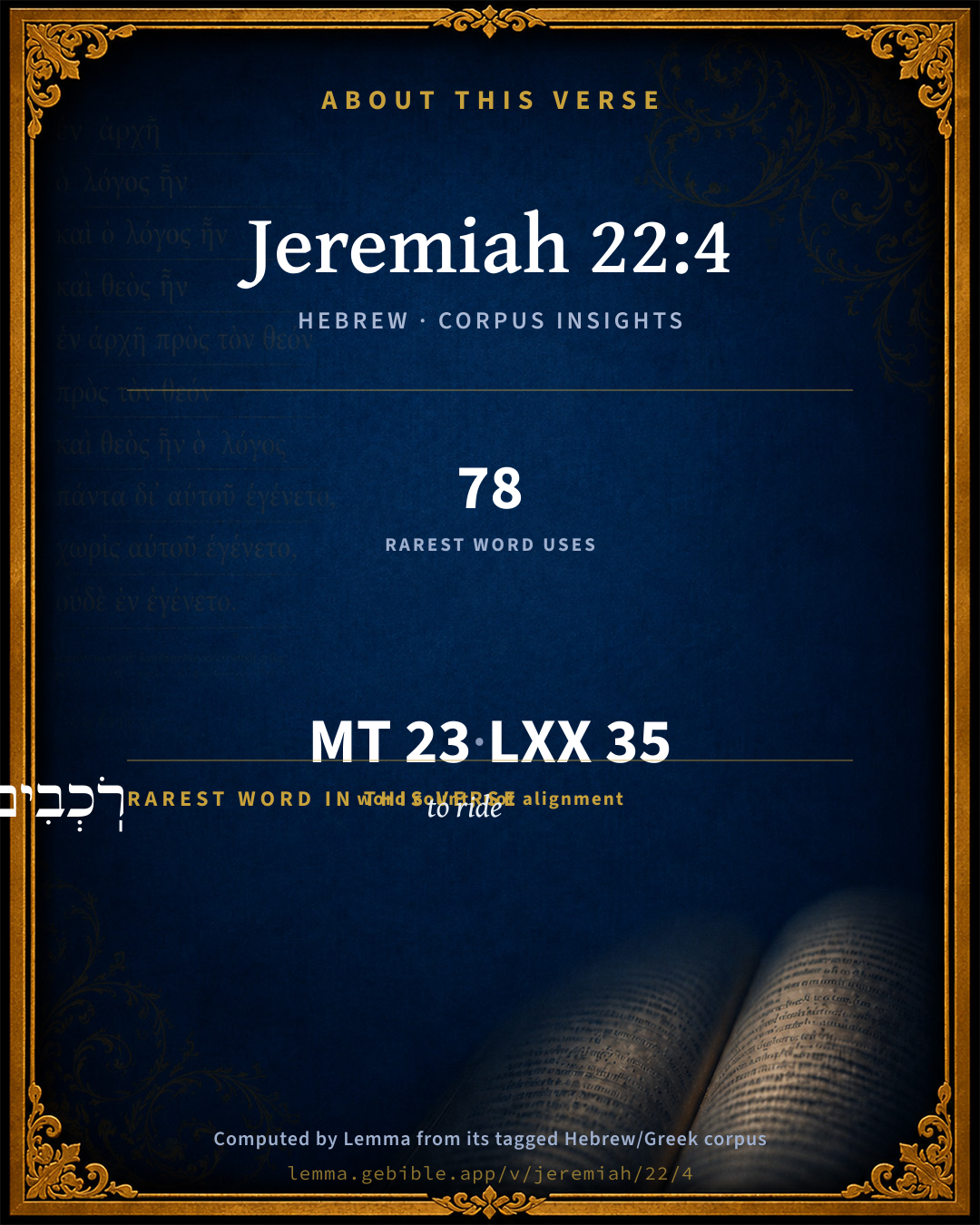
About this verse

These counts appear in no published source. They are computed here, from the morphology-tagged text and Lemma’s own curated glosses. What Lemma adds →

23
words
20
distinct lemmas
Prophets
section

Grammatical profile

  • 5 verbs
  • 11 nouns
  • 3 pronouns
  • 1 preposition
  • 2 conjunctions
  • 1 particle

Verb forms

  • עָשׂוֹ֙ Qal · Infinitive Absolute
  • תַּֽעֲשׂ֔וּ Qal · Imperfect
  • וּבָ֣אוּ Qal · Sequential Perfect
  • יֹשְׁבִ֨ים Qal · Participle Active
  • רֹֽכְבִים֙ Qal · Participle Active

Repetition

Words recur within this verse — often emphatic in Hebrew:

  • עָשׂוֹ֙ to do H6213 ×2
  • ועבדו servant H5650 ×2
  • הַזֶּ֑ה this H2088 ×2

Hebrew & Septuagint length

In the original languages it is 23 Hebrew tokens and 35 Greek tokens — but the two are counted differently (Hebrew bundles its prefixes and suffixes into one token; the Greek is in lemma form), so that isn’t a like-for-like length.

Cross-references

1

Topical passages linked to Jeremiah 22:4 in the Treasury of Scripture Knowledge — connected by theme and wording, ordered by reader-vote popularity; previews shown in the World English Bible.

  • Jeremiah 17:25 then shall there enter in by the gates of this city kings and princes sitting on the throne of David, riding in chariots and on horses, they, and their princes, the men of Judah, and the inhabitants of Jerusalem; and this city shall remain forever.

Cross-references courtesy of OpenBible.info (CC BY 4.0).

Hebrew and Greek witnesses Masoretic Hebrew ↔ Greek Septuagint

The same verse in the two great witnesses to the Old Testament, shown verse-for-verse.

These are two independent witnesses, not word-aligned to each other, and the Septuagint is shown in lemma (dictionary) form.

Hebrew Jeremiah 22:4 Masoretic · Westminster Leningrad Codex

כִּ֤י אִם עָשׂוֹ֙ תַּֽעֲשׂ֔וּ אֶת הַדָּבָ֖ר הַזֶּ֑ה וּבָ֣אוּ בְשַׁעֲרֵ֣י הַבַּ֣יִת הַזֶּ֡ה מְלָכִים֩ יֹשְׁבִ֨ים לְדָוִ֜ד עַל כִּסְא֗וֹ רֹֽכְבִים֙ בָּרֶ֣כֶב וּבַסּוּסִ֔ים ה֥וּא ועבדו וַעֲבָדָ֖יו וְעַמּֽוֹ

For if you do this thing indeed, then shall there enter in by the gates of this house kings sitting on the throne of David, riding in chariots and on horses, he, and his servants, and his people.

World English Bible · Public Domain

Greek LXX Structure differs

In the Septuagint, Jeremiah is about an eighth shorter than the Hebrew and arranges its material differently — the Oracles Against the Nations (Hebrew chapters 46–51) appear in the middle of the Greek book, after 25:13. Because the chapter and verse boundaries do not line up, a verse-for-verse comparison with the Hebrew is not shown.

A verse-for-verse comparison isn’t shown here because the chapters and verses don’t line up. Switch to the LXX edition with the MT / LXX toggle above to read the Greek directly.

Hebrew: Westminster Leningrad Codex (CC BY 4.0). Greek: Septuagint (public domain); English from a public-domain English Septuagint. How the Septuagint differs from the Hebrew →

Targum (Aramaic paraphrase)

1

The Targum is the ancient Jewish Aramaic paraphrase of the Hebrew Scriptures — an interpretive translation, not the Hebrew text itself. Onkelos (literal) and Pseudo-Jonathan (expansive) render the Torah, and Jonathan the Prophets. Coverage is partial: where no permissively-licensed English translation exists for a verse, only the Aramaic is shown. This is verse-level text, not a word-by-word alignment to the Hebrew.

  1. Targum Jonathan Prophets (Joshua–Malachi)
    אֲרֵי אִם מֵעְבַּד תַּעְבְּדוּן יַת פִּתְגָמָא הָדֵין וְיַעֲלוּן בְּתַרְעֵי בֵּיתָא הָדֵין מַלְכִין יַתְבִין לְדָוִד עַל כּוּרְסוֹהִי רְכִיבִין בִּרְתִיכִין וּבְסוּסְוָן הוּא וְעַבָדוֹהִי וְעַמֵיהּ:

    (no public-domain English translation for this verse)

    Targum Jonathan — Aramaic: “Mikraot Gedolot” (public domain). English: “Sefaria Community Translation” (CC0 1.0 (public-domain dedication)); “London "Chaldee Paraphrase," 1871” (public domain). Text via Sefaria.

Commentary

Notes on Jeremiah 22:4 from classic Christian and Jewish commentators (each source and its license shown beneath its notes). The classic Christian expositions comment on the surrounding passage and are grouped to its opening verse, so a note may address several verses; the Jewish commentaries on the Tanakh (Rashi and others) are per-verse, so they appear only where the commentator wrote on this verse.

Lemma curates 59 commentaries, every one of them public domain or Creative Commons licensed, each selected and text-cleaned for this edition rather than reprinted as found. About our sources →

Trapp's Complete Commentary

John Trapp

Jer 22:4 For if ye do this thing indeed, then shall there enter in by the gates of this house kings sitting upon the throne of David, riding in chariots and on horses, he, and his servants, and his people.

Ver. 4. For if ye do this thing indeed.] Heb., If doing you do this word, i.e., If seriously and sedulously ye do it.

Then shall there enter in … kings sitting.] See Jer 17:25.

John Trapp, A Commentary or Exposition upon All the Books of the Old and New Testament (1647–1656) — public domain. Text from a community e-Sword module.

Jamieson, Fausset & Brown

Robert Jamieson, A. R. Fausset & David Brown

upon the throne of David--literally, "or David on his throne" (see on Jer 13:13). This verse is repeated substantially from Jer 17:25.

his servants--so the Keri. But Chetib, singular, "his servant;" that is, distributively, "each with his servants;" Jer 17:25, "their princes."

Jamieson, Fausset & Brown — Commentary Critical and Explanatory on the Whole Bible (1871) — public domain (CC PDM 1.0). Text via the HelloAO Bible API.

John Calvin's Commentaries

The Prophet expresses more clearly what I have already stated, that if the Jews from the heart repented, there was yet a place for mercy; for he promises them that God would be reconcilable, if they sought to be reconciled to him; he allures them to repentance by words of kindness. We may, indeed, read כיאם, kiam, as one word, and render it, “But rather;” but I follow others who give this version, For if by doing ye will do this word, then ye shall enter in, etc.; and thus they turn the copulative into an adverb of time, which is often the case. Still the other meaning is not unsuitable, when the future verb, תעשו, toshu, is taken in a hortative sense; for we know that the future tense in Hebrew is often to be understood as an imperative. As to the general meaning, there is not much difference; for what the Prophet designed to shew was this, that God would be reconciled to the Jews, if they were not wholly disobedient. “Only,” he says, “obey my word, and your safety shall be secured.” Not that impunity was to be expected, as I have said before, but, as they would have found, their reconciliation to God would not have been in vain, for their punishment would have been mitigated; in that case their exile would have been rendered more endurable, for God would have doubtless made their adversaries kind to them; in short, mercy would have been shewn to them in many ways. Moreover, the Prophet shews that he called them not in vain to repent; for he sets before them God’s favor in mitigating their punishment.

And he adds, Ye shall enter through the gates of this house, both your kings and their counsellors; but the number is afterwards changed, he, that is, every king. The Prophet, seems, at the first view, to have retracted what he had said respecting exile; but the two things are to be connected together, that there was some hope remaining, if the Jews accepted the favor of God, and then that the punishment, once decreed, was to be borne by them. These two things do not disagree. For God had resolved to drive the Jews into exile; but all Judea would not doubtless have been reduced to solitude, as that happened through their irreclaimable obstinacy, according to what we read at the end of this Book; for they might have otherwise dwelt still in their own country. This is one thing; and then their condition after their exile would have been better and far more happy. But even at that time, the crown was trodden under foot, and all the dignity and power of the family of David were nearly abolished.

When, therefore, the Prophet says, “Enter shall kings in chariots and on horses,” and also “the people and he and his counsellors, through the gates of this city;” he does not mean that they would so escape as that God would not chastise them for their sins, as he had declared, but that there would still be some form of a kingdom, and that exile would be short, and also that there would be at length a restoration, so that the descendants of David would return to their former state, and that the city itself would be restored so as to abound in wealth as in all other blessings. Such is the promise. The Prophet further adds what would otherwise take place, If they will not hear, this place shall become a desolation. But this threatening shall be considered tomorrow.

John Calvin's Commentaries (1540-1563) — public domain. Text from the Calvin Translation Society English edition (1840s-50s) via the Christian Classics Ethereal Library (ccel.org). Calvin's coverage is partial (roughly two-thirds of the Bible); uncommented books and verses are honest gaps, never fabricated. The 19th-century editor's footnotes and remarks are omitted so the notes are faithfully Calvin's own voice.

Ellicott's Commentary for English Readers

(4) Then shall there enter in . . .—The picture of renewed and continued prosperity gains a fresh force, as reproducing the very terms of Jer_17:25. In both the “chariots and horses” are conspicuous as the symbol of kingly pomp (1Ki_4:26), just as their absence furnished a topic to the sarcastic taunts of Rabshakeh (Isa_36:8), and entered into the picture of the true, peaceful king in Zec_9:9-10.

A Bible Commentary for English Readers, edited by Charles John Ellicott (1878–1897) — public domain. Text from a community e-Sword module.

The Cambridge Bible for Schools and Colleges

gen. ed. J. J. S. Perowne

4. Cp. Jer_17:25.

upon the throne of David] lit. as mg. for David upon his throne.

The Cambridge Bible for Schools and Colleges (gen. ed. J. J. S. Perowne; Cambridge University Press, 1878–1918) — public domain. Text from a community e-Sword module.

John Gill's Exposition

For if ye do this thing indeed,.... Or, "in doing do this word" (y); diligently and carefully attend to this word of exhortation, and constantly perform the duties required:

then shall there enter in by the gates of this house kings sitting upon the throne of David; or, upon the throne for David: in his room and stead, as successors of his; or of his lineage and descent, as the Vulgate Latin version. The meaning is, that should the kings of Judah do the duty of their office, before pointed at, there should never be any want of successors of the seed of David; but there should be a race of kings descending from him, and sitting on his throne in all after ages, who should dwell in the royal palace, and go in and out at the gates of it; and they should also live in great pomp and splendour, in royal dignity, answerable to their characters:

riding in chariots, and on horses, he, and his servants, and his people; the king, his nobles, and other his attendants; some on one, and some on another, when they went out or came in; see Jer 17:25.

(y) "si namque faciendo feceritis verbum hoc", Montanus, Schmidt.

John Gill's Exposition of the Whole Bible (1746–1763) — public domain (CC PDM 1.0). Text via the HelloAO Bible API.

Matthew Poole's English Annotations

If ye do this thing indeed; if ye will not pretendedly, but really, give to every one their due, and look that inferior magistrates acting under you do so. Then, he doth not say, you shall be saved: the promise is only of a secular, temporal nature, of all prosperity, and continuance of the family of David, with great honour and splendour, expressed by those phrases of

riding in chariots and on horses. Though the performance of moral acts of justice and mercy, which men may perform without any special grace of God, be not enough to entitle them to the hopes of spiritual and eternal good things; yet they may entitle them to the hopes of outward prosperity and happiness in this life, Dan 4:27; which is sufficient to demonstrate that men’s outward infelicities and sufferings under the grievous judgments of God upon themselves is from their selves; they might in a great measure avoid them, by doing such acts as are in their power to do.

Matthew Poole's English Annotations on the Holy Bible (1683–1685) — public domain. Text from a community e-Sword/MySword module.

Whedon's Commentary on the Bible

Daniel D. Whedon

4. Kings sitting… riding — See Jer_17:25. Servants and people are introduced as participating in the pomp of the royal retinue and as sharing the benefits of the kingly rule.

Daniel D. Whedon (gen. ed.), Commentary on the Old and New Testaments (1874–1909) — public domain. Text from a community e-Sword module.

The Pulpit Commentary

Parallel passage, Jer_17:25.

The Pulpit Commentary (1880–1919), ed. H.D.M. Spence-Jones & Joseph S. Exell — public domain. Text from a community e-Sword module.

unfoldingWord translationNotes

Door43 World Missions Community

kings sitting on David's throne

The metonym "throne" refers to kingly authority like David had. AT: "kings, ruling like David before them" (See: Metonymy)

the gates of this house

This refers to the gates to the courtyard of the palace.

riding in a chariot and on horses

This phrase is a metonym that describes the kings as powerful and wealthy. (See: Metonymy)

he, his servants, and his people

This sentence lists all who will be powerful and wealthy. This can be stated clearly. AT: "he, his servants, and his people will ride into the palace on chariots and horses" (See: Ellipsis)

if you do not listen to

"if you refuse to pay attention to" or "if you do not obey"

this is Yahweh's declaration

Yahweh speaks of himself by name to express the certainty of what he is declaring. See how you translated this in Jeremiah 1:8. AT: "this is what Yahweh has declared" or "this is what I, Yahweh, have declared" (See: First, Second, or Third Person)

this royal house

This phrase here appears to refer specifically to the royal palace.

translationWords

David

throne

gate

chariot

horse

royal

ruin

unfoldingWord translationNotes — © Distant Shores Media and the Door43 World Missions Community, licensed CC BY-SA 4.0. Source: git.door43.org/Door43/en_tn.

Lesson kit

Teaching starters — assembled from the data on this page, not authored interpretation. Every prompt links to the verse data it draws on. Edit before teaching.

Jeremiah, in the Prophets, opens this verse with 23 words (20 distinct Hebrew lemmas). Its most distinctive word is râkab (“to ride”). A historical commentator’s framing appears above. Read the whole chapter for the surrounding context.

Discussion questions

  1. How does “to ride” (râkab) shape what this verse is saying?
  2. How does Jeremiah 17:25, which shares this passage’s theme, read alongside this verse?
  3. What does the repetition of “to do” (2× in this one verse) do in this verse?
  4. These translations render this verse differently; the difference is in the English rendering, not the original. What questions does that raise?
  5. «עָשׂוֹ֙» is a Qal Infinitive Absolute verb. How does that grammatical form shape the action described?
  6. Compare how Trapp's Complete Commentary and Jamieson, Fausset & Brown read this verse. Where do they agree or differ?

Things to notice

Reading settings

Reading text

Shown beneath each verse's original-language words.

Old Testament
Old Testament edition

Read the OT as the Masoretic Hebrew (MT) or the Greek Septuagint (LXX).

English shown for the Greek Septuagint (in the Hebrew ↔ Greek comparison).

Comparing translations? Open the Compare panel on any verse page to stack up to four side by side.