
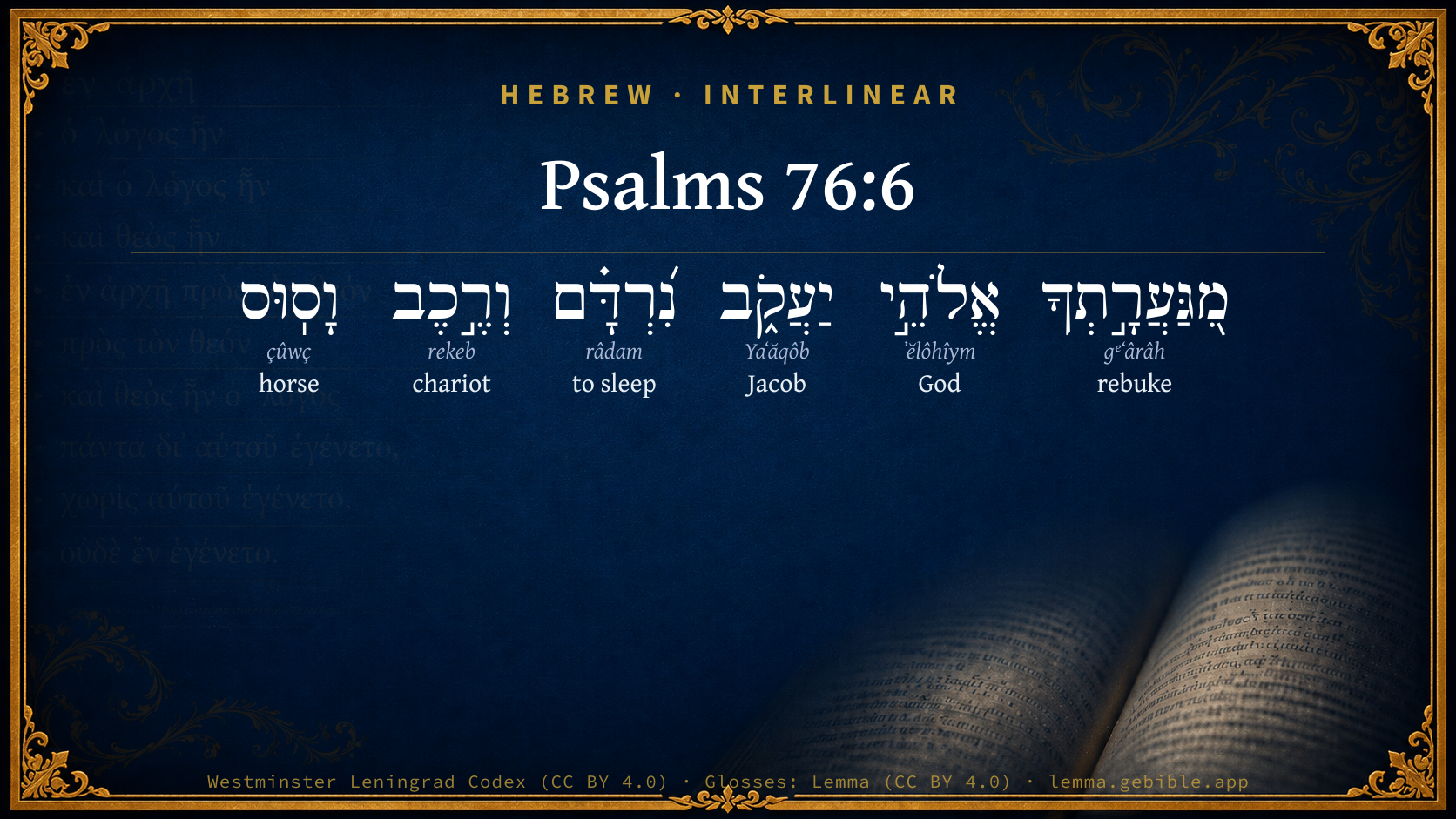
Psalms 76:6

Hebrew (Westminster Leningrad Codex) Psalms 76:6 appears in the Hebrew Old Testament. The text above is from the Westminster Leningrad Codex. Each word links to its Strong’s number, a concise gloss, and parsing drawn from the Open Scriptures Hebrew Bible morphology. Click any word for its full Brown-Driver-Briggs (BDB) entry.
Download image
Cite this verse

Psalms 76:6 (World English Bible). Public Domain. Lemma interlinear Bible study tool, https://lemma.gebible.app/v/psalms/76/6.

Show BibTeX & RIS
BibTeX
RIS
English Translation
At your rebuke, God of Jacob, Both chariot and horse are cast into a deep sleep.
World English Bible · Public Domain
Download a study sheet

One document with this verse’s original text, its word-by-word gloss line, the meaning frame, cross-references with their text, attributed commentary, and full source and license credits — printable, and it pastes into notes with its structure intact.

This verse Autodidact and up

Study sheet (.html) Plain text (.txt)

A passage Seminary Student

Up to 50 verses in one chapter. A passage sheet keeps up to 6 commentary sources and 12 cross-references per verse, in the order this page ranks them, and says so on the sheet whenever that leaves anything out. Ask for a single verse and you get the Autodidact verse sheet above.

Everything on this page stays free to read, with no account — the sheet is a download of what is already on screen, not access to it.

Want to remove ads? Support Godless Engineer
Compare translations 3

The same verse in 3 English versions, stacked beneath the original-language interlinear above. Click any original word for its lexicon entry.

Each is an independent rendering of the whole verse — the interlinear is not word-aligned to these translations.

Highlighted words mark where these versions differ — a whole-verse word diff, not a word-by-word alignment.

  • World English Bible Public Domain
    At your rebuke, God of Jacob, Both chariot and horse are cast into a deep sleep.
  • King James Version Public Domain
    At thy rebuke, O God of Jacob, both the chariot and horse are cast into a dead sleep.
  • unfoldingWord Literal Text CC BY-SA 4.0
    At your rebuke, O God of Jacob, both rider and horse fell deeply asleep. ts\*

unfoldingWord Literal Text — © unfoldingWord, licensed CC BY-SA 4.0. Word-aligned USFM3 via Door43 (git.door43.org/unfoldingWord/en_ult).

Versions to compare (up to 4)

3 of 4 selected

Show all 18 translations

Every available English version of this verse, each an independent rendering of the whole verse.

  • World English Bible Public Domain
    At your rebuke, God of Jacob, Both chariot and horse are cast into a deep sleep.
  • Berean Standard Bible Public Domain
    At Your rebuke, O God of Jacob, both horse and rider lie stunned.
  • Majority Standard Bible Public Domain
    At Your rebuke, O God of Jacob, both horse and rider lie stunned.
  • King James Version Public Domain
    At thy rebuke, O God of Jacob, both the chariot and horse are cast into a dead sleep.
  • American Standard Version (1901) Public Domain
    At thy rebuke, O God of Jacob, Both chariot and horse are cast into a deep sleep.
  • Revised Version (1885) Public Domain
    At thy rebuke, O God of Jacob, both chariot and horse are cast into a dead sleep.
  • Geneva Bible (1599) Public Domain
    At thy rebuke, O God of Iaakob, both the chariot and horse are cast a sleepe.
  • Douay-Rheims (1899) Public Domain
    All the foolish of heart were troubled. They have slept their sleep; and all the men of riches have found nothing in their hands.
  • Young's Literal Translation Public Domain
    From Thy rebuke, O God of Jacob, Both rider and horse have been fast asleep.
  • Literal Standard Version CC BY-SA 4.0
    From Your rebuke, O God of Jacob, || Both rider and horse have been fast asleep.
  • Unlocked Literal Bible CC BY-SA 4.0
    At your rebuke, God of Jacob, both rider and horse fell asleep.
  • unfoldingWord Literal Text CC BY-SA 4.0
    At your rebuke, O God of Jacob, both rider and horse fell deeply asleep. ts\*
  • Darby Bible Public Domain
    At thy rebuke, O God of Jacob, both chariot and horse are cast into a dead sleep.
  • World Messianic Bible Public Domain
    At your rebuke, God of Jacob, both chariot and horse are cast into a dead sleep.
  • Webster's Bible Public Domain
    \\76:5\\The stout-hearted are spoiled, they have slept their sleep: and none of the men of might have found their hands.
  • Free Bible Version CC BY-SA 4.0
    At your command, God of Jacob, both horse and rider fell down dead.
  • Bible in Basic English Public Domain
    At the voice of your wrath, O God of Jacob, deep sleep has overcome carriage and horse.
  • JPS Tanakh (1917) Public Domain
    (76-7) At Thy rebuke, O God of Jacob, they are cast into a dead sleep, the riders also and the horses.

Literal Standard Version (2020), Covenant Press — licensed CC BY-SA 4.0. Text via the HelloAO Bible API (eBible.org). Unlocked Literal Bible (unfoldingWord) — licensed CC BY-SA 4.0. Text via the HelloAO Bible API (eBible.org). unfoldingWord Literal Text — © unfoldingWord, licensed CC BY-SA 4.0. Word-aligned USFM3 via Door43 (git.door43.org/unfoldingWord/en_ult). Free Bible Version, Dr. Jonathan Gallagher — licensed CC BY-SA 4.0. Text via the HelloAO Bible API (eBible.org).

Word by word

More ways to search: Search by grammar → Find every occurrence → Compare this word →

Practice this passage: Drill this verse → Learn its vocabulary →

About this verse

These counts appear in no published source. They are computed here, from the morphology-tagged text and Lemma’s own curated glosses. What Lemma adds →

6
words
6
distinct lemmas
Wisdom
section

Notable vocabulary

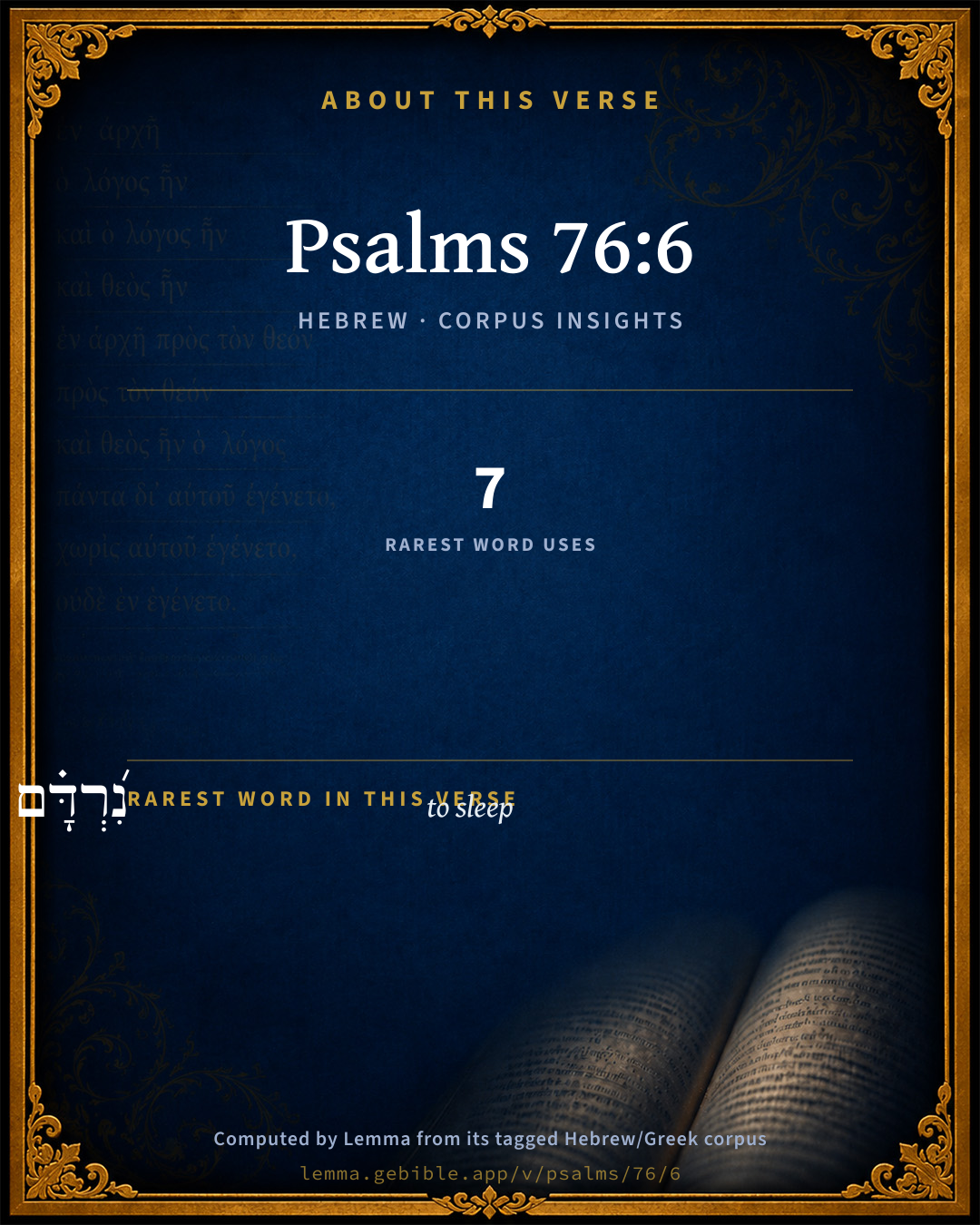
The rarest word here is נִ֝רְדָּ֗ם to sleep H7290 — appearing just 7 times in the whole Hebrew Bible.

Shared distinctive vocabulary

נִ֝רְדָּ֗ם to sleep H7290 occurs in 7 verses of the Hebrew Bible. Also found in:

Grammatical profile

  • 1 verb
  • 5 nouns

Verb forms

  • נִ֝רְדָּ֗ם Niphal · Participle Active

Hebrew & Septuagint length

In English translation the verse runs 16 words from the Hebrew and 12 from the Septuagint (LXX English) — closely comparable.

A rough comparison of the two English renderings, which tokenize alike — not a word-level alignment.

Word counts can differ between the Hebrew and the Greek without any difference in meaning — e.g. the Hebrew direct-object marker אֵת has no separate Greek word, and Greek often adds the article ὁ.

Cross-references

18

Topical passages linked to Psalms 76:6 in the Treasury of Scripture Knowledge — connected by theme and wording, ordered by reader-vote popularity; previews shown in the World English Bible.

  • Exodus 15:1 Then Moses and the children of Israel sang this song to Yahweh, and said, "I will sing to Yahweh, for he has triumphed gloriously: The horse and his rider he has thrown into the sea.
  • Exodus 15:21 Miriam answered them, "Sing to Yahweh, for he has triumphed gloriously: The horse and his rider he has thrown into the sea."
  • Psalms 80:16 It's burned with fire. It's cut down. They perish at your rebuke.
  • Exodus 14:27–28 Moses stretched out his hand over the sea, and the sea returned to its strength when the morning appeared; and the Egyptians fled against it. Yahweh overthrew the Egyptians in the midst of the sea.
  • Exodus 15:10 You blew with your wind. The sea covered them. They sank like lead in the mighty waters.
  • Ezekiel 39:20 You shall be filled at my table with horses and chariots, with mighty men, and with all men of war, says the Lord Yahweh.
  • Exodus 15:4–6 Pharaoh's chariots and his host has he cast into the sea; His chosen captains are sunk in the Red Sea.
  • 1 Samuel 26:12 So David took the spear and the jar of water from Saul's head; and they got them away: and no man saw it, nor knew it, neither did any awake; for they were all asleep, because a deep sleep from Yahweh was fallen on them.
  • 2 Samuel 10:18 The Syrians fled before Israel; and David killed of the Syrians [the men of] seven hundred chariots, and forty thousand horsemen, and struck Shobach the captain of their host, so that he died there.
  • Psalms 18:15 Then the channels of waters appeared, The foundations of the world were laid bare at your rebuke, Yahweh, At the blast of the breath of your nostrils.
  • Psalms 104:7 At your rebuke they fled. At the voice of your thunder they hurried away.
  • Isaiah 37:36 The angel of Yahweh went forth, and struck in the camp of the Assyrians one hundred and eighty-five thousand; and when men arose early in the morning, behold, these were all dead bodies.
  • Jeremiah 51:39 When they are heated, I will make their feast, and I will make them drunken, that they may rejoice, and sleep a perpetual sleep, and not wake, says Yahweh.
  • Jeremiah 51:57 I will make drunk her princes and her wise men, her governors and her deputies, and her mighty men; and they shall sleep a perpetual sleep, and not wake up, says the King, whose name is Yahweh of Hosts.
  • Nahum 1:6 Who can stand before his indignation? Who can endure the fierceness of his anger? His wrath is poured out like fire, and the rocks are broken apart by him.
  • Nahum 2:13 "Behold, I am against you," says Yahweh of Hosts, "and I will burn her chariots in the smoke, and the sword will devour your young lions; and I will cut off your prey from the earth, and the voice of your messengers will no longer be heard."
  • Nahum 3:18 Your shepherds slumber, king of Assyria. Your nobles lie down. Your people are scattered on the mountains, and there is no one to gather them.
  • Zechariah 12:4 In that day," says Yahweh, "I will strike every horse with terror, and his rider with madness; and I will open my eyes on the house of Judah, and will strike every horse of the peoples with blindness.

Cross-references courtesy of OpenBible.info (CC BY 4.0).

Hebrew and Greek witnesses Masoretic Hebrew ↔ Greek Septuagint

The same verse in the two great witnesses to the Old Testament, shown verse-for-verse.

You’re reading Greek Psalm 75 (Hebrew Psalm 76). The Septuagint counts the superscription, so verse numbers can differ from the Hebrew — chapter-level alignment, not verse-by-verse. Numbering follows Rahlfs.

These are two independent witnesses, not word-aligned to each other, and the Septuagint is shown in lemma (dictionary) form.

Hebrew Psalms 76:6 Masoretic · Westminster Leningrad Codex

מִ֭גַּעֲרָ֣תְךָ אֱלֹהֵ֣י יַעֲקֹ֑ב נִ֝רְדָּ֗ם וְרֶ֣כֶב וָסֽוּס

At your rebuke, God of Jacob, Both chariot and horse are cast into a deep sleep.

World English Bible · Public Domain

Greek LXX Greek Psalm 75:6 Septuagint · lemma form

ταράσσω πᾶς ὁ ἀσύνετος ὁ καρδία ὑπνόω ὕπνος αὐτός καί οὐ εὑρίσκω οὐδείς πᾶς ὁ ἀνήρ ὁ πλοῦτος ὁ χείρ αὐτός

At your rebuke, O God of Jacob, the riders on horses slumbered.

LXX2012 (modern English Septuagint) · Public Domain

On this verse, Albert Barnes' Notes on the Bible discusses the Septuagint’s reading. Read the note in Commentary ↓

Hebrew: Westminster Leningrad Codex (CC BY 4.0). Greek: Septuagint (public domain); English from LXX2012 (modern English Septuagint) (Public Domain). How the Septuagint differs from the Hebrew →

Commentary

Notes on Psalms 76:6 from classic Christian and Jewish commentators (each source and its license shown beneath its notes). The classic Christian expositions comment on the surrounding passage and are grouped to its opening verse, so a note may address several verses; the Jewish commentaries on the Tanakh (Rashi and others) are per-verse, so they appear only where the commentator wrote on this verse.

Lemma curates 59 commentaries, every one of them public domain or Creative Commons licensed, each selected and text-cleaned for this edition rather than reprinted as found. About our sources →

Trapp's Complete Commentary

John Trapp

Psa 76:6 At thy rebuke, O God of Jacob, both the chariot and horse are cast into a dead sleep.

Ver. 6. At thy rebuke, O God, &c.] i.e. With thy mighty word of command, and without any more ado. God can nod men to destruction, Psa 80:16, blow them into hell, Job 4:9, rebuke them to death, as here; do it with as much ease as he that swimmeth spreadeth forth his hands to swim, Isa 25:11,

The chariot and horse] The chieftains of the army.

John Trapp, A Commentary or Exposition upon All the Books of the Old and New Testament (1647–1656) — public domain. Text from a community e-Sword module.

J. A. Alexander on Psalms

Joseph Addison Alexander

7. (Psa 76:6). At thy rebuke, 0 God of Jacob, put to sleep (is) both chariot and horse. The particle at the beginning is both temporal and causal, post hoc et propter hoc. After and because of thy rebuke. This noun denotes not merely a verbal but a real or practical expression of the divine displeasure. See above, on Psa 9:5; Psa 68:30. God of Jacob, see above, on Psa 76:9. Put to sleep is here used to translate a passive participle, denoting not a mere state or condition, but the violence by which it is produced. The sleep meant is of course the sleep of death. The application of this figure to the chariot as well as to the horse, is less paradoxical in Hebrew, where the noun used is sometimes a collective meaning cavalry. See my note on Isa 21:7. At the same time there is beauty in the figure, as suggesting that the noisy rattle of the wheels is hushed in death-like silence.

Joseph Addison Alexander, The Psalms Translated and Explained (1850) — public domain. Text from a community e-Sword module.

Adam Clarke's Commentary

Verse 6. At thy rebuke] It was not by any human means that this immense army was overthrown; it was by the power of God alone. Not only infantry was destroyed, but the cavalry also.

The chariot and horse] That is, the chariot horses, as well as the men, were

Cast into a dead sleep.] Were all suffocated in the same night. On the destruction of this mighty host, the reader is requested to refer to Clarke's notes on "2Ki 19:35".

Adam Clarke's Commentary on the Bible (1810–1826) — public domain. Text from a community e-Sword/MySword module.

Ellicott's Commentary for English Readers

(6) Are cast into a deep sleep.—The same Hebrew expression is used of Sisera’s profound slumber (Jdg_4:21). Deborah’s Song and Exodus 15 are in the poet’s mind, as they were to the author of Isa_43:17, and as they have inspired the well-known lines of Byron’s “Sennacherib.”

A Bible Commentary for English Readers, edited by Charles John Ellicott (1878–1897) — public domain. Text from a community e-Sword module.

The Cambridge Bible for Schools and Colleges

gen. ed. J. J. S. Perowne

6. At thy rebuke] Cp. Psa_9:5; Psa_18:15; Isa_17:13.

are cast into a dead sleep] A word which denotes a deep, supernaturally caused slumber. It is usual to say that ‘chariot and horse’ stand by metonymy for charioteers and horsemen: but surely poetry imagines chariots as well as horses to be alive. The “pransing horses” and the “bounding chariots” (Nah_2:3-4; Nah_3:2), all the rush and roar of the battle, are still and silent as the grave. Cp. Isa_43:17.

The Cambridge Bible for Schools and Colleges (gen. ed. J. J. S. Perowne; Cambridge University Press, 1878–1918) — public domain. Text from a community e-Sword module.

John Gill's Exposition

At thy rebuke, O God of Jacob,.... The God of Jacob personally, and of his posterity, the children of Israel, and of the church, often so called who rebukes his people in love, but his enemies with furious rebukes, with rebukes in flames of fire; with such he rebukes the Heathen, destroys the wicked, and puts out their name for ever:

both the chariot and horse are cast into a dead sleep; that is, the riders in chariots and on horses; such there were doubtless in the Assyrian army, it being usual to have such in great armies. Kimchi observes, that the word translated "cast into a dead sleep", is in the singular number, and interprets it of the king, the head of the men of might: but Sennacherib, king of Assyria, was not slain, he departed to his own country; wherefore he applies it to Gog and Magog, the chief prince of Meshech and Tubal, Eze 39:1 and may very well be understood of the head of the apostasy, the king of the bottomless pit, the beast or false prophet, who being destroyed, the flesh of his captains and horsemen shall be the food of the fowls of the air, at the supper of the great God, Rev 19:17.

John Gill's Exposition of the Whole Bible (1746–1763) — public domain (CC PDM 1.0). Text via the HelloAO Bible API.

Albert Barnes' Notes on the Bible

At thy rebuke, O God of Jacob - At thy word; thy bidding; or, when God rebuked them for their attempt to attack the city. The idea is, that they were discomfited by a word spoken by God.

Both the chariot and horse ... - The Septuagint renders this, “They who are mounted on horses.” The word rendered “chariot” here - רכב rekeb - may mean “riders, cavalry,” as well as chariot. See the notes at Isa 21:7. Hence, there would be less incongruity in the Hebrew than in our translation, where it is said that the “chariots” have fallen into a deep sleep. The idea may be either that horsemen and horses had fallen into a deep slumber, or that the rumbling of the chariot-wheels had ceased, and that there was a profound silence, like a deep sleep.

Albert Barnes' Notes on the Bible (1834–1885) — public domain. Text from a community e-Sword/MySword module.

Matthew Poole's English Annotations

The chariot and horse; the men who rode upon and fought from chariots and horses, who fight with most advantage, and usually have most courage; and much more unable were their footmen to resist or avoid the stroke.

Matthew Poole's English Annotations on the Holy Bible (1683–1685) — public domain. Text from a community e-Sword/MySword module.

The Treasury of David

Charles H. Spurgeon

Ver. 6. At thy rebuke. A word accomplished all, there was no need of a single blow.

O God of Jacob. God of thy wrestling people, who again like their father supplant their enemy; God of the covenant and the promise, thou hast in this gracious character fought for thine elect nation.

Both the chariot and horse are cast into a dead sleep. They will neither neigh nor rattle again; still are the trampings of the horses and the crash of the cars; the calvary no more creates its din. The Israelites always had a special fear of horses and scythed chariots; and, therefore, the sudden stillness of the entire force of the enemy in this department is made the theme of special rejoicing. The horses were stretched on the ground, and the chariots stood still, as if the whole camp had fallen asleep. Thus can the Lord send a judicial sleep over the enemies of the church, a premonition of the second death, and this he can do when they are in the zenith of power; and, as they imagine, in the very act of blotting out the remembrance of his people. The world's Rabshakahs can write terrible letters, but the Lord answers not with pen and ink, but with rebukes, which bear death in every syllable.

Whole Psalm. No Psalm has a greater right to follow Psalm 75 than this, which is inscribed To the Precentor, with accompaniment of stringed instruments (vid. iv. 1), a Psalm by Asaph, a song. Similar expressions (God of Jacob, Ps 75:10 77:7; saints, wicked of the earth, Ps 75:9 76:10), and the same impress throughout speak in favour of unity of authorship. In other respects too, they form a pair: Psalm 75 prepares the way for the divine deed of judgments as imminent, which Psalm 76 celebrates as having taken place. Franz Delitzsch.

Ver. 6. Cast into a deep sleep. It is observable that the verb here used is the same as is used in the narrative of the act of Jael, and of the death of the proud enemy of Israel, Sisera, cast into a deep sleep, by God's power, working by the hand of a woman. Christopher Wordsworth.

None.

Psalms 76:7*

Charles H. Spurgeon's The Treasury of David (1869–1885) — public domain. Psalms only. Text from a community e-Sword/MySword module.

Whedon's Commentary on the Bible

Daniel D. Whedon

6. The chariot and horse—Cavalry and the war-chariot were the terror of ancient warfare.

Dead sleep—The word indicates a profounder sleep than is natural, (Dan_8:18; Dan_10:9,) and the language intimates that the judgment was not heralded by any alarm. Whatever physical cause was used, if any, it occasioned no disturbance of the camp. Silently, at the rebuke of Jehovah, from a deeper sleep than was natural they slept the sleep of death. See note on Psa_46:6

Daniel D. Whedon (gen. ed.), Commentary on the Old and New Testaments (1874–1909) — public domain. Text from a community e-Sword module.

The Pulpit Commentary

At thy rebuke, O God of Jacob. The catastrophe has been God"s doing; man has had no part in it. (comp. 2Ki_19:28, 2Ki_19:35) Both the chariot and the horse are cast into a dead sleep. Metonymy for the charioteers and the horsemen. (comp. Isa_43:17) These were the two chief arms of the military service with the Assyrians.

The power of the Lord"s rebuke.

"At thy rebuke, O God of Jacob, both chariot and horse are cast into a deep sleep." Byron pictures the scene with great poetical force"And there lay the steed with his nostril all wide, But through it there rolled not the breath of his pride; And the foam of his gasping lay white on the turf, And cold as the spray of the rock-beating surf. "And there lay the rider distorted and pale, With the dew on his brow, and the rust on his mail.

"God did but speak the word, as the God of Jacob that commands deliverances for Jacob, and, at his rebuke, the chariot and horse were both cast into a dead sleep. See the power and efficacy of God"s rebukes." "It is impossible to mistake the allusion to the deeper sleep of death, falling on the sleeping Assyrian army, before the valiant men could "find their hands," in the half-waking grasp of weapons in the hour of danger.

I GOD"S REBUKES ARE SOMETIMES WORDS. Illustrate by Moses" messages from God to Pharaoh. Or the case of the prophet who went to Bethel to rebuke Jeroboam. Or Nathan"s rebuke of David. Or Elijah"s rebuke of Ahab. What is it that specially calls for the Lord"s rebuke? Wilfulness. Persistent forcing of a man"s own way. And even more precisely, the daring of the man who forces his way when he knows it is contrary to the will of God, or when he means to put dishonour on God. This is the case before us now. Sennacherib was forcing his own way, with designed intention of insulting and humiliating the God of Israel. And still the Divine rebuke is called forth when we fall into the committal of "presumptuous sins.

II GOD"S REBUKES ARE SOMETIMES DEEDS. But they are voiceful deeds. See here, the rebuke was a night blast that slew the tens of thousands, and drove Sennacherib back to his land, a defeated and humiliated man. God"s rebuke to hardened Pharaoh was the flower of his army drowned in the Red Sea. God"s rebuke to over confident David was three days" plague in the land. God"s rebuke to Herod, who accepted the homage due alone to God, was a terrible disease, that carried him off in agony and disgrace. Read life aright, and we may find God"s rebuke in disappointments that we have known, and disasters we have suffered. Blessed are they who

(1) receive, who

(2) heed, and who

(3) respond to, their Lord"s rebuke! R.T.

The Pulpit Commentary (1880–1919), ed. H.D.M. Spence-Jones & Joseph S. Exell — public domain. Text from a community e-Sword module.

John Wesley's Explanatory Notes

Chariot - The men who rode upon, and fought from chariots and horses.

John Wesley, Explanatory Notes Upon the Whole Bible (1754–1765) — public domain. Text via the GEBible commentary corpus.

unfoldingWord translationNotes

Door43 World Missions Community

At your rebuke

The abstract noun "rebuke" refers to saying something in an angry or critical way. AT: "When you rebuked them" (See: Abstract Nouns)

fell asleep

This phrase is a polite way to say that they died. AT: "died" or "fell down dead" (See: Euphemism)

who can stand in your sight when you are angry?

This can be translated as a statement. AT: "No one can stand in your sight when you are angry." or "You can destroy anyone at whom you are angry." (See: Rhetorical Question)

translationWords

rebuke

Jacob

horse

fear

anger

unfoldingWord translationNotes — © Distant Shores Media and the Door43 World Missions Community, licensed CC BY-SA 4.0. Source: git.door43.org/Door43/en_tn.

Rashi

Rabbi Shlomo Yitzchaki (Rashi)

became mad Heb. אשתוללו, like השתוללוּ. As (II Chron. 20:35): “And afterwards, Jehoshaphat the king of Judah joined (אתחבר) Ahaziah the king of Israel,” like התחבר. [The word] אשתוללוּ is derived from (Job 12:17): “He leads counselors away with madness (שולל).” It is an expression of error and tranquility, as madmen err, and the “tav” falls into the middle of the word in the reflexive, as in every word beginning with “shin.”

slumbered in their sleep They Heb. נמו. They fell into a deep sleep, an expression of תנוּמה slumber.

and none...found their hands and their strength when You came to punish them.

Rashi on the Tanakh — English translations: “The Judaica Press complete Tanach with Rashi, translated by A. J. Rosenberg” (CC BY 4.0); “Pentateuch with Rashi's commentary by M. Rosenbaum and A.M. Silbermann, 1929-1934” (public domain); “The Metsudah Tanach series, Lakewood, N.J” (CC BY 4.0); and “The Book of Joshua, Metsudah Publications, 1997” (CC BY 4.0). Text via Sefaria.

Lesson kit

Teaching starters — assembled from the data on this page, not authored interpretation. Every prompt links to the verse data it draws on. Edit before teaching.

Psalms, in the Wisdom, opens this verse with 6 words (6 distinct Hebrew lemmas). Its most distinctive word is râdam (“to sleep”). A historical commentator’s framing appears above. Read the whole chapter for the surrounding context.

Discussion questions

  1. What does “to sleep” (râdam) contribute to the verse as a whole?
  2. How does Judges 4:21, which shares the word «to sleep», read alongside this verse?
  3. These translations render this verse differently; the difference is in the English rendering, not the original. What questions does that raise?
  4. «נִ֝רְדָּ֗ם» is a Niphal Participle Active verb. How does that grammatical form shape the action described?
  5. Compare how Trapp's Complete Commentary and J. A. Alexander on Psalms read this verse. Where do they agree or differ?

Things to notice

Reading settings

Reading text

Shown beneath each verse's original-language words.

Old Testament
Old Testament edition

Read the OT as the Masoretic Hebrew (MT) or the Greek Septuagint (LXX).

English shown for the Greek Septuagint (in the Hebrew ↔ Greek comparison).

Comparing translations? Open the Compare panel on any verse page to stack up to four side by side.