Ezekiel 39:20

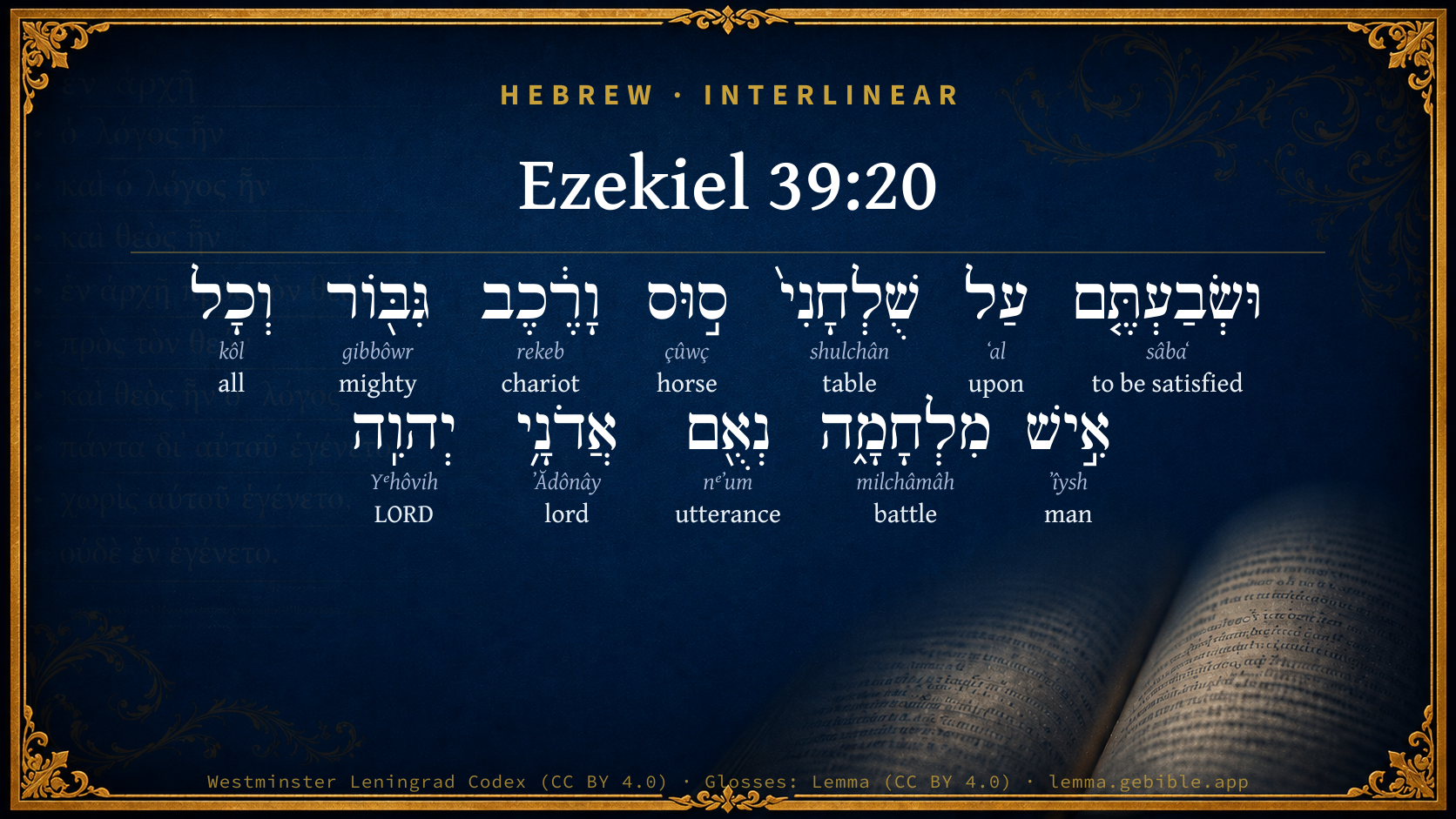
Hebrew (Westminster Leningrad Codex) Ezekiel 39:20 appears in the Hebrew Old Testament. The text above is from the Westminster Leningrad Codex. Each word links to its Strong’s number, a concise gloss, and parsing drawn from the Open Scriptures Hebrew Bible morphology. Click any word for its full Brown-Driver-Briggs (BDB) entry.
Download image
Cite this verse

Ezekiel 39:20 (World English Bible). Public Domain. Lemma interlinear Bible study tool, https://lemma.gebible.app/v/ezekiel/39/20.

Show BibTeX & RIS
BibTeX
RIS
English Translation
You shall be filled at my table with horses and chariots, with mighty men, and with all men of war, says the Lord Yahweh.
World English Bible · Public Domain
Download a study sheet

One document with this verse’s original text, its word-by-word gloss line, the meaning frame, cross-references with their text, attributed commentary, and full source and license credits — printable, and it pastes into notes with its structure intact.

This verse Autodidact and up

Study sheet (.html) Plain text (.txt)

A passage Seminary Student

Up to 50 verses in one chapter. A passage sheet keeps up to 6 commentary sources and 12 cross-references per verse, in the order this page ranks them, and says so on the sheet whenever that leaves anything out. Ask for a single verse and you get the Autodidact verse sheet above.

Everything on this page stays free to read, with no account — the sheet is a download of what is already on screen, not access to it.

Want to remove ads? Support Godless Engineer
Compare translations 3

The same verse in 3 English versions, stacked beneath the original-language interlinear above. Click any original word for its lexicon entry.

Each is an independent rendering of the whole verse — the interlinear is not word-aligned to these translations.

Highlighted words mark where these versions differ — a whole-verse word diff, not a word-by-word alignment.

  • World English Bible Public Domain
    You shall be filled at my table with horses and chariots, with mighty men, and with all men of war, says the Lord Yahweh.
  • King James Version Public Domain
    Thus ye shall be filled at my table with horses and chariots, with mighty men, and with all men of war, saith the Lord GOD.
  • unfoldingWord Literal Text CC BY-SA 4.0
    You will be satisfied at my table with horse, chariot, warrior, and every man of war—this is the Lord Yahweh’s declaration.’

unfoldingWord Literal Text — © unfoldingWord, licensed CC BY-SA 4.0. Word-aligned USFM3 via Door43 (git.door43.org/unfoldingWord/en_ult).

Versions to compare (up to 4)

3 of 4 selected

Show all 18 translations

Every available English version of this verse, each an independent rendering of the whole verse.

  • World English Bible Public Domain
    You shall be filled at my table with horses and chariots, with mighty men, and with all men of war, says the Lord Yahweh.
  • Berean Standard Bible Public Domain
    And at My table you will eat your fill of horses and riders, of mighty men and warriors of every kind,’ declares the Lord GOD.
  • Majority Standard Bible Public Domain
    And at My table you will eat your fill of horses and riders, of mighty men and warriors of every kind,’ declares the Lord GOD.
  • King James Version Public Domain
    Thus ye shall be filled at my table with horses and chariots, with mighty men, and with all men of war, saith the Lord GOD.
  • American Standard Version (1901) Public Domain
    And ye shall be filled at my table with horses and chariots, with mighty men, and with all men of war, saith the Lord Jehovah.
  • Revised Version (1885) Public Domain
    And ye shall be filled at my table with horses and chariots, with mighty men, and with all men of war, saith the Lord GOD.
  • Geneva Bible (1599) Public Domain
    Thus you shalbe filled at my table with horses and chariots, with valiant men, and with al men of warre, sayth the Lord God.
  • Douay-Rheims (1899) Public Domain
    And you shall be filled at my table with horses, and mighty horsemen, and all the men of war, saith the Lord God.
  • Young's Literal Translation Public Domain
    And ye have been satisfied at My table with horse and rider, Mighty man, and every man of war, An affirmation of the Lord Jehovah.
  • Literal Standard Version CC BY-SA 4.0
    And you have been satisfied at My table with horse and rider, || Mighty man, and every man of war, || A declaration of Lord YHWH.
  • Unlocked Literal Bible CC BY-SA 4.0
    You will be satisfied at my table with horse, chariot, warrior, and every man of war—this is the Lord Yahweh's declaration.'
  • unfoldingWord Literal Text CC BY-SA 4.0
    You will be satisfied at my table with horse, chariot, warrior, and every man of war—this is the Lord Yahweh’s declaration.’
  • Darby Bible Public Domain
    And ye shall be filled at my table with horses and charioteers, with mighty men, and with all men of war, saith the Lord Jehovah.
  • World Messianic Bible Public Domain
    You shall be filled at my table with horses and charioteers, with mighty men, and with all men of war,” says the Lord GOD.’
  • Webster's Bible Public Domain
    Thus ye shall be filled at my table with horses and chariots, with mighty men, and with all men of war, saith the Lord GOD.
  • Free Bible Version CC BY-SA 4.0
    You will eat at my table until you're full, consuming horses and riders, powerful men and all kinds of warriors, declares the Lord God.
  • Bible in Basic English Public Domain
    At my table you will have food in full measure, horses and war-carriages, great men and all the men of war, says the Lord.
  • JPS Tanakh (1917) Public Domain
    And ye shall be filled at My table with horses and horsemen, with mighty men, and with all men of war, saith the Lord GOD.

Literal Standard Version (2020), Covenant Press — licensed CC BY-SA 4.0. Text via the HelloAO Bible API (eBible.org). Unlocked Literal Bible (unfoldingWord) — licensed CC BY-SA 4.0. Text via the HelloAO Bible API (eBible.org). unfoldingWord Literal Text — © unfoldingWord, licensed CC BY-SA 4.0. Word-aligned USFM3 via Door43 (git.door43.org/unfoldingWord/en_ult). Free Bible Version, Dr. Jonathan Gallagher — licensed CC BY-SA 4.0. Text via the HelloAO Bible API (eBible.org).

Word by word

More ways to search: Search by grammar → Find every occurrence → Compare this word →

Practice this passage: Drill this verse → Learn its vocabulary →

שֻׁלְחָנִי֙
shulchân
H7979
“table · my”
Noun, Common, Masculine, Singular, Construct + Suffix, Personal, 1st Person, Common, Singular
Part of Speech
Noun
Type
Common
Gender
Masculine
Number
Singular
State
Construct
Full BDB Definition

Origin: from H7971

TWOT: 2395a

table - table - of king's table, private use, sacred uses
  1. וּשְׂבַעְתֶּ֤ם sâbaʻ H7646 “and · to be satisfied” Conjunction + Verb, Qal, Sequential Perfect, 2nd Person, Masculine, Plural
  2. עַל ʻal H5921 “upon” Preposition
  3. ס֣וּס çûwç H5483 “horse” Noun, Common, Masculine, Singular, Absolute
  4. וָרֶ֔כֶב rekeb H7393 “and · chariot” Conjunction + Noun, Common, Masculine, Singular, Absolute
  5. גִּבּ֖וֹר gibbôwr H1368 “mighty” Adjective, Adjective, Masculine, Singular, Absolute
  6. וְכָל kôl H3605 “and · all of” Conjunction + Noun, Common, Masculine, Singular, Construct
  7. אִ֣ישׁ ʼîysh H376 “man of” Noun, Common, Masculine, Singular, Construct
  8. מִלְחָמָ֑ה milchâmâh H4421 “battle” Noun, Common, Feminine, Singular, Absolute
  9. נְאֻ֖ם nᵉʼum H5002 “utterance of” Noun, Common, Masculine, Singular, Construct
  10. אֲדֹנָ֥י ʼĂdônây H136 “Lord · my” Noun, Common, Masculine, Plural, Construct + Suffix, Personal, 1st Person, Common, Singular
  11. יְהוִֽה Yᵉhôvih H3069 “LORD” Noun, Proper

About this verse

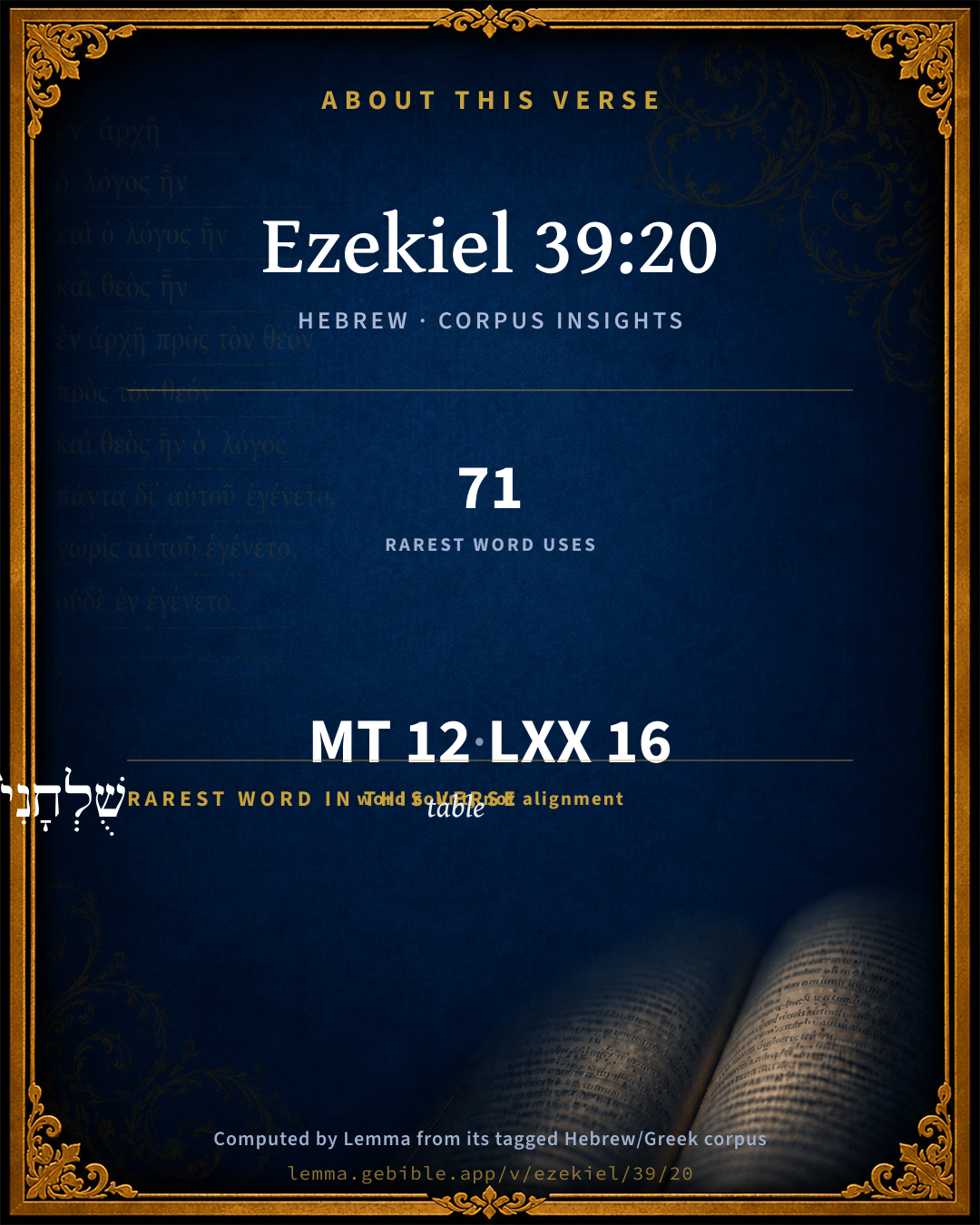
These counts appear in no published source. They are computed here, from the morphology-tagged text and Lemma’s own curated glosses. What Lemma adds →

12
words
12
distinct lemmas
Prophets
section

Grammatical profile

  • 1 verb
  • 9 nouns
  • 1 adjective
  • 1 preposition

Verb forms

  • וּשְׂבַעְתֶּ֤ם Qal · Sequential Perfect

Hebrew & Septuagint length

In English translation the verse runs 24 words from the Hebrew and 21 from the Septuagint (LXX English) — closely comparable.

A rough comparison of the two English renderings, which tokenize alike — not a word-level alignment.

Word counts can differ between the Hebrew and the Greek without any difference in meaning — e.g. the Hebrew direct-object marker אֵת has no separate Greek word, and Greek often adds the article ὁ.

In the original languages it is 12 Hebrew tokens and 16 Greek tokens — but the two are counted differently (Hebrew bundles its prefixes and suffixes into one token; the Greek is in lemma form), so that isn’t a like-for-like length.

Cross-references

4

Topical passages linked to Ezekiel 39:20 in the Treasury of Scripture Knowledge — connected by theme and wording, ordered by reader-vote popularity; previews shown in the World English Bible.

  • Revelation 19:18 that you may eat the flesh of kings, the flesh of captains, the flesh of mighty men, and the flesh of horses and of those who sit on them, and the flesh of all men, both free and slave, and small and great."
  • Haggai 2:22 I will overthrow the throne of kingdoms. I will destroy the strength of the kingdoms of the nations. I will overthrow the chariots, and those who ride in them. The horses and their riders will come down, everyone by the sword of his brother.
  • Psalms 76:5–6 Valiant men lie plundered, They have slept their last sleep. None of the men of war can lift their hands.
  • Ezekiel 38:4 and I will turn you about, and put hooks into your jaws, and I will bring you forth, and all your army, horses and horsemen, all of them clothed in full armor, a great company with buckler and shield, all of them handling swords;

Cross-references courtesy of OpenBible.info (CC BY 4.0).

Hebrew and Greek witnesses Masoretic Hebrew ↔ Greek Septuagint

The same verse in the two great witnesses to the Old Testament, shown verse-for-verse.

These are two independent witnesses, not word-aligned to each other, and the Septuagint is shown in lemma (dictionary) form.

Hebrew Ezekiel 39:20 Masoretic · Westminster Leningrad Codex

וּשְׂבַעְתֶּ֤ם עַל שֻׁלְחָנִי֙ ס֣וּס וָרֶ֔כֶב גִּבּ֖וֹר וְכָל אִ֣ישׁ מִלְחָמָ֑ה נְאֻ֖ם אֲדֹנָ֥י יְהוִֽה

You shall be filled at my table with horses and chariots, with mighty men, and with all men of war, says the Lord Yahweh.

World English Bible · Public Domain

Greek LXX Ezekiel 39:20 Septuagint · lemma form

καί ἐνπίμπλημι ἐπί ὁ τράπεζα ἐγώ ἵππος καί ἀναβάτης γίγας καί πᾶς ἀνήρ πολεμιστής λέγω κύριος

And you⌃ shall be filled at my table, eating horse, and rider, and mighty man, and every warrior, says the Lord.

LXX2012 (modern English Septuagint) · Public Domain

On this verse, The Cambridge Bible for Schools and Colleges discusses the Septuagint’s reading. Read the note in Commentary ↓

Hebrew: Westminster Leningrad Codex (CC BY 4.0). Greek: Septuagint (public domain); English from LXX2012 (modern English Septuagint) (Public Domain). How the Septuagint differs from the Hebrew →

Targum (Aramaic paraphrase)

1

The Targum is the ancient Jewish Aramaic paraphrase of the Hebrew Scriptures — an interpretive translation, not the Hebrew text itself. Onkelos (literal) and Pseudo-Jonathan (expansive) render the Torah, and Jonathan the Prophets. Coverage is partial: where no permissively-licensed English translation exists for a verse, only the Aramaic is shown. This is verse-level text, not a word-by-word alignment to the Hebrew.

  1. Targum Jonathan Prophets (Joshua–Malachi)
    וְתִסְבְּעוּן עַל טוּרֵי יִשְׂרָאֵל סוּסְוָן וּרְתִיכִין גִבָּרִין וְכָל גַבְרֵי עָבְדֵי קְרָבָא אֲמַר יְיָ אֱלֹהִים:

    (no public-domain English translation for this verse)

    Targum Jonathan — Aramaic: “Mikraot Gedolot” (public domain). English: “Sefaria Community Translation” (CC0 1.0 (public-domain dedication)); “London "Chaldee Paraphrase," 1871” (public domain). Text via Sefaria.

Commentary

Notes on Ezekiel 39:20 from classic Christian and Jewish commentators (each source and its license shown beneath its notes). The classic Christian expositions comment on the surrounding passage and are grouped to its opening verse, so a note may address several verses; the Jewish commentaries on the Tanakh (Rashi and others) are per-verse, so they appear only where the commentator wrote on this verse.

Lemma curates 59 commentaries, every one of them public domain or Creative Commons licensed, each selected and text-cleaned for this edition rather than reprinted as found. About our sources →

Trapp's Complete Commentary

John Trapp

Eze 39:20 Thus ye shall be filled at my table with horses and chariots, with mighty men, and with all men of war, saith the Lord GOD.

Ver. 20. With horses and chariots,] i.e., With men that ride on horses, and fight out of chariots.

John Trapp, A Commentary or Exposition upon All the Books of the Old and New Testament (1647–1656) — public domain. Text from a community e-Sword module.

Jamieson, Fausset & Brown

Robert Jamieson, A. R. Fausset & David Brown

my table--the field of battle on the mountains of Israel (Eze 38:8, Eze 38:20).

chariots--that is, charioteers.

Jamieson, Fausset & Brown — Commentary Critical and Explanatory on the Whole Bible (1871) — public domain (CC PDM 1.0). Text via the HelloAO Bible API.

The Cambridge Bible for Schools and Colleges

gen. ed. J. J. S. Perowne

20. my table] It is the Lord that holds the sacrificial feast here (Eze_39:19), and it is his table to which he invites the fowls and beasts.

horses and chariots] It is scarcely necessary to point with LXX. horse and rider; “chariot” suggests that those borne in the chariot are intended. The term rendered “chariot” seems used, however, of “riding-beasts,” e.g. the ass and the camel, Isa_21:7; Isa_21:9; and there is no intimation elsewhere that Gog’s army rode in chariots: they were horsemen and bowmen.

The Cambridge Bible for Schools and Colleges (gen. ed. J. J. S. Perowne; Cambridge University Press, 1878–1918) — public domain. Text from a community e-Sword module.

John Gill's Exposition

Thus shall ye be filled at my table with horses and chariots,.... With the flesh of horses, and of them that sit on them, as John interprets it, Rev 19:18, and so the Septuagint, Syriac, and Arabic versions: and with the flesh of men that ride in chariots used in war; for chariots themselves cannot be eaten; and with these the birds and beasts of prey will be filled at the Lord's table, which he will furnish for them on the mountains of Israel, on the field of battle, where Gog and his army will fall: and thus as the Lord's supper is called the table of the Lord, Co1 10:21, so this table of the Lord is called the supper of the great God, Rev 19:17, this is further explained,

with mighty men, and with all men of war, saith the Lord God; that is, with the flesh of valiant men, generals, captains, officers of all sorts, and common soldiers, even of all men, great and small, bond and free, Rev 19:18.

John Gill's Exposition of the Whole Bible (1746–1763) — public domain (CC PDM 1.0). Text via the HelloAO Bible API.

Matthew Poole's English Annotations

At my table; in the field where Gog, his princes, and army are slain, compared to a table.

Horses put for horsemen, not common foot-soldiers.

Chariots for the men that ride in them.

Mighty men; see Eze 39:18.

Matthew Poole's English Annotations on the Holy Bible (1683–1685) — public domain. Text from a community e-Sword/MySword module.

John Wesley's Explanatory Notes

At my table - In the field where Gog, his princes, and army, are slain, compared to a table. Horses - Horsemen, not common foot soldiers. Chariots - The men that ride in them.

John Wesley, Explanatory Notes Upon the Whole Bible (1754–1765) — public domain. Text via the GEBible commentary corpus.

Lesson kit

Teaching starters — assembled from the data on this page, not authored interpretation. Every prompt links to the verse data it draws on. Edit before teaching.

Ezekiel, in the Prophets, opens this verse with 12 words (12 distinct Hebrew lemmas). Its most distinctive word is shulchân (“table”). A historical commentator’s framing appears above. Read the whole chapter for the surrounding context.

Discussion questions

  1. What does “table” (shulchân) contribute to the verse as a whole?
  2. How does Revelation 19:18, which shares this passage’s theme, read alongside this verse?
  3. These translations render this verse differently; the difference is in the English rendering, not the original. What questions does that raise?
  4. «וּשְׂבַעְתֶּ֤ם» is a Qal Sequential Perfect verb. How does that grammatical form shape the action described?
  5. Compare how Trapp's Complete Commentary and Jamieson, Fausset & Brown read this verse. Where do they agree or differ?

Things to notice

Reading settings

Reading text

Shown beneath each verse's original-language words.

Old Testament
Old Testament edition

Read the OT as the Masoretic Hebrew (MT) or the Greek Septuagint (LXX).

English shown for the Greek Septuagint (in the Hebrew ↔ Greek comparison).

Comparing translations? Open the Compare panel on any verse page to stack up to four side by side.