2 Kings 7:14

Hebrew (Westminster Leningrad Codex) 2 Kings 7:14 appears in the Hebrew Old Testament. The text above is from the Westminster Leningrad Codex. Each word links to its Strong’s number, a concise gloss, and parsing drawn from the Open Scriptures Hebrew Bible morphology. Click any word for its full Brown-Driver-Briggs (BDB) entry.
Download image
Cite this verse

2 Kings 7:14 (World English Bible). Public Domain. Lemma interlinear Bible study tool, https://lemma.gebible.app/v/2-kings/7/14.

Show BibTeX & RIS
BibTeX
RIS
English Translation
They took therefore two chariots with horses; and the king sent after the host of the Syrians, saying, Go and see.
World English Bible · Public Domain
Download a study sheet

One document with this verse’s original text, its word-by-word gloss line, the meaning frame, cross-references with their text, attributed commentary, and full source and license credits — printable, and it pastes into notes with its structure intact.

This verse Autodidact and up

Study sheet (.html) Plain text (.txt)

A passage Seminary Student

Up to 50 verses in one chapter. A passage sheet keeps up to 6 commentary sources and 12 cross-references per verse, in the order this page ranks them, and says so on the sheet whenever that leaves anything out. Ask for a single verse and you get the Autodidact verse sheet above.

Everything on this page stays free to read, with no account — the sheet is a download of what is already on screen, not access to it.

Want to remove ads? Support Godless Engineer
Compare translations 3

The same verse in 3 English versions, stacked beneath the original-language interlinear above. Click any original word for its lexicon entry.

Each is an independent rendering of the whole verse — the interlinear is not word-aligned to these translations.

Highlighted words mark where these versions differ — a whole-verse word diff, not a word-by-word alignment.

  • World English Bible Public Domain
    They took therefore two chariots with horses; and the king sent after the host of the Syrians, saying, Go and see.
  • King James Version Public Domain
    They took therefore two chariot horses; and the king sent after the host of the Syrians, saying, Go and see.
  • unfoldingWord Literal Text CC BY-SA 4.0
    And they took two chariots horses, and the king sent after the camp of Aram, saying, “Go and see.”

unfoldingWord Literal Text — © unfoldingWord, licensed CC BY-SA 4.0. Word-aligned USFM3 via Door43 (git.door43.org/unfoldingWord/en_ult).

Versions to compare (up to 4)

3 of 4 selected

Show all 18 translations

Every available English version of this verse, each an independent rendering of the whole verse.

  • World English Bible Public Domain
    They took therefore two chariots with horses; and the king sent after the host of the Syrians, saying, Go and see.
  • Berean Standard Bible Public Domain
    Then the scouts took two chariots with horses, and the king sent them after the Aramean army, saying, “Go and see.”
  • Majority Standard Bible Public Domain
    Then the scouts took two chariots with horses, and the king sent them after the Aramean army, saying, “Go and see.”
  • King James Version Public Domain
    They took therefore two chariot horses; and the king sent after the host of the Syrians, saying, Go and see.
  • American Standard Version (1901) Public Domain
    They took therefore two chariots with horses; and the king sent after the host of the Syrians, saying, Go and see.
  • Revised Version (1885) Public Domain
    They took therefore two chariots with horses; and the king sent after the host of the Syrians, saying, Go and see.
  • Geneva Bible (1599) Public Domain
    So they tooke two charets of horses, and the King sent after the hoste of the Aramites, saying, Goe and see.
  • Douay-Rheims (1899) Public Domain
    They brought therefore two horses, and the king sent into the camp of the Syrians, saying: Go, and see.
  • Young's Literal Translation Public Domain
    And they take two chariot-horses, and the king sendeth after the camp of Aram, saying, `Go, and see.'
  • Literal Standard Version CC BY-SA 4.0
    And they take two chariot-horses, and the king sends [them] after the camp of Aram, saying, “Go, and see.”
  • Unlocked Literal Bible CC BY-SA 4.0
    So they took two chariots with horses, and the king sent them after the army of the Arameans, saying, “Go and see.”
  • unfoldingWord Literal Text CC BY-SA 4.0
    And they took two chariots horses, and the king sent after the camp of Aram, saying, “Go and see.”
  • Darby Bible Public Domain
    And they took two chariots with their horses; and the king sent after the army of the Syrians, saying, Go and see.
  • World Messianic Bible Public Domain
    Therefore they took two chariots with horses; and the king sent them out to the Syrian army, saying, “Go and see.”
  • Webster's Bible Public Domain
    They took therefore two chariot horses; and the king sent after the host of the Syrians, saying, Go and see.
  • Free Bible Version CC BY-SA 4.0
    So they got two chariots ready with their horses, and the king sent them out to the Aramean camp, telling them “Go and take a look.”
  • Bible in Basic English Public Domain
    So they took two horsemen; and the king sent them after the army of the Aramaeans, saying, Go and see.
  • JPS Tanakh (1917) Public Domain
    They took therefore two chariots with horses; and the king sent after the host of the Arameans, saying: 'Go and see.'

Literal Standard Version (2020), Covenant Press — licensed CC BY-SA 4.0. Text via the HelloAO Bible API (eBible.org). Unlocked Literal Bible (unfoldingWord) — licensed CC BY-SA 4.0. Text via the HelloAO Bible API (eBible.org). unfoldingWord Literal Text — © unfoldingWord, licensed CC BY-SA 4.0. Word-aligned USFM3 via Door43 (git.door43.org/unfoldingWord/en_ult). Free Bible Version, Dr. Jonathan Gallagher — licensed CC BY-SA 4.0. Text via the HelloAO Bible API (eBible.org).

Word by word

More ways to search: Search by grammar → Find every occurrence → Compare this word →

Practice this passage: Drill this verse → Learn its vocabulary →

רֶ֣כֶב
rekeb
H7393
“chariot”
Noun, Common, Masculine, Singular, Absolute
Part of Speech
Noun
Type
Common
Gender
Masculine
Number
Singular
State
Absolute
Full BDB Definition

Origin: from H7392

TWOT: 2163a

a team, chariot, chariotry, mill-stone, riders - chariotry, chariots - chariot (single) - upper millstone (as riding on lower millstone) - riders, troop (of riders), horsemen, pair of horsemen, men riding, ass-riders, camel-riders
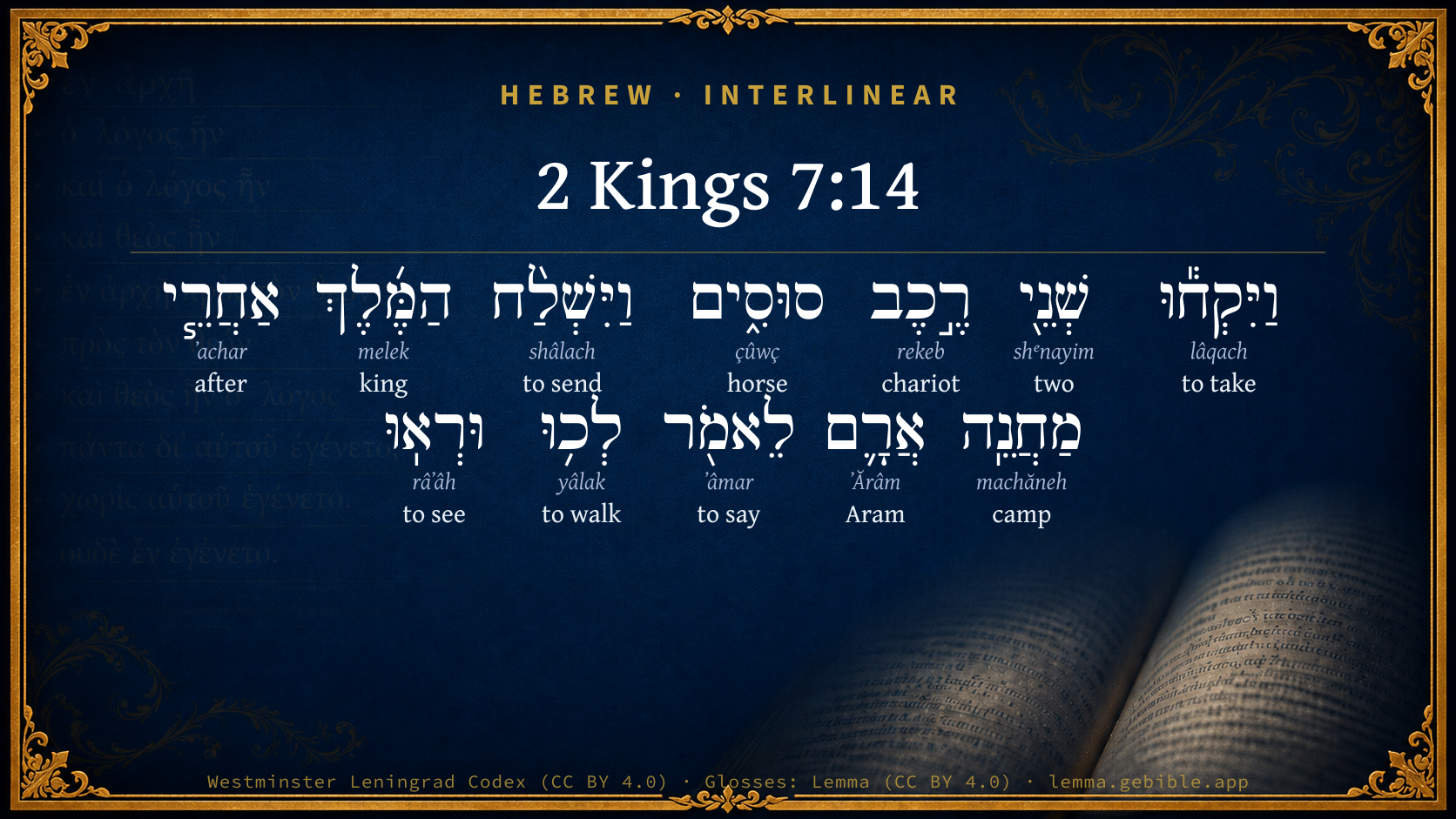
  1. וַיִּקְח֕וּ lâqach H3947 “and · to take” Conjunction + Verb, Qal, Sequential Imperfect, 3rd Person, Masculine, Plural
  2. שְׁנֵ֖י shᵉnayim H8147 “two” Adjective, Cardinal number, Masculine, Dual, Construct
  3. סוּסִ֑ים çûwç H5483 “horses” Noun, Common, Masculine, Plural, Absolute
  4. וַיִּשְׁלַ֨ח shâlach H7971 “and · to send” Conjunction + Verb, Qal, Sequential Imperfect, 3rd Person, Masculine, Singular
  5. הַמֶּ֜לֶךְ melek H4428 “the · king” Particle, Definite Article + Noun, Common, Masculine, Singular, Absolute
  6. אַחֲרֵ֧י ʼachar H310 “after” Preposition
  7. מַחֲנֵֽה machăneh H4264 “camp of” Noun, Common, Both, Singular, Construct
  8. אֲרָ֛ם ʼĂrâm H758 “Aram” Noun, Proper
  9. לֵאמֹ֖ר ʼâmar H559 “to say” Preposition + Verb, Qal, Infinitive Construct
  10. לְכ֥וּ yâlak H3212 “walk” Verb, Qal, Imperative, 2nd Person, Masculine, Plural
  11. וּרְאֽוּ râʼâh H7200 “and · see” Conjunction + Verb, Qal, Imperative, 2nd Person, Masculine, Plural

About this verse

These counts appear in no published source. They are computed here, from the morphology-tagged text and Lemma’s own curated glosses. What Lemma adds →

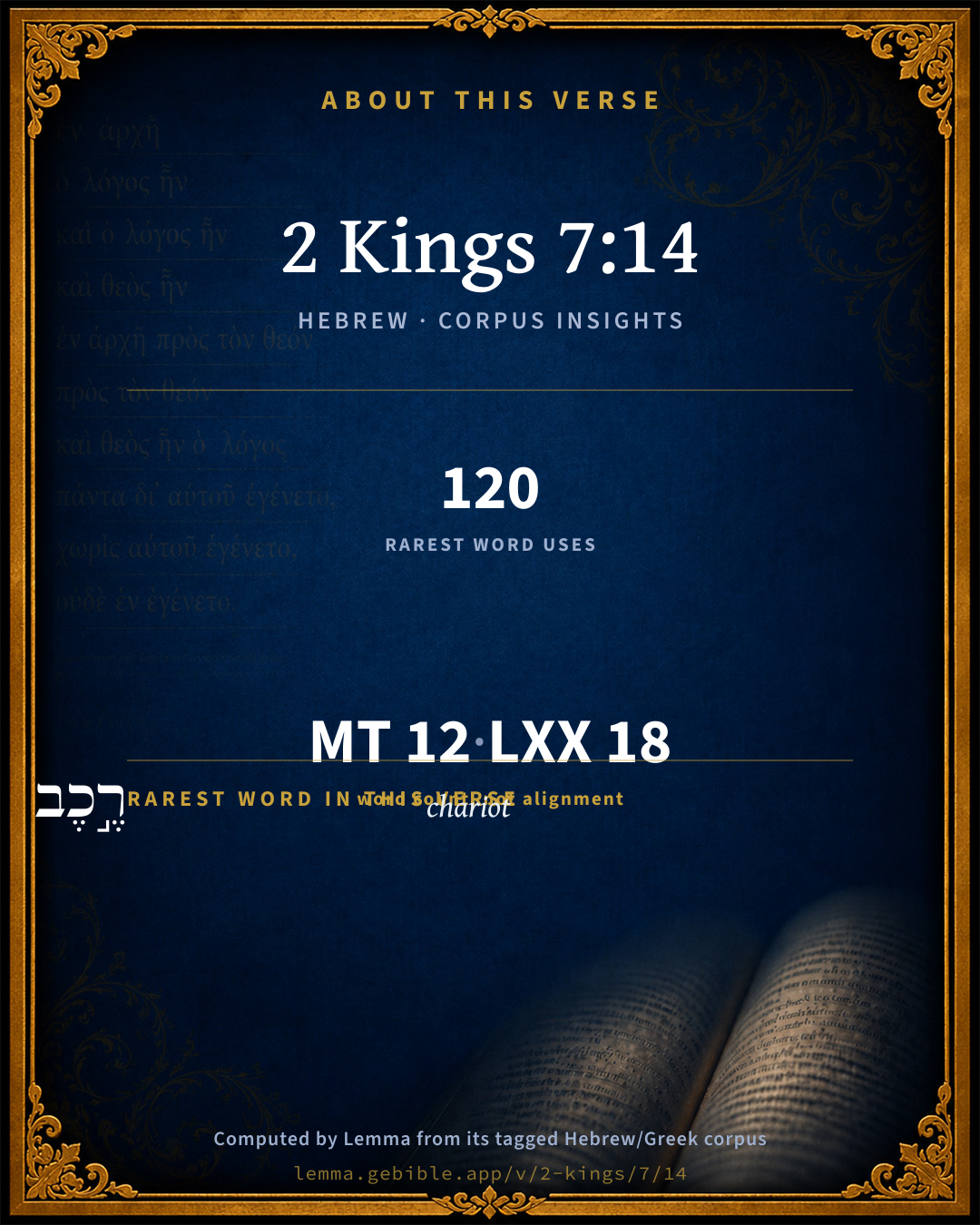
12
words
12
distinct lemmas
Historical
section

Grammatical profile

  • 5 verbs
  • 5 nouns
  • 1 adjective
  • 1 preposition

Verb forms

  • וַיִּקְח֕וּ Qal · Sequential Imperfect
  • וַיִּשְׁלַ֨ח Qal · Sequential Imperfect
  • לֵאמֹ֖ר Qal · Infinitive Construct
  • לְכ֥וּ Qal · Imperative
  • וּרְאֽוּ Qal · Imperative

Hebrew & Septuagint length

In English translation the verse runs 21 words from the Hebrew and 20 from the Septuagint (LXX English) — closely comparable.

A rough comparison of the two English renderings, which tokenize alike — not a word-level alignment.

Word counts can differ between the Hebrew and the Greek without any difference in meaning — e.g. the Hebrew direct-object marker אֵת has no separate Greek word, and Greek often adds the article ὁ.

In the original languages it is 12 Hebrew tokens and 18 Greek tokens — but the two are counted differently (Hebrew bundles its prefixes and suffixes into one token; the Greek is in lemma form), so that isn’t a like-for-like length.

Hebrew and Greek witnesses Masoretic Hebrew ↔ Greek Septuagint

The same verse in the two great witnesses to the Old Testament, shown verse-for-verse.

These are two independent witnesses, not word-aligned to each other, and the Septuagint is shown in lemma (dictionary) form.

Hebrew 2 Kings 7:14 Masoretic · Westminster Leningrad Codex

וַיִּקְח֕וּ שְׁנֵ֖י רֶ֣כֶב סוּסִ֑ים וַיִּשְׁלַ֨ח הַמֶּ֜לֶךְ אַחֲרֵ֧י מַחֲנֵֽה אֲרָ֛ם לֵאמֹ֖ר לְכ֥וּ וּרְאֽוּ

They took therefore two chariots with horses; and the king sent after the host of the Syrians, saying, Go and see.

World English Bible · Public Domain

Greek LXX 2 Kings 7:14 Septuagint · lemma form

καί λαμβάνω δύο ἐπιβάτης ἵππος καί ἀποστέλλω ὁ βασιλεύς ἰσραήλ ὀπίσω ὁ βασιλεύς συρία λέγω δεῦτε καί ὁράω

So they took two horsemen; and the king of Israel sent after the king of Syria, saying, Go, and see.

LXX2012 (modern English Septuagint) · Public Domain

Hebrew: Westminster Leningrad Codex (CC BY 4.0). Greek: Septuagint (public domain); English from LXX2012 (modern English Septuagint) (Public Domain). How the Septuagint differs from the Hebrew →

Targum (Aramaic paraphrase)

1

The Targum is the ancient Jewish Aramaic paraphrase of the Hebrew Scriptures — an interpretive translation, not the Hebrew text itself. Onkelos (literal) and Pseudo-Jonathan (expansive) render the Torah, and Jonathan the Prophets. Coverage is partial: where no permissively-licensed English translation exists for a verse, only the Aramaic is shown. This is verse-level text, not a word-by-word alignment to the Hebrew.

  1. Targum Jonathan Prophets (Joshua–Malachi)
    וְדַבָּרוּ תְרֵין רִכְבֵי סוּסִין וּשְׁלַח מַלְכָּא בָּתַר מַשִׁרְיַת אֲרָם לְמֵימַר אֱזִילוּ וַחֲזוֹ:

    (no public-domain English translation for this verse)

    Targum Jonathan — Aramaic: “Mikraot Gedolot” (public domain). English: “Sefaria Community Translation” (CC0 1.0 (public-domain dedication)); “London "Chaldee Paraphrase," 1871” (public domain). Text via Sefaria.

Commentary

Notes on 2 Kings 7:14 from classic Christian and Jewish commentators (each source and its license shown beneath its notes). The classic Christian expositions comment on the surrounding passage and are grouped to its opening verse, so a note may address several verses; the Jewish commentaries on the Tanakh (Rashi and others) are per-verse, so they appear only where the commentator wrote on this verse.

Lemma curates 59 commentaries, every one of them public domain or Creative Commons licensed, each selected and text-cleaned for this edition rather than reprinted as found. About our sources →

Trapp's Complete Commentary

John Trapp

2Ki 7:14 They took therefore two chariot horses; and the king sent after the host of the Syrians, saying, Go and see.

Ver. 14. Two chariot horses.] With their riders.

John Trapp, A Commentary or Exposition upon All the Books of the Old and New Testament (1647–1656) — public domain. Text from a community e-Sword module.

Joseph Benson's Commentary

2Ki 7:14-16. They took therefore two chariot horses — It is probable the king would venture no more than two horsemen, whom he thought sufficient: and these took two of his own horses to make the discovery. They went after them unto Jordan — Finding the camp empty, as the lepers had related, they followed them as far as this river. All the way was full of garments, &c., cast away in their haste — Hebrew, בחפזם, bechaphezam, in their fear, trepidation, or consternation, wherewith God had struck them. So a measure of fine flour was sold for a shekel, &c. —

They found such store of provisions in the tents of the Syrians, that it made this sudden change in the price of corn, according to Elisha’s prediction.

Joseph Benson's Commentary on the Old and New Testaments (1811–1818) — public domain. Text from a community e-Sword module.

Geneva Bible (1599)

Geneva Bible translators

Or, two horses of the chariot, which were accustomed to draw in the chariot.

Geneva Bible (1599) marginal notes — public domain. Text via Bolls.life.

Adam Clarke's Commentary

Verse 14. They took - two chariot horses] They had at first intended to send five; probably they found on examination that only two were effective. But if they sent two chariots, each would have two horses, and probably a single horse for crossing the country.

Adam Clarke's Commentary on the Bible (1810–1826) — public domain. Text from a community e-Sword/MySword module.

Ellicott's Commentary for English Readers

(14) Two chariot horses.—Literally, two chariots (of) horses, i.e., teams for two chariots, or two pairs of horses. The chariots and their drivers are implied, not mentioned. Two chariots were sent, so that if attacked they might make a better resistance; or perhaps in order that, if one were captured by the enemy, the other might escape with the news.

A Bible Commentary for English Readers, edited by Charles John Ellicott (1878–1897) — public domain. Text from a community e-Sword module.

The Cambridge Bible for Schools and Colleges

gen. ed. J. J. S. Perowne

14. two chariot horses] R.V. two chariots with horses. Each chariot had its pair of horses, so that there were four horses, and probably two or three people in each chariot. If anything happened to one chariot, the other might come to the rescue, or, at all events, have a chance of escaping to the city.

after the host of the Syrians] The spies were not content with searching the camp. For the king’s misgivings had no doubt communicated themselves to the messengers. So they went on the way where scattered property of all kinds shewed that the Syrians had taken their flight.

The Cambridge Bible for Schools and Colleges (gen. ed. J. J. S. Perowne; Cambridge University Press, 1878–1918) — public domain. Text from a community e-Sword module.

John Gill's Exposition

They took therefore two chariot horses,.... Not five, but two only, and those the best, that drew in the king's chariot perhaps, and so were better fed, and fitter for this expedition:

and the king sent after the host of the Syrians, saying, go and see; whether they are fled or not.

John Gill's Exposition of the Whole Bible (1746–1763) — public domain (CC PDM 1.0). Text via the HelloAO Bible API.

Albert Barnes' Notes on the Bible

Two chariot horses - Translate, “two horse-chariots.” They dispatched i. e. two war-chariots, with their proper complement of horses and men, to see whether the retreat was a reality or only a feint. The “horses” sent would be four or six, since chariots were drawn by either two or three horses.

Albert Barnes' Notes on the Bible (1834–1885) — public domain. Text from a community e-Sword/MySword module.

Haydock's Catholic Bible Commentary

Horses. Hebrew, "chariot horses," or two chariots with (each) two horses, as it was customary to go to war, and to travel on chariots. (Calmet)

George Leo Haydock (1774–1849), Haydock's Catholic Family Bible and Commentary, 1859 edition — public domain. Excludes Psalms (Douay-Rheims chapter numbering differs from Protestant) and Deuterocanonical books (Catholic canon only).

Matthew Poole's English Annotations

Two chariot horses, or, two chariots of horses; or rather, two chariot horses, as divers render the words, i.e. horses which belonged to the king’s chariots. For single horses seem much more proper for this service than chariots and horses. And whereas it was moved by the king’s servant, that all the five horses should be sent, it seems it was thought by the king and others that two were sufficient for that purpose.

Matthew Poole's English Annotations on the Holy Bible (1683–1685) — public domain. Text from a community e-Sword/MySword module.

Whedon's Commentary on the Bible

Daniel D. Whedon

14. Two chariot horses — Literally, two chariot of horses; that is, two span of horses; horses enough to accompany two chariots. Instead of five, as the servants proposed, the king sent four.

Daniel D. Whedon (gen. ed.), Commentary on the Old and New Testaments (1874–1909) — public domain. Text from a community e-Sword module.

The Pulpit Commentary

They took therefore two chariot horses; literally, two chariots of horses; i.e. two chariots, with the accustomed number of horses, which (with the Israelites) was two, though with the Assyrians and Egyptians it was frequently three. The employment of chariots instead of horsemen is remarkable, and seems to indicate that with the Israelites, as with the Egyptians, the chariot force was regarded as superior to the cavalry for practical purposes. And the king sent after the host of the Syrians, saying, Go and see. The advice of the king"s "servant" was taken; a couple of chariots were sent out to reconnoiter.

The Pulpit Commentary (1880–1919), ed. H.D.M. Spence-Jones & Joseph S. Exell — public domain. Text from a community e-Sword module.

unfoldingWord translationNotes

Door43 World Missions Community

Go and see

The implicit information about what the king wanted them to see may be stated clearly. AT: "Go and see if what these lepers have said is true" (See: Assumed Knowledge and Implicit Information)

They went after them to the Jordan

"They followed the path the Aramean army took all the way to the Jordan River"

all the road was full of clothes and equipment

This is an exaggeration that means the men saw these items scattered along the road as they traveled. AT: "there were clothes and equipment all along the road" (See: Hyperbole and Generalization)

translationWords

chariot

Jordan River

messenger

unfoldingWord translationNotes — © Distant Shores Media and the Door43 World Missions Community, licensed CC BY-SA 4.0. Source: git.door43.org/Door43/en_tn.

Lesson kit

Teaching starters — assembled from the data on this page, not authored interpretation. Every prompt links to the verse data it draws on. Edit before teaching.

2 Kings, in the Historical, opens this verse with 12 words (12 distinct Hebrew lemmas). Its most distinctive word is rekeb (“chariot”). A historical commentator’s framing appears above. Read the whole chapter for the surrounding context.

Discussion questions

  1. The word rekeb carries the sense “chariot.” How does it shape the verse?
  2. These translations render this verse differently. What is at stake in choosing one wording over another?
  3. The verb «וַיִּקְח֕וּ» is Qal Sequential Imperfect. How does its form color the action?
  4. Reading how Trapp's Complete Commentary and Joseph Benson's Commentary read this verse, where do the two commentators agree and where do they part?

Things to notice

Reading settings

Reading text

Shown beneath each verse's original-language words.

Old Testament
Old Testament edition

Read the OT as the Masoretic Hebrew (MT) or the Greek Septuagint (LXX).

English shown for the Greek Septuagint (in the Hebrew ↔ Greek comparison).

Comparing translations? Open the Compare panel on any verse page to stack up to four side by side.