1 Kings 10:28

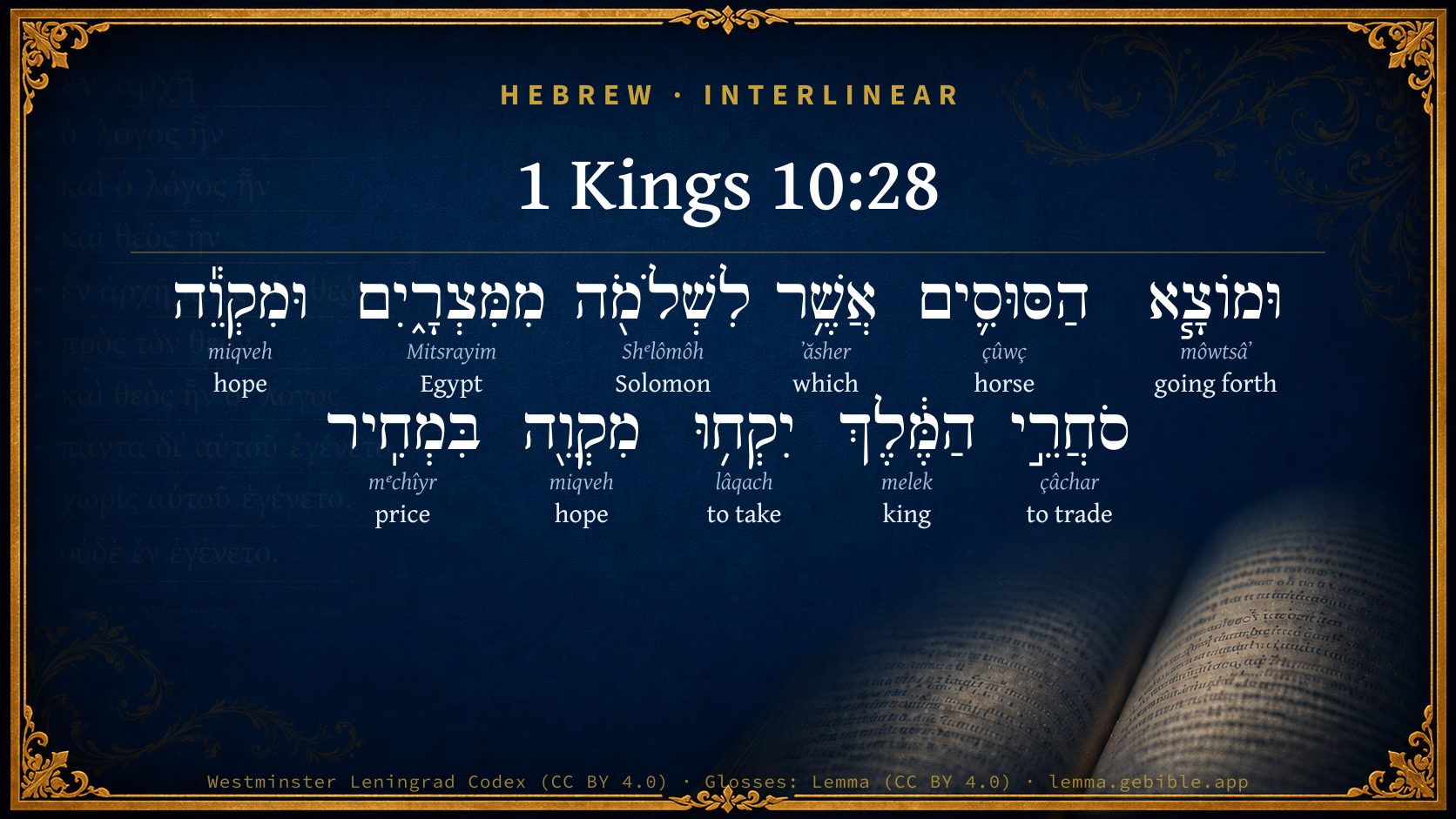
Hebrew (Westminster Leningrad Codex) 1 Kings 10:28 appears in the Hebrew Old Testament. The text above is from the Westminster Leningrad Codex. Each word links to its Strong’s number, a concise gloss, and parsing drawn from the Open Scriptures Hebrew Bible morphology. Click any word for its full Brown-Driver-Briggs (BDB) entry.
Download image
Cite this verse

1 Kings 10:28 (World English Bible). Public Domain. Lemma interlinear Bible study tool, https://lemma.gebible.app/v/1-kings/10/28.

Show BibTeX & RIS
BibTeX
RIS
English Translation
The horses which Solomon had were brought out of Egypt; and the king's merchants received them in droves, each drove at a price.
World English Bible · Public Domain
Download a study sheet

One document with this verse’s original text, its word-by-word gloss line, the meaning frame, cross-references with their text, attributed commentary, and full source and license credits — printable, and it pastes into notes with its structure intact.

This verse Autodidact and up

Study sheet (.html) Plain text (.txt)

A passage Seminary Student

Up to 50 verses in one chapter. A passage sheet keeps up to 6 commentary sources and 12 cross-references per verse, in the order this page ranks them, and says so on the sheet whenever that leaves anything out. Ask for a single verse and you get the Autodidact verse sheet above.

Everything on this page stays free to read, with no account — the sheet is a download of what is already on screen, not access to it.

Want to remove ads? Support Godless Engineer
Compare translations 3

The same verse in 3 English versions, stacked beneath the original-language interlinear above. Click any original word for its lexicon entry.

Each is an independent rendering of the whole verse — the interlinear is not word-aligned to these translations.

Highlighted words mark where these versions differ — a whole-verse word diff, not a word-by-word alignment.

  • World English Bible Public Domain
    The horses which Solomon had were brought out of Egypt; and the king's merchants received them in droves, each drove at a price.
  • King James Version Public Domain
    And Solomon had horses brought out of Egypt, and linen yarn: the king's merchants received the linen yarn at a price.
  • unfoldingWord Literal Text CC BY-SA 4.0
    And the going out of the horses that to Solomon from Egypt and from Kue. The traders of the king would take from Kue for a price.

unfoldingWord Literal Text — © unfoldingWord, licensed CC BY-SA 4.0. Word-aligned USFM3 via Door43 (git.door43.org/unfoldingWord/en_ult).

Versions to compare (up to 4)

3 of 4 selected

Show all 18 translations

Every available English version of this verse, each an independent rendering of the whole verse.

  • World English Bible Public Domain
    The horses which Solomon had were brought out of Egypt; and the king's merchants received them in droves, each drove at a price.
  • Berean Standard Bible Public Domain
    Solomon’s horses were imported from Egypt and Kue; the royal merchants purchased them from Kue.
  • Majority Standard Bible Public Domain
    Solomon’s horses were imported from Egypt and Kue; the royal merchants purchased them from Kue.
  • King James Version Public Domain
    And Solomon had horses brought out of Egypt, and linen yarn: the king's merchants received the linen yarn at a price.
  • American Standard Version (1901) Public Domain
    And the horses which Solomon had were brought out of Egypt; and the king's merchants received them in droves, each drove at a price.
  • Revised Version (1885) Public Domain
    And the horses which Solomon had were brought out of Egypt; and the king’s merchants received them in droves, each drove at a price.
  • Geneva Bible (1599) Public Domain
    Also Salomon had horses brought out of Egypt, and fine linen: the Kings marchants receiued the linen for a price.
  • Douay-Rheims (1899) Public Domain
    And horses were brought for Solomon out of Egypt, and Coa: for the king's merchants brought them out of Coa, and bought them at a set price.
  • Young's Literal Translation Public Domain
    And the outgoing of the horses that king Solomon hath `is' from Egypt, and from Keveh; merchants of the king take from Keveh at a price;
  • Literal Standard Version CC BY-SA 4.0
    And the outgoing of the horses that King Solomon has [is] from Egypt, and from Keveh; merchants of the king take from Keveh at a price;
  • Unlocked Literal Bible CC BY-SA 4.0
    The horses that belonged to Solomon were imported from Egypt, and Kue and the king's merchants purchased them from Kue.
  • unfoldingWord Literal Text CC BY-SA 4.0
    And the going out of the horses that to Solomon from Egypt and from Kue. The traders of the king would take from Kue for a price.
  • Darby Bible Public Domain
    And the exportation of horses that Solomon had was from Egypt: a caravan of the king's merchants fetched a drove [of horses], at a price.
  • World Messianic Bible Public Domain
    The horses which Solomon had were brought out of Egypt. The king’s merchants received them in droves, each drove at a price.
  • Webster's Bible Public Domain
    And Solomon had horses brought from Egypt, and linen yarn: the king's merchants received the linen yarn at a price.
  • Free Bible Version CC BY-SA 4.0
    Solomon's horses were imported from Egypt and Kue—the royal merchants purchased them in Kue.
  • Bible in Basic English Public Domain
    And Solomon's horses came from Egypt and from Kue; the king's traders got them at a price from Kue.
  • JPS Tanakh (1917) Public Domain
    And the horses which Solomon had were brought out of Egypt; also out of Keveh, the king's merchants buying them of the men of Keveh at a price.

Literal Standard Version (2020), Covenant Press — licensed CC BY-SA 4.0. Text via the HelloAO Bible API (eBible.org). Unlocked Literal Bible (unfoldingWord) — licensed CC BY-SA 4.0. Text via the HelloAO Bible API (eBible.org). unfoldingWord Literal Text — © unfoldingWord, licensed CC BY-SA 4.0. Word-aligned USFM3 via Door43 (git.door43.org/unfoldingWord/en_ult). Free Bible Version, Dr. Jonathan Gallagher — licensed CC BY-SA 4.0. Text via the HelloAO Bible API (eBible.org).

Word by word

More ways to search: Search by grammar → Find every occurrence → Compare this word →

Practice this passage: Drill this verse → Learn its vocabulary →

וּמִקְוֵ֕ה
miqveh
H4723
“and · from · hope”
Conjunction + Preposition + Noun, Proper
Part of Speech
Conjunction + Preposition + Noun
Type
Proper
Full BDB Definition

Origin: from H6960

TWOT: 1994c , 1995a

hope - hope - ground of hope - things hoped for, outcome - collection, collected mass
  1. וּמוֹצָ֧א môwtsâʼ H4161 “and · going forth of” Conjunction + Noun, Common, Masculine, Singular, Construct
  2. הַסּוּסִ֛ים çûwç H5483 “the · horses” Particle, Definite Article + Noun, Common, Masculine, Plural, Absolute
  3. אֲשֶׁ֥ר ʼăsher H834 “which” Particle, Relative
  4. לִשְׁלֹמֹ֖ה Shᵉlômôh H8010 “to/for · Solomon” Preposition + Noun, Proper
  5. מִמִּצְרָ֑יִם Mitsrayim H4714 “from · Egypt” Preposition + Noun, Proper
  6. סֹחֲרֵ֣י çâchar H5503 “trading” Verb, Qal, Participle Active, Masculine, Plural, Construct
  7. הַמֶּ֔לֶךְ melek H4428 “the · king” Particle, Definite Article + Noun, Common, Masculine, Singular, Absolute
  8. יִקְח֥וּ lâqach H3947 “to take” Verb, Qal, Imperfect, 3rd Person, Masculine, Plural
  9. מִקְוֵ֖ה miqveh H4723 “from · hope” Preposition + Noun, Proper
  10. בִּמְחִֽיר mᵉchîyr H4242 “in/at · price” Preposition + Noun, Common, Masculine, Singular, Absolute

About this verse

These counts appear in no published source. They are computed here, from the morphology-tagged text and Lemma’s own curated glosses. What Lemma adds →

11
words
10
distinct lemmas
Historical
section

Notable vocabulary

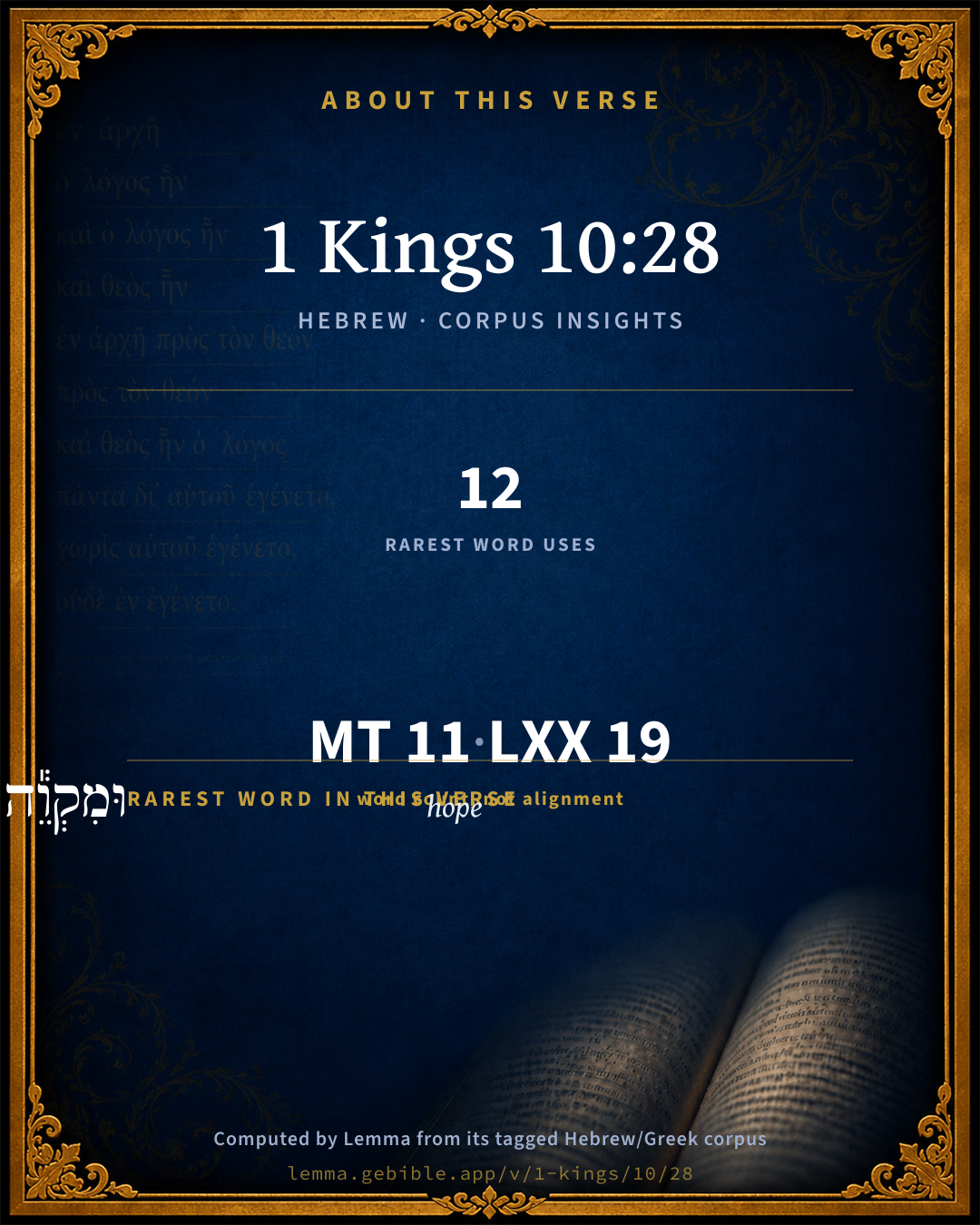
The rarest word here is וּמִקְוֵ֕ה hope H4723 — appearing just 12 times in the whole Hebrew Bible.

Shared distinctive vocabulary

וּמִקְוֵ֕ה hope H4723 occurs in 10 verses of the Hebrew Bible. Also found in:

Grammatical profile

  • 2 verbs
  • 8 nouns
  • 1 particle

Verb forms

  • סֹחֲרֵ֣י Qal · Participle Active
  • יִקְח֥וּ Qal · Imperfect

Repetition

A word recurs within this verse — often emphatic in Hebrew:

  • וּמִקְוֵ֕ה hope H4723 ×2

Hebrew & Septuagint length

In English translation the verse runs 23 words from the Hebrew and 29 from the Septuagint (LXX English) — closely comparable.

A rough comparison of the two English renderings, which tokenize alike — not a word-level alignment.

Word counts can differ between the Hebrew and the Greek without any difference in meaning — e.g. the Hebrew direct-object marker אֵת has no separate Greek word, and Greek often adds the article ὁ.

In the original languages it is 11 Hebrew tokens and 19 Greek tokens — but the two are counted differently (Hebrew bundles its prefixes and suffixes into one token; the Greek is in lemma form), so that isn’t a like-for-like length.

Cross-references

9

Topical passages linked to 1 Kings 10:28 in the Treasury of Scripture Knowledge — connected by theme and wording, ordered by reader-vote popularity; previews shown in the World English Bible.

  • Deuteronomy 17:16 Only he shall not multiply horses to himself, nor cause the people to return to Egypt, to the end that he may multiply horses; because Yahweh has said to you, You shall henceforth return no more that way.
  • 2 Chronicles 9:28 They brought horses for Solomon out of Egypt, and out of all lands.
  • Isaiah 31:1–3 Woe to those who go down to Egypt for help, and rely on horses, and trust in chariots because they are many, and in horsemen because they are very strong, but they don't look to the Holy One of Israel, neither seek Yahweh!
  • Isaiah 36:9 How then can you turn away the face of one captain of the least of my master's servants, and put your trust on Egypt for chariots and for horsemen?
  • 2 Chronicles 1:16–17 The horses which Solomon had were brought out of Egypt and from Kue; the king's merchants purchased them from Kue.
  • Proverbs 7:16 I have spread my couch with carpets of tapestry, With striped cloths of the yarn of Egypt.
  • Genesis 41:42 Pharaoh took off his signet ring from his hand, and put it on Joseph's hand, and arrayed him in robes of fine linen, and put a gold chain about his neck,
  • Isaiah 19:9 Moreover those who work in combed flax, and those who weave white cloth, shall be confounded.
  • Ezekiel 27:7 Of fine linen with embroidered work from Egypt was your sail, that it might be to you for an ensign; blue and purple from the isles of Elishah was your awning.

Cross-references courtesy of OpenBible.info (CC BY 4.0).

Hebrew and Greek witnesses Masoretic Hebrew ↔ Greek Septuagint

The same verse in the two great witnesses to the Old Testament, shown verse-for-verse.

These are two independent witnesses, not word-aligned to each other, and the Septuagint is shown in lemma (dictionary) form.

Hebrew 1 Kings 10:28 Masoretic · Westminster Leningrad Codex

וּמוֹצָ֧א הַסּוּסִ֛ים אֲשֶׁ֥ר לִשְׁלֹמֹ֖ה מִמִּצְרָ֑יִם וּמִקְוֵ֕ה סֹחֲרֵ֣י הַמֶּ֔לֶךְ יִקְח֥וּ מִקְוֵ֖ה בִּמְחִֽיר

The horses which Solomon had were brought out of Egypt; and the king's merchants received them in droves, each drove at a price.

World English Bible · Public Domain

Greek LXX 1 Kings 10:28 Septuagint · lemma form

καί ὁ ἔξοδος ὁ ἵππος σαλωμών ἐκ αἴγυπτος καί ἐκ θεκουε ἔμπορος ὁ βασιλεύς λαμβάνω ἐκ θεκουε ἐν ἄλλαγμα

And the goings forth of Solomon's horsemen was also out of Egypt, and the king's merchants were of Thecue; and they received them out of Thecue at a price.

LXX2012 (modern English Septuagint) · Public Domain

On this verse, Adam Clarke's Commentary discusses the Septuagint’s reading. Read the note in Commentary ↓

Hebrew: Westminster Leningrad Codex (CC BY 4.0). Greek: Septuagint (public domain); English from LXX2012 (modern English Septuagint) (Public Domain). How the Septuagint differs from the Hebrew →

Targum (Aramaic paraphrase)

1

The Targum is the ancient Jewish Aramaic paraphrase of the Hebrew Scriptures — an interpretive translation, not the Hebrew text itself. Onkelos (literal) and Pseudo-Jonathan (expansive) render the Torah, and Jonathan the Prophets. Coverage is partial: where no permissively-licensed English translation exists for a verse, only the Aramaic is shown. This is verse-level text, not a word-by-word alignment to the Hebrew.

  1. Targum Jonathan Prophets (Joshua–Malachi)
    וּמִתַּפְקִין סוּסְוָתָא דְלִשְׁלֹמֹה מִמִצְרָיִם וּמִקְוֵה תַּגְרֵי מַלְכָּא זַבְּנִין מִקְוֵה בְּדָמִין:

    (no public-domain English translation for this verse)

    Targum Jonathan — Aramaic: “Mikraot Gedolot” (public domain). English: “Sefaria Community Translation” (CC0 1.0 (public-domain dedication)); “London "Chaldee Paraphrase," 1871” (public domain). Text via Sefaria.

Commentary

Notes on 1 Kings 10:28 from classic Christian and Jewish commentators (each source and its license shown beneath its notes). The classic Christian expositions comment on the surrounding passage and are grouped to its opening verse, so a note may address several verses; the Jewish commentaries on the Tanakh (Rashi and others) are per-verse, so they appear only where the commentator wrote on this verse.

Lemma curates 59 commentaries, every one of them public domain or Creative Commons licensed, each selected and text-cleaned for this edition rather than reprinted as found. About our sources →

Trapp's Complete Commentary

John Trapp

1Ki 10:28 And Solomon had horses brought out of Egypt, and linen yarn: the king’s merchants received the linen yarn at a price.

Ver. 28. And Solomon had horses brought out of Egypt.] Which abounded with these commodities. {Pro 7:16 Isa 31:1; Isa 31:3 Eze 27:7}

Received the linen yarn at a price.] And so got the trade and monopoly thereof, and of horses, into their own hand, for the king’s behoof and benefit.

John Trapp, A Commentary or Exposition upon All the Books of the Old and New Testament (1647–1656) — public domain. Text from a community e-Sword module.

Tyndale Open Study Notes

Tyndale Open Resources

10:28-29 In addition to his own accumulation, Solomon apparently served as a middleman, exchanging horses and chariots between the Egyptians to the south and the Syrians and Anatolians to the north.

Tyndale Open Study Notes — © Tyndale Open Resources, licensed CC BY-SA 4.0. Text via the HelloAO Bible API.

Geneva Bible (1599)

Geneva Bible translators

Or, for the company of the King’s merchants did receive a number at a price.

Geneva Bible (1599) marginal notes — public domain. Text via Bolls.life.

Adam Clarke's Commentary

Verse 28. Horses brought out of Egypt] It is thought that the first people who used horses in war were the Egyptians; and it is well known that the nations who knew the use of this creature in battle had greatly the advantage of those who did not. God had absolutely prohibited horses to be imported or used; but in many things Solomon paid little attention to the Divine command.

And linen yarn] The original word, מקוה mikveh, is hard to be understood, if it be not indeed a corruption.

The versions are all puzzled with it: the Vulgate and Septuagint make it a proper name: "And Solomon had horses brought out of Egypt, and from Coa, or Tekoa." Some think it signifies a tribute, thus Bochart: "They brought horses to Solomon out of Egypt; and as to the tribute, the farmers of this prince received it at a price." They farmed the tribute, gave so much annually for it, taking the different kinds to themselves, and giving a round sum for the whole.

Some suppose that MIKVEH signifies the string or cord by which one horse's head is tied to the tail of another; and that the meaning is, Solomon brought droves of horses, thus tied, out of Egypt.

Rabbi Solomon Jarchi, in his comment on the parallel place, 2Ch 1:14, says that מקוה mikveh signifies a collection or drove of horses, or what the Germans call stutte, a stud. He observes on that place, "That he has heard that there was a company of merchants in Egypt, who bought horses from the Egyptians at a certain price, on condition that no person should be permitted to bring a horse out of Egypt but through them."

Houbigant supposes the place to be corrupt, and that for מקוה mikveh we should read mercabah, chariots: "And Solomon had horses brought out of Egypt, and chariots; and the king's merchants received the chariots at a price: and a chariot came up and went out of Egypt for six hundred shekels of silver," c. This makes a very good and consistent sense but none of the versions acknowledged it, nor is there any various reading here in any of the MSS. yet collated.

If we understand it of thread, it may refer to the byssus or fine flax for which Egypt was famous; but I do not see on what authority we translate it linen thread. Bochart's opinion appears to me the most probable, as the text now stands; but the charge contended for by Houbigant makes the text far more simple and intelligible.

Adam Clarke's Commentary on the Bible (1810–1826) — public domain. Text from a community e-Sword/MySword module.

Ellicott's Commentary for English Readers

(28) Linen yarn.—The introduction of this seems to be an error. If the reading of the Hebrew text is to stand, the sense appears to be, “And Solomon’s horses were brought from Egypt; a troop of the king’s merchants obtained a troop (of horses) at a fixed price.” The horses were brought up (that is) in caravans from the plains of Egypt, where they abounded (see Gen_47:17; Exo_9:3; Exo_14:9; Deu_17:17; Isa_31:1; Isa_36:9), although from their not being represented on the monuments before the eighteenth dynasty it is thought they were introduced from abroad, perhaps by the Hyksos, or shepherd kings. But the LXX. has a remarkable various reading “and from Tekoa” (from which the Vulg. et de Coa, probably comes), according to which the passage runs very simply: “And Solomon’s horses were brought from Egypt; and from Tekoa the king’s merchants,” &c. Tekoa lay on the hills to the east of Hebron, not far from Bethlehem, and might well be an emporium for caravans from Egypt. The parallel passages of 2Ch_1:16-17; 2Ch_9:28, give us no help, for the former is exactly the same as this, and the latter runs thus: “And they brought unto Solomon horses out of Egypt and out of all lands.”

A Bible Commentary for English Readers, edited by Charles John Ellicott (1878–1897) — public domain. Text from a community e-Sword module.

The Cambridge Bible for Schools and Colleges

gen. ed. J. J. S. Perowne

28. And Solomon had horses brought out of Egypt] The first clause of the verse ends here according to the Hebrew punctuation, and this appears to be a general statement, of which the particulars are given in what follows. But the literal rendering is ‘and the export of horses which was to Solomon (was) from Egypt;’ and this the R.V. represents by And the horses which Solomon had were brought out of Egypt.

and linen yarn] The word (מקוה) mikveh so translated, is derived from a verb which implies ‘a stringing together,’ and a kindred noun (תקוה) tikvah, is used (Jos_2:18) for the line of scarlet cord which Rahab was ordered to bind in her window. From this connexion the rendering of the A.V. is derived. But the word in the text is used for gathering together in other senses, and here seems to be intended for ‘a string of horses,’ which sense the R.V. has represented by ‘a drove.’ The word occurs twice over and must have the same sense in both places of the same verse. The whole is rendered in R.V. and the king’s merchants received them in droves, each drove at a price. The Hebrew pointing represents the word מקוה in a form which may be considered in construction, though it need not necessarily be so. Hence some have given a double meaning to the word, referringit in the first place to the caravan of merchants, and only in the second place to the string of horses. The rendering then would be ‘And a company of the king’s merchants received a (each) drove of horses at a price.’ But it appears harsh to give two senses to the same word in the same verse.

What appears to be meant is that the king’s representatives dealt wholesale with the Egyptian breeders, contracting to take so many horses for a stipulated sum; afterwards they brought the droves away, and disposed of them, as retailers, and hence secured for king Solomon a considerable revenue by the profits.

The Vulgate takes the word ‘Mikveh’ ‘a drove’ as being a proper name preceded by a preposition, and renders ‘and from Coa.’ The LXX. has done something of the same kind, but has taken the word as ‘Tekoa’ καὶ ἐκ Θεκουέ.

The Cambridge Bible for Schools and Colleges (gen. ed. J. J. S. Perowne; Cambridge University Press, 1878–1918) — public domain. Text from a community e-Sword module.

John Gill's Exposition

And a chariot came up and went out of Egypt for six hundred shekels of silver,.... Which, reckoning at two shillings and six pence a shekel, amounted to seventy five pounds; but a shekel was not worth more than two shillings and four pence farthing:

and an horse for one hundred and fifty; and this being the fourth part of the above sum, the Jews gather from hence that there were four horses in a chariot; the horses must be reckoned one with another, the whole collection of them, or otherwise no doubt but one horse was better than another; and it was a pretty large price to give for a horse in those times; which, taking a shekel at the lowest rate, must be upwards of ten pounds; and which is too great a sum still for a custom or tribute to be paid for them, whether to Pharaoh or Solomon, as some understand it:

and so for all the kings of the Hittites; perhaps the same with the kings of Arabia, Kg1 10:15 and for the kings of Syria; those of Damascus, Zobah, &c.

did they bring them out by their means; that is, by the means of Solomon's merchants, who bought them out of Egypt, and sold them to these kings.

Next: 1 Kings Chapter 11

John Gill's Exposition of the Whole Bible (1746–1763) — public domain (CC PDM 1.0). Text via the HelloAO Bible API.

Albert Barnes' Notes on the Bible

The word translated “linen yarn” is thought now by Hebraists to mean “a troop” or “company.” If the present reading is retained, they would translate the passage - “As for the bringing up of Solomon’s horses out of Egypt, a band of the king’s merchants fetched a band (or troop) of horses at a price.” But the reading is very uncertain. The Septuagint had before them a different one, which they render “and from Tekoa.” Tekoa, the home of Amos Amo 1:1, was a small town on the route from Egypt to Jerusalem, through which the horses would have naturally passed. The monuments of the 18th and of later dynasties make it clear that the horse, though introduced from abroad, became very abundant in Egypt. During the whole period of Egyptian prosperity the corps of chariots constituted a large and effective portion of the army. That horses were abundant in Egypt at the time of the Exodus is evident from Exo 9:3; Exo 14:9, Exo 14:23, Exo 14:28; Deu 17:16. That they continued numerous in later times appears from frequent allusions, both in the Historical Books of Scripture and in the prophets, as 2Ki 7:6; 2Ki 18:24; Isa 36:9; Eze 17:15, etc. The monuments show that the horse was employed by the Egyptians in peace no less than in war, private persons being often represented as paying visits to their friends in chariots.

Albert Barnes' Notes on the Bible (1834–1885) — public domain. Text from a community e-Sword/MySword module.

Haydock's Catholic Bible Commentary

CHAPTER X.

Egypt was once very famous for horses, and the breed is much admired by travellers. The Turks will not suffer strangers to have them. The canals made by Sesostris and other kings, caused their numbers to be diminished. (Herodotus ii. 108.) --- Yet there were many used in the time of Ezechias, 4 Kings xviii. 24. --- And Coa. Some take this to be the name of some unknown place, (Du Hamel) or of a town in Arabia Felix, (Ptol. vi. 17.) or "of a fair." (Tirinus) --- Hebrew, "and from Michoe," which was the ancient name of Troglodytis, near Egypt. (Pliny, [Natural History?] vi. 29.) (Calmet) --- Protestants, "and linen yarn; the king’s merchants received the linen yarn at the price." Mokue signifies "a thread;" (Haydock) and the linen cloth of Egypt was in high estimation, Isaias xix. 9., and Ezechiel xxvii. 7. (Pliny, [Natural History?] xix. 1.) --- Jarchi and others understand, "a string" of horses, tied together by the tails. But Bochart translates, "They brought horses for Solomon out of Egypt; and, as for the tribute, the custom-house officers of the king received it, at a certain rate," agreed upon between Solomon and the king of Egypt.

George Leo Haydock (1774–1849), Haydock's Catholic Family Bible and Commentary, 1859 edition — public domain. Excludes Psalms (Douay-Rheims chapter numbering differs from Protestant) and Deuterocanonical books (Catholic canon only).

Matthew Poole's English Annotations

Horses and linen yarn; the two chief commodities of Egypt. See Pro 7:16; Son 1:9; Isa 3:23; Eze 27:7.

The king’s merchants received the linen yarn for a price; Solomon received them from Pharaoh at a certain price agreed between them, and gave this privilege to his merchants, for a tribute to be paid to him out of it.

Matthew Poole's English Annotations on the Holy Bible (1683–1685) — public domain. Text from a community e-Sword/MySword module.

Whedon's Commentary on the Bible

Daniel D. Whedon

28. Solomon had horses brought — More literally, As to the bringing of the horses of Solomon out of Egypt. In importing horses from Egypt Solomon further broke the Divine commandment. Deu_17:16.

And linen yarn — This translation of מקוהmust be given up as unsupported by any sufficient reason or authority. Gesenius renders the word a troop or company: And a company of the king’s merchants brought (from Egypt) a company (of horses) at a price. But the old versions and many critics take the word as the name of a place, Koa, or Coa, somewhere “in the neighbourhood of Egypt, where Israelite traders abode for the sake of the traffic in horses.” — Furst. The whole verse would then read: As to the bringing of the horses of Solomon from Egypt, and from Coa, the traders of the king received them from Coa at a price. This, on the whole, seems to be the best explanation of this passage.

Daniel D. Whedon (gen. ed.), Commentary on the Old and New Testaments (1874–1909) — public domain. Text from a community e-Sword module.

The Pulpit Commentary

And Solomon had horses brought out of Egypt, and linen yarn: the king"s merchants received the linen yarn at a price. This is a difficult passage, and the difficulty lies in the word hwqmi, here rendered "linen yarn." Elsewhere the word signifies, a congregation, or gathering, as of water (Gen_1:10; Exo_7:19; Lev_11:36) Consequently, Gesenius (with Vatablus, al.) would here interpret, "company." "And the company of kings" merchants took the company (of horses) at a price." The great difficulty in the way of this interpretation is perhaps the paronomasia, which, though not altogether without precedent, would be formal and unusual in grave history. Somewhat similarly Bahr: "and as to horses and their collection, the merchants of the king made a collection for a certain price," but this again is strained and artificial. Perhaps it is safer to see in the word the name of a place. The LXX (similarly the Vulgate) renders, "from Egypt and from Thekoa," kai ejk qekoue, which Keil, however, contends is manifestly a variation of an older reading, kai ejk Koue, and from Koua." As to Koa or Kova, it is objected that no such place is mentioned elsewhere, and it is alleged that if it were a market for horses, or even if it were a frontier station, where the duties on horses were collected, we should surely have heard of it again. But this is by no means certain. Koa may well have been an in. significant post on the frontier which it was only necessary to mention in this connexion. Qekoue certainly looks like an emendation, but it is to be remembered that although Tekoa (Amo_1:1; 2Ch_11:6 2Ch_20:20) was apparently an insignificant village, still it gave its name to a district; it was no great distance from the Egyptian frontier it was some six Roman miles south of Bethlehem, according to Jerome (in Amos, Proem.), and it may have been the rendezvous of the Egyptian and Hebrew horse dealers. The text would thus yield the following meaning: "And as for the expert of Solomon"s horses from Egypt and from Koa (or Tekoa), the king"s merchants took them from Koa (or Tekoa) at a price."

The Pulpit Commentary (1880–1919), ed. H.D.M. Spence-Jones & Joseph S. Exell — public domain. Text from a community e-Sword module.

John Wesley's Explanatory Notes

Horses, &c. - The two chief commodities of Egypt. Price - Solomon received them from Pharaoh at a price agreed between them, and gave this privilege to his merchants, for a tribute to be paid out of it.

John Wesley, Explanatory Notes Upon the Whole Bible (1754–1765) — public domain. Text via the GEBible commentary corpus.

unfoldingWord translationNotes

Door43 World Missions Community

were imported from Egypt

This can be stated in active form. AT: "that his merchants had bought from people in Egypt" (See: Active or Passive)

Kue

This is the name of a region. Some think that Kue was the same as Cilicia, in Asia Minor. (See: How to Translate Names)

Chariots were purchased

This can be stated in active form. AT: "His merchants purchased chariots" (See: Active or Passive)

six hundred shekels of silver ... 150 shekels

A shekel is a unit of weight equal to about 11 grams. AT: "about 6.6 kilograms of silver ... about 1.7 kilograms" (See: Biblical Weight)

six hundred shekels of silver

"600 shekels of silver" (See: Numbers)

150 shekels

"one hundred and fifty shekels" (See: Numbers)

Many of these were then sold

This can be stated in active form. AT: "His merchants then sold many of these" (See: Active or Passive)

translationWords

Solomon

Egypt

king

flocks

silver

Hittite

Aram

unfoldingWord translationNotes — © Distant Shores Media and the Door43 World Missions Community, licensed CC BY-SA 4.0. Source: git.door43.org/Door43/en_tn.

Rashi

Rabbi Shlomo Yitzchaki (Rashi)

The source of the horses that Shlomo possessed. Was from Egypt.

A privileged cartel. The gathering of horse dealers was in Egypt. Shlomo’s merchants bought [the rights] from the king of Egypt, because no person could export horses from there except through them. This is what I heard. Therefore, there is a “zakef gadol” on “ומקוה,” to denote that the word מקוה stands by itself and is not connected with what follows it.

Rashi on the Tanakh — English translations: “The Judaica Press complete Tanach with Rashi, translated by A. J. Rosenberg” (CC BY 4.0); “Pentateuch with Rashi's commentary by M. Rosenbaum and A.M. Silbermann, 1929-1934” (public domain); “The Metsudah Tanach series, Lakewood, N.J” (CC BY 4.0); and “The Book of Joshua, Metsudah Publications, 1997” (CC BY 4.0). Text via Sefaria.

Lesson kit

Teaching starters — assembled from the data on this page, not authored interpretation. Every prompt links to the verse data it draws on. Edit before teaching.

1 Kings, in the Historical, opens this verse with 11 words (10 distinct Hebrew lemmas). Its most distinctive word is miqveh (“hope”). A historical commentator’s framing appears above. Read the whole chapter for the surrounding context.

Discussion questions

  1. The word miqveh carries the sense “hope.” How does it shape the verse?
  2. Genesis 1:10 shares the word «hope» with this verse. How do the two illuminate each other?
  3. “hope” occurs 2× in this one verse. What is the effect of the repetition?
  4. These translations render this verse differently; the difference is in the English rendering, not the original. What questions does that raise?
  5. The verb «סֹחֲרֵ֣י» is Qal Participle Active. How does its form color the action?
  6. Reading how Trapp's Complete Commentary and Tyndale Open Study Notes read this verse, where do the two commentators agree and where do they part?

Things to notice

Reading settings

Reading text

Shown beneath each verse's original-language words.

Old Testament
Old Testament edition

Read the OT as the Masoretic Hebrew (MT) or the Greek Septuagint (LXX).

English shown for the Greek Septuagint (in the Hebrew ↔ Greek comparison).

Comparing translations? Open the Compare panel on any verse page to stack up to four side by side.