
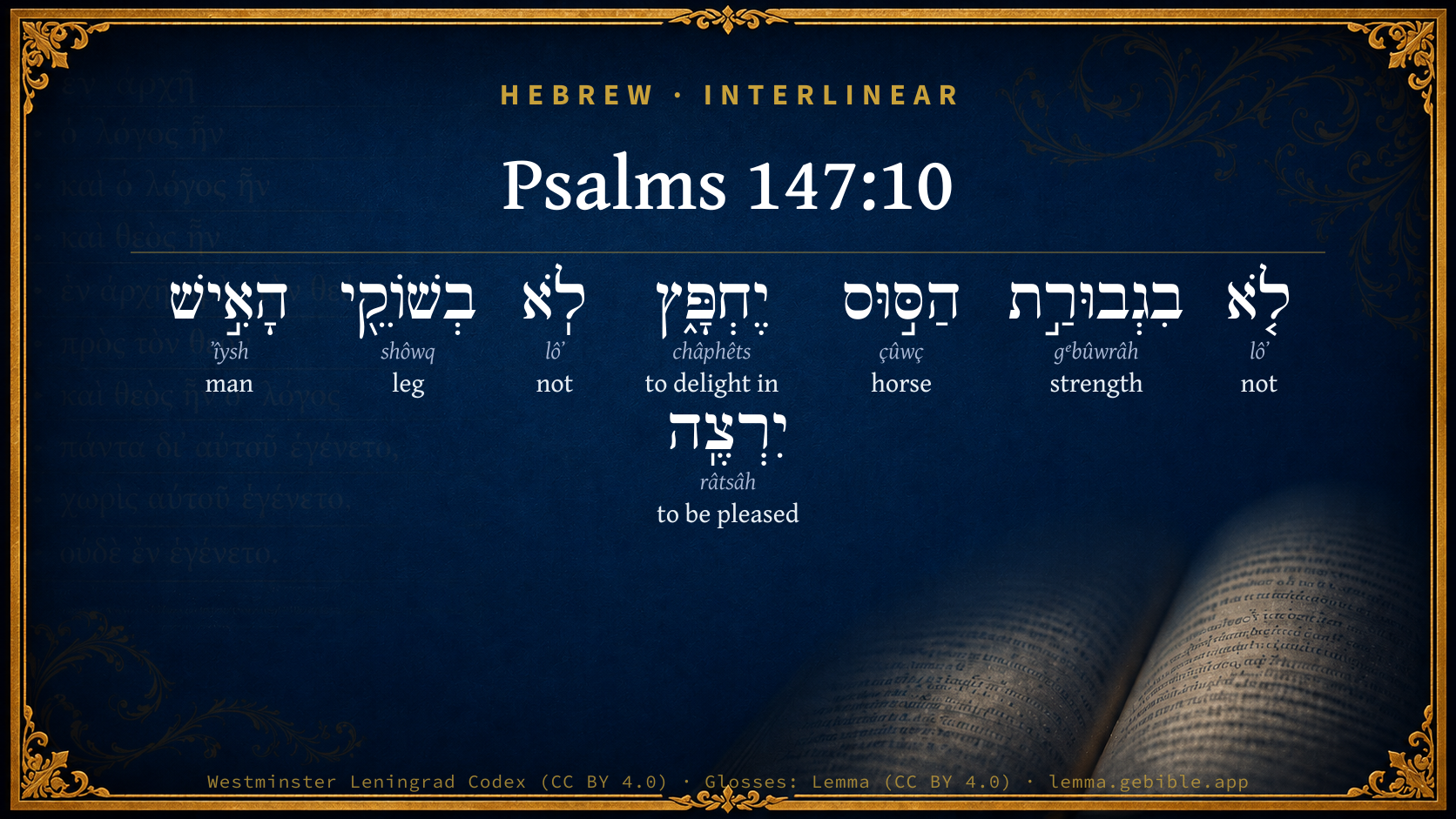
Psalms 147:10

Hebrew (Westminster Leningrad Codex) Psalms 147:10 appears in the Hebrew Old Testament. The text above is from the Westminster Leningrad Codex. Each word links to its Strong’s number, a concise gloss, and parsing drawn from the Open Scriptures Hebrew Bible morphology. Click any word for its full Brown-Driver-Briggs (BDB) entry.
Download image
Cite this verse

Psalms 147:10 (World English Bible). Public Domain. Lemma interlinear Bible study tool, https://lemma.gebible.app/v/psalms/147/10.

Show BibTeX & RIS
BibTeX
RIS
English Translation
He doesn't delight in the strength of the horse. He takes no pleasure in the legs of a man.
World English Bible · Public Domain
Download a study sheet

One document with this verse’s original text, its word-by-word gloss line, the meaning frame, cross-references with their text, attributed commentary, and full source and license credits — printable, and it pastes into notes with its structure intact.

This verse Autodidact and up

Study sheet (.html) Plain text (.txt)

A passage Seminary Student

Up to 50 verses in one chapter. A passage sheet keeps up to 6 commentary sources and 12 cross-references per verse, in the order this page ranks them, and says so on the sheet whenever that leaves anything out. Ask for a single verse and you get the Autodidact verse sheet above.

Everything on this page stays free to read, with no account — the sheet is a download of what is already on screen, not access to it.

Want to remove ads? Support Godless Engineer
Compare translations 3

The same verse in 3 English versions, stacked beneath the original-language interlinear above. Click any original word for its lexicon entry.

Each is an independent rendering of the whole verse — the interlinear is not word-aligned to these translations.

Highlighted words mark where these versions differ — a whole-verse word diff, not a word-by-word alignment.

  • World English Bible Public Domain
    He doesn't delight in the strength of the horse. He takes no pleasure in the legs of a man.
  • King James Version Public Domain
    He delighteth not in the strength of the horse: he taketh not pleasure in the legs of a man.
  • unfoldingWord Literal Text CC BY-SA 4.0
    He does not delight in the strength of a horse; he does not take pleasure the legs of a man.

unfoldingWord Literal Text — © unfoldingWord, licensed CC BY-SA 4.0. Word-aligned USFM3 via Door43 (git.door43.org/unfoldingWord/en_ult).

Versions to compare (up to 4)

3 of 4 selected

Show all 18 translations

Every available English version of this verse, each an independent rendering of the whole verse.

  • World English Bible Public Domain
    He doesn't delight in the strength of the horse. He takes no pleasure in the legs of a man.
  • Berean Standard Bible Public Domain
    He does not delight in the strength of the horse; He takes no pleasure in the legpower of the man.
  • Majority Standard Bible Public Domain
    He does not delight in the strength of the horse; He takes no pleasure in the legs of a man.
  • King James Version Public Domain
    He delighteth not in the strength of the horse: he taketh not pleasure in the legs of a man.
  • American Standard Version (1901) Public Domain
    He delighteth not in the strength of the horse: He taketh no pleasure in the legs of a man.
  • Revised Version (1885) Public Domain
    He delighteth not in the strength of the horse: he taketh no pleasure in the legs of a man.
  • Geneva Bible (1599) Public Domain
    He hath not pleasure in the strength of an horse, neither delighteth he in the legs of man.
  • Douay-Rheims (1899) Public Domain
    The Lord shall reign for ever: thy God, O Sion, unto generation and generation.
  • Young's Literal Translation Public Domain
    Not in the might of the horse doth He delight, Not in the legs of a man is He pleased.
  • Literal Standard Version CC BY-SA 4.0
    He does not delight in the might of the horse, || He is not pleased in the legs of a man.
  • Unlocked Literal Bible CC BY-SA 4.0
    He finds no delight in the strength of a horse, he takes no pleasure in the strong legs of a man.
  • unfoldingWord Literal Text CC BY-SA 4.0
    He does not delight in the strength of a horse; he does not take pleasure the legs of a man.
  • Darby Bible Public Domain
    He delighteth not in the strength of the horse, he taketh not pleasure in the legs of a man;
  • World Messianic Bible Public Domain
    He doesn’t delight in the strength of the horse. He takes no pleasure in the legs of a man.
  • Webster's Bible Public Domain
    He delighteth not in the strength of the horse: he taketh not pleasure in the legs of a man.
  • Free Bible Version CC BY-SA 4.0
    The Lord doesn't appreciate the strength of war-horses or value human power.
  • Bible in Basic English Public Domain
    He has no delight in the strength of a horse; he takes no pleasure in the legs of a man.
  • JPS Tanakh (1917) Public Domain
    He delighteth not in the strength of the horse; He taketh no pleasure in the legs of a man.

Literal Standard Version (2020), Covenant Press — licensed CC BY-SA 4.0. Text via the HelloAO Bible API (eBible.org). Unlocked Literal Bible (unfoldingWord) — licensed CC BY-SA 4.0. Text via the HelloAO Bible API (eBible.org). unfoldingWord Literal Text — © unfoldingWord, licensed CC BY-SA 4.0. Word-aligned USFM3 via Door43 (git.door43.org/unfoldingWord/en_ult). Free Bible Version, Dr. Jonathan Gallagher — licensed CC BY-SA 4.0. Text via the HelloAO Bible API (eBible.org).

Word by word

More ways to search: Search by grammar → Find every occurrence → Compare this word →

Practice this passage: Drill this verse → Learn its vocabulary →

About this verse

These counts appear in no published source. They are computed here, from the morphology-tagged text and Lemma’s own curated glosses. What Lemma adds →

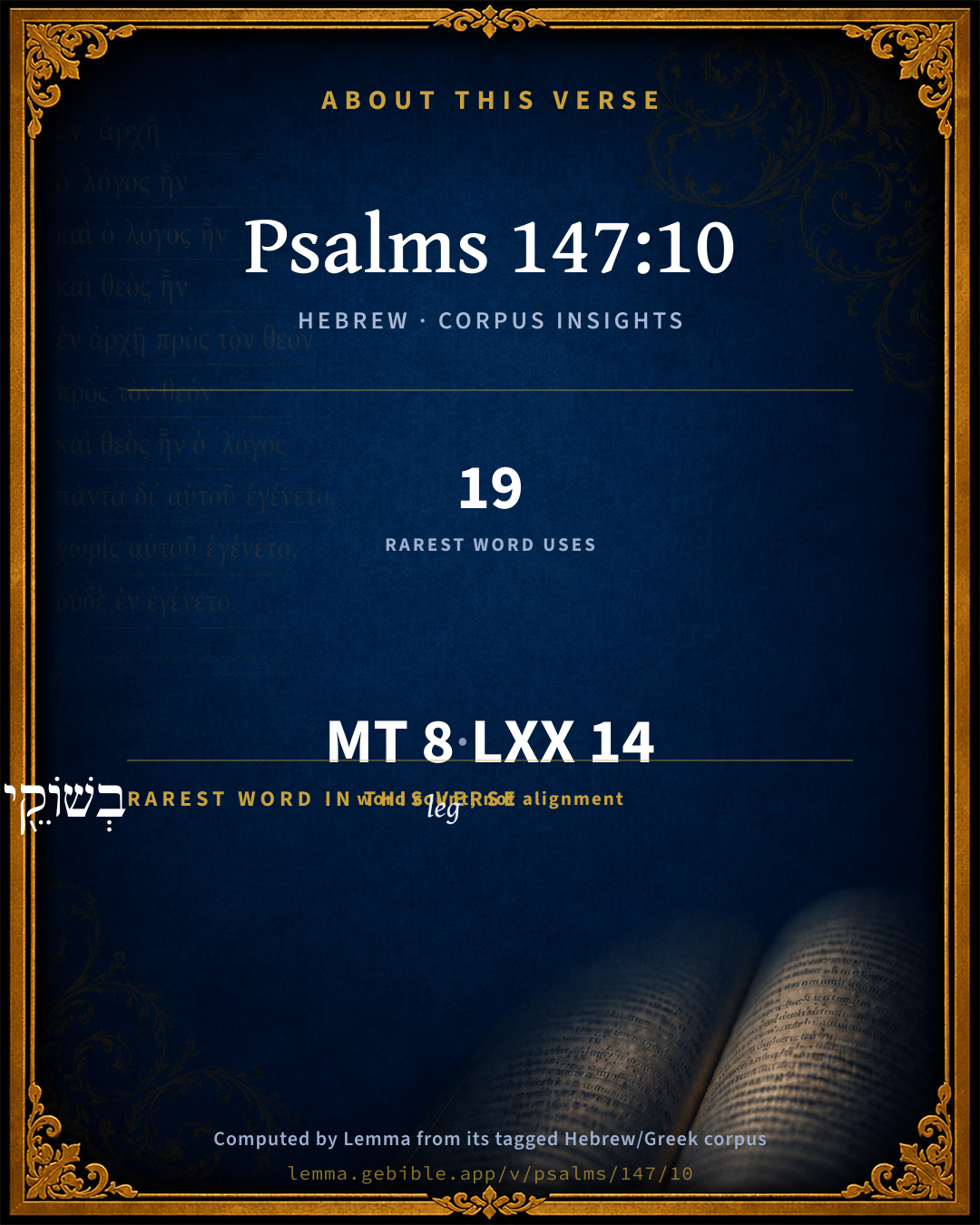
8
words
7
distinct lemmas
Wisdom
section

Notable vocabulary

The rarest word here is בְשׁוֹקֵ֖י leg H7785 — appearing just 19 times in the whole Hebrew Bible.

Shared distinctive vocabulary

בְשׁוֹקֵ֖י leg H7785 occurs in 19 verses of the Hebrew Bible. Also found in:

Grammatical profile

  • 2 verbs
  • 4 nouns
  • 2 particles

Verb forms

  • יֶחְפָּ֑ץ Qal · Imperfect
  • יִרְצֶֽה Qal · Imperfect

Repetition

A word recurs within this verse — often emphatic in Hebrew:

Hebrew & Septuagint length

In English translation the verse runs 19 words from the Hebrew and 21 from the Septuagint (LXX English) — closely comparable.

A rough comparison of the two English renderings, which tokenize alike — not a word-level alignment.

Word counts can differ between the Hebrew and the Greek without any difference in meaning — e.g. the Hebrew direct-object marker אֵת has no separate Greek word, and Greek often adds the article ὁ.

In the original languages it is 8 Hebrew tokens and 14 Greek tokens — but the two are counted differently (Hebrew bundles its prefixes and suffixes into one token; the Greek is in lemma form), so that isn’t a like-for-like length.

Cross-references

10

Topical passages linked to Psalms 147:10 in the Treasury of Scripture Knowledge — connected by theme and wording, ordered by reader-vote popularity; previews shown in the World English Bible.

  • 1 Samuel 16:7 But Yahweh said to Samuel, "Don't look on his face, or on the height of his stature; because I have rejected him: for [Yahweh sees] not as man sees; for man looks at the outward appearance, but Yahweh looks at the heart."
  • Psalms 20:7 Some trust in chariots, and some in horses, But we trust the name of Yahweh our God.
  • Psalms 33:16–18 There is no king saved by the multitude of a host. A mighty man is not delivered by great strength.
  • Proverbs 21:31 The horse is prepared for the day of battle; But victory is with Yahweh.
  • Isaiah 31:1 Woe to those who go down to Egypt for help, and rely on horses, and trust in chariots because they are many, and in horsemen because they are very strong, but they don't look to the Holy One of Israel, neither seek Yahweh!
  • Ecclesiastes 9:11 I returned, and saw under the sun, that the race is not to the swift, nor the battle to the strong, neither yet bread to the wise, nor yet riches to men of understanding, nor yet favor to men of skill; but time and chance happen to them all.
  • Hosea 1:7 But I will have mercy on the house of Judah, and will save them by Yahweh their God, and will not save them by bow, nor by sword, nor by battle, by horses, nor by horsemen."
  • 2 Samuel 1:23 Saul and Jonathan were lovely and pleasant in their lives, In their death they were not divided: They were swifter than eagles, They were stronger than lions.
  • Job 39:19–25 "Have you given the horse might? Have you clothed his neck with a quivering mane?
  • 2 Samuel 2:18–23 The three sons of Zeruiah were there, Joab, and Abishai, and Asahel: and Asahel was as light of foot as a wild gazelle.

Cross-references courtesy of OpenBible.info (CC BY 4.0).

Hebrew and Greek witnesses Masoretic Hebrew ↔ Greek Septuagint

The same verse in the two great witnesses to the Old Testament, shown verse-for-verse.

You’re reading Greek Psalm 146 (Hebrew Psalm 147). The Septuagint counts the superscription, so verse numbers can differ from the Hebrew — chapter-level alignment, not verse-by-verse. Numbering follows Rahlfs.

These are two independent witnesses, not word-aligned to each other, and the Septuagint is shown in lemma (dictionary) form.

Hebrew Psalms 147:10 Masoretic · Westminster Leningrad Codex

לֹ֤א בִגְבוּרַ֣ת הַסּ֣וּס יֶחְפָּ֑ץ לֹֽא בְשׁוֹקֵ֖י הָאִ֣ישׁ יִרְצֶֽה

He doesn't delight in the strength of the horse. He takes no pleasure in the legs of a man.

World English Bible · Public Domain

Greek LXX Greek Psalm 146:10 Septuagint · lemma form

οὐ ἐν ὁ δυναστεία ὁ ἵππος θέλω οὐδέ ἐν ὁ κνήμη ὁ ἀνήρ εὐδοκέω

He will not take pleasure in the strength of a horse; neither is he well-pleased with the legs of a man.

LXX2012 (modern English Septuagint) · Public Domain

Hebrew: Westminster Leningrad Codex (CC BY 4.0). Greek: Septuagint (public domain); English from LXX2012 (modern English Septuagint) (Public Domain). How the Septuagint differs from the Hebrew →

Commentary

Notes on Psalms 147:10 from classic Christian and Jewish commentators (each source and its license shown beneath its notes). The classic Christian expositions comment on the surrounding passage and are grouped to its opening verse, so a note may address several verses; the Jewish commentaries on the Tanakh (Rashi and others) are per-verse, so they appear only where the commentator wrote on this verse.

Lemma curates 59 commentaries, every one of them public domain or Creative Commons licensed, each selected and text-cleaned for this edition rather than reprinted as found. About our sources →

Trapp's Complete Commentary

John Trapp

Psa 147:10 He delighteth not in the strength of the horse: he taketh not pleasure in the legs of a man.

Ver. 10. He delighteth not in the strength of the horse] Plutarch in Numa saith the same, Yεος ουκ εστι φιλιππος, God careth not for horses, or any such helps as wherein carnal people confide, as if they had no need of God. Origen observeth that in the conquest of Canaan, the enemies had horses and chariots, but Israel had none. And it is expressly cautioned that the king of Israel "shall not multiply horses to himself, nor cause the people to return to Egypt, to the end that he should multiply horses," Deu 17:16, lest they should occasion him or his people to trade with that idolatrous people, 1Ki 10:26; 1Ki 10:28, or to trust in the number and strength of that warlike creature, a horse, Pro 21:31.

He taketh not pleasure in the legs of a man] How swift soever, as Achilles, ποδας ωκυς, or Asahel, as light of foot as a wild roe, 2Sa 2:18. None sooner perish in the waters, nor oftener, than those that are most skilled in swimming and diving, because they do too much trust to their skill; so it is here; for there is no outrunning of Divine vengeance. Nemo scelus gerit in pectore qui non idem Nemesin in tergo; your sin will find you out. Here "the race is not to the swift, nor the battle to the strong," Ecc 9:11.

John Trapp, A Commentary or Exposition upon All the Books of the Old and New Testament (1647–1656) — public domain. Text from a community e-Sword module.

Joseph Benson's Commentary

Psa 147:10-11. He delighteth not in the strength of the horse, &c. — As if he needed either one or the other for the accomplishment of his designs: see the note on Psa 33:16-17. Mr. Green translates the verse, He delights not in the courage of the horse, nor is pleased with the agility of the warrior; and Bishop Patrick connects it with the preceding verse: and paraphrases it thus: “Let us not doubt, then, but he that takes care of crows will much more take care of us; and not be afraid, though we are of little force, (Neh 4:3; Neh 7:4,) and have no armies of horse and foot to defend us: for the Lord, who fights for us, hath no need of these, (4:29,) and will not take part with our enemies, because they are superior to us in the strength of their horses, and the nimbleness of their soldiers.” But the Lord taketh pleasure in them that fear him — “He delights to give those his assistance and protection who, worshipping him devoutly, fear to offend him; and having no help in themselves, nor any earthly refuge to flee to, depend, notwithstanding, with a steadfast faith on his infinite mercy.”

Joseph Benson's Commentary on the Old and New Testaments (1811–1818) — public domain. Text from a community e-Sword module.

J. A. Alexander on Psalms

Joseph Addison Alexander

10. (Psa 147:10) Not in the strength of a horse does he delight; not with the legs of a man is he pleased. The best explanation of the singular expressions in the last clause is, that the whole verse was intended to describe horse and. foot, or cavalry and infantry, as forming the military strength of armies. It is not to those who trust in these that God is disposed to extend favour, nor do these advantages at all attract him.

Joseph Addison Alexander, The Psalms Translated and Explained (1850) — public domain. Text from a community e-Sword module.

Tyndale Open Study Notes

Tyndale Open Resources

147:10-11 human might: Any physical or intellectual achievement is a gift from the Lord, just like the strength of a horse. These gifts are a reason to praise the Lord, not to boast (Jer 9:23-24).

Tyndale Open Study Notes — © Tyndale Open Resources, licensed CC BY-SA 4.0. Text via the HelloAO Bible API.

Geneva Bible (1599)

Geneva Bible translators

Though to use lawful means is both profitable and pleaseth God, yet to put our trust in them, is to defraud God of his honor.

Geneva Bible (1599) marginal notes — public domain. Text via Bolls.life.

Jamieson, Fausset & Brown

Robert Jamieson, A. R. Fausset & David Brown

The advantages afforded, as in war by the strength of the horse or the agility of man, do not incline God to favor any; but those who fear and, of course, trust Him, will obtain His approbation and aid.

Jamieson, Fausset & Brown — Commentary Critical and Explanatory on the Whole Bible (1871) — public domain (CC PDM 1.0). Text via the HelloAO Bible API.

Adam Clarke's Commentary

Verse 10. He delighteth not] The horse, among all animals, is most delighted in by man for beauty, strength, and fleetness. And a man's legs, if well proportioned, are more admired than even the finest features of his face. Though God has made these, yet they are not his peculiar delight.

Adam Clarke's Commentary on the Bible (1810–1826) — public domain. Text from a community e-Sword/MySword module.

John Calvin's Commentaries

10. Not in the strength of the horse, etc. After the Psalmist has shown that there is proof of the divine goodness in every part of the world, he takes particular notice that men have no strength but what is given them from above, and this he adds with the express purpose of checking the pride by which almost all men are inflamed, and which leads them to trust in their own strength. The meaning of the passage is, that let man come in the preparation of his own strength, and with all the assistance’s that seem to him most prevalent, this will only issue in smoke and vanity; nay, that in arrogating the very least to himself, this will only be a hindrance in the way of the mercy of God, by which alone we stand. The strength of the horse is mentioned by synecdoche to denote any kind of protection. Not that God is displeased with those things in themselves considered which he has given us as helps, but it is necessary that we be withdrawn from a false confidence in them, for very commonly when any resource is at hand, we are foolishly intoxicated and lifted up with pride. He opposes the fear of God therefore to the strength both of men and of horses, and places his hope in his mercy, intimating that it is highly incumbent upon us to show our moderation in worshipping God with reverence and holiness, and depending upon his grace. Hence we learn that he only condemns that strength which would take from God the honor due to him.

John Calvin's Commentaries (1540-1563) — public domain. Text from the Calvin Translation Society English edition (1840s-50s) via the Christian Classics Ethereal Library (ccel.org). Calvin's coverage is partial (roughly two-thirds of the Bible); uncommented books and verses are honest gaps, never fabricated. The 19th-century editor's footnotes and remarks are omitted so the notes are faithfully Calvin's own voice.

Ellicott's Commentary for English Readers

(10) Strength of the horse . . . legs of a man.—This somewhat strange antithesis has been explained to refer to cavalry and infantry, but the much more expressive passage, Psa_33:16-17, which was plainly before this poet, would hardly have been altered so strangely. The horse as a type of strength and endurance was of course common. (Comp. especially Job_39:19-25.) And we have before seen that Eastern nations naturally select fleetness of foot as the typical quality in a vigorous warrior. (See Psa_18:33.)

The constant epithet “swift-footed Achilles,” suggests the best explanation of the second clause of the verse. (Comp. 2Sa_2:18).

A Bible Commentary for English Readers, edited by Charles John Ellicott (1878–1897) — public domain. Text from a community e-Sword module.

The Cambridge Bible for Schools and Colleges

gen. ed. J. J. S. Perowne

10. 11. Based upon Psa_33:16-18. Jehovah’s delight is not in physical strength, but in reverent trustfulness;—a thought of consolation, parallel to Psa_147:6. Israel might look regretfully back to its ancient military power, or envy the forces of neighbouring nations; but it is by spiritual strength that its victories are to be won. The horse is the warhorse (Job_39:19): the man is the warrior, for whom strength and swiftness of foot were indispensable qualifications. Cp. Psa_20:7; Psa_18:33; Amo_2:14-15 : and the standing epithet in Homer for Achilles, “swift of foot.”

The Cambridge Bible for Schools and Colleges (gen. ed. J. J. S. Perowne; Cambridge University Press, 1878–1918) — public domain. Text from a community e-Sword module.

John Gill's Exposition

He delighteth not in the strength of the horse,.... It has been his will and pleasure to give the horse strength for the use and service of men, both for labour and war; and as this is a creature of his, and the work of his hands, it must be agreeable to him, Job 39:19 yet a horse, though prepared for the battle, is a vain thing for safety, which is only of the Lord; neither can it deliver any by its great strength; nor are a king and his country saved by the multitude of an host, or by a large cavalry: nor are these what the Lord delights in, nor does he save men for the sake of them; though a well-mounted cavalry may be a pleasing sight to men, and they may raise their expectations, and promise themselves great things from them; yet these are of no account with God, who can save as well without them as with them, Pro 21:31. The Targum is,

"he delighteth not in the strength of those that ride on horses;''

that are well mounted, and pride themselves in it; and are equipped for war, and are mighty to engage in it, and prepared to make their escape in danger: Kimchi's note is,

"he delighteth not in man, who puts his confidence in the strength of the horse;''

see Psa 20:8;

he taketh not pleasure in the legs of a man; in which his strength lies, and of which he is apt to glory; but should not, it being displeasing to God; who delights not therein, but in lovingkindness, judgment, and righteousness, Jer 9:23; not in the legs of a man of war, as Arama; which are strong to stand his ground, or swift to flee away when hard-pressed; see Amo 2:14; so the Targum,

"he takes no pleasure in the legs of men that run;''

that are swift to run races, or to flee in battle; to this sense are the notes of Jarchi and Kimchi. It seems to intend the infantry in an army, as the cavalry before; and both intimate that neither horse nor foot are to be trusted in for safety, how pleasing or promising they may be, since God seeth not as man does: or reference may be had to athletic exercises of horse and foot races, of wrestling, combats, &c. men may delight in, but God does not. What are pleasing to him are exercises of a spiritual kind; such as fleeing to Jesus, the strong tower; running the Christian race, to obtain the incorruptible crown; wrestling against principalities and powers, and such acts of grace as are next mentioned.

John Gill's Exposition of the Whole Bible (1746–1763) — public domain (CC PDM 1.0). Text via the HelloAO Bible API.

Albert Barnes' Notes on the Bible

He delighteth not in the strength of the horse - The horse is among the noblest works of God - perhaps the noblest of all the animals that he has made. See the notes at Job 39:19-25. Yet God regards with more interest and pleasure humble piety than he does any mere power, however great and wonderful it may be.

He taketh not pleasure in the legs of a man - Not the same pleasure as in piety; he prefers the humble heart to this. The reference is to man as capable of rapid marches, of quick movements in assaulting an enemy; the allusion being, perhaps, to an army prepared for war - cavalry and infantry - the horse moving on with resistless force - the foot-soldiers with rapid motion.

Albert Barnes' Notes on the Bible (1834–1885) — public domain. Text from a community e-Sword/MySword module.

Matthew Poole's English Annotations

As if he needed either the one or the other for the accomplishment of his designs.

Matthew Poole's English Annotations on the Holy Bible (1683–1685) — public domain. Text from a community e-Sword/MySword module.

The Treasury of David

Charles H. Spurgeon

Ver. 10. He delighteth not in the strength of the horse. Not to great and strong animals doth the Creator in any measure direct his special thought; but in lesser living things he has equal pleasure. If man could act the Creator's part, he would take peculiar delight in producing noble quadrupeds like horses, whose strength and speed would reflect honour upon their maker; but Jehovah has no such feeling; lie cares as much for helpless birds in the nest as for the war horse in the pride of its power. He taketh not pleasure in the legs of a man. These are the athlete's glory, but God hath no pleasure in them. Not the capacities of the creature, but rather its weakness and necessity, win the regard of our God. Monarchs trust in their cavalry and infantry; but the King of kings exults not in the hosts of his creatures as though they could lend power to him. Physical or material greatness and power are of no account with Jehovah; he has respect to other and more precious qualities. Men who boast in fight the valour of gigantic might, will not find themselves the favourites of God: though earthly princes may feast their eyes upon their Joabs and their Abners, their Abishais and Asahels, the Lord of hosts has no pleasure in mere bone and muscle. Sinews and thews are of small account, either in horses or in men, with Him who is a spirit, and delights most in spiritual things. The expression of the text may be viewed as including all creature power, even of a mental or moral kind. God does not take pleasure in us because of our attainments, or potentialities: he respects character rather than capacity.

Ver. 10. The two clauses of this verse are probably intended to describe cavalry and infantry, as forming the military strength of nations. It is not to those who trust in such resources that Jehovah shows favour, but to those who rely on his protection (Ps 147:11). Annotated Paragraph Bible.

Ver. 10-11. When a sinner is brought upon his knees, and becomes a suppliant, when as he is laid low by affliction, so he lieth low in prayer and supplication, then the Lord will be favourable to him, and show his delight in him. The Lord delighteth not in the strength of the horse: he taketh not pleasure in the legs of a man. No man is favoured by God because of his outward favour, because he hath a beautiful face, or strong, clean limbs; yea, not only hath the Lord no pleasure in any man's legs, but not in any man's brains, how reaching soever, not in any man's wit how quick soever, nor in any man's judgment how deep soever, nor in any man's tongue how eloquent or well spoken soever; but The Lord taketh pleasure in them that fear him, in those that hope in his mercy, in those that walk humbly with him, and call upon him...All the beauties and rarities both of persons and things are dull and flat, yea, wearisome and loathsome to God, in comparison of a gracious, honest, humble soul. Princes have their favourites (Job 33:26); they are favourable to some above many, either because they are beautiful and goodly persons, or because they are men of excellent speech, prudence and deportment. All godly men are God's favourites; he is favourable to them not only above many men in the world, but above all the men of this world, who have their portion in this life; and he therefore favours them, because they are the purchase of his Son and the workmanship of his Spirit, convincing them of, and humbling them for, their sins, as also creating them after God in righteousness and true holiness. Such shall be his favourites. Joseph Caryl.

Psalms 147:11*

Charles H. Spurgeon's The Treasury of David (1869–1885) — public domain. Psalms only. Text from a community e-Sword/MySword module.

Whedon's Commentary on the Bible

Daniel D. Whedon

10. Delighteth not… taketh not pleasure—Hebrew poetry loves to divide thoughts into parallel expressions. The English would be more likely to say: “The strength and legs (speed) of horse or man.”

Daniel D. Whedon (gen. ed.), Commentary on the Old and New Testaments (1874–1909) — public domain. Text from a community e-Sword module.

The Pulpit Commentary

He delighteth not in the strength of the horse. In a certain sense, God no doubt "delights" in the glory and excellency of all his creatures; but their physical endowments do not give him the sensible pleasure which he derives from the moral qualities of his rational creation (see ver. 11). The negation is not absolute, but relative (compare "I will have mercy, and not sacrifice"). He taketh not pleasure in the legs of a man; i.e. in his strength and swiftness.

The Pulpit Commentary (1880–1919), ed. H.D.M. Spence-Jones & Joseph S. Exell — public domain. Text from a community e-Sword module.

John Wesley's Explanatory Notes

Delighteth not - As if he needed either the one or the other for the accomplishment of his designs.

John Wesley, Explanatory Notes Upon the Whole Bible (1754–1765) — public domain. Text via the GEBible commentary corpus.

unfoldingWord translationNotes

Door43 World Missions Community

He finds no delight in the strength of a horse

"Strong horses do not delight him"

the strong legs of a man

Possible meanings are 1) "strong legs" is a metonym that represents how swiftly a man can run. AT: "men who can run swiftly" or 2) "strong legs" represents the strength of the whole man. AT: "how strong a man is" (See: Metonymy and Synecdoche)

who hope in his covenant faithfulness

The abstract noun "faithfulness" can be translated with and adjective. AT: "who trust him because he is faithful to his covenant" (See: Abstract Nouns)

translationWords

horse

honor

hope

covenant faithfulness

unfoldingWord translationNotes — © Distant Shores Media and the Door43 World Missions Community, licensed CC BY-SA 4.0. Source: git.door43.org/Door43/en_tn.

Rashi

Rabbi Shlomo Yitzchaki (Rashi)

He does not desire the might of the horse [i.e.,] the Holy One, blessed be He.

nor does He take pleasure in the legs of man nor does He want the swiftness of the running of the legs of man.

Rashi on the Tanakh — English translations: “The Judaica Press complete Tanach with Rashi, translated by A. J. Rosenberg” (CC BY 4.0); “Pentateuch with Rashi's commentary by M. Rosenbaum and A.M. Silbermann, 1929-1934” (public domain); “The Metsudah Tanach series, Lakewood, N.J” (CC BY 4.0); and “The Book of Joshua, Metsudah Publications, 1997” (CC BY 4.0). Text via Sefaria.

Lesson kit

Teaching starters — assembled from the data on this page, not authored interpretation. Every prompt links to the verse data it draws on. Edit before teaching.

Psalms, in the Wisdom, opens this verse with 8 words (7 distinct Hebrew lemmas). Its most distinctive word is shôwq (“leg”). A historical commentator’s framing appears above. Read the whole chapter for the surrounding context.

Discussion questions

  1. What does “leg” (shôwq) contribute to the verse as a whole?
  2. How does Exodus 29:22, which shares the word «leg», read alongside this verse?
  3. What does the repetition of “not” (2× in this one verse) do in this verse?
  4. These translations render this verse differently. What is at stake in choosing one wording over another?
  5. «יֶחְפָּ֑ץ» is a Qal Imperfect verb. How does that grammatical form shape the action described?
  6. Compare how Trapp's Complete Commentary and Joseph Benson's Commentary read this verse. Where do they agree or differ?

Things to notice

Reading settings

Reading text

Shown beneath each verse's original-language words.

Old Testament
Old Testament edition

Read the OT as the Masoretic Hebrew (MT) or the Greek Septuagint (LXX).

English shown for the Greek Septuagint (in the Hebrew ↔ Greek comparison).

Comparing translations? Open the Compare panel on any verse page to stack up to four side by side.