2 Chronicles 1:16

Hebrew (Westminster Leningrad Codex) 2 Chronicles 1:16 appears in the Hebrew Old Testament. The text above is from the Westminster Leningrad Codex. Each word links to its Strong’s number, a concise gloss, and parsing drawn from the Open Scriptures Hebrew Bible morphology. Click any word for its full Brown-Driver-Briggs (BDB) entry.
Download image
Cite this verse

2 Chronicles 1:16 (World English Bible). Public Domain. Lemma interlinear Bible study tool, https://lemma.gebible.app/v/2-chronicles/1/16.

Show BibTeX & RIS
BibTeX
RIS
English Translation
The horses which Solomon had were brought out of Egypt and from Kue; the king's merchants purchased them from Kue.
World English Bible · Public Domain
Download a study sheet

One document with this verse’s original text, its word-by-word gloss line, the meaning frame, cross-references with their text, attributed commentary, and full source and license credits — printable, and it pastes into notes with its structure intact.

This verse Autodidact and up

Study sheet (.html) Plain text (.txt)

A passage Seminary Student

Up to 50 verses in one chapter. A passage sheet keeps up to 6 commentary sources and 12 cross-references per verse, in the order this page ranks them, and says so on the sheet whenever that leaves anything out. Ask for a single verse and you get the Autodidact verse sheet above.

Everything on this page stays free to read, with no account — the sheet is a download of what is already on screen, not access to it.

Want to remove ads? Support Godless Engineer
Compare translations 3

The same verse in 3 English versions, stacked beneath the original-language interlinear above. Click any original word for its lexicon entry.

Each is an independent rendering of the whole verse — the interlinear is not word-aligned to these translations.

Highlighted words mark where these versions differ — a whole-verse word diff, not a word-by-word alignment.

  • World English Bible Public Domain
    The horses which Solomon had were brought out of Egypt and from Kue; the king's merchants purchased them from Kue.
  • King James Version Public Domain
    And Solomon had horses brought out of Egypt, and linen yarn: the king's merchants received the linen yarn at a price.
  • unfoldingWord Literal Text CC BY-SA 4.0
    And the source of the horses which were to Solomon was from Egypt and from Kue; the traders of the king, they would take at a price from Kue.

unfoldingWord Literal Text — © unfoldingWord, licensed CC BY-SA 4.0. Word-aligned USFM3 via Door43 (git.door43.org/unfoldingWord/en_ult).

Versions to compare (up to 4)

3 of 4 selected

Show all 18 translations

Every available English version of this verse, each an independent rendering of the whole verse.

  • World English Bible Public Domain
    The horses which Solomon had were brought out of Egypt and from Kue; the king's merchants purchased them from Kue.
  • Berean Standard Bible Public Domain
    Solomon’s horses were imported from Egypt and Kue; the royal merchants purchased them from Kue.
  • Majority Standard Bible Public Domain
    Solomon’s horses were imported from Egypt and Kue; the royal merchants purchased them from Kue.
  • King James Version Public Domain
    And Solomon had horses brought out of Egypt, and linen yarn: the king's merchants received the linen yarn at a price.
  • American Standard Version (1901) Public Domain
    And the horses which Solomon had were brought out of Egypt; the king's merchants received them in droves, each drove at a price.
  • Revised Version (1885) Public Domain
    And the horses which Solomon had were brought out of Egypt; the king’s merchants received them in droves, each drove at a price.
  • Geneva Bible (1599) Public Domain
    Also Salomon had horses brought out of Egypt and fine linen: the Kings marchants receiued the fine linen for a price.
  • Douay-Rheims (1899) Public Domain
    And there were horses brought him from Egypt, and from Coa by the king's merchants, who went, and bought at a price,
  • Young's Literal Translation Public Domain
    And the source of the horses that `are' to Solomon `is' from Egypt and from Keva; merchants of the king from Keva take at a price,
  • Literal Standard Version CC BY-SA 4.0
    And the source of the horses that [are] for Solomon [is] from Egypt and from Keva; merchants of the king take [them] from Keva at a price,
  • Unlocked Literal Bible CC BY-SA 4.0
    As for the importation of horses from Egypt and Kue for Solomon, his merchants bought them from Kue at a price.
  • unfoldingWord Literal Text CC BY-SA 4.0
    And the source of the horses which were to Solomon was from Egypt and from Kue; the traders of the king, they would take at a price from Kue.
  • Darby Bible Public Domain
    And the exportation of horses that Solomon had was from Egypt: a caravan of the king's merchants fetched a drove [of horses], at a price.
  • World Messianic Bible Public Domain
    The horses which Solomon had were brought out of Egypt and from Kue. The king’s merchants purchased them from Kue.
  • Webster's Bible Public Domain
    And Solomon had horses brought out of Egypt, and linen yarn: the king's merchants received the linen yarn at a price.
  • Free Bible Version CC BY-SA 4.0
    Solomon imported horses for himself from Egypt and Kue; the king's traders bought them in Kue.
  • Bible in Basic English Public Domain
    And Solomon's horses came out of Egypt; the king's traders got them from Kue at a price.
  • JPS Tanakh (1917) Public Domain
    And the horses which Solomon had were brought out of Egypt; also out of Keve, the king's merchants buying them of the men of Keve at a price.

Literal Standard Version (2020), Covenant Press — licensed CC BY-SA 4.0. Text via the HelloAO Bible API (eBible.org). Unlocked Literal Bible (unfoldingWord) — licensed CC BY-SA 4.0. Text via the HelloAO Bible API (eBible.org). unfoldingWord Literal Text — © unfoldingWord, licensed CC BY-SA 4.0. Word-aligned USFM3 via Door43 (git.door43.org/unfoldingWord/en_ult). Free Bible Version, Dr. Jonathan Gallagher — licensed CC BY-SA 4.0. Text via the HelloAO Bible API (eBible.org).

Word by word

More ways to search: Search by grammar → Find every occurrence → Compare this word →

Practice this passage: Drill this verse → Learn its vocabulary →

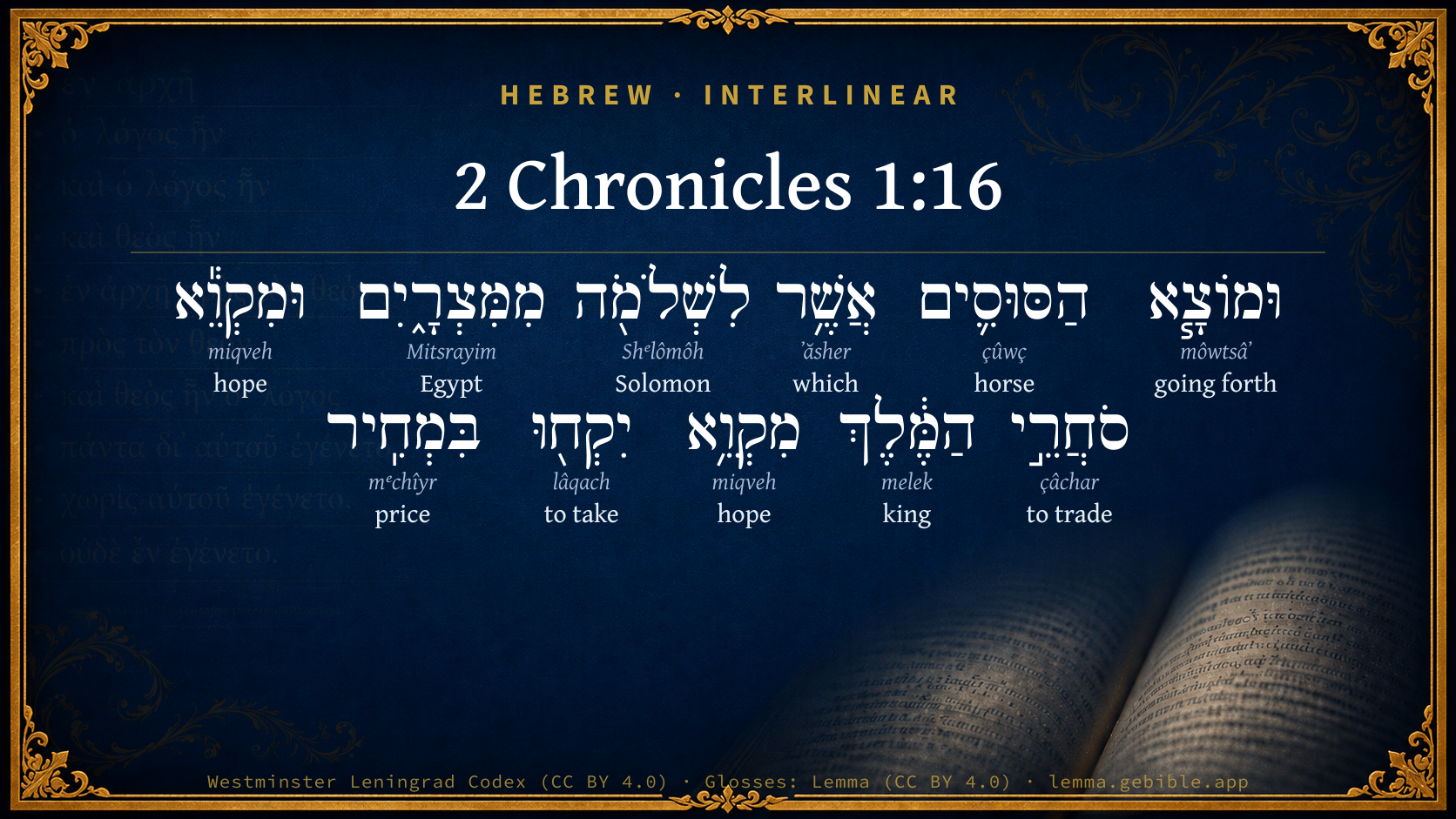
וּמִקְוֵ֕א
miqveh
H4723
“and · from · hope”
Conjunction + Preposition + Noun, Proper
Part of Speech
Conjunction + Preposition + Noun
Type
Proper
Full BDB Definition

Origin: from H6960

TWOT: 1994c , 1995a

hope - hope - ground of hope - things hoped for, outcome - collection, collected mass
  1. וּמוֹצָ֧א môwtsâʼ H4161 “and · going forth of” Conjunction + Noun, Common, Masculine, Singular, Construct
  2. הַסּוּסִ֛ים çûwç H5483 “the · horses” Particle, Definite Article + Noun, Common, Masculine, Plural, Absolute
  3. אֲשֶׁ֥ר ʼăsher H834 “which” Particle, Relative
  4. לִשְׁלֹמֹ֖ה Shᵉlômôh H8010 “to/for · Solomon” Preposition + Noun, Proper
  5. מִמִּצְרָ֑יִם Mitsrayim H4714 “from · Egypt” Preposition + Noun, Proper
  6. סֹחֲרֵ֣י çâchar H5503 “trading” Verb, Qal, Participle Active, Masculine, Plural, Construct
  7. הַמֶּ֔לֶךְ melek H4428 “the · king” Particle, Definite Article + Noun, Common, Masculine, Singular, Absolute
  8. מִקְוֵ֥א miqveh H4723 “from · hope” Preposition + Noun, Proper
  9. יִקְח֖וּ lâqach H3947 “to take” Verb, Qal, Imperfect, 3rd Person, Masculine, Plural
  10. בִּמְחִֽיר mᵉchîyr H4242 “in/at · price” Preposition + Noun, Common, Masculine, Singular, Absolute

About this verse

These counts appear in no published source. They are computed here, from the morphology-tagged text and Lemma’s own curated glosses. What Lemma adds →

11
words
10
distinct lemmas
Historical
section

Notable vocabulary

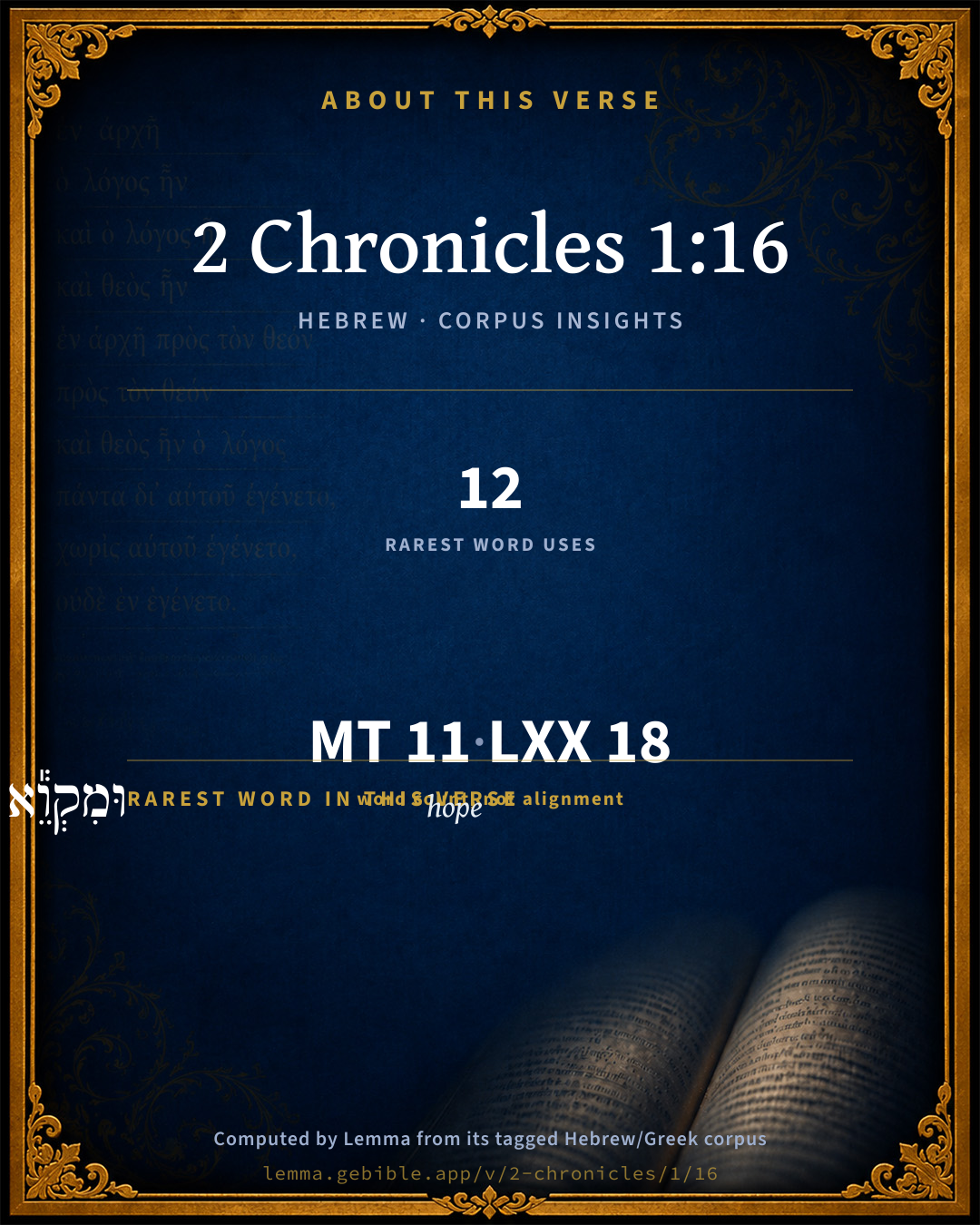
The rarest word here is וּמִקְוֵ֕א hope H4723 — appearing just 12 times in the whole Hebrew Bible.

Shared distinctive vocabulary

וּמִקְוֵ֕א hope H4723 occurs in 10 verses of the Hebrew Bible. Also found in:

Grammatical profile

  • 2 verbs
  • 8 nouns
  • 1 particle

Verb forms

  • סֹחֲרֵ֣י Qal · Participle Active
  • יִקְח֖וּ Qal · Imperfect

Repetition

A word recurs within this verse — often emphatic in Hebrew:

  • וּמִקְוֵ֕א hope H4723 ×2

Hebrew & Septuagint length

In English translation the verse runs 20 words from the Hebrew and 21 from the Septuagint (LXX English) — closely comparable.

A rough comparison of the two English renderings, which tokenize alike — not a word-level alignment.

Word counts can differ between the Hebrew and the Greek without any difference in meaning — e.g. the Hebrew direct-object marker אֵת has no separate Greek word, and Greek often adds the article ὁ.

In the original languages it is 11 Hebrew tokens and 18 Greek tokens — but the two are counted differently (Hebrew bundles its prefixes and suffixes into one token; the Greek is in lemma form), so that isn’t a like-for-like length.

Cross-references

2

Topical passages linked to 2 Chronicles 1:16 in the Treasury of Scripture Knowledge — connected by theme and wording, ordered by reader-vote popularity; previews shown in the World English Bible.

  • 1 Kings 10:28–29 The horses which Solomon had were brought out of Egypt; and the king's merchants received them in droves, each drove at a price.
  • 2 Chronicles 9:28 They brought horses for Solomon out of Egypt, and out of all lands.

Cross-references courtesy of OpenBible.info (CC BY 4.0).

Hebrew and Greek witnesses Masoretic Hebrew ↔ Greek Septuagint

The same verse in the two great witnesses to the Old Testament, shown verse-for-verse.

These are two independent witnesses, not word-aligned to each other, and the Septuagint is shown in lemma (dictionary) form.

Hebrew 2 Chronicles 1:16 Masoretic · Westminster Leningrad Codex

וּמוֹצָ֧א הַסּוּסִ֛ים אֲשֶׁ֥ר לִשְׁלֹמֹ֖ה מִמִּצְרָ֑יִם וּמִקְוֵ֕א סֹחֲרֵ֣י הַמֶּ֔לֶךְ מִקְוֵ֥א יִקְח֖וּ בִּמְחִֽיר

The horses which Solomon had were brought out of Egypt and from Kue; the king's merchants purchased them from Kue.

World English Bible · Public Domain

Greek LXX 2 Chronicles 1:16 Septuagint · lemma form

καί ὁ ἔξοδος ὁ ἵππος ὁ σαλωμών ἐκ αἴγυπτος καί ὁ τιμή ὁ ἔμπορος ὁ βασιλεύς ἐνπορεύομαι ἀγοράζω

And Solomon imported horses from Egypt, and the charge of the king's merchants for going was as follows, and they traded,

LXX2012 (modern English Septuagint) · Public Domain

On this verse, Ellicott's Commentary for English Readers discusses the Septuagint’s reading. Read the note in Commentary ↓

Hebrew: Westminster Leningrad Codex (CC BY 4.0). Greek: Septuagint (public domain); English from LXX2012 (modern English Septuagint) (Public Domain). How the Septuagint differs from the Hebrew →

Commentary

Notes on 2 Chronicles 1:16 from classic Christian and Jewish commentators (each source and its license shown beneath its notes). The classic Christian expositions comment on the surrounding passage and are grouped to its opening verse, so a note may address several verses; the Jewish commentaries on the Tanakh (Rashi and others) are per-verse, so they appear only where the commentator wrote on this verse.

Lemma curates 59 commentaries, every one of them public domain or Creative Commons licensed, each selected and text-cleaned for this edition rather than reprinted as found. About our sources →

The Biblical Illustrator

Joseph S. Exell

2Ch_1:16

The Kings merchants received the linen yarn at a price.

The kings merchants

I. The advantages of commerce. In softening manners and breaking down prejudices, in helping industry, promoting peace, and stimulating into Natures resources.

II. The blessings of the nation whose sovereign takes an interest in commerce (J. Wolfendale.)

.

The Biblical Illustrator, edited by Joseph S. Exell (c. 1880s–1900s) — public domain. Text from a community e-Sword module.

Tyndale Open Study Notes

Tyndale Open Resources

1:16 If Egypt is the correct translation, this verse indicates disobedience by Solomon (see Deut 17:16). However, importing from Muzur in Anatolia was not prohibited.

Tyndale Open Study Notes — © Tyndale Open Resources, licensed CC BY-SA 4.0. Text via the HelloAO Bible API.

Geneva Bible (1599)

Geneva Bible translators

Read 1 Kings. 10:28.

Geneva Bible (1599) marginal notes — public domain. Text via Bolls.life.

Adam Clarke's Commentary

Verse 16. Linen yarn] 1Kg 10:28, where this subject is particularly examined.

Adam Clarke's Commentary on the Bible (1810–1826) — public domain. Text from a community e-Sword/MySword module.

Ellicott's Commentary for English Readers

(16) And Solomon had horses brought out . . .—Rather, And the outcome (export) of horses for Solomon was from Egypt, and the company of the king’s merchants—a company (of horses) they would fetch at a price. The same is read in Kings, only that the word company (miqwç) is there spelt in the ancient fashion (miqwçh), and two words are transposed (“they would fetch a company”). Miqweh means gathering, collection (Gen_1:10 [of the waters]). The repetition of this term constitutes a kind of artless play on words, such as is common in the Old Testament. (Comp. Gen_15:2; Jdg_15:16.) Both here and in Kings the Vulg. renders the word as a proper name, “from Coa.” So also the LXX. in Kings “from Thekkoue” (Tekoa); and the Syriac of Chronicles, “from the city of the Aphelâvç.” These variations only prove that the text was felt to be obscure. The “linen yarn” of the Authorised version is a guess based upon the likeness of the word miqweh to qaw, “rope,” and tiqwâh, “line” (Jos_2:18), and upon the fact that much linen was made in Egypt.

A Bible Commentary for English Readers, edited by Charles John Ellicott (1878–1897) — public domain. Text from a community e-Sword module.

The Cambridge Bible for Schools and Colleges

gen. ed. J. J. S. Perowne

16. And Solomon had horses brought out of Egypt] R.V. And the horses which Solomon had were brought out of Egypt. Egypt is an agricultural not a pastoral country; it lacks the broad plains suitable for the rearing of large numbers of horses. Egypt was therefore probably only the market; the raising ground was elsewhere.

and linen yarn: the king’s merchants received the linen yarn at a price] R.V. the king’s merchants received them in droves, each drove at a price. “Linen yarn” is a mistranslation of a word which perhaps means “drove.” The whole verse refers to traffic in horses. According to a third view the Heb. “miḳvê” means neither “yarn” nor “drove,” but conceals a proper name, known to us from Assyrian inscriptions, Ku‘i or Kuë (= Cilicia). In this case the horses would be brought in the first place from eastern Asia Minor and Armenia, since Cilicia itself is not a horse-breeding country. We then translate, And the horses which Solomon had were brought out of Egypt and out of Cilicia; the king’s merchants received them from Cilicia at a price. The further supposition that “Egypt” (Mizraim) is a mistake for “Musri” (a land supposed to lie N.E. of Cilicia) may be true but is difficult to prove.

The Cambridge Bible for Schools and Colleges (gen. ed. J. J. S. Perowne; Cambridge University Press, 1878–1918) — public domain. Text from a community e-Sword module.

Haydock's Catholic Bible Commentary

Coa may signify either some city, (Mariana) or an "exporium," where things are sold, as kuch means "a collection." (Tirinus) (3 Kings x. 28.) Neglecting the points of the Masorets, we may well understand Coa, a city of Egypt, or an island of the Mediterranean. The Masorets read Mikve, instead of Micoa. (Du Hamel)

George Leo Haydock (1774–1849), Haydock's Catholic Family Bible and Commentary, 1859 edition — public domain. Excludes Psalms (Douay-Rheims chapter numbering differs from Protestant) and Deuterocanonical books (Catholic canon only).

The Pulpit Commentary

Horses brought.., out of Egypt. Later on we read that horses were imported from other countries as well, (2Ch_9:24, 2Ch_9:28) as, for instance, from Arabia and Armenia. (Eze_27:14) Linen yarn. The words are without doubt wrong here. But it is impossible to say with any certainty what should be in their place. The Vulgate shows here from Coa, presumably meaning Tekoa, a small place on the road from Egypt to Jerusalem. It might not have been easy to surmise, however, so much as this, but for the fact that the Septuagint shows in the parallel place, "And from Tekoa". (Amo_1:1) The Septuagint, however, has for the present place, Kai hJ timhrwntou basilewv poreuesqai kairazon The Hebrew word here translated "linen yarn" is aewqmi (i.q. hwqmi niph. of hwq "to be gathered together")." Gesenius, followed by De Wette (and others), and himself following Piscator (born tire. 1480) and Vatablus (born circ. 1546), would translate the word "company," and read, "a company of the king"s merchants took a company (of horses) at a price." Others would translate the word "import;" and read, "the import of the king"s merchants was an import at a price," i.e. in money. Neither of these renderings can be considered really satisfactory. Some slight corruption of text still baulks us, therefore.

The Pulpit Commentary (1880–1919), ed. H.D.M. Spence-Jones & Joseph S. Exell — public domain. Text from a community e-Sword module.

unfoldingWord translationNotes

Door43 World Missions Community

As for the importation of horses from Egypt and Kue for Solomon

"Importation" is the act of bringing something into one country from another country. This can be stated as a verb. AT: "As for the horses Solomon imported from Egypt and Kue" (See: Abstract Nouns)

Kue

This is the name of a region. Some think that Kue was the same as Cilicia, in Asia Minor. (See: How to Translate Names)

at a price

"at a set price" or "for money"

six hundred shekels of silver ... 150 shekels

A shekel is a unit of weight equal to about 11 grams. AT: "about 6.6 kilograms of silver ... about 1.7 kilograms" (See: Biblical Weight)

six hundred

"600" (See: Numbers)

exported

to send something out of one country into another

translationWords

horse

Egypt

Hittite

Aram

unfoldingWord translationNotes — © Distant Shores Media and the Door43 World Missions Community, licensed CC BY-SA 4.0. Source: git.door43.org/Door43/en_tn.

Rashi

Rabbi Shlomo Yitzchaki (Rashi)

And Solomon’s source of horses i.e., Solomon’s entire source of horses was exclusively from Egypt.

and [there was] an assemblage from which the king’s agents - Heb. מִקְוֵה, the assemblage of the horses in Egypt, and it is called stutte in Middle High German.

Rashi on the Tanakh — English translations: “The Judaica Press complete Tanach with Rashi, translated by A. J. Rosenberg” (CC BY 4.0); “Pentateuch with Rashi's commentary by M. Rosenbaum and A.M. Silbermann, 1929-1934” (public domain); “The Metsudah Tanach series, Lakewood, N.J” (CC BY 4.0); and “The Book of Joshua, Metsudah Publications, 1997” (CC BY 4.0). Text via Sefaria.

Lesson kit

Teaching starters — assembled from the data on this page, not authored interpretation. Every prompt links to the verse data it draws on. Edit before teaching.

2 Chronicles, in the Historical, opens this verse with 11 words (10 distinct Hebrew lemmas). Its most distinctive word is miqveh (“hope”). A historical commentator’s framing appears above. Read the whole chapter for the surrounding context.

Discussion questions

  1. The word miqveh carries the sense “hope.” How does it shape the verse?
  2. Genesis 1:10 shares the word «hope» with this verse. How do the two illuminate each other?
  3. “hope” occurs 2× in this one verse. What is the effect of the repetition?
  4. These translations render this verse differently; the difference is in the English rendering, not the original. What questions does that raise?
  5. The verb «סֹחֲרֵ֣י» is Qal Participle Active. How does its form color the action?
  6. Reading how The Biblical Illustrator and Tyndale Open Study Notes read this verse, where do the two commentators agree and where do they part?

Things to notice

Reading settings

Reading text

Shown beneath each verse's original-language words.

Old Testament
Old Testament edition

Read the OT as the Masoretic Hebrew (MT) or the Greek Septuagint (LXX).

English shown for the Greek Septuagint (in the Hebrew ↔ Greek comparison).

Comparing translations? Open the Compare panel on any verse page to stack up to four side by side.