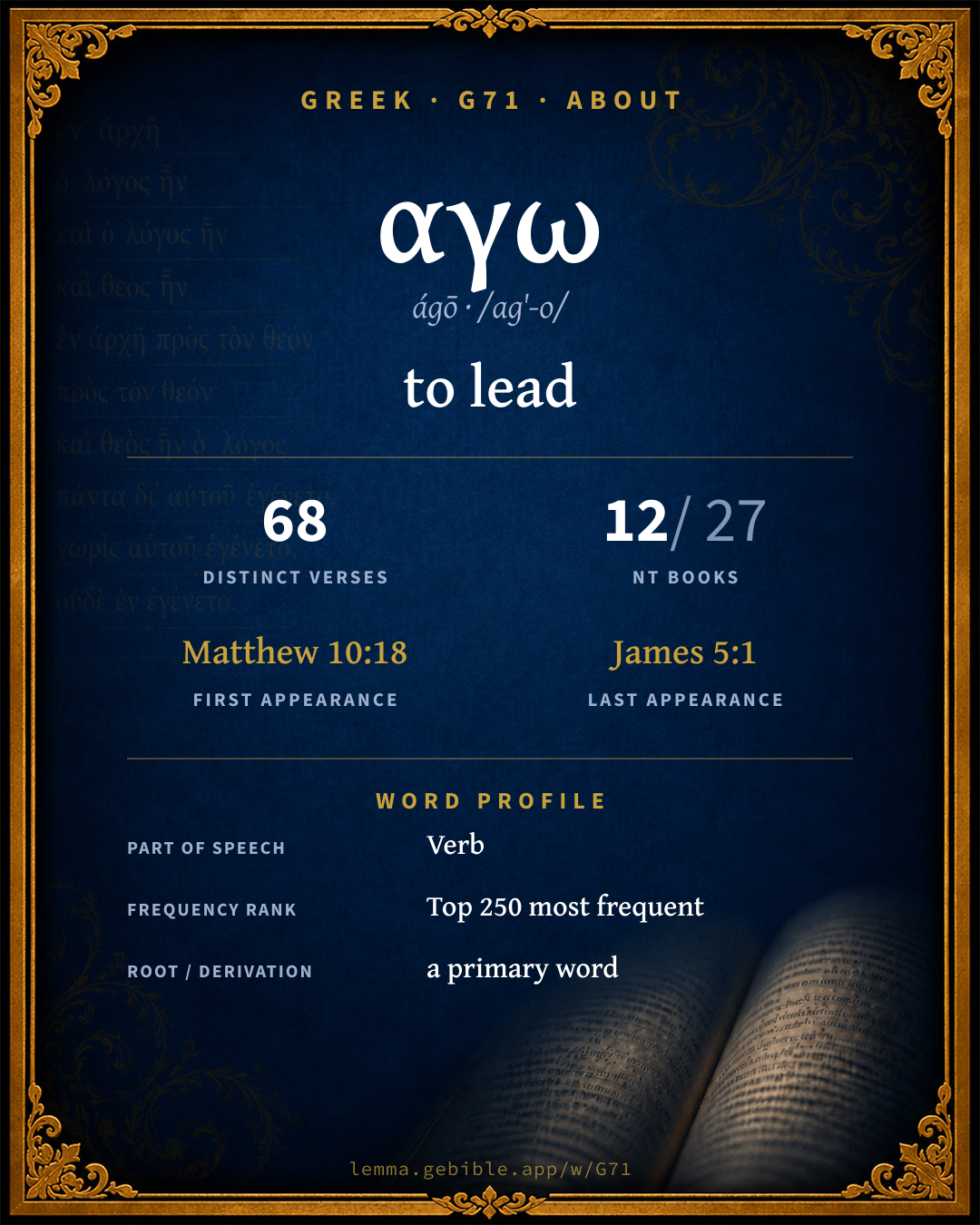
ἄγω
to lead
‘to lead’ is one of 10 main senses fuller range ↓
Full lexicon entry — Thayer's Greek Lexicon
From Thayer's Greek Lexicon
Where this word appears
See every Aorist-tense verb in the Greek New Testament →
Grammar key — what these labels mean
Part of speech
- Verb
- An action or state-of-being word.
Tense
- Aorist
- Action viewed as a simple whole, without regard to duration — often past (perfective aspect).
- Present
- Ongoing or general action in present time (imperfective aspect).
- Future
- Action expected in future time.
- Imperfect
- Continuous or repeated action in past time (“was writing”).
Voice
- Active
- The subject performs the action.
- Passive
- The subject receives the action.
Mood
- Indicative
- States a fact or asks a factual question (the mood of reality).
- Subjunctive
- Expresses probability, purpose, or possibility (the mood of contingency).
- Infinitive
- A verbal noun (“to write”), unmarked for person or number.
- Imperative
- Expresses a command or request.
- Participle
- A verbal adjective (“writing,” “having written”).
Case
- Accusative
- The case of the direct object and of extent.
- Nominative
- The case of the subject (and the predicate nominative).
Person
- 3rd person
- The one spoken about (“he / she / it / they”).
- 1st person
- The speaker (“I / we”).
- 2nd person
- The one addressed (“you”).
Gender
- Masculine
- Grammatically masculine.
- Neuter
- Grammatically neuter.
Number
- Plural
- More than one.
- Singular
- One.
2 verses where G71 appears in the Aorist tense in the Book of Matthew. Filtered view — show all forms. Click any verse to open its interlinear word-by-word view. Verse text shown in the World English Bible for context — . Each verse’s Greek form is shown with its reference; the English is not keyword-highlighted, since the data carries no word-level English alignment. Use “Compare translations” on any verse to read it across multiple English versions. This concordance covers the Greek New Testament; Septuagint (Greek Old Testament) occurrences of this word are not indexed here.
Matthew
- Matthew 21:2 ἀγάγετέ aor act impv 2pl saying to them, "Go into the village that is opposite you, and immediately you will find a donkey tied, and a colt with her. Untie them, and bring them to me.
- Matthew 21:7 ἤγαγον aor act ind 3pl and brought the donkey and the colt, and laid their clothes on them; and he sat on them.
About this entry
At a glance — auto-summarized from this page’s data, not written by a person. Every figure links to its source below. This summary describes the numbers; it doesn’t interpret them.
αγω (ágō) is a Greek verb most often rendered “to lead.” Its lexical range runs to 10 senses. Spanning 68 verses in 12 books, it ranks among the moderately common words of the Greek New Testament. Acts dominates its distribution — 25 of 68 verses. It first appears in Matthew 10:18. The sections below give every sense, occurrence, and version rendering.
Gloss history
Strong's 1890 vs modern scholarship

About this word
Strong's G71 catalogs a Greek word from the Greek New Testament.
These counts are not copied from any lexicon or concordance. They are computed here, from the morphology-tagged Greek New Testament. What Lemma adds →
- 68
- distinct verses
- The word appears in 68 distinct verses.
- 12 / 27
- NT books
- The word appears in 12 of 27 New Testament books.
- #241
- by frequency
- Top 250 most frequent Greek words (rank 241 of 5,347 Greek words by occurrence).
View all 68 occurrences in the concordance →
By section of the New Testament
By traditional corpus
Conventional, traditional groupings — biblical authorship is debated, so this is a traditional corpus grouping, not an authorship claim. Some books belong to more than one corpus (Luke is in both the Gospels and the Lukan corpus, and so on), so these shares overlap and need not total 100%. Each figure is a share of the word’s 68 distinct verses.
- Lukan (Luke–Acts) 38 verses · 56%
- Gospels 33 verses · 49%
- Johannine 13 verses · 19%
- Pauline corpus 7 verses · 10%
- General (Catholic) Epistles 2 verses · 3%
- Hebrews 1 verse · 1%
How translations render this word
Counts come from each version’s own published word-to-Strong’s tagging or interlinear alignment — an approximate guide to how each version renders this word, not a word-level alignment the data otherwise carries. Because each total is that version’s own tagged count, the per-version totals vary from one another and need not match the appearance or distinct-verse counts above. These counts may also differ from a printed concordance because Lemma counts each distinctly tagged rendering and does not collapse phrase taggings into a single head-word total. This is a fixed set of word-tagged versions (KJV, ASV, BSB, ULT) and does not change with the reading translation you choose elsewhere. Each version’s license is shown beside its name below (and on Sources).
- King James Version: Brought 14×, Bring 10×, Let us go 5×
- American Standard Version: Brought 13×, Bring 9×, Be brought 5×
- Berean Standard Bible: Brought 9×, Bring 8×, Let us go 5×
- unfoldingWord Literal Text: Bring 7×, Brought 7×, Let us go 6×
King James Version Public Domain
Renders G71 across 75 tagged occurrences — most commonly:
Plus 31 renderings that appear only once — usually multi-word phrases or single function words the recovered tagging swept in, not distinct renderings. Not rendered by a distinct English word in 1 further occurrence.
American Standard Version Public Domain
Renders G71 across 79 tagged occurrences — most commonly:
Plus other, less common renderings. Plus 29 renderings that appear only once — usually multi-word phrases or single function words the recovered tagging swept in, not distinct renderings.
Berean Standard Bible Public Domain
Renders G71 across 65 tagged occurrences — most commonly:
Plus 25 renderings that appear only once — usually multi-word phrases or single function words the recovered tagging swept in, not distinct renderings. Not rendered by a distinct English word in 4 further occurrences.
unfoldingWord Literal Text CC BY-SA 4.0
Renders G71 across 79 tagged occurrences — most commonly:
Plus other, less common renderings. Plus 32 renderings that appear only once — usually multi-word phrases or single function words the recovered tagging swept in, not distinct renderings.
10 senses in Thayer's, in lexicon order
The 10 senses Thayer's distinguishes for this word, in lexicon order (not ranked by frequency or importance). The full entry — with sub-senses — is in the Lexicon Entry tab.
- to lead by laying hold of, and this way to bring to the point of destination: of an animal
- to lead by accompanying to (into) a place
- to lead with one's self, attach to one's self as an attendant
- to conduct, bring
- to lead away, to a court of justice, magistrate, etc.
- to lead, guide, direct
- to lead through, conduct to: to something
- to move, impel: of forces and influences on the mind
- to pass a day, keep or celebrate a feast, etc.
- to go, depart
Word origin
Origin: a primary word
A primary verb; properly to lead ; by implication to bring drive (reflexively) go (specifically) pass (time) or (figuratively) induce : - be bring (forth) carry (let) go keep lead away be open.
— Strong’s Exhaustive Concordance (1890), public domain.
Forms in the corpus
The 32 distinct written forms G71 takes in the Greek New Testament, most frequent first — each parse links to that tense’s occurrences in the concordance.
Same root — word family
Other Thayer's entries built from the same root as G71, grouped by Strong’s listed origin. These share a root / origin per the lexicon — not necessarily a shared meaning. Each links to that word’s own entry.
Derived from this word
- αγγελος ángelos G32 angel
- αγε áge G33 come
- αγελη agélē G34 herd
- αγρα ágra G61 prey
- αγρος agrós G68 land
- αγωγη agōgḗ G72 conduct
- αγων agṓn G73 assembly
- αξιος áxios G514 worthy
- ηγεομαι hēgéomai G2233 to govern
Compare all same-root words → Showing 4 of 10 — not the complete family. They share a root, not necessarily a meaning.
Septuagint usage
The same Greek word αγω appears 159 times in the Greek Old Testament (Septuagint), across 151 verses in 27 books.
- 159
- LXX occurrences
- Tagged occurrences of this Greek word in the Septuagint.
- 151
- verses
- Distinct Septuagint verses containing this word.
- 27 / 39
- OT books
- The word appears in 27 of the 39 Old Testament books.
Sample Septuagint occurrences
- Genesis 2:19 ἄγω
- Exodus 3:1 ἄγω
- Leviticus 13:2 ἄγω
- Numbers 5:15 ἄγω
- Deuteronomy 8:2 ἄγω
- Joshua 24:8 ἄγω
- Judges 1:7 ἄγω
- 1 Samuel 15:20 ἄγω
- 2 Samuel 3:13 ἄγω
- 1 Kings 2:40 ἄγω
- 2 Kings 4:24 ἄγω
- 1 Chronicles 5:26 ἄγω
Septuagint occurrences (same lexeme)
Every verse where the same Strong’s number (G71) appears in the Greek Septuagint — showing the first 50 of 151. Verse text shown in the World English Bible for context; the Greek form is the matched word — the English is not keyword-highlighted.
- Genesis 2:19 ἄγω Out of the ground Yahweh God formed every animal of the field, and every bird of the sky, and brought them to the man to see what he would call them. Whatever the man called every living creature, that was its name.
- Genesis 2:22 ἄγω He made the rib, which Yahweh God had taken from the man, into a woman, and brought her to the man.
- Genesis 38:25 ἄγω When she was brought forth, she sent to her father-in-law, saying, "By the man, whose these are, I am with child." She also said, "Please discern whose are these-- the signet, and the cords, and the staff."
- Genesis 42:20 ἄγω Bring your youngest brother to me; so will your words be verified, and you won't die." They did so.
- Genesis 42:34 ἄγω Bring your youngest brother to me. Then I will know that you are not spies, but that you are honest men. So I will deliver your brother to you, and you shall trade in the land.'"
- Genesis 42:37 ἄγω Reuben spoke to his father, saying, "Kill my two sons, if I don't bring him to you. Deliver him into my hand, and I will bring him to you again."
- Genesis 43:7 ἄγω They said, "The man asked directly concerning ourselves, and concerning our relatives, saying, 'Is your father still alive? Have you another brother?' We just answered his questions. Is there any way we could know that he would say, 'Bring your brother down?'"
- Genesis 43:9 ἄγω I will be collateral for him. From my hand will you require him. If I don't bring him to you, and set him before you, then let me bear the blame forever,
- Genesis 43:29 ἄγω He lifted up his eyes, and saw Benjamin, his brother, his mother's son, and said, "Is this your youngest brother, of whom you spoke to me?" He said, "God be gracious to you, my son."
- Genesis 44:32 ἄγω For your servant became collateral for the boy to my father, saying, 'If I don't bring him to you, then I will bear the blame to my father forever.'
- Genesis 46:7 ἄγω his sons, and his sons' sons with him, his daughters, and his sons' daughters, and he brought all his seed with him into Egypt.
- Genesis 46:32 ἄγω These men are shepherds, for they have been keepers of cattle, and they have brought their flocks, and their herds, and all that they have.'
- Genesis 47:17 ἄγω They brought their cattle to Joseph, and Joseph gave them bread in exchange for the horses, and for the flocks, and for the herds, and for the donkeys: and he fed them with bread in exchange for all their cattle for that year.
- Exodus 3:1 ἄγω Now Moses was keeping the flock of Jethro, his father-in-law, the priest of Midian, and he led the flock to the back of the wilderness, and came to God's mountain, to Horeb.
- Exodus 14:25 ἄγω He took off their chariot wheels, and they drove them heavily; so that the Egyptians said, "Let's flee from the face of Israel, for Yahweh fights for them against the Egyptians!"
- Exodus 15:22 ἄγω Moses led Israel onward from the Red Sea, and they went out into the wilderness of Shur; and they went three days in the wilderness, and found no water.
- Exodus 22:12 ἄγω But if it is stolen from him, he shall make restitution to the owner of it.
- Leviticus 13:2 ἄγω "When a man shall have a rising in his body's skin, or a scab, or a bright spot, and it becomes in the skin of his body the plague of leprosy, then he shall be brought to Aaron the priest, or to one of his sons the priests:
- Leviticus 24:11 ἄγω The son of the Israelite woman blasphemed the Name, and cursed; and they brought him to Moses. His mother's name was Shelomith, the daughter of Dibri, of the tribe of Dan.
- Leviticus 26:13 ἄγω I am Yahweh your God, who brought you forth out of the land of Egypt, that you should not be their slaves; and I have broken the bars of your yoke, and made you go upright.
- Numbers 5:15 ἄγω then the man shall bring his wife to the priest, and shall bring her offering for her: the tenth part of an ephah of barley meal. He shall pour no oil on it, nor put frankincense on it, for it is a meal offering of jealousy, a meal offering of memorial, bringing iniquity to memory.
- Numbers 11:16 ἄγω Yahweh said to Moses, Gather to me seventy men of the elders of Israel, whom you know to be the elders of the people, and officers over them; and bring them to the tent of meeting, that they may stand there with you.
- Numbers 31:12 ἄγω They brought the captives, and the prey, and the spoil, to Moses, and to Eleazar the priest, and to the congregation of the children of Israel, to the camp at the plains of Moab, which are by the Jordan at Jericho.
- Numbers 32:17 ἄγω but we ourselves will be ready armed to go before the children of Israel, until we have brought them to their place: and our little ones shall dwell in the fortified cities because of the inhabitants of the land.
- Deuteronomy 8:2 ἄγω You shall remember all the way which Yahweh your God has led you these forty years in the wilderness, that he might humble you, to prove you, to know what was in your heart, whether you would keep his commandments, or not.
- Deuteronomy 8:15 ἄγω who led you through the great and terrible wilderness, [in which were] fiery serpents and scorpions, and thirsty ground where was no water; who brought you forth water out of the rock of flint;
- Deuteronomy 29:4 ἄγω but Yahweh has not given you a heart to know, and eyes to see, and ears to hear, to this day.
- Deuteronomy 32:12 ἄγω Yahweh alone did lead him, There was no foreign god with him.
- Joshua 24:8 ἄγω I brought you into the land of the Amorites, that lived beyond the Jordan: and they fought with you; and I gave them into your hand, and you possessed their land; and I destroyed them from before you.
- Judges 1:7 ἄγω Adoni-bezek said, "Seventy kings, having their thumbs and their great toes cut off, gathered [their food] under my table: as I have done, so God has requited me." They brought him to Jerusalem, and he died there.
- Judges 19:6 ἄγω So they sat down, and ate and drink, both of them together: and the young lady's father said to the man, Please be pleased to stay all night, and let your heart be merry.
- 1 Samuel 15:20 ἄγω Saul said to Samuel, Yes, I have obeyed the voice of Yahweh, and have gone the way which Yahweh sent me, and have brought Agag the king of Amalek, and have utterly destroyed the Amalekites.
- 1 Samuel 19:15 ἄγω Saul sent the messengers to see David, saying, Bring him up to me in the bed, that I may kill him.
- 1 Samuel 30:11 ἄγω They found an Egyptian in the field, and brought him to David, and gave him bread, and he ate; and they gave him water to drink.
- 2 Samuel 3:13 ἄγω He said, Well; I will make a league with you; but one thing I require of you: that is, you shall not see my face, except you first bring Michal, Saul's daughter, when you come to see my face.
- 2 Samuel 3:23 ἄγω When Joab and all the host who was with him had come, they told Joab, saying, Abner the son of Ner came to the king, and he has sent him away, and he is gone in peace.
- 2 Samuel 6:3 ἄγω They set the ark of God on a new cart, and brought it out of the house of Abinadab that was in the hill: and Uzzah and Ahio, the sons of Abinadab, drove the new cart.
- 2 Samuel 14:10 ἄγω The king said, Whoever says anything to you, bring him to me, and he shall not touch you any more.
- 2 Samuel 14:23 ἄγω So Joab arose and went to Geshur, and brought Absalom to Jerusalem.
- 1 Kings 2:40 ἄγω Shimei arose, and saddled his donkey, and went to Gath to Achish, to seek his servants; and Shimei went, and brought his servants from Gath.
- 2 Kings 4:24 ἄγω Then she saddled a donkey, and said to her servant, Drive, and go forward; don't slacken me the riding, except I bid you.
- 2 Kings 9:20 ἄγω The watchman told, saying, He came even to them, and isn't coming back: and the driving is like the driving of Jehu the son of Nimshi; for he drives furiously.
- 2 Kings 9:28 ἄγω His servants carried him in a chariot to Jerusalem, and buried him in his tomb with his fathers in the city of David.
- 2 Kings 17:24 ἄγω The king of Assyria brought men from Babylon, and from Cuthah, and from Avva, and from Hamath and Sepharvaim, and placed them in the cities of Samaria instead of the children of Israel; and they possessed Samaria, and lived in the cities of it.
- 2 Kings 17:28 ἄγω So one of the priests whom they had carried away from Samaria came and lived in Bethel, and taught them how they should fear Yahweh.
- 2 Kings 19:25 ἄγω Haven't you heard how I have done it long ago, and formed it of ancient times? now have I brought it to pass, that it should be yours to lay waste fortified cities into ruinous heaps.
- 2 Kings 23:30 ἄγω His servants carried him in a chariot dead from Megiddo, and brought him to Jerusalem, and buried him in his own tomb. The people of the land took Jehoahaz the son of Josiah, and anointed him, and made him king in his father's place.
- 2 Kings 24:16 ἄγω All the men of might, even seven thousand, and the craftsmen and the smiths one thousand, all of them strong and apt for war, even them the king of Babylon brought captive to Babylon.
- 2 Kings 25:6 ἄγω Then they took the king, and carried him up to the king of Babylon to Riblah; and they gave judgment on him.
- 2 Kings 25:7 ἄγω They killed the sons of Zedekiah before his eyes, and put out the eyes of Zedekiah, and bound him in fetters, and carried him to Babylon.
These are occurrences of the same Greek lexeme (G71) in the Septuagint — not a translation of any one Hebrew word. The store carries no word-level Hebrew↔Greek alignment, so no Hebrew original is asserted here. Counts come from the recovered LXX Strong's tagging — high-frequency vocabulary is well covered, while rare or late forms may be untagged — so they reflect tagged occurrences and may slightly undercount.