2 Timothy 4:11

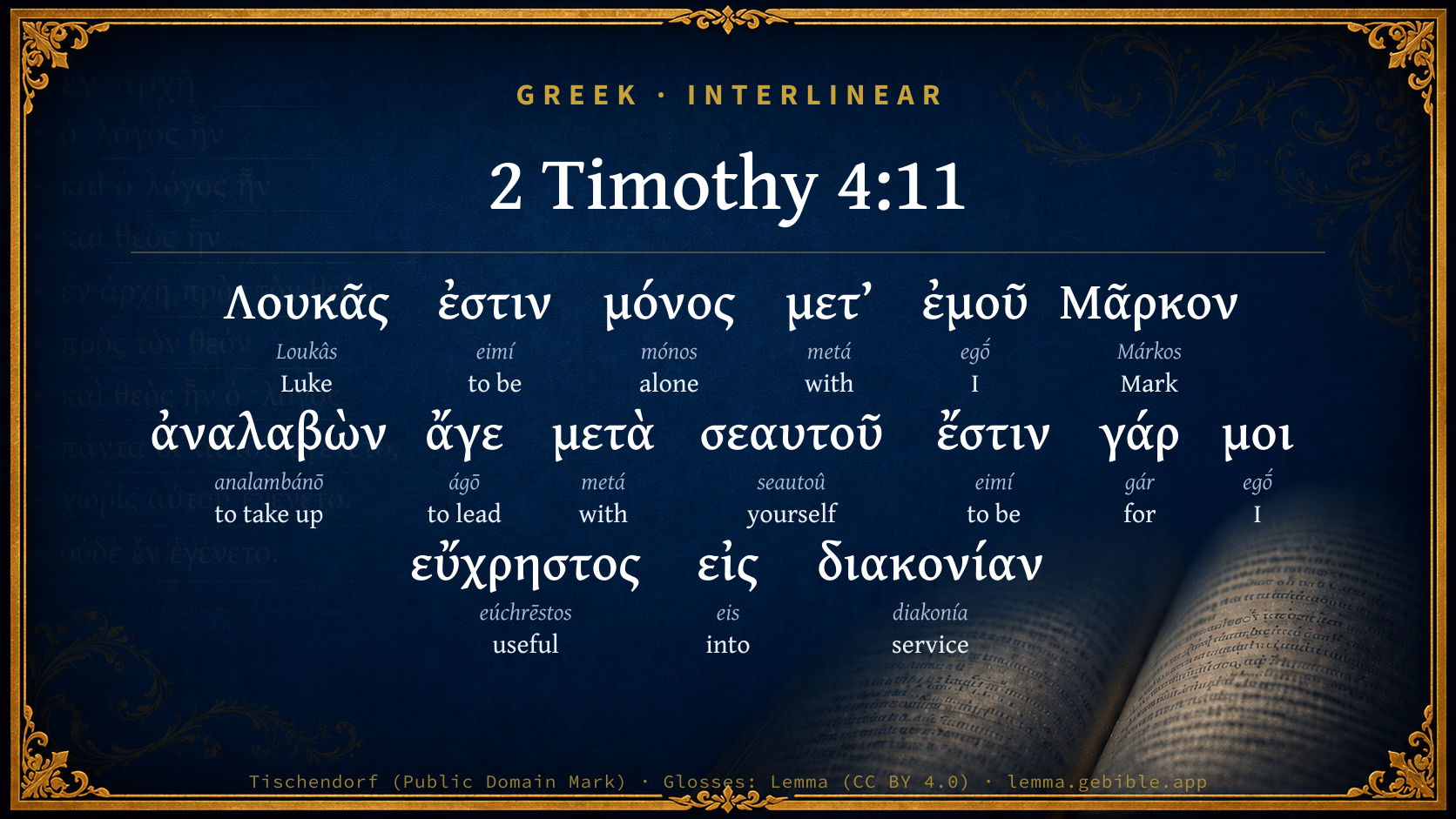
Greek (Tischendorf 8th ed.) 2 Timothy 4:11 appears in the Greek New Testament. The text above is from the Tischendorf 8th edition. Each word links to its Strong’s number and a concise gloss. Click any word for its full Thayer’s Greek Lexicon entry.
Download image
Cite this verse

2 Timothy 4:11 (World English Bible). Public Domain. Lemma interlinear Bible study tool, https://lemma.gebible.app/v/2-timothy/4/11.

Show BibTeX & RIS
BibTeX
RIS
English Translation
Only Luke is with me. Take Mark, and bring him with you, for he is useful to me for ministering.
World English Bible · Public Domain
Download a study sheet

One document with this verse’s original text, its word-by-word gloss line, the meaning frame, cross-references with their text, attributed commentary, and full source and license credits — printable, and it pastes into notes with its structure intact.

This verse Autodidact and up

Study sheet (.html) Plain text (.txt)

A passage Seminary Student

Up to 50 verses in one chapter. A passage sheet keeps up to 6 commentary sources and 12 cross-references per verse, in the order this page ranks them, and says so on the sheet whenever that leaves anything out. Ask for a single verse and you get the Autodidact verse sheet above.

Everything on this page stays free to read, with no account — the sheet is a download of what is already on screen, not access to it.

Want to remove ads? Support Godless Engineer
Compare translations 3

The same verse in 3 English versions, stacked beneath the original-language interlinear above. Click any original word for its lexicon entry.

Each is an independent rendering of the whole verse — the interlinear is not word-aligned to these translations.

Highlighted words mark where these versions differ — a whole-verse word diff, not a word-by-word alignment.

  • World English Bible Public Domain
    Only Luke is with me. Take Mark, and bring him with you, for he is useful to me for ministering.
  • King James Version Public Domain
    Only Luke is with me. Take Mark, and bring him with thee: for he is profitable to me for the ministry.
  • unfoldingWord Literal Text CC BY-SA 4.0
    Only Luke is with me. Taking Mark, bring with you, for he is useful to me for service.

unfoldingWord Literal Text — © unfoldingWord, licensed CC BY-SA 4.0. Word-aligned USFM3 via Door43 (git.door43.org/unfoldingWord/en_ult).

Versions to compare (up to 4)

3 of 4 selected

Show all 19 translations

Every available English version of this verse, each an independent rendering of the whole verse.

  • World English Bible Public Domain
    Only Luke is with me. Take Mark, and bring him with you, for he is useful to me for ministering.
  • Berean Standard Bible Public Domain
    Only Luke is with me. Get Mark and bring him with you, because he is useful to me in the ministry.
  • Majority Standard Bible Public Domain
    Only Luke is with me. Get Mark and bring him with you, because he is useful to me in the ministry.
  • King James Version Public Domain
    Only Luke is with me. Take Mark, and bring him with thee: for he is profitable to me for the ministry.
  • American Standard Version (1901) Public Domain
    Only Luke is with me. Take Mark, and bring him with thee; for he is useful to me for ministering.
  • Revised Version (1885) Public Domain
    Only Luke is with me. Take Mark, and bring him with thee: for he is useful to me for ministering.
  • Geneva Bible (1599) Public Domain
    Onely Luke is with me. Take Marke and bring him with thee: for he is profitable vnto me to minister.
  • Douay-Rheims (1899) Public Domain
    Only Luke is with me. Take Mark, and bring him with thee: for he is profitable to me for the ministry.
  • Young's Literal Translation Public Domain
    Lukas only is with me; Markus having taken, bring with thyself, for he is profitable to me for ministration;
  • Literal Standard Version CC BY-SA 4.0
    only Lucas is with me; having taken Mark, bring [him] with you, for he is profitable to me for ministry;
  • Unlocked Literal Bible CC BY-SA 4.0
    Only Luke is with me. Get Mark and bring him with you because he is useful to me in the work.
  • unfoldingWord Literal Text CC BY-SA 4.0
    Only Luke is with me. Taking Mark, bring with you, for he is useful to me for service.
  • Darby Bible Public Domain
    Luke alone is with me. Take Mark, and bring [him] with thyself, for he is serviceable to me for ministry.
  • World Messianic Bible Public Domain
    Only Luke is with me. Take Mark and bring him with you, for he is useful to me for service.
  • Webster's Bible Public Domain
    Luke only is with me. Take Mark, and bring him with thee: for he is profitable to me for the ministry.
  • Free Bible Version CC BY-SA 4.0
    Only Luke is here with me. Bring Mark with you, because he can help me with my work.
  • Bible in Basic English Public Domain
    Only Luke is with me. Get Mark and take him with you; for he is of use to me in the work.
  • Text-Critical English NT CC BY 4.0
    Luke alone is with me. Get Mark and bring him with yoʋ, for he is useful to me for ministry.
  • Tyndale New Testament (1534) Public Domain
    Only Lucas is with me. Take Marke and bringe him with the for he is necessary vnto me forto minister.

Literal Standard Version (2020), Covenant Press — licensed CC BY-SA 4.0. Text via the HelloAO Bible API (eBible.org). Unlocked Literal Bible (unfoldingWord) — licensed CC BY-SA 4.0. Text via the HelloAO Bible API (eBible.org). unfoldingWord Literal Text — © unfoldingWord, licensed CC BY-SA 4.0. Word-aligned USFM3 via Door43 (git.door43.org/unfoldingWord/en_ult). Free Bible Version, Dr. Jonathan Gallagher — licensed CC BY-SA 4.0. Text via the HelloAO Bible API (eBible.org).

Word by word

More ways to search: Search by grammar → Find every occurrence → Compare this word →

Practice this passage: Drill this verse → Learn its vocabulary →

Λουκᾶς
Loukâs
G3065
“Luke”
Noun, Nominative, Singular, Masculine
Part of Speech
Noun
Case
Nominative
Number
Singular
Gender
Masculine
Full Thayer's Definition

Origin: contracted from Latin Lucanus

TDNT: None

Luke or Lucus = "light-giving" 1. a Gentile Christian, the companion of Paul in preaching the gospel and on his many journeys; he was a physician and author of the book of Luke and Acts in the NT
  1. ἐστιν eimí G1510 “to be” Verb, Present, Active, Indicative, 3rd person, Singular
  2. μόνος mónos G3441 “alone” Adjective, Nominative, Singular, Masculine
  3. μετ’ metá G3326 “with” Preposition
  4. ἐμοῦ egṓ G1473 “I” Personal pronoun, 1st person, Genitive, Singular
  5. Μᾶρκον Márkos G3138 “Mark” Noun, Accusative, Singular, Masculine
  6. ἀναλαβὼν analambánō G353 “to take up” Verb, Aorist, Active, Participle, Nominative, Singular, Masculine
  7. ἄγε ágō G71 “to lead” Verb, Present, Active, Imperative, 2nd person, Singular
  8. μετὰ metá G3326 “with” Preposition
  9. σεαυτοῦ seautoû G4572 “yourself” Reflexive pronoun, 2nd person, Genitive, Singular, Masculine
  10. ἔστιν eimí G1510 “to be” Verb, Present, Active, Indicative, 3rd person, Singular
  11. γάρ gár G1063 “for” Conjunction
  12. μοι egṓ G1473 “I” Personal pronoun, 1st person, Dative, Singular
  13. εὔχρηστος eúchrēstos G2173 “useful” Adjective, Nominative, Singular, Masculine
  14. εἰς eis G1519 “into” Preposition
  15. διακονίαν diakonía G1248 “service” Noun, Accusative, Singular, Feminine

About this verse

These counts appear in no published source. They are computed here, from the morphology-tagged text and Lemma’s own curated glosses. What Lemma adds →

16
words
13
distinct lemmas
Pauline Epistles
section

Notable vocabulary

The rarest word here is Λουκᾶς Luke G3065 — appearing just 3 times in the whole Greek New Testament.

Shared distinctive vocabulary

Λουκᾶς Luke G3065 occurs in 3 verses of the Greek New Testament. Also found in:

Repetition

Words recur within this verse:

  • ἐστιν to be G1510 ×2
  • μετ’ with G3326 ×2
  • ἐμοῦ I G1473 ×2

Cross-references

13

Topical passages linked to 2 Timothy 4:11 in the Treasury of Scripture Knowledge — connected by theme and wording, ordered by reader-vote popularity; previews shown in the World English Bible.

  • Acts 12:12 Thinking about that, he came to the house of Mary, the mother of John whose surname was Mark, where many were gathered together and were praying.
  • Acts 12:25 Barnabas and Saul returned to Jerusalem, when they had fulfilled their service, also taking with them John whose surname was Mark.
  • Philemon 1:24 as do Mark, Aristarchus, Demas, and Luke, my fellow workers.
  • Acts 15:39 Then the contention grew so sharp that they separated from each other. Barnabas took Mark with him, and sailed away to Cyprus,
  • Colossians 4:10 Aristarchus, my fellow prisoner greets you, and Mark, the cousin of Barnabas (concerning whom you received commandments, "if he comes to you, receive him"),
  • Colossians 4:14 Luke, the beloved physician, and Demas greet you.
  • 2 Timothy 1:15 This you know, that all who are in Asia turned away from me; of whom are Phygelus and Hermogenes.
  • 1 Peter 5:13 She who is in Babylon, chosen together with you, greets you; and so does Mark, my son.
  • Hosea 14:4 "I will heal their waywardness. I will love them freely; For my anger is turned away from him.
  • Matthew 19:30 But many will be last who are first; and first who are last.
  • Matthew 20:16 So the last will be first, and the first last. For many are called, but few are chosen."
  • Luke 13:30 Behold, there are some who are last who will be first, and there are some who are first who will be last."
  • Acts 16:10 When he had seen the vision, immediately we sought to go out to Macedonia, concluding that the Lord had called us to preach the Gospel to them.

Cross-references courtesy of OpenBible.info (CC BY 4.0).

Commentary

Notes on 2 Timothy 4:11 from classic Christian and Jewish commentators (each source and its license shown beneath its notes). The classic Christian expositions comment on the surrounding passage and are grouped to its opening verse, so a note may address several verses; the Jewish commentaries on the Tanakh (Rashi and others) are per-verse, so they appear only where the commentator wrote on this verse.

Lemma curates 59 commentaries, every one of them public domain or Creative Commons licensed, each selected and text-cleaned for this edition rather than reprinted as found. About our sources →

Tyndale Open Study Notes

Tyndale Open Resources

4:11 Luke, the author of Luke and Acts, accompanied Paul in his journeys at various times. It is often supposed that Luke was with Paul as his physician (Col 4:14). Luke was the only one of Paul’s co-workers who was continuously present with him. Thus Paul wished for Timothy to come quickly. • Mark: Paul’s assessment that he will be helpful to me tells a story of forgiveness and redemption (see Acts 13:13; 15:36-40; see also Col 4:10; Phlm 1:24).

Tyndale Open Study Notes — © Tyndale Open Resources, licensed CC BY-SA 4.0. Text via the HelloAO Bible API.

Bengel's Gnomon

Johann Albrecht Bengel

2Ti 4:11. Λουκᾶς, Luke) Luke has not brought down the history of the Acts of the Apostles to this period.—μόνος, alone) He is speaking of his companions; for he had many other friends present: 2Ti 4:21.—εὔχρηστος, profitable) more than formerly, Act 13:13; Act 15:38: comp. Phm 1:11. Demas apostatizes: Mark recovers himself: but he (viz. Mark), who had gone away in the case of an easier undertaking, ought now to be present in a time of more serious difficulties.

Bengel's Gnomon of the New Testament — English translation (T&T Clark, Edinburgh, 1860) — public domain. Text from a community e-Sword module.

Meyer's Critical & Exegetical Commentary

Heinrich August Wilhelm Meyer

2Ti_4:11. Λουκᾶς ἐστὶ μόνος μετʼ ἐμοῦ] There is no reason for doubting that this Luke was the apostles well-known assistant. He accompanied Paul on his second missionary journey from Troas, Act_16:10, then on his third journey, Act_20:5 to Act_21:18. He was with Paul both in his imprisonment at Caesarea and in the first imprisonment at Rome, Acts 27; Col_4:14; Phm_1:24.

Μάρκον ἀναλαβὼν ἄγαγε (or common reading: ἄγε) μετὰ σεαυτοῦ] Mark, too, is the young apostle with whom we are acquainted from the Book of Acts. According to Col_4:10, Phm_1:13, he was likewise with Paul in his first Roman imprisonment; ἀναλαβών, see Act_20:14. It is not known where Mark was at this time. The reason why Paul wished to have him is given in the words: ἔστι γάρ μοι εὔχρηστος εἰς διακονίαν] εὔχρηστος, 2Ti_2:21. Διακονία here is to be understood of the apostolic office[67] (according to Wiesinger: of Marks personal services, but certainly in the apostles vocation).

[67] What Otto (pp. 257 ff.) on this passage adduces regarding the relation of Mark to Paul are groundless suppositions. It is a purely arbitrary assumption that Mark, after abstaining for some time from work among the heathen, had again offered his services to Paul through Timothy. And it is equally an assumption to say, that from the words εὔχρηστος κ.τ.λ. it would appear that Mark could not have hitherto given Paul his services, because in that case Paul would not have censured him regarding his usefulness for the ministry (!).

Meyer — Critical and Exegetical Commentary on the New Testament — English translation by Peter Christie, edited by Frederick Crombie (T&T Clark, 1880) — public domain. Text from a community e-Sword module.

Expositor's Greek Testament

ed. W. Robertson Nicoll

2Ti 4:11 . Λουκᾶς : Nothing can be more natural than that “the beloved physician” and historian should feel that he of all men was in his place beside St. Paul when the end was to nearly approaching. The μόνος is relative to fellow-labourers in the gospel. St. Paul had many friends in Rome (2Ti 4:21 ).

Μᾶρκον : St. Paul was now completely reconciled to John Mark who had, before Col 4:10 was written, vindicated and justified the risk Barnabas had run in giving him a chance of recovering his character (see Act 13:13 ; Act 15:38 ). ἀναλαβών : assume (Vulg.). Take up on your way. Assumere is also the Latin in Act 20:14 ; Act 23:31 , but suscipere in Act 20:13 . It is implied that Mark was somewhere on the line of route between Ephesus and Rome; but we do not know the precise place.

ἄγε μετὰ σεαυτοῦ : This phrase is illustrated from the papyri by Moulton and Milligan, Expositor , vii., 4:57.

εὔχρηστος εἰς διακονίαν : As Mark was the ἑρμηνευτής of St. Peter, rendering his Aramaic into Greek, so he may have helped St. Paul by a knowledge of Latin. διακονία , however, does not necessarily include preaching. It is characteristic of St. Paul that he should not regard “the ministry which he had received from the Lord Jesus” as “accomplished” so long as he had breath to “testify the gospel of the grace of God” (Act 20:24 ).

The Expositor's Greek Testament, edited by W. Robertson Nicoll (1897–1910) — public domain. Text from a community e-Sword module.

International Critical Commentary

11. Μάρκον] Act 12:25, Act 15:37, Col 4:10, Phm 1:24; for the details of his life, cf. Swete, St. Mark, Introd. i.

ἀναλαβών] Act 20:13, Act 20:14. εὔχρηστος, cf. 2:21, Phm 1:11. εἰς διακονίαν, either for personal service in prison, or for missions to the city, or for help in worship. Mark had proved his capacity as ὑπηρέτης, Act 13:5; as συνεργὸς εἰς τὴν βασιλείαν, Col 4:11; as a comforter in trouble (ibid.); and, like Onesimus, though once ἄχρηστος, had become εὔχρηστος again.

International Critical Commentary — older volumes (1896–1929), various authors — public domain. Text from a community e-Sword module.

Jamieson, Fausset & Brown

Robert Jamieson, A. R. Fausset & David Brown

Take--Greek, "take up" on thy journey (Act 20:13-14). John Mark was probably in, or near, Colosse, as in the Epistle to the Colossians (Col 4:10), written two years before this, he is mentioned as about to visit them. Timothy was now absent from Ephesus and somewhere in the interior of Asia Minor; hence he would be sure to fall in with Mark on his journey.

he is profitable to me for the ministry--Mark had been under a cloud for having forsaken Paul at a critical moment in his missionary tour with Barnabas (Act 15:37-40; Act 13:5, Act 13:13). Timothy had subsequently occupied the same post in relation to Paul as Mark once held. Hence Paul, appropriately here, wipes out the past censure by high praise of Mark and guards against Timothy's making self-complacent comparisons between himself and Mark, as though he were superior to the latter (compare Plm 1:24). Demas apostatizes. Mark returns to the right way, and is no longer unprofitable, but is profitable for the Gospel ministry (Plm 1:11).

Jamieson, Fausset & Brown — Commentary Critical and Explanatory on the Whole Bible (1871) — public domain (CC PDM 1.0). Text via the HelloAO Bible API.

Adam Clarke's Commentary

Verse 11. Only Luke is with me.] This was Luke the evangelist, and writer of the Acts of the Apostles, who was always much attached to St. Paul, and it is supposed continued with him even to his martyrdom.

Take Mark, and bring him with thee] This was John Mark, the sister's son of Barnabas, who, after having wavered a little at first, became a steady, zealous, and useful man; his name and conduct have been often before the reader. See the parallel passages.

For he is profitable to me for the ministry.] εις διακονιαν. For service; that is, he would be very useful to the apostle, to minister to him in his present close confinement. Some think that the apostle means his preaching the Gospel; but at this time, I should suppose, there was very little, if any, public preaching at Rome.

Adam Clarke's Commentary on the Bible (1810–1826) — public domain. Text from a community e-Sword/MySword module.

Ellicott's Commentary for English Readers

(11) Only Luke is with me.—The “writer” of the Third Gospel, the Gospel which, as has been stated above, was very possibly the work of St. Paul—“my Gospel.” Luke, “the beloved physician” of Col_4:14, of all St. Paul’s companions, seems to have been most closely associated with the Apostle. Most likely this close intimacy and long-continued association was owing to the Apostle’s weak and infirm health—to that dying body—the noble Paul ever bore about with him. Luke was with St. Paul, we know, in his second missionary journey, and again in his third missionary journey; he accompanied him to Asia, and then to Jerusalem; was with him during the captivity time of Cæsarea, and subsequently of Rome, the first time St. Paul was imprisoned in the capital (Acts 18). After St. Paul’s death, Epiphanius speaks of him as preaching chiefly in Gaul; a very general tradition includes him among the martyrs of the first age of the Church. The name is probably a contraction of Lucanus. (See Introduction to the Acts of the Apostles.)

Take Mark, and bring him with thee: for he is profitable to me for the ministry.—“But Paul thought not good to take him with them, who departed from them . . . and went not with them to the work” (Act_15:38). There is something strangely touching in this message of the aged master to Timothy to bring with him on that last solemn journey one whom, some quarter of a century before, St. Paul had judged so severely, and on whose account he had separated from his old loved friend, Barnabas the Apostle. Since that hour when the young missionary’s heart had failed him in Pamphylia, Mark had, by steady, earnest work, won back his place in St. Paul’s heart. Barnabas, we know, when his brother Apostle rejected him, took him with him to Cyprus. After some twelve years, we find him, during the first imprisonment, with St. Paul at Rome (Col_4:10; Phm_1:24). He is mentioned (1Pe_5:13) by the endearing term of “my son,” and the unanimous traditions of the ancient Christian writers represent him as the secretary or amanuensis of St. Peter. It was his office to commit to writing the orally delivered instructions and narrations of his master. These, in some revised and arranged form, probably under the direction of Peter himself, were given to the Church under the title of St. Mark’s Gospel. A later and uncertain tradition says he subsequently became first Bishop of Alexandria, and there suffered martyrdom.

For he is profitable to me for the ministry.—Profitable, according to the suggestion of Grotius, owing to Mark’s knowledge of the Latin tongue. This is possible; but it is more likely that he was profitable or serviceable as an assistant who was well acquainted with the details of St. Paul’s many sided work.

A Bible Commentary for English Readers, edited by Charles John Ellicott (1878–1897) — public domain. Text from a community e-Sword module.

The Cambridge Bible for Schools and Colleges

gen. ed. J. J. S. Perowne

11. Only Luke] Lucas is a contraction of Lucanus, which occurs frequently in inscriptions, and may indicate the position of a libertus or freedman: many such, we know, were the house physicians, the profession, as such, being in very little esteem. See Plaut. Menæchm. 2Ti_4:3-5, and cf. Bekker’s Gallus, p. 207. St Luke is distinguished from ‘they of the circumcision,’ Col_4:14, and so cannot be identified with Lucius St Paul’s ‘kinsman,’ Rom_16:21. He first appears as a companion of St Paul, Act_16:1, at a time very nearly that of an attack of the Apostle’s constitutional malady or ‘thorn in the flesh,’ Gal_4:13; and the words in Col_4:14 ‘the beloved physician’ seem to breathe a feeling of personal gratitude and obligation. St Luke travelled with the Apostle on his last journey to Jerusalem (Act_21:1) and also, two years later from Jerusalem to Rome (Act_27:2). The absence of his name from the greetings in Philippians may be due to his having then left Rome for a time; but he was again with him before the close of the two years, Col_4:14, Phm_1:24; and is now at his side ‘alone’ in his last hours. See Introd. p. 44. After St Paul’s death, according to Epiphanius cont. Hær. li. 11, St Luke ‘preaches first in Dalmatia and Gallia; in Italy and Macedonia, but first in Gallia; as Paul himself says of some of his companions in his epistles “Crescens in Gallia,” for we are not to read “in Galatia” as some mistakenly think, but “in Gallia.” ’ Bithynia and Achaia are named as the place of his martyrdom somewhere between a.d. 75 and a.d. 100.

For a striking comparison drawn between St Luke and Demas see Keble’s Poem on St Luke’s Day (Christian Year):

‘Two converts, watching by his side,

Alike his love and greetings share;

Luke the beloved, the sick soul’s guide,

And Demas, named in faltering prayer.

Pass a few years—look in once more—

The Saint is in his bonds again;

Save that his hopes more boldly soar,

He and his lot unchanged remain.

But only Luke is with him now!—

Alas! that even the martyr’s cell,

Heaven’s very gate, should scope allow

For the false world’s seducing spell.’

Take Mark] A.V. varies between ‘Mark’ and ‘Marcus’ in the different passages where the name occurs. R.V. rightly throughout ‘Mark’ (Lightfoot, N. T. Rev., p. 157). ‘Marcus’ was the Latin surname for John (Johanan, the Grace of God) the son of Mary, who lived at Jerusalem, apparently with good means (Act_12:12), and ‘cousin’ of Barnabas of Cyprus (Col_4:10). He and his mother must have been well known to St Peter, who went to her house straight from the prison; and the phrase ‘Mark my son’ 1Pe_5:13 makes it probable that he was converted by that Apostle. Compare a similar phrase in 1Ti_1:2; 1Ti_1:18. He was ‘minister’ to Paul and Barnabas on the first missionary journey through Cyprus, but left them at Perga (Act_13:5; Act_13:13), possibly to escape the dangers of Asia Minor; and for this reason St Paul declined to have his help on the second journey (Act_15:38) though at the cost of breaking with St Barnabas, who took St Mark again to Cyprus. A reconciliation must have taken place before we next hear of him, as he is reckoned by St Paul in the first imprisonment at Rome as one of his ‘fellow labourers unto the kingdom’ who have been ‘a comfort’ unto him, Col_4:10. After this he seems to have joined St Peter at ‘Babylon’ (1Pe_5:13) whence he must have returned to Asia Minor, so that Timothy could now ‘take him up.’ After St Paul’s death he is said to have laboured in Egypt and to have died by martyrdom. His Gospel must have been written between a.d. 63 and a.d. 70; according to Irenæus, after the deaths of St Peter and St Paul; according to Jerome, ‘Peter relating and Mark writing.’ See Maclear’s Introduction to St Mark’s Gospel, pp. 14, 15, &c. As especially in keeping (by undesigned coincidence) with what we have seen above of St Mark’s own fall and restoration and his slow advance to settled power as a ‘fellow labourer unto the kingdom’ and ‘profitable to the ministry,’ we should observe (if it has not been noticed in this connexion before) what significance the two parables and the one miracle have which are recorded only by St Mark. They are the healing of the deaf and dumb man at Decapolis, with the five stages in his gradual cure (Mar_7:31), the healing of the blind man at Bethsaida, with the four successive stages (Mar_8:22), and the parable of the seed growing secretly and slowly, ‘first the blade, then the ear, after that the full corn in the ear’ (Mar_4:26). Among the many lessons learnt from Christ, through St Peter, this laid hold of St Mark; it fitted his need, gave him good hope and heart that he could indeed ‘rise on stepping-stones of his dead self’ to a new and higher life; and what he thus found so true in his own case he could not but put on record, to be a ‘profitable ministry’ through the Holy Spirit to very many ‘feeble-hearts,’ who like him have become ‘great-hearts’ and ‘lion-hearts’ for Christ.

‘Companion of the Saints! ’twas thine

To taste that drop of peace divine,

When the great soldier of thy Lord

Call’d thee to take his last farewell,

Teaching the Church with joy to tell

The story of your love restored.’

The Christian Year, ‘St Mark’s Day.’

profitable … for the ministry] Lit. serviceable for ministering. Observe the emphatic position of the verb ‘for he is,’ almost implying ‘whatever he once may have been’: primarily this ministering would be to himself, as Erastus and Timothy are designated ‘ministers unto him,’ Act_19:22.

The Cambridge Bible for Schools and Colleges (gen. ed. J. J. S. Perowne; Cambridge University Press, 1878–1918) — public domain. Text from a community e-Sword module.

John Gill's Exposition

And Tychicus have I sent to Ephesus. To supply the place of Timothy, while he came to Rome, and continued there: so careful was the apostle of the church there, that they might not be without the ministry of the word during his absence; see Eph 6:20.

.

2 Timothy 4:13

ti2 4:13

ti2 4:13

ti2 4:13The cloak that I left at Troas with Carpus,.... About the word here rendered a "cloak", interpreters are not agreed: some take it for a garment, and about this they differ; some would have it to be a dignified robe, such as the Roman consuls and senators of Rome wore; which is not likely, this being not suitable to the apostle's character, state, and circumstances. Others take it to be a courser and meaner garment, wore in cold and rainy weather, to preserve from the inclementencies of it; and winter now coming on, Ti2 4:21 the apostle sends for it; which he perhaps had left at Troas in the summer season, as he came: but others take it to be a kind of desk or scrutoire, to put papers in, or a chest for books, a book press; and so the Syriac version renders it; and which agrees with what follows. Jerom understands it of a book itself, of the Hebrew volume of the Pentateuch (g). Troas, where this cloak, or book press, or book was, was a city in Asia Minor, that stood upon, or near the same place where old Troy stood, and from whence it seems to have had its name, and lay in Timothy's way from Ephesus to Rome; See Gill on Act 16:8, Act 20:7 and as for Carpus, he was Paul's host when he was at Troas. Some make him to be first bishop of Laodicea, and then of Crete; he is reckoned among the seventy disciples, and is said to be bishop of Berytus in Thrace; See Gill on Luk 10:1.

When thou comest, bring with thee; he would have him call for it at Troas as he came by, and bring it with him:

and the books; that were in it, or were there, besides the Hebrew Pentateuch: the apostle was a great reader of books, of various sorts, both Gentile and Jewish, as appears by his citations out of the Heathen poets, and his acquaintance with Jewish records, Act 17:28. And though he was now grown old, and near his exit, yet was mindful and careful of his books, and desirous of having them to read; and herein set an example to Timothy and others, and enforced the exhortation he gave him, Ti1 4:13.

But especially the parchments: which might contain his own writings he had a mind to revise before his death, and commit into the hands of proper persons; or some observations which he had made in his travels, concerning persons and things; though it is most likely that these were the books of the Old Testament, which were written on parchments, and rolled up together; and hence they are called the volume of the book; and these the apostle had a special regard for, that whatever was neglected, he desired that these might not, but be carefully brought unto him.

(g) Epist. ad Damas. qu. 2. p. 12. Tom. 3.

John Gill's Exposition of the Whole Bible (1746–1763) — public domain (CC PDM 1.0). Text via the HelloAO Bible API.

Trapp's Complete Commentary

John Trapp

11 Only Luke is with me. Take Mark, and bring him with thee: for he is profitable to me for the ministry.

Ver. 11. For he is profitable] Once unprofitable, {Act 15:38} {See Trapp on "Act 15:38"} but now profitable, Phm

11.

John Trapp, A Commentary or Exposition upon All the Books of the Old and New Testament (1647–1656) — public domain. Text from a community e-Sword module.

Albert Barnes' Notes on the Bible

Only Luke is with me - Luke, the author of the gospel which bears his name, and of the Acts of the Apostles. For a considerable part of the ministry of Paul, he was his traveling companion (compare the notes on Act 16:10), and we know that he went with him to Rome; Act 27:1.

Take Mark - John Mark, see the notes at Act 15:37. He was the son of a sister of Barnabas, and had been the traveling companion of Barnabas and Paul. There had been a temporary alienation between Paul and him Act 15:38; but this passage proves that that had been removed, and that Paul was reconciled to him.

For he is profitable to me for the ministry - In what way he would be profitable, he does not say; nor is it known why Mark was at that time with Timothy. It may be observed, however, that this is such language as Paul might be expected to use of Mark, after what had occurred, as recorded in Act 15:38. He felt that he was now about to die. If he suspected that there was on the part of Mark any lingering apprehension that the great apostle was not entirely reconciled to him, or retained a recollection of what had formerly occurred, nothing would be more natural than that, at this trying time of his life, Paul should summon him to his side, and express toward him the kindest emotions. It would soothe any lingering irritation in the mind of Mark, to receive such a message.

Albert Barnes' Notes on the Bible (1834–1885) — public domain. Text from a community e-Sword/MySword module.

Haydock's Catholic Bible Commentary

Luke. St. Luke was always much attached to St. Paul. It is thought he accompanied him to the time of his martyrdom. When St. Paul says Luke alone was with him, we must understand that no other disciple was at that time with him; not that the faithful of Rome, whose faith was so lively and charity so ardent, had abandoned him in this time of danger. (St. John Chrysostom, hom. x. p. 610.) --- Mark. This is John Mark, cousin of Barnabas, of whom mention was made, Acts xiii. 12. &c. also Colossians iv. 10. He rather wavered in faith at the beginning, but was afterwards much attached to the apostle. (Calmet)\

George Leo Haydock (1774–1849), Haydock's Catholic Family Bible and Commentary, 1859 edition — public domain. Excludes Psalms (Douay-Rheims chapter numbering differs from Protestant) and Deuterocanonical books (Catholic canon only).

Matthew Poole's English Annotations

Only Luke is with me; of whom we also read Col 4:14. He was a physician, Paul’s fellow labourer, Phm 1:24.

Take Mark, and bring him with thee; of Mark we read Act 12:12; 15:37. He was kinsman to Barnabas, Col 4:10. It appears by that text that he was at Rome with Paul, and his fellow labourer, Phm 1:24, For he is prifitable to me for the ministry; the ministry of the gospel. Paul’s care was more for that, than for a ministering to himself, though he was a prisioner.

Matthew Poole's English Annotations on the Holy Bible (1683–1685) — public domain. Text from a community e-Sword/MySword module.

Whedon's Commentary on the Bible

Daniel D. Whedon

11. Luke—See notice of Luke, vol. 2, p. 11, and note Act_13:1.

Mark—According to Col_4:10, he is commended to Colosse. Timothy might easily take Mark from there if he received this epistle at Ephesus.

Daniel D. Whedon (gen. ed.), Commentary on the Old and New Testaments (1874–1909) — public domain. Text from a community e-Sword module.

The Pulpit Commentary

Useful for profitable, A.V; ministering for the ministry, A.V Luke; probably a shortened form of Lucanus. Luke was with St. Paul in his voyage to Rome, (Act_27:1 Act_28:11, Act_28:16) and when he wrote the Epistles to the Colossians and Philemon, (Col_4:14 Phm_1:4) having doubtless composed the Acts of the Apostles during St. Paul"s two years" imprisonment. (Act_28:30) How he spent his time between that date and the mention of him here as still with St. Paul, we have no knowledge. But it looks as if he may have been in close personal attendance upon him all the time. if he had been permitted to write a supplement to the Acts, perhaps the repeated "we" would have shown this. Take Mark. Mark had apparently been recently reconciled to St. Paul when he wrote Col_4:10, and was with him when he wrote Phm_1:24. We know nothing more of him till we learn from this passage that he was with or near to Timothy, and likely to accompany him to Rome in his last visit to St. Paul. He is mentioned again inn), 1Pe_5:13, as being with St. Peter at Babylon. The expression, "take" (ajnalabw) seems to imply that Timothy was to pick him up on the way, as the word is used in Act_20:13, Act_20:14; and, though less certainly, incrhstov Act_23:31. He is useful to me, etc. (eu) as ch. 2:21 (where see note). This testimony to Mark"s ministerial usefulness, at a time when his faithfulness and courage would be put to a severe test, is very satisfactory. For ministering (eijv diakonian). It may be doubted whether diakonia here means "the ministry," as in the A.V and 1Ti_1:12, or, as in the R.V, more generally "for ministering," i.e. for acting as an assistant to me in my apostolic labours. The words, "to me," favour the latter rendering. The sense would then be the same as that of the verb inthv Act_19:22, where we read that Timothy and Erastus "ministered unto him," i.e. to St. Paul, and that of uJphre applied to Mark in Act_13:5.

The Pulpit Commentary (1880–1919), ed. H.D.M. Spence-Jones & Joseph S. Exell — public domain. Text from a community e-Sword module.

John Wesley's Explanatory Notes

Only Luke - Of my fellowlabourers, is with me - But God is with me; and it is enough. Take Mark - Who, though he once "departed from the work," is now again profitable to me.

John Wesley, Explanatory Notes Upon the Whole Bible (1754–1765) — public domain. Text via the GEBible commentary corpus.

Fairbairn on Ezekiel, Jonah & the Pastoral Epistles

Patrick Fairbairn

Ver. 11. Luke alone is with me—the beloved physician, as he is called in Col 4:14; there also, and in Phm 1:24, coupled with Demas in salutations—but now different in the relations they now occupy! All the names mentioned in the passage of Philemon referred to again recur here, except that of Aristarchus. De Wette asks what has become of it? and Alford justly replies, that while we have no means of answering the question, “a forger, such as De Wette supposes the writer of this epistle to be, would have taken good care to account for him.”

Mark take up (ἀναλαβὼν, here, the literal sense the best, implying that he was to be picked up on the way), and bring with thee; for he is serviceable to me for the ministry. There can be no reasonable doubt that the Mark here is John Mark, the evangelist, who caused the unfortunate split between Paul and Barnabas (Act 15:36-41), but who at a later period became reconciled to the apostle, and was in close fellowship with him (Col 4:10). By being serviceable for the ministry—εἰς διακονίαν—cannot be understood otherwise, when spoken in this absolute manner, than of the ministry of the gospel. There is a similar omission of the article at 1Ti 1:12, where, beyond doubt, it is that kind of ministration which is meant. Mark, probably, had been more at Rome than most of the other evangelists known to Paul, and was hence better acquainted both with the language (whence not a few Latin words have crept into his Gospel) and the manners of the place. If so, the apostle might see his peculiar adaptation for evangelistic work there, and naturally wish to have him again employed in it.

Patrick Fairbairn — An Exposition of Ezekiel (1851), Jonah (1849), and The Pastoral Epistles (1874) — public domain. Text from a community e-Sword module.

The People's New Testament

B. W. Johnson

11. Only Luke is with me. Of my traveling companions. The old friend is faithful to the last. Take Mark. John Mark, so well known. He seems to have been at this date at Ephesus. For more of Luke and Mark, see Introduction to the Gospels which they wrote.

B. W. Johnson's The People's New Testament with Notes (1889–1891) — public domain. Electronic text from the Christian Classics Ethereal Library (CCEL) ThML edition.

unfoldingWord translationNotes

Door43 World Missions Community

he is useful to me in the work

Possible meanings are 1) "he can help me in the ministry" or 2) "he can help me by serving me."

cloak

a heavy garment worn over clothes

Carpus

This is the name of a man. (See: How to Translate Names)

the books

This refers to scrolls. A scroll was a type of book made of one long sheet of papyrus or leather. After writing on a scroll or reading it, people rolled it up using rods on the ends

especially the parchments

This may refer to a specific type of scroll. AT: "especially those made from animal skins" (See: Assumed Knowledge and Implicit Information)

translationWords

Luke

John Mark

Tychicus

Ephesus

Troas

unfoldingWord translationNotes — © Distant Shores Media and the Door43 World Missions Community, licensed CC BY-SA 4.0. Source: git.door43.org/Door43/en_tn.

Cambridge Greek Testament for Schools and Colleges

11. Λουκᾶς ἐστὶν μόνος μετʼ ἐμοῦ, only Luke is with me; i.e. Luke is the only one of his intimate friends and usual companions who is still with him. St Luke’s affection for St Paul is not like that of Demas; he remains with him to the end. During his first imprisonment he was by his side, ὁ ἰατρὸς ὁ ἀγαπητός (Col 4:14; cp. Phm 1:24), and he now appears again, faithful to the last.

Μάρκον ἀναλαβὼν ἄγε μετὰ σεαυτοῦ. Having taken up Mark, sc. on your way hither (cp. Act 20:13 for this use of ἀναλαμβάνειν), bring him with you. There had been a time (Act 15:38) when Paul had little confidence in Mark, because he had turned back to Jerusalem just as the difficulties of Paul’s first missionary journey became apparent (Act 13:13). But such feelings of distrust had long since passed away. During the first Roman imprisonment we find him with St Paul at Rome (Col 4:10), and he was commended by that Apostle to the Church of Colossae when he should visit it. He is also found in St Peter’s company at Rome (1Pe 5:13), and he joins in the salutation addressed to Churches in the Asiatic provinces. It is probable that at the time of writing 2 Timothy he was somewhere on the coast in the Province of Asia proper, and that thus Timothy could ‘pick him up’ on his way northward.

ἔστιν γάρ μοι εὔχρηστος εἰς διακονίαν, for he is useful to me for ministering. διακονία may be understood either of personal service to St Paul, such as a free man could offer to a captive, a young man to an old one, or else (less probably) of the ministry of the gospel in which Mark could usefully take his part. That he probably had a knowledge of Latin might make his services in either capacity specially valuable at Rome. For the adjective εὔχρηστος cp. ch. 2Ti 2:21.

Cambridge Greek Testament for Schools and Colleges (Cambridge University Press, 1896; 21 vols, various authors incl. Carr, Maclear, Plummer, Farrar, Lumby, Moule, M. R. James, Simcox) — public domain. Text from a community e-Sword module.

Vincent's Word Studies in the New Testament

Marvin R. Vincent

Luke. See Intro. to Luke. His connection with Paul appears first in Act 16:10. He remained at Philippi after Paul 's departure, and was there seven years later, when Paul revisited the city (Act 20:5, 6). He accompanied Paul to Jerusalem (Act 21:15), after which we lose sight of him until he appears at Caesarea (Act 27:2), whence he accompanies Paul to Rome. He is mentioned Col 4:14 and Phl 1:24.

Take [αναλαβων] . In N. T. mostly in Acts. See on Act 23:31, and comp. Act 20:13, 14.

Mark. Mentioned Col 4:10; Phl 1:24; 1Pe 5:13. Probably John Mark (Act 12:12, 25; Act 14:37), called the cousin of Barnabas (Col 6:10). The first mention of him since the separation from Paul (Act 14:39) occurs in Colossians and Philemon. He is commended to the church at Colossae. In 1st Peter he sends salutations to Asia. In both Colossians and Philemon his name appears along with that of Demas. In Colossians he is named shortly before Luke and along with Aristarchus who does not appear here. He (Mark) is about to come to Asia where 2nd Timothy finds him. The appearance in Colossians of Aristarchus with Mark and of Demas with Luke is probably the point of connection with the representation in 2nd Timothy.

Profitable for the ministry [ευχρηστος εις διακονιαν] . Eucrhstov profitable, only here, chapter 2Ti 2:21, Phl 1:11. For for the ministry rend. for ministering or for service, and see on 1Ti 1:12.

Marvin R. Vincent, Word Studies in the New Testament (1887–1900) — public domain. Text from a community e-Sword/MySword module.

Lesson kit

Teaching starters — assembled from the data on this page, not authored interpretation. Every prompt links to the verse data it draws on. Edit before teaching.

2 Timothy, in the Pauline Epistles, opens this verse with 16 words (13 distinct Greek lemmas). Its most distinctive word is Loukâs (“Luke”). A historical commentator’s framing appears above. Read the whole chapter for the surrounding context.

Discussion questions

  1. How does “Luke” (Loukâs) shape what this verse is saying?
  2. Colossians 4:14 shares the word «Luke» with this verse. How do the two illuminate each other?
  3. “to be” occurs 2× in this one verse. What is the effect of the repetition?
  4. These translations render this verse differently; the difference is in the English rendering, not the original. What questions does that raise?
  5. Reading how Tyndale Open Study Notes and Bengel's Gnomon read this verse, where do the two commentators agree and where do they part?

Things to notice

  • These translations choose different wording for 9 words in this verse.
  • “to be” occurs 2× in this single verse.
  • 13 distinct Greek lemmas span 16 words in this verse.

Reading settings

Reading text

Shown beneath each verse's original-language words.

Old Testament
Old Testament edition

Read the OT as the Masoretic Hebrew (MT) or the Greek Septuagint (LXX).

English shown for the Greek Septuagint (in the Hebrew ↔ Greek comparison).

Comparing translations? Open the Compare panel on any verse page to stack up to four side by side.