2 Kings 25:6

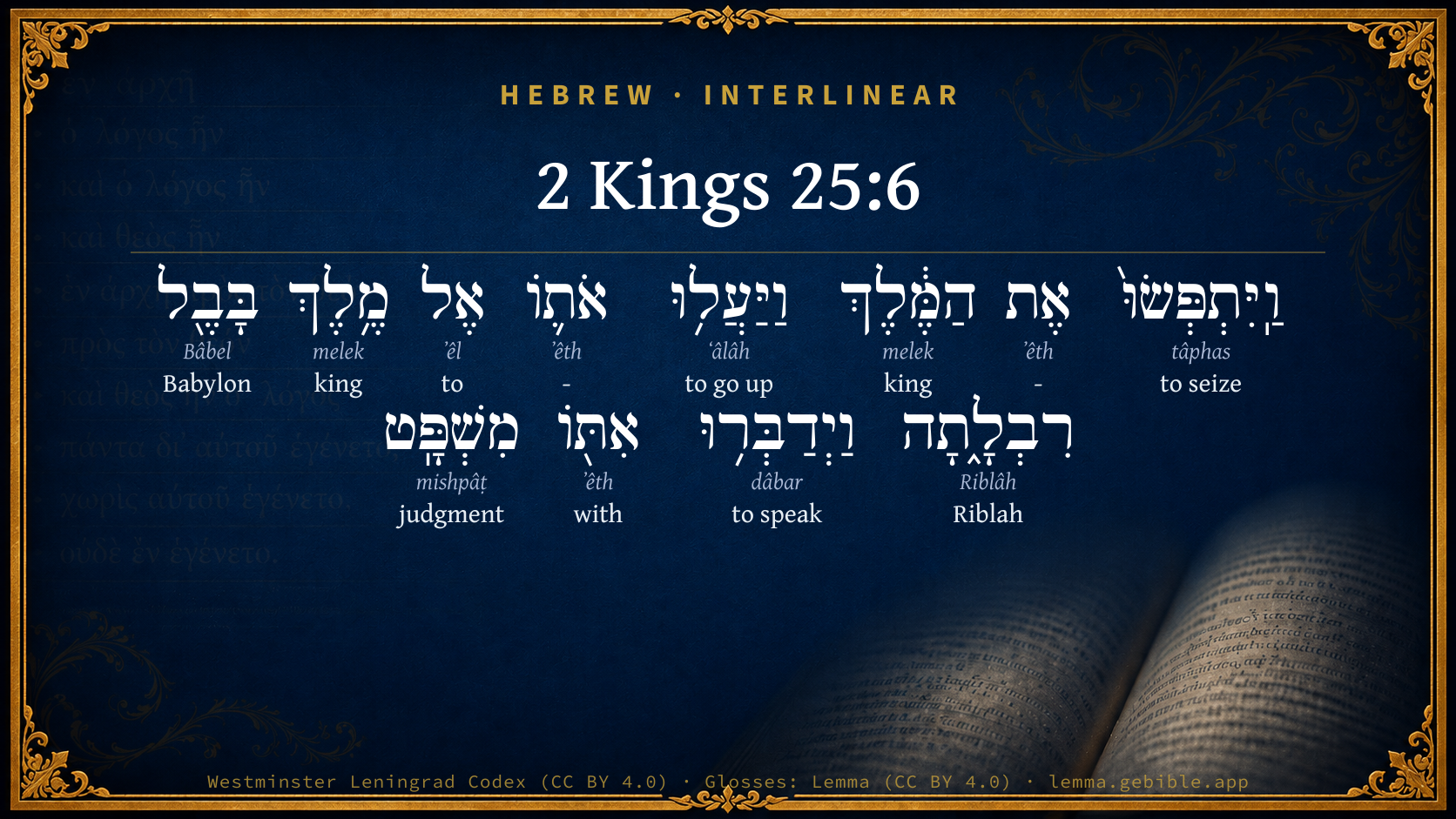
Hebrew (Westminster Leningrad Codex) 2 Kings 25:6 appears in the Hebrew Old Testament. The text above is from the Westminster Leningrad Codex. Each word links to its Strong’s number, a concise gloss, and parsing drawn from the Open Scriptures Hebrew Bible morphology. Click any word for its full Brown-Driver-Briggs (BDB) entry.
Download image
Cite this verse

2 Kings 25:6 (World English Bible). Public Domain. Lemma interlinear Bible study tool, https://lemma.gebible.app/v/2-kings/25/6.

Show BibTeX & RIS
BibTeX
RIS
English Translation
Then they took the king, and carried him up to the king of Babylon to Riblah; and they gave judgment on him.
World English Bible · Public Domain
Download a study sheet

One document with this verse’s original text, its word-by-word gloss line, the meaning frame, cross-references with their text, attributed commentary, and full source and license credits — printable, and it pastes into notes with its structure intact.

This verse Autodidact and up

Study sheet (.html) Plain text (.txt)

A passage Seminary Student

Up to 50 verses in one chapter. A passage sheet keeps up to 6 commentary sources and 12 cross-references per verse, in the order this page ranks them, and says so on the sheet whenever that leaves anything out. Ask for a single verse and you get the Autodidact verse sheet above.

Everything on this page stays free to read, with no account — the sheet is a download of what is already on screen, not access to it.

Want to remove ads? Support Godless Engineer
Compare translations 3

The same verse in 3 English versions, stacked beneath the original-language interlinear above. Click any original word for its lexicon entry.

Each is an independent rendering of the whole verse — the interlinear is not word-aligned to these translations.

Highlighted words mark where these versions differ — a whole-verse word diff, not a word-by-word alignment.

  • World English Bible Public Domain
    Then they took the king, and carried him up to the king of Babylon to Riblah; and they gave judgment on him.
  • King James Version Public Domain
    So they took the king, and brought him up to the king of Babylon to Riblah; and they gave judgment upon him.
  • unfoldingWord Literal Text CC BY-SA 4.0
    And they captured the king, and they brought him up to the king of Babylon, to Riblah. And they pronounced judgment on him.

unfoldingWord Literal Text — © unfoldingWord, licensed CC BY-SA 4.0. Word-aligned USFM3 via Door43 (git.door43.org/unfoldingWord/en_ult).

Versions to compare (up to 4)

3 of 4 selected

Show all 18 translations

Every available English version of this verse, each an independent rendering of the whole verse.

  • World English Bible Public Domain
    Then they took the king, and carried him up to the king of Babylon to Riblah; and they gave judgment on him.
  • Berean Standard Bible Public Domain
    The Chaldeans seized the king and brought him up to the king of Babylon at Riblah, where they pronounced judgment on him.
  • Majority Standard Bible Public Domain
    The Chaldeans seized the king and brought him up to the king of Babylon at Riblah, where they pronounced judgment on him.
  • King James Version Public Domain
    So they took the king, and brought him up to the king of Babylon to Riblah; and they gave judgment upon him.
  • American Standard Version (1901) Public Domain
    Then they took the king, and carried him up unto the king of Babylon to Riblah; and they gave judgment upon him.
  • Revised Version (1885) Public Domain
    Then they took the king, and carried him up unto the king of Babylon to Riblah; and they gave judgment upon him.
  • Geneva Bible (1599) Public Domain
    Then they tooke the King, and caried him vp to the King of Babel to Riblah, where they gaue iudgement vpon him.
  • Douay-Rheims (1899) Public Domain
    So they took the king, and brought him to the king of Babylon to Reblatha, and he gave judgment upon him.
  • Young's Literal Translation Public Domain
    and they seize the king, and bring him up unto the king of Babylon, to Riblah, and they speak with him -- judgment.
  • Literal Standard Version CC BY-SA 4.0
    and they seize the king, and bring him up to the king of Babylon, to Riblah, and they speak judgment with him.
  • Unlocked Literal Bible CC BY-SA 4.0
    They captured the king and brought him up to the king of Babylon at Riblah, where they passed sentence on him.
  • unfoldingWord Literal Text CC BY-SA 4.0
    And they captured the king, and they brought him up to the king of Babylon, to Riblah. And they pronounced judgment on him.
  • Darby Bible Public Domain
    And they took the king, and brought him up to the king of Babylon unto Riblah; and they pronounced judgment upon him,
  • World Messianic Bible Public Domain
    Then they captured the king and carried him up to the king of Babylon to Riblah; and they passed judgment on him.
  • Webster's Bible Public Domain
    So they took the king, and brought him to the king of Babylon to Riblah; and they gave judgment upon him.
  • Free Bible Version CC BY-SA 4.0
    They captured the king and took him to the king of Babylon at Riblah, where he was sentenced.
  • Bible in Basic English Public Domain
    And they made the king a prisoner and took him up to the king of Babylon at Riblah to be judged.
  • JPS Tanakh (1917) Public Domain
    Then they took the king, and carried him up unto the king of Babylon to Riblah; and they gave judgment upon him.

Literal Standard Version (2020), Covenant Press — licensed CC BY-SA 4.0. Text via the HelloAO Bible API (eBible.org). Unlocked Literal Bible (unfoldingWord) — licensed CC BY-SA 4.0. Text via the HelloAO Bible API (eBible.org). unfoldingWord Literal Text — © unfoldingWord, licensed CC BY-SA 4.0. Word-aligned USFM3 via Door43 (git.door43.org/unfoldingWord/en_ult). Free Bible Version, Dr. Jonathan Gallagher — licensed CC BY-SA 4.0. Text via the HelloAO Bible API (eBible.org).

Word by word

More ways to search: Search by grammar → Find every occurrence → Compare this word →

Practice this passage: Drill this verse → Learn its vocabulary →

רִבְלָ֑תָה
Riblâh
H7247
“Riblah · toward”
Noun, Proper + Suffix, Demonstrative
Part of Speech
Noun
Type
Proper
Full BDB Definition

Origin: from an unused root meaning to be fruitful

TWOT: None

Riblah = "fertility" - a place on the eastern boundary of Israel - a town in the land of Hamath on the great road between Babylon and Palestine
  1. וַֽיִּתְפְּשׂוּ֙ tâphas H8610 “and · to seize” Conjunction + Verb, Qal, Sequential Imperfect, 3rd Person, Masculine, Plural
  2. אֶת ʼêth H853 “-” Particle, Direct Object
  3. הַמֶּ֔לֶךְ melek H4428 “the · king” Particle, Definite Article + Noun, Common, Masculine, Singular, Absolute
  4. וַיַּעֲל֥וּ ʻâlâh H5927 “and · to go up” Conjunction + Verb, Hiphil, Sequential Imperfect, 3rd Person, Masculine, Plural
  5. אֹת֛וֹ ʼêth H853 “- · him” Particle, Direct Object + Suffix, Personal, 3rd Person, Masculine, Singular
  6. אֶל ʼêl H413 “to” Preposition
  7. מֶ֥לֶךְ melek H4428 “king of” Noun, Common, Masculine, Singular, Construct
  8. בָּבֶ֖ל Bâbel H894 “Babylon” Noun, Proper
  9. וַיְדַבְּר֥וּ dâbar H1696 “and · to speak” Conjunction + Verb, Piel, Sequential Imperfect, 3rd Person, Masculine, Plural
  10. אִתּ֖וֹ ʼêth H854 “with · him” Preposition + Suffix, Personal, 3rd Person, Masculine, Singular
  11. מִשְׁפָּֽט mishpâṭ H4941 “judgment” Noun, Common, Masculine, Singular, Absolute

About this verse

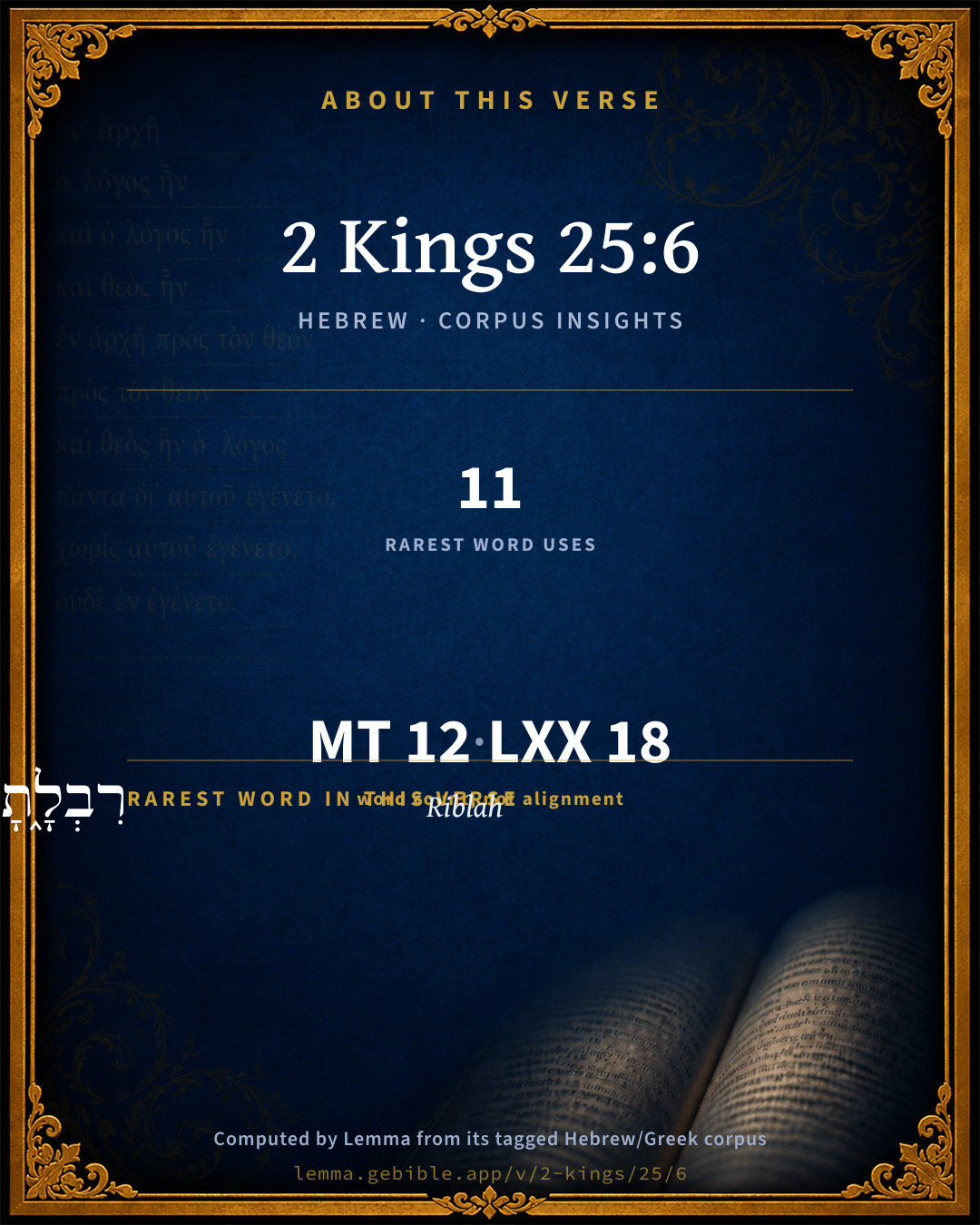
These counts appear in no published source. They are computed here, from the morphology-tagged text and Lemma’s own curated glosses. What Lemma adds →

12
words
10
distinct lemmas
Historical
section

Notable vocabulary

The rarest word here is רִבְלָ֑תָה Riblah H7247 — appearing just 11 times in the whole Hebrew Bible.

Shared distinctive vocabulary

רִבְלָ֑תָה Riblah H7247 occurs in 11 verses of the Hebrew Bible. Also found in:

Grammatical profile

  • 3 verbs
  • 5 nouns
  • 2 prepositions
  • 2 particles

Verb forms

  • וַֽיִּתְפְּשׂוּ֙ Qal · Sequential Imperfect
  • וַיַּעֲל֥וּ Hiphil · Sequential Imperfect
  • וַיְדַבְּר֥וּ Piel · Sequential Imperfect

Repetition

A word recurs within this verse — often emphatic in Hebrew:

  • הַמֶּ֔לֶךְ king H4428 ×2

Hebrew & Septuagint length

In English translation the verse runs 22 words from the Hebrew and 21 from the Septuagint (LXX English) — closely comparable.

A rough comparison of the two English renderings, which tokenize alike — not a word-level alignment.

Word counts can differ between the Hebrew and the Greek without any difference in meaning — e.g. the Hebrew direct-object marker אֵת has no separate Greek word, and Greek often adds the article ὁ.

In the original languages it is 12 Hebrew tokens and 18 Greek tokens — but the two are counted differently (Hebrew bundles its prefixes and suffixes into one token; the Greek is in lemma form), so that isn’t a like-for-like length.

Cross-references

10

Topical passages linked to 2 Kings 25:6 in the Treasury of Scripture Knowledge — connected by theme and wording, ordered by reader-vote popularity; previews shown in the World English Bible.

  • 2 Kings 23:33 Pharaoh Necoh put him in bonds at Riblah in the land of Hamath, that he might not reign in Jerusalem; and put the land to a tribute of one hundred talents of silver, and a talent of gold.
  • Jeremiah 34:21–22 Zedekiah king of Judah and his princes will I give into the hand of their enemies, and into the hand of those who seek their life, and into the hand of the king of Babylon's army, who have gone away from you.
  • 2 Chronicles 33:11 Therefore Yahweh brought on them the captains of the host of the king of Assyria, who took Manasseh in chains, and bound him with fetters, and carried him to Babylon.
  • Jeremiah 21:7 Afterward, says Yahweh, I will deliver Zedekiah king of Judah, and his servants, and the people, even such as are left in this city from the pestilence, from the sword, and from the famine, into the hand of Nebuchadrezzar king of Babylon, and into the hand of their enemies, and into the hand of those who seek their life: and he shall strike them with the edge of the sword; he shall not spare them, neither have pity, nor have mercy.
  • Jeremiah 32:4 and Zedekiah king of Judah shall not escape out of the hand of the Chaldeans, but shall surely be delivered into the hand of the king of Babylon, and shall speak with him mouth to mouth, and his eyes shall see his eyes;
  • Jeremiah 38:23 They shall bring out all your wives and your children to the Chaldeans; and you shall not escape out of their hand, but shall be taken by the hand of the king of Babylon: and you shall cause this city to be burned with fire.
  • Jeremiah 52:9 Then they took the king, and carried him up to the king of Babylon to Riblah in the land of Hamath; and he gave judgment on him.
  • Lamentations 4:19–20 Our pursuers were swifter than the eagles of the sky: They chased us on the mountains, they laid wait for us in the wilderness.
  • Ezekiel 17:20–21 I will spread my net on him, and he shall be taken in my snare, and I will bring him to Babylon, and will enter into judgment with him there for his trespass that he has trespassed against me.
  • Ezekiel 21:25–27 You, deadly wounded wicked one, the prince of Israel, whose day is come, in the time of the iniquity of the end,

Cross-references courtesy of OpenBible.info (CC BY 4.0).

Hebrew and Greek witnesses Masoretic Hebrew ↔ Greek Septuagint

The same verse in the two great witnesses to the Old Testament, shown verse-for-verse.

These are two independent witnesses, not word-aligned to each other, and the Septuagint is shown in lemma (dictionary) form.

Hebrew 2 Kings 25:6 Masoretic · Westminster Leningrad Codex

וַֽיִּתְפְּשׂוּ֙ אֶת הַמֶּ֔לֶךְ וַיַּעֲל֥וּ אֹת֛וֹ אֶל מֶ֥לֶךְ בָּבֶ֖ל רִבְלָ֑תָה וַיְדַבְּר֥וּ אִתּ֖וֹ מִשְׁפָּֽט

Then they took the king, and carried him up to the king of Babylon to Riblah; and they gave judgment on him.

World English Bible · Public Domain

Greek LXX 2 Kings 25:6 Septuagint · lemma form

καί συνλαμβάνω ὁ βασιλεύς καί ἄγω αὐτός πρός ὁ βασιλεύς βαβυλών εἰς δεβλαθα καί λαλέω μετά αὐτός κρίσις

And they took the king, and brought him to the king of Babylon to Reblatha; and he gave judgment upon him.

LXX2012 (modern English Septuagint) · Public Domain

Hebrew: Westminster Leningrad Codex (CC BY 4.0). Greek: Septuagint (public domain); English from LXX2012 (modern English Septuagint) (Public Domain). How the Septuagint differs from the Hebrew →

Targum (Aramaic paraphrase)

1

The Targum is the ancient Jewish Aramaic paraphrase of the Hebrew Scriptures — an interpretive translation, not the Hebrew text itself. Onkelos (literal) and Pseudo-Jonathan (expansive) render the Torah, and Jonathan the Prophets. Coverage is partial: where no permissively-licensed English translation exists for a verse, only the Aramaic is shown. This is verse-level text, not a word-by-word alignment to the Hebrew.

  1. Targum Jonathan Prophets (Joshua–Malachi)
    וַאֲחָדוּ יַת מַלְכָּא וְאַסִיקוּ יָתֵיהּ לְוַת מַלְכָּא דְבָבֶל לְרִבְלָת וּמַלִילוּ עִמֵיהּ פִּתְגָמֵי דִינִין:

    (no public-domain English translation for this verse)

    Targum Jonathan — Aramaic: “Mikraot Gedolot” (public domain). English: “Sefaria Community Translation” (CC0 1.0 (public-domain dedication)); “London "Chaldee Paraphrase," 1871” (public domain). Text via Sefaria.

Commentary

Notes on 2 Kings 25:6 from classic Christian and Jewish commentators (each source and its license shown beneath its notes). The classic Christian expositions comment on the surrounding passage and are grouped to its opening verse, so a note may address several verses; the Jewish commentaries on the Tanakh (Rashi and others) are per-verse, so they appear only where the commentator wrote on this verse.

Lemma curates 59 commentaries, every one of them public domain or Creative Commons licensed, each selected and text-cleaned for this edition rather than reprinted as found. About our sources →

Trapp's Complete Commentary

John Trapp

2Ki 25:6 So they took the king, and brought him up to the king of Babylon to Riblah; and they gave judgment upon him.

Ver. 6. To Riblah.] A city of Syria, which was afterwards called Apamia; as the Jerusalem Paraphrast on Num 34:11 showeth.

And they gave judgment upon him.] They, by public sentence, pronounced him perfidious, and perjured - see Eze 17:18, - and dealt with him accordingly. Rabbi Solomon undertaketh to tell us how they rated him, and in what terms.

John Trapp, A Commentary or Exposition upon All the Books of the Old and New Testament (1647–1656) — public domain. Text from a community e-Sword module.

Joseph Benson's Commentary

2Ki 25:6. And brought him to the king of Babylon, to Riblah — Where Nebuchadnezzar stayed, that he might both supply the besiegers with men and military provisions, as their occasions required, and have an eye to Chaldea, to prevent or suppress any commotions which might happen there in his absence. They gave judgment upon him — The king’s officers appointed thereunto examined his cause, and passed the following sentence against him.

Joseph Benson's Commentary on the Old and New Testaments (1811–1818) — public domain. Text from a community e-Sword module.

Tyndale Open Study Notes

Tyndale Open Resources

25:6 Riblah, formerly an Assyrian administrative center, served as Nebuchadnezzar’s battle headquarters, as it had for the Egyptians (23:33).

Tyndale Open Study Notes — © Tyndale Open Resources, licensed CC BY-SA 4.0. Text via the HelloAO Bible API.

Geneva Bible (1599)

Geneva Bible translators

Or, condemned him for his perjury and treason, 2 Chron. 36:13.

Geneva Bible (1599) marginal notes — public domain. Text via Bolls.life.

Jamieson, Fausset & Brown

Robert Jamieson, A. R. Fausset & David Brown

they took the king, and brought him . . . to Riblah--Nebuchadnezzar, having gone from the siege to oppose the auxiliary forces of Pharaoh-hophra, left his generals to carry on the blockade, he himself not returning to the scene of action, but taking up his station at Riblah in the land of Hamath (Kg2 23:33).

they gave judgment upon him--They, that is, the council (Jer 39:3, Jer 39:13; Dan 6:7-8, Dan 6:12), regarding him as a seditious and rebellious vassal, condemned him for violating his oath and neglecting the announcement of the divine will as made known to him by Jeremiah (compare Jer 32:5; Jer 34:2; Jer 38:17). His sons and the nobles who had joined in his flight were slain before his eyes (Jer 39:6; Jer 52:10). In conformity with Eastern ideas, which consider a blind man incapable of ruling, his eyes were put out, and being put in chains, he was carried to perpetual imprisonment in Babylon (Jer 52:11), which, though he came to it, as Ezekiel had foretold, he did not see (Jer 32:5; Eze 12:13; Eze 17:16).

Jamieson, Fausset & Brown — Commentary Critical and Explanatory on the Whole Bible (1871) — public domain (CC PDM 1.0). Text via the HelloAO Bible API.

Ellicott's Commentary for English Readers

(6) To the king of Babylon, to Riblah.—2Ki_23:33. Nebuchadnezzar was not present at the storm of Jerusalem (Jer_39:3). He awaited the result in his headquarters.

And they gave judgment upon him.—Or, brought him to trial. (Comp. Jer_1:16; Jer_4:12.) Nebuchadnezzar with the grandees of his court, perhaps including some dependent princes of the country, held a solemn trial of Zedekiah, as a rebel against his liege lord, in which, no doubt, his breach of oath was made prominent (2Ch_36:13; Eze_17:15; Eze_17:18). The verb is singular in Jeremiah, and the versions. (See next Note.)

A Bible Commentary for English Readers, edited by Charles John Ellicott (1878–1897) — public domain. Text from a community e-Sword module.

The Cambridge Bible for Schools and Colleges

gen. ed. J. J. S. Perowne

6. So [R.V. Then] they took the king, and brought him up to [R.V. unto] the king of Babylon] Nebuchadnezzar was stationed at some distance, and was awaiting the issue of the campaign. The verb rendered ‘take’ implies seizure as a prisoner. It is used before (2Ki_10:14) ‘Take them alive’.

to Riblah] See on 2Ki_23:33.

and they gave judgement upon him] Jer_39:5 says, ‘He gave judgement upon him’. No doubt the proceeding was of this kind. The king appointed a committee to try Zedekiah, and when they had given their sentence, Nebuchadnezzar commanded it to be carried into effect.

The Cambridge Bible for Schools and Colleges (gen. ed. J. J. S. Perowne; Cambridge University Press, 1878–1918) — public domain. Text from a community e-Sword module.

Albert Barnes' Notes on the Bible

To Riblah - See 2Ki 23:33 note. A position from where Nebuchadnezzar could most conveniently superintend the operations against Tyre and Jerusalem. In the absence of the monarch, the siege of Jerusalem was conducted by a number of his officers, the chief of whom were Nebuzar-adan, the captain of the guard, and Nergal-shar-ezer (Neriglissar), the Rab-mag Jer 39:3, Jer 39:13.

Albert Barnes' Notes on the Bible (1834–1885) — public domain. Text from a community e-Sword/MySword module.

Haydock's Catholic Bible Commentary

Rablatha, the Antioch of Syria, (St. Jerome) which was styled also Ephiphania, (Tirinus) or more probably Apamea, where Nabuchodonosor was, when Jerusalem was taken. --- Upon him, by the advice of his council, Jeremias xxxix. 3, 13. Syriac, "they made him answer the charges brought against him," (Calmet) of ingratitude and rebellion, as he had been appointed by the king of Babylon, and had sworn to be faithful to him. (Menochius) --- This repeated infidelity made Nabuchodonosor resolve to remove the people from their own country. (Calmet) --- He sentenced the last of the kings of Juda to see his children slain, (Haydock) to have his eyes put out, and to remain in prison till his death, Jeremias lii. 11., &c. (Calmet) --- Hebrew, he "spake judgments with him." Thus was accomplished the prediction of Jeremias, (xxxiv. 3.) "thine eyes shall behold the eyes of the king of Babylon, and he shall speak to thee." (Watson) --- The same prophet had said the same (Jeremias xxxii. 4.) before he was throne into prison. The sight of an angry judge is no small punishment. (Haydock)

George Leo Haydock (1774–1849), Haydock's Catholic Family Bible and Commentary, 1859 edition — public domain. Excludes Psalms (Douay-Rheims chapter numbering differs from Protestant) and Deuterocanonical books (Catholic canon only).

Matthew Poole's English Annotations

To Riblah; of which See Poole "2Ki 23:33", and See Poole "2Ki 25:21", where Nebuchadnezzar staid, that he might both supply the besiegers with more men, and military provisions, as their occasions required; and have an eye to Chaldea, to prevent or suppress any commotions which might happen there in the time of his absence.

They gave judgement upon him; the king’s officers appointed thereunto examined his cause, and passed the following sentence against him.

Matthew Poole's English Annotations on the Holy Bible (1683–1685) — public domain. Text from a community e-Sword/MySword module.

Whedon's Commentary on the Bible

Daniel D. Whedon

6. To Riblah — See note on 2Ki_23:33. “Nebuchadnezzar had commenced the siege of Jerusalem in person, (2Ki_25:1,) but afterwards, (possibly not till after the Egyptians who came to relieve the besieged city had been repulsed,) he transferred the continuance of the siege, which was a prolonged one, to his generals, and retired to Riblah, to conduct the operations of the whole campaign from thence.” — Keil.

Gave judgment upon him — Josephus says: “When he was come, Nebuchadnezzar began to call him a wicked wretch, and a covenant breaker, and one that had forgotten his former words, when he promised to keep the country for him.

He also reproached him for his ingratitude, that when he had received the kingdom from him, who had taken it from Jehoiachin and given it to him, he had made use of his power against his benefactor.” It was surely no difficult matter for all who had a voice in this judgment to find the captive king guilty, and worthy of severest punishment.

Daniel D. Whedon (gen. ed.), Commentary on the Old and New Testaments (1874–1909) — public domain. Text from a community e-Sword module.

The Pulpit Commentary

So they took the king Zedekiah, and brought him up to the King of Babylon. The presentation of rebel kings, when captured, to their suzerain, seated on his throne, is one of the most common subjects of Assyrian and Babylonian sculptures (see "Ancient Monarchies," vol. 1. p. 292; vol. 3. p. 7; Layard, "Monuments of Nineveh," second series, pls. 23, 36, etc.). The Egyptian and Persian artists also represent it. To Riblah. (For the situation of Riblah, see the comment on 2Ki_23:33) As Nebuchadnezzar was engaged at one and the same time in directing the sieges both of Tyro and of Jerusalem, it was a most convenient position for him to occupy. And they gave judgment upon him. As a rebel, who had broken his covenant and his oath, (Eze_17:16, Eze_17:18) Zedekiah was brought to trial before Nebuchadnezzar and his great lords. The facts could not be denied, and sentence was therefore passed upon him, nominally by the court, practically by Nebuchadnezzar. (Jer_52:9) By an unusual act of clemency, his life was spared; but the judgment was still sufficiently severe (see the next verse).

The Pulpit Commentary (1880–1919), ed. H.D.M. Spence-Jones & Joseph S. Exell — public domain. Text from a community e-Sword module.

John Wesley's Explanatory Notes

Riblah - Where Nebuchadnezzar staid, that he might both supply the besiegers with men, and military provisions, as their occasions required; and have an eye to Chaldea, to prevent or suppress any commotions which might happen there in his absence. They - The king's officers appointed thereunto, examined his cause, and passed the following sentence against him.

John Wesley, Explanatory Notes Upon the Whole Bible (1754–1765) — public domain. Text via the GEBible commentary corpus.

unfoldingWord translationNotes

Door43 World Missions Community

Riblah

This is the name of a place. (See: How to Translate Names)

passed sentence on him

"decided what they would do to punish him"

they slaughtered them before his eyes

The eyes are synecdoche for the whole person. AT: "they forced king Zedekiah to watch them kill his sons" (See: Synecdoche)

he put out his eyes

"Nebuchadnezzar put out Zedekiah's eyes." It might be best to translate so that the reader understands that other people might have helped Nebuchadnezzar do this. (See: Assumed Knowledge and Implicit Information)

translationWords

slaughter

bronze

unfoldingWord translationNotes — © Distant Shores Media and the Door43 World Missions Community, licensed CC BY-SA 4.0. Source: git.door43.org/Door43/en_tn.

Rashi

Rabbi Shlomo Yitzchaki (Rashi)

And called him to account. He debated with him concerning the oath.

Rashi on the Tanakh — English translations: “The Judaica Press complete Tanach with Rashi, translated by A. J. Rosenberg” (CC BY 4.0); “Pentateuch with Rashi's commentary by M. Rosenbaum and A.M. Silbermann, 1929-1934” (public domain); “The Metsudah Tanach series, Lakewood, N.J” (CC BY 4.0); and “The Book of Joshua, Metsudah Publications, 1997” (CC BY 4.0). Text via Sefaria.

Lesson kit

Teaching starters — assembled from the data on this page, not authored interpretation. Every prompt links to the verse data it draws on. Edit before teaching.

2 Kings, in the Historical, opens this verse with 12 words (10 distinct Hebrew lemmas). Its most distinctive word is Riblâh (“Riblah”). A historical commentator’s framing appears above. Read the whole chapter for the surrounding context.

Discussion questions

  1. How does “Riblah” (Riblâh) shape what this verse is saying?
  2. How does Numbers 34:11, which shares the word «Riblah», read alongside this verse?
  3. What does the repetition of “king” (2× in this one verse) do in this verse?
  4. These translations render this verse differently. What is at stake in choosing one wording over another?
  5. «וַֽיִּתְפְּשׂוּ֙» is a Qal Sequential Imperfect verb. How does that grammatical form shape the action described?
  6. Compare how Trapp's Complete Commentary and Joseph Benson's Commentary read this verse. Where do they agree or differ?

Things to notice

Reading settings

Reading text

Shown beneath each verse's original-language words.

Old Testament
Old Testament edition

Read the OT as the Masoretic Hebrew (MT) or the Greek Septuagint (LXX).

English shown for the Greek Septuagint (in the Hebrew ↔ Greek comparison).

Comparing translations? Open the Compare panel on any verse page to stack up to four side by side.