2 Corinthians 1:14

Greek (Tischendorf 8th ed.) 2 Corinthians 1:14 appears in the Greek New Testament. The text above is from the Tischendorf 8th edition. Each word links to its Strong’s number and a concise gloss. Click any word for its full Thayer’s Greek Lexicon entry.
Download image
Cite this verse

2 Corinthians 1:14 (World English Bible). Public Domain. Lemma interlinear Bible study tool, https://lemma.gebible.app/v/2-corinthians/1/14.

Show BibTeX & RIS
BibTeX
RIS
English Translation
as also you acknowledged us in part, that we are your boasting, even as you also are ours, in the day of our Lord Jesus.
World English Bible · Public Domain
Download a study sheet

One document with this verse’s original text, its word-by-word gloss line, the meaning frame, cross-references with their text, attributed commentary, and full source and license credits — printable, and it pastes into notes with its structure intact.

This verse Autodidact and up

Study sheet (.html) Plain text (.txt)

A passage Seminary Student

Up to 50 verses in one chapter. A passage sheet keeps up to 6 commentary sources and 12 cross-references per verse, in the order this page ranks them, and says so on the sheet whenever that leaves anything out. Ask for a single verse and you get the Autodidact verse sheet above.

Everything on this page stays free to read, with no account — the sheet is a download of what is already on screen, not access to it.

Want to remove ads? Support Godless Engineer
Compare translations 3

The same verse in 3 English versions, stacked beneath the original-language interlinear above. Click any original word for its lexicon entry.

Each is an independent rendering of the whole verse — the interlinear is not word-aligned to these translations.

Highlighted words mark where these versions differ — a whole-verse word diff, not a word-by-word alignment.

  • World English Bible Public Domain
    as also you acknowledged us in part, that we are your boasting, even as you also are ours, in the day of our Lord Jesus.
  • King James Version Public Domain
    As also ye have acknowledged us in part, that we are your rejoicing, even as ye also are our's in the day of the Lord Jesus.
  • unfoldingWord Literal Text CC BY-SA 4.0
    just as you also understood us in part—so that we are your boasting, just as you also ours, on the day of our Lord Jesus.

unfoldingWord Literal Text — © unfoldingWord, licensed CC BY-SA 4.0. Word-aligned USFM3 via Door43 (git.door43.org/unfoldingWord/en_ult).

Versions to compare (up to 4)

3 of 4 selected

Show all 19 translations

Every available English version of this verse, each an independent rendering of the whole verse.

  • World English Bible Public Domain
    as also you acknowledged us in part, that we are your boasting, even as you also are ours, in the day of our Lord Jesus.
  • Berean Standard Bible Public Domain
    as you have already understood us in part, so that you may boast of us just as we will boast of you in the day of our Lord Jesus.
  • Majority Standard Bible Public Domain
    as you have already understood us in part, that you may boast of us just as we will boast of you in the day of the Lord Jesus.
  • King James Version Public Domain
    As also ye have acknowledged us in part, that we are your rejoicing, even as ye also are our's in the day of the Lord Jesus.
  • American Standard Version (1901) Public Domain
    as also ye did acknowledge us in part, that we are your glorying, even as ye also are ours, in the day of our Lord Jesus.
  • Revised Version (1885) Public Domain
    as also ye did acknowledge us in part, that we are your glorying, even as ye also are ours, in the day of our Lord Jesus.
  • Geneva Bible (1599) Public Domain
    Euen as ye haue acknowledged vs partly, that we are your reioycing, euen as ye are ours, in the day of our Lord Iesus.
  • Douay-Rheims (1899) Public Domain
    As also you have known us in part, that we are your glory, as you also are ours, in the day of our Lord Jesus Christ.
  • Young's Literal Translation Public Domain
    according as also ye did acknowledge us in part, that your glory we are, even as also ye `are' ours, in the day of the Lord Jesus;
  • Literal Standard Version CC BY-SA 4.0
    according as you also acknowledged us in part, that we are your glory, even as also you [are] ours, in the Day of the Lord Jesus;
  • Unlocked Literal Bible CC BY-SA 4.0
    as you have understood us in part, we will be your reason for boasting on the day of our Lord Jesus, just as you will be our reason to boast.
  • unfoldingWord Literal Text CC BY-SA 4.0
    just as you also understood us in part—so that we are your boasting, just as you also ours, on the day of our Lord Jesus.
  • Darby Bible Public Domain
    even as also ye have recognised us in part, that we are your boast, even as *ye* [are] ours in the day of the Lord Jesus.
  • World Messianic Bible Public Domain
    as also you acknowledged us in part—that we are your boasting, even as you also are ours, in the day of our Lord Yeshua.
  • Webster's Bible Public Domain
    As also ye have acknowledged us in part, that we are your rejoicing, even as ye also are ours in the day of the Lord Jesus.
  • Free Bible Version CC BY-SA 4.0
    even if you only understand part of it now, so that when the Lord comes you will be proud of us, just as we are of you.
  • Bible in Basic English Public Domain
    Even as you have been ready, in part, to say that we are your glory, in the same way that you are ours, in the day of the Lord Jesus.
  • Text-Critical English NT CC BY 4.0
    just as you have understood us in part—that on the day of the Lord Jesus you will be proud of us just as we will be proud of you.
  • Tyndale New Testament (1534) Public Domain
    even as ye have founde vs partly: for we are youre reioysynge even as ye are oures in the daye of the Lorde Iesus.

Literal Standard Version (2020), Covenant Press — licensed CC BY-SA 4.0. Text via the HelloAO Bible API (eBible.org). Unlocked Literal Bible (unfoldingWord) — licensed CC BY-SA 4.0. Text via the HelloAO Bible API (eBible.org). unfoldingWord Literal Text — © unfoldingWord, licensed CC BY-SA 4.0. Word-aligned USFM3 via Door43 (git.door43.org/unfoldingWord/en_ult). Free Bible Version, Dr. Jonathan Gallagher — licensed CC BY-SA 4.0. Text via the HelloAO Bible API (eBible.org).

Word by word

More ways to search: Search by grammar → Find every occurrence → Compare this word →

Practice this passage: Drill this verse → Learn its vocabulary →

καύχημα
kaúchēma
G2745
“boasting”
Noun, Nominative, Singular, Neuter
Part of Speech
Noun
Case
Nominative
Number
Singular
Gender
Neuter
Full Thayer's Definition

Origin: from G2744

TDNT: 13:45,4

1. that of which one glories or can glory, matter or ground of glorying 2. a glorying or boasting
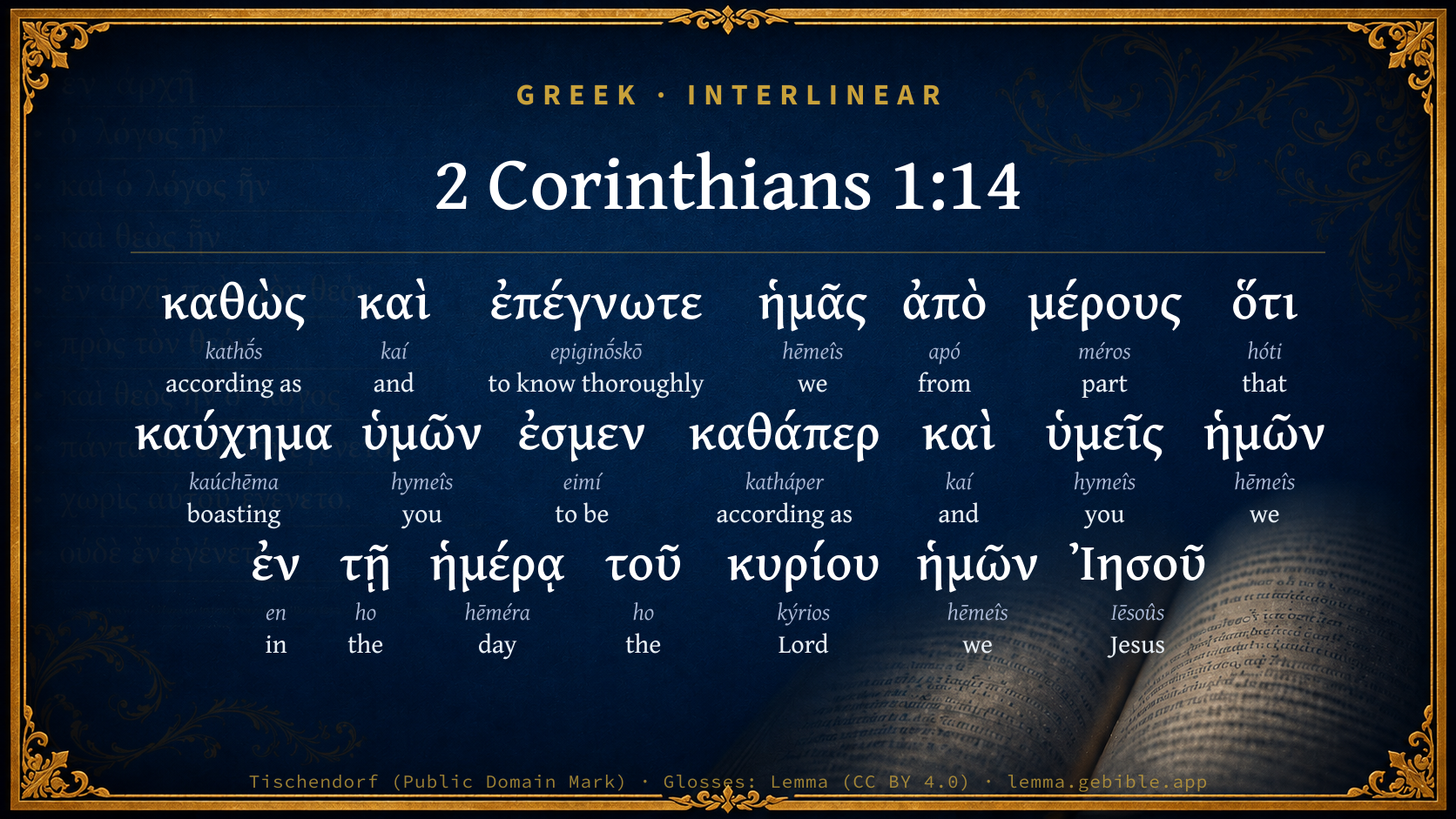
  1. καθὼς kathṓs G2531 “according as” Adverb
  2. καὶ kaí G2532 “and” Conjunction
  3. ἐπέγνωτε epiginṓskō G1921 “to know thoroughly” Verb, Aorist, Active, Indicative, 2nd person, Plural
  4. ἡμᾶς hēmeîs G2249 “we” Personal pronoun, 1st person, Accusative, Plural
  5. ἀπὸ apó G575 “from” Preposition
  6. μέρους méros G3313 “part” Noun, Genitive, Singular, Neuter
  7. ὅτι hóti G3754 “that” Conjunction
  8. ὑμῶν hymeîs G5210 “you” Personal pronoun, 2nd person, Genitive, Plural
  9. ἐσμεν eimí G1510 “to be” Verb, Present, Active, Indicative, 1st person, Plural
  10. καθάπερ katháper G2509 “according as” Adverb
  11. καὶ kaí G2532 “and” Conjunction
  12. ὑμεῖς hymeîs G5210 “you” Personal pronoun, 2nd person, Nominative, Plural
  13. ἡμῶν hēmeîs G2249 “we” Personal pronoun, 1st person, Genitive, Plural
  14. ἐν en G1722 “in” Preposition
  15. τῇ ho G3588 “the” Article, Dative, Singular, Feminine
  16. ἡμέρᾳ hēméra G2250 “day” Noun, Dative, Singular, Feminine
  17. τοῦ ho G3588 “the” Article, Genitive, Singular, Masculine
  18. κυρίου kýrios G2962 “Lord” Noun, Genitive, Singular, Masculine
  19. ἡμῶν hēmeîs G2249 “we” Personal pronoun, 1st person, Genitive, Plural
  20. Ἰησοῦ Iēsoûs G2424 “Jesus” Noun, Genitive, Singular, Masculine

About this verse

These counts appear in no published source. They are computed here, from the morphology-tagged text and Lemma’s own curated glosses. What Lemma adds →

21
words
16
distinct lemmas
Pauline Epistles
section

Notable vocabulary

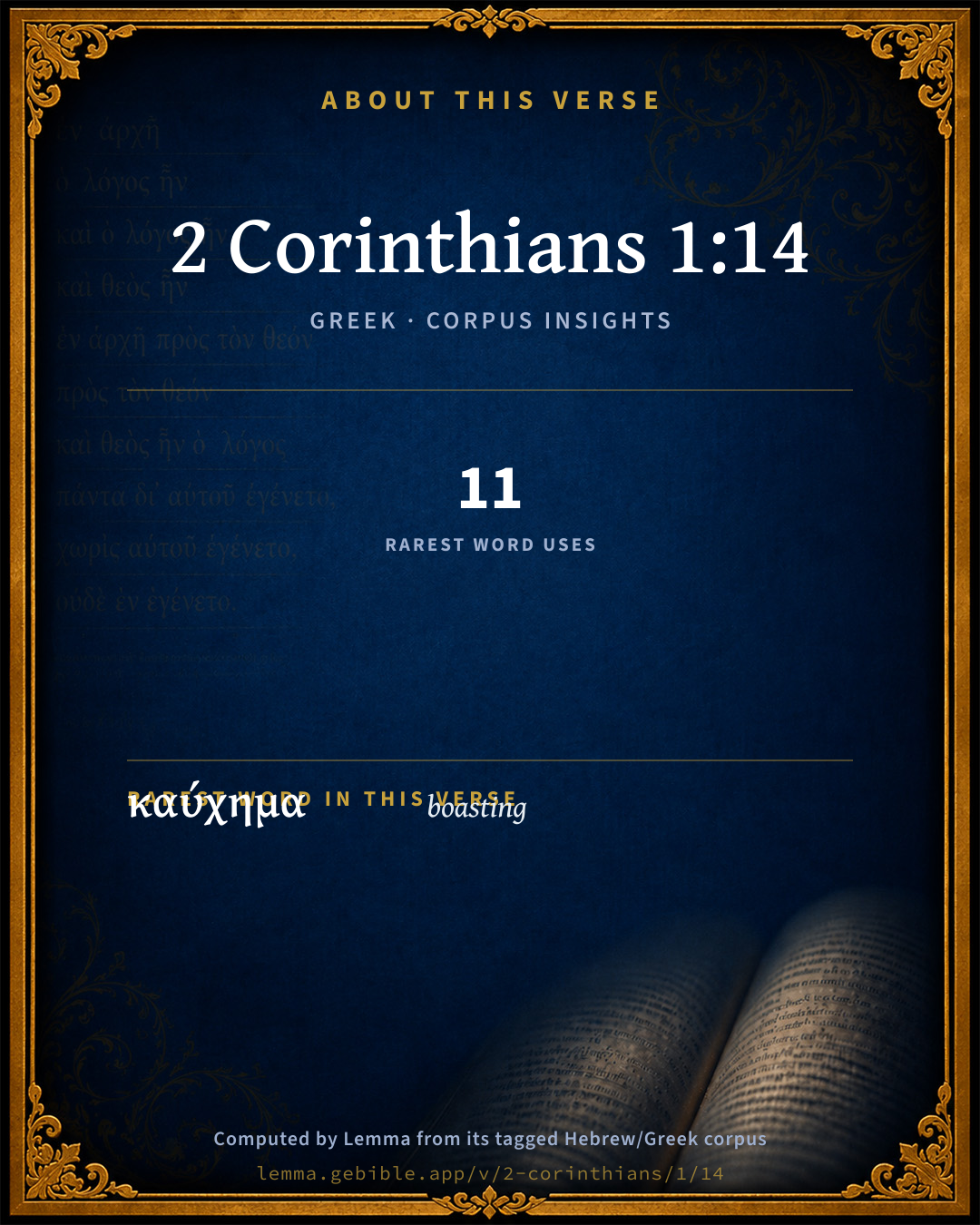
The rarest word here is καύχημα boasting G2745 — appearing just 11 times in the whole Greek New Testament.

Shared distinctive vocabulary

καύχημα boasting G2745 occurs in 11 verses of the Greek New Testament. Also found in:

Repetition

Words recur within this verse:

Cross-references

13

Topical passages linked to 2 Corinthians 1:14 in the Treasury of Scripture Knowledge — connected by theme and wording, ordered by reader-vote popularity; previews shown in the World English Bible.

  • Philippians 2:16 holding up the word of life; that I may have something to boast in the day of Christ, that I didn't run in vain nor labor in vain.
  • 1 Thessalonians 2:19–20 For what is our hope, or joy, or crown of rejoicing? Isn't it even you, before our Lord Jesus at his coming?
  • 1 Corinthians 1:8 who will also confirm you until the end, blameless in the day of our Lord Jesus Christ.
  • 1 Thessalonians 3:13 to the end he may establish your hearts blameless in holiness before our God and Father, at the coming of our Lord Jesus with all his saints.
  • Philippians 1:10 so that you may approve the things that are excellent; that you may be sincere and without offense to the day of Christ;
  • Philippians 4:1 Therefore, my brothers, beloved and longed for, my joy and crown, so stand firm in the Lord, my beloved.
  • Philippians 1:6 being confident of this very thing, that he who began a good work in you will complete it until the day of Jesus Christ.
  • 1 Thessalonians 5:23 May the God of peace himself sanctify you completely. May your whole spirit, soul, and body be preserved blameless at the coming of our Lord Jesus Christ.
  • Romans 11:25 For I don't desire, brothers, to have you ignorant of this mystery, so that you won't be wise in your own conceits, that a partial hardening has happened to Israel, until the fullness of the Gentiles has come in,
  • 2 Corinthians 2:5 But if any has caused sorrow, he has caused sorrow, not to me, but in part (that I not press too heavily) to you all.
  • 2 Corinthians 5:12 For we are not commending ourselves to you again, but speak as giving you occasion of boasting on our behalf, that you may have something to answer those who boast in appearance, and not in heart.
  • 1 Corinthians 11:18 For first of all, when you come together in the assembly, I hear that divisions exist among you, and I partly believe it.
  • 1 Corinthians 15:31 I affirm, by the boasting in you which I have in Christ Jesus our Lord, I die daily.

Cross-references courtesy of OpenBible.info (CC BY 4.0).

Where the printed editions differ

1 variant

Places in this verse where the major printed Greek editions disagree on the wording in a way that affects the translation — a comparison of editions, not a manuscript-by-manuscript collation. The editions are the modern critical texts (Nestlé-Aland 28/27, SBL, Westcott-Hort, Tregelles, Tyndale House) and the traditional texts behind the KJV (the Textus Receptus and the Byzantine/Majority text). It is not a claim about which reading is original.

  1. Extra text
    ἡμῶν

    “of us”

    In NA28NA27SBLWH Not in TynTregTRByz

    ἡμῶν (hēmōn) 'of us' is only in older manuscripts (NA28+NA27+SBL+WH)

Textual data: Translators Amalgamated Greek New Testament (STEPBible TAGNT) · CC BY 4.0.

Commentary

Notes on 2 Corinthians 1:14 from classic Christian and Jewish commentators (each source and its license shown beneath its notes). The classic Christian expositions comment on the surrounding passage and are grouped to its opening verse, so a note may address several verses; the Jewish commentaries on the Tanakh (Rashi and others) are per-verse, so they appear only where the commentator wrote on this verse.

Lemma curates 59 commentaries, every one of them public domain or Creative Commons licensed, each selected and text-cleaned for this edition rather than reprinted as found. About our sources →

Bengel's Gnomon

Johann Albrecht Bengel

2Co 1:14. Ἀπὸ μέρους, in part) The antithesis, even unto the end, is in the preceding verse.

Bengel's Gnomon of the New Testament — English translation (T&T Clark, Edinburgh, 1860) — public domain. Text from a community e-Sword module.

Expositor's Greek Testament

ed. W. Robertson Nicoll

2Co 1:14 . καθὼς καὶ ἐπέγνωτε κ . τ . λ .: as also ye did acknowledge us in part; i.e., some of them made this acknowledgment, but not all (1Co 3:4 ). ὅτι καύχημα ὑμῶν ἐσμεν : that (not “because”) we are your glorying ( cf. 2Co 5:12 ); that is, the Corinthian Church was proud of its connexion with the great Apostle, and still “gloried” in him. καθάπερ καὶ ὑμεῖς ἡμῶν κ . τ . λ .: as ye also are ours, in the day of our Lord Jesus . Lest this assertion of his single-mindedness and integrity should seem to claim any undue superiority to his fellow Christians at Corinth, he hastens to add, parenthetically, with remarkable tact, that if he is their “glory” so are they his. He constantly thinks thus of his converts; cf., e.g. , Phi 2:16 and 1Th 2:19-20 . ἐν τῇ ἡμέρᾳ τοῦ Κυρίου Ἰησοῦ : “A day of the Lord,” “The Day of the Lord” are common expressions in the prophets; cf. Isa 13:6 ; Isa 13:9 , Jer 46:10 , Eze 30:3 , Zec 14:1 , Joe 1:15 ; Joe 2:1 ; Joe 2:11 ; Joe 2:31 (cited Act 2:20 ), etc. And the phrase is taken up by St. Paul (1Th 5:2 , 1Co 1:8 ; 1Co 5:5 ; cf. Phi 1:10 , 2Ti 1:12 ), and is applied to the Second Advent of Christ; cf. also 2Pe 3:10 , and Mat 24:42 .

The Expositor's Greek Testament, edited by W. Robertson Nicoll (1897–1910) — public domain. Text from a community e-Sword module.

International Critical Commentary

14. καθὼς καὶ ἐπέγνωτε ἡμᾶς ἀπὸ μέρους. ‘As also you did acknowledge us in part.’ His reason for hoping that they will now always form a right estimate of his letters is that they have already formed a right estimate of himself—at any rate to some extent. The ἀπὸ μέρους is an afterthought, to qualify the statement. The qualification may be understood in two ways,—‘part of you,’ or ‘part of me.’ Either, ‘There are some of you who still misjudge me,’ or, ‘There is something in me which none of you quite understands.’ Thdrt. adopts the former; οὐχ ἁπλῶς προστέθεικεν, ἀλλά νύττων αὐτούς, ὡς μὴ παντελῶς ἀποσαμένους τὰς κατʼ αὐτοῦ γεγεννημένας διαβολάς Chrys. with more probability adopts the latter, and thinks that St Paul is contrasting the imperfect estimate of his sincerity which the Corinthians now have with that which will be theirs when the secrets of all hearts are revealed at the Last Day. So also pseudo-Primasius; quia nondum est finis; cum autem venerit finis, tunc ex integro cognoscetis. In Rom 11:25 and 15:24 there is a similar ambiguity as to what is the exact force of ἀπὸ μέρους. But the two interpretations might both be true. Some Corinthians had been more prejudiced against the Apostle than others, and none fully appreciated him. His irony might easily puzzle them. As Lietzmann remarks, Beschränkte Leute halten oft Ironie für Zweideutigkeit.

The change from ἐπιγινώσκετε to ἐπιγνώσεσθε is intelligible enough: the change to ἐπέγνωτε is not so clear. To what period does the aorist refer? Probably to the time before their rebellion against him. But it may refer to the time of their estrangement; he is willing to believe that even then they did not wholly distrust him.

ὃτι καύχημα ὑμῶν ἐσμέν. There are three ways of taking ὅτι. 1. It = ‘because,’ and gives the reason for their past recognition of him. 2. It = ‘that,’ and depends upon ἐπιγινώσκετε the intervening words being parenthetical. 3. It = ‘that,’ and depends upon, ἐπέγνωτε: ‘ye acknowledged us in part, that we are your glorying—something that you are proud of.’ The last is the best, and the first is the worst, of the three possible constructions. In these chapters (1-9). καύχησις and καύχημα “have an apologetic note and refer to the self-glorying forced upon him when composing 10-13. (10:8, 13, 15, 16, 17, 11:10, 12, 16, 17, 18, 30, 12:1, 4, 5, 6, 9). In this Epistle (1.-9.) all glorying in personal claims or services is set aside; the letter is a reaction from the unwelcome temper of rights, of claims, of authority, of reproof, to the satisfactions of reconciliation, the fruitions of friendship, the understandings of confidence and love. For himself his one boast is sincerity; above all, sincerity of relation to themselves (v. 12); apart from that the one thought of glorying is that they could find some cause of glorying in him, as he abundantly in them (1:14, 5:12, 7:4, 14, 8:24, 9:2, 3). The whole of this is sacrificed and unsaid if 10-13. is read as a continuation and part of 1-9; and the end miserably stultifies the beginning” (G. H. Rendall, The Epistles of St Paul to the Corinthians, pp. 49, 51). The change from καύχησις (v. 12) to καύχημα is probably intentional: the difference between the act of glorying and the material for it is here quite in point. The ἐσμέν is a timeless present expressing a permanent relationship, a relationship so real that it will stand the scrutiny of the Day of the Lord.

καθάπερ καὶ ὑμεῖς ἡμῶν. He has been suspected of glorifying himself and looking down on them. That is a double mistake. He does glory, but not about himself; and, so far from looking down on them, it is about them that he glories. He is just as proud of them as his spiritual children (1Co 4:15) as (he feels sure) they are of him as their spiritual father. The καθάπερ brushes away all idea of his claiming superiority; ὡς μοθηταῖς ὁμοτίμοις διαλεγόμενος οὓτως ἐξισάζει τὸν λόγον (Chrys.). He thus cuts at the root (ὐποτέμνεται) of all jealousy (ibid.) by making the glorying mutual and equal. St Paul rather frequently brings in the thought of the Day of the Lord as a sort of test of the value of his missionary work and its results (1Co 3:12, 1Co 3:13, 1Co 3:4:5; Php 2:16; 1Th 2:19, 1Th 2:20, which is a close parallel to this). The Attic καθάπερ is frequent in N.T., and, excepting Heb 4:10, is wholly Pauline (3:13, 18, 8:11; etc.).

τῇ ἡμέρᾳ κ.τ.λ. Non in nocte praesentis saeculi, sed in die et clarificatione Domini nostri Jesus Christi (Herveius); ubi et veri magistri et boni discipuli probabuntur (Pseudo-Primasius). St Paul still believed that the Day of the Lord would come soon (1Co 7:29, 1Co 10:11, 1Co 15:51), and had imparted this belief to his converts (see on Rom 13:11-14, p. 379); it is therefore no remote date to which he appeals. Cf. 1Th 2:19.

A C D E K L omit ἡμῶν before Ἰησοῦ. א* A B C D2 and 3 K L omit Χριστοῦ after Ἰησοῦ, and it is probably not original. Even if the evidence were less strong, its insertion would be more probable than its omission. Nearly all Versions have the addition.

In LXX, ἡμέρα Κυρίου (MSS. differ as to ἡ ἡμ and τοῦ K.) is frequent in the Prophets. St Paul uses ἡ ἡμέρα of the Parousia, with τ. Κυρίον (1Co 5:5 ; 2Th 2:2), or τ. Κυρ. Ἰησοῦ (here) ; also ἡμέρα, with Ἰησοῦ Χριστοῦ (Php 1:6) or Χριστοῦ only (Php 1:10, Php 2:16). The fullest form is ἡ ἡμ. τ. Κυρ. ἡμῶν Ἰ. Χριστοῦ (1Co 1:8). The Day in which the thoughts of all hearts shall be revealed is mentioned here in confirmation of the Apostle’s claim to perfect sincerity. He is not afraid of what will then be revealed about his heart. The mention of it forms a solemn conclusion to this introduction (vv. 12-14) to his defence of his conduct. We have similar solemn conclusions 2:17, 4:6, 5:10, 9:15, 11:15.

1:15-2:4. The Postponement of the Intended Visit

It was out of consideration to you that I abandoned my original plan of coming to see you.

15 In the confidence that we stood on these terms of mutual trust and esteem, and that you would not take it amiss if I was obliged after all to change my plans, I entertained the desire to come first to you, so that I might give you the pleasure of two visits from me on the same tour, 16 one on my way to Macedonia and one on my way back from it, and then be helped forward by you to Judæa. 17 Well, that was my desire. Do you suppose that I did not care whether I fulfilled it or not? that I make plans and unmake them, like a man of the world, just as the fancy of the moment takes me, and that, when I give a promise, I always hold myself free to break it, if I please. 18 But, whatever you think of me, God is faithful, and of this you have evidence, in that the Gospel which we preach to you is no uncertain message wavering between ‘Yes’ and ‘No.’ 19 For the Son of this same faithful God, Christ Jesus, who was proclaimed among you by us—by me and Silvanus and Timothy—was not found by you to be a waverer between ‘Yes’ and ‘No’; a steadfast ‘Yes’ has ever been found in Him. 20 For however many promises God may have made to us, they are all of them assured to us in Christ with His affirming ‘Yes’: He is their fulfilment. And so it is through Him that the ‘Amen’ goes up to God in thankful assent, and He is glorified through the faith of us who are His ministers. 21 And it is God who causes us, yes, and you also, to be securely established in the life of His Anointed, and it is God who anointed us, 22 and sealed us as His own, and gave us the presence of His Spirit in our hearts as an earnest and foretaste of future blessings.

23 Now it is this same faithful and never-failing God that I who have been distrusted by you call as a witness; and, as my life shall answer for it, I assert that it was from a wish to spare you pain that I abandoned my original plan of coming to Corinth. 24 Do not misunderstand me again. We have no wish to domineer over you as regards your faith; not at all. But we do wish to have a share in making you happy in your faith. You need no one now to tell you what to believe; as regards that your condition is sound. II. 1 For I made up my mind for my own sake not to come again to see you in pain and grief; it would be better to stay away. 2 For if I of all men make you grieve, who then is to cheer me when I need cheering but the very people who receive pain and grief from me? 3 This is just what I said in the letter which I wrote instead of coming; that it was better not to come at all, if, instead of the happiness which I might expect to have from you, I was to have only pain and grief by coming; because I was and am confident, with regard to every one of you, that what gives me happiness is a happiness to all of you. 4 For that letter was the outcome of intense affliction and anguish of heart. I shed many tears as I wrote it. Yet it was not written to make you grieve, but to make you see how abundantly my love overflows towards you.

International Critical Commentary — older volumes (1896–1929), various authors — public domain. Text from a community e-Sword module.

Geneva Bible (1599)

Geneva Bible translators

When he shall sit as judge.

Paul’s rejoicing in the Lord was, that he had won the Corinthians: and they themselves rejoiced that such an Apostle was their instructor, and taught them so purely and sincerely.

Geneva Bible (1599) marginal notes — public domain. Text via Bolls.life.

Jamieson, Fausset & Brown

Robert Jamieson, A. R. Fausset & David Brown

in part--In contrast to "even to the end": the testimony of his life was not yet completed [THEOPHYLACT and BENGEL]. Rather, "in part," that is, some of you, not all [GROTIUS, ALFORD]. So in Co2 2:5; Rom 11:25. The majority at Corinth had shown a willing compliance with Paul's directions in the first Epistle: but some were still refractory. Hence arises the difference of tone in different parts of this Epistle. See Introduction.

your rejoicing--your subject of glorying or boast. "Are" (not merely shall be) implies the present recognition of one another as a subject of mutual glorying: that glorying being about to be realized in its fulness "in the day (of the coming) of the Lord Jesus."

Jamieson, Fausset & Brown — Commentary Critical and Explanatory on the Whole Bible (1871) — public domain (CC PDM 1.0). Text via the HelloAO Bible API.

Adam Clarke's Commentary

Verse 14. Have acknowledged us in part] Απο μερους may signify here not in part, but some of you; and it is evident, from the distracted state of the Corinthians, and the opposition raised there against the apostle, that it was only a part of them that did acknowledge him, and receive and profit by his epistles and advice.

We are your rejoicing, c.] You boast of us as the ministers of Christ through whom ye have believed as we boast of you as genuine converts to the Christian faith, and worthy members of the Church of God.

Adam Clarke's Commentary on the Bible (1810–1826) — public domain. Text from a community e-Sword/MySword module.

John Calvin's Commentaries

14. For we are your glorying. We have briefly adverted to the manner in which it is allowable for saints to glory in God’s benefits — when they repose themselves in God alone, and have no other object of aim. Thus it was a ground of pious glorying on the part of Paul, that he had, by his ministry, brought the Corinthians under obedience to Christ; and of the Corinthians, on the other hand, that they had been trained up so faithfully and so virtuously by such an Apostle — a privilege that had not been allotted to all. This way of glorying in men does not stand in the way of our glorying in God alone. Now he instructs the Corinthians, that it is of the greatest importance for themselves that they should acknowledge him to be a faithful, and not a merely pretended, servant of Christ; because, in the event of their withdrawing from him, they would deprive themselves of the highest glory. In these words he reproves their fickleness, inasmuch as they voluntarily deprived themselves of the highest glory, by listening too readily to the spiteful and envious.

In the day of the Lord By this I understand the last day, which will put an end to all the fleeting glories of this world. He means, then, that the glorying of which he is now speaking is not evanescent, as those things are that glitter in the eyes of men, but is abiding and stable, inasmuch as it will remain until the day of Christ. For then will Paul enjoy the triumph of the many victories that he had obtained under Christ’s auspices, and will lead forth in splendor all the nations that have, by means of his ministry, been brought under Christ’s glorious yoke; and the Church of the Corinthians will glory in having been founded and trained up by the services of so distinguished an Apostle.

John Calvin's Commentaries (1540-1563) — public domain. Text from the Calvin Translation Society English edition (1840s-50s) via the Christian Classics Ethereal Library (ccel.org). Calvin's coverage is partial (roughly two-thirds of the Bible); uncommented books and verses are honest gaps, never fabricated. The 19th-century editor's footnotes and remarks are omitted so the notes are faithfully Calvin's own voice.

Ellicott's Commentary for English Readers

(14) As also ye have acknowledged.—The parenthetical clause (better, ye did acknowledge) comes in to qualify the fear which had been partly veiled by the hope. They had done him some, though not adequate, justice. The phrase “in part” may be noted as specially characteristic of the Epistles of this period (Rom_11:25; Rom_15:15; Rom_15:24; 1Co_11:18; 1Co_12:27; 1Co_13:9).

That we are your rejoicing . . .—Better, a ground of exultation to you, as you are to us. The words must be connected with the future rather than the past. “I trust that you will one day recognise that you have as much reason to be proud of me as I have to be proud of you.” The word for “rejoicing,” “boasting,” “glorying,” &c., is specially characteristic of this period of St. Paul’s life, occurring forty-six times in 1 Corinthians, 2 Corinthians, Galatians, and Romans, and only six times in his other Epistles. The “day of the Lord Jesus,” of His great advent to judge the world (comp. Rom_2:16), defines the “end” to which the previous verse had pointed.

A Bible Commentary for English Readers, edited by Charles John Ellicott (1878–1897) — public domain. Text from a community e-Sword module.

The Cambridge Bible for Schools and Colleges

gen. ed. J. J. S. Perowne

14. As also] St Paul connects “the future for which he hopes, with the past of which he knows.”—Meyer.

in part] It is here delicately hinted that the whole Corinthian Church did not acknowledge St Paul.

we are your rejoicing] Rather, ground of rejoicing. The word here rendered ‘rejoicing’ is rendered indifferently ‘boasting,’ ‘glorying,’ ‘rejoicing,’ ‘whereof to glory ‘in the A.V. See Rom_4:2; 1Co_5:6, and ch. 2Co_9:3.

even as ye also are ours] See note on 2Co_1:11. It was, moreover, the special object of the Apostle to remind the Corinthians of the identity of their interests before he proceeded to vindicate himself or to rebuke them. Some of them, he says, already recognized this truth. See also next verse. Chrysostom remarks on the humility of the Apostle in thus placing himself on a level with his converts.

in the day of the Lord Jesus] See 1Co_3:13; 1Co_4:3; 1Co_4:5 and notes.

The Cambridge Bible for Schools and Colleges (gen. ed. J. J. S. Perowne; Cambridge University Press, 1878–1918) — public domain. Text from a community e-Sword module.

John Gill's Exposition

As also you have acknowledged us in part,.... This may refer either to the thing known and acknowledged, namely, the integrity of the apostle's conversation, and others; which though they did not know thoroughly and perfectly, yet did in part, and that so far as that they might acquit them from the charge brought against them; or to the persons who knew this, as that there were some in the church of Corinth, a part of them, though not all, who knew and had acknowledged them to be upright and sincere ministers of the word, and had declared that they had reason to rejoice and bless God that ever they heard them: and

that we are your rejoicing: or "glorying in", or "unto the day of the Lord Jesus": when he shall come to judge the world in righteousness, then they should before him, angels and men, rejoice and glory in this, that they had been blessed with such sincere and faithful ministers, who sought not any worldly advantage, but the glory of Christ, and the salvation of souls:

even as, adds the apostle,

ye also are ours; we do now, and so we shall then, rejoice and glory in this, that our labour among you was not in vain, but was blessed for your conversion and edification.

John Gill's Exposition of the Whole Bible (1746–1763) — public domain (CC PDM 1.0). Text via the HelloAO Bible API.

Trapp's Complete Commentary

John Trapp

14 As also ye have acknowledged us in part, that we are your rejoicing, even as ye also are ours in the day of the Lord Jesus.

Ver. 14. You have acknowledged in part] q.d. You ought to have done it more fully; but you have been carried away, as ye were led by the false apostles.

John Trapp, A Commentary or Exposition upon All the Books of the Old and New Testament (1647–1656) — public domain. Text from a community e-Sword module.

Albert Barnes' Notes on the Bible

As also ye have acknowledged us - You have had occasion to admit my singleness of aim, and purity of intention and of life by your former acquaintance with me; and you have cheerfully done it. “In part” (ἀπὸ μέρους apo merous). Tyndale renders this: “as ye have found us partly.” The sense seems to be, “as part of you acknowledge;” meaning that a portion of the church was ready to concede to him the praise of consistency and uprightness, though there was a faction, or a part that denied it.

That we are your rejoicing - That we are your joy, and your boasting. That is, you admit me to be an apostle. You regard me as your teacher, and guide. You recognize my authority, and acknowledge the benefits which you have received through me.

Even as ye also are ours - Or, as you will be our rejoicing in the day when the Lord Jesus shall come to gather his people to himself. Then it will be seen that you were saved by our ministry; and then it will be an occasion of abundant and eternal thanksgiving to God that you were converted by our labors. And as you now regard it as a matter of congratulation and thanksgiving that you have such teachers as we are, so shall we regard it as a matter of congratulation and thanksgiving - as our chief joy - that we were the instruments of saving such a people. The expression implies that there was mutual confidence, mutual love, and mutual cause of rejoicing. It is well when ministers and people have such confidence in each other, and have occasion to regard their connection as a mutual cause of rejoicing and of καύχημα kauchēma or boasting.

Albert Barnes' Notes on the Bible (1834–1885) — public domain. Text from a community e-Sword/MySword module.

Matthew Poole's English Annotations

In part, may either refer to persons or things; part of you have so owned and acknowledged us, though others of you have abused us. Or you have in part, or at some times, owned us, that you had cause to bless God for us, and to rejoice that God ever sent us to preach the gospel amongst you. And as some have owned us as their joy, or all of you have at some times acknowledged us as such, so you are also

our rejoicing; we rejoice tllat God hath made our labour successful to your souls, and I trust, in the day when the Lord Jesus shall come to judge the world, you shall be more our rejoicing.

Matthew Poole's English Annotations on the Holy Bible (1683–1685) — public domain. Text from a community e-Sword/MySword module.

Whedon's Commentary on the Bible

Daniel D. Whedon

14. In part—Either meaning a part of you have acknowledged me; or, you have acknowledged as to the part of my life and character that you have thus far seen and understood, although another large part has needed much explanation and defence; or, you have, partially but not adequately, acknowledged. The second we think the real sense.

Your rejoicing— Rather, your boast; the opposite of shame, as rejoicing is the opposite of sorrow.

Day… Jesus—Our boasting of each other now and ever will be ratified and completed at the judgment-day.

Daniel D. Whedon (gen. ed.), Commentary on the Old and New Testaments (1874–1909) — public domain. Text from a community e-Sword module.

The Pulpit Commentary

In part. Not as a whole Church. Some only of the Corinthians had been faithful to his teaching and to himself. (For the phrase, see Rom_11:25 Rom_15:15, Rom_15:24; 1Co_11:18 1Co_12:27 1Co_13:9) Rejoicing; rather, ground of boast, as in 2Co_9:3; Rom_4:2, "whereof to glory;" 1Co_5:6. In ver. 12 the substantive means "the act of rejoicing." The word is characteristic of this group of Epistles, in which it occurs forty-six times, Even as ye also are ours. This clause takes away all semblance of self-glorification. In 1Th_2:19, 20 and Php_2:16 he expresses the natural thought that a teacher"s converts are, and will be in the last day, his "crown of exultation." Here alone he implies that they may glory in him as he in them. The thought, however, so far frond being egotistical, merely indicates the in. tense intercommunion of sympathy which existed between him and them. He does but place himself on a level with his converts, and imply that they mutually gloried in each other. In the day of the Lord Jesus. (see on 1Co_3:13)

The Pulpit Commentary (1880–1919), ed. H.D.M. Spence-Jones & Joseph S. Exell — public domain. Text from a community e-Sword module.

John Wesley's Explanatory Notes

Ye have acknowledged us in part - Though not so fully as ye will do. That we are you rejoicing - That ye rejoice in having known us. As ye also are ours - As we also rejoice in the success of our labours among you; and we trust shall rejoice therein in the day of the Lord Jesus.

John Wesley, Explanatory Notes Upon the Whole Bible (1754–1765) — public domain. Text via the GEBible commentary corpus.

Scofield Reference Notes

C. I. Scofield

day of

(See Scofield "1Co 1:8").

The Scofield Reference Bible (1917 edition), notes by C. I. Scofield — public domain. Text from a community e-Sword module.

Burkitt's Expository Notes on the New Testament

William Burkitt

Observe here, 1. The great trial which St. Paul met with from the Corinthians, whose spiritual father he was: though he had served them with great faithfulness, yet they did acknowledge him but in part. There was a time when he was high in their esteem. Who but Paul! None but he! but now a great part leave him, and admire others.

Learn hence, What great levity, fickleness, and inconstancy, may be found in good men in general; and what great mutability and changeableness of affection in particular to their ministers and spiritual guides, though never so sincere and faithful.

Although St. Paul, with a laborious diligence, and divine success, had planted and propagated the Christian faith amongst them; yet now not only his person, but his very office, falls under contempt by many of them. None more than ministers do experience this truth, that nothing is so mutable as the mind of man.

Though ministers are the same, and their message the same; though they continue burning and shining lights, though they burn out, and consume life, health, and estate, among and for their people; yet it is only for a season, for an hour, for a short time, at their first coming amongst them, that they rejoice in their light: You have acknowledged us in part.

Observe, 2. That notwithstanding the contempt cast upon St. Paul by some in the church of Corinth, yet there were others among them who did greatly rejoice in him, and bless God for him, and he for them: We are your rejoicing, and ye are ours, as being converted by us; and I trust we shall be a farther joy and mutual rejoicing each to other in the day of our Lord Jesus.

Learn hence, What unspeakable rejoicings and joyful congratulations there will be in the day of Christ, between laborious faithful ministers and their believing obedient hearers.

"Lord! will the Christian say, this was the blessed instrument, under God, of my happy illumination and conversion; by the blessing of the Spirit upon his ministry, my soul was begotten unto Christ." But on the other hand, if we be ignornat or lazy, unskillful or unfaithful, in our office, our people will come in against us as swift witnesses in the day of Christ: and, Lord, what an intolerable aggravation will it be of our misery in hell, to have any of our people thus upbraiding us!

"O cruel man! that sawest my soul in danger, but never dealt faithfully and plainly with me; the same time that we spent together in sin and vanity, in sensual mirth and jollity, might have been instrumental to save us both from this place of torment." Let ministers consider themselves as witnesses for God, and their people as witnesses for or against them; and under that consideration, so study, preach, and pray; so live, walk, and act, that they may, with this great apostle, take God to record, that they are free from the blood of all men.

William Burkitt's Expository Notes on the New Testament (1700–1703) — public domain. Text from a community e-Sword module.

McGarvey & Pendleton's Commentaries

J. W. McGarvey

as also ye did acknowledge us in part, that we are your glorying, even as ye also are ours, in the day of our Lord Jesus . [ 1Co_3:13 . If my words sound boastful, my conscience justifies me in using them, since I have manifested the holy and sincere life befitting one who is directed of God, and not the life of one who is moved by worldly policy and wisdom, and is void of principle. Such has been my general conduct, and it has been especially so in my dealings with you. Thus the apostle shows himself conscious of the scrutinizing suspicion with which the Corinthians watched all his actions. He knew that to govern such a people he must walk with more than common circumspection. Therefore, with a careful, guarded spirit he had penned his letters to them so that there was nothing in them of doubtful meaning. If we assume, with Conybeare and Howson, that the apostle had been suspected of sending private letters in which he modified the statements of his public epistles, the reading becomes clear and smooth, and runs thus: "I have written you nothing save what has been read in public and generally acknowledged as authoritatively mine, and I hope you will thus acknowledge my epistles to the end of the world, even as part of you acknowledged me to be an apostle, and gloried in me as your teacher, even as I also gloried in you as disciples, in expectation that I would appear with you before the Lord Jesus ( 1Th_2:19-20 ; Phi_2:16 ). By thus placing himself on a level with his disciples in mutual glorying, the apostle removes every semblance of unseemly self-glorification. But the meaning of the passage is practically the same if we merely understand the apostle as appealing from the false constructions placed upon his letters, to the text of the letters, and as asserting that he wrote no words which justified the ambiguous meaning placed upon them. We shall now be told about these ambiguous words.]

J. W. McGarvey (with Philip Y. Pendleton), Commentaries on the New Testament (The Fourfold Gospel, 1914; Acts; and the epistles) — public domain. Text from a community e-Sword/MySword module.

The People's New Testament

B. W. Johnson

14. As also ye have acknowledged us in part. All but a faction acknowledged him as an apostle and rejoiced in his labors.

B. W. Johnson's The People's New Testament with Notes (1889–1891) — public domain. Electronic text from the Christian Classics Ethereal Library (CCEL) ThML edition.

Cambridge Greek Testament for Schools and Colleges

14. ὅτι καύχημα ὑμῶν ἐσμέν. Ye acknowledged us in part, that we are your glorying, or, because we are your glorying: the former is better. See on 2Co 3:14. As distinct from καύχησις (2Co 1:12, 2Co 7:4, &c.), καύχημα is that which is gloried in, the thing boasted of: but S. Paul is not careful to distinguish the two words. By ἀπὸ μέρους he means that not all had been completely won over: comp. Rom 11:25; Rom 15:15; Rom 15:24.

καθάπερ καὶ ὑμεῖς ἡμῶν. Exact reciprocity of feeling between himself and his converts is one of the keynotes of this letter: comp. 2Co 1:7; 2Co 1:11, 2Co 4:15: ἐν ἴσῃ τέθεικα τάξει ἑαυτὸν καὶ τοὺς μαθητάς (Theodoret).

τῇ ἡμέρᾳ τ. κ. ἡμ. Ἰ. Comp. 1Co 1:8; 1Co 5:5; Php 1:6; Php 1:10; Php 2:16. The words may be taken either with the whole sentence or with the last clause only. They solemnly close the paragraph: comp. 2Co 5:10.

Cambridge Greek Testament for Schools and Colleges (Cambridge University Press, 1896; 21 vols, various authors incl. Carr, Maclear, Plummer, Farrar, Lumby, Moule, M. R. James, Simcox) — public domain. Text from a community e-Sword module.

Alford’s Greek Testament

Henry Alford

14.] Confirmation of the foregoing assertion. For we do not write to you any other things, except those which ye read, or [even] acknowledge (by experience of facts), and I hope, shall [continue to] acknowledge to the end:—i.e. ‘my character in my writings is one and the same, not fickle and changing, but such as past facts have substantiated it to be, and as I hope future facts to the end of my life will continue to do.’ ἀναγινώσκοντες γὰρ ἐπιγινώσκετε, ὅτι ἃ σύνιστε ἡμῖν ἐν τοῖς ἔργοις, ταῦτα καὶ ἐν τοῖς γράμμασι λέγομεν· καὶ οὐκ ἐναντιοῦται ὑμῶν ἡ μαρτυρία ταῖς ἐπιστολαῖς, ἀλλὰ συνᾴδει τῇ ἀναγνώσει ἡ γνῶσις, ἣν προλαβόντες εἴχετε (al. ἔχετε) περὶ ἡμῶν. Chrys., Hom. iii. p. 443, who has the advantage of being able to express in his exposition the play of words in ἀνα- and ἐπι-γινώσκετε. As also ye did partly (that part of you, viz. which have fairly tried me: ἀπὸ μέρους, because they were divided in their estimate of him, and those who were prejudiced against him had shut their minds to this knowledge. Chrys. refers it to what follows: μετριάζων εἶπεν: Theophyl. to the not yet completed testimony of his ἐναρέτου βίου: Estius and Calvin, to their inadequate estimation of him, which he blames: but I much prefer the above. So most Commentators) acknowledge us, that (not ‘because,’ putting a colon at μέρους, as Luth., Griesbach, and Scholz: nor is it to be joined with ἐπιγνώσεσθε, what follows being parenthesized, as Theophyl., al., Meyer, Olsh.) we are your boast, [even] as ye [also] are ours, in the day of the Lord Jesus. ἐσμεν, ‘present,’ as of that which is a settled recognized fact. But this is no ground for its being joined with ἐπιγνώσεσθε, as Olsh. The experimental mutual knowledge of one another as a καύχημα was not confined to what should take place ἐν τῇ ἡμ. τ. κ. Ἰησοῦ, but regarded a present fact, which should receive its full completion at the day of the Lord.

Henry Alford, The Greek Testament (1849–1861) — public domain. Text from a community e-Sword module.

Vincent's Word Studies in the New Testament

Marvin R. Vincent

In part [απο μερους] . Referring to the partial understanding of his character and motives by the Corinthians.

15 Before [προτερον] . Rather, first of all. Instead of going first to the Macedonians, as he afterward decided. See 1Co 16:5.

Second benefit (deuteran carin). Benefit is, literally, grace. Not a mere pleasurable experience through Paul 's visit, but a divine bestowal of grace. Compare Rom 1:11. Second refers to his original plan to visit Corinth twice, on his way to Macedonia and on his return.

Marvin R. Vincent, Word Studies in the New Testament (1887–1900) — public domain. Text from a community e-Sword/MySword module.

Lesson kit

Teaching starters — assembled from the data on this page, not authored interpretation. Every prompt links to the verse data it draws on. Edit before teaching.

2 Corinthians, in the Pauline Epistles, opens this verse with 21 words (16 distinct Greek lemmas). Its most distinctive word is kaúchēma (“boasting”). A historical commentator’s framing appears above. Read the whole chapter for the surrounding context.

Discussion questions

  1. What does “boasting” (kaúchēma) contribute to the verse as a whole?
  2. Romans 4:2 shares the word «boasting» with this verse. How do the two illuminate each other?
  3. “we” occurs 3× in this one verse. What is the effect of the repetition?
  4. These translations render this verse differently. What is at stake in choosing one wording over another?
  5. Reading how Bengel's Gnomon and Expositor's Greek Testament read this verse, where do the two commentators agree and where do they part?

Things to notice

Reading settings

Reading text

Shown beneath each verse's original-language words.

Old Testament
Old Testament edition

Read the OT as the Masoretic Hebrew (MT) or the Greek Septuagint (LXX).

English shown for the Greek Septuagint (in the Hebrew ↔ Greek comparison).

Comparing translations? Open the Compare panel on any verse page to stack up to four side by side.