
2 Corinthians 11:9

Greek (Tischendorf 8th ed.) 2 Corinthians 11:9 appears in the Greek New Testament. The text above is from the Tischendorf 8th edition. Each word links to its Strong’s number and a concise gloss. Click any word for its full Thayer’s Greek Lexicon entry.
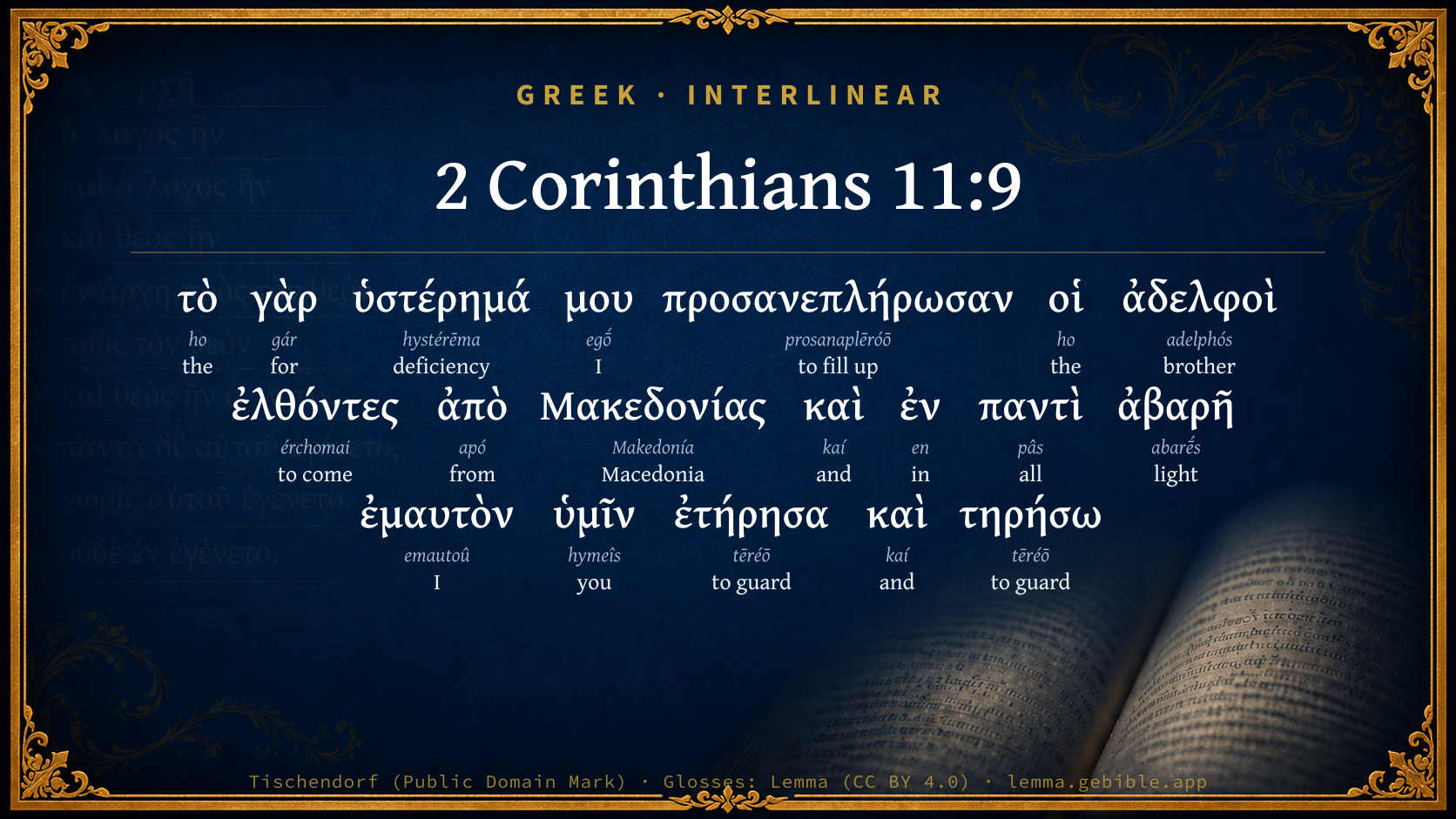
Download image
Cite this verse

2 Corinthians 11:9 (World English Bible). Public Domain. Lemma interlinear Bible study tool, https://lemma.gebible.app/v/2-corinthians/11/9.

Show BibTeX & RIS
BibTeX
RIS
English Translation
When I was present with you and was in need, I wasn't a burden on anyone, for the brothers, when they came from Macedonia, supplied the measure of my need. In everything I kept myself from being burdensome to you, and I will continue to do so.
World English Bible · Public Domain
Highlights
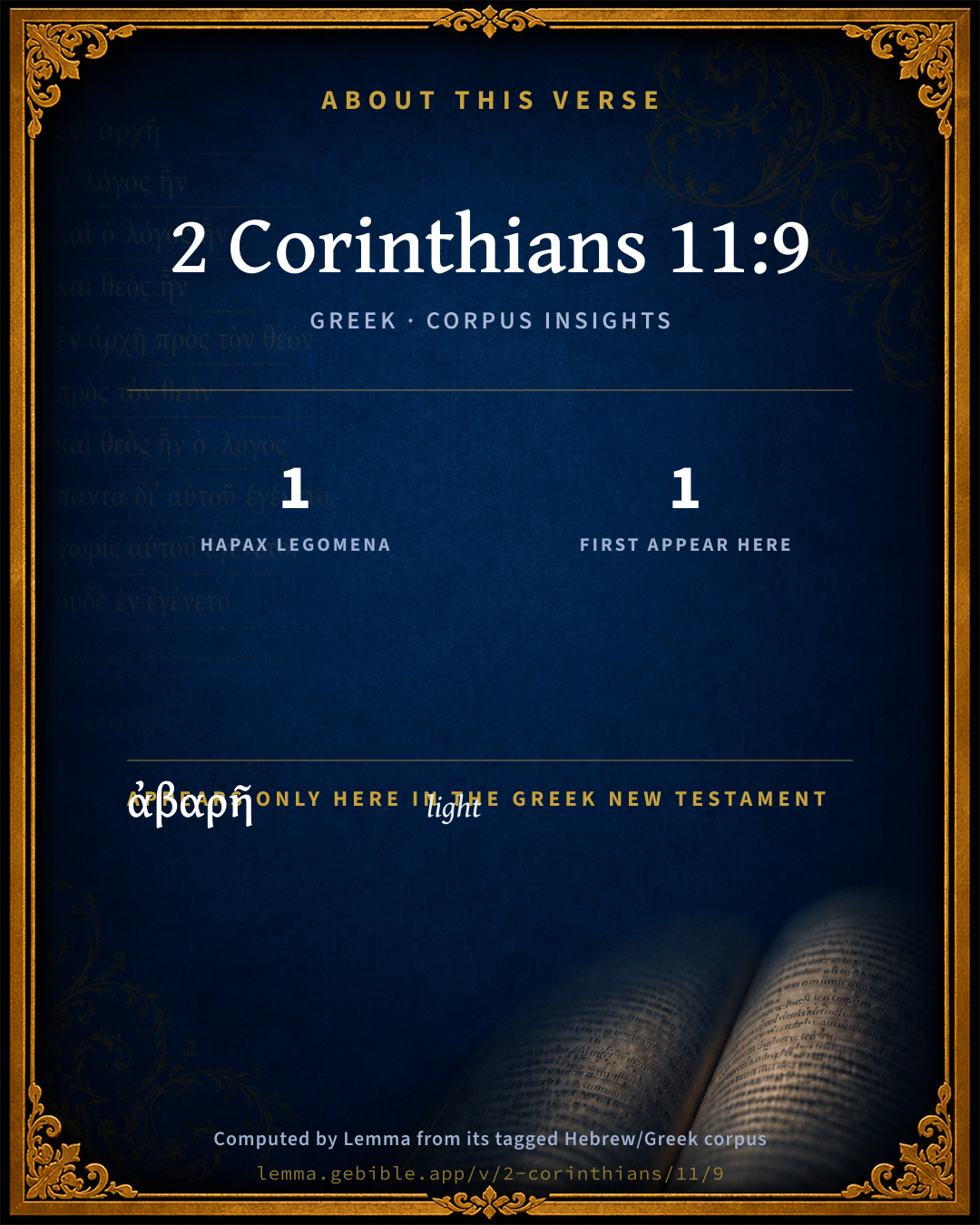
  • 1 hapax legomenon — only here in the Greek New Testament
  • 1 first appearance in the Greek New Testament
Full analysis ↓
Download a study sheet

One document with this verse’s original text, its word-by-word gloss line, the meaning frame, cross-references with their text, attributed commentary, and full source and license credits — printable, and it pastes into notes with its structure intact.

This verse Autodidact and up

Study sheet (.html) Plain text (.txt)

A passage Seminary Student

Up to 50 verses in one chapter. A passage sheet keeps up to 6 commentary sources and 12 cross-references per verse, in the order this page ranks them, and says so on the sheet whenever that leaves anything out. Ask for a single verse and you get the Autodidact verse sheet above.

Everything on this page stays free to read, with no account — the sheet is a download of what is already on screen, not access to it.

Want to remove ads? Support Godless Engineer
Compare translations 3

The same verse in 3 English versions, stacked beneath the original-language interlinear above. Click any original word for its lexicon entry.

Each is an independent rendering of the whole verse — the interlinear is not word-aligned to these translations.

Highlighted words mark where these versions differ — a whole-verse word diff, not a word-by-word alignment.

  • World English Bible Public Domain
    When I was present with you and was in need, I wasn't a burden on anyone, for the brothers, when they came from Macedonia, supplied the measure of my need. In everything I kept myself from being burdensome to you, and I will continue to do so.
  • King James Version Public Domain
    And when I was present with you, and wanted, I was chargeable to no man: for that which was lacking to me the brethren which came from Macedonia supplied: and in all things I have kept myself from being burdensome unto you, and so will I keep myself.
  • unfoldingWord Literal Text CC BY-SA 4.0
    And being present with you—and having lacked—I did not burden anyone. For the brothers having come from Macedonia completely met my need, and in everything I kept and will keep myself a burden to you.

unfoldingWord Literal Text — © unfoldingWord, licensed CC BY-SA 4.0. Word-aligned USFM3 via Door43 (git.door43.org/unfoldingWord/en_ult).

Versions to compare (up to 4)

3 of 4 selected

Show all 19 translations

Every available English version of this verse, each an independent rendering of the whole verse.

  • World English Bible Public Domain
    When I was present with you and was in need, I wasn't a burden on anyone, for the brothers, when they came from Macedonia, supplied the measure of my need. In everything I kept myself from being burdensome to you, and I will continue to do so.
  • Berean Standard Bible Public Domain
    And when I was with you and in need, I was not a burden to anyone; for the brothers who came from Macedonia supplied my needs. I have refrained from being a burden to you in any way, and I will continue to do so.
  • Majority Standard Bible Public Domain
    And when I was with you and in need, I was not a burden to anyone; for the brothers who came from Macedonia supplied my needs. I have refrained from being a burden to you in any way, and I will continue to do so.
  • King James Version Public Domain
    And when I was present with you, and wanted, I was chargeable to no man: for that which was lacking to me the brethren which came from Macedonia supplied: and in all things I have kept myself from being burdensome unto you, and so will I keep myself.
  • American Standard Version (1901) Public Domain
    and when I was present with you and was in want, I was not a burden on any man; for the brethren, when they came from Macedonia, supplied the measure of my want; and in everything I kept myself from being burdensome unto you, and `so' will I keep `myself'.
  • Revised Version (1885) Public Domain
    and when I was present with you and was in want, I was not a burden on any man; for the brethren, when they came from Macedonia, supplied the measure of my want; and in everything I kept myself from being burdensome unto you, and so will I keep myself.
  • Geneva Bible (1599) Public Domain
    And when I was present with you, and had neede, I was not slouthfull to the hinderance of any man: for that which was lacking vnto me, the brethre which came from Macedonia, supplied, and in all thinges I kept and will keepe my selfe, that I should not be grieuous to you.
  • Douay-Rheims (1899) Public Domain
    And, when I was present with you, and wanted, I was chargeable to no man: for that which was wanting to me, the brethren supplied who came from Macedonia; and in all things I have kept myself from being burthensome to you, and so I will keep myself.
  • Young's Literal Translation Public Domain
    and being present with you, and having been in want, I was chargeable to no one, for my lack did the brethren supply -- having come from Macedonia -- and in everything burdenless to you I did keep myself, and will keep.
  • Literal Standard Version CC BY-SA 4.0
    and being present with you, and having been in want, I was chargeable to no one, for the brothers supplied my lack—having come from Macedonia—and I kept myself burdenless to you in everything, and will keep.
  • Unlocked Literal Bible CC BY-SA 4.0
    When I was with you and I was in need, I did not burden anyone. For my needs were met by the brothers who came from Macedonia. In everything I have kept myself from being a burden to you, and I will continue to do that.
  • unfoldingWord Literal Text CC BY-SA 4.0
    And being present with you—and having lacked—I did not burden anyone. For the brothers having come from Macedonia completely met my need, and in everything I kept and will keep myself a burden to you.
  • Darby Bible Public Domain
    And being present with you and lacking, I did not lazily burden any one, (for the brethren who came from Macedonia supplied what I lacked,) and in everything I kept myself from being a burden to you, and will keep myself.
  • World Messianic Bible Public Domain
    When I was present with you and was in need, I wasn’t a burden on anyone, for the brothers, when they came from Macedonia, supplied the measure of my need. In everything I kept myself from being burdensome to you, and I will continue to do so.
  • Webster's Bible Public Domain
    And when I was present with you, and wanted, I was chargeable to no man: for that which was lacking to me the brethren who came from Macedonia supplied: and in all things I have kept myself from being burdensome to you, and so will I keep myself.
  • Free Bible Version CC BY-SA 4.0
    When I was there with you and needed something, I wasn't a burden to anyone because the believers who came from Macedonia took care of my needs. I was determined never to be a burden to you and I never shall.
  • Bible in Basic English Public Domain
    And when I was present with you, and was in need, I let no man be responsible for me; for the brothers, when they came from Macedonia, gave me whatever was needed; and in everything I kept myself from being a trouble to you, and I will go on doing so.
  • Text-Critical English NT CC BY 4.0
    When I was with you and in need, I did not burden anyone, for the brothers who came from Macedonia supplied what I needed. I kept myself from being a burden to you in any way, and I will continue to do so.
  • Tyndale New Testament (1534) Public Domain
    And when I was present with yov and had nede I was greuous to no man for that which was lackynge vnto me the brethren which came from Macedonia supplied: and in all thynges I kept my silfe that I shuld not be greveous to you: and so will I kepe my silfe.

Literal Standard Version (2020), Covenant Press — licensed CC BY-SA 4.0. Text via the HelloAO Bible API (eBible.org). Unlocked Literal Bible (unfoldingWord) — licensed CC BY-SA 4.0. Text via the HelloAO Bible API (eBible.org). unfoldingWord Literal Text — © unfoldingWord, licensed CC BY-SA 4.0. Word-aligned USFM3 via Door43 (git.door43.org/unfoldingWord/en_ult). Free Bible Version, Dr. Jonathan Gallagher — licensed CC BY-SA 4.0. Text via the HelloAO Bible API (eBible.org).

Word by word

More ways to search: Search by grammar → Find every occurrence → Compare this word →

Practice this passage: Drill this verse → Learn its vocabulary →

ἀβαρῆ
abarḗs
G4
“light”
Adjective, Accusative, Singular, Masculine
Part of Speech
Adjective
Case
Accusative
Number
Singular
Gender
Masculine
Full Thayer's Definition

Origin: from G1 (as a negative particle) and G922

TDNT: None

1. not burdensome 2. not heavy 3. light without weight
  1. τὸ ho G3588 “the” Article, Accusative, Singular, Neuter
  2. γὰρ gár G1063 “for” Conjunction
  3. ὑστέρημά hystérēma G5303 “deficiency” Noun, Accusative, Singular, Neuter
  4. μου egṓ G1473 “I” Personal pronoun, 1st person, Genitive, Singular
  5. προσανεπλήρωσαν prosanaplēróō G4322 “to fill up” Verb, Aorist, Active, Indicative, 3rd person, Plural
  6. οἱ ho G3588 “the” Article, Nominative, Plural, Masculine
  7. ἀδελφοὶ adelphós G80 “brother” Noun, Nominative, Plural, Masculine
  8. ἐλθόντες érchomai G2064 “to come” Verb, Aorist, Active, Participle, Nominative, Plural, Masculine
  9. ἀπὸ apó G575 “from” Preposition
  10. Μακεδονίας Makedonía G3109 “Macedonia” Noun, Genitive, Singular, Feminine
  11. καὶ kaí G2532 “and” Conjunction
  12. ἐν en G1722 “in” Preposition
  13. παντὶ pâs G3956 “all” Adjective, Dative, Singular, Neuter
  14. ἐμαυτὸν emautoû G1683 “I” Reflexive pronoun, 1st person, Accusative, Singular, Masculine
  15. ὑμῖν hymeîs G5210 “you” Personal pronoun, 2nd person, Dative, Plural
  16. ἐτήρησα tēréō G5083 “to guard” Verb, Aorist, Active, Indicative, 1st person, Singular
  17. καὶ kaí G2532 “and” Conjunction
  18. τηρήσω tēréō G5083 “to guard” Verb, Future, Active, Indicative, 1st person, Singular

About this verse

These counts appear in no published source. They are computed here, from the morphology-tagged text and Lemma’s own curated glosses. What Lemma adds →

19
words
16
distinct lemmas
Pauline Epistles
section

Notable vocabulary

1 hapax legomenon — a word that appears only here in the entire Greek New Testament:

  • ἀβαρῆ light G4

First appearance in Scripture

This word makes its first canonical appearance in the Greek New Testament here:

  • ἀβαρῆ light G4

Shared distinctive vocabulary

προσανεπλήρωσαν to fill up G4322 occurs in 2 verses of the Greek New Testament. Also found in:
Repetition

Words recur within this verse:

  • ἐτήρησα to guard G5083 ×2
  • τὸ the G3588 ×2
  • καὶ and G2532 ×2

Cross-references

13

Topical passages linked to 2 Corinthians 11:9 in the Treasury of Scripture Knowledge — connected by theme and wording, ordered by reader-vote popularity; previews shown in the World English Bible.

  • 1 Thessalonians 2:6 nor seeking glory from men (neither from you nor from others), when we might have claimed authority as apostles of Christ.
  • 1 Thessalonians 2:9 For you remember, brothers, our labor and travail; for working night and day, that we might not burden any of you, we preached to you the Gospel of God.
  • 2 Thessalonians 3:8–9 neither did we eat bread from anyone's hand without paying for it, but in labor and travail worked night and day, that we might not burden any of you;
  • Philippians 4:10–16 But I rejoice in the Lord greatly, that now at length you have revived your thought for me; in which you did indeed take thought, but you lacked opportunity.
  • Nehemiah 5:15 But the former governors who were before me were chargeable to the people, and took of them bread and wine, besides forty shekels of silver; yes, even their servants bore rule over the people: but I didn't do so, because of the fear of God.
  • Acts 18:3 and because he practiced the same trade, he lived with them and worked, for by trade they were tent makers.
  • Acts 20:33 I coveted no one's silver, or gold, or clothing.
  • 2 Corinthians 6:4 but in everything commending ourselves, as servants of God, in great endurance, in afflictions, in hardships, in distresses,
  • 2 Corinthians 8:1–2 Moreover, brothers, we make known to you the grace of God which has been given in the assemblies of Macedonia;
  • 2 Corinthians 9:12 For this service of giving that you perform not only makes up for lack among the saints, but abounds also through many givings of thanks to God;
  • 2 Corinthians 12:13–16 For what is there in which you were made inferior to the rest of the assemblies, unless it is that I myself was not a burden to you? Forgive me this wrong.
  • Philippians 2:25 But I counted it necessary to send to you Epaphroditus, my brother, fellow worker, fellow soldier, and your apostle and minister to my need;
  • Hebrews 11:37 They were stoned. They were sawn apart. They were tempted. They were slain with the sword. They went around in sheep skins and in goat skins; being destitute, afflicted, ill-treated

Cross-references courtesy of OpenBible.info (CC BY 4.0).

Commentary

Notes on 2 Corinthians 11:9 from classic Christian and Jewish commentators (each source and its license shown beneath its notes). The classic Christian expositions comment on the surrounding passage and are grouped to its opening verse, so a note may address several verses; the Jewish commentaries on the Tanakh (Rashi and others) are per-verse, so they appear only where the commentator wrote on this verse.

Lemma curates 59 commentaries, every one of them public domain or Creative Commons licensed, each selected and text-cleaned for this edition rather than reprinted as found. About our sources →

Bengel's Gnomon

Johann Albrecht Bengel

2Co 11:9. Προσανεπλήρωσαν, [further] supplied in addition) A double compound. Paul supplied something by his own manual labour.—καὶ τηρήσω, and I will keep) so far is he from repenting.—See 2Co 12:14.

Bengel's Gnomon of the New Testament — English translation (T&T Clark, Edinburgh, 1860) — public domain. Text from a community e-Sword module.

Meyer's Critical & Exegetical Commentary

Heinrich August Wilhelm Meyer

2Co_11:9. τὸ γὰρ ὑστέρημα down to Μακεδονίας is not, with Griesbach, Lachmann, and others, to be made parenthetical,[326] since ΚΑῚ ἘΝ ΠΑΝΤῚ Κ.Τ.Λ. is structurally and logically (as consequence) connected with it: for what was wanting to me the brethren (known to you) supplied, after they had come from Macedonia, and, et.

προσανεπλήρωσαν] addendo suppleverunt (comp. 2Co_9:12). But we are not, with Grotius (who in 2Co_11:8 and here thinks of the means for supporting the poor) and Bengel, to seek the reference of πρός in the addition to the earnings of his labour, for of this the whole context contains nothing; but the brethren added the support brought by them to the apostles still very small provision, and so supplemented his ὑστέρημα. This aid is later than that mentioned in Php_4:15 (see in loc.). the names of the brethren (were they Silas and Timothy? Act_18:5) are unknown to u.

καὶ ἐν παντὶ κ.τ.λ.] and in every point (comp. 2Co_11:6) I have kept and will keep myself non-burdensome to you; I have occasioned you no burden in mine own person, and will occasion you none in the future (tantum abest, ut poeniteat, Bengel).

ἀβαρής only here in the N. T., but see Arist. de coel. 4; Chrysipp. in Plut. Mor. p. 1053 E; Luc. D. M. x. 5.

[326] So also Ewald, who takes ver. 8 and ver. 9 still as a continuation of the question in ver. 7.

Meyer — Critical and Exegetical Commentary on the New Testament — English translation by Peter Christie, edited by Frederick Crombie (T&T Clark, 1880) — public domain. Text from a community e-Sword module.

Expositor's Greek Testament

ed. W. Robertson Nicoll

2Co 11:9 . τὸ γὰρ ὑστέρημά μου κ . τ . λ . for the brethren, when they came from Macedonia (very likely Silas and Timothy; see Act 18:5 , Phi 4:15 ), supplied the measure of my want; and in everything I kept myself (note the aorists as pointing to the definite period of his residence in Corinth) from being burdensome unto you ( cf. 2Co 12:16 , 1Th 2:6 ), and so will I keep myself .

The Expositor's Greek Testament, edited by W. Robertson Nicoll (1897–1910) — public domain. Text from a community e-Sword module.

Geneva Bible (1599)

Geneva Bible translators

An amplification: so far is he from being ashamed of this act, that he hath also resolved with himself to do no otherwise hereafter amongst them, to the intent that it may always be truly said, that he taught in Achaia for nothing: not that he disdaineth the Corinthians, but that these Thrasoes may never find the occasion which they have already sought for, and he in the mean season may set something before them to follow, that at length they may truly say, that they are like to Paul.

Geneva Bible (1599) marginal notes — public domain. Text via Bolls.life.

Jamieson, Fausset & Brown

Robert Jamieson, A. R. Fausset & David Brown

wanted--"was in want."

chargeable--Greek, "burdensome," literally, "to torpify," and so to oppress. JEROME says it is a Cilician word (Co2 12:14, Co2 12:16).

the brethren which came--rather, as Greek, "the brethren when they came." Perhaps Timotheus and Silas (Act 8:1, Act 8:5). Compare Phi 4:15-16, which refers to donations received from the Philippians (who were in Macedonia) at two distinct periods ("once and again"), one at Thessalonica, the other after his departure from Macedonia, that is, when he came into Achaia to Corinth (from the church in which city he would receive no help); and this "in the beginning of the Gospel," that is, at its first preaching in these parts. Thus all three, the two Epistles and history, mutually, and no doubt undesignedly, coincide; a sure test of genuineness.

supplied--Greek, "supplied in addition," namely, in addition to their former contributions; or as BENGEL, in addition to the supply obtained by my own manual labor.

Jamieson, Fausset & Brown — Commentary Critical and Explanatory on the Whole Bible (1871) — public domain (CC PDM 1.0). Text via the HelloAO Bible API.

Adam Clarke's Commentary

Verse 9. And when I was present with you] The particle και which we translate and, should be rendered for in this place: For when I was with you, and was in want, I was chargeable to no man. I preferred to be, for a time, even without the necessaries of life, rather than be a burden to you. To whom was this a reproach, to me or to you?

The brethren which came from Macedonia] He probably refers to the supplies which he received from the Church at Philippi, which was in Macedonia; of which he says, that in the beginning of the Gospel no Church communicated with me, as concerning giving and receiving, but you only; for even at Thessalonica ye sent once and again to my necessity, Phi 4:15-16. See the Introduction, sec. vi.

Adam Clarke's Commentary on the Bible (1810–1826) — public domain. Text from a community e-Sword/MySword module.

John Calvin's Commentaries

Observe, however, that he says that he had been in want, for he would never have been a burden to them, had he not been constrained by necessity. He, nevertheless, in the mean time, labored with his hands, as we have seen before, (1 Corinthians 4:12,) but, as the labor of his hands was not sufficient for sustaining life, something additional was contributed by the Macedonians. Accordingly he does not say, that his living had been furnished to him by the Macedonians, but merely that they had supplied what was wanting. We have spoken elsewhere of the Apostle’s holy prudence and diligence in providing against dangers. Here we must take notice of the pious zeal of the Macedonians, who did not hesitate to contribute of their substance for his pay, that the gospel might be proclaimed to others, and those, too, that were wealthier than themselves. Ah! how few Macedonians are there in the present day, and on the other hand how many Corinthians you may find everywhere!

John Calvin's Commentaries (1540-1563) — public domain. Text from the Calvin Translation Society English edition (1840s-50s) via the Christian Classics Ethereal Library (ccel.org). Calvin's coverage is partial (roughly two-thirds of the Bible); uncommented books and verses are honest gaps, never fabricated. The 19th-century editor's footnotes and remarks are omitted so the notes are faithfully Calvin's own voice.

Ellicott's Commentary for English Readers

(9) I was chargeable to no man.—There is no doubt that this gives substantially the meaning of the Greek word, but the word is a very peculiar one, and has a history which, as throwing light on the sources of St. Paul’s phraseology, and his character as shown in his use of it, is not without interest. The verb (katanarkaô) is not found elsewhere in the New Testament, nor in the LXX. versions of the Old, nor, indeed, in any known Greek author, except Hippocrates. Jerome describes it as belonging to the patois of Cilicia, which, if true, would be interesting; but he gives no proof of it (Ep. ad Aglaia), and the statement must be treated as unproven. The history which we are about to trace, tends, however, to confirm it as a probable conjecture. The root of the verb is found in the noun narkè, which is used (1) for “numbness,” or “torpor” (a sense found in our “narcotic”), and (2) as the name of a fish of the torpedo genus, causing numbness by its contact with the human body (Aristotle, Anim. Hist. vi. 10). The verb derived from the noun is accordingly used by Hippocrates and Galen in the sense of “being benumbed,” or causing numbness. (See Foesius, Lexic. Hippocrat. s.v, ναρκὴ.) As used here, it takes its place as a bold figurative expression. To benumb any one, was to exhaust him, to drain him of his vitality by pressing on him, and, as it were, living upon him. St. Paul accordingly means, in using the word, to say, “I didn’t drain you of your resources—did not live upon you.” An analogous similitude is found in Shakespeare’s lines:—

“That now he was

The ivy which had hid my princely trunk,

And suck’d my verdure out on’t

—Tempest, i. 2.

Our modern phrase which speaks of one man as “sponging” on another implies a like metaphor. In the word “parasitic” as applied to plants and animals, we have an inverted transfer of the same idea from the incidents of man’s social life to that of lower organisms. As a word belonging, through Hippocrates, to the recognised terminology of physicians, it takes its place in the vocabulary which St. Paul may be supposed to have derived from St. Luke (see Introduction to St. Luke’s Gospel, Vol. I., p. 239), and which the fame of Tarsus as a medical school may also have made more or less familiar, as Jerome states, in the conversational idioms of Cilicia.

The brethren which came from Macedonia supplied.—Not “which came,” but when they came. The Acts of the Apostles present no record of any such supply, but Php_4:15 presents an interesting and confirmatory coincidence. The Philippians had sent supplies to him twice at Thessalonica, and it was a natural sequel to this that they should send to him also at Corinth. The Apostle may well have accepted what they thus sent, and yet have thought his acceptance perfectly compatible with his boast that he was not preaching at Corinth for the sake of gain (1Co_9:16-18). He was not to be robbed of whatever credit attached to his working for his own livelihood at Corinth and elsewhere, by any sneers which had that acceptance for their starting-point.

And so will I keep myself.—It adds to the interest of this declaration to remember that St. Paul had acted on this principle both at Ephesus, which he had just left (Act_20:34), and in the Macedonian churches which he was now visiting (2Th_3:8). The future tense obviously points to his resolution to continue to act on the same lines during his promised visit to Corinth.

A Bible Commentary for English Readers, edited by Charles John Ellicott (1878–1897) — public domain. Text from a community e-Sword module.

The Cambridge Bible for Schools and Colleges

gen. ed. J. J. S. Perowne

9. and wanted] Rather, was in want. The same word is used in 2Co_11:5. See note on 1Co_1:6.

I was chargeable to no man] Greuous, Tyndale. Our translation is Cranmer’s (though Wiclif’s is almost identical, ‘chargeous’). The Geneva version is nearer to the original, I was not slothful to the hinderance of any man. The original word is remarkable. It signifies originally to benumb thoroughly, and our word narcotic comes from this root, as also narcissus from the narcotic qualities of the plant. The torpedo, from its benumbing properties, had in Greek the name of νἀρκη, from whence some have translated it, ‘I attached myself to no man like the torpedo attaches itself.’ But as it is doubtful whether the fish gave the name to the sensation or the sensation to the fish, it will be sufficient to render by I disabled, or paralysed, no man, by throwing my maintenance on him.

from Macedonia] See note on last verse. “The principal fact set forth in this passage, the arrival at Corinth of brethren from Macedonia during St Paul’s residence in that city, is explicitly recorded, Act_18:1; Act_18:5.” Paley. See also Php_4:15.

and so will I keep myself] Cf. 1Co_9:18.

The Cambridge Bible for Schools and Colleges (gen. ed. J. J. S. Perowne; Cambridge University Press, 1878–1918) — public domain. Text from a community e-Sword module.

John Gill's Exposition

And when I was present with you, and wanted,.... Whilst he was among them, preaching the Gospel to them, he wanted the common necessaries of life: and yet, says he,

I was chargeable to no man, or "benumbed no man"; a metaphor, as some think, taken from the torpedo, or cramp fish; which is of such a cold and benumbing nature, as that, when even at the hook, it will strike the fisherman with its cold, and so benumb him as to take away his feeling, and the use of his limbs: now the apostle's meaning is, that he did not chill and benumb any man's charity, by asking relief from him, for he importuned no man on this account; nor was he benumbed himself, to the detriment of any man; for though he was reduced to great straits, he was not slothful and sluggish in preaching the Gospel, but pursued it with as much diligence and industry as if he had been supported by it in the most handsome manner; nor did he act the part of an idle drone, sit still and starve, but laboured with his own hands, to the relief of himself and others; and whereas it could not be thought he should be able to provide this way thoroughly, both for himself and these that were with him, it was made up by other hands:

for that which was lacking to me; which he could not make up by his own hand labour and industry:

the brethren which came from Macedonia supplied; meaning either Silas and Timotheus, who came to him from Macedonia, whilst he was at Corinth, working at his trade with Aquila and Priscilla, Act 18:5 who might bring him a supply out of these parts; or else some that belonged to the churches of Macedonia, particularly the Philippians, who frequently communicated to him, and sent him presents by some or other of the brethren, as by Epaphroditus, Phi 4:15.

And in all things, adds he,

I have kept myself from being burdensome unto you; he worked hard, lived sparingly, and received from others; that as in respect to his maintenance, so in everything else he might live without being a dead weight upon them, or any ways troublesome to them: not that a minister's maintenance is, or ought to be reckoned a burden upon a people; it is but a due debt, and what is their just right; but because it is accounted so by carnal men, and such as are disaffected to the Gospel, and the ministry of it, therefore the apostle uses such language:

and so will I keep myself; time is, for the future; he having taken up a resolution in himself not to be chargeable and troublesome to them, but to provide for himself some other way. This he adds, lest they should think that he had said what lie did to stir them up to a discharge of their duty, in contributing towards his support for time to come.

John Gill's Exposition of the Whole Bible (1746–1763) — public domain (CC PDM 1.0). Text via the HelloAO Bible API.

Trapp's Complete Commentary

John Trapp

9 And when I was present with you, and wanted, I was chargeable to no man: for that which was lacking to me the brethren which came from Macedonia supplied: and in all things I have kept myself from being burdensome unto you, and so will I keep myself.

Ver. 9. And wanted] Gr. and was behind hand.

I was chargeable to no man] I was none of those drones that chill the charity of well-disposed people, as the cramp-fish benumbeth those that touch or come near it. (κατεναρκησα, ναρκη, Torpedo.)

John Trapp, A Commentary or Exposition upon All the Books of the Old and New Testament (1647–1656) — public domain. Text from a community e-Sword module.

Albert Barnes' Notes on the Bible

And when I was present with you - When I was laboring in order to build up the church in Corinth.

I was chargeable to no man - I was burdensome to no one; or more liter ally,” I did not lie as a dead weight upon you.” The word used here, which occurs nowhere else in the New Testament (κατενάρκησα katenarkēsa), means, literally, to become torpid against, that is, to the detriment of anyone; and hence, to be burdensome. According to Jerome, its use here is a Cilicism of Paul. The idea is that he did not lead a torpid, inactive life at the expense of others. He did not expect a support from them when he was doing nothing; nor did he demand support which would in any sense be a burden to them. By his own hands Act 18:3, and by the aid which he received from abroad, he was supported without deriving aid from the people of Corinth.

And in all things ... - In all respects I have carefully kept myself from being a burden on the church. Paul had no idea of living at other people’s expense when he was doing nothing. He did not, as a general thing, mean to receive anything for which he had not rendered a fair equivalent; a just principle for ministers and for all other people; see 2Co 12:13.

Albert Barnes' Notes on the Bible (1834–1885) — public domain. Text from a community e-Sword/MySword module.

Matthew Poole's English Annotations

The word which we translate chargeable, signifies to benumb; I benumbed no man: or, (as others), I was not myself more benumbed in any thing. If we take it in the first mentioned sense, it lets us see a reason why Paul refused to take wages of the church of Corinth, test he should cool and benumb them as to the receiving of the gospel, when they saw it would prove chargeable to them. If in the latter sense, the apostle seems to reflect upon such whom wages only edged to their work, who preached merely for gain and filthy lucre. To distinguish himself from such hirelings, he tells them, that when he was with them, and laboured amongst them in preaching the gospel, he put them to no charge; yet he was not slothful in his work, but as laborious as those who did take wages. As to himself, he had want enough whilst he was amongst them; but the providence of God ordered him a supply from the churches of Macedonia, and by that means he kept himself from being burdensome to them; and, he tells them, so he was resolved that he would still be.

Matthew Poole's English Annotations on the Holy Bible (1683–1685) — public domain. Text from a community e-Sword/MySword module.

Whedon's Commentary on the Bible

Daniel D. Whedon

9. Wanted—Was in need of funds.

From Macedonia—Silas and Timothy, who, coming from Macedonia, found Paul lonely, dispirited, and working at his trade, brought him glad news, needed funds, and brotherly re-enforcement in preaching the gospel.

Burdensome—A figurative word borrowed from the torpedo, which by its touch torpifies. St. Paul did not by pecuniary pressure torpify or burden the Corinthians. The harsh figure, perhaps, was borrowed from the sarcasms of his detractors.

So will I—The principle required it, and his will was firm.

Daniel D. Whedon (gen. ed.), Commentary on the Old and New Testaments (1874–1909) — public domain. Text from a community e-Sword module.

The Pulpit Commentary

And wanted. The aorist shows that this sad condition of extreme poverty was a crisis rather than chronic. Yet even at that supreme moment of trial, when from illness or accident the scanty income of his trade failed him, he would not tell them that he was starving, but rather accepted help from the Philippians, who, as he knew, felt for him an unfeigned affection. It is needless to point out once more how strong is the argument in favour of the genuineness of the Acts and the Epistles from the numberless undesigned coincidences between them in such passages as those to which I have referred in the foregoing notes. I was chargeable to no man; literally, I did not benumb you. The word katenarkesa, which occurs only here and in 2Co_12:13, 2Co_12:14, is ranked by St. Jerome among St. Paul"s cilicisms, i.e. the provincial expressions which he picked up during his long residence at Tarsus. Narke (whence our narcissus and narcotie) means "paralysis," and is also the name given to the gymnotus, or electric eel in Latin, torpedo, the cramp-fish which benumbs with the shock of its touch. "I did not," he indignantly says, "cramp you with my torpedo touch." Perhaps in a less vehement mood he would have chosen a less picturesque or technical and medical term. That which was lacking to me the brethren which came from Macedonia supplied; rather, for the brethren, on their arrival from Macedonia; filled up my deficiency. This must have been the third present which St. Paul received from Philippi. (Php_4:15, 16) These brethren from Macedonia accompanied Silas and Timotheus. (Act_18:5) And so will I keep myself. (2Co_12:14)

The Pulpit Commentary (1880–1919), ed. H.D.M. Spence-Jones & Joseph S. Exell — public domain. Text from a community e-Sword module.

John Wesley's Explanatory Notes

For - I choose to receive help from the poor Macedonians, rather than the rich Corinthians! Were the poor in all ages more generous than the rich?

John Wesley, Explanatory Notes Upon the Whole Bible (1754–1765) — public domain. Text via the GEBible commentary corpus.

McGarvey & Pendleton's Commentaries

J. W. McGarvey

and when I was present with you and was in want, I was not a burden on any man; for the brethren [i. e., Silas and Timothy, Act_18:5 ], when they came from Macedonia, supplied the measure of my want; and in everything I kept myself from being burdensome unto you, and so will I keep myself . [Here the apostle relates the well-known history of his ministry at Corinth. The church at Philippi is the only one which we know of that contributed to his needs while in Corinth ( Phi_4:15-16 ). When his necessities had reached a crisis and he had come to want, he had not appealed to the Corinthians, but had endured until relieved by the coming of his friends from Macedonia. His enemies had slandered him as to this, hoping to drive him to receive wages that they might reduce his influence in this respect to the level of their own; but in this hope they would be disappointed, for he would continue to preach without compensation as he always had done.]

J. W. McGarvey (with Philip Y. Pendleton), Commentaries on the New Testament (The Fourfold Gospel, 1914; Acts; and the epistles) — public domain. Text from a community e-Sword/MySword module.

The People's New Testament

B. W. Johnson

9. When I was present with you and wanted. When his supplies fell short, he worked at tent-making until Silas and Timothy came from Macedonia with supplies (Acts 18:5). These were the brethren which came from Macedonia.

B. W. Johnson's The People's New Testament with Notes (1889–1891) — public domain. Electronic text from the Christian Classics Ethereal Library (CCEL) ThML edition.

Cambridge Greek Testament for Schools and Colleges

9. καὶ παρὼν πρὸς ὑμᾶς καὶ ὑστερηθείς. And when I was with you and was reduced to want (Luk 15:14). He brought Macedonian supplies with him and they were exhausted before fresh contributions from Macedonia came.

οὐ κατενάρκησα οὐθενός. I was a burden on no man. The verb is found here, 2Co 12:13-14, once in Hippocrates, and nowhere else in Greek literature. Jerome, in a letter to the Gallic lady Algasia (Ep. 121), says, Multa sunt verba, quibus juxta morem urbis et provinciae suae familiarius Apostolus utitur; e quibus exempli gratia οὐ κατενάρκησα ὑμῶν, h. e. non gravavi vos [nulli onerosus fui, Vulg.]. Quibus et aliis multis verbis usque hodie utuntur Cilices. Nee hoc miremur in Apostolo, si utatur ejus linguae consuetudine, in quâ natus est et nutritus. This lacks confirmation. The word looks more like a medical one, possibly picked up in the schools at Tarsus. Hippocrates (Art. 816 c), uses the passive in the sense of ‘being benumbed’ a sense which ναρκάω has in the active; τὴν ψυχὴν καὶ τὸ στόμα ναρκῶ (Plat. Meno 80 B). Comp. Gen 32:25-32; Job 33:19; Dan 11:6. The substantive νάρκη means ‘numbness,’ μικροῦ δεῖν ἁναισθησία (Galen); also the ‘electric fish’ which ναρκᾷν ποιεῖ ὦν ἅν κρατήσειν μέλλῃ ἰχθύων (Arist. Hist. Animal xi. xxv. 2). Here the ‘numbness’ is caused by pressure; ‘paralysing a man by squeezing money out of him.’

τὸ γὰρ ὑστέρημά μου. For my want the brethren, when they came from Macedonia, supplied. The relation between ὑστερηθείς and ὑστέρημα must be marked in translation. The compound προσανεπλήρωσαν means ‘supplied in addition,’ and this may refer to what Macedonia had contributed before, or to what the Apostle earned with his own hands. See on 2Co 9:12. The coincidence with Act 18:1; Act 18:5 must not be overlooked. There the arrival of S. Paul at Corinth, and the subsequent arrival of brethren from Macedonia, are recorded. Those brethren were Silas and Timothy; and that gives us a coincidence with 2Co 1:19, and also with the salutations of 1 and 2 Thes., both of which were written from Corinth. See Paley, Horae Paulinae, iv. 6, 7, viii. 4. But it is not certain that these ἀδελφοὶ ἀπὸ Μακεδονίας were Silas and Timothy.

ἑν παντὶ ἀβαρῆ ἐμαυτὸν ὑμῖν ἐτήρησα. In everything (2Co 4:8, 2Co 6:4, 2Co 7:16, 2Co 8:7, 2Co 9:8, 2Co 11:6) I kept myself from being burdensome, viz. during my stay; not ‘have kept myself’ (A.V.). The addition of καὶ τηρήσω shows that he has in no way repented of his ἁμαρτία (2Co 11:7): tantum abest ut poeniteat (Bengel). The rather rare word ἁβαρής occurs nowhere else in Biblical Greek. Arist. De Coelo I. viii. 16 is its earliest occurrence: and we have ἀβαρῆ ἑαυτὸν παρέχειν (C. I. 5361. 15). Comp. πρὸς τὸ μὴ ἐπιβαρῆσαί τινα ὑμῶν (1Th 2:9; 2Th 3:8).

Why did S. Paul, who was so vehement (2Co 11:10, 1Co 9:15) in refusing maintenance from the congregations to which he was ministering, yet allow the Macedonian Churches to contribute to his support when he was labouring at Corinth and elsewhere? The answer to this shows us the main reason for the Apostle’s rejection of entertainment. He wished to be absolutely free and independent in his preaching, and to be under no temptation to ‘prophesy smooth things’ to those whose hospitality and alms he was accepting, nor to be open to the charge, ‘you are paid to say that.’ He must be free to rebuke, where rebuke was required, and his praise must be beyond the suspicion of being bought. There were other reasons also, such as a desire to avoid the accusation of greed (2Co 11:12). But the preservation of perfect liberty was the chief reason: and to accept help from Macedonia, when he was preaching at Corinth, did not interfere with his independence at Corinth.

Cambridge Greek Testament for Schools and Colleges (Cambridge University Press, 1896; 21 vols, various authors incl. Carr, Maclear, Plummer, Farrar, Lumby, Moule, M. R. James, Simcox) — public domain. Text from a community e-Sword module.

Alford’s Greek Testament

Henry Alford

9.] For (reason why he burdened no one) the brethren (who, he does not say: their names were well known to the Corinthians. Possibly, Timotheus and Silas, Act 18:5) when they came from Macedonia (not as E. V., ‘which came,’ οἱ ἐλθόντες) brought a fresh supply of my want (or perhaps προσαν. is used without the idea of additional supply, as in ch. 9:12, the πρός merely denoting direction): and in every thing I kept myself (‘during my residence:’ not, ‘have kept myself,’ as E. V.) unburdensome to you, and will keep myself.

Henry Alford, The Greek Testament (1849–1861) — public domain. Text from a community e-Sword module.

International Critical Commentary

9. καὶ παρὼν πρὸς ὑμῦς καὶ ὑστερηθείς. ‘And when I was staying with you and found myself in want’; tense and mood imply that he ran short and felt it. For the mood, comp. Php 4:12; Luk 15:14.

οὐ κατενάρκησα οὐθενός. ‘I put pressure on no man,’ ‘did not squeeze him till he was numb.’ Verbs compounded with κατά often take a gen., as καταγελάω, καταγινώσκω, καταδυναστεύω, κατακυριεύω, καταλαλέω, κ.τ.λ. This compound is found nowhere in Greek literature, excepting here, 12:13, 14, and once in Hippocrates (Art. 816 C), who uses the passive of ‘being numbed,’ a meaning which ναρκάω has in the active. Ναρκάω is used of the cramping or numbing of the sinew of Jacob’s thigh (Gen. 32:25-33), and in LXX of two other passages of doubtful reading and meaning; πλῆθος ὀστῶν αὐτοῦ ἐνάρκησεν (Job 33:19), and ὁ βραχίων αὐτοῦ ναρκήσει (Dan 11:6). The compound verb used here may be medical. It must have been in fairly common use, for neither Chrysostom nor Theodoret think it necessary to give any explanation. Hesychius gives ἐβάρυνα and κατεβάρησα as equivalents, which agrees with Vulg. onorosus fui. In his letter to the Gallic Lady Algesia (Ep. 121) Jerome uses gravavi, and he adds, quibus et aliis multis verbis usque hodie utuntur Cilices. Nec hoc miremur in Apostolo, si utatur ejus linguae consuetudine, in qua natus est et nutritus. It may have been current in the medical school at Tarsus. Galen explains νάρκη as much the same as ἀναισθησία. The meaning here seems to be ‘I crippled no man by sponging on him,’ i.e. by draining him dry. *

τὸ γὰρ ὑστέρημά μου. ‘For my want the brethren, when they came from Macedonia, relieved with a further supply.’ The compound, προσανεπλήρωσαν, implies something in addition, and this probably refers to the previous gifts of the generous Macedonians; but it might mean in addition to what St Paul earned by his handicraft. AV obliterates the manifest connexion between ὑστερηθείς and ὑστέρημα by changing from ‘wanted’ to ‘was lacking,’ as also does Vulg. with agerem and deerat. It is probable that these brethren who came from Macedonia were Silas and Timothy (Act 18:5), which would give a coincidence between this passage and 1:19. Apparently they had both joined St Paul at Athens and had thence been sent back into Macedonia, and had finally joined the Apostle at Corinth. Milligan. Thessalonians, p. 30.

At first sight St Paul seems to be very inconsistent in ostentatiously refusing maintenance from the Corinthians, and yet making no secret of receiving maintenance from the Macedonians. We are nowhere told that he accepted anything for himself from the Philippians, while he was at Philippi, or from the Thessalonians, while he was at Thessalonica. His main object was to avoid all possibility of suspicion that in his preaching he was influenced by the thought that he must say what would please the people who housed and fed him. He must be free to rebuke and exhort, without fear or desire of losing or gaining favour, and without being open to the charge of seeking popularity for the sake of gain. His independence as a preacher must be complete and unassailable. It no way interfered with this that, while he was preaching in Corinth, he accepted supplies from Philippi.

ἐν παντὶ ἀβαρῆ ἐμαυτὸν ὑμῖν ἐτήρησα. ‘In everything (see on 5:6) I kept myself from being burdensome.’ The aor. refers to the year and a half that he stayed in Corinth, and it should be retained in translation. Cf. πρὸς τὸ μὴ ἐπιβαρῆσαὶ τινα ὑμῶν (1Th 2:9; 2Th 3:8); also οὐκ ἔχει τις καυχήσασθαι οὔτα λάθρα οὔτε φανερῶς, ὅτι ἐβάρησά τινα ἐν μικρῷ ἤ ἐν μεγάλῳ (Ign. Philad. 6.), and 2Sa 12:3. Ἀβυρής seems to occur first in Arist. De Coelo, 1. viii.16, τὸ μὲν γὰρ ἀβαρὲς, τὸ δʼ ἔχον βὰρος. It occurs nowhere else in Bibl. Grk.

καὶ τηρήσω. He has no misgivings as to the wisdom of this practice, and has no intention of changing it. We may assume that the Judaizing teachers claimed, or at any rate accepted, maintenance, and they wanted to taunt St Paul into following this ‘Apostolic’ custom. They saw that in this matter they were at a disadvantage as compared with him.

οὐθενός (א B M P 17). rather than οὐδενός (D E G K L). ἐμαυτὸν ὑμῖν (א* B M P, d e f Vulg.) rather than ὑμῖν ἐμαυτόν (א3 D E F G L); note the divergence between D E F and d e f.

International Critical Commentary — older volumes (1896–1929), various authors — public domain. Text from a community e-Sword module.

Vincent's Word Studies in the New Testament

Marvin R. Vincent

I was chargeable [κατεναρκησα] . Only in this epistle. From narkh numbnees, deadness; also a torpedo or gymnotus, which benumbs whatever touches it. Compare Homer : "His hand grew stiff at the wrist" (" Iliad, "8, 328). Meno says to Socrates :" You seem to me both in your appearance and in your power over others, to be very like the flat torpedo - fish [ναρκη] , who torpifies [ναρκαν ποιει] those who come near him with the touch, as you have now torpified [ναρκαν] me, I think "(Plato," Meno, " 80). The compound verb used here occurs in Hippocrates in the sense of growing quite stiff. The simple verb occurs in the Sept., Gen 32:25, 32, of Jacob 's thigh, which was put out of joint and shrank. Compare Job 33:19. According to the etymology of the word, Paul would say that he did not benumb the Corinthians by his demand for pecuniary aid. Rev., rather mildly, I was not a burden.

Marvin R. Vincent, Word Studies in the New Testament (1887–1900) — public domain. Text from a community e-Sword/MySword module.

Lesson kit

Teaching starters — assembled from the data on this page, not authored interpretation. Every prompt links to the verse data it draws on. Edit before teaching.

2 Corinthians, in the Pauline Epistles, opens this verse with 19 words (16 distinct Greek lemmas). Its most distinctive word is abarḗs (“light”). A historical commentator’s framing appears above. Read the whole chapter for the surrounding context.

Discussion questions

  1. How does “light” (abarḗs) shape what this verse is saying?
  2. 1 word here appears nowhere else in the Greek New Testament. Why might the author reach for such rare wording?
  3. This is the first place “light” appears in Scripture (first appears here). What does its debut here establish?
  4. How does 2 Corinthians 9:12, which shares the word «to fill up», read alongside this verse?
  5. What does the repetition of “to guard” (2× in this one verse) do in this verse?
  6. These translations render this verse differently. What is at stake in choosing one wording over another?
  7. Compare how Bengel's Gnomon and Meyer's Critical & Exegetical Commentary read this verse. Where do they agree or differ?

Things to notice

  • 1 word in this verse appears nowhere else in the Greek New Testament.
  • 1 word makes its first canonical appearance in Scripture here.
  • These translations choose different wording for 31 words in this verse.
  • “to guard” occurs 2× in this single verse.
  • 16 distinct Greek lemmas span 19 words in this verse.

Reading settings

Reading text

Shown beneath each verse's original-language words.

Old Testament
Old Testament edition

Read the OT as the Masoretic Hebrew (MT) or the Greek Septuagint (LXX).

English shown for the Greek Septuagint (in the Hebrew ↔ Greek comparison).

Comparing translations? Open the Compare panel on any verse page to stack up to four side by side.