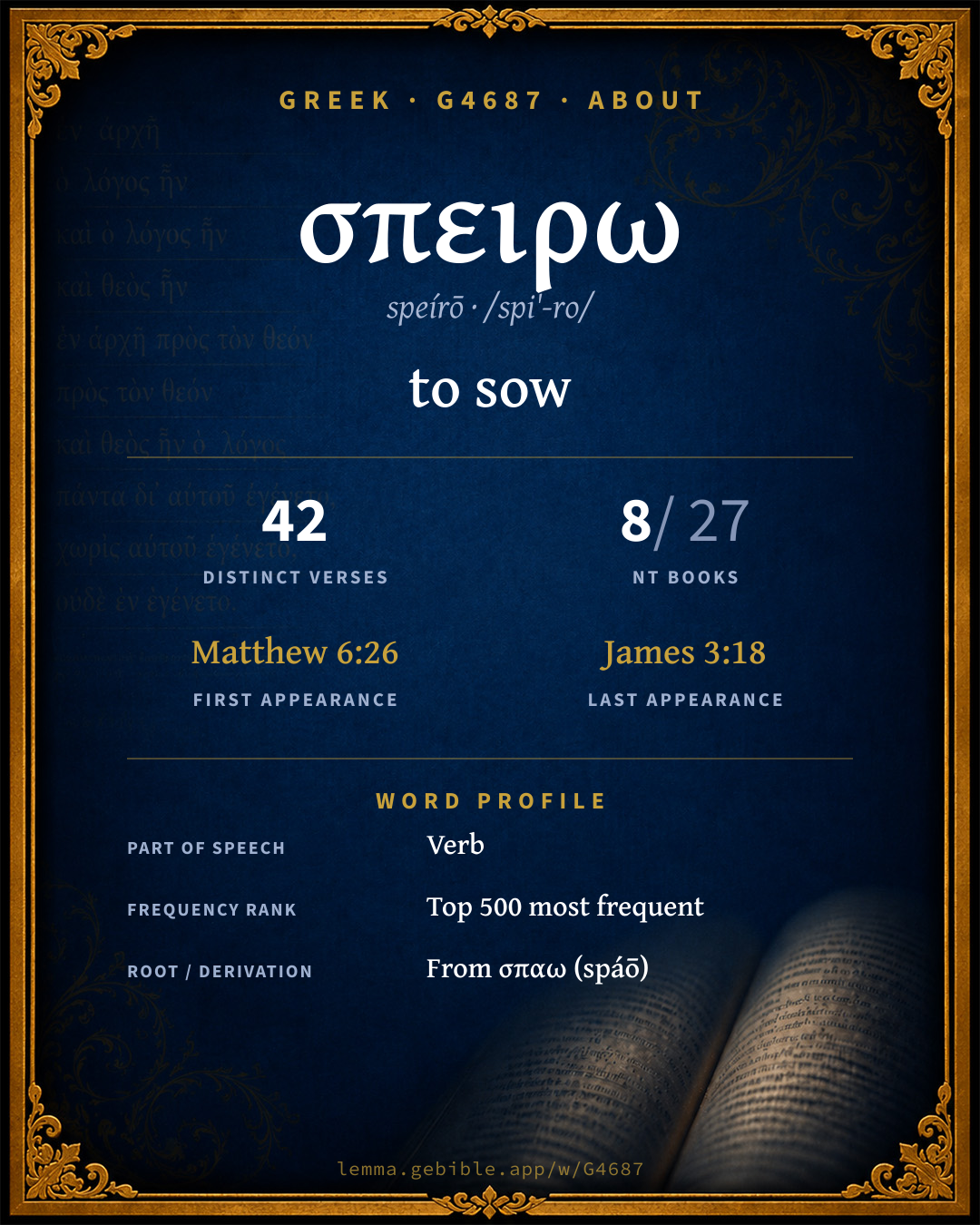
σπείρω
to sow
also: scatter, seed fuller range ↓
Full lexicon entry — Thayer's Greek Lexicon
From Thayer's Greek Lexicon
Where this word appears
See every Present-tense verb in the Greek New Testament →
Grammar key — what these labels mean
Part of speech
- Verb
- An action or state-of-being word.
Tense
- Present
- Ongoing or general action in present time (imperfective aspect).
- Aorist
- Action viewed as a simple whole, without regard to duration — often past (perfective aspect).
- Perfect
- A completed past action with continuing present results.
Voice
- Active
- The subject performs the action.
- Passive
- The subject receives the action.
Mood
- Participle
- A verbal adjective (“writing,” “having written”).
- Indicative
- States a fact or asks a factual question (the mood of reality).
- Infinitive
- A verbal noun (“to write”), unmarked for person or number.
- Subjunctive
- Expresses probability, purpose, or possibility (the mood of contingency).
Case
- Nominative
- The case of the subject (and the predicate nominative).
- Dative
- The case of the indirect object, means, or location — “to / for / with / in.”
- Genitive
- The case of source, possession, or “of” — answers “whose / from what.”
- Accusative
- The case of the direct object and of extent.
Person
- 3rd person
- The one spoken about (“he / she / it / they”).
- 2nd person
- The one addressed (“you”).
- 1st person
- The speaker (“I / we”).
Gender
- Masculine
- Grammatically masculine.
- Neuter
- Grammatically neuter.
Number
- Singular
- One.
- Plural
- More than one.
Grammatical forms 22 distinct
- Verb, Present, Active, Participle, Nominative, Singular, Masculine 11 times (21%)
- Verb, Present, Passive, Indicative, 3rd person, Singular 6 times (11%)
- Verb, Aorist, Passive, Participle, Nominative, Singular, Masculine 4 times (8%)
- Verb, Present, Active, Infinitive 4 times (8%)
- Verb, Aorist, Active, Indicative, 2nd person, Singular 3 times (6%)
- Verb, Present, Active, Indicative, 2nd person, Singular 3 times (6%)
- Verb, Aorist, Passive, Subjunctive, 3rd person, Singular 2 times (4%)
- Verb, Aorist, Active, Indicative, 1st person, Singular 2 times (4%)
+14 more forms (18 occurrences)
Parsed forms decoded from the imported morphology (Robinson–Tischendorf, public domain), counted across 53 parsed occurrences — not distinct verses.
Every verse where G4687 appears — 42 distinct verses across 8 books. Click any verse to open its interlinear word-by-word view. Verse text shown in the World English Bible for context — . Each verse’s Greek form is shown with its reference; the English is not keyword-highlighted, since the data carries no word-level English alignment. Use “Compare translations” on any verse to read it across multiple English versions. This concordance covers the Greek New Testament; Septuagint (Greek Old Testament) occurrences of this word are not indexed here.
Matthew 16 verses
- Matthew 6:26 σπείρουσιν pres act ind 3pl See the birds of the sky, that they don't sow, neither do they reap, nor gather into barns. Your heavenly Father feeds them. Aren't you of much more value than they?
- Matthew 13:3 σπείρων σπείρειν pres act ptcp nom sg masc pres act inf He spoke to them many things in parables, saying, "Behold, a farmer went out to sow.
- Matthew 13:4 σπείρειν pres act inf As he sowed, some seeds fell by the roadside, and the birds came and devoured them.
- Matthew 13:18 σπείραντος aor act ptcp gen sg masc "Hear, then, the parable of the farmer.
- Matthew 13:19 ἐσπαρμένον σπαρείς perf pass ptcp acc sg neut aor pass ptcp nom sg masc When anyone hears the word of the Kingdom, and doesn't understand it, the evil one comes, and snatches away that which has been sown in his heart. This is what was sown by the roadside.
- Matthew 13:20 σπαρείς aor pass ptcp nom sg masc What was sown on the rocky places, this is he who hears the word, and immediately with joy receives it;
- Matthew 13:22 σπαρείς aor pass ptcp nom sg masc What was sown among the thorns, this is he who hears the word, but the cares of this age and the deceitfulness of riches choke the word, and he becomes unfruitful.
- Matthew 13:23 σπαρείς aor pass ptcp nom sg masc What was sown on the good ground, this is he who hears the word, and understands it, who most assuredly bears fruit, and brings forth, some one hundred times as much, some sixty, and some thirty."
- Matthew 13:24 σπείραντι aor act ptcp dat sg masc He set another parable before them, saying, "The Kingdom of Heaven is like a man who sowed good seed in his field,
- Matthew 13:25 ἐπέσπειρεν aor act ind 3sg but while people slept, his enemy came and sowed darnel also among the wheat, and went away.
- Matthew 13:27 ἔσπειρας aor act ind 2sg The servants of the householder came and said to him, 'Sir, didn't you sow good seed in your field? Where did this darnel come from?'
- Matthew 13:31 ἔσπειρεν aor act ind 3sg He set another parable before them, saying, "The Kingdom of Heaven is like a grain of mustard seed, which a man took, and sowed in his field;
- Matthew 13:37 σπείρων pres act ptcp nom sg masc He answered them, "He who sows the good seed is the Son of Man,
- Matthew 13:39 σπείρας aor act ptcp nom sg masc The enemy who sowed them is the devil. The harvest is the end of the age, and the reapers are angels.
- Matthew 25:24 ἔσπειρας aor act ind 2sg "He also who had received the one talent came and said, 'Lord, I knew you that you are a hard man, reaping where you did not sow, and gathering where you did not scatter.
- Matthew 25:26 ἔσπειρα aor act ind 1sg "But his lord answered him, 'You wicked and slothful servant. You knew that I reap where I didn't sow, and gather where I didn't scatter.
Mark 9 verses
- Mark 4:3 σπείρων σπεῖραι pres act ptcp nom sg masc aor act inf "Listen! Behold, the farmer went out to sow,
- Mark 4:4 σπείρειν pres act inf and it happened, as he sowed, some seed fell by the road, and the birds came and devoured it.
- Mark 4:14 σπείρων σπείρει pres act ptcp nom sg masc pres act ind 3sg The farmer sows the word.
- Mark 4:15 σπείρεται ἐσπαρμένον pres pass ind 3sg perf pass ptcp acc sg masc These are the ones by the road, where the word is sown; and when they have heard, immediately Satan comes, and takes away the word which has been sown in them.
- Mark 4:16 σπειρόμενοι pres pass ptcp nom pl masc These in like manner are those who are sown on the rocky places, who, when they have heard the word, immediately receive it with joy.
- Mark 4:18 σπειρόμενοι pres pass ptcp nom pl masc Others are those who are sown among the thorns. These are those who have heard the word,
- Mark 4:20 σπαρέντες aor pass ptcp nom pl masc These are those which were sown on the good ground: such as hear the word, and accept it, and bear fruit, some thirty times, some sixty times, and some one hundred times."
- Mark 4:31 σπαρῇ aor pass subj 3sg It's like a grain of mustard seed, which, when it is sown in the earth, though it is less than all the seeds that are on the earth,
- Mark 4:32 σπαρῇ aor pass subj 3sg yet when it is sown, grows up, and becomes greater than all the herbs, and puts out great branches, so that the birds of the sky can lodge under its shadow."
Luke 4 verses
- Luke 8:5 σπείρων σπεῖραι σπείρειν pres act ptcp nom sg masc aor act inf pres act inf "The farmer went out to sow his seed. As he sowed, some fell along the road, and it was trampled under foot, and the birds of the sky devoured it.
- Luke 12:24 σπείρουσιν pres act ind 3pl Consider the ravens: they don't sow, they don't reap, they have no warehouse or barn, and God feeds them. How much more valuable are you than birds!
- Luke 19:21 ἔσπειρας aor act ind 2sg for I feared you, because you are an exacting man. You take up that which you didn't lay down, and reap that which you didn't sow.'
- Luke 19:22 ἔσπειρα aor act ind 1sg "He said to him, 'Out of your own mouth will I judge you, you wicked servant! You knew that I am an exacting man, taking up that which I didn't lay down, and reaping that which I didn't sow.
John 2 verses
1 Corinthians 6 verses
- 1 Corinthians 9:11 ἐσπείραμεν aor act ind 1pl If we sowed to you spiritual things, is it a great thing if we reap your fleshly things?
- 1 Corinthians 15:36 σπείρεις pres act ind 2sg You foolish one, that which you yourself sow is not made alive unless it dies.
- 1 Corinthians 15:37 σπείρεις σπείρεις pres act ind 2sg pres act ind 2sg That which you sow, you don't sow the body that will be, but a bare grain, maybe of wheat, or of some other kind.
- 1 Corinthians 15:42 σπείρεται pres pass ind 3sg So also is the resurrection of the dead. It is sown in corruption; it is raised in incorruption.
- 1 Corinthians 15:43 σπείρεται σπείρεται pres pass ind 3sg pres pass ind 3sg It is sown in dishonor; it is raised in glory. It is sown in weakness; it is raised in power.
- 1 Corinthians 15:44 σπείρεται pres pass ind 3sg It is sown a natural body; it is raised a spiritual body. There is a natural body and there is also a spiritual body.
2 Corinthians 2 verses
- 2 Corinthians 9:6 σπείρων σπείρων pres act ptcp nom sg masc pres act ptcp nom sg masc Remember this: he who sows sparingly will also reap sparingly. He who sows bountifully will also reap bountifully.
- 2 Corinthians 9:10 σπείροντι pres act ptcp dat sg masc Now may he who supplies seed to the sower and bread for food, supply and multiply your seed for sowing, and increase the fruits of your righteousness;
Galatians 2 verses
- Galatians 6:7 σπείρῃ pres act subj 3sg Don't be deceived. God is not mocked, for whatever a man sows, that will he also reap.
- Galatians 6:8 σπείρων σπείρων pres act ptcp nom sg masc pres act ptcp nom sg masc For he who sows to his own flesh will from the flesh reap corruption. But he who sows to the Spirit will from the Spirit reap eternal life.
James 1 verse
About this entry
At a glance — auto-summarized from this page’s data, not written by a person. Every figure links to its source below. This summary describes the numbers; it doesn’t interpret them.
At its core, σπειρω (speírō) means “to sow.” Its English rendering has broadened — “is sown” classically, “sows” (Berean Standard Bible) in modern versions; see the renderings breakdown. Spanning 42 verses in 8 books, it ranks among the moderately common words of the Greek New Testament. Its uses concentrate in Matthew (38% of all occurrences). Ranging over 2 senses, its meaning includes “scatter” and “seed”. Dig into 42-verse concordance and the renderings breakdown below.
Gloss history
Strong's 1890 vs modern scholarship
About this word
Strong's G4687 catalogs a Greek word from the Greek New Testament.
These counts are not copied from any lexicon or concordance. They are computed here, from the morphology-tagged Greek New Testament. What Lemma adds →
- 42
- distinct verses
- The word appears in 42 distinct verses.
- 8 / 27
- NT books
- The word appears in 8 of 27 New Testament books.
- #300
- by frequency
- Top 500 most frequent Greek words (rank 300 of 5,347 Greek words by occurrence).
View all 42 occurrences in the concordance →
Most concentrated in
- Matthew 16 verses 38%
- Mark 9 verses 21%
- 1 Corinthians 6 verses 14%
By section of the New Testament
By traditional corpus
Conventional, traditional groupings — biblical authorship is debated, so this is a traditional corpus grouping, not an authorship claim. Some books belong to more than one corpus (Luke is in both the Gospels and the Lukan corpus, and so on), so these shares overlap and need not total 100%. Each figure is a share of the word’s 42 distinct verses.
- Gospels 31 verses · 74%
- Pauline corpus 10 verses · 24%
- Lukan (Luke–Acts) 4 verses · 10%
- Johannine 2 verses · 5%
- General (Catholic) Epistles 1 verse · 2%
How translations render this word
Counts come from each version’s own published word-to-Strong’s tagging or interlinear alignment — an approximate guide to how each version renders this word, not a word-level alignment the data otherwise carries. Because each total is that version’s own tagged count, the per-version totals vary from one another and need not match the appearance or distinct-verse counts above. These counts may also differ from a printed concordance because Lemma counts each distinctly tagged rendering and does not collapse phrase taggings into a single head-word total. This is a fixed set of word-tagged versions (KJV, ASV, BSB, ULT) and does not change with the reading translation you choose elsewhere. Each version’s license is shown beside its name below (and on Sources).
- King James Version: Is sown 8×, Sow 6×, Sowed 6×
- American Standard Version: Is sown 8×, Sow 8×, Sower 6×
- Berean Standard Bible: Sows 9×, Sown 8×, Is sown 5×
- unfoldingWord Literal Text: Sow 11×, Sowing 7×, Sower 6×
King James Version Public Domain
Renders G4687 across 56 tagged occurrences — most commonly:
Plus 18 renderings that appear only once — usually multi-word phrases or single function words the recovered tagging swept in, not distinct renderings. Not rendered by a distinct English word in 2 further occurrences.
American Standard Version Public Domain
Renders G4687 across 56 tagged occurrences — most commonly:
Plus 11 renderings that appear only once — usually multi-word phrases or single function words the recovered tagging swept in, not distinct renderings.
Berean Standard Bible Public Domain
Renders G4687 across 52 tagged occurrences — most commonly:
Plus 11 renderings that appear only once — usually multi-word phrases or single function words the recovered tagging swept in, not distinct renderings. Not rendered by a distinct English word in 1 further occurrence.
unfoldingWord Literal Text CC BY-SA 4.0
Renders G4687 across 62 tagged occurrences — most commonly:
Plus other, less common renderings. Plus 10 renderings that appear only once — usually multi-word phrases or single function words the recovered tagging swept in, not distinct renderings.
Senses in Thayer's
The 2 senses Thayer's distinguishes for this word, in lexicon order (not ranked by frequency or importance). The full entry — with sub-senses — is in the Lexicon Entry tab.
- to sow, scatter, seed
- metaph. of proverbial sayings
Word origin
Derived from σπαω (spáō) (G4685) — to draw.
Probably strengthened from G4685 (through the idea of extending ); to scatter that is sow (literally or figuratively): - sow (-er) receive seed.
— Strong’s Exhaustive Concordance (1890), public domain.
Forms in the corpus
The 22 distinct written forms G4687 takes in the Greek New Testament, most frequent first — each parse links to that tense’s occurrences in the concordance.
Same root — word family
Other Thayer's entries built from the same root as G4687, grouped by Strong’s listed origin. These share a root / origin per the lexicon — not necessarily a shared meaning. Each links to that word’s own entry.
Derives from
Shares the same root
Derived from this word
Compare all same-root words → Showing 4 of 7 — not the complete family. They share a root, not necessarily a meaning.
Septuagint usage
The same Greek word σπειρω appears 55 times in the Greek Old Testament (Septuagint), across 53 verses in 18 books.
- 55
- LXX occurrences
- Tagged occurrences of this Greek word in the Septuagint.
- 53
- verses
- Distinct Septuagint verses containing this word.
- 18 / 39
- OT books
- The word appears in 18 of the 39 Old Testament books.
Sample Septuagint occurrences
- Genesis 1:11 σπείρω
- Exodus 23:10 σπείρω
- Leviticus 11:37 σπείρω
- Numbers 17:2 σπείρω
- Deuteronomy 11:10 σπείρω
- Judges 6:3 σπείρω
- Job 4:8 σπείρω
- Psalms 125:5 σπείρω
- Proverbs 11:21 σπείρω
- Ecclesiastes 11:4 σπείρω
- Isaiah 5:10 σπείρω
- Jeremiah 4:3 σπείρω
Septuagint occurrences (same lexeme)
Every verse where the same Strong’s number (G4687) appears in the Greek Septuagint — showing the first 50 of 53. Verse text shown in the World English Bible for context; the Greek form is the matched word — the English is not keyword-highlighted.
- Genesis 1:11 σπείρω God said, "Let the earth put forth grass, herbs yielding seed, and fruit trees bearing fruit after their kind, with its seed in it, on the earth," and it was so.
- Genesis 1:12 σπείρω The earth brought forth grass, herbs yielding seed after their kind, and trees bearing fruit, with its seed in it, after their kind: and God saw that it was good.
- Genesis 1:29 σπείρω God said, "Behold, I have given you every herb yielding seed, which is on the surface of all the earth, and every tree, which bears fruit yielding seed. It will be your food.
- Genesis 26:12 σπείρω Isaac sowed in that land, and reaped in the same year one hundred times what he planted. Yahweh blessed him.
- Genesis 47:19 σπείρω Why should we die before your eyes, both we and our land? Buy us and our land for bread, and we and our land will be servants to Pharaoh. Give us seed, that we may live, and not die, and that the land won't be desolate."
- Genesis 47:23 σπείρω Then Joseph said to the people, "Behold, I have bought you and your land today for Pharaoh. Behold, here is seed for you, and you shall sow the land.
- Exodus 23:10 σπείρω "For six years you shall sow your land, and shall gather in its increase,
- Exodus 23:16 σπείρω And the feast of harvest, the first fruits of your labors, which you sow in the field: and the feast of harvest, at the end of the year, when you gather in your labors out of the field.
- Exodus 32:20 σπείρω He took the calf which they had made, and burnt it with fire, ground it to powder, and scattered it on the water, and made the children of Israel drink of it.
- Leviticus 11:37 σπείρω If part of their carcass falls on any sowing seed which is to be sown, it is clean.
- Leviticus 25:3 σπείρω Six years you shall sow your field, and six years you shall prune your vineyard, and gather in its fruits;
- Leviticus 25:4 σπείρω but in the seventh year there shall be a Sabbath of solemn rest for the land, a Sabbath to Yahweh. You shall not sow your field or prune your vineyard.
- Leviticus 25:11 σπείρω That fiftieth year shall be a jubilee to you. In it you shall not sow, neither reap that which grows of itself, nor gather from the undressed vines.
- Leviticus 25:20 σπείρω If you said, "What shall we eat the seventh year? Behold, we shall not sow, nor gather in our increase;"
- Leviticus 25:22 σπείρω You shall sow the eighth year, and eat of the fruits, the old store; until the ninth year, until its fruits come in, you shall eat the old store.
- Leviticus 26:16 σπείρω I also will do this to you: I will appoint terror over you, even consumption and fever, that shall consume the eyes, and make the soul to pine away; and you will sow your seed in vain, for your enemies will eat it.
- Numbers 17:2 σπείρω Speak to the children of Israel, and take of them rods, one for each fathers' house, of all their princes according to their fathers' houses, twelve rods: write you every man's name on his rod.
- Numbers 20:5 σπείρω Why have you made us to come up out of Egypt, to bring us in to this evil place? it is no place of seed, or of figs, or of vines, or of pomegranates; neither is there any water to drink.
- Deuteronomy 11:10 σπείρω For the land, where you go in to possess it, isn't as the land of Egypt, from whence you came out, where you sowed your seed, and watered it with your foot, as a garden of herbs;
- Deuteronomy 21:4 σπείρω and the elders of that city shall bring down the heifer to a valley with running water, which is neither plowed nor sown, and shall break the heifer's neck there in the valley.
- Deuteronomy 22:9 σπείρω You shall not sow your vineyard with two kinds of seed, lest the whole fruit be forfeited, the seed which you have sown, and the increase of the vineyard.
- Deuteronomy 29:22 σπείρω The generation to come, your children who shall rise up after you, and the foreigner who shall come from a far land, shall say, when they see the plagues of that land, and the sicknesses with which Yahweh has made it sick;
- Judges 6:3 σπείρω So it was, when Israel had sown, that the Midianites came up, and the Amalekites, and the children of the east; they came up against them;
- Judges 9:45 σπείρω Abimelech fought against the city all that day; and he took the city, and killed the people who were therein: and he beat down the city, and sowed it with salt.
- Job 4:8 σπείρω According to what I have seen, those who plow iniquity, And sow trouble, Reap the same.
- Job 31:8 σπείρω Then let me sow, and let another eat; Yes, let the produce of my field be rooted out.
- Psalms 125:5 σπείρω But as for those who turn aside to their crooked ways, Yahweh will lead them away with the workers of iniquity. Peace be on Israel.
- Proverbs 11:21 σπείρω Most assuredly, the evil man will not be unpunished, But the seed of the righteous will be delivered.
- Proverbs 11:24 σπείρω There is one who scatters, and increases yet more. There is one who withholds more than is appropriate, but gains poverty.
- Proverbs 22:8 σπείρω He who sows wickedness reaps trouble, And the rod of his fury will be destroyed.
- Ecclesiastes 11:4 σπείρω He who observes the wind won't sow; And he who regards the clouds won't reap.
- Ecclesiastes 11:6 σπείρω In the morning sow your seed, And in the evening don't withhold your hand; For you don't know which will prosper, whether this or that, Or whether they both will be equally good.
- Isaiah 5:10 σπείρω For ten acres of vineyard shall yield one bath, And a homer of seed shall yield an ephah."
- Isaiah 17:11 σπείρω In the day of your planting you hedge it in, and in the morning you make your seed to blossom; but the harvest flees away in the day of grief and of desperate sorrow.
- Isaiah 19:7 σπείρω The meadows by the Nile, by the brink of the Nile, and all the sown fields of the Nile, shall become dry, be driven away, and be no more.
- Isaiah 28:25 σπείρω When he has leveled the surface of it, doesn't he cast abroad the dill, and scatter the cumin, and put in the wheat in rows, and the barley in the appointed place, and the spelt in the border of it?
- Isaiah 32:20 σπείρω Blessed are you who sow beside all waters, who send forth the feet of the ox and the donkey.
- Isaiah 37:30 σπείρω This shall be the sign to you: you shall eat this year that which grows of itself, and in the second year that which springs of the same; and in the third year sow you, and reap, and plant vineyards, and eat the fruit of it.
- Isaiah 40:24 σπείρω Yes, they have not been planted; yes, they have not been sown; yes, their stock has not taken root in the earth: moreover he blows on them, and they wither, and the whirlwind takes them away as stubble.
- Isaiah 55:10 σπείρω For as the rain comes down and the snow from the sky, and doesn't return there, but waters the earth, and makes it bring forth and bud, and gives seed to the sower and bread to the eater;
- Jeremiah 4:3 σπείρω For thus says Yahweh to the men of Judah and to Jerusalem, Break up your fallow ground, and don't sow among thorns.
- Jeremiah 12:13 σπείρω They have sown wheat, and have reaped thorns; they have put themselves to pain, and profit nothing: and you shall be ashamed of your fruits, because of the fierce anger of Yahweh.
- Jeremiah 37:17 σπείρω Then Zedekiah the king sent, and fetched him: and the king asked him secretly in his house, and said, Is there any word from Yahweh? Jeremiah said, There is. He said also, You shall be delivered into the hand of the king of Babylon.
- Jeremiah 38:27 σπείρω Then came all the princes to Jeremiah, and asked him; and he told them according to all these words that the king had commanded. So they left off speaking with him; for the matter was not perceived.
- Jeremiah 42:7 σπείρω It happened after ten days, that the word of Yahweh came to Jeremiah.
- Ezekiel 36:9 σπείρω For, behold, I am for you, and I will turn into you, and you shall be tilled and sown;
- Hosea 2:25 σπείρω
- Hosea 8:7 σπείρω For they sow the wind, And they will reap the whirlwind. He has no standing grain. The stalk will yield no head. If it does yield, strangers will swallow it up.
- Hosea 10:12 σπείρω Sow to yourselves in righteousness, Reap according to kindness. Break up your fallow ground; For it is time to seek Yahweh, Until he comes and rains righteousness on you.
- Micah 6:15 σπείρω You will sow, but won't reap. You will tread the olives, but won't anoint yourself with oil; And crush grapes, but won't drink the wine.
These are occurrences of the same Greek lexeme (G4687) in the Septuagint — not a translation of any one Hebrew word. The store carries no word-level Hebrew↔Greek alignment, so no Hebrew original is asserted here. Counts come from the recovered LXX Strong's tagging — high-frequency vocabulary is well covered, while rare or late forms may be untagged — so they reflect tagged occurrences and may slightly undercount.