1 Corinthians 9:11

Greek (Tischendorf 8th ed.) 1 Corinthians 9:11 appears in the Greek New Testament. The text above is from the Tischendorf 8th edition. Each word links to its Strong’s number and a concise gloss. Click any word for its full Thayer’s Greek Lexicon entry.

Download image
Cite this verse

1 Corinthians 9:11 (World English Bible). Public Domain. Lemma interlinear Bible study tool, https://lemma.gebible.app/v/1-corinthians/9/11.

Show BibTeX & RIS
BibTeX
RIS
English Translation
If we sowed to you spiritual things, is it a great thing if we reap your fleshly things?
World English Bible · Public Domain
Download a study sheet

One document with this verse’s original text, its word-by-word gloss line, the meaning frame, cross-references with their text, attributed commentary, and full source and license credits — printable, and it pastes into notes with its structure intact.

This verse Autodidact and up

Study sheet (.html) Plain text (.txt)

A passage Seminary Student

Up to 50 verses in one chapter. A passage sheet keeps up to 6 commentary sources and 12 cross-references per verse, in the order this page ranks them, and says so on the sheet whenever that leaves anything out. Ask for a single verse and you get the Autodidact verse sheet above.

Everything on this page stays free to read, with no account — the sheet is a download of what is already on screen, not access to it.

Want to remove ads? Support Godless Engineer
Compare translations 3

The same verse in 3 English versions, stacked beneath the original-language interlinear above. Click any original word for its lexicon entry.

Each is an independent rendering of the whole verse — the interlinear is not word-aligned to these translations.

Highlighted words mark where these versions differ — a whole-verse word diff, not a word-by-word alignment.

  • World English Bible Public Domain
    If we sowed to you spiritual things, is it a great thing if we reap your fleshly things?
  • King James Version Public Domain
    If we have sown unto you spiritual things, is it a great thing if we shall reap your carnal things?
  • unfoldingWord Literal Text CC BY-SA 4.0
    If we sowed spiritual things among you, too much if we will reap material things from you?

unfoldingWord Literal Text — © unfoldingWord, licensed CC BY-SA 4.0. Word-aligned USFM3 via Door43 (git.door43.org/unfoldingWord/en_ult).

Versions to compare (up to 4)

3 of 4 selected

Show all 19 translations

Every available English version of this verse, each an independent rendering of the whole verse.

  • World English Bible Public Domain
    If we sowed to you spiritual things, is it a great thing if we reap your fleshly things?
  • Berean Standard Bible Public Domain
    If we have sown spiritual seed among you, is it too much for us to reap a material harvest from you?
  • Majority Standard Bible Public Domain
    If we have sown spiritual seed among you, is it too much for us to reap a material harvest from you?
  • King James Version Public Domain
    If we have sown unto you spiritual things, is it a great thing if we shall reap your carnal things?
  • American Standard Version (1901) Public Domain
    If we sowed unto you spiritual things, is it a great matter if we shall reap your carnal things?
  • Revised Version (1885) Public Domain
    If we sowed unto you spiritual things, is it a great matter if we shall reap your carnal things?
  • Geneva Bible (1599) Public Domain
    If wee haue sowen vnto you spirituall thinges, is it a great thing if we reape your carnall thinges?
  • Douay-Rheims (1899) Public Domain
    If we have sown unto you spiritual things, is it a great matter if we reap your carnal things?
  • Young's Literal Translation Public Domain
    If we to you the spiritual things did sow -- great `is it' if we your fleshly things do reap?
  • Literal Standard Version CC BY-SA 4.0
    If we sowed to you the spiritual things—[is it] great if we reap your fleshly things?
  • Unlocked Literal Bible CC BY-SA 4.0
    If we sowed spiritual things among you, is it too much for us to reap material things from you?
  • unfoldingWord Literal Text CC BY-SA 4.0
    If we sowed spiritual things among you, too much if we will reap material things from you?
  • Darby Bible Public Domain
    If we have sown to you spiritual things, [is it a] great [thing] if *we* shall reap your carnal things?
  • World Messianic Bible Public Domain
    If we sowed to you spiritual things, is it a great thing if we reap your fleshly things?
  • Webster's Bible Public Domain
    If we have sown to you spiritual things, is it a great thing if we shall reap your carnal things?
  • Free Bible Version CC BY-SA 4.0
    If we sowed what is spiritual with you, does it really matter if we reap some material benefit?
  • Bible in Basic English Public Domain
    If we have been planting the things of the Spirit for you, does it seem a great thing for you to give us a part in your things of this world?
  • Text-Critical English NT CC BY 4.0
    If we have sown spiritual blessings among you, is it too much if we reap material benefits from you?
  • Tyndale New Testament (1534) Public Domain
    Yf we sowe vnto you spirituall thynges: is it a greate thynge yf we reepe youre carnall thynges

Literal Standard Version (2020), Covenant Press — licensed CC BY-SA 4.0. Text via the HelloAO Bible API (eBible.org). Unlocked Literal Bible (unfoldingWord) — licensed CC BY-SA 4.0. Text via the HelloAO Bible API (eBible.org). unfoldingWord Literal Text — © unfoldingWord, licensed CC BY-SA 4.0. Word-aligned USFM3 via Door43 (git.door43.org/unfoldingWord/en_ult). Free Bible Version, Dr. Jonathan Gallagher — licensed CC BY-SA 4.0. Text via the HelloAO Bible API (eBible.org).

Word by word

More ways to search: Search by grammar → Find every occurrence → Compare this word →

Practice this passage: Drill this verse → Learn its vocabulary →

σαρκικὰ
sarkikós
G4559
“carnal”
Adjective, Accusative, Plural, Neuter
Part of Speech
Adjective
Case
Accusative
Number
Plural
Gender
Neuter
Full Thayer's Definition

Origin: from G4561

TDNT: 08:38,1

1. fleshly, carnal a. having the nature of flesh, i.e. under the control of the animal appetites 1. governed by mere human nature not by the Spirit of God 2. having its seat in the animal nature or aroused by the animal nature 3. human: with the included idea of depravity b. pertaining to the flesh 1. to the body: related to birth, linage, etc
  1. Εἰ ei G1487 “if” Conditional
  2. ἡμεῖς hēmeîs G2249 “we” Personal pronoun, 1st person, Nominative, Plural
  3. ὑμῖν hymeîs G5210 “you” Personal pronoun, 2nd person, Dative, Plural
  4. τὰ ho G3588 “the” Article, Accusative, Plural, Neuter
  5. πνευματικὰ pneumatikós G4152 “spiritual” Adjective, Accusative, Plural, Neuter
  6. ἐσπείραμεν speírō G4687 “to sow” Verb, Aorist, Active, Indicative, 1st person, Plural
  7. μέγα mégas G3173 “great” Adjective, Nominative, Singular, Neuter
  8. εἰ ei G1487 “if” Conditional
  9. ἡμεῖς hēmeîs G2249 “we” Personal pronoun, 1st person, Nominative, Plural
  10. ὑμῶν hymeîs G5210 “you” Personal pronoun, 2nd person, Genitive, Plural
  11. τὰ ho G3588 “the” Article, Accusative, Plural, Neuter
  12. θερίσομεν therízō G2325 “to reap” Verb, Future, Active, Indicative, 1st person, Plural

About this verse

These counts appear in no published source. They are computed here, from the morphology-tagged text and Lemma’s own curated glosses. What Lemma adds →

13
words
9
distinct lemmas
Pauline Epistles
section

Notable vocabulary

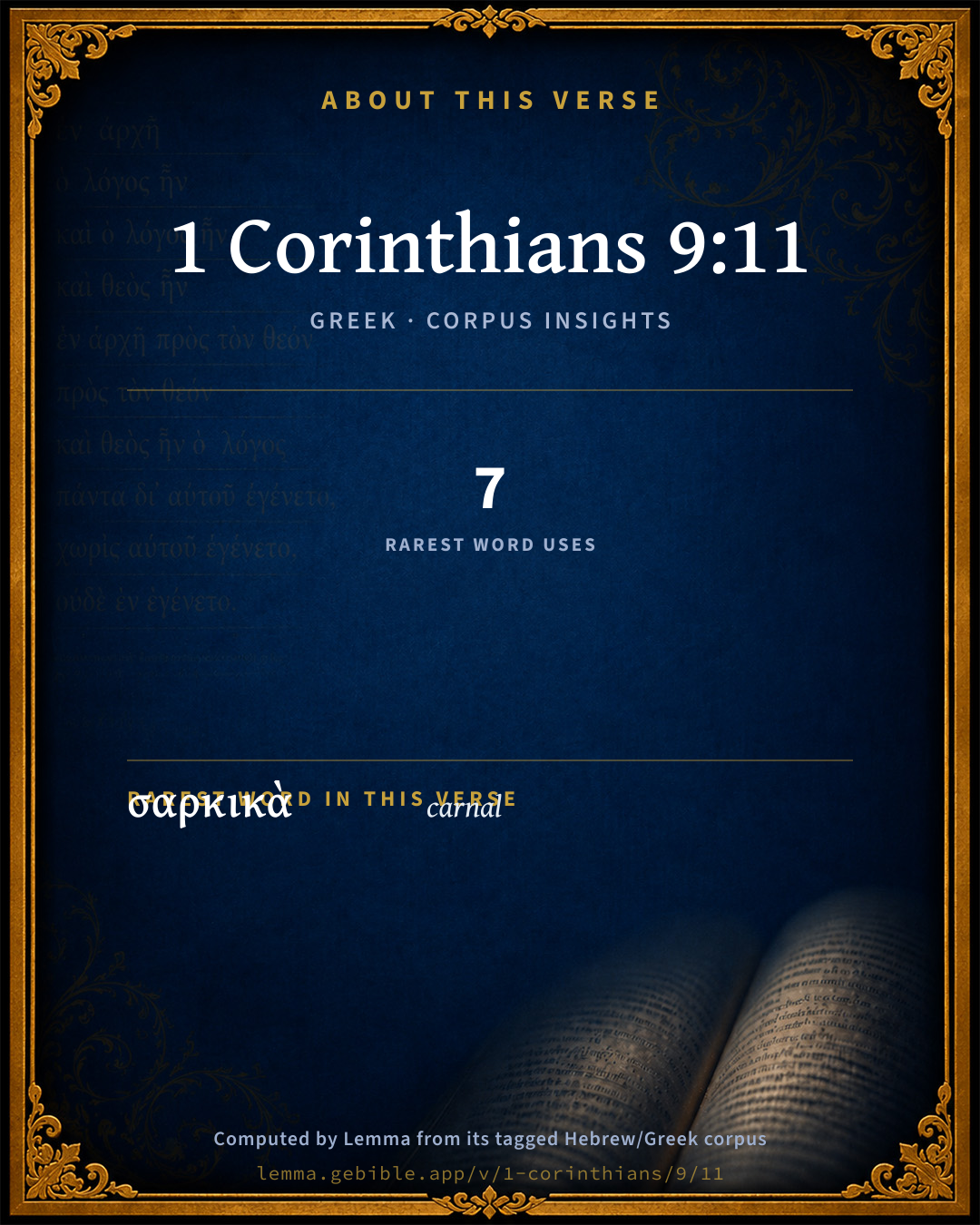
The rarest word here is σαρκικὰ carnal G4559 — appearing just 7 times in the whole Greek New Testament.

Shared distinctive vocabulary

σαρκικὰ carnal G4559 occurs in 6 verses of the Greek New Testament. Also found in:

Repetition

Words recur within this verse:

Cross-references

6

Topical passages linked to 1 Corinthians 9:11 in the Treasury of Scripture Knowledge — connected by theme and wording, ordered by reader-vote popularity; previews shown in the World English Bible.

  • Romans 15:27 Yes, it has been their good pleasure, and they are their debtors. For if the Gentiles have been made partakers of their spiritual things, they owe it to them also to serve them in fleshly things.
  • Galatians 6:6 But let him who is taught in the word share all good things with him who teaches.
  • Matthew 10:10 Take no bag for your journey, neither two coats, nor shoes, nor staff: for the laborer is worthy of his food.
  • 2 Corinthians 11:15 It is no great thing therefore if his ministers also masquerade as servants of righteousness, whose end will be according to their works.
  • 2 Kings 5:13 His servants came near, and spoke to him, and said, My father, if the prophet had bid you do some great thing, wouldn't you have done it? how much rather then, when he says to you, Wash, and be clean?
  • Malachi 3:8–9 Will a man rob God? Yet you rob me! But you say, 'How have we robbed you?' In tithes and offerings.

Cross-references courtesy of OpenBible.info (CC BY 4.0).

Commentary

Notes on 1 Corinthians 9:11 from classic Christian and Jewish commentators (each source and its license shown beneath its notes). The classic Christian expositions comment on the surrounding passage and are grouped to its opening verse, so a note may address several verses; the Jewish commentaries on the Tanakh (Rashi and others) are per-verse, so they appear only where the commentator wrote on this verse.

Lemma curates 59 commentaries, every one of them public domain or Creative Commons licensed, each selected and text-cleaned for this edition rather than reprinted as found. About our sources →

Joseph Benson's Commentary

1Co 9:11-12. If we have sown unto you spiritual things — By our incessant diligence in preaching to you the gospel of the blessed God; is it a great thing — More than we have a right to expect; if we shall reap your carnal things — Namely, as much as is needful for our sustenance? Do you give us things of greater value than those you receive from us? If others — Whether true or false apostles or ministers; be partakers of this power over you — Have a right to be maintained by you; are not we rather — Entitled to it, having first preached the gospel among you, and brought you to the knowledge of the truth, and having laboured much more among you? Nevertheless we have not used this power — Though founded in such evident and various principles of equity; but suffer all things — Every kind of hardship, particularly the fatigues of labour, and the want of needful or convenient support, 1Co 4:11-12; lest we should hinder the gospel of Christ — By giving an occasion of cavil or reproach to those who are watchful for opportunities to misrepresent and censure our conduct. “By preaching the gospel free of expense, the apostle rendered it the more acceptable to the Gentiles, and drew them the more readily to hear him. There was another reason also for his demanding no reward for preaching, namely, that in future ages mankind might be sensible that in preaching the gospel, he was not animated by any worldly motive, but merely by a full persuasion of its truth. Foreseeing, therefore, that his disinterestedness would, in all ages, be a strong proof of the truth of the gospel, the apostle gloried in preaching it to all men, without fee or reward.” — Macknight.

Joseph Benson's Commentary on the Old and New Testaments (1811–1818) — public domain. Text from a community e-Sword module.

Bengel's Gnomon

Johann Albrecht Bengel

1Co 9:11. Ὑμῖν, unto you) he does not say yours, as afterwards.—μέγα, a great thing) Comp. 2Co 11:15; 2Co 11:14, where it is explained as the same as “a marvel.”

Bengel's Gnomon of the New Testament — English translation (T&T Clark, Edinburgh, 1860) — public domain. Text from a community e-Sword module.

Meyer's Critical & Exegetical Commentary

Heinrich August Wilhelm Meyer

1Co_9:11. Application of 1Co_9:10, and that in such a way as to make the readers feel ὅτι μείζονα λαμβάνουσιν ἢ διδόασιν, Chrysostom; an argument a majori ad minus.

ἡμεῖς] does not include Barnabas, who cannot be proved ever to have joined company again with Paul after the separation recorded in Act_15:39, and who certainly had no share in founding the church at Corinth. The apostle means himself along with his companions of that period, when by casting forth the seed of the gospel he founded the church to which his readers belonged (ἐσπείραμεν), Act_18:5; 2Co_1:19.

ἡμεῖς ὑμῖν] An emphatic juxtaposition, the emphasis of which is further heightened by the ἡμεῖς ὑμῶν which follows.

τὰ πνευματικά] spiritual things, Christian knowledge, faith, love, etc., inasmuch as these are the blessings which, proceeding from the Holy Spirit (Gal_5:22), become the portion of believers through the sowers work of preaching the gospel (Mat_13:3 ff.). Contrasted with these are τὰ σαρκικά, the things which have nothing to do with the Holy Spirit, but belong to the lower sphere of mans life, to his sensuous, corporeal nature, such as food, clothing, money, etc. Comp as regards the antithesis, Rom_15:27.

ΜΈΓΑ] res magni momenti, Xen. Cyrop. vii. 5. 52, Anab. vii. 7. 27. It means here, from the connection: something disproportionate. Comp 2Co_11:15.

ΘΕΡΊΣΩΜΕΝ] see the critical remarks. The subjunctive after εἰ respectum comprehendit experientiae (Hermann, de partic. ἄν, p. 97); see regarding this idiom on Luk_9:13, and Hermann, a[1437] Viger. p. 831; it occurs in Homer and the lyric poets, and, although no certain instance of it can be given from the Attic prose writers, is frequent again in later Greek.

[1437] d refers to the note of the commentator or editor named on the particular passage.

Meyer — Critical and Exegetical Commentary on the New Testament — English translation by Peter Christie, edited by Frederick Crombie (T&T Clark, 1880) — public domain. Text from a community e-Sword module.

Expositor's Greek Testament

ed. W. Robertson Nicoll

1Co 9:11-12 a appeal to the sense of justice in the Cor [1311] ; τὸ δίκαιον δείκνυσιν τοῦ πράγματος (Thp [1312] ): cf. Gal 6:6 . μέγα εἰ …; “Is it a great thing if …?” = “Is it a great thing to ask ( or look for) that …?” cf. 2Co 11:15 ; the construction is akin to that of θαυμάζω εἰ (see Gm [1313] , s.v . Εἰ , i., 4) a kind of litotes, suggesting where one might have vigorously asserted. The repeated collocation ἡμεῖς ὑμῖν , ἡμεῖς ὑμῶν , brings out the personal nature of this claim: “ We sowed for you the things of the Spirit; should not we reap from you the (needed) carnal things?” τὰ πνευματικὰ ( cf 1Co 2:12 , 1Co 12:1-13 , Rom 8:2 ; Rom 8:5 f., Gal 5:22 , etc.) include all the distinctive boons of the Christian faith; “the carnal things” embrace, besides food and drink (1Co 9:4 ), all suitable bodily “goods” (Gal 6:6 ). The question of 1Co 9:12 a assumes that other Christian teachers received maintenance from the Cor [1314] Church; the claim of Paul and his fellow-missioners was paramount ( cf. 1Co 4:15 ; also 2Co 10:12-18 ; 2Co 11:12 ff., 2Co 11:20 , where this comparison comes up in a new form). ὑμῶν is surely gen [1315] of object , as in Mat 10:1 (= ἐξουσίαν ἐπὶ , Luk 9:1 ), Joh 17:2 , “the claim upon you”. Ev [1316] and Ed [1317] read the pron [1318] as subjective gen [1319] the latter basing the phrase on 1Co 3:22 f. sc . “if others share in your domain ,” instead of “in dominion over you ”; this rendering is sound in grammar, and has a basis in 1Co 4:7-12 , but lies outside the scope of ἐξουσία in this context. The expression “others participate” suggests a right belonging to these “others” in a lesser degree ( cf. μετέχω in 10): the πατὴρ should be first honoured, then the παιδαγωγοί (1Co 4:15 ).

[1311] Corinth, Corinthian or Corinthians.

[1312] Theophylact, Greek Commentator.

[1313] Grimm-Thayer’s Greek-English Lexicon of the N.T.

[1314] Corinth, Corinthian or Corinthians.

[1315] genitive case.

[1316] T. S. Evans in Speaker’s Commentary .

[1317] T. C. Edwards’ Commentary on the First Ep. to the Corinthians . 2

[1318] ron. pronoun.

[1319] genitive case.

1Co 9:12 b . “But we did not use this right” i.e. , P. and his comrades in the Cor [1320] mission (2Co 1:19 ). ἀλλὰ πάντα στέγομεν : “Nay, we put up with everything ( omnia sustinemus , Vg [1321] ), lest we should cause any (kind of) hindrance to the good news about Christ”. στέγω (see parls.), syn [1322] in later Gr [1323] with ὑπομένω , βαστάζω , “marks the patient and enduring spirit with which the Ap. puts up with all the consequences naturally resulting from” his policy of abstinence (El.). What this involved we have partly seen in 1Co 4:2 ff.; cf. 2Co 11:27 , Act 20:34 . The ἐνκοπὴ he sought to obviate (military term of later Gr [1324] , from ἐνκόπτω , to cut into, break up , a road, so to hinder a march) lay ( a ) in the reproach of venality, as old as Socrates and the Sophists, attaching to the acceptance of remuneration by a wandering teacher, which his enemies desired to fasten on Paul (1Th 2:3 ff., 2Co 11:7 ff; 2Co 12:13 ff.); and ( b ) in the fact that P. would have shackled his movements by taking wages from particular Churches (1Co 9:19 ), so giving them a lien upon his ministrations. For the Hebraistic phrase ἐνκοπὴν δίδωμι (= ἐνκόπτω ), cf. 1Co 14:7 , 2Th 1:8 . τοῦ Χριστοῦ is always obj . gen [1325] after εὐαγγέλιον ; see Rom 1:2 f., also μαρτύριον τ . Χριστοῦ , 1Co 1:6 above.

[1320] Corinth, Corinthian or Corinthians.

[1321] Latin Vulgate Translation.

[1322] synonym, synonymous.

[1323] Greek, or Grotius’ Annotationes in N.T.

[1324] Greek, or Grotius’ Annotationes in N.T.

[1325] genitive case.

The Expositor's Greek Testament, edited by W. Robertson Nicoll (1897–1910) — public domain. Text from a community e-Sword module.

Hodge's Commentary on Romans, Ephesians & First Corinthians

Charles Hodge

1Co_9:11

If we have sown unto you spiritual things, (is it) a great thing if we shall reap your carnal things?

That is, if we have bestowed on you one class of benefits, is it unreasonable that we should receive from you another class? And if the benefits which we bestow are spiritual, such as knowledge, faith and hope, the fruits of the Spirit, and therefore of infinite value, is it much that we should derive from you carnal things, i.e. things necessary for the support of the body? On every principle of commutative justice, the ministers right to a support must be conceded.

Charles Hodge — Commentary on Romans (1835), First Corinthians (1857), and Ephesians (1856) — public domain. Text from a community e-Sword module.

Geneva Bible (1599)

Geneva Bible translators

An assumption of the arguments with an amplification, for neither in so doing do we require a reward meet for our deserts.

Geneva Bible (1599) marginal notes — public domain. Text via Bolls.life.

Jamieson, Fausset & Brown

Robert Jamieson, A. R. Fausset & David Brown

we . . . we--emphatical in the Greek. WE, the same persons who have sown to you the infinitely more precious treasures of the Spirit, may at least claim in return what is the only thing you have to give, namely, the goods that nourish the flesh ("your carnal things").

Jamieson, Fausset & Brown — Commentary Critical and Explanatory on the Whole Bible (1871) — public domain (CC PDM 1.0). Text via the HelloAO Bible API.

Adam Clarke's Commentary

Verse 11. If we have sown unto you spiritual things] If we have been the means of bringing you into a state of salvation by the Divine doctrines which we have preached unto you, is it too much for us to expect a temporal support then we give ourselves up entirely to this work? Every man who preaches the Gospel has a right to his own support and that of his family while thus employed.

Adam Clarke's Commentary on the Bible (1810–1826) — public domain. Text from a community e-Sword/MySword module.

John Calvin's Commentaries

11. If we have sown unto you spiritual things There was one cavil remaining — for it might be objected, that labors connected with this life should without doubt have food and clothing as their reward; and that plowing and thrashing yield fruit, of which those that labor in these things are partakers; but that it is otherwise with the gospel, because its fruit is spiritual; and hence the minister of the word, if he would receive fruit corresponding to his labor, ought to demand nothing that is carnal. Lest any one, therefore, should cavil in this manner, he argues from the greater to the less. “Though food and clothing are not of the same nature with a minister’s labors, what injury do you sustain, if you recompense what is inestimable with a thing that is small and contemptible? For in proportion to the superiority of the soul above the body, does the word of the Lord excel outward sustenance, inasmuch as it is the food of the soul.”

John Calvin's Commentaries (1540-1563) — public domain. Text from the Calvin Translation Society English edition (1840s-50s) via the Christian Classics Ethereal Library (ccel.org). Calvin's coverage is partial (roughly two-thirds of the Bible); uncommented books and verses are honest gaps, never fabricated. The 19th-century editor's footnotes and remarks are omitted so the notes are faithfully Calvin's own voice.

Ellicott's Commentary for English Readers

(11) If we have sown unto you spiritual things.—The two sentences in this verse contain a striking double antithesis, the “we” and “you” being emphatic, and “spiritual” being opposed to “carnal.” The spiritual things are, of course, the things of the Spirit of God, by which their spiritual natures are sustained; the carnal things those which the teachers might expect in return, the ordinary support of their physical nature. The force of the climax will be better realised if we notice that the previous argument proved the right of a labourer to receive a remuneration the same in kind as was the quality of his labour. A plougher or a sower would have his reward in a harvest of the same kind as he had sown. That being the principle recognised in civilised life, and sanctioned by the object which the Law of God had in view, the Apostle adds, with a slight touch of sarcasm—Such being an ordinary thing in life, is it a great thing for us to have a reward as inferior to our work as carnal things are to spiritual things?

A Bible Commentary for English Readers, edited by Charles John Ellicott (1878–1897) — public domain. Text from a community e-Sword module.

The Cambridge Bible for Schools and Colleges

gen. ed. J. J. S. Perowne

11. If we have sown unto you spiritual things] St Paul’s third argument is drawn from the principles of natural gratitude. If we have conferred on you such inestimable benefits, it is surely no very burdensome return to give us our maintenance. Not, says Estius, that the one is in any sense the price paid for the other, for the two are too unequal: but that he who receives gifts so invaluable certainly lies under an obligation to him who imparts them—an obligation which he may well requite by ministering to his benefactor in such trifles (see Act_6:1-4) as food and drink. Cf. Rom_15:17; Gal_6:6.

The Cambridge Bible for Schools and Colleges (gen. ed. J. J. S. Perowne; Cambridge University Press, 1878–1918) — public domain. Text from a community e-Sword module.

John Gill's Exposition

If others are partakers of this power over you,.... Meaning not any tyrannical power and jurisdiction over them, with respect either to faith or practice; but the right of a maintenance, which either the false apostles, or the true ordinary ministers of the word there, justly claimed, and did enjoy:

are not we rather? he and Barnabas, especially himself, who was more than an ordinary minister, an apostle, and the first preacher of the Gospel to them:

nevertheless, we have not used this power; though others had, and they had a right to it, but did not choose to insist upon it; and, rather than do so, worked with their own hands; their not making use of this power was not because they stood in no need of it, and enjoyed an affluence of temporal things, for the reverse of this was their case:

but suffer all things: famine, thirst, nakedness, hard labour, and many other hardships:

lest we should hinder the Gospel of Christ; some might suggest, that they preached the Gospel only for gain, and not for the good of souls, and glory of Christ; and other mean spirited persons might be backward of embracing and professing the Gospel, lest it should become chargeable to them; wherefore that the Gospel might not be retarded in its course by the calumny of some, and the sordidness of others, the apostle thought fit to drop his claim to a maintenance from them; though at the same time he would have them know it was a just due, and therefore goes on to defend it by other arguments.

John Gill's Exposition of the Whole Bible (1746–1763) — public domain (CC PDM 1.0). Text via the HelloAO Bible API.

Trapp's Complete Commentary

John Trapp

11 If we have sown unto you spiritual things, is it a great thing if we shall reap your carnal things?

Ver. 11. Is it a great thing, &c.] Do not we give you gold for brass? Cast we not pearls before you? Alexander the Great gave Aristotle for his book de Natura Animalium, 800 talents, which is 800,000 crowns at least. Theodorus Gaza translated that book into Latin, and dedicated it to Pope Sixtus. The Pope asked him how much the rich outside of the book stood him in; Gaza answered, forty crowns. Those forty crowns he commanded to be repaid him, and so sent him away without any reward for so precious a piece of work. Interrogavit asinus papa quanti ornatus constaret? (John Manl. loc. com.) How well might the poor old Grecian sit and sing,

" Heu male nune artes miseras haec saecula tractant,

Spes nulla ulterior." (Juven. Satir. 7.)

John Trapp, A Commentary or Exposition upon All the Books of the Old and New Testament (1647–1656) — public domain. Text from a community e-Sword module.

Albert Barnes' Notes on the Bible

If we have sown unto you spiritual things - If we have been the means of imparting to you the gospel, and bestowing upon you its high hopes and privileges; see the note at Rom 15:27. The figure of “sowing,” to denote the preaching of the gospel, is not unfrequently employed in the Scriptures; see Joh 4:37, and the parable of the sower, Mat 13:3 ff.

Is it a great thing ... - See the note at Rom 15:27. Is it to be regarded as unequal, unjust, or burdensome? Is it to be supposed that we are receiving that for which we have not rendered a valuable consideration? The sense is, “We impart blessings of more value than we receive. We receive a supply of our temporal needs. We impart to you, under the divine blessing, the gospel, with all its hopes and consolations. We make you acquainted with God; with the plan of salvation; with the hope of heaven. We instruct your children; we guide you in the path of comfort and peace; we raise you from the degradations of idolatry and of sin; and we open before you the hope of the resurrection of the just, and of all the bliss of heaven; and to do this, we give ourselves to toil and peril by land and by sea. And can it be made a matter of question whether all these high and exalted hopes are of as much value to dying man as the small amount which shall be needful to minister to the needs of those who are the means of imparting these blessings?” Paul says this, therefore, from the reasonableness of the case. The propriety of support might be further urged:

(1) Because without it the ministry would be comparatively useless. Ministers, like physicians, lawyers, and farmers, should be allowed to attend mainly to the great business of their lives, and to their appropriate work. No physician, no farmer, no mechanic, could accomplish much, if his attention was constantly turned off from his appropriate business to engage in something else. And how can the minister of the gospel, if his time is nearly all taken up in laboring to provide for the needs of his family?

(2) The great mass of ministers spend their early days, and many of them all their property, in preparing to preach the gospel to others. And as the mechanic who has spent his early years in learning a trade, and the physician and lawyer in preparing for their profession, receive support in that calling, why should not the minister of the gospel?

(3) People in other things cheerfully pay those who labor for them. They compensate the schoolmaster, the physician, the lawyer; the merchant, the mechanic; and they do it cheerfully, because they suppose they receive a valuable consideration for their money. But is it not so with regard to ministers of the gospel? Is not a man’s family as certainly benefited by the labors of a faithful clergyman and pastor, as by the skill of a physician or a lawyer, or by the service of the schoolmaster? Are not the affairs of the soul and of eternity as important to a man’s family as those of time and the welfare of the body? So the music-master and the dancing master are paid, and paid cheerfully and liberally; and yet can there be any comparison between the value of their services and those of the minister of the gospel?

(4) It might be added, that society is benefited in a “pecuniary” way by the service of a faithful minister to a far greater extent than the amount of compensation which he receives. One drunkard, reformed under his labors, may earn and save to his family and to society as much as the whole salary of the pastor. The promotion of order, peace, sobriety, industry, education, and regularity in business, and honesty in contracting and in paying debts, saves much more to the community at large than the cost of the support of the gospel. In regard to this, any man may make the comparison at his leisure, between those places where the ministry is established, and where temperance, industry, and sober habits prevail, and those places where there is no ministry, and where gambling, idleness, and dissipation abound. It is always a matter of “economy” to a people, in the end, to support schoolmasters and ministers as they ought to be supported.

Reap your carnal things - Partake of those things which relate to the present life; the support of the body, that is, food and raiment.

Albert Barnes' Notes on the Bible (1834–1885) — public domain. Text from a community e-Sword/MySword module.

Haydock's Catholic Bible Commentary

Is it a great matter? The apostle is here speaking of what he had given to the Corinthians, and what he had received from them; and this he does under the comparison of the sower and the reaper. Can any of you think it hared that we receive some part of your temporal goods, when we have bestowed upon you spiritual: nevertheless, we have not used this power, but we bear all things, &c. (ver. 12.) (Estius)

George Leo Haydock (1774–1849), Haydock's Catholic Family Bible and Commentary, 1859 edition — public domain. Excludes Psalms (Douay-Rheims chapter numbering differs from Protestant) and Deuterocanonical books (Catholic canon only).

Matthew Poole's English Annotations

By spiritual things the apostle meaneth the doctrine and sacraments of the gospel; which are called spiritual things, because they come from heaven, they affect the soul and spirit of a man, they tend to make men spiritual, they prepare the soul for heaven. By carnal things he means things which only serve our bodies, which are our carnal, fleshly part. From the inequality of these things, and the excellency of the former above the latter, the apostle argueth the reasonableness of ministers’ maintenance from their people, they giving them quid pro quo, a just compensation for such allowance, yea, what was of much more value; for there is a great disproportion between things spiritual and things carnal, the former much excelling the latter: so as the minister of the gospel had the odds of them, giving people things of a much greater and more excellent value, for things of a much less and inferior value.

Matthew Poole's English Annotations on the Holy Bible (1683–1685) — public domain. Text from a community e-Sword/MySword module.

Whedon's Commentary on the Bible

Daniel D. Whedon

11. Carnal things—That is, secular goods.

Daniel D. Whedon (gen. ed.), Commentary on the Old and New Testaments (1874–1909) — public domain. Text from a community e-Sword module.

The Pulpit Commentary

If we. The we is in both clauses emphatic, to show that the argument applied directly to St. Paul"s own case. Is it a great thing. An argument a fortiori. If ordinary labour is not undertaken gratuitously, is the spiritual labourer to be left to starve? St. Paul always recognized the rights of preachers and ministers, and stated them with emphasis (Gal_6:6; Rom_15:27) although from higher motives he waived all personal claim to profit by the result of his arguments.

Vers. 11, 12.

Rights asserted and foregone.

No passage in Paul"s writings more reveals to us the nobility of the man"s nature than this. As we read, we feel that such a character could not fail to command the admiration and sympathy of all who were capable of appreciating it. The apostle"s abilities were great; but his moral qualities towered more loftily above those of other men, even than did his intellectual powers. Such a servant of God was well fitted to be the first and the greatest preacher of Christ to the nations; for he so shared the mind of the Master, that they who saw, heard, and knew him must have been brought by such experience very near to the Saviour whose Spirit he possessed and whose gospel he preached.

I THE JUST RIGHTS THE APOSTLE ASSERTED. Paul claimed that, like other teachers, he had a claim upon his scholars for recompense and support.

1. He supported this by striking illustrations. The soldier has his rations provided by his country on whose behalf he fights; the vine dresser eats of the produce of the vineyard; the shepherd shares in the profit of the flock which he feeds; the husbandman who ploughs, sows, and threshes does so in the expectation that he shall eat of the corn he grows.

2. He adds an argument from Scripture. Ingeniously does he apply the principle involved in the humane regulation which forbids the ox to be muzzled when it treads out the corn. A principle which holds good even with regard to cattle is surely valid when applied to men, to Christian labourers.

3. He urges the superiority of the advantages bestowed by the teacher over those which he is justified in expecting by way of acknowledgment if not of return. They who receive spiritual things may surely yield carnal things.

4. This right Paul claims for all ministers and evangelists, himself included.

II THE NOBILITY OF SPIRIT WITH WHICH THE APOSTLE WAS WONT DELIBERATELY TO FOREGO THESE RIGHTS.

1. Observe the fact. The apostle had acted upon this principle from the beginning. An open statement like this could not have been made had it not corresponded with the actual and well known facts of the case.

2. Consider what this purpose involved, viz. hard manual labour. Like every Jew, Paul had been taught a trade; he wove the Cilician goats" hair into the fabric used for tents and sails, etc. It was a tax upon his energies whilst he was thinking, writing, and preaching, to spend part of the day in hard, rough toil.

3. Remember the exception; from the Macedonian Churches, for a special reason, Paul had consented to receive a liberal gift.

4. The motive which animated Paul deserves attention. It was not pride. There was a personal motive; whilst preaching was a necessity in his case, so that he could take no credit and make no boast for his ministry, he willingly gave up his right to maintenance, that he might have the pleasure of a voluntary sacrifice, a ground of lowly glorying. And there was an official motive; his design was to remove any hindrance out of the way of the progress of the gospel. It might be thought by some that he preached for gain, and such a supposition would render his hearers suspicious and unreceptive. That this should not be the case, he chose to forego his rights, that the obvious disinterestedness of his conduct might support and render effective the gospel which he proclaimed. T.

The Pulpit Commentary (1880–1919), ed. H.D.M. Spence-Jones & Joseph S. Exell — public domain. Text from a community e-Sword module.

John Wesley's Explanatory Notes

Is it a great matter if we shall reap as much of your carnal things - As is needful for our sustenance? Do you give us things of greater value than those you receive from us?

John Wesley, Explanatory Notes Upon the Whole Bible (1754–1765) — public domain. Text via the GEBible commentary corpus.

Scofield Reference Notes

C. I. Scofield

carnel

i.e. things for the body.

The Scofield Reference Bible (1917 edition), notes by C. I. Scofield — public domain. Text from a community e-Sword module.

Burkitt's Expository Notes on the New Testament

William Burkitt

A third argument for the ministers’ maintenance is here taken from common justice: they sow spiritual things. That is, they dispense the word and sacraments, and endeavour to make men spiritual and holy here, and happy hereafter; and therefore they ought to reap some of their people’s carnal things, things for the support of their lives, and subsistence for themselves and their families: so that the ministers of God are not indebted both to God and them; they give their people things of a much greater value, and more excellent use, for things of a much lesser value, and more inferior use; for their carnal things they give them spiritual things.

William Burkitt's Expository Notes on the New Testament (1700–1703) — public domain. Text from a community e-Sword module.

Godbey's Commentary on the New Testament

William B. Godbey

11. “If we have shown unto you spiritual things, is it a great thing if we shall reap your carnal things?” This is clear on temporal support.

William B. Godbey, Commentary on the New Testament (1896–1900) — public domain. Text from a community e-Sword module.

McGarvey & Pendleton's Commentaries

J. W. McGarvey

If we sowed unto you spiritual things, is it a great matter if we shall reap your carnal things? [What was earthly support in comparison with the riches of the gospel? If Paul had demanded his full carnal recompense, it would have been a meager compensation for blessings and benefits which can never be weighed in dollars and cents. Fourth argument: The concessions which you have made in supporting others having inferior claims debar you from thus denying apostolic claims.]

J. W. McGarvey (with Philip Y. Pendleton), Commentaries on the New Testament (The Fourfold Gospel, 1914; Acts; and the epistles) — public domain. Text from a community e-Sword/MySword module.

The People's New Testament

B. W. Johnson

11–14. If we have sown to you in spiritual things. Preached the gospel, converted them, built them up in Christ. This conserved their eternal interests. Carnal things. An earthly support.

B. W. Johnson's The People's New Testament with Notes (1889–1891) — public domain. Electronic text from the Christian Classics Ethereal Library (CCEL) ThML edition.

Cambridge Greek Testament for Schools and Colleges

11. θερίσομεν אABD. θερίσωμεν CDEFG Vetus Lat. Vulg.

11. εἰ ἡμεῖς ὑμῖν. St Paul’s third argument is drawn from the principles of natural gratitude. If we have conferred on you such inestimable benefits, it is surely no very burdensome return to give us our maintenance. Not, says Estius, that the one is in any sense the price paid for the other, for the two are too unequal: but that he who receives gifts so invaluable certainly lies under an obligation to him who imparts them—an obligation which he may well requite by ministering to his benefactor in such trifles (see Act 6:2-4) as food and drink. Cf. Rom 15:27; Gal 6:6.

τὰ πνευματικά. Cf. ch. 1Co 2:10-15, 1Co 3:1. The revelation of God through the Spirit, conveyed to the Corinthians by the agency of St Paul.

ἐσπείραμεν. Sowed, i.e. when we were with you.

τὰ σαρκικά. The things that serve to the nourishment of the flesh.

θερίσομεν. If this be the correct reading, it implies that the Apostle will actually partake of these things. But many important MSS. read θερίσωμεν. See Critical Note.

Cambridge Greek Testament for Schools and Colleges (Cambridge University Press, 1896; 21 vols, various authors incl. Carr, Maclear, Plummer, Farrar, Lumby, Moule, M. R. James, Simcox) — public domain. Text from a community e-Sword module.

Alford’s Greek Testament

Henry Alford

11.] The ἡμεῖς (both times strongly emphatic:—we need sorely some means of marking in our English Bibles, for ordinary readers, which words have the emphasis) is categoric, but in fact applies to Paul alone. The secondary emphasis is on ὑμῖν … ὑμῶν. It is one of those elaborately antithetical sentences which the great Apostle wields so powerfully in argument. The ἡμεῖς—ἡμεῖς, being identical, stand out in so much the stronger relief against the triple antithesis, ὑμῖν, πνευματικά, ἐσπείραμεν,—and ὑμων, σαρκικά, θερίσωμεν.

If we read the subjunctive, for the usage after εἰ, see Winer, edn. 6, § 41. b. 2, end; ch. 14:5; 1Th 5:10; Kühner, § 818 a. 1. The usage is common in Homer, Od. α. 204, al. fr.,—doubtful in Herod. 2:13; 8:49, 118,—and hardly ever found in Attic writers. See Soph. Œd. Tyr. 198, εἴ τι νὺξ ἀφῇ, and Œd. Col. 1442, εἴ σου στερηθῶ.

πνευμ. and σαρκ. (see Rom 15:27) need no explanation. The first are so called as belonging to the spirit of man (De W. and Meyer, as coming from the Spirit of God; but it is better to keep the antithesis exact and perspicuous), the second as serving for the nourishment of the flesh.

Henry Alford, The Greek Testament (1849–1861) — public domain. Text from a community e-Sword module.

International Critical Commentary

11. Εἰ ἡμεῖς ὑμῖν … εἰ ἡμεῖς ὑμῶν. The ἡμεῖς in both places is emphatic and by juxtaposition is brought into contrast with the pronoun which follows. Cf. σύ μου νίπτεις τοὺς πόδας (Joh 13:6). There is possibly a slight vein of banter in the question. ‘If it is we who in your hearts sowed spiritual blessings, is it an exorbitant thing that we out of your possessions shall reap material blessings?’ What the Apostle gave was incalculable in its richness, what he might have claimed but never took, was a trivial advantage: was it worth disputing about? Was a little bodily sustenance to be compared with the blessings of the Gospel? With μέγα εἰ cf. 2Co 11:15: with τὰ σαρκικά cf. τὰ βιωτικά (6:3); ‘all that is necessary for our bodily sustenance.’

θερισομεν (א A B K) seems preferable to θερίσωμεν (C D E F G L P). The future indicative marks the reaping as more certain to follow, for which reason Evans prefers the subjunctive. The Apostle refused to reap. See Lightfoot on Php 3:11: he thinks that there is only one decisive instance of εἰ with subj. in N.T.

International Critical Commentary — older volumes (1896–1929), various authors — public domain. Text from a community e-Sword module.

Godet's Commentaries

Frédéric Louis Godet

Vv. 11. “If we have sown unto you spiritual things, is it a great thing if we should reap your carnal things?” — When the vine-dresser and the shepherd partake of the fruit of their labour, when the ox eats the corn while treading it out, the part thus allowed to the worker is taken from the very produce of his labour, and consequently his part is of the same nature as that produce. It is not so with the wages of the preacher. What he receives is greatly inferior in value to what he has given. It follows that his right to be supported is still more indisputable than would appear if we held to the preceding examples.

The plural: we have sown, can refer only to the three founders of the Church of Corinth, Paul, Silas, and Timothy (2Co 1:19).

The dative ὑμῖν, for you, is the dative of favour; they are the soil which has benefited by the seed scattered with so much labour. To this dative corresponds the genitive ὑμῶν, of you, on your part, which indicates the origin of the wages. It seems to us that we must read with the Alex. the subjunctive θερίσωμεν, rather than the indicative θερίσομεν. The Greco-Lats. have substituted the latter for the former because of the εἰ, if, which did not seem to be in keeping with the subjunctive mood. But it is precisely the opposite which is true, for the harvest in question exists only in thought, according to Paul, and he does not in the least ask that it should be realized.

To this first à fortiori the apostle adds a second.

Frédéric Louis Godet — Commentaries on Luke, John, Romans, and 1 Corinthians — English translation (T&T Clark, Edinburgh, 1870s–1890s) — public domain. Text from a community e-Sword module.

Lesson kit

Teaching starters — assembled from the data on this page, not authored interpretation. Every prompt links to the verse data it draws on. Edit before teaching.

1 Corinthians, in the Pauline Epistles, opens this verse with 13 words (9 distinct Greek lemmas). Its most distinctive word is sarkikós (“carnal”). A historical commentator’s framing appears above. Read the whole chapter for the surrounding context.

Discussion questions

  1. How does “carnal” (sarkikós) shape what this verse is saying?
  2. Romans 15:27 shares the word «carnal» with this verse. How do the two illuminate each other?
  3. “if” occurs 2× in this one verse. What is the effect of the repetition?
  4. These translations render this verse differently. What is at stake in choosing one wording over another?
  5. Reading how Joseph Benson's Commentary and Bengel's Gnomon read this verse, where do the two commentators agree and where do they part?

Things to notice

Reading settings

Reading text

Shown beneath each verse's original-language words.

Old Testament
Old Testament edition

Read the OT as the Masoretic Hebrew (MT) or the Greek Septuagint (LXX).

English shown for the Greek Septuagint (in the Hebrew ↔ Greek comparison).

Comparing translations? Open the Compare panel on any verse page to stack up to four side by side.