
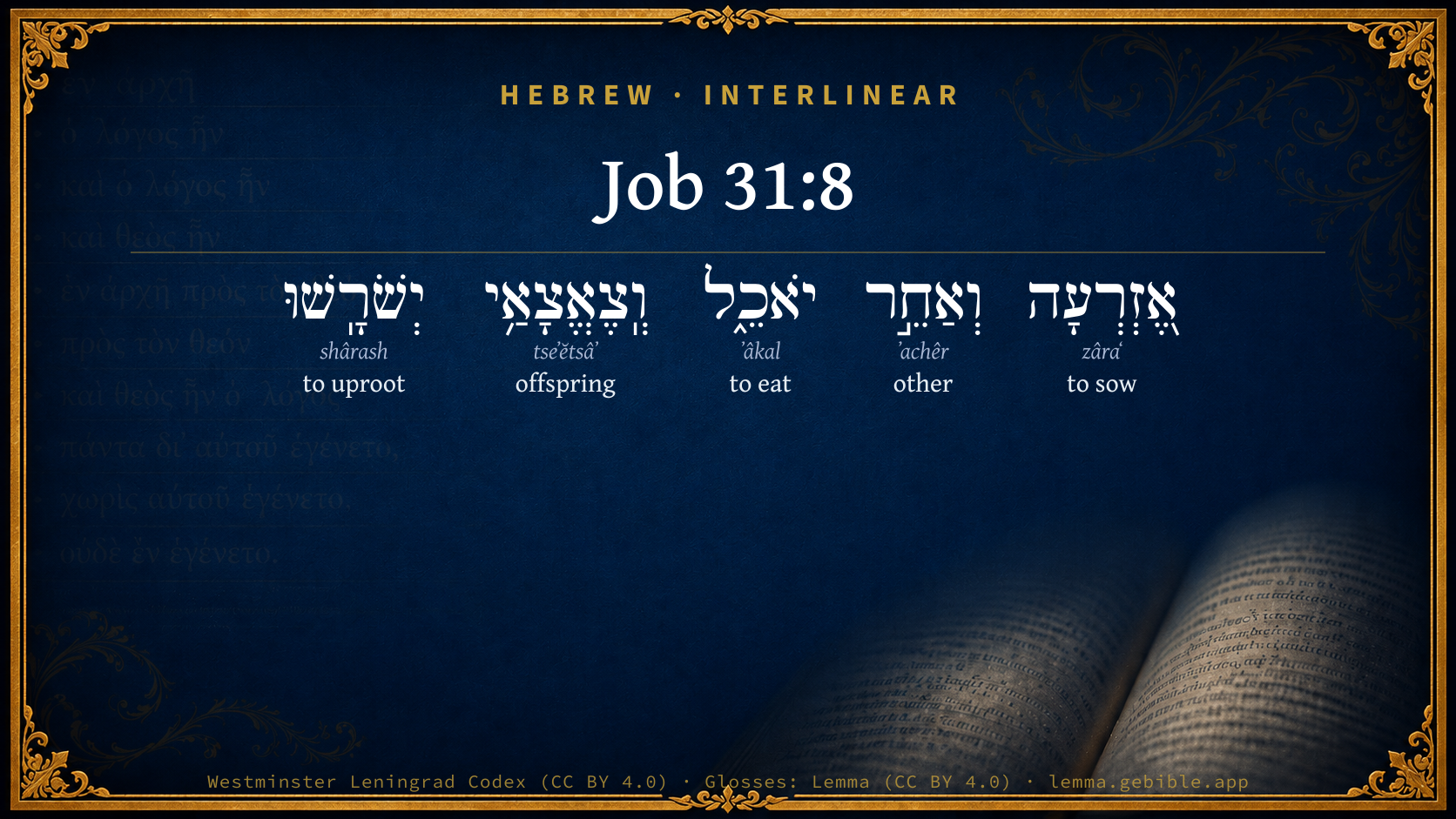
Job 31:8

Hebrew (Westminster Leningrad Codex) Job 31:8 appears in the Hebrew Old Testament. The text above is from the Westminster Leningrad Codex. Each word links to its Strong’s number, a concise gloss, and parsing drawn from the Open Scriptures Hebrew Bible morphology. Click any word for its full Brown-Driver-Briggs (BDB) entry.
Download image
Cite this verse

Job 31:8 (World English Bible). Public Domain. Lemma interlinear Bible study tool, https://lemma.gebible.app/v/job/31/8.

Show BibTeX & RIS
BibTeX
RIS
English Translation
Then let me sow, and let another eat; Yes, let the produce of my field be rooted out.
World English Bible · Public Domain
Download a study sheet

One document with this verse’s original text, its word-by-word gloss line, the meaning frame, cross-references with their text, attributed commentary, and full source and license credits — printable, and it pastes into notes with its structure intact.

This verse Autodidact and up

Study sheet (.html) Plain text (.txt)

A passage Seminary Student

Up to 50 verses in one chapter. A passage sheet keeps up to 6 commentary sources and 12 cross-references per verse, in the order this page ranks them, and says so on the sheet whenever that leaves anything out. Ask for a single verse and you get the Autodidact verse sheet above.

Everything on this page stays free to read, with no account — the sheet is a download of what is already on screen, not access to it.

Want to remove ads? Support Godless Engineer
Compare translations 3

The same verse in 3 English versions, stacked beneath the original-language interlinear above. Click any original word for its lexicon entry.

Each is an independent rendering of the whole verse — the interlinear is not word-aligned to these translations.

Highlighted words mark where these versions differ — a whole-verse word diff, not a word-by-word alignment.

  • World English Bible Public Domain
    Then let me sow, and let another eat; Yes, let the produce of my field be rooted out.
  • King James Version Public Domain
    Then let me sow, and let another eat; yea, let my offspring be rooted out.
  • unfoldingWord Literal Text CC BY-SA 4.0
    let me sow and may another eat, or may my crops be uprooted!

unfoldingWord Literal Text — © unfoldingWord, licensed CC BY-SA 4.0. Word-aligned USFM3 via Door43 (git.door43.org/unfoldingWord/en_ult).

Versions to compare (up to 4)

3 of 4 selected

Show all 18 translations

Every available English version of this verse, each an independent rendering of the whole verse.

  • World English Bible Public Domain
    Then let me sow, and let another eat; Yes, let the produce of my field be rooted out.
  • Berean Standard Bible Public Domain
    then may another eat what I have sown, and may my crops be uprooted.
  • Majority Standard Bible Public Domain
    then may another eat what I have sown, and may my crops be uprooted.
  • King James Version Public Domain
    Then let me sow, and let another eat; yea, let my offspring be rooted out.
  • American Standard Version (1901) Public Domain
    Then let me sow, and let another eat; Yea, let the produce of my field be rooted out.
  • Revised Version (1885) Public Domain
    Then let me sow, and let another eat; yea, let the produce of my field be rooted out.
  • Geneva Bible (1599) Public Domain
    Let me sowe, and let another eate: yea, let my plantes be rooted out.
  • Douay-Rheims (1899) Public Domain
    Then let me sow and let another eat: and let my offspring be rooted out.
  • Young's Literal Translation Public Domain
    Let me sow -- and another eat, And my products let be rooted out.
  • Literal Standard Version CC BY-SA 4.0
    Let me sow—and another eat, || And let my products be rooted out.
  • Unlocked Literal Bible CC BY-SA 4.0
    then let me sow, and let another eat, and let my crops be uprooted.
  • unfoldingWord Literal Text CC BY-SA 4.0
    let me sow and may another eat, or may my crops be uprooted!
  • Darby Bible Public Domain
    Let me sow, and another eat; and let mine offspring be rooted out.
  • World Messianic Bible Public Domain
    then let me sow, and let another eat. Yes, let the produce of my field be rooted out.
  • Webster's Bible Public Domain
    Then let me sow, and let another eat; yes, let my offspring be rooted out.
  • Free Bible Version CC BY-SA 4.0
    then let someone else eat what I have sown, and all that I have grown be uprooted.
  • Bible in Basic English Public Domain
    Let me put seed in the earth for another to have the fruit of it, and let my produce be uprooted.
  • JPS Tanakh (1917) Public Domain
    Then let me sow, and let another eat; yea, let the produce of my field be rooted out.

Literal Standard Version (2020), Covenant Press — licensed CC BY-SA 4.0. Text via the HelloAO Bible API (eBible.org). Unlocked Literal Bible (unfoldingWord) — licensed CC BY-SA 4.0. Text via the HelloAO Bible API (eBible.org). unfoldingWord Literal Text — © unfoldingWord, licensed CC BY-SA 4.0. Word-aligned USFM3 via Door43 (git.door43.org/unfoldingWord/en_ult). Free Bible Version, Dr. Jonathan Gallagher — licensed CC BY-SA 4.0. Text via the HelloAO Bible API (eBible.org).

Word by word

More ways to search: Search by grammar → Find every occurrence → Compare this word →

Practice this passage: Drill this verse → Learn its vocabulary →

About this verse

These counts appear in no published source. They are computed here, from the morphology-tagged text and Lemma’s own curated glosses. What Lemma adds →

5
words
5
distinct lemmas
Wisdom
section

Notable vocabulary

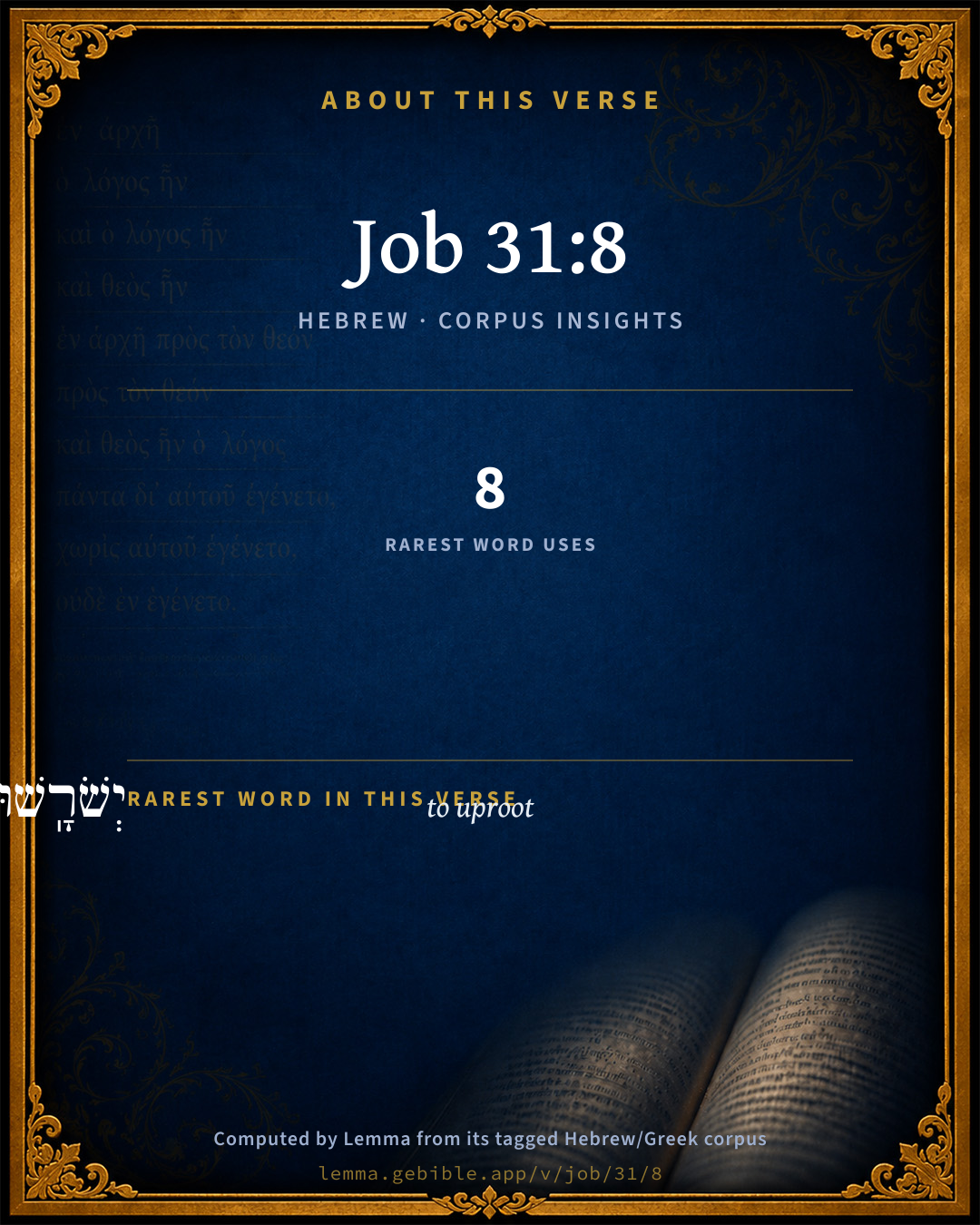
The rarest word here is יְשֹׁרָֽשׁוּ to uproot H8327 — appearing just 8 times in the whole Hebrew Bible.

Shared distinctive vocabulary

יְשֹׁרָֽשׁוּ to uproot H8327 occurs in 8 verses of the Hebrew Bible. Also found in:

Grammatical profile

  • 3 verbs
  • 1 noun
  • 1 adjective

Verb forms

  • אֶ֭זְרְעָה Qal · Cohortative
  • יֹאכֵ֑ל Qal · Imperfect
  • יְשֹׁרָֽשׁוּ Pual · Imperfect

Hebrew & Septuagint length

In English translation the verse runs 18 words from the Hebrew and 16 from the Septuagint (LXX English) — closely comparable.

A rough comparison of the two English renderings, which tokenize alike — not a word-level alignment.

Word counts can differ between the Hebrew and the Greek without any difference in meaning — e.g. the Hebrew direct-object marker אֵת has no separate Greek word, and Greek often adds the article ὁ.

Cross-references

12

Topical passages linked to Job 31:8 in the Treasury of Scripture Knowledge — connected by theme and wording, ordered by reader-vote popularity; previews shown in the World English Bible.

  • Leviticus 26:16 I also will do this to you: I will appoint terror over you, even consumption and fever, that shall consume the eyes, and make the soul to pine away; and you will sow your seed in vain, for your enemies will eat it.
  • Micah 6:15 You will sow, but won't reap. You will tread the olives, but won't anoint yourself with oil; And crush grapes, but won't drink the wine.
  • Deuteronomy 28:38 You shall carry much seed out into the field, and shall gather little in; for the locust shall consume it.
  • Deuteronomy 28:30–33 You shall betroth a wife, and another man shall lie with her: you shall build a house, and you shall not dwell therein: you shall plant a vineyard, and shall not use the fruit of it.
  • Deuteronomy 28:51 and shall eat the fruit of your cattle, and the fruit of your ground, until you are destroyed; that also shall not leave you grain, new wine, or oil, the increase of your cattle, or the young of your flock, until they have caused you to perish.
  • Judges 6:3–6 So it was, when Israel had sown, that the Midianites came up, and the Amalekites, and the children of the east; they came up against them;
  • Job 5:4–5 His children are far from safety, They are crushed in the gate. Neither is there any to deliver them,
  • Job 15:30 He shall not depart out of darkness; The flame shall dry up his branches, By the breath of God's mouth shall he go away.
  • Job 18:19 He shall have neither son nor grandson among his people, Nor any remaining where he sojourned.
  • Job 20:18 That for which he labored he shall restore, and shall not swallow it down; According to the substance that he has gotten, he shall not rejoice.
  • Job 24:6 They cut their provender in the field. They glean the vineyard of the wicked.
  • Psalms 109:13 Let his posterity be cut off. In the generation following let their name be blotted out.

Cross-references courtesy of OpenBible.info (CC BY 4.0).

Hebrew and Greek witnesses Masoretic Hebrew ↔ Greek Septuagint

The same verse in the two great witnesses to the Old Testament, shown verse-for-verse.

These are two independent witnesses, not word-aligned to each other, and the Septuagint is shown in lemma (dictionary) form.

Hebrew Job 31:8 Masoretic · Westminster Leningrad Codex

אֶ֭זְרְעָה וְאַחֵ֣ר יֹאכֵ֑ל וְֽצֶאֱצָאַ֥י יְשֹׁרָֽשׁוּ

Then let me sow, and let another eat; Yes, let the produce of my field be rooted out.

World English Bible · Public Domain

Greek LXX Job 31:8 Septuagint · lemma form

σπείρω ἄρα καί ἄλλος ἐσθίω ἄρριζος δέ γίγνομαι ἐπί γῆ

then let me sow, and let others eat; and let me be uprooted on the earth.

LXX2012 (modern English Septuagint) · Public Domain

Hebrew: Westminster Leningrad Codex (CC BY 4.0). Greek: Septuagint (public domain); English from LXX2012 (modern English Septuagint) (Public Domain). How the Septuagint differs from the Hebrew →

Commentary

Notes on Job 31:8 from classic Christian and Jewish commentators (each source and its license shown beneath its notes). The classic Christian expositions comment on the surrounding passage and are grouped to its opening verse, so a note may address several verses; the Jewish commentaries on the Tanakh (Rashi and others) are per-verse, so they appear only where the commentator wrote on this verse.

Lemma curates 59 commentaries, every one of them public domain or Creative Commons licensed, each selected and text-cleaned for this edition rather than reprinted as found. About our sources →

Trapp's Complete Commentary

John Trapp

Job 31:8 [Then] let me sow, and let another eat; yea, let my offspring be rooted out.

Ver. 8. Then let me sow, and another eat] God loves to retaliate; and let him do so to me, according to that he hath threatened, Deu 28:30, &c., and as he executed upon Laban, Nabal, Saul, Haman, others. The Greeks have a proverb,

Aλλοι μεν σπειρουσ’ αλλοι δ αν αμησονται.

Some sow that which others reap. This Job wisheth may befall, if he had been oppressive and injurious, as Eliphaz had wrongfully accused him, Job 22:6.

Yea, let my offspring be rooted out] Or, Let that which I have planted be plucked up by the roots. It is commonly seen that oppressors and unconscionable persons procure their own ruth and ruin; and he that gathereth the fruits of another man’s tree pulleth his own up by the roots.

Oι αυτω κακα τευχει ανηρ, αλλω κακα τευχων.

Those who spoil houses which they builded not, Job 20:19, shall, when they cease to spoil, be made a spoil; and when they have made an end of dealing treacherously, be treacherously dealt with themselves, Isa 13:1.

John Trapp, A Commentary or Exposition upon All the Books of the Old and New Testament (1647–1656) — public domain. Text from a community e-Sword module.

Geneva Bible (1599)

Geneva Bible translators

According to the curse of the law, Deut. 28:33.

Geneva Bible (1599) marginal notes — public domain. Text via Bolls.life.

Jamieson, Fausset & Brown

Robert Jamieson, A. R. Fausset & David Brown

Apodosis to Job 31:5, Job 31:7; the curses which he imprecates on himself, if he had done these things (Lev 26:16; Amo 9:14; Psa 128:2).

offspring--rather, "what I plant," my harvests.

Jamieson, Fausset & Brown — Commentary Critical and Explanatory on the Whole Bible (1871) — public domain (CC PDM 1.0). Text via the HelloAO Bible API.

Adam Clarke's Commentary

Verse 8. Let me sow, and let another eat] Let me be plagued both in my circumstances and in my family.

My offspring be rooted out.] It has already appeared probable that all Job's children were not destroyed in the fall of the house mentioned Job 1:18-19.

Adam Clarke's Commentary on the Bible (1810–1826) — public domain. Text from a community e-Sword/MySword module.

The Cambridge Bible for Schools and Colleges

gen. ed. J. J. S. Perowne

8. The imprecation.

let my offspring be rooted out] Rather, let my produce, i. e. what springs out of that which I have planted or sown; comp. Lev_26:16; Deu_28:33.

The Cambridge Bible for Schools and Colleges (gen. ed. J. J. S. Perowne; Cambridge University Press, 1878–1918) — public domain. Text from a community e-Sword module.

John Gill's Exposition

If mine heart have been deceived by a woman,.... By another man's wife, by wantonly looking at her beauty, and so lusting after her; and so, not through any blame or fault of hers, or by any artful methods made use of by her, to allure and ensnare; such as were practised by the harlot, Pro 7:1; but by neither was the heart of Job deceived, and drawn into the sin of uncleanness; for he had made a covenant with his eyes, as not to look at a virgin, so much less at another man's wife, to prevent his lusting after her; and whatever temptations and solicitations he might have been attended with, through the grace of God, as Joseph was, he was enabled to withstand them; though as wise a man, and the wisest of men, had his heart deceived and drawn aside thereby, Ecc 7:26;

or if I have laid wait at my neighbour's door: to meet with his wife there, and carry on an intrigue with her; or to take the opportunity of going in when opened, in order to solicit her to his embraces, knowing her husband to be away from home; see Pro 5:8.

John Gill's Exposition of the Whole Bible (1746–1763) — public domain (CC PDM 1.0). Text via the HelloAO Bible API.

Albert Barnes' Notes on the Bible

Then let me sow, and let another eat - This is the imprecation which he invokes, in case he had been guilty in this respect. He consented to sow his fields, and let others enjoy the harvest. The expression used here is common in the Scriptures to denote insecurity of property or calamity in general; see Lev 26:16 : “And ye shall sow your seed in vain, for your enemies shall eat it;” compare Deu 28:30; Amo 9:13-14.

Yea, let my offspring be rooted out - Or, rather, “Let what I plant be rooted up.” So Umbreit, Noyes, Schultens, Rosenmuller, Herder, and Lee understand it. There is no evidence that he here alludes to his children, for the connection does not demand it, nor does the word used here require such an interpretation. The word צאצאים tse'ĕtsâ'iym - means properly shoots; that is, what springs out of anything - as the earth, or a tree - from יצא yâtsâ' - to go out, to go forth. It is applied to the productions of the earth in Isa 42:5; Isa 34:1, and to children or posterity, in Isa 22:24; Isa 61:9; Isa 65:23; Job 5:25; Job 21:8. Here it refers evidently to the productions of the earth; and the idea is, that if he had been guilty of dishonesty or fraud in his dealings, he wished that all that he had sowed should be rooted up.

Albert Barnes' Notes on the Bible (1834–1885) — public domain. Text from a community e-Sword/MySword module.

Matthew Poole's English Annotations

Let strangers enjoy the fruit of my labours, according to God’s curse, Lev 26:16; Deu 28:30.

My offspring; as this word is used, Job 5:25; 27:14. Or rather, my increase, or growths, or sprouts, i.e. all my plants, and fruits, and improvements. For,

1. So the word properly signifies.

2. So this latter branch of the verse explains the former, as is most frequent in this and some other books of Scripture.

3. He had not now any children to be rooted out.

Matthew Poole's English Annotations on the Holy Bible (1683–1685) — public domain. Text from a community e-Sword/MySword module.

Whedon's Commentary on the Bible

Daniel D. Whedon

8. Let me sow, etc. — A proverbial phrase. See Joh_4:37.

Offspring — Produce of the land.

Daniel D. Whedon (gen. ed.), Commentary on the Old and New Testaments (1874–1909) — public domain. Text from a community e-Sword module.

The Pulpit Commentary

Then let me sow, and let another eat. (comp. Job_5:5 Lev_26:16 Deu_28:33, Deu_28:51, etc.) The expression is proverbial. Yea, lot my offspring be rooted out; rather, my produce, or the produce of my field (see the Revised Version).

The Pulpit Commentary (1880–1919), ed. H.D.M. Spence-Jones & Joseph S. Exell — public domain. Text from a community e-Sword module.

John Wesley's Explanatory Notes

Increase - All my plants, and fruits, and improvements.

John Wesley, Explanatory Notes Upon the Whole Bible (1754–1765) — public domain. Text via the GEBible commentary corpus.

Rashi

Rabbi Shlomo Yitzchaki (Rashi)

may I sow and another eat, and my produce be uprooted their roots should be torn up.

Rashi on the Tanakh — English translations: “The Judaica Press complete Tanach with Rashi, translated by A. J. Rosenberg” (CC BY 4.0); “Pentateuch with Rashi's commentary by M. Rosenbaum and A.M. Silbermann, 1929-1934” (public domain); “The Metsudah Tanach series, Lakewood, N.J” (CC BY 4.0); and “The Book of Joshua, Metsudah Publications, 1997” (CC BY 4.0). Text via Sefaria.

Lesson kit

Teaching starters — assembled from the data on this page, not authored interpretation. Every prompt links to the verse data it draws on. Edit before teaching.

Job, in the Wisdom, opens this verse with 5 words (5 distinct Hebrew lemmas). Its most distinctive word is shârash (“to uproot”). A historical commentator’s framing appears above. Read the whole chapter for the surrounding context.

Discussion questions

  1. The word shârash carries the sense “to uproot.” How does it shape the verse?
  2. How does Job 5:3, which shares the word «to uproot», read alongside this verse?
  3. These translations render this verse differently; the difference is in the English rendering, not the original. What questions does that raise?
  4. «אֶ֭זְרְעָה» is a Qal Cohortative verb. How does that grammatical form shape the action described?
  5. Compare how Trapp's Complete Commentary and Geneva Bible (1599) read this verse. Where do they agree or differ?

Things to notice

Reading settings

Reading text

Shown beneath each verse's original-language words.

Old Testament
Old Testament edition

Read the OT as the Masoretic Hebrew (MT) or the Greek Septuagint (LXX).

English shown for the Greek Septuagint (in the Hebrew ↔ Greek comparison).

Comparing translations? Open the Compare panel on any verse page to stack up to four side by side.