
Jeremiah 12:13

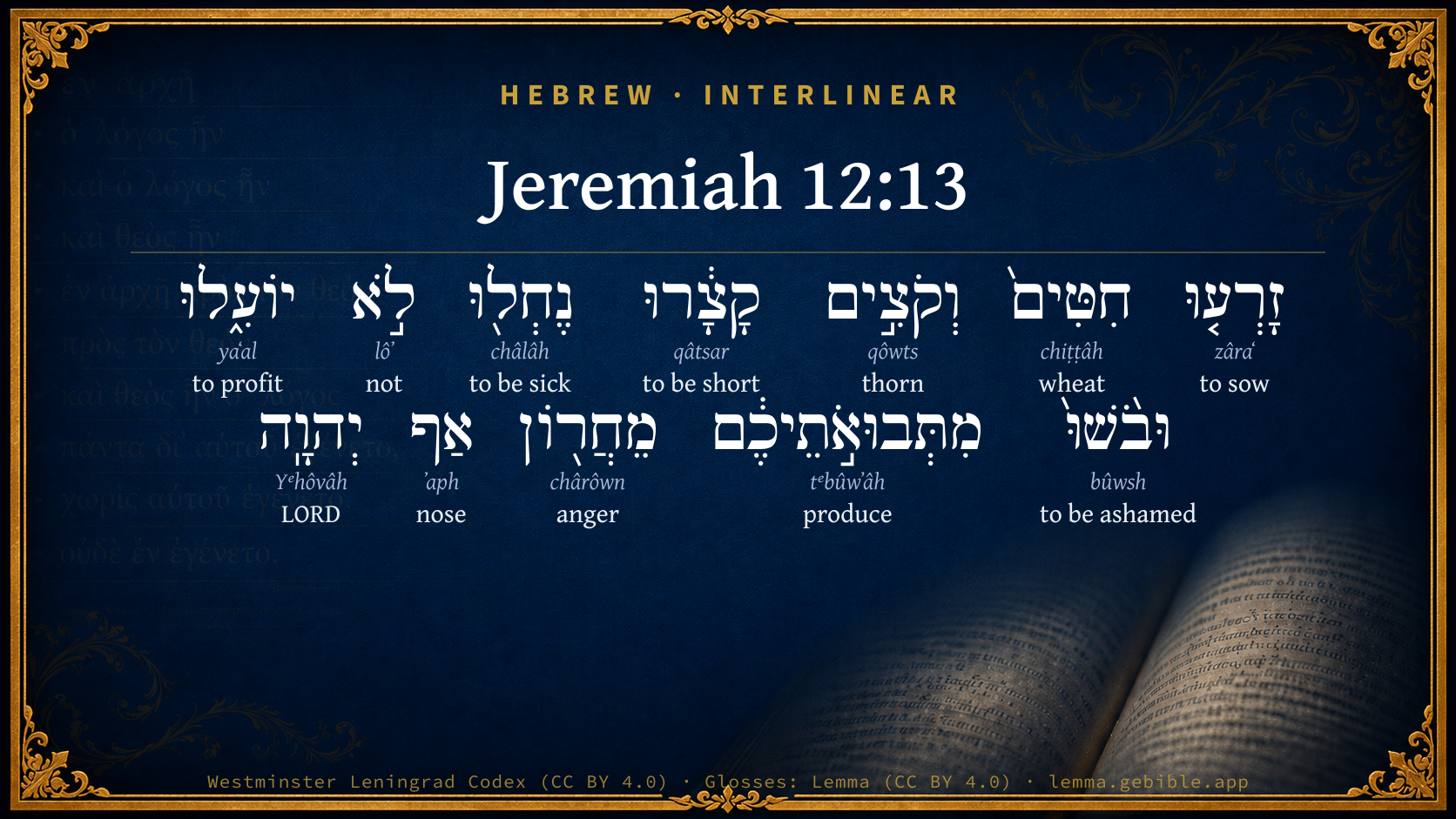
Hebrew (Westminster Leningrad Codex) Jeremiah 12:13 appears in the Hebrew Old Testament. The text above is from the Westminster Leningrad Codex. Each word links to its Strong’s number, a concise gloss, and parsing drawn from the Open Scriptures Hebrew Bible morphology. Click any word for its full Brown-Driver-Briggs (BDB) entry.
Download image
Cite this verse

Jeremiah 12:13 (World English Bible). Public Domain. Lemma interlinear Bible study tool, https://lemma.gebible.app/v/jeremiah/12/13.

Show BibTeX & RIS
BibTeX
RIS
English Translation
They have sown wheat, and have reaped thorns; they have put themselves to pain, and profit nothing: and you shall be ashamed of your fruits, because of the fierce anger of Yahweh.
World English Bible · Public Domain
Download a study sheet

One document with this verse’s original text, its word-by-word gloss line, the meaning frame, cross-references with their text, attributed commentary, and full source and license credits — printable, and it pastes into notes with its structure intact.

This verse Autodidact and up

Study sheet (.html) Plain text (.txt)

A passage Seminary Student

Up to 50 verses in one chapter. A passage sheet keeps up to 6 commentary sources and 12 cross-references per verse, in the order this page ranks them, and says so on the sheet whenever that leaves anything out. Ask for a single verse and you get the Autodidact verse sheet above.

Everything on this page stays free to read, with no account — the sheet is a download of what is already on screen, not access to it.

Want to remove ads? Support Godless Engineer
Compare translations 3

The same verse in 3 English versions, stacked beneath the original-language interlinear above. Click any original word for its lexicon entry.

Each is an independent rendering of the whole verse — the interlinear is not word-aligned to these translations.

Highlighted words mark where these versions differ — a whole-verse word diff, not a word-by-word alignment.

  • World English Bible Public Domain
    They have sown wheat, and have reaped thorns; they have put themselves to pain, and profit nothing: and you shall be ashamed of your fruits, because of the fierce anger of Yahweh.
  • King James Version Public Domain
    They have sown wheat, but shall reap thorns: they have put themselves to pain, but shall not profit: and they shall be ashamed of your revenues because of the fierce anger of the LORD.
  • unfoldingWord Literal Text CC BY-SA 4.0
    They have sown wheat but harvested thorns. They have exhausted themselves, they did not profit. Be ashamed of your harvests, because of the burning of the nose of Yahweh.”

unfoldingWord Literal Text — © unfoldingWord, licensed CC BY-SA 4.0. Word-aligned USFM3 via Door43 (git.door43.org/unfoldingWord/en_ult).

Versions to compare (up to 4)

3 of 4 selected

Show all 18 translations

Every available English version of this verse, each an independent rendering of the whole verse.

  • World English Bible Public Domain
    They have sown wheat, and have reaped thorns; they have put themselves to pain, and profit nothing: and you shall be ashamed of your fruits, because of the fierce anger of Yahweh.
  • Berean Standard Bible Public Domain
    They have sown wheat but harvested thorns. They have exhausted themselves to no avail. Bear the shame of your harvest because of the fierce anger of the LORD.”
  • Majority Standard Bible Public Domain
    They have sown wheat but harvested thorns. They have exhausted themselves to no avail. Bear the shame of your harvest because of the fierce anger of the LORD.”
  • King James Version Public Domain
    They have sown wheat, but shall reap thorns: they have put themselves to pain, but shall not profit: and they shall be ashamed of your revenues because of the fierce anger of the LORD.
  • American Standard Version (1901) Public Domain
    They have sown wheat, and have reaped thorns; they have put themselves to pain, and profit nothing: and ye shall be ashamed of your fruits, because of the fierce anger of Jehovah.
  • Revised Version (1885) Public Domain
    They have sown wheat, and have reaped thorns; they have put themselves to pain, and profit nothing: and ye shall be ashamed of your fruits, because of the fierce anger of the LORD.
  • Geneva Bible (1599) Public Domain
    They haue sowen wheate, and reaped thornes: they were sicke, and had no profite: and they were ashamed of your fruites, because of the fierce wrath of the Lord.
  • Douay-Rheims (1899) Public Domain
    They have sown wheat, and reaped thorns: they have received an inheritance, and it shall not profit them: you shall be ashamed of your fruits, because of the fierce wrath of the Lord.
  • Young's Literal Translation Public Domain
    They sowed wheat, and have thorns reaped, They have become sick -- they profit not, And they have been ashamed of your increases, Because of the fierceness of the anger of Jehovah.
  • Literal Standard Version CC BY-SA 4.0
    They sowed wheat, and have reaped thorns, || They have become sick—they do not profit, || And they have been ashamed of your increases, || Because of the fierceness of the anger of YHWH.”
  • Unlocked Literal Bible CC BY-SA 4.0
    They have sown wheat but harvest thornbushes. They are exhausted from work but have gained nothing. So be ashamed of your gain because of Yahweh's anger.”
  • unfoldingWord Literal Text CC BY-SA 4.0
    They have sown wheat but harvested thorns. They have exhausted themselves, they did not profit. Be ashamed of your harvests, because of the burning of the nose of Yahweh.”
  • Darby Bible Public Domain
    They have sown wheat, and they reap thorns; they have put themselves to pain, [and] do not profit. Be ye therefore ashamed of your revenues, because of the fierce anger of Jehovah.
  • World Messianic Bible Public Domain
    They have sown wheat, and have reaped thorns. They have exhausted themselves, and profit nothing. You will be ashamed of your fruits, because of the LORD’s fierce anger.”
  • Webster's Bible Public Domain
    They have sown wheat, but shall reap thorns: they have put themselves to pain, but shall not profit; and they shall be ashamed of your revenues because of the fierce anger of the LORD.
  • Free Bible Version CC BY-SA 4.0
    My people sowed wheat but harvested thorns. They wore themselves out but gained no benefit. You should be ashamed of such a poor harvest, caused by the Lord's furious anger.
  • Bible in Basic English Public Domain
    Though good grain was planted, they have got in thorns: they have given themselves pain without profit: they will be shamed on account of their produce, because of the burning wrath of the Lord.
  • JPS Tanakh (1917) Public Domain
    They have sown wheat, and have reaped thorns; they have put themselves to pain, they profit not; be ye then ashamed of your increase, because of the fierce anger of the LORD.

Literal Standard Version (2020), Covenant Press — licensed CC BY-SA 4.0. Text via the HelloAO Bible API (eBible.org). Unlocked Literal Bible (unfoldingWord) — licensed CC BY-SA 4.0. Text via the HelloAO Bible API (eBible.org). unfoldingWord Literal Text — © unfoldingWord, licensed CC BY-SA 4.0. Word-aligned USFM3 via Door43 (git.door43.org/unfoldingWord/en_ult). Free Bible Version, Dr. Jonathan Gallagher — licensed CC BY-SA 4.0. Text via the HelloAO Bible API (eBible.org).

Word by word

More ways to search: Search by grammar → Find every occurrence → Compare this word →

Practice this passage: Drill this verse → Learn its vocabulary →

וְקֹצִ֣ים
qôwts
H6975
“and · thorns”
Conjunction + Noun, Common, Masculine, Plural, Absolute
Part of Speech
Conjunction + Noun
Type
Common
Gender
Masculine
Number
Plural
State
Absolute
Full BDB Definition

Origin: from H6972 (in the sense of pricking)

TWOT: 2003a

thorn, thornbush - thornbush - thorn
  1. זָרְע֤וּ zâraʻ H2232 “to sow” Verb, Qal, Perfect, 3rd Person, Common, Plural
  2. חִטִּים֙ chiṭṭâh H2406 “wheat” Noun, Common, Feminine, Plural, Absolute
  3. קָצָ֔רוּ qâtsar H7114 “to be short” Verb, Qal, Perfect, 3rd Person, Common, Plural
  4. נֶחְל֖וּ châlâh H2470 “to be sick” Verb, Niphal, Perfect, 3rd Person, Common, Plural
  5. לֹ֣א lôʼ H3808 “not” Particle, Negative
  6. יוֹעִ֑לוּ yaʻal H3276 “to profit” Verb, Hiphil, Imperfect, 3rd Person, Masculine, Plural
  7. וּבֹ֨שׁוּ֙ bûwsh H954 “and · be ashamed” Conjunction + Verb, Qal, Imperative, 2nd Person, Masculine, Plural
  8. מִתְּבוּאֹ֣תֵיכֶ֔ם tᵉbûwʼâh H8393 “from · produce · your” Preposition + Noun, Common, Feminine, Plural, Construct + Suffix, Personal, 2nd Person, Masculine, Plural
  9. מֵחֲר֖וֹן chârôwn H2740 “from · anger of” Preposition + Noun, Common, Masculine, Singular, Construct
  10. אַף ʼaph H639 “nose” Particle, Accusative
  11. יְהוָֽה Yᵉhôvâh H3068 “LORD” Noun, Proper

About this verse

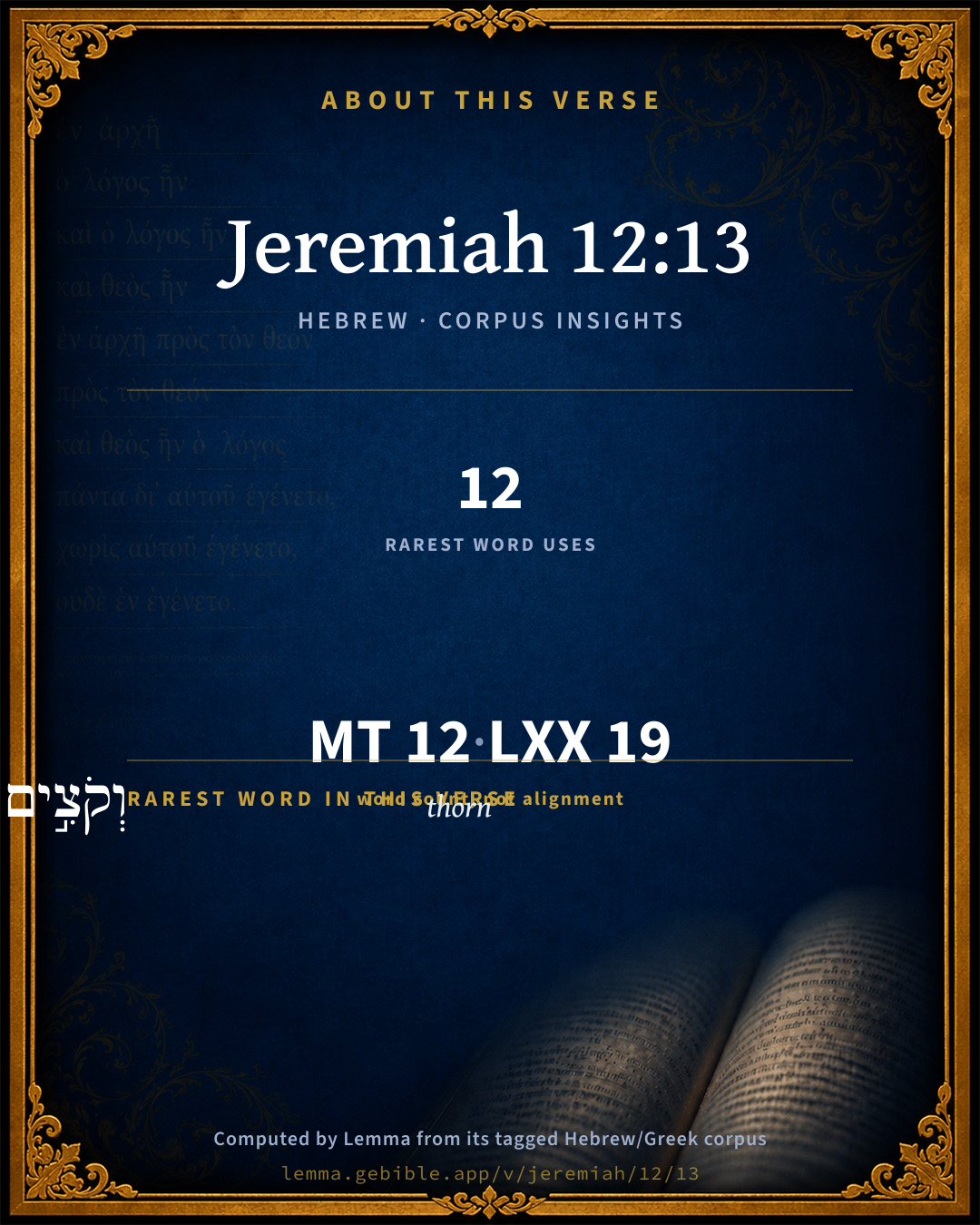
These counts appear in no published source. They are computed here, from the morphology-tagged text and Lemma’s own curated glosses. What Lemma adds →

12
words
12
distinct lemmas
Prophets
section

Notable vocabulary

The rarest word here is וְקֹצִ֣ים thorn H6975 — appearing just 12 times in the whole Hebrew Bible.

Shared distinctive vocabulary

וְקֹצִ֣ים thorn H6975 occurs in 12 verses of the Hebrew Bible. Also found in:

Grammatical profile

  • 5 verbs
  • 5 nouns
  • 2 particles

Verb forms

  • זָרְע֤וּ Qal · Perfect
  • קָצָ֔רוּ Qal · Perfect
  • נֶחְל֖וּ Niphal · Perfect
  • יוֹעִ֑לוּ Hiphil · Imperfect
  • וּבֹ֨שׁוּ֙ Qal · Imperative

Hebrew & Septuagint length

In the original languages it is 12 Hebrew tokens and 19 Greek tokens — but the two are counted differently (Hebrew bundles its prefixes and suffixes into one token; the Greek is in lemma form), so that isn’t a like-for-like length.

Cross-references

13

Topical passages linked to Jeremiah 12:13 in the Treasury of Scripture Knowledge — connected by theme and wording, ordered by reader-vote popularity; previews shown in the World English Bible.

  • Deuteronomy 28:38 You shall carry much seed out into the field, and shall gather little in; for the locust shall consume it.
  • Micah 6:15 You will sow, but won't reap. You will tread the olives, but won't anoint yourself with oil; And crush grapes, but won't drink the wine.
  • Haggai 1:6 You have sown much, and bring in little. You eat, but you don't have enough. You drink, but you aren't filled with drink. You clothe yourselves, but no one is warm, and he who earns wages earns wages to put them into a bag with holes in it."
  • Leviticus 26:16 I also will do this to you: I will appoint terror over you, even consumption and fever, that shall consume the eyes, and make the soul to pine away; and you will sow your seed in vain, for your enemies will eat it.
  • Isaiah 55:2 Why do you spend money for that which is not bread? and your labor for that which doesn't satisfy? listen diligently to me, and eat you that which is good, and let your soul delight itself in fatness.
  • Jeremiah 4:26 I saw, and, behold, the fruitful field was a wilderness, and all the cities of it were broken down at the presence of Yahweh, [and] before his fierce anger.
  • Jeremiah 25:37–38 The peaceable folds are brought to silence because of the fierce anger of Yahweh.
  • Habakkuk 2:13 Behold, isn't it of Yahweh of Hosts that the peoples labor for the fire, and the nations weary themselves for vanity?
  • Isaiah 30:1–6 Woe to the rebellious children, says Yahweh, who take counsel, but not of me; and who make a league, but not of my Spirit, that they may add sin to sin,
  • Isaiah 31:1–3 Woe to those who go down to Egypt for help, and rely on horses, and trust in chariots because they are many, and in horsemen because they are very strong, but they don't look to the Holy One of Israel, neither seek Yahweh!
  • Jeremiah 3:23–25 Truly in vain is [the help that is looked for] from the hills, the tumult on the mountains: truly in Yahweh our God is the salvation of Israel.
  • Haggai 2:16–17 Through all that time, when one came to a heap of twenty measures, there were only ten. When one came to the wine vat to draw out fifty, there were only twenty.
  • Romans 6:21 What fruit then did you have at that time in the things of which you are now ashamed? For the end of those things is death.

Cross-references courtesy of OpenBible.info (CC BY 4.0).

Hebrew and Greek witnesses Masoretic Hebrew ↔ Greek Septuagint

The same verse in the two great witnesses to the Old Testament, shown verse-for-verse.

These are two independent witnesses, not word-aligned to each other, and the Septuagint is shown in lemma (dictionary) form.

Hebrew Jeremiah 12:13 Masoretic · Westminster Leningrad Codex

זָרְע֤וּ חִטִּים֙ וְקֹצִ֣ים קָצָ֔רוּ נֶחְל֖וּ לֹ֣א יוֹעִ֑לוּ וּבֹ֨שׁוּ֙ מִתְּבוּאֹ֣תֵיכֶ֔ם מֵחֲר֖וֹן אַף יְהוָֽה

They have sown wheat, and have reaped thorns; they have put themselves to pain, and profit nothing: and you shall be ashamed of your fruits, because of the fierce anger of Yahweh.

World English Bible · Public Domain

Greek LXX Structure differs

In the Septuagint, Jeremiah is about an eighth shorter than the Hebrew and arranges its material differently — the Oracles Against the Nations (Hebrew chapters 46–51) appear in the middle of the Greek book, after 25:13. Because the chapter and verse boundaries do not line up, a verse-for-verse comparison with the Hebrew is not shown.

A verse-for-verse comparison isn’t shown here because the chapters and verses don’t line up. Switch to the LXX edition with the MT / LXX toggle above to read the Greek directly.

On this verse, John Gill's Exposition discusses the Septuagint’s reading. Read the note in Commentary ↓

Hebrew: Westminster Leningrad Codex (CC BY 4.0). Greek: Septuagint (public domain); English from a public-domain English Septuagint. How the Septuagint differs from the Hebrew →

Targum (Aramaic paraphrase)

1

The Targum is the ancient Jewish Aramaic paraphrase of the Hebrew Scriptures — an interpretive translation, not the Hebrew text itself. Onkelos (literal) and Pseudo-Jonathan (expansive) render the Torah, and Jonathan the Prophets. Coverage is partial: where no permissively-licensed English translation exists for a verse, only the Aramaic is shown. This is verse-level text, not a word-by-word alignment to the Hebrew.

  1. Targum Jonathan Prophets (Joshua–Malachi)
    לָא תְהוֹן דָמִין לְדִזְרָעוּ חִטִים עַל בְּיָר וְלָא מַשְׁכְּחִין לְמִכְנַשׁ אֱלָהֵין כּוּבִין וּמַעֲלַלְתְּהוֹן לֵית לְהוֹן הֲנָאָה וְתִבָּהֲתוּן בְּעוֹבָדֵיכוֹן בְּמֵיתֵי עֲלֵיכוֹן תְּקוֹף רוּגְזָא דַיָי:

    (no public-domain English translation for this verse)

    Targum Jonathan — Aramaic: “Mikraot Gedolot” (public domain). English: “Sefaria Community Translation” (CC0 1.0 (public-domain dedication)); “London "Chaldee Paraphrase," 1871” (public domain). Text via Sefaria.

Commentary

Notes on Jeremiah 12:13 from classic Christian and Jewish commentators (each source and its license shown beneath its notes). The classic Christian expositions comment on the surrounding passage and are grouped to its opening verse, so a note may address several verses; the Jewish commentaries on the Tanakh (Rashi and others) are per-verse, so they appear only where the commentator wrote on this verse.

Lemma curates 59 commentaries, every one of them public domain or Creative Commons licensed, each selected and text-cleaned for this edition rather than reprinted as found. About our sources →

Trapp's Complete Commentary

John Trapp

Jer 12:13 They have sown wheat, but shall reap thorns: they have put themselves to pain, [but] shall not profit: and they shall be ashamed of your revenues because of the fierce anger of the LORD.

Ver. 13. They have sown wheat.] The prophets have, say some, but to no profit.

They shall put themselves to pain.] Or, They are sick, sc., for the affliction of Joseph. {as Amo 6:6} {See Trapp on "Amo 6:6"} Others {a} interpret it of the Jews, who sought to help themselves by this means and that, but lost their labours and their hopes together.

Because of the fierce anger of the Lord.] Quo laeso nihil est illaesum, tutum, et fidum hominibus.

{a} Vatab.

John Trapp, A Commentary or Exposition upon All the Books of the Old and New Testament (1647–1656) — public domain. Text from a community e-Sword module.

Tyndale Open Study Notes

Tyndale Open Resources

12:13 The Lord found no joy in seeing his people’s crops eaten by invaders, who left only thorns. However, the apostasy of the people of Judah merited the fierce anger of the Lord (cp. Ezek 16:36-39), resulting in shame.

Tyndale Open Study Notes — © Tyndale Open Resources, licensed CC BY-SA 4.0. Text via the HelloAO Bible API.

Geneva Bible (1599)

Geneva Bible translators

To wit, the Prophets.

They lamented the sins of the people.

For instead of amendment, you grew worse and worse, as God’s plagues testified.

Geneva Bible (1599) marginal notes — public domain. Text via Bolls.life.

Jamieson, Fausset & Brown

Robert Jamieson, A. R. Fausset & David Brown

Description in detail of the devastation of the land (Mic 6:15).

they shall be ashamed of your--The change of persons, in passing from indirect to direct address, is frequent in the prophets. Equivalent to, "Ye shall be put to the shame of disappointment at the smallness of your produce."

Jamieson, Fausset & Brown — Commentary Critical and Explanatory on the Whole Bible (1871) — public domain (CC PDM 1.0). Text via the HelloAO Bible API.

Adam Clarke's Commentary

Verse 13. They have sown wheat, but shall reap thorns] All their projects shall fail: none of their enterprises shall succeed. They are enemies to God, and therefore cannot have his blessing.

Adam Clarke's Commentary on the Bible (1810–1826) — public domain. Text from a community e-Sword/MySword module.

John Calvin's Commentaries

Most interpreters understand this of the prophets, that they had been disappointed, after having faithfully cultivated the field of God and sown good seed, that thorns only had sprung up, and briars only had grown: but this is a strained exposition. The Prophet, I doubt not, sets forth the curse of God, which the people were soon to experience. I indeed readily admit, that when he speaks of sowing and reaping, the expression is metaphorical; but I have no doubt but that the Jews are said to sow in seeking aids here and there, in strengthening themselves by confederacies, and in devising means to repel dangers.

Hence he says, by way of concession, that they had sown wheat; for they had recourse to false counsels: but he speaks according to what they themselves thought; for they imagined that they were safe when they found that the Egyptians were ready to help them; and when they procured assistance from various quarters, they considered that they were acting wisely, and. thus they flattered themselves with a prosperous issue. The Prophet now laughs to scorn this vain confidence: but yet in words he allows that they were going on successfully: as a husbandman, while sowing, expects that he will have a good harvest, so also the Jews thought that they would have good fruit after having thus sown. But the Prophet says that they would be disappointed; for instead of wheat briars and thorns would grow, so that the issue would not answer their expectations. Thus the words of the Prophet would well harmonize: but to explain the passage of the prophets would by no means be suitable, as it will hereafter appear more clearly.

He then says that they had sown wheat (he uses the plural number) and reaped thorns He intimates that they hoped for a good harvest, for they sowed wheat, as they thought; that is, they wisely, or rather astutely, provided for themselves, as they left undone nothing that was necessary for their safety; but they reaped, or shall reap thorns; for he speaks of what was future. He means that God would frustrate their expectation; for their sowing, from which they promised themselves so much, would prove fruitless.

He then adds, that they had obtained an inheritance, or had endured grief, but were not enriched Some render the first clause a little more harshly, that “they were riJeremiah” But I readily excuse its harshness, if it suits the place: then the meaning would be, — that they tormented themselves with continual labors, and thus became rich; for we know that they who are extremely anxious about anything wear out themselves, and become in a manner their own executioners; and this would not be unsuitable to this place. However, a different view may be taken, — that the Prophet uses the expression, that they had obtained an heritage, not in its ordinary sense, as signifying, not that God gave them the land of Canaan as their hereditary possession, or that they had accumulated wealth, but that they had thus increased in their own esteem, because they had the Egyptians as their friends, and looked for help to the neighboring nations, and because they thought that they could by various stratagems prevent the Chaldeans from coming nigh them. Their heritage then was, that they were able to collect from various quarters such assistance as would render them safe, and repel all dangers. God then allows that they had obtained an heritage; but what then, he says? All this will not avail them, nor shall they be thereby enriched. He, in short, intimates that they would be thus deceived by trusting in helps so laboriously and sedulously acquired; for the aids in which they proudly trusted would vanish away, as well as all their counsels and designs; in a word, the vain attempts by which they thought to secure everything for themselves are laughed to scorn.

He adds, for the same purpose, that they were confounded on account of their produce They who understand this of the prophets read thus, “they were ashamed,” that is, “of their own labors;” but this is wholly foreign to the subject. He then continues in the same strain, — that the Jews were ashamed when they found the issue contrary to what they expected. He mentions “produce:” the noun conms from בא ba, which means to come or to enter; it has also other meanings. But the Hebrews call it produce, because it comes every year. He says then, that they were ashamed of their produce, because they received no fruit such as they expected. Thus Jeremiah carries on the same metaphor: they had sown, but thorns were found instead of wheat; they also obtained for themselves an heritage, or they wearied themselves with labor, but it was useless: they further promised to themselves a great and rich produce, but it came to nothing. We now then understand the meaning of the words.

But we must at the same time consider what the Prophet had in view. Doubtless he intended to shake off from the Jews that arrogance by which they blinded themselves, as though he had said, — “I see that I effect but little; for the Egyptians, who are to come to your aid, are as yet strong; ye think that they are prepared to oppose the Assyrians and Chaldeans, and ye have also other confederacies As then ye are thus well fortified, ye consider yourselves to be cut of the reach of danger; but the Lord will make you ashamed of this your presumption, for all your produce or provision will come to nothing.” The produce, we know, was the successful issue with which they flattered themselves, so that they thought that nothing would do them harm. This then is the meaning of the Prophet.

He adds, Through the burning of the wrath of Jehovah They could not have been otherwise awakened, except they were made to think that God was angry with them. The Prophet then says, though the whole world might laugh him to scorn, that nothing would avail them, inasmuch as God fought against them. We must at the same time notice the change of person, They have been ashamed of your produce Some have on this account applied the verb, בשו, beshu, “they have been ashamed,” to the prophets; but it is an anomaly often found, and it is in this place very emphatical. Had he said, in the third person, “They were ashamed of their fruits,” it would have been less calculated to rouse their minds; but having previously spoken in disdain of the Jews, as he knew them to be deaf, he now, as he proceeds, turns his discourse to them, and says that they were ashamed; yes, he says, “Ye were ashamed of your fruits.” It is therefore a kind of modification; but it is only used that the Prophet might more sharply touch their feelings; for they had need of this kind of speaking, as a plain discourse would have produced no effect. It follows —

John Calvin's Commentaries (1540-1563) — public domain. Text from the Calvin Translation Society English edition (1840s-50s) via the Christian Classics Ethereal Library (ccel.org). Calvin's coverage is partial (roughly two-thirds of the Bible); uncommented books and verses are honest gaps, never fabricated. The 19th-century editor's footnotes and remarks are omitted so the notes are faithfully Calvin's own voice.

Ellicott's Commentary for English Readers

(13) But shall reap thorns.—Better, have reaped thorns; and so in the next clause they have profited nothing. This which is truer to the Hebrew is also truer to the Prophet’s meaning. The sentence of failure is already written on everything. The best plans are marred, the “wheat” turned to “thorns.” The words are obviously of the nature of a proverbial saying, of the same type as that of Hag_1:6.

They shall be ashamed.—The word is imperative, be ashamed.

Revenues.—The word had not acquired, at the time of the translation of 1611, the exclusively financial sense which now attaches to it, and was used as equivalent to increase or “produce” generally. By some commentators the words are referred to the conquerors, who are to be ashamed of their scanty spoil; by others to the conquered, who are to find all their hopes of increase disappointed. The latter seems preferable.

A Bible Commentary for English Readers, edited by Charles John Ellicott (1878–1897) — public domain. Text from a community e-Sword module.

The Cambridge Bible for Schools and Colleges

gen. ed. J. J. S. Perowne

13. The v., at least in its present context, is obscure. The subject is either (a) the spoilers, whose disasters, however, belong not to this but to the following paragraph, or (b) Judah, in which case the expressions are unsuited to the previous description of their attitude. Co. suggests that it should follow immediately on Jer_12:4, but even so its connexion with that v. is not obvious.

ye … your] Read they … their.

ashamed] See on Jer_2:26.

The Cambridge Bible for Schools and Colleges (gen. ed. J. J. S. Perowne; Cambridge University Press, 1878–1918) — public domain. Text from a community e-Sword module.

John Gill's Exposition

They have sown wheat, but shall reap thorns,.... Which may be understood literally, the land of Judea being cursed for their sins, and become barren and unfruitful, as the earth originally was for the sin of the first man, Gen 3:19, or rather figuratively, which some interpret of the prophets as Kimchi, sowing the good seed of the word among the Jews; but it did not take place in them, and bring forth fruit; instead thereof thorns sprung up, or evil works were done by them, comparable thereunto; but it seems better to understand it of the people; not, as Jarchi, of their prayers, which were not accepted, because unattended with repentance and good works; but of their schemes, which they thought were prudently laid, in forming an alliance with Egypt, and sending thither for help against the Chaldeans, but all in vain; these proved in the issue like thorns, grievous and vexatious to them. The Septuagint version reads imperatively, "sow ye": and Jarchi makes mention of a copy, in which the word was pointed as to be so read, as in Hos 10:12, and may be understood ironically. The Targum is,

"be ye not like those who sow wheat in untilled land, and can gather nothing but thorns.''

They have put themselves to pain, but shall not profit; were at a great deal of pains and trouble to make Egypt their ally, and send thither for assistance, and all to no purpose. Kimchi's father interprets this of their uneasiness and grief, at parting with so much money to the king of Egypt, without having any advantage by it; which is to be preferred to the sense Jarchi gives, of the people crying to God, and grieving because not regarded by him. Some render the words, "they have got an inheritance", as the Vulgate Latin; the land of Canaan, but they will not be able to keep it; it shall no longer be theirs, or any advantage to them.

And they shall be ashamed of your revenues; not the prophets of the evil works of the people, but rather the people of their own evil works; and, particularly, of their schemes, counsels, and preparations, to secure themselves against the enemy; of their alliances with other nations, and of vain confidences; the success not answering to the pains and expense they had been at; but these failing and disappointing them, would fill them with shame and confusion.

Because of the fierce anger of the Lord; against which there was no standing; this being infinitely more powerful than the Chaldean army, by the means of which it came upon them, and from which no schemes and alliances could protect them.

John Gill's Exposition of the Whole Bible (1746–1763) — public domain (CC PDM 1.0). Text via the HelloAO Bible API.

Albert Barnes' Notes on the Bible

Shall reap ... shall not profit - Rather, have reaped ... have profited nothing. The force of the proverb is that all their labors had ended only in disappointment.

And they shall be ashamed of your revenues - Or, yea, be ashamed of your produce - the produce of the fields.

Albert Barnes' Notes on the Bible (1834–1885) — public domain. Text from a community e-Sword/MySword module.

Haydock's Catholic Bible Commentary

Fruits. They shall not satisfy your expectations or wants.

George Leo Haydock (1774–1849), Haydock's Catholic Family Bible and Commentary, 1859 edition — public domain. Excludes Psalms (Douay-Rheims chapter numbering differs from Protestant) and Deuterocanonical books (Catholic canon only).

Matthew Poole's English Annotations

They have sown wheat, but shall reap thorns: if these words be understood literally, they only signify that God would blast the labours of the husbandman, and curse them in the field. The earth’s bringing forth thorns and thistles was part of the curse for the first transgression of man, Gen 3:18. God’s blasting the labours of husbandmen is often threatened as a punishment of sin. See Lev 26:16; Deu 28:38. If it be taken metaphorically, it is expounded by the next words.

They have put themselves to pain, but shall not profit; that they should labour in vain, all the works of their hands, all their counsels and deliberations, should be of no profit or avail unto them.

They shall be ashamed of your revenues because of the fierce anger of the Lord; the fierce anger of God against them shall be so showed, that the returns of their labours or estates, the profits of their trades, &c., shall be so small that they shall be ashamed of them.

Matthew Poole's English Annotations on the Holy Bible (1683–1685) — public domain. Text from a community e-Sword/MySword module.

Whedon's Commentary on the Bible

Daniel D. Whedon

13. Sown wheat… reap thorns — Apparently an aphorism for coming to the opposite of what is aimed at.

Revenues — Produce, the old meaning of this word.

Daniel D. Whedon (gen. ed.), Commentary on the Old and New Testaments (1874–1909) — public domain. Text from a community e-Sword module.

The Pulpit Commentary

A description in proverbial language of the absence of "peace" (literally, soundness, i.e. prosperity, security), from which "all flesh" in Judah at this time shall suffer. The trouble of sowing has been in vain, for they have reaped thorns (so we must render grammatically, and not shall reap, and in the next clause shall not profit ought to be have not profited). And they shall be ashamed of your revenues; rather, be ashamed then of your produce; but it is more natural to emend the pronominal suffix, and render, and are ashamed of their produce (the Authorized Version seems to have very nearly taken this easy step). It is, of course, the produce of husbandry which is referred to.

Profitless labor.

I PUNISHMENT WILL CONSIST IN PART IN THE PROFITLESSNESS OF LABOR. This will perhaps be the special punishment of industrious bad people. To them it will be peculiarly painful, for in proportion to the zest and earnestness with which any work is carried on will be the bitterness of disappointment when this is seen to fail Thus the victorious general is punished by being robbed of his conquests, the statesman by having his political schemes frustrated, the inventor by finding his invention superseded or rendered futile, the literary man by seeing his pro-auctions treated with neglect.

II LABOR MAY BE GOOD IN ITSELF AND YET PROFITLESS. It need not be mistaken in direction nor incompetent in execution.

1. It may be real sowing. "They have sown have not simply run uncertainly nor beaten the air with indefinite energy.

2. It may be the sowing of good seed. "They have sown wheat.

3. It may be assiduous and arduous. "They have put themselves to pain.

III LABOR WILL BE PROFITLESS IF IT BE CURSED BY GOD. "They are ashamed of their increase because of the fierce anger of Jehovah.

1. We cannot succeed in our work without the blessing of God. This is necessary, not only for those things in which we can do nothing and are wholly dependent on him, but also in regard to our own efforts. Man sows, but God must give the increase. We cannot order the seasons, command the weather, determine the germinating power of nature. The farmer is but the attendant of nature. The real work of the farm is done by nature, and nature is a name we give to the action of God. If, therefore, God did not follow with his work, the farmer might as well scatter sand of the desert over his fields as sow good wheat. So also all our labor depends on God"s biasing for its fruitfulness.

2. The curse of God will destroy the fruits of labor. Tremendous destructive agencies are in his hands. He can send frost to nip the tender buds, drought to wither the growing plant, blight to destroy the filling ears, storms to beat down the ripe corn. Sickness, commercial disaster, wars, etc., may frustrate the wisest, ablest, most industrious efforts of men. Therefore let us learn

a. to live so that we dare ask for God"s favor;

b. to labor at such work as God will approve; and

c. to seek the blessing of God upon our efforts. (Psa_90:17)

Sowing wheat and reaping thorns.

It is true that "whatsoever a man soweth, that shall he also reap." It is also true that "men cannot gather grapes of thorns, or figs of thistles." And at the same time it is emphatically true that men may sow wheat and yet reap thorns. The contradiction is only on the surface; it suggests inquiry, and the further the inquiry is continued, the more it is seen what serious truth is contained in the prophet"s statement. Consider, then, the statement in two aspects.

I AS SHOWING THAT MEN DO NOT REAP WHAT THEY HAVE SOWN. They sow wheat. It is surely not to a mere semblance of wheat-sowing that the prophet here refers. It is true that men sow unconsciously the seeds of misery, of a bitter and shameful harvest, the gathering of which they cannot escape. It is true that the men who consuit present pleasure and the present appearances of things are every day sowing evil seed, without having the least suspicion that they are sowing at all. It is even true that men may be so led away by errors of education, or habits received by mere tradition, as to go on all life through in what they suppose to be right, but which nevertheless is utterly wrong. All this, however, is rather to be classed under the sowing of tares which are like wheat. The prophet is here dealing with the sowing of something really good, and something capable of truly satisfactory results. The truth he would indicate is more fully set forth in our Lord"s parable of the four different kinds of seed. The seed which the sower went forth to sow was all good seed. The seed which fell in the good ground was not one whir better than what fell by the wayside. We see, therefore, that a large part of good seed is not reaped. Just according to the area comprised by the terms trodden ground, stony ground, and thorny ground, is there force in the statement that wheat has been sown, and yet wheat not reaped. The prophet"s reference is to the great, unquestionable, and peculiar privileges of Israel. The Lord had not dealt with any nation as he had dealt with Israel. Other nations had found rising up amongst them men of genius and worldly wisdom and originating power; but no other nation of antiquity shows in its history any man like a Moses, a Samuel, or a David, or even the very least of the prophets. We look upon Israel, therefore, as representative of all who have enjoyed abundance of religious privileges, of those whose early days have been in the midst of religious instructions and associations. Yet out of this very class the worldliest of the worldly have come. For all the truth that has been bountifully sown not one stalk of result is to be seen. Mark that what is to be first noticed is the negation of good results. Is it not a sad thing that one should have to read first of all of so much Divine truth coming down from heaven, so many glorious revelations, so many angelic visits, so many inspired prophets and witnesses, and then, on the other hand of so little manifest result in regenerated and purified human lives?

II AS SHOWING THAT MEN REAP WHAT THEY HAVE NOT SOWN. Thorns, of course, could not be reaped unless thorns were planted, but no one would deliberately plant thorns. That would be to say, at the very beginning of one"s possibilities of choice, "Evil, be thou my good." But the heart of man, rich, deep, inexhaustible ground as it is, has come under a curse of which Gen_3:18 is but a shadowy suggestion. The vicious willingness of the ground to bring forth thorns and thistles every husbandman knows full well. Jer_4:3 needs to be borne in mind: "Sow not among thorns." Men shrink from the toil and suffering needful to uproot the false and the injurious, and still more difficult do they find the watchfulness and determination which would prevent thorns from getting hold at all; and yet it is perfectly certain that thorns, allowed to continue, wilt in time destroy anything like abiding fruit from the good seed. Note the important difference between the tares and the thorns. The wheat and the tares grow together till the harvest; then the tares are easily separated and burnt. The perfected wheat is as easily separated and garnered. But the thorns choke the wheat, and there is never any real gathering at all. Wheat that does not reach maturity is worth nothing as wheat. It cannot be put into the garner. Hence the keeping down of the thorns is every whir as important as the pushing forward of the wheat. If the negative conditions are neglected, the positive conditions are nullified. Israel was now, as we see, sunk in the filthiest abominations of idolatry. But it had come to this through a long neglect of the most earnest warnings. Note in particular Num_33:55, "If ye will not drive out the inhabitants of the land from before you; then it shall come to pass, that those which ye let remain of them shall be pricks in your eyes, and thorns in your sides." The idolatry of Israel was a far worse thing than the idolatry of the heathen; just as a neglected garden overrun with weeds and briars is worse than a weedy and briery corner of the wilderness. Y. (Lev_26:16 Deu_28:38-40 Mic_6:15 Hag_1:6)

The Pulpit Commentary (1880–1919), ed. H.D.M. Spence-Jones & Joseph S. Exell — public domain. Text from a community e-Sword module.

John Wesley's Explanatory Notes

Shall not profit - All the works of their hands, all their counsels and deliberations should be of no profit unto them. Because - The fierce anger of God shall be so shewed, that the returns of their labours or estates, the profits of their trades, shall be so small, that they shall be ashamed of them.

John Wesley, Explanatory Notes Upon the Whole Bible (1754–1765) — public domain. Text via the GEBible commentary corpus.

Rashi

Rabbi Shlomo Yitzchaki (Rashi)

They sowed wheat, but they reaped thorns They prayed, but their prayer was not accepted. Why? Because they did not plow for themselves a furrow of repentance and good deeds. Therefore, they sowed seeds resulting in thorns. A book in which זרעו is vowelized with a ‘chirik’ under the ‘zayin,’ is erroneous.

they have become ill Heb. נחלו, an expression of illness. They have become ill with their pain and their cry before Me, but they did not avail.

of your increase Of your deeds.

Rashi on the Tanakh — English translations: “The Judaica Press complete Tanach with Rashi, translated by A. J. Rosenberg” (CC BY 4.0); “Pentateuch with Rashi's commentary by M. Rosenbaum and A.M. Silbermann, 1929-1934” (public domain); “The Metsudah Tanach series, Lakewood, N.J” (CC BY 4.0); and “The Book of Joshua, Metsudah Publications, 1997” (CC BY 4.0). Text via Sefaria.

Lesson kit

Teaching starters — assembled from the data on this page, not authored interpretation. Every prompt links to the verse data it draws on. Edit before teaching.

Jeremiah, in the Prophets, opens this verse with 12 words (12 distinct Hebrew lemmas). Its most distinctive word is qôwts (“thorn”). A historical commentator’s framing appears above. Read the whole chapter for the surrounding context.

Discussion questions

  1. How does “thorn” (qôwts) shape what this verse is saying?
  2. Genesis 3:18 shares the word «thorn» with this verse. How do the two illuminate each other?
  3. The translations on this page render this verse differently — a whole-verse word diff, not a word-by-word alignment. What might account for the different wordings?
  4. The verb «זָרְע֤וּ» is Qal Perfect. How does its form color the action?
  5. Reading how Trapp's Complete Commentary and Tyndale Open Study Notes read this verse, where do the two commentators agree and where do they part?

Things to notice

Reading settings

Reading text

Shown beneath each verse's original-language words.

Old Testament
Old Testament edition

Read the OT as the Masoretic Hebrew (MT) or the Greek Septuagint (LXX).

English shown for the Greek Septuagint (in the Hebrew ↔ Greek comparison).

Comparing translations? Open the Compare panel on any verse page to stack up to four side by side.