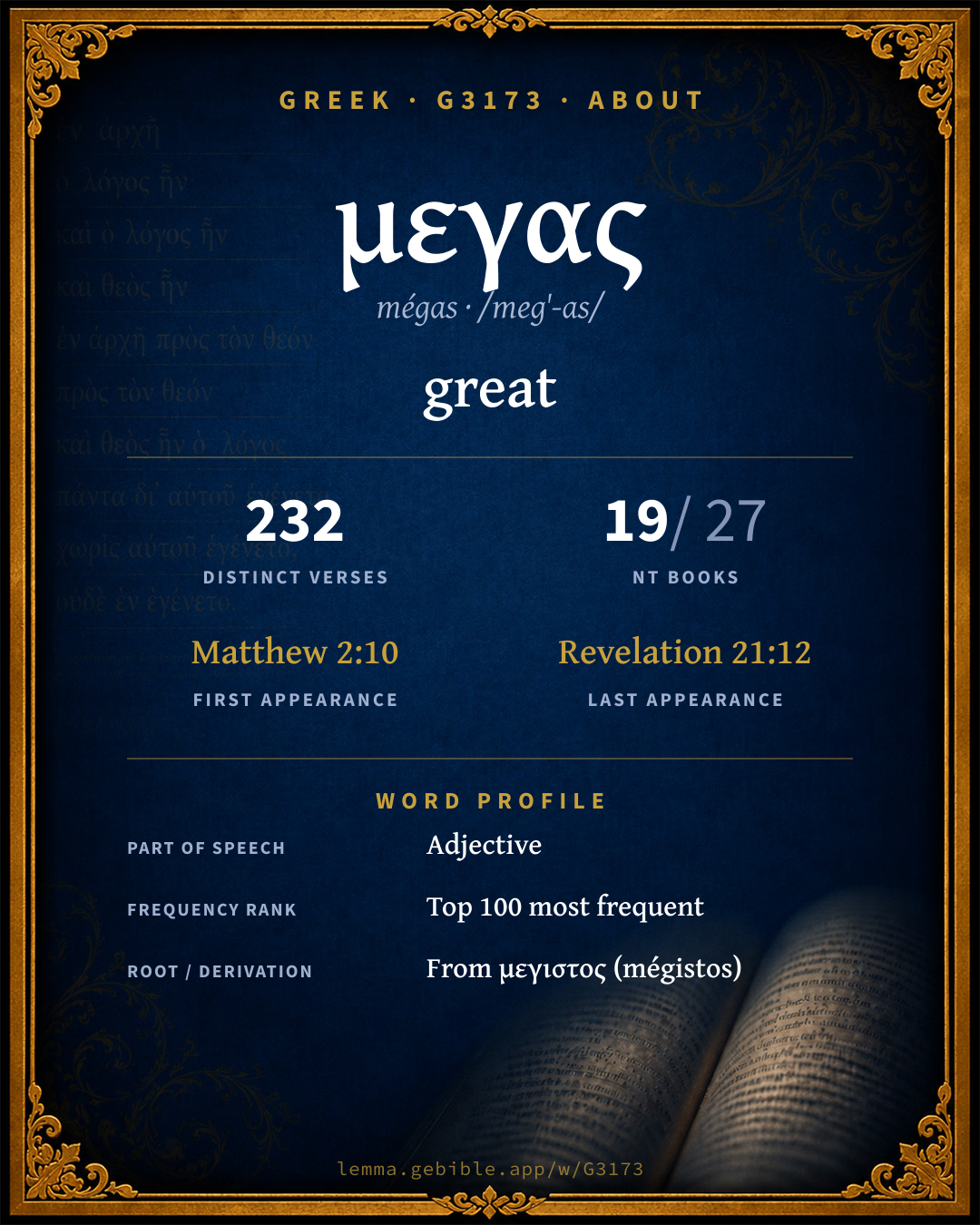
μέγας
great
‘great’ is one of 4 main senses fuller range ↓
Full lexicon entry — Thayer's Greek Lexicon
From Thayer's Greek Lexicon
Where this word appears
See every Nominative-case word in the Greek New Testament →
Grammar key — what these labels mean
Part of speech
- Adjective
- A word that describes or qualifies a noun.
- Adverb
- A word that modifies a verb, adjective, or other adverb.
Case
- Nominative
- The case of the subject (and the predicate nominative).
- Dative
- The case of the indirect object, means, or location — “to / for / with / in.”
- Accusative
- The case of the direct object and of extent.
- Genitive
- The case of source, possession, or “of” — answers “whose / from what.”
Gender
- Feminine
- Grammatically feminine.
- Masculine
- Grammatically masculine.
- Neuter
- Grammatically neuter.
Number
- Singular
- One.
- Plural
- More than one.
Degree
- Comparative
- Expresses a greater degree (“greater,” “more”).
- Superlative
- Expresses the greatest degree (“greatest,” “most”).
7 verses where G3173 appears in the Accusative case in the Book of Luke. Filtered view — show all forms. Click any verse to open its interlinear word-by-word view. Verse text shown in the World English Bible for context — . Each verse’s Greek form is shown with its reference; the English is not keyword-highlighted, since the data carries no word-level English alignment. Use “Compare translations” on any verse to read it across multiple English versions. This concordance covers the Greek New Testament; Septuagint (Greek Old Testament) occurrences of this word are not indexed here.
Luke
- Luke 1:49 μεγάλα adj acc pl neut For he who is mighty has done great things for me. Holy is his name.
- Luke 2:9 μέγαν adj acc sg masc Behold, an angel of the Lord stood by them, and the glory of the Lord shone around them, and they were terrified.
- Luke 2:10 μεγάλην adj acc sg fem The angel said to them, "Don't be afraid, for behold, I bring you good news of great joy which will be to all the people.
- Luke 5:29 μεγάλην adj acc sg fem Levi made a great feast for him in his house. There was a great crowd of tax collectors and others who were reclining with them.
- Luke 12:18 μείζονας adj acc pl fem comp He said, 'This is what I will do. I will pull down my barns, and build bigger ones, and there I will store all my grain and my goods.
- Luke 14:16 μέγα adj acc sg neut But he said to him, "A certain man made a great supper, and he invited many people.
- Luke 22:12 μέγα adj acc sg neut He will show you a large, furnished upper room. Make preparations there."
About this entry
At a glance — auto-summarized from this page’s data, not written by a person. Every figure links to its source below. This summary describes the numbers; it doesn’t interpret them.
μεγας (mégas) is a Greek adjective most often rendered “great.” Ranging over 4 senses, it is not a single-sense word. It turns up in 232 verses across 19 books, a common footprint. It concentrates in Revelation, which alone accounts for 32% of its uses. Scripture first uses it in Matthew 2:10. The sections below give every sense, occurrence, and version rendering.
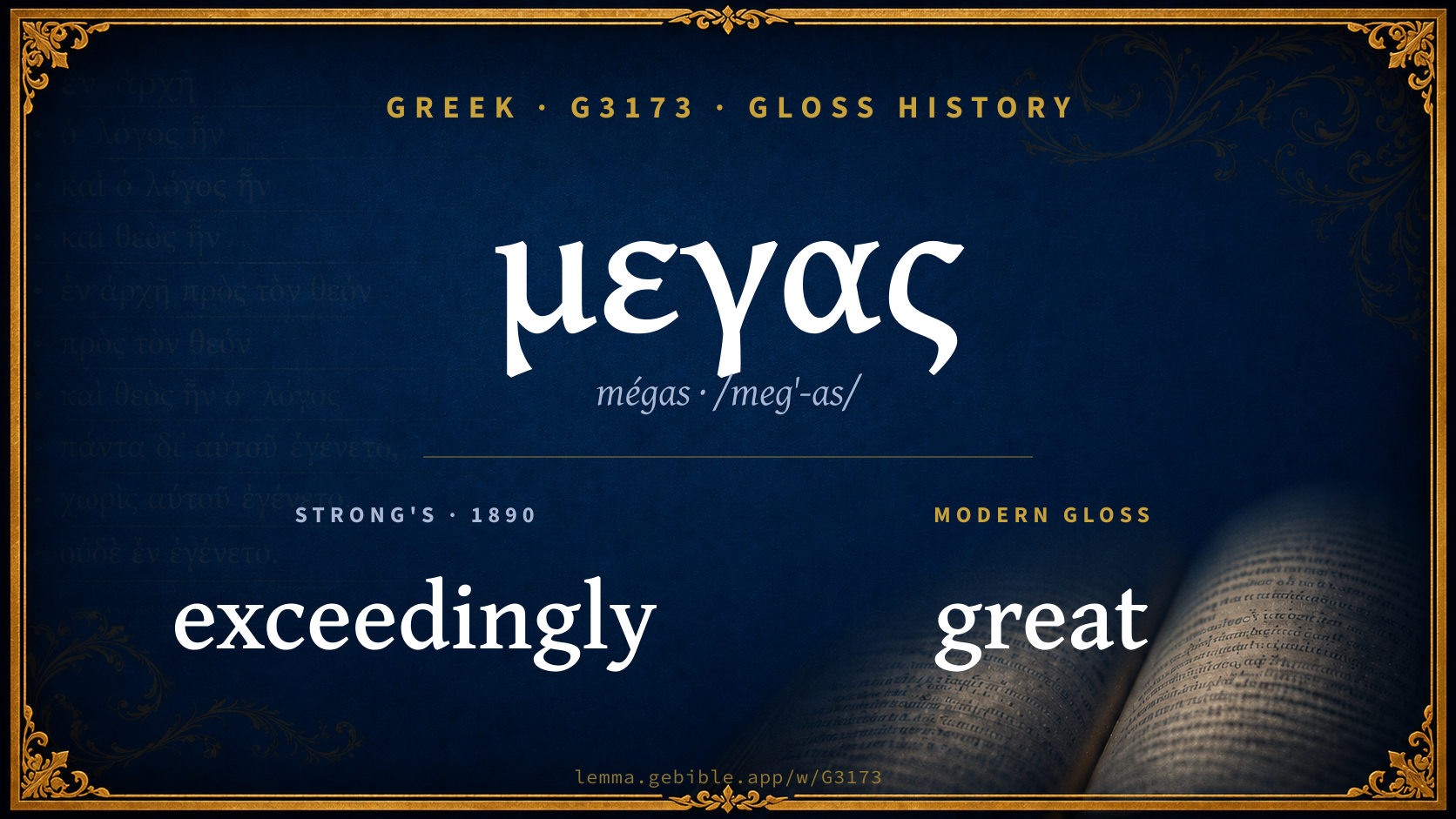
Gloss history
Strong's 1890 vs modern scholarship
About this word
Strong's G3173 catalogs a Greek word from the Greek New Testament.
These counts are not copied from any lexicon or concordance. They are computed here, from the morphology-tagged Greek New Testament. What Lemma adds →
- 232
- distinct verses
- The word appears in 232 distinct verses.
- 19 / 27
- NT books
- The word appears in 19 of 27 New Testament books.
- #64
- by frequency
- Top 100 most frequent Greek words (rank 64 of 5,347 Greek words by occurrence).
View all 232 occurrences in the concordance →
Most concentrated in
- Revelation 75 verses 32%
- Luke 31 verses 13%
- Acts 30 verses 13%
By section of the New Testament
By traditional corpus
Conventional, traditional groupings — biblical authorship is debated, so this is a traditional corpus grouping, not an authorship claim. Some books belong to more than one corpus (Luke is in both the Gospels and the Lukan corpus, and so on), so these shares overlap and need not total 100%. Each figure is a share of the word’s 232 distinct verses.
- Johannine 96 verses · 41%
- Gospels 94 verses · 41%
- Revelation 75 verses · 32%
- Lukan (Luke–Acts) 61 verses · 26%
- Pauline corpus 13 verses · 6%
- Hebrews 10 verses · 4%
- General (Catholic) Epistles 10 verses · 4%
How translations render this word
Counts come from each version’s own published word-to-Strong’s tagging or interlinear alignment — an approximate guide to how each version renders this word, not a word-level alignment the data otherwise carries. Because each total is that version’s own tagged count, the per-version totals vary from one another and need not match the appearance or distinct-verse counts above. These counts may also differ from a printed concordance because Lemma counts each distinctly tagged rendering and does not collapse phrase taggings into a single head-word total. This is a fixed set of word-tagged versions (KJV, ASV, BSB, ULT) and does not change with the reading translation you choose elsewhere. Each version’s license is shown beside its name below (and on Sources).
- King James Version: Great 141×, Loud 33×, Greatest 2×
- American Standard Version: Great 145×, Loud 21×, Greater 10×
- Berean Standard Bible: Great 108×, Loud 23×, Greater 21×
- unfoldingWord Literal Text: Great 134×, Loud 39×, Large 10×
King James Version Public Domain
Renders G3173 across 193 tagged occurrences — most commonly:
Plus 15 renderings that appear only once — usually multi-word phrases or single function words the recovered tagging swept in, not distinct renderings. Not rendered by a distinct English word in 2 further occurrences.
American Standard Version Public Domain
Renders G3173 across 207 tagged occurrences — most commonly:
Plus 24 renderings that appear only once — usually multi-word phrases or single function words the recovered tagging swept in, not distinct renderings.
Berean Standard Bible Public Domain
Renders G3173 across 218 tagged occurrences — most commonly:
Plus other, less common renderings. Plus 23 renderings that appear only once — usually multi-word phrases or single function words the recovered tagging swept in, not distinct renderings. Not rendered by a distinct English word in 6 further occurrences.
unfoldingWord Literal Text CC BY-SA 4.0
Renders G3173 across 198 tagged occurrences — most commonly:
Plus 9 renderings that appear only once — usually multi-word phrases or single function words the recovered tagging swept in, not distinct renderings.
Senses in Thayer's
The 4 senses Thayer's distinguishes for this word, in lexicon order (not ranked by frequency or importance). The full entry — with sub-senses — is in the Lexicon Entry tab.
- great
- predicated of rank, as belonging to
- splendid, prepared on a grand scale, stately
- great things
Word origin
Derived from μεγιστος (mégistos) (G3176) — greatest.
Including the prolonged forms femine μεγάλη megalē plural μέγάλοι megaloi etc.; compare also G3176 G3187 ] big (literally or figuratively in a very wide application): - (+ fear) exceedingly great (-est) high large loud mighty + (be) sore (afraid) strong X to years.
— Strong’s Exhaustive Concordance (1890), public domain.
Forms in the corpus
The 27 distinct written forms G3173 takes in the Greek New Testament, most frequent first — each parse links to that case’s occurrences in the concordance.
Same root — word family
Other Thayer's entries built from the same root as G3173, grouped by Strong’s listed origin. These share a root / origin per the lexicon — not necessarily a shared meaning. Each links to that word’s own entry.
Derives from
Shares the same root
Derived from this word
- μεγαλαυχεω megalauchéō G3166 to boast greatly
- μεγαλειος megaleîos G3167 magnificent
- μεγαλοπρεπης megaloprepḗs G3169 magnificent
- μεγαλυνω megalýnō G3170 to magnify
- μεγαλως megálōs G3171 greatly
- μεγαλωσυνη megalōsýnē G3172 majesty
- μεγεθος mégethos G3174 greatness
- μεγιστος mégistos G3176 greatest
- μειζων meízōn G3187 greater
- μηκος mēkos G3372 length
Compare all same-root words → Showing 4 of 12 — not the complete family. They share a root, not necessarily a meaning.
Septuagint usage
The same Greek word μεγας appears 602 times in the Greek Old Testament (Septuagint), across 569 verses in 32 books.
- 602
- LXX occurrences
- Tagged occurrences of this Greek word in the Septuagint.
- 569
- verses
- Distinct Septuagint verses containing this word.
- 32 / 39
- OT books
- The word appears in 32 of the 39 Old Testament books.
Sample Septuagint occurrences
- Genesis 1:16 μέγας
- Exodus 1:9 μέγας
- Leviticus 21:10 μέγας
- Numbers 11:33 μέγας
- Deuteronomy 1:7 μέγας
- Joshua 1:4 μέγας
- Judges 2:7 μέγας
- 1 Samuel 2:14 μέγας
- 2 Samuel 3:38 μέγας
- 1 Kings 1:40 μέγας
- 2 Kings 3:27 μέγας
- 1 Chronicles 9:31 μέγας
Septuagint occurrences (same lexeme)
Every verse where the same Strong’s number (G3173) appears in the Greek Septuagint — showing the first 50 of 569. Verse text shown in the World English Bible for context; the Greek form is the matched word — the English is not keyword-highlighted.
- Genesis 1:16 μέγας God made the two great lights: the greater light to rule the day, and the lesser light to rule the night. He also made the stars.
- Genesis 1:21 μέγας God created the large sea creatures, and every living creature that moves, with which the waters swarmed, after their kind, and every winged bird after its kind. God saw that it was good.
- Genesis 4:13 μέγας Cain said to Yahweh, "My punishment is greater than I can bear.
- Genesis 10:12 μέγας and Resen between Nineveh and Calah (the same is the great city).
- Genesis 10:21 μέγας To Shem, the father of all the children of Eber, the elder brother of Japheth, to him also were children born.
- Genesis 12:2 μέγας I will make of you a great nation. I will bless you, and make your name great. You will be a blessing.
- Genesis 12:17 μέγας Yahweh plagued Pharaoh and his house with great plagues because of Sarai, Abram's wife.
- Genesis 15:12 μέγας When the sun was going down, a deep sleep fell on Abram. Now terror and great darkness fell on him.
- Genesis 15:18 μέγας In that day Yahweh made a covenant with Abram, saying, "To your seed have I given this land, from the river of Egypt to the great river, the river Euphrates:
- Genesis 17:20 μέγας As for Ishmael, I have heard you. Behold, I have blessed him, and will make him fruitful, and will multiply him exceedingly. He will become the father of twelve princes, and I will make him a great nation.
- Genesis 18:18 μέγας seeing that Abraham has surely become a great and mighty nation, and all the nations of the earth will be blessed in him?
- Genesis 18:20 μέγας Yahweh said, "Because the cry of Sodom and Gomorrah is great, and because their sin is very grievous,
- Genesis 19:11 μέγας They struck the men who were at the door of the house with blindness, both small and great, so that they wearied themselves to find the door.
- Genesis 20:9 μέγας Then Abimelech called Abraham, and said to him, "What have you done to us? How have I sinned against you, that you have brought on me and on my kingdom a great sin? You have done deeds to me that ought not to be done!"
- Genesis 21:8 μέγας The child grew, and was weaned. Abraham made a great feast on the day that Isaac was weaned.
- Genesis 21:13 μέγας Also of the son of the handmaid will I make a nation, because he is your seed."
- Genesis 21:18 μέγας Get up, lift up the boy, and hold him in your hand. For I will make him a great nation."
- Genesis 25:23 μέγας Yahweh said to her, Two nations are in your womb, Two peoples will be separated from your body. The one people will be stronger than the other people. The elder will serve the younger.
- Genesis 26:13 μέγας The man grew great, and grew more and more until he became very great.
- Genesis 27:33 μέγας Isaac trembled violently, and said, "Who, then, is he who has taken venison, and brought it me, and I have eaten of all before you came, and have blessed him? Yes, he will be blessed."
- Genesis 27:34 μέγας When Esau heard the words of his father, he cried with an exceeding great and bitter cry, and said to his father, "Bless me, even me also, my father."
- Genesis 29:2 μέγας He looked, and behold, a well in the field, and, behold, three flocks of sheep lying there by it. For out of that well they watered the flocks. The stone on the well's mouth was great.
- Genesis 29:16 μέγας Laban had two daughters. The name of the elder was Leah, and the name of the younger was Rachel.
- Genesis 38:11 μέγας Then Judah said to Tamar, his daughter-in-law, "Remain a widow in your father's house, until Shelah, my son, is grown up;" for he said, "Lest he also die, like his brothers." Tamar went and lived in her father's house.
- Genesis 38:14 μέγας She took off of her the garments of her widowhood, and covered herself with her veil, and wrapped herself, and sat in the gate of Enaim, which is by the way to Timnah; for she saw that Shelah was grown up, and she wasn't given to him as a wife.
- Genesis 39:14 μέγας that she called to the men of her house, and spoke to them, saying, "Behold, he has brought in a Hebrew to us to mock us. He came in to me to lie with me, and I cried with a loud voice.
- Genesis 45:7 μέγας God sent me before you to preserve you a remnant in the earth, and to save you alive by a great deliverance.
- Genesis 45:28 μέγας Israel said, "It is enough. Joseph my son is still alive. I will go and see him before I die."
- Genesis 46:3 μέγας He said, "I am God, the God of your father. Don't be afraid to go down into Egypt; for there I will make of you a great nation.
- Genesis 48:19 μέγας His father refused, and said, "I know, my son, I know. He also will become a people, and he also will be great. However, his younger brother will be greater than he, and his seed will become a multitude of nations."
- Genesis 50:9 μέγας There went up with him both chariots and horsemen. It was a very great company.
- Genesis 50:10 μέγας They came to the threshing floor of Atad, which is beyond the Jordan, and there they lamented with a very great and sore lamentation. He mourned for his father seven days.
- Genesis 50:11 μέγας When the inhabitants of the land, the Canaanites, saw the mourning in the floor of Atad, they said, "This is a grievous mourning by the Egyptians." Therefore, the name of it was called Abel Mizraim, which is beyond the Jordan.
- Exodus 1:9 μέγας He said to his people, "Behold, the people of the children of Israel are more and mightier than we.
- Exodus 2:11 μέγας It happened in those days, when Moses had grown up, that he went out to his brothers, and looked at their burdens. He saw an Egyptian striking a Hebrew, one of his brothers.
- Exodus 3:3 μέγας Moses said, I will turn aside now, and see this great sight, why the bush is not burnt.
- Exodus 6:6 μέγας Therefore tell the children of Israel, 'I am Yahweh, and I will bring you out from under the burdens of the Egyptians, and I will rid you out of their bondage, and I will redeem you with an outstretched arm, and with great judgments:
- Exodus 7:4 μέγας But Pharaoh will not listen to you, and I will lay my hand on Egypt, and bring forth my hosts, my people the children of Israel, out of the land of Egypt by great judgments.
- Exodus 9:3 μέγας behold, the hand of Yahweh is on your cattle which are in the field, on the horses, on the donkeys, on the camels, on the herds, and on the flocks with a very grievous pestilence.
- Exodus 11:3 μέγας Yahweh gave the people favor in the sight of the Egyptians. Moreover the man Moses was very great in the land of Egypt, in the sight of Pharaoh's servants, and in the sight of the people.
- Exodus 11:6 μέγας There shall be a great cry throughout all the land of Egypt, such as there has not been, nor shall be any more.
- Exodus 12:30 μέγας Pharaoh rose up in the night, he, and all his servants, and all the Egyptians; and there was a great cry in Egypt, for there was not a house where there was not one dead.
- Exodus 14:31 μέγας Israel saw the great work which Yahweh did to the Egyptians, and the people feared Yahweh; and they believed in Yahweh, and in his servant Moses.
- Exodus 18:11 μέγας Now I know that Yahweh is greater than all gods because of the thing in which they dealt arrogantly against them."
- Exodus 19:16 μέγας It happened on the third day, when it was morning, that there were thunders and lightnings, and a thick cloud on the mountain, and the sound of an exceedingly loud trumpet; and all the people who were in the camp trembled.
- Exodus 23:31 μέγας I will set your border from the Red Sea even to the sea of the Philistines, and from the wilderness to the River; for I will deliver the inhabitants of the land into your hand, and you shall drive them out before you.
- Exodus 32:10 μέγας Now therefore leave me alone, that my wrath may burn hot against them, and that I may consume them; and I will make of you a great nation."
- Exodus 32:11 μέγας Moses begged Yahweh his God, and said, "Yahweh, why does your wrath burn hot against your people, that you have brought forth out of the land of Egypt with great power and with a mighty hand?
- Exodus 32:21 μέγας Moses said to Aaron, "What did these people do to you, that you have brought a great sin on them?"
- Exodus 32:30 μέγας It happened on the next day, that Moses said to the people, "You have sinned a great sin. Now I will go up to Yahweh. Perhaps I shall make atonement for your sin."
These are occurrences of the same Greek lexeme (G3173) in the Septuagint — not a translation of any one Hebrew word. The store carries no word-level Hebrew↔Greek alignment, so no Hebrew original is asserted here. Counts come from the recovered LXX Strong's tagging — high-frequency vocabulary is well covered, while rare or late forms may be untagged — so they reflect tagged occurrences and may slightly undercount.