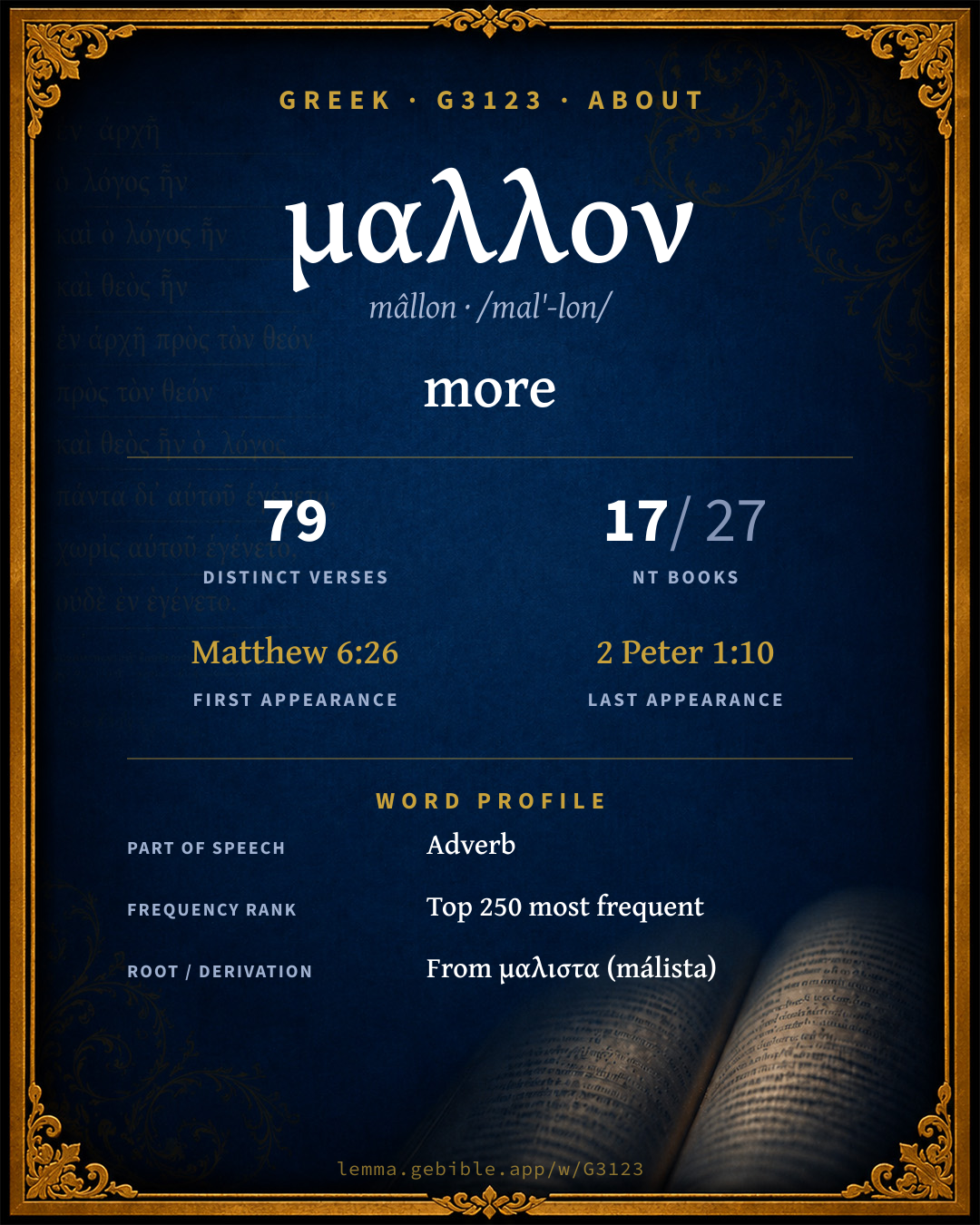
μᾶλλον
more
Full lexicon entry — Thayer's Greek Lexicon
From Thayer's Greek Lexicon
Where this word appears
Grammar key — what these labels mean
Part of speech
- Adverb
- A word that modifies a verb, adjective, or other adverb.
Every verse where G3123 appears — 79 distinct verses across 17 books. Click any verse to open its interlinear word-by-word view. Verse text shown in the World English Bible for context — . Each verse’s Greek form is shown with its reference; the English is not keyword-highlighted, since the data carries no word-level English alignment. Use “Compare translations” on any verse to read it across multiple English versions. This concordance covers the Greek New Testament; Septuagint (Greek Old Testament) occurrences of this word are not indexed here.
Matthew 9 verses
- Matthew 6:26 μᾶλλον adv See the birds of the sky, that they don't sow, neither do they reap, nor gather into barns. Your heavenly Father feeds them. Aren't you of much more value than they?
- Matthew 6:30 μᾶλλον adv But if God so clothes the grass of the field, which today exists, and tomorrow is thrown into the oven, won't he much more clothe you, you of little faith?
- Matthew 7:11 μᾶλλον adv If you then, being evil, know how to give good gifts to your children, how much more will your Father who is in heaven give good things to those who ask him!
- Matthew 10:6 μᾶλλον adv Rather, go to the lost sheep of the house of Israel.
- Matthew 10:25 μᾶλλον adv It is enough for the disciple that he be like his teacher, and the servant like his lord. If they have called the master of the house Beelzebul, how much more those of his household!
- Matthew 10:28 μᾶλλον adv Don't be afraid of those who kill the body, but are not able to kill the soul. Rather, fear him who is able to destroy both soul and body in Gehenna.
- Matthew 18:13 μᾶλλον adv If he finds it, most assuredly I tell you, he rejoices over it more than over the ninety-nine which have not gone astray.
- Matthew 25:9 μᾶλλον adv But the wise answered, saying, 'What if there isn't enough for us and you? You go rather to those who sell, and buy for yourselves.'
- Matthew 27:24 μᾶλλον adv So when Pilate saw that nothing was being gained, but rather that a disturbance was starting, he took water, and washed his hands before the multitude, saying, "I am innocent of the blood of this righteous person. You see to it."
Mark 5 verses
- Mark 5:26 μᾶλλον adv and had suffered many things by many physicians, and had spent all that she had, and was no better, but rather grew worse,
- Mark 7:36 μᾶλλον adv He commanded them that they should tell no one, but the more he commanded them, so much the more widely they proclaimed it.
- Mark 9:42 μᾶλλον adv Whoever will cause one of these little ones who believe in me to stumble, it would be better for him if he was thrown into the sea with a millstone hung around his neck.
- Mark 10:48 μᾶλλον adv Many rebuked him, that he should be quiet, but he cried out much more, "You son of David, have mercy on me!"
- Mark 15:11 μᾶλλον adv But the chief priests stirred up the multitude, that he should release Barabbas to them instead.
Luke 5 verses
- Luke 5:15 μᾶλλον adv But the report concerning him spread much more, and great multitudes came together to hear, and to be healed by him of their infirmities.
- Luke 11:13 μᾶλλον adv If you then, being evil, know how to give good gifts to your children, how much more will your heavenly Father give the Holy Spirit to those who ask him?"
- Luke 12:24 μᾶλλον adv Consider the ravens: they don't sow, they don't reap, they have no warehouse or barn, and God feeds them. How much more valuable are you than birds!
- Luke 12:28 μᾶλλον adv But if this is how God clothes the grass in the field, which today exists, and tomorrow is cast into the oven, how much more will he clothe you, O you of little faith?
- Luke 18:39 μᾶλλον adv Those who led the way rebuked him, that he should be quiet; but he cried out all the more, "You son of David, have mercy on me!"
John 4 verses
- John 3:19 μᾶλλον adv This is the judgment, that the light has come into the world, and men loved the darkness rather than the light; for their works were evil.
- John 5:18 μᾶλλον adv For this cause therefore the Jews sought all the more to kill him, because he not only broke the Sabbath, but also called God his own Father, making himself equal with God.
- John 12:43 μᾶλλον adv for they loved men's praise more than God's praise.
- John 19:8 μᾶλλον adv When therefore Pilate heard this saying, he was more afraid.
Acts 7 verses
- Acts 4:19 μᾶλλον adv But Peter and John answered them, "Whether it is right in the sight of God to listen to you rather than to God, judge for yourselves,
- Acts 5:14 μᾶλλον adv More believers were added to the Lord, multitudes of both men and women.
- Acts 5:29 μᾶλλον adv But Peter and the apostles answered, "We must obey God rather than men.
- Acts 9:22 μᾶλλον adv But Saul increased more in strength, and confounded the Jews who lived at Damascus, proving that this is the Christ.
- Acts 20:35 μᾶλλον adv In all things I gave you an example, that so laboring you ought to help the weak, and to remember the words of the Lord Jesus, that he himself said, 'It is more blessed to give than to receive.'"
- Acts 22:2 μᾶλλον adv When they heard that he spoke to them in the Hebrew language, they were even more quiet. He said,
- Acts 27:11 μᾶλλον adv But the centurion gave more heed to the master and to the owner of the ship than to those things which were spoken by Paul.
Romans 8 verses
- Romans 5:9 μᾶλλον adv Much more then, being now justified by his blood, we will be saved from God's wrath through him.
- Romans 5:10 μᾶλλον adv For if, while we were enemies, we were reconciled to God through the death of his Son, much more, being reconciled, we will be saved by his life.
- Romans 5:15 μᾶλλον adv But the free gift isn't like the trespass. For if by the trespass of the one the many died, much more did the grace of God, and the gift by the grace of the one man, Jesus Christ, abound to the many.
- Romans 5:17 μᾶλλον adv For if by the trespass of the one, death reigned through the one; so much more will those who receive the abundance of grace and of the gift of righteousness reign in life through the one, Jesus Christ.
- Romans 8:34 μᾶλλον adv Who is he who condemns? It is Christ who died, yes rather, who was raised from the dead, who is at the right hand of God, who also makes intercession for us.
- Romans 11:12 μᾶλλον adv Now if their fall is the riches of the world, and their loss the riches of the Gentiles; how much more their fullness?
- Romans 11:24 μᾶλλον adv For if you were cut out of that which is by nature a wild olive tree, and were grafted contrary to nature into a good olive tree, how much more will these, which are the natural branches, be grafted into their own olive tree?
- Romans 14:13 μᾶλλον adv Therefore let's not judge one another any more, but judge this rather, that no man put a stumbling block in his brother's way, or an occasion for falling.
1 Corinthians 9 verses
- 1 Corinthians 5:2 μᾶλλον adv You are puffed up, and didn't rather mourn, that he who had done this deed might be removed from among you.
- 1 Corinthians 6:7 μᾶλλον μᾶλλον adv adv Therefore it is already altogether a defect in you, that you have lawsuits one with another. Why not rather be wronged? Why not rather be defrauded?
- 1 Corinthians 7:21 μᾶλλον adv Were you called being a bondservant? Don't let that bother you, but if you get an opportunity to become free, use it.
- 1 Corinthians 9:12 μᾶλλον adv If others partake of this right over you, don't we yet more? Nevertheless we did not use this right, but we bear all things, that we may cause no hindrance to the Gospel of Christ.
- 1 Corinthians 9:15 μᾶλλον adv But I have used none of these things, and I don't write these things that it may be done so in my case; for I would rather die, than that anyone should make my boasting void.
- 1 Corinthians 12:22 μᾶλλον adv No, much rather, those members of the body which seem to be weaker are necessary.
- 1 Corinthians 14:1 μᾶλλον adv Follow after love, and earnestly desire spiritual gifts, but especially that you may prophesy.
- 1 Corinthians 14:5 μᾶλλον adv Now I desire to have you all speak with other languages, but rather that you would prophesy. For he is greater who prophesies than he who speaks with other languages, unless he interprets, that the assembly may be built up.
- 1 Corinthians 14:18 μᾶλλον adv I thank my God, I speak with other languages more than you all.
2 Corinthians 8 verses
- 2 Corinthians 2:7 μᾶλλον adv so that on the contrary you should rather forgive him and comfort him, lest by any means such a one should be swallowed up with his excessive sorrow.
- 2 Corinthians 3:8 μᾶλλον adv won't service of the Spirit be with much more glory?
- 2 Corinthians 3:9 μᾶλλον adv For if the service of condemnation has glory, the service of righteousness exceeds much more in glory.
- 2 Corinthians 3:11 μᾶλλον adv For if that which passes away was with glory, much more that which remains is in glory.
- 2 Corinthians 5:8 μᾶλλον adv We are of good courage, I say, and are willing rather to be absent from the body, and to be at home with the Lord.
- 2 Corinthians 7:7 μᾶλλον adv and not by his coming only, but also by the comfort with which he was comforted in you, while he told us of your longing, your mourning, and your zeal for me; so that I rejoiced still more.
- 2 Corinthians 7:13 μᾶλλον adv Therefore we have been comforted. In our comfort we rejoiced the more exceedingly for the joy of Titus, because his spirit has been refreshed by you all.
- 2 Corinthians 12:9 μᾶλλον adv He has said to me, "My grace is sufficient for you, for my power is made perfect in weakness." Most gladly therefore I will rather glory in my weaknesses, that the power of Christ may rest on me.
Galatians 2 verses
- Galatians 4:9 μᾶλλον adv But now that you have come to know God, or rather to be known by God, why do you turn back again to the weak and miserable elements, to which you desire to be in bondage all over again?
- Galatians 4:27 μᾶλλον adv For it is written, "Rejoice, you barren who don't bear. Break forth and shout, you that don't travail. For more are the children of the desolate than of her who has a husband."
Ephesians 3 verses
- Ephesians 4:28 μᾶλλον adv Let him who stole steal no more; but rather let him labor, working with his hands the thing that is good, that he may have something to give to him who has need.
- Ephesians 5:4 μᾶλλον adv nor filthiness, nor foolish talking, nor jesting, which are not appropriate; but rather giving of thanks.
- Ephesians 5:11 μᾶλλον adv Have no fellowship with the unfruitful works of darkness, but rather even reprove them.
Philippians 5 verses
- Philippians 1:9 μᾶλλον μᾶλλον adv adv This I pray, that your love may abound yet more and more in knowledge and all discernment;
- Philippians 1:12 μᾶλλον adv Now I desire to have you know, brothers, that the things which happened to me have turned out rather to the progress of the Gospel;
- Philippians 1:23 μᾶλλον adv But I am in a dilemma between the two, having the desire to depart and be with Christ, which is far better.
- Philippians 2:12 μᾶλλον adv So then, my beloved, even as you have always obeyed, not only in my presence, but now much more in my absence, work out your own salvation with fear and trembling.
- Philippians 3:4 μᾶλλον adv though I myself might have confidence even in the flesh. If any other man thinks that he has confidence in the flesh, I yet more:
1 Thessalonians 2 verses
- 1 Thessalonians 4:1 μᾶλλον adv Finally then, brothers, we beg and exhort you in the Lord Jesus, that as you received from us how you ought to walk and to please God, that you abound more and more.
- 1 Thessalonians 4:10 μᾶλλον adv for indeed you do it toward all the brothers who are in all Macedonia. But we exhort you, brothers, that you abound more and more;
1 Timothy 2 verses
- 1 Timothy 1:4 μᾶλλον adv neither to pay attention to myths and endless genealogies, which cause disputes, rather than God's stewardship, which is in faith--
- 1 Timothy 6:2 μᾶλλον adv Those who have believing masters, let them not despise them, because they are brothers, but rather let them serve them, because those who partake of the benefit are believing and beloved. Teach and exhort these things.
2 Timothy 1 verse
Philemon 2 verses
- Philemon 1:9 μᾶλλον adv yet for love's sake I rather beg, being such a one as Paul, the aged, but also a prisoner of Jesus Christ.
- Philemon 1:16 μᾶλλον adv no longer as a slave, but more than a slave, a beloved brother, especially to me, but how much rather to you, both in the flesh and in the Lord.
Hebrews 6 verses
- Hebrews 9:14 μᾶλλον adv how much more will the blood of Christ, who through the eternal Spirit offered himself without blemish to God, cleanse your conscience from dead works to serve the living God?
- Hebrews 10:25 μᾶλλον adv not forsaking our own assembling together, as the custom of some is, but exhorting one another; and so much the more, as you see the Day approaching.
- Hebrews 11:25 μᾶλλον adv choosing rather to share ill treatment with God's people, than to enjoy the pleasures of sin for a time;
- Hebrews 12:9 μᾶλλον adv Furthermore, we had the fathers of our flesh to chasten us, and we paid them respect. Shall we not much rather be in subjection to the Father of spirits, and live?
- Hebrews 12:13 μᾶλλον adv and make straight paths for your feet, so that which is lame may not be dislocated, but rather be healed.
- Hebrews 12:25 μᾶλλον adv See that you don't refuse him who speaks. For if they didn't escape when they refused him who warned on the Earth, how much more will we not escape who turn away from him who warns from heaven,
2 Peter 1 verse
About this entry
At a glance — auto-summarized from this page’s data, not written by a person. Every figure links to its source below. This summary describes the numbers; it doesn’t interpret them.
μαλλον (mâllon) is a Greek verb most often rendered “more.” It first appears in Matthew 6:26. The Greek New Testament uses it across 79 verses — moderately common. The sections below give every sense, occurrence, and version rendering.
Gloss history
Strong's 1890 vs modern scholarship

About this word
Strong's G3123 catalogs a Greek word from the Greek New Testament.
These counts are not copied from any lexicon or concordance. They are computed here, from the morphology-tagged Greek New Testament. What Lemma adds →
- 79
- distinct verses
- The word appears in 79 distinct verses.
- 17 / 27
- NT books
- The word appears in 17 of 27 New Testament books.
- #210
- by frequency
- Top 250 most frequent Greek words (rank 210 of 5,347 Greek words by occurrence).
View all 79 occurrences in the concordance →
Most concentrated in
- Matthew 9 verses 11%
- 1 Corinthians 9 verses 11%
- Romans 8 verses 10%
By section of the New Testament
By traditional corpus
Conventional, traditional groupings — biblical authorship is debated, so this is a traditional corpus grouping, not an authorship claim. Some books belong to more than one corpus (Luke is in both the Gospels and the Lukan corpus, and so on), so these shares overlap and need not total 100%. Each figure is a share of the word’s 79 distinct verses.
- Pauline corpus 42 verses · 53%
- Gospels 23 verses · 29%
- Lukan (Luke–Acts) 12 verses · 15%
- Hebrews 6 verses · 8%
- Johannine 4 verses · 5%
- General (Catholic) Epistles 1 verse · 1%
How translations render this word
Counts come from each version’s own published word-to-Strong’s tagging or interlinear alignment — an approximate guide to how each version renders this word, not a word-level alignment the data otherwise carries. Because each total is that version’s own tagged count, the per-version totals vary from one another and need not match the appearance or distinct-verse counts above. These counts may also differ from a printed concordance because Lemma counts each distinctly tagged rendering and does not collapse phrase taggings into a single head-word total. This is a fixed set of word-tagged versions (KJV, ASV, BSB, ULT) and does not change with the reading translation you choose elsewhere. Each version’s license is shown beside its name below (and on Sources).
- King James Version: More 37×, Rather 32×, More and more 2×
- American Standard Version: Rather 32×, More 31×, Much the more 2×
- Berean Standard Bible: More 23×, Rather 13×, All the more 7×
- unfoldingWord Literal Text: More 44×, Rather 17×, Instead 10×
King James Version Public Domain
Renders G3123 across 81 tagged occurrences — most commonly:
Plus 6 renderings that appear only once — usually multi-word phrases or single function words the recovered tagging swept in, not distinct renderings. Not rendered by a distinct English word in 2 further occurrences.
American Standard Version Public Domain
Renders G3123 across 78 tagged occurrences — most commonly:
Plus 13 renderings that appear only once — usually multi-word phrases or single function words the recovered tagging swept in, not distinct renderings.
Berean Standard Bible Public Domain
Renders G3123 across 64 tagged occurrences — most commonly:
Plus 12 renderings that appear only once — usually multi-word phrases or single function words the recovered tagging swept in, not distinct renderings. Not rendered by a distinct English word in 15 further occurrences.
unfoldingWord Literal Text CC BY-SA 4.0
Renders G3123 across 86 tagged occurrences — most commonly:
Plus 13 renderings that appear only once — usually multi-word phrases or single function words the recovered tagging swept in, not distinct renderings.
Senses in Thayer's
The 1 sense Thayer's distinguishes for this word, in lexicon order (not ranked by frequency or importance). The full entry — with sub-senses — is in the Lexicon Entry tab.
- more, to a greater degree, rather
Word origin
Derived from μαλιστα (málista) (G3122) — especially.
Neuter of the comparative of the same as G3122 ; (adverb) more ( in a greater degree ) or rather : - + better X far (the) more (and more) (so) much (the more) rather.
— Strong’s Exhaustive Concordance (1890), public domain.
Septuagint usage
The same Greek word μαλλον appears 23 times in the Greek Old Testament (Septuagint), across 22 verses in 8 books.
- 23
- LXX occurrences
- Tagged occurrences of this Greek word in the Septuagint.
- 22
- verses
- Distinct Septuagint verses containing this word.
- 8 / 39
- OT books
- The word appears in 8 of the 39 Old Testament books.
Sample Septuagint occurrences
- Genesis 19:9 μᾶλλον
- Numbers 13:31 μᾶλλον
- Deuteronomy 9:1 μᾶλλον
- Job 20:2 μᾶλλον
- Psalms 83:11 μᾶλλον
- Proverbs 5:4 μᾶλλον
- Isaiah 13:12 μᾶλλον
- Jonah 1:11 μᾶλλον
Septuagint occurrences (same lexeme)
Every verse where the same Strong’s number (G3123) appears in the Greek Septuagint. Verse text shown in the World English Bible for context; the Greek form is the matched word — the English is not keyword-highlighted.
- Genesis 19:9 μᾶλλον They said, "Stand back!" They said, "This one fellow came in to live as a foreigner, and he appoints himself a judge. Now will we deal worse with you, than with them!" They pressed hard on the man, even Lot, and drew near to break the door.
- Genesis 29:30 μᾶλλον He went in also to Rachel, and he loved also Rachel more than Leah, and served with him yet seven other years.
- Numbers 13:31 μᾶλλον But the men who went up with him said, We aren't able to go up against the people; for they are stronger than we.
- Numbers 14:12 μᾶλλον I will strike them with the pestilence, and disinherit them, and will make of you a nation greater and mightier than they.
- Deuteronomy 9:1 μᾶλλον Hear, Israel: you are to pass over the Jordan this day, to go in to dispossess nations greater and mightier than yourself, cities great and fortified up to the sky,
- Deuteronomy 9:14 μᾶλλον let me alone, that I may destroy them, and blot out their name from under the sky; and I will make of you a nation mightier and greater than they.
- Deuteronomy 11:23 μᾶλλον then will Yahweh drive out all these nations from before you, and you shall dispossess nations greater and mightier than yourselves.
- Job 20:2 μᾶλλον "Therefore do my thoughts give answer to me, Even by reason of my haste that is in me.
- Job 30:26 μᾶλλον When I looked for good, then evil came; When I waited for light, there came darkness.
- Psalms 83:11 μᾶλλον Make their nobles like Oreb and Zeeb; Yes, all their princes like Zebah and Zalmunna;
- Proverbs 5:4 μᾶλλον But in the end she is as bitter as wormwood, And as sharp as a two-edged sword.
- Proverbs 15:18 μᾶλλον A wrathful man stirs up contention, But one who is slow to anger appeases strife.
- Proverbs 16:3 μᾶλλον Commit your deeds to Yahweh, And your plans shall succeed.
- Proverbs 18:2 μᾶλλον A fool has no delight in understanding, But only in revealing his own opinion.
- Proverbs 21:3 μᾶλλον To do righteousness and justice Is more acceptable to Yahweh than sacrifice.
- Proverbs 26:12 μᾶλλον Do you see a man wise in his own eyes? There is more hope for a fool than for him.
- Proverbs 28:23 μᾶλλον One who rebukes a man will afterward find more favor Than one who flatters with the tongue.
- Proverbs 29:20 μᾶλλον Do you see a man who is hasty in his words? There is more hope for a fool than for him.
- Isaiah 13:12 μᾶλλον I will make a man more rare than fine gold, even a man than the pure gold of Ophir.
- Isaiah 54:1 μᾶλλον Sing, barren, you who didn't bear; break forth into singing, and cry aloud, you who did not travail with child: for more are the children of the desolate than the children of the married wife, says Yahweh.
- Jonah 1:11 μᾶλλον Then said they to him, "What shall we do to you, that the sea may be calm to us?" For the sea grew more and more tempestuous.
- Jonah 1:13 μᾶλλον Nevertheless the men rowed hard to get them back to the land; but they could not, for the sea grew more and more tempestuous against them.
These are occurrences of the same Greek lexeme (G3123) in the Septuagint — not a translation of any one Hebrew word. The store carries no word-level Hebrew↔Greek alignment, so no Hebrew original is asserted here. Counts come from the recovered LXX Strong's tagging — high-frequency vocabulary is well covered, while rare or late forms may be untagged — so they reflect tagged occurrences and may slightly undercount.