
2 Timothy 3:4

Greek (Tischendorf 8th ed.) 2 Timothy 3:4 appears in the Greek New Testament. The text above is from the Tischendorf 8th edition. Each word links to its Strong’s number and a concise gloss. Click any word for its full Thayer’s Greek Lexicon entry.
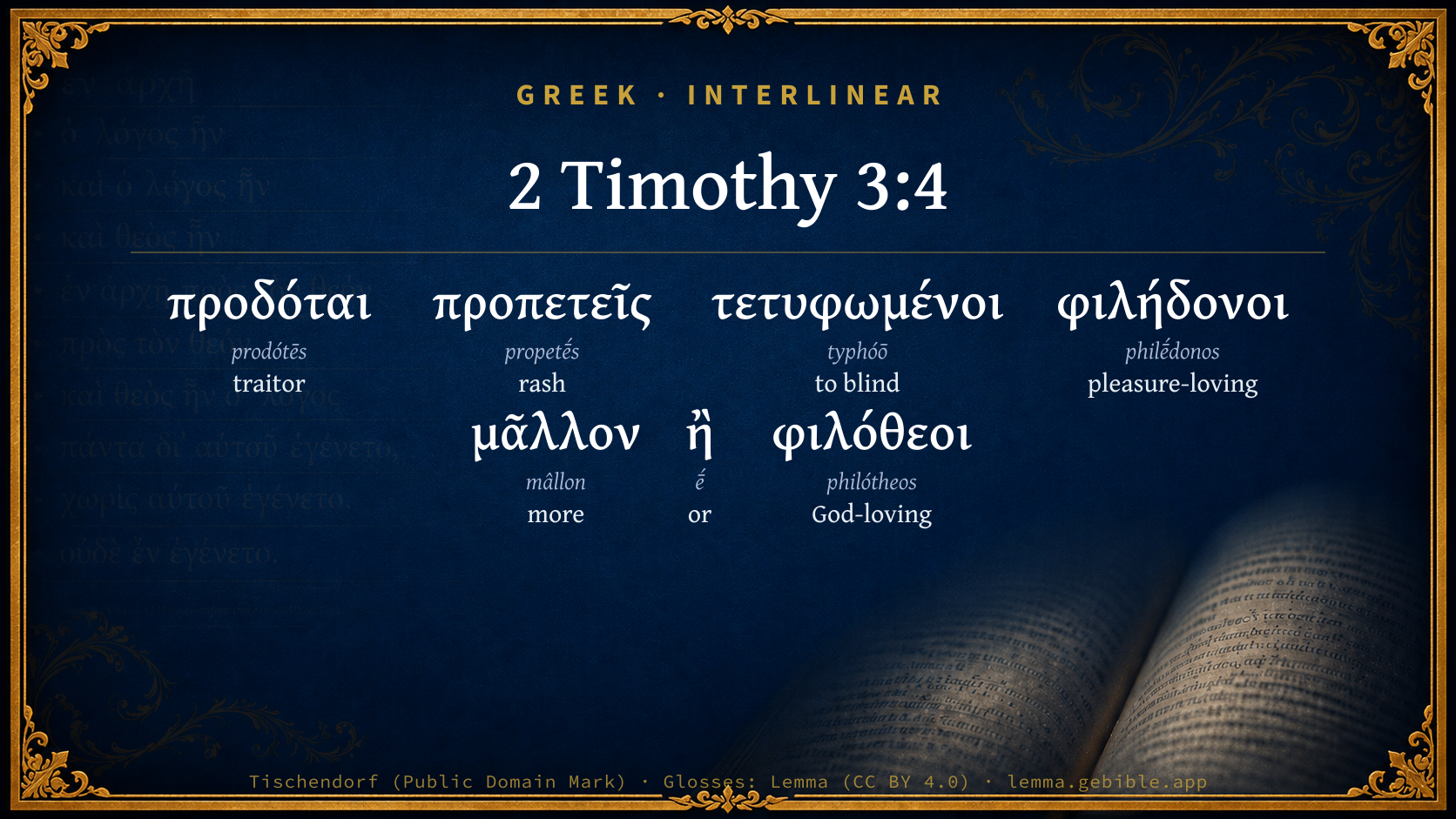
Download image
Cite this verse

2 Timothy 3:4 (World English Bible). Public Domain. Lemma interlinear Bible study tool, https://lemma.gebible.app/v/2-timothy/3/4.

Show BibTeX & RIS
BibTeX
RIS
English Translation
traitors, headstrong, conceited, lovers of pleasure rather than lovers of God;
World English Bible · Public Domain
Highlights
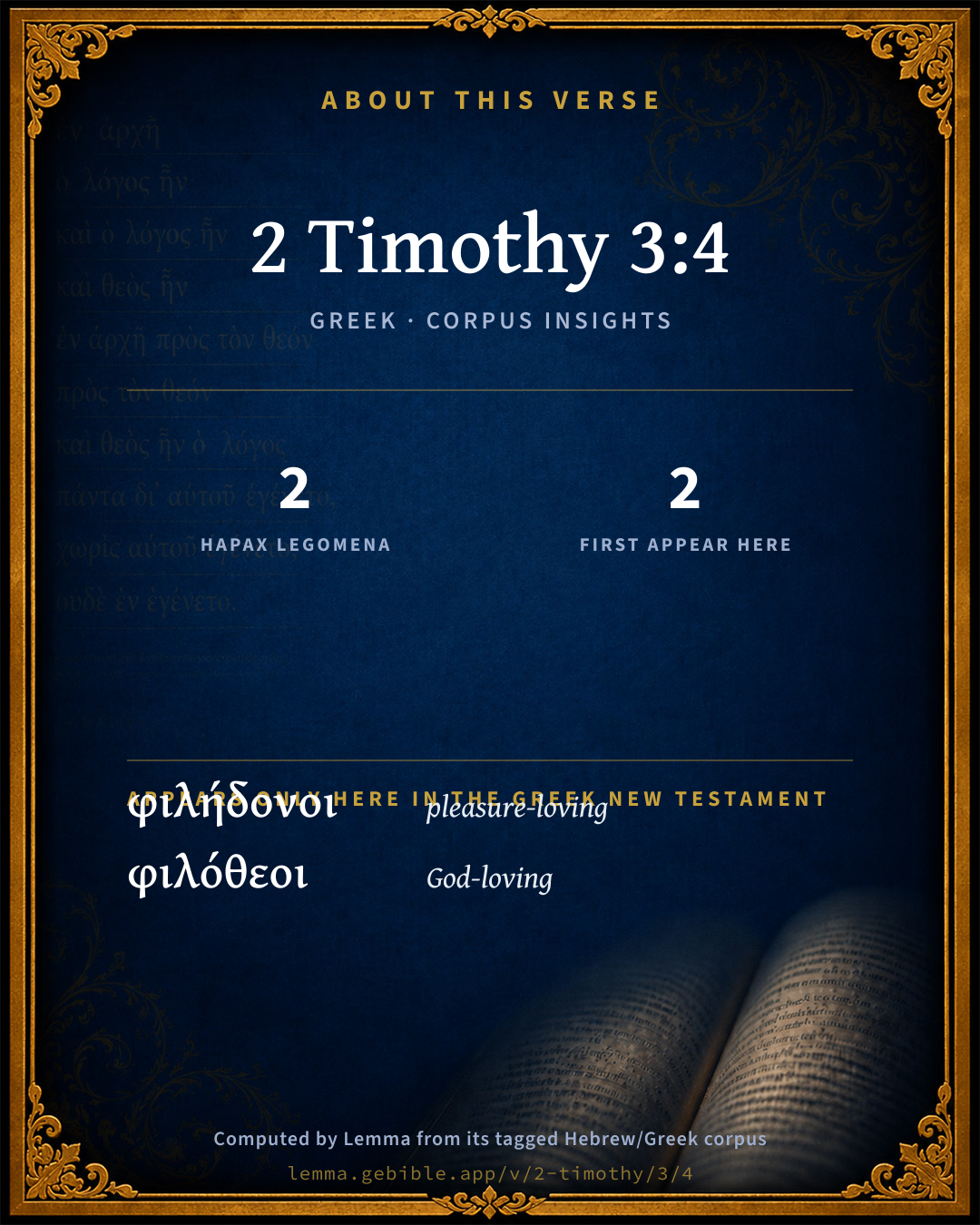
  • 2 hapax legomena — only here in the Greek New Testament
  • 2 first appearances in the Greek New Testament
Full analysis ↓
Download a study sheet

One document with this verse’s original text, its word-by-word gloss line, the meaning frame, cross-references with their text, attributed commentary, and full source and license credits — printable, and it pastes into notes with its structure intact.

This verse Autodidact and up

Study sheet (.html) Plain text (.txt)

A passage Seminary Student

Up to 50 verses in one chapter. A passage sheet keeps up to 6 commentary sources and 12 cross-references per verse, in the order this page ranks them, and says so on the sheet whenever that leaves anything out. Ask for a single verse and you get the Autodidact verse sheet above.

Everything on this page stays free to read, with no account — the sheet is a download of what is already on screen, not access to it.

Want to remove ads? Support Godless Engineer
Compare translations 3

The same verse in 3 English versions, stacked beneath the original-language interlinear above. Click any original word for its lexicon entry.

Each is an independent rendering of the whole verse — the interlinear is not word-aligned to these translations.

Highlighted words mark where these versions differ — a whole-verse word diff, not a word-by-word alignment.

  • World English Bible Public Domain
    traitors, headstrong, conceited, lovers of pleasure rather than lovers of God;
  • King James Version Public Domain
    Traitors, heady, highminded, lovers of pleasures more than lovers of God;
  • unfoldingWord Literal Text CC BY-SA 4.0
    traitors, reckless, puffed up, lovers of pleasure rather than lovers of God,

unfoldingWord Literal Text — © unfoldingWord, licensed CC BY-SA 4.0. Word-aligned USFM3 via Door43 (git.door43.org/unfoldingWord/en_ult).

Versions to compare (up to 4)

3 of 4 selected

Show all 19 translations

Every available English version of this verse, each an independent rendering of the whole verse.

  • World English Bible Public Domain
    traitors, headstrong, conceited, lovers of pleasure rather than lovers of God;
  • Berean Standard Bible Public Domain
    traitorous, reckless, conceited, lovers of pleasure rather than lovers of God,
  • Majority Standard Bible Public Domain
    traitorous, reckless, conceited, lovers of pleasure rather than lovers of God,
  • King James Version Public Domain
    Traitors, heady, highminded, lovers of pleasures more than lovers of God;
  • American Standard Version (1901) Public Domain
    traitors, headstrong, puffed up, lovers of pleasure rather than lovers of God;
  • Revised Version (1885) Public Domain
    traitors, headstrong, puffed up, lovers of pleasure rather than lovers of God;
  • Geneva Bible (1599) Public Domain
    Traitours, headie, high minded, louers of pleasures more then louers of God,
  • Douay-Rheims (1899) Public Domain
    Traitors, stubborn, puffed up, and lovers of pleasures more than of God:
  • Young's Literal Translation Public Domain
    traitors, heady, lofty, lovers of pleasure more than lovers of God,
  • Literal Standard Version CC BY-SA 4.0
    traitors, reckless, lofty, lovers of pleasure more than lovers of God,
  • Unlocked Literal Bible CC BY-SA 4.0
    They will be betrayers, reckless, conceited, lovers of pleasure rather than lovers of God.
  • unfoldingWord Literal Text CC BY-SA 4.0
    traitors, reckless, puffed up, lovers of pleasure rather than lovers of God,
  • Darby Bible Public Domain
    traitors, headlong, of vain pretensions, lovers of pleasure rather than lovers of God;
  • World Messianic Bible Public Domain
    traitors, headstrong, conceited, lovers of pleasure rather than lovers of God,
  • Webster's Bible Public Domain
    Traitors, heady, high-minded, lovers of pleasures more than lovers of God;
  • Free Bible Version CC BY-SA 4.0
    they will betray others and be totally thoughtless. They are absurdly full of themselves, living so much for pleasure that they don't care about loving God.
  • Bible in Basic English Public Domain
    False to their friends, acting without thought, lifted up in mind, loving pleasure more than God;
  • Text-Critical English NT CC BY 4.0
    traitors, reckless, puffed up, and lovers of pleasure rather than lovers of God,
  • Tyndale New Testament (1534) Public Domain
    traytours heddy hye mynded gredy apon volupteousnes more then the lovers of god

Literal Standard Version (2020), Covenant Press — licensed CC BY-SA 4.0. Text via the HelloAO Bible API (eBible.org). Unlocked Literal Bible (unfoldingWord) — licensed CC BY-SA 4.0. Text via the HelloAO Bible API (eBible.org). unfoldingWord Literal Text — © unfoldingWord, licensed CC BY-SA 4.0. Word-aligned USFM3 via Door43 (git.door43.org/unfoldingWord/en_ult). Free Bible Version, Dr. Jonathan Gallagher — licensed CC BY-SA 4.0. Text via the HelloAO Bible API (eBible.org).

Word by word

More ways to search: Search by grammar → Find every occurrence → Compare this word →

Practice this passage: Drill this verse → Learn its vocabulary →

About this verse

These counts appear in no published source. They are computed here, from the morphology-tagged text and Lemma’s own curated glosses. What Lemma adds →

7
words
7
distinct lemmas
Pauline Epistles
section

Notable vocabulary

2 hapax legomena — words that appear only here in the entire Greek New Testament:

  • φιλήδονοι pleasure-loving G5369
  • φιλόθεοι God-loving G5377

First appearance in Scripture

These words make their first canonical appearance in the Greek New Testament here:

  • φιλήδονοι pleasure-loving G5369
  • φιλόθεοι God-loving G5377

Shared distinctive vocabulary

προπετεῖς rash G4312 occurs in 2 verses of the Greek New Testament. Also found in:
Cross-references

10

Topical passages linked to 2 Timothy 3:4 in the Treasury of Scripture Knowledge — connected by theme and wording, ordered by reader-vote popularity; previews shown in the World English Bible.

  • Philippians 3:18–19 For many walk, of whom I told you often, and now tell you even weeping, as the enemies of the cross of Christ,
  • 1 Timothy 3:6 not a new convert, lest being puffed up he fall into the same condemnation as the devil.
  • Jude 1:4 For there are certain men who crept in secretly, even those who were long ago written about for this condemnation: ungodly men, turning the grace of our God into lasciviousness, and denying our only Master, God, and Lord, Jesus Christ.
  • 2 Peter 2:10–22 but chiefly those who walk after the flesh in the lust of defilement, and despise authority. Daring, self-willed, they are not afraid to speak evil of dignitaries;
  • Jude 1:8–9 Yet in like manner these also in their dreaming defile the flesh, despise authority, and slander celestial beings.
  • Romans 16:18 For those who are such don't serve our Lord, Jesus Christ, but their own belly; and by their smooth and flattering speech, they deceive the hearts of the innocent.
  • Jude 1:19 These are they who cause divisions, and are sensual, not having the Spirit.
  • Romans 11:20 True; by their unbelief they were broken off, and you stand by your faith. Don't be conceited, but fear;
  • 1 Timothy 5:6 But she who gives herself to pleasure is dead while she lives.
  • 1 Timothy 6:17 Charge those who are rich in this present world that they not be haughty, nor have their hope set on the uncertainty of riches, but on the living God, who richly provides us with everything to enjoy;

Cross-references courtesy of OpenBible.info (CC BY 4.0).

Commentary

Notes on 2 Timothy 3:4 from classic Christian and Jewish commentators (each source and its license shown beneath its notes). The classic Christian expositions comment on the surrounding passage and are grouped to its opening verse, so a note may address several verses; the Jewish commentaries on the Tanakh (Rashi and others) are per-verse, so they appear only where the commentator wrote on this verse.

Lemma curates 59 commentaries, every one of them public domain or Creative Commons licensed, each selected and text-cleaned for this edition rather than reprinted as found. About our sources →

Bengel's Gnomon

Johann Albrecht Bengel

2Ti 3:4. Προπετεῖς) rash, those who are headstrong [Engl. Vers. heady] in acting, etc.—τετυφωμένοι, [high-minded] puffed up) 1Ti 6:4, note; as if a person should be so suffocated with smoke (τύφω), that he has no longer power over his mind. Such is the condition to which pride brings men.—φιλήδονοι, lovers of pleasure) An epithet of the Epicureans. Pleasure destroys the love and sense of God. Such are our Epicureans.

Bengel's Gnomon of the New Testament — English translation (T&T Clark, Edinburgh, 1860) — public domain. Text from a community e-Sword module.

Expositor's Greek Testament

ed. W. Robertson Nicoll

2Ti 3:4 . προδοται : has no special reference to persecution of Christians.

τετυφωμένοι : See note on 1Ti 3:6 .

The Expositor's Greek Testament, edited by W. Robertson Nicoll (1897–1910) — public domain. Text from a community e-Sword module.

Jamieson, Fausset & Brown

Robert Jamieson, A. R. Fausset & David Brown

heady--precipitate in action and in passion.

high-minded--literally, "puffed up" with pride, as with smoke blinding them.

lovers of pleasure . . . God--Love of pleasure destroys the love and sense of God.

Jamieson, Fausset & Brown — Commentary Critical and Explanatory on the Whole Bible (1871) — public domain (CC PDM 1.0). Text via the HelloAO Bible API.

Adam Clarke's Commentary

Verse 4. Traitors] προδοται. From προ, before, and διδωμι, to deliver up. Those who deliver up to an enemy the person who has put his life in their hands; such as the Scots of 1648, who delivered up into the hands of his enemies their unfortunate countryman and king, Charles the First; a stain which no lapse of ages can wipe out.

Heady] προπετεις. From προ, forwards, and πιπτω, to fall; headstrong, precipitate, rash, inconsiderate.

High-minded] τετυφωμενοι. From τοφος, smoke; the frivolously aspiring; those who are full of themselves, and empty of all good.

Lovers of pleasures more than lovers of God] This is nervously and beautifully expressed in the Greek, φιληδονοιμαλλονη φιλοθεοι lovers of pleasure rather than lovers of God; i.e. pleasure, sensual gratification, is their god; and this they love and serve; God they do not.

Adam Clarke's Commentary on the Bible (1810–1826) — public domain. Text from a community e-Sword/MySword module.

Ellicott's Commentary for English Readers

(4) Traitors.—Or, betrayers, probably, as it has been suggested, of their Christian brethren. (Comp. Luk_6:16, where this epithet is used of Judas Iscariot, “which also was the traitor;” and also Act_7:52, where Stephen, in his Sanhedrin speech, uses this term “betrayers” of the Jews, “of whom—the Just One—ye have been now the betrayers.” In these days of Timothy, and for many a long year, to inform against the believers in Jesus of Nazareth, to give information of their places of meeting in times of persecution, was often a profitable’ though a despicable work.

Heady.—Better rendered, headstrong in words, or thoughts, or actions.

Highminded.—Better translated, blinded by pride. (See 1Ti_3:6.)

Lovers of pleasures more than lovers of God.—Men who would make any sacrifice to procure a fleeting pleasure, and who would give nothing up in order to do honour to the eternal but invisible God. Need the ministers of the Lord tarry for the last period preceding the return of Messiah for judgment—when a still more awful iniquity shall reign—for examples of these short-sighted mortals? The sorrowful catalogue began with “love of self,” that unhappy vice which excludes all love for others; it closes with that “love of pleasure” which shuts out all love of God.

A Bible Commentary for English Readers, edited by Charles John Ellicott (1878–1897) — public domain. Text from a community e-Sword module.

The Cambridge Bible for Schools and Colleges

gen. ed. J. J. S. Perowne

4. traitors, heady, highminded] The last triad again descending, false and forward and full of conceit, the spirit of one who ‘with a light heart’ (1) betrays old friends, and (2) rushes headlong on new faiths, and (3) remains to the end impenetrably wrapped in clouds of self-esteem. The second word only occurs Act_19:36, ‘to do nothing rash’; the third has been explained 1Ti_6:4; cf. 1Ti_3:6; a purely ‘pastoral’ phrase in N.T., though thoroughly classical. Note the weight and force of the perfect participle closing the list of epithets. Cf. 2Ti_2:25. The A.V. ‘highminded’ has entirely changed its meaning, as Rom_11:20 shews, ‘be not highminded, but fear.’ Cf. Lightfoot, Revision of N. T. p. 175; and see note on 1Ti_6:17.

lovers of pleasures more than lovers of God] Both compounds only occurring here, like the similar compounds ‘self-lovers’ and ‘money-lovers’ with which the passage opens. The word for ‘pleasures’ is always in a bad sense in N.T., Luk_8:14 ‘choked with … pleasures of this life.’ So Jas_4:1; Jas_4:3; 2Pe_2:13.

The Cambridge Bible for Schools and Colleges (gen. ed. J. J. S. Perowne; Cambridge University Press, 1878–1918) — public domain. Text from a community e-Sword module.

John Gill's Exposition

Traitors,.... To their princes and sovereigns, whose deaths they have contrived and compassed, and whom they have assassinated and murdered; and have been betrayers of the secrets of persons, which they have come at by auricular confession to them; and of their best and nearest friends, to preserve and secure themselves.

Heady; rash, daring, bold, and impudent, fit to say and do any thing, though ever so vile and wicked.

High, minded; puffed and swelled up with a vain conceit of themselves, and speaking great swelling words of vanity;

lovers of pleasure more than lovers of God; lovers of sinful pleasures, or the pleasures of sin, which are but for a season, and not God; serving divers lusts and pleasures, and not God; making a god of their belly; sensual idolaters, delighting themselves in their carnal lusts, and not in the service of God.

John Gill's Exposition of the Whole Bible (1746–1763) — public domain (CC PDM 1.0). Text via the HelloAO Bible API.

Trapp's Complete Commentary

John Trapp

4 Traitors, heady, highminded, lovers of pleasures more than lovers of God;

Ver. 4. Heady] Head long and head strong, rash and inconsiderate, Qui non vident προσσω και οπισσω, that look not well about them, but make desperate adventures. The Greek word προπετεις signifieth such as fly before they are fledged.

Lovers of pleasure] Not considering that the pleasure passeth, but the pain that attends it is perpetual, φιληδονοι. (Chrysost.) Momentaneum est quod delectat, aeternum quod cruciat. Let not men take pleasure in pleasure. It was not simply a sin in Esau to go a hunting; but yet the more he used it, the more profane he waxed, and came at length to contemn his birthright. Who are void of the Spirit but sensual ones? Jdg 1:18-19. Who say to God, Depart from us, but those that dance? Job 21:10-11. Better be preserved in brine than rot in honey. These pleasure mongers are at last as the worst of all. Such a one was Catullus, who wished all his body were nose, that he might spend all his time in sweet smells. Such was Philoxenus, who likewise wished that his neck were as long as a crane’s, that he might take more delight in meats and drinks. Such was Boccas the poet, who said that he was born por l’amore delle donne, for the love of women. But in the kingdom of pleasure virtue cannot consist. These voluptuaries (as one saith of them) are, Magis solliciti de mero quam de vero: Magisque amantes mundi delicias quam Christi divitias: as those recusant guests; the worst of all whom, and least excusable, was that epicure, who had married a wife, and therefore could not come.

John Trapp, A Commentary or Exposition upon All the Books of the Old and New Testament (1647–1656) — public domain. Text from a community e-Sword module.

Albert Barnes' Notes on the Bible

Traitors - This word is used in the New Testament only here and in Luk 6:16; Act 7:52. It means any one who betrays - whether it be a friend or his country. Treason has been in all ages regarded as one of the worst crimes that man can commit.

Heady - The same word in Act 19:36, is rendered rashly. It occurs only there and in this place in the New Testament. It properly means “falling forwards; prone, inclined, ready to do anything; then precipitate, headlong, rash.” It is opposed to that which is deliberate and calm, and here means that men would be ready to do anything without deliberation, or concern for the consequences. They would engage in enterprises which would only disturb society, or prove their own ruin.

High-minded - Literally, “puffed up;” compare the notes at 1Ti 3:6, where the same word is rendered “lifted up with pride.” The meaning is, that they would be inflated with pride or self-conceit.

Lovers of pleasures more than lovers of God - That is, of sensual pleasures, or vain amusements. This has been, and is, the characteristic of a great part of the world, and has often distinguished even many who profess religion. Of a large portion of mankind it may be said that this is their characteristic, that they live for pleasure; they have no serious pursuits; they brook no restraints which interfere with their amusements, and they greatly prefer the pleasures to be found in the gay assembly, in the ball-room, or in the place of low dissipation, to the friendship of their Creator.

Albert Barnes' Notes on the Bible (1834–1885) — public domain. Text from a community e-Sword/MySword module.

Matthew Poole's English Annotations

Traitors; prodotai signifies the betraying of any trust, or a falsehood to any person to whom we are obliged. It is in Scripture applied to Judas, Luk 6:16, and to the Jews that crucified Christ, Act 7:52. The verb whence it derives is by authors applied to persons, places, and causes: it signifies that in the latter times there should be a general falsehood amongst men; see Mat 10:21; falsehood towards their superiors, their relation, profession, &c.

Heady; rash, inconsiderate.

High-minded; blown up as bladders with an opinion of their own deserts.

Lovers of pleasures more than lovers of God; voluptuous men, not using what God hath given them with a moderate satisfaction and delight in them, but contrary to God’s commandments, and thereby showing that they have more love for the gratification of their sensitive appetite than the pleasing of God.

Matthew Poole's English Annotations on the Holy Bible (1683–1685) — public domain. Text from a community e-Sword/MySword module.

Whedon's Commentary on the Bible

Daniel D. Whedon

4. Traitors—Ready to sacrifice a friend for self-interest.

Heady— Headstrong, impetuous, rushing heedless in their own course.

Highminded—Puffed up and swelling with self-conceit.

Lovers of pleasures… God—A clear and striking antithesis, but too descriptive of most of the world.

Daniel D. Whedon (gen. ed.), Commentary on the Old and New Testaments (1874–1909) — public domain. Text from a community e-Sword module.

The Pulpit Commentary

Headstrong for heady, A.V; puffed up for high minded, A.V; pleasure for pleasures, A.V; rather for more, A.V Traitors (prodotai); Luk_6:16; Act_7:52. It does not mean traitors to their king or country, but generally betrayers of the persons who trust in them, and of the cause of the trust committed to them; perhaps specially, as Bishop Ellicott suggests, of their brethren in times of persecution. Headstrong (propeteiv) as inv, Act_19:36. Neither "heady" nor "headstrong" gives the exact meaning of propeth) which is "rash," "hasty," "headlong." "Headstrong" rather denotes obstinacy which will not be influenced by wise advice, but propethv is the person who acts from impulse, without considering consequences, or weighing principles. Puffed up (tetufwmenoi); seedonoi); 1Ti_3:6, note. Lovers of pleasure (filh) only here in the New Testament, and not found in the LXX, but occasionally in classical Greek. "Fond of pleasure" (Liddell and Scott). It is used here as an antithesis to lovers of God (filoqeoi), which also occurs only here either in the New Testament or the LXX, but is used by Aristotle. Philo, quoted by Bishop Ellicott (from Wetstein), has exactly the same contrast: filhdonon mallon h) filoqeon. It looks as if the men spoken of claimed to be filoqeoi. A somewhat similar paronomasia occurs incmiis Isa_5:7, where hp opposed to fpvmi, and hqx to hqdx.

HOMILIES BY W.M. STATHAM Ver. 4.

The love of pleasure.

of pleasure more than lovers of God." "Pleasure" is a word used in Scripture to denote, not lawful and wise enjoyment, but a carnal sensuousness which often leads to sensuality. We see what an absorbing power pleasure is, and how by degrees it destroys the sense of duty and ignores the voice of conscience.

I HERE IS A GREAT FORCE. Lovers!" Love will surely be exercised in some form. Sin is perversion. We are so constituted as to love something. There is an enthusiasm of evil. Men delight in sin; and so the forces of the soul run to weeds.

II HERE IS A WRONG OBJECT. Pleasure instead of God. What a contrast! We find that there is sometimes an aesthetic sensuousness that finds pleasure in immoral "art where God is not, where there is no reverence, no righteousness, no purity, no goodness. And men worship before the shrine of pleasure till they become idolaters, worshipping worldly applause, fleshly satisfaction, and carnal joy. There is a pleasure that is lawful and healthful; without it brain and body, mind and heart, suffer; but it must ever be subordinated to an earnest life and a godly devotion, or we become "lovers of pleasure more than lovers of God. W.M.S.

The Pulpit Commentary (1880–1919), ed. H.D.M. Spence-Jones & Joseph S. Exell — public domain. Text from a community e-Sword module.

John Wesley's Explanatory Notes

Lovers of sensual pleasure - Which naturally extinguishes all love and sense of God.

John Wesley, Explanatory Notes Upon the Whole Bible (1754–1765) — public domain. Text via the GEBible commentary corpus.

Fairbairn on Ezekiel, Jonah & the Pastoral Epistles

Patrick Fairbairn

Ver. 4. Betrayers, headlong (προπετεῖς, ready to precipitate matters by hasty speech or action), carried truth conceit (see at 1Ti 3:6), lovers of pleasure rather than lovers of God (φιλήδονοι,—φιλόθεοι, both ἅπαξ λεγόμ., but quite natural compounds, and found in Philo; see Wetstein).

Patrick Fairbairn — An Exposition of Ezekiel (1851), Jonah (1849), and The Pastoral Epistles (1874) — public domain. Text from a community e-Sword module.

The People's New Testament

B. W. Johnson

4. Heady. Headstrong. Lovers of pleasures. Lovers of pleasure rather than lovers of God.

B. W. Johnson's The People's New Testament with Notes (1889–1891) — public domain. Electronic text from the Christian Classics Ethereal Library (CCEL) ThML edition.

Cambridge Greek Testament for Schools and Colleges

4. προδόται, traitors, sc. treacherous in their dealings with their fellows. Cp. Luk 6:16, where the word is used of Judas, and Act 7:52. It is not necessary to suppose any reference to the betrayal of fellow Christians in times of persecution.

προπετεῖς, headstrong; cp. Act 19:36.

τετυφωμένοι, besotted, a form of conceit which is often accompanied by hasty and headstrong action. see on 1Ti 3:6.

φιλήδονοι μᾶλλον ἢ φιλόθεοι. Both words are ἅπ. λεγ. in the N.T. and φιλόθεος does not occur in the LXX. After Wetstein few commentators have omitted to cite an interesting parallel from Philo (de Agric. § 19), φιλήδονον καὶ φιλοπαθῆ μᾶλλον ἤ φιλάρετον καὶ φιλόθεον ἀνὰ κράτος ἐργάσηται.

Cambridge Greek Testament for Schools and Colleges (Cambridge University Press, 1896; 21 vols, various authors incl. Carr, Maclear, Plummer, Farrar, Lumby, Moule, M. R. James, Simcox) — public domain. Text from a community e-Sword module.

Vincent's Word Studies in the New Testament

Marvin R. Vincent

Traitors [προδοται] . Or betrayers. Only here, Luk 6:16; Act 7:52. Heady [προπετεις] . Precipitate, reckless, headstrong in the pursuit of a bad end under the influence of passion. Only here and Act 19:36. In LXX, slack, loose, hence foolish, Pro 10:14, and dividing or parting asunder, as the lips; of one who opens his lips and speaks hastily or thoughtlessly, Pro 13:3. Comp. Sir. 9 18.

High - minded [τετυφωμενοι] . Better, besotted or clouded with pride. See on 1Ti 3:6, and comp. 1Ti 6:4.

Lovers of pleasure more than lovers of God [φιληδονοι μαλλον ηφιλοθεοι] . Pleasure - lovers rather than God - lovers. Both words N. T. o. o LXX

Marvin R. Vincent, Word Studies in the New Testament (1887–1900) — public domain. Text from a community e-Sword/MySword module.

Lesson kit

Teaching starters — assembled from the data on this page, not authored interpretation. Every prompt links to the verse data it draws on. Edit before teaching.

2 Timothy, in the Pauline Epistles, opens this verse with 7 words (7 distinct Greek lemmas). Its most distinctive word is philḗdonos (“pleasure-loving”). A historical commentator’s framing appears above. Read the whole chapter for the surrounding context.

Discussion questions

  1. How does “pleasure-loving” (philḗdonos) shape what this verse is saying?
  2. 2 words here appear nowhere else in the Greek New Testament. Why might the author reach for such rare wording?
  3. 2 words make their first appearance in Scripture here. What does this debut establish?
  4. How does Acts 19:36, which shares the word «rash», read alongside this verse?
  5. The translations on this page render this verse differently — a whole-verse word diff, not a word-by-word alignment. What might account for the different wordings?
  6. Compare how Bengel's Gnomon and Expositor's Greek Testament read this verse. Where do they agree or differ?

Things to notice

  • 2 words in this verse appear nowhere else in the Greek New Testament.
  • 2 words make their first canonical appearance in Scripture here.
  • These translations choose different wording for 11 words in this verse.
  • 7 distinct Greek lemmas span 7 words in this verse.

Reading settings

Reading text

Shown beneath each verse's original-language words.

Old Testament
Old Testament edition

Read the OT as the Masoretic Hebrew (MT) or the Greek Septuagint (LXX).

English shown for the Greek Septuagint (in the Hebrew ↔ Greek comparison).

Comparing translations? Open the Compare panel on any verse page to stack up to four side by side.