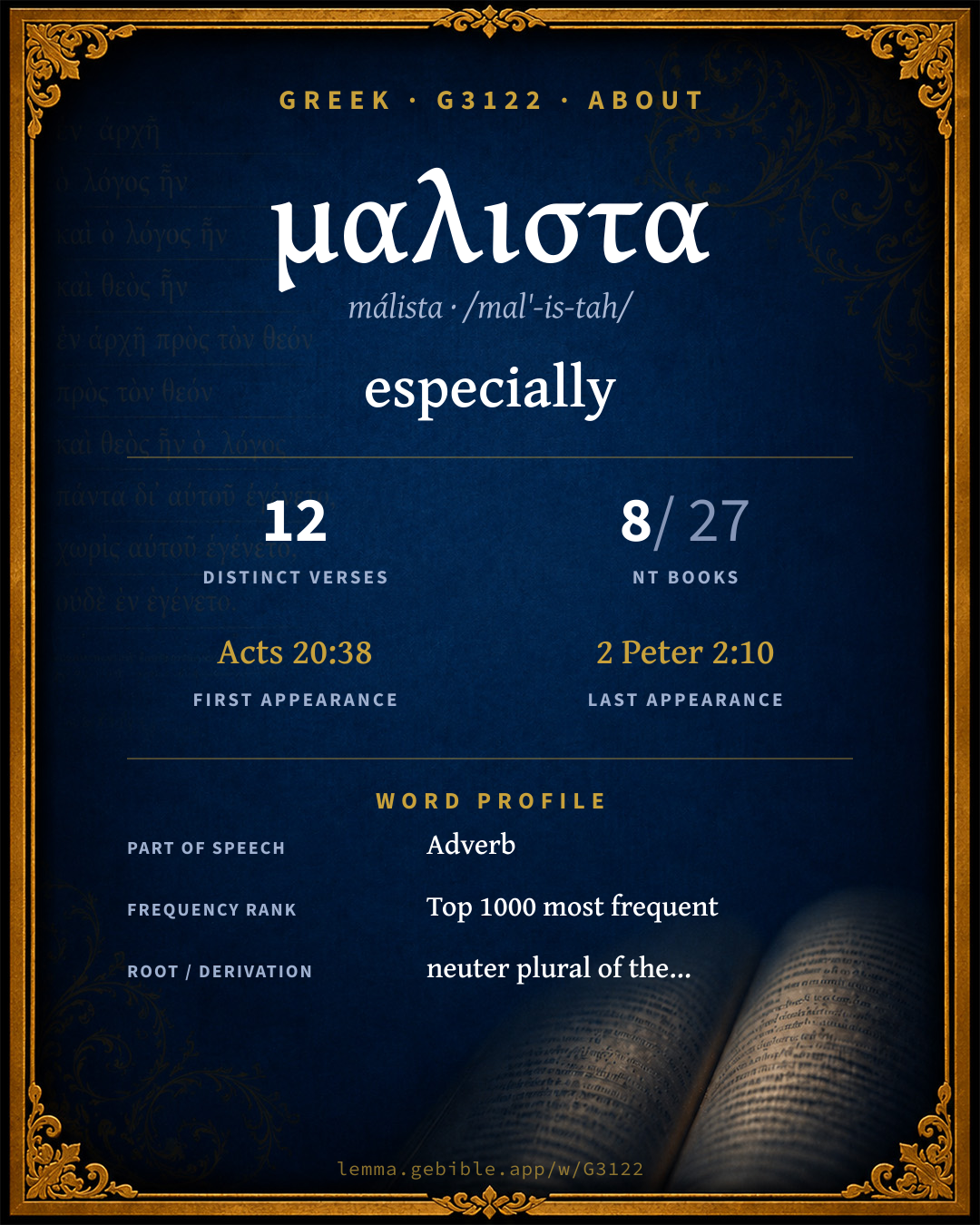
μάλιστα
especially
Full lexicon entry — Thayer's Greek Lexicon
From Thayer's Greek Lexicon
Where this word appears
Grammar key — what these labels mean
Part of speech
- Adverb
- A word that modifies a verb, adjective, or other adverb.
Degree
- Superlative
- Expresses the greatest degree (“greatest,” “most”).
Every verse where G3122 appears — 12 distinct verses across 8 books. Click any verse to open its interlinear word-by-word view. Verse text shown in the World English Bible for context — . Each verse’s Greek form is shown with its reference; the English is not keyword-highlighted, since the data carries no word-level English alignment. Use “Compare translations” on any verse to read it across multiple English versions. This concordance covers the Greek New Testament; Septuagint (Greek Old Testament) occurrences of this word are not indexed here.
Acts 3 verses
- Acts 20:38 μάλιστα adv supl sorrowing most of all because of the word which he had spoken, that they should see his face no more. And they accompanied him to the ship.
- Acts 25:26 μάλιστα adv supl Of whom I have no certain thing to write to my lord. Therefore I have brought him forth before you, and especially before you, King Agrippa, that, after examination, I may have something to write.
- Acts 26:3 μάλιστα adv supl especially because you are expert in all customs and questions which are among the Jews. Therefore I beg you to hear me patiently.
Galatians 1 verse
Philippians 1 verse
1 Timothy 3 verses
- 1 Timothy 4:10 μάλιστα adv supl For to this end we both labor and suffer reproach, because we have set our trust in the living God, who is the Savior of all men, especially of those who believe.
- 1 Timothy 5:8 μάλιστα adv supl But if anyone doesn't provide for his own, and especially his own household, he has denied the faith, and is worse than an unbeliever.
- 1 Timothy 5:17 μάλιστα adv supl Let the elders who rule well be counted worthy of double honor, especially those who labor in the word and in teaching.
2 Timothy 1 verse
Titus 1 verse
Philemon 1 verse
2 Peter 1 verse
About this entry
At a glance — auto-summarized from this page’s data, not written by a person. Every figure links to its source below. This summary describes the numbers; it doesn’t interpret them.
At its core, μαλιστα (málista) means “especially.” Scripture first uses it in Acts 20:38. With 12 verses in 8 books, it is an uncommon word in the Greek New Testament. Its uses concentrate in Acts (25% of all occurrences). Sharing its root, it stands alongside μαλλον. Each statement above links to its evidence; the full detail follows below.
Gloss history
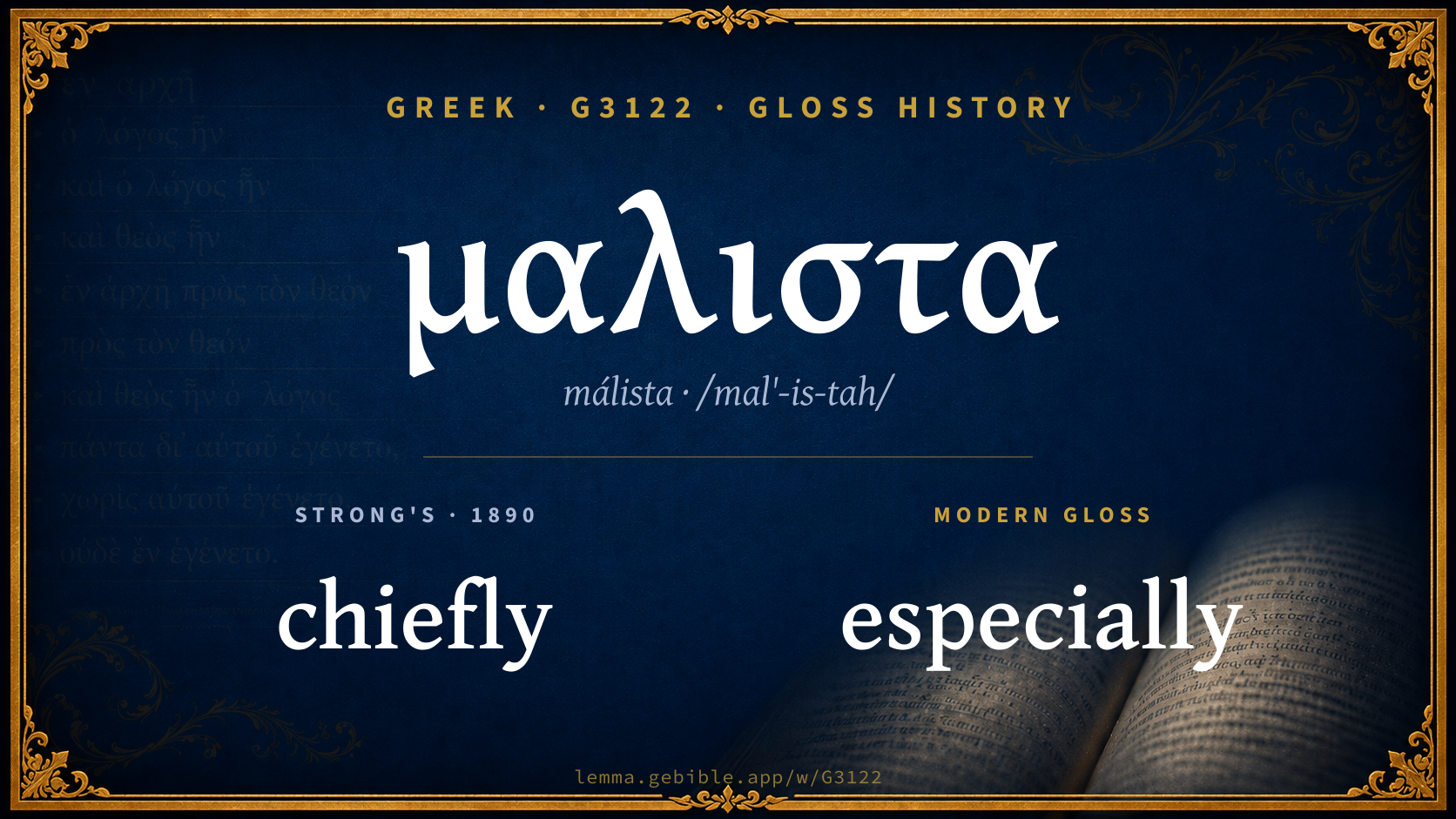
Strong's 1890 vs modern scholarship
About this word
Strong's G3122 catalogs a Greek word from the Greek New Testament.
These counts are not copied from any lexicon or concordance. They are computed here, from the morphology-tagged Greek New Testament. What Lemma adds →
- 12
- distinct verses
- The word appears in 12 distinct verses.
- 8 / 27
- NT books
- The word appears in 8 of 27 New Testament books.
- #904
- by frequency
- Top 1000 most frequent Greek words (rank 904 of 5,347 Greek words by occurrence).
View all 12 occurrences in the concordance →
By section of the New Testament
By traditional corpus
Conventional, traditional groupings — biblical authorship is debated, so this is a traditional corpus grouping, not an authorship claim. Some books belong to more than one corpus (Luke is in both the Gospels and the Lukan corpus, and so on), so these shares overlap and need not total 100%. Each figure is a share of the word’s 12 distinct verses.
- Pauline corpus 8 verses · 67%
- Lukan (Luke–Acts) 3 verses · 25%
- General (Catholic) Epistles 1 verse · 8%
How translations render this word
Counts come from each version’s own published word-to-Strong’s tagging or interlinear alignment — an approximate guide to how each version renders this word, not a word-level alignment the data otherwise carries. Because each total is that version’s own tagged count, the per-version totals vary from one another and need not match the appearance or distinct-verse counts above. These counts may also differ from a printed concordance because Lemma counts each distinctly tagged rendering and does not collapse phrase taggings into a single head-word total. This is a fixed set of word-tagged versions (KJV, ASV, BSB, ULT) and does not change with the reading translation you choose elsewhere. Each version’s license is shown beside its name below (and on Sources).
- King James Version: Specially 5×, Especially 3×, Chiefly 2×
- American Standard Version: Specially 5×, Especially 4×
- Berean Standard Bible: Especially 10×
- unfoldingWord Literal Text: Especially 11×
King James Version Public Domain
Renders G3122 across 11 tagged occurrences — most commonly:
Plus 1 rendering that appears only once — usually multi-word phrases or single function words the recovered tagging swept in, not distinct renderings. Not rendered by a distinct English word in 1 further occurrence.
American Standard Version Public Domain
Renders G3122 across 10 tagged occurrences — most commonly:
Plus 1 rendering that appears only once — usually multi-word phrases or single function words the recovered tagging swept in, not distinct renderings.
Berean Standard Bible Public Domain
Renders G3122 across 11 tagged occurrences — most commonly:
Plus 1 rendering that appears only once — usually multi-word phrases or single function words the recovered tagging swept in, not distinct renderings. Not rendered by a distinct English word in 1 further occurrence.
unfoldingWord Literal Text CC BY-SA 4.0
Renders G3122 across 12 tagged occurrences — most commonly:
Plus 1 rendering that appears only once — usually multi-word phrases or single function words the recovered tagging swept in, not distinct renderings.
Senses in Thayer's
The 1 sense Thayer's distinguishes for this word, in lexicon order (not ranked by frequency or importance). The full entry — with sub-senses — is in the Lexicon Entry tab.
- especially, chiefly, most of all, above all
Word origin
Origin: neuter plural of the superlative of an apparently primary adverb mala (very)
Neuter plural of the superlative of an apparently primary adverb μάλα mala ( very ); (adverb) most ( in the greatest degree ) or particularly : - chiefly most of all (e-) specially.
— Strong’s Exhaustive Concordance (1890), public domain.
Same root — word family
Other Thayer's entries built from the same root as G3122, grouped by Strong’s listed origin. These share a root / origin per the lexicon — not necessarily a shared meaning. Each links to that word’s own entry.
Derived from this word
Compare all same-root words → They share a root, not necessarily a meaning.