

Proverbs 29:20

Hebrew (Westminster Leningrad Codex) Proverbs 29:20 appears in the Hebrew Old Testament. The text above is from the Westminster Leningrad Codex. Each word links to its Strong’s number, a concise gloss, and parsing drawn from the Open Scriptures Hebrew Bible morphology. Click any word for its full Brown-Driver-Briggs (BDB) entry.
Download image
Cite this verse

Proverbs 29:20 (World English Bible). Public Domain. Lemma interlinear Bible study tool, https://lemma.gebible.app/v/proverbs/29/20.

Show BibTeX & RIS
BibTeX
RIS
English Translation
Do you see a man who is hasty in his words? There is more hope for a fool than for him.
World English Bible · Public Domain
Download a study sheet

One document with this verse’s original text, its word-by-word gloss line, the meaning frame, cross-references with their text, attributed commentary, and full source and license credits — printable, and it pastes into notes with its structure intact.

This verse Autodidact and up

Study sheet (.html) Plain text (.txt)

A passage Seminary Student

Up to 50 verses in one chapter. A passage sheet keeps up to 6 commentary sources and 12 cross-references per verse, in the order this page ranks them, and says so on the sheet whenever that leaves anything out. Ask for a single verse and you get the Autodidact verse sheet above.

Everything on this page stays free to read, with no account — the sheet is a download of what is already on screen, not access to it.

Want to remove ads? Support Godless Engineer
Compare translations 3

The same verse in 3 English versions, stacked beneath the original-language interlinear above. Click any original word for its lexicon entry.

Each is an independent rendering of the whole verse — the interlinear is not word-aligned to these translations.

Highlighted words mark where these versions differ — a whole-verse word diff, not a word-by-word alignment.

  • World English Bible Public Domain
    Do you see a man who is hasty in his words? There is more hope for a fool than for him.
  • King James Version Public Domain
    Seest thou a man that is hasty in his words? there is more hope of a fool than of him.
  • unfoldingWord Literal Text CC BY-SA 4.0
    You see a man hurrying in his words. hope for a stupid one than him.

unfoldingWord Literal Text — © unfoldingWord, licensed CC BY-SA 4.0. Word-aligned USFM3 via Door43 (git.door43.org/unfoldingWord/en_ult).

Versions to compare (up to 4)

3 of 4 selected

Show all 18 translations

Every available English version of this verse, each an independent rendering of the whole verse.

  • World English Bible Public Domain
    Do you see a man who is hasty in his words? There is more hope for a fool than for him.
  • Berean Standard Bible Public Domain
    Do you see a man who speaks in haste? There is more hope for a fool than for him.
  • Majority Standard Bible Public Domain
    Do you see a man who speaks in haste? There is more hope for a fool than for him.
  • King James Version Public Domain
    Seest thou a man that is hasty in his words? there is more hope of a fool than of him.
  • American Standard Version (1901) Public Domain
    Seest thou a man that is hasty in his words? There is more hope of a fool than of him.
  • Revised Version (1885) Public Domain
    Seest thou a man that is hasty in his words? there is more hope of a fool than of him.
  • Geneva Bible (1599) Public Domain
    Seest thou a man hastie in his matters? there is more hope of a foole, then of him.
  • Douay-Rheims (1899) Public Domain
    Hast thou seen a man hasty to speak? folly is rather to be looked for, than his amendment.
  • Young's Literal Translation Public Domain
    Thou hast seen a man hasty in his words! More hope of a fool than of him.
  • Literal Standard Version CC BY-SA 4.0
    You have seen a man hasty in his words! More hope of a fool than of him.
  • Unlocked Literal Bible CC BY-SA 4.0
    See a man who is hasty in his words? There is more hope for a fool than for him.
  • unfoldingWord Literal Text CC BY-SA 4.0
    You see a man hurrying in his words. hope for a stupid one than him.
  • Darby Bible Public Domain
    Hast thou seen a man hasty in his words? there is more hope of a fool than of him.
  • World Messianic Bible Public Domain
    Do you see a man who is hasty in his words? There is more hope for a fool than for him.
  • Webster's Bible Public Domain
    Seest thou a man that is hasty in his words? there is more hope of a fool than of him.
  • Free Bible Version CC BY-SA 4.0
    Have you seen a man who speaks without thinking? There's more hope for stupid people than for him!
  • Bible in Basic English Public Domain
    Have you seen a man who is quick with his tongue? There is more hope for a foolish man than for him.
  • JPS Tanakh (1917) Public Domain
    Seest thou a man that is hasty in his words? there is more hope for a fool than for him.

Literal Standard Version (2020), Covenant Press — licensed CC BY-SA 4.0. Text via the HelloAO Bible API (eBible.org). Unlocked Literal Bible (unfoldingWord) — licensed CC BY-SA 4.0. Text via the HelloAO Bible API (eBible.org). unfoldingWord Literal Text — © unfoldingWord, licensed CC BY-SA 4.0. Word-aligned USFM3 via Door43 (git.door43.org/unfoldingWord/en_ult). Free Bible Version, Dr. Jonathan Gallagher — licensed CC BY-SA 4.0. Text via the HelloAO Bible API (eBible.org).

Word by word

More ways to search: Search by grammar → Find every occurrence → Compare this word →

Practice this passage: Drill this verse → Learn its vocabulary →

About this verse

These counts appear in no published source. They are computed here, from the morphology-tagged text and Lemma’s own curated glosses. What Lemma adds →

7
words
7
distinct lemmas
Wisdom
section

Notable vocabulary

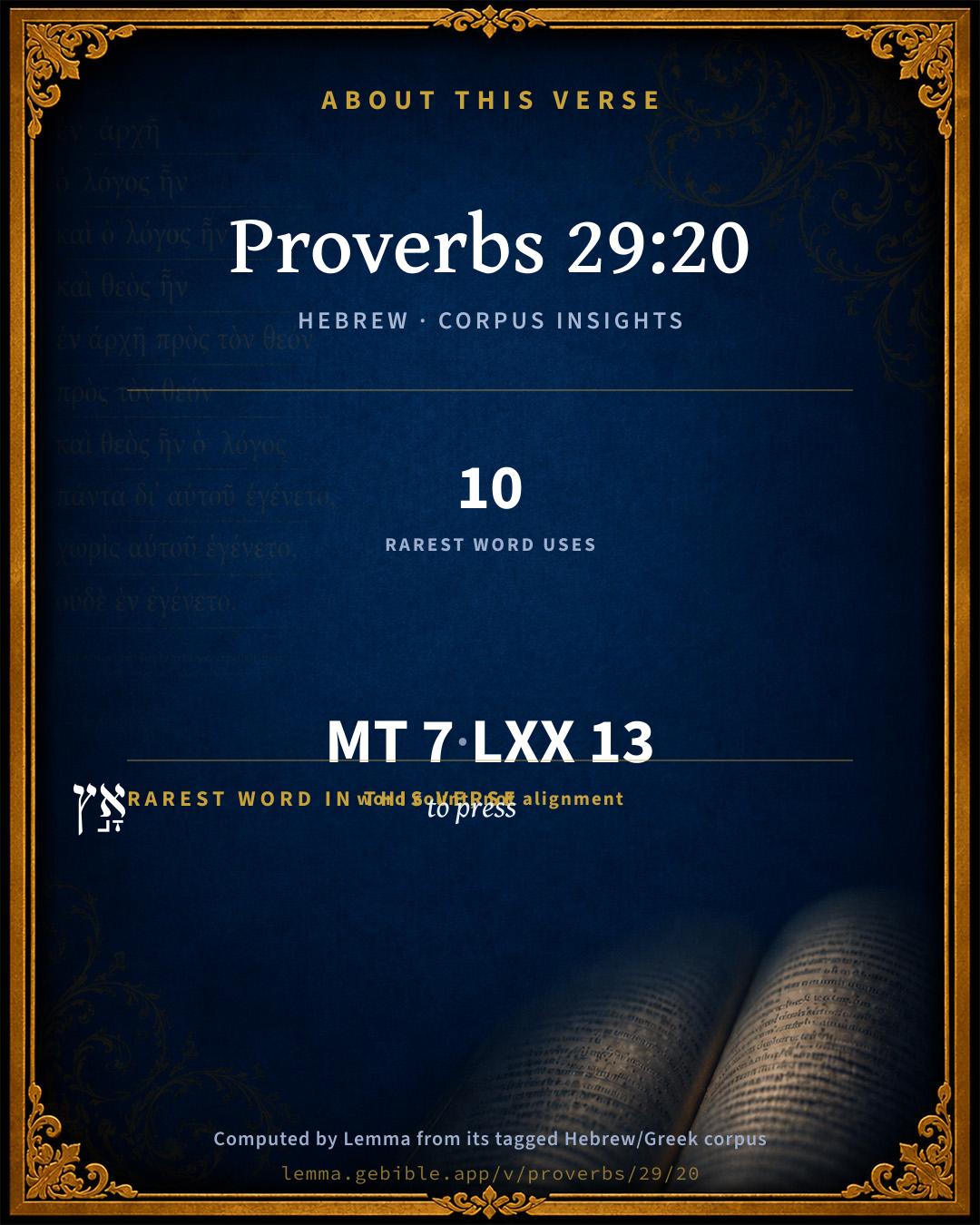
The rarest word here is אָ֣ץ to press H213 — appearing just 10 times in the whole Hebrew Bible.

Shared distinctive vocabulary

אָ֣ץ to press H213 occurs in 10 verses of the Hebrew Bible. Also found in:

Grammatical profile

  • 2 verbs
  • 3 nouns
  • 1 adjective
  • 1 preposition

Verb forms

  • חָזִ֗יתָ Qal · Perfect
  • אָ֣ץ Qal · Participle Active

Hebrew & Septuagint length

In English translation the verse runs 21 words from the Hebrew and 18 from the Septuagint (LXX English) — closely comparable.

A rough comparison of the two English renderings, which tokenize alike — not a word-level alignment.

Word counts can differ between the Hebrew and the Greek without any difference in meaning — e.g. the Hebrew direct-object marker אֵת has no separate Greek word, and Greek often adds the article ὁ.

In the original languages it is 7 Hebrew tokens and 13 Greek tokens — but the two are counted differently (Hebrew bundles its prefixes and suffixes into one token; the Greek is in lemma form), so that isn’t a like-for-like length.

Cross-references

6

Topical passages linked to Proverbs 29:20 in the Treasury of Scripture Knowledge — connected by theme and wording, ordered by reader-vote popularity; previews shown in the World English Bible.

  • Proverbs 26:12 Do you see a man wise in his own eyes? There is more hope for a fool than for him.
  • James 1:19 So, then, my beloved brothers, let every man be swift to hear, slow to speak, and slow to anger;
  • Proverbs 14:29 He who is slow to anger has great understanding, But he who has a quick temper displays folly.
  • Ecclesiastes 5:2 Don't be rash with your mouth, and don't let your heart be hasty to utter anything before God; for God is in heaven, and you on earth. Therefore let your words be few.
  • Proverbs 29:11 A fool vents all of his anger, But a wise man brings himself under control.
  • Proverbs 21:5 The plans of the diligent surely lead to profit; And everyone who is hasty surely rushes to poverty.

Cross-references courtesy of OpenBible.info (CC BY 4.0).

Hebrew and Greek witnesses Masoretic Hebrew ↔ Greek Septuagint

The same verse in the two great witnesses to the Old Testament, shown verse-for-verse.

These are two independent witnesses, not word-aligned to each other, and the Septuagint is shown in lemma (dictionary) form.

Hebrew Proverbs 29:20 Masoretic · Westminster Leningrad Codex

חָזִ֗יתָ אִ֭ישׁ אָ֣ץ בִּדְבָרָ֑יו תִּקְוָ֖ה לִכְסִ֣יל מִמֶּֽנּוּ

Do you see a man who is hasty in his words? There is more hope for a fool than for him.

World English Bible · Public Domain

Greek LXX Proverbs 29:20 Septuagint · lemma form

ἐάν ὁράω ἀνήρ ταχύς ἐν λόγος γιγνώσκω ὅτι ἐλπίς ἔχω μᾶλλον ἄφρων αὐτός

If you see a man hasty in his words, know that the fool has hope rather than he.

LXX2012 (modern English Septuagint) · Public Domain

On this verse, The Pulpit Commentary discusses the Septuagint’s reading. Read the note in Commentary ↓

Hebrew: Westminster Leningrad Codex (CC BY 4.0). Greek: Septuagint (public domain); English from LXX2012 (modern English Septuagint) (Public Domain). How the Septuagint differs from the Hebrew →

Commentary

Notes on Proverbs 29:20 from classic Christian and Jewish commentators (each source and its license shown beneath its notes). The classic Christian expositions comment on the surrounding passage and are grouped to its opening verse, so a note may address several verses; the Jewish commentaries on the Tanakh (Rashi and others) are per-verse, so they appear only where the commentator wrote on this verse.

Lemma curates 59 commentaries, every one of them public domain or Creative Commons licensed, each selected and text-cleaned for this edition rather than reprinted as found. About our sources →

Trapp's Complete Commentary

John Trapp

Pro 29:20 Seest thou a man [that is] hasty in his words? [there is] more hope of a fool than of him.

Ver. 20. Seest thou a man that is hasty in his words.] Or, Matters; that weighs not his words before he utters them, but too soon shoots his fool’s bolt, let it light where it will, hit or miss, it matters not; that had rather be reckoned temerarious than timorous, and is with child till delivered of an abortive birth; that rashly rusheth on the weightiest businesses, and holds it loss of time to take counsel; this hasty, headlong man, as he never wants woe, so - because he is no less headstrong than headlong, wise in his own conceit, than witless in every man’s else - there is more hope of a natural than of him, and sooner he will be wrought upon. Scaliger {a} tells us the nature of some kind of amber is such, that it will draw to itself all kind of stalks of any herb, except basilisk, a herb called capitalis, because it maketh men heady, filling their brains with black exhalations. Thus those hastings, who, by the fumes of their corrupt wills are grown headstrong, and by it are conceited, {Pro 26:12} will not be drawn by that which draws others that are of lower parts and capacities, it being easier to deal with twenty men’s reasons than with one man’s will. Good therefore is the counsel of St James, "Be swift to hear, slow to speak," &c., and of the preacher, {Ecc 5:2} "Be not rash with thy mouth, and let not thy heart be hasty to utter anything before God," in prayer, vows, and especially in preaching. It was a wise speech of Aristides, who being required of the emperor to speak to something propounded ex tempore, answered, Propound today, and I will answer tomorrow; for we are not of those that spit or vomit things, but of those that do them carefully and accurately. {b} Demosthenes in like manner, when it was objected unto him that he came premeditated to plead, answered, that he, if it might be possible, would plead, Non tantum scripta sed etiam sculpta, not things written only, but even engraven. And when Eccius told Melanchthon that it was little for his praise that he was so long ere he answered his adversaries’ arguments - he would take three days sometimes to think on it - he replied, Nos non quaerimus gloriam, sed veritatem, We seek not victory but verity.

{a} Scal., Exercit. 140. Num 12:1-16.

{b} Oυ γαρ ες μεν των εμουντων αλλα των ακριβουντων

John Trapp, A Commentary or Exposition upon All the Books of the Old and New Testament (1647–1656) — public domain. Text from a community e-Sword module.

The Biblical Illustrator

Joseph S. Exell

Pro_29:20

Seest thou a man that is hasty in his words?

Impetuosity of temper

The Adige at Verona appears to be a river quite broad and deep enough for navigation, but its current is so rapid as to make it quite unserviceable. Many men are so rash and impetuous, and at the same time so suddenly angry and excited, that their otherwise most valuable abilities are rendered useless for any good purpose. (C. H. Spurgeon.)

The Biblical Illustrator, edited by Joseph S. Exell (c. 1880s–1900s) — public domain. Text from a community e-Sword module.

Joseph Benson's Commentary

Pro 29:20. Seest thou a man hasty in his words — Or rather, in his business; who is rash and heady in the management of his affairs? There is more hope of a fool — Who is sensible of his folly, and willing to hearken to the advice of others, than of him — Because he is self-confident, and neither considers things seriously within himself, nor seeks counsel from the wise.

Joseph Benson's Commentary on the Old and New Testaments (1811–1818) — public domain. Text from a community e-Sword module.

Matthew Henry's Commentary

Solomon here shows that there is little hope of bringing a man to wisdom that is hasty either, 1. Through rashness and inconsideration: Seest thou a man that is hasty in his matters, that is of a light desultory wit, that seems to take a thing quickly, but takes it by the halves, gallops over a book or science, but takes no time to digest it, no time to pause or muse upon a business? There is more hope of making a scholar and a wise man of one that is dull and heavy, and slow in his studies, than of one that has such a mercurial genius and cannot fix. 2. Through pride and conceitedness: Seest thou a man that is forward to speak to every matter that is started, and affects to speak first to it, to open it, and speak last to it, to give judgment upon it, as if he were an oracle? There is more hope of a modest fool, who is sensible of his folly, than of such a self-conceited one.

Matthew Henry's Commentary on the Whole Bible (1708–1710) — public domain (CC PDM 1.0). Text via the HelloAO Bible API.

Jamieson, Fausset & Brown

Robert Jamieson, A. R. Fausset & David Brown

(Compare Pro 21:5).

hasty in . . . words?--implying self-conceit (Pro 26:12).

Jamieson, Fausset & Brown — Commentary Critical and Explanatory on the Whole Bible (1871) — public domain (CC PDM 1.0). Text via the HelloAO Bible API.

Ellicott's Commentary for English Readers

(20) There is more hope of a fool (khesîl) than of him.—The fool is a dull, self-satisfied person, but may learn better; the man who is hasty and ill-advised in his words has a harder task before him in governing his tongue. (Comp. Jas_3:2 sqq.)

A Bible Commentary for English Readers, edited by Charles John Ellicott (1878–1897) — public domain. Text from a community e-Sword module.

The Cambridge Bible for Schools and Colleges

gen. ed. J. J. S. Perowne

20. Comp. Jas_1:26.

The Cambridge Bible for Schools and Colleges (gen. ed. J. J. S. Perowne; Cambridge University Press, 1878–1918) — public domain. Text from a community e-Sword module.

John Gill's Exposition

Seest thou a man that is hasty in his words,.... Swift to speak either before God or men; that takes upon him to speak upon a subject, or return an answer to a question, before he has thoroughly thought of it, and well considered it, and digested what he should say; see Ecc 5:2; or "hasty in matters" (x); in his business; runs rashly and precipitately into things, without duly considering within himself what is right and proper to be done, and without taking the advice of others;

there is more hope of a fool than of him; of one that has not the gift of elocution, or not so much sagacity in business, and yet takes time to think, and advises with others.

(x) "praecipitem in negotiis suis", Vatablus, Piscator; "in rebus suis", Mercerus.

John Gill's Exposition of the Whole Bible (1746–1763) — public domain (CC PDM 1.0). Text via the HelloAO Bible API.

Haydock's Catholic Bible Commentary

Amendment. St. Jerome (as Evag.) says, after Thucydides: "Ignorance produces confidence, and learning fear."

George Leo Haydock (1774–1849), Haydock's Catholic Family Bible and Commentary, 1859 edition — public domain. Excludes Psalms (Douay-Rheims chapter numbering differs from Protestant) and Deuterocanonical books (Catholic canon only).

Matthew Poole's English Annotations

In his words; or rather, in his business, who is rash and heady in the management of his affairs.

There is more hope of a fool, who is sensible of his folly, and willing to hearken to the advice of others, as this word is used, Pro 26:12, though commonly it be meant of a wilful and wicked fool;

than of him, because he is self-confident, and neither considers things seriously within himself, nor seeks counsel from the wise.

Matthew Poole's English Annotations on the Holy Bible (1683–1685) — public domain. Text from a community e-Sword/MySword module.

Whedon's Commentary on the Bible

Daniel D. Whedon

20. Very similar to Pro_26:12, which see.

Hasty in his words — Urgent to speak on all occasions, or rash, inconsiderate, in the use of words; voluble.

Daniel D. Whedon (gen. ed.), Commentary on the Old and New Testaments (1874–1909) — public domain. Text from a community e-Sword module.

The Pulpit Commentary

Seest thou a man that is hasty in his words?; (comp. Pro_26:12) Vulgate, velocem ad loquendum; Septuagint, tacugoiv . Jam_1:19," Let every man be swift to hear, slow to speak." "A talkative (glwsswdhv ) man is dangerous in his city; and he that is rash (propethv ) in his words shall be hated" (Ecc_9:18). We might also translate, "hasty in his matters," "hasty in business," and the gnome would be equally true. (see note on Pro_19:2) There is more hope era fool than of him. The dull, stupid man (kesil) may be instructed and guided and made to listen to reason; the hasty and ill-advised speaker consults no one, takes no thought before he speaks, nor reflects on the effect of his words; such a man it is almost impossible to reform. (see Jam_3:5, etc.) "Every one that speaks," says St. Gregory, "while he waits for his hearer"s sentence upon his words, is as it were subjected to the judgment of him by whom he is heard. Accordingly, he that fears to be condemned in respect of his words ought first to put to the test that which he delivers that there may be a kind of impartial and sober umpire sitting between the hear and tongue, weighing with exactness whether the heart presents right words, which the tongue taking up with advantage may bring forward for the heater"s judgment" ("Moral.," 8:5, Oxford transl.).

Vers. 20, 22. See homily on ver. 11. C.

The Pulpit Commentary (1880–1919), ed. H.D.M. Spence-Jones & Joseph S. Exell — public domain. Text from a community e-Sword module.

John Wesley's Explanatory Notes

Hasty - Who is rash and heady in the management of his affairs.

John Wesley, Explanatory Notes Upon the Whole Bible (1754–1765) — public domain. Text via the GEBible commentary corpus.

Keil & Delitzsch

C. F. Keil & F. Delitzsch

20 Seest thou a man hasty in his words?

The fool hath more hope than he.

Cf. Pro 26:12. Such an one has blocked up against himself the path to wisdom, which to the fool, i.e., to the ingenuous, stands open; the former is perfect, of the latter something may yet be made. In this passage the contrast is yet more precise, for the fool is thought of as the dull, which is the proper meaning of כּסיל, vid., under Pro 17:24. There is more hope for the fool than for him, although he may be no fool in himself, who overthrows himself by his words. "The προπετὴς ἐν λόγῳ αὐτοῦ (Sir. 9:18) has, in the existing case, already overleaped the thought; the כסיל has it still before him, and comes at length, perhaps with his slow conception, to it" (Hitzig); for the ass, according to the fable, comes at last farther than the greyhound. Hence, in words as well as in acts, the proverb holds good, "Eile mit Weile" [= festina lente]. Every word, as well as act, can only be matured by being thought out, and thought over. From this proverb, which finds its practical application to the affairs of a house, and particularly also to the relation to domestics, the group returns to the subject of instruction, which is its ground-tone.

Keil & Delitzsch — Biblical Commentary on the Old Testament (1861–1891) — public domain (CC PDM 1.0). Text via the HelloAO Bible API. (Old Testament only.)

Bridges on Proverbs

Charles Bridges

We have just been warned against sullen silence. The next warning is directed against hasty words. When a man flows on in his words, evidently without time for consideration (Pro 18:13 ); when he gives his opinion, as if it were a loss of time to take counsel, or regard the judgment of others; when you find him forward in pronouncing judgment before men of acknowledged wisdom and experience; this is the "fool uttering all his mind." (Pro 29:11 ); the man lately marked out for our warning (Pro 26:12 ), as an hopeless fool, "wise in his own conceit."

It is very difficult to deal effectively with him. Until the stronghold of his own conceit be shaken, argument and instruction are lost upon him. The man who is conscious of his weakness, distrusts himself, and is ready to ask and receive counsel; is more likely to be led right, than he, who thinks himself to be right already.

It is a special mercy to be preserved from hasty judgments, or expression of judgments. The first stamp upon a perfect mind is infallibly correct. On an imperfect mind it must be subjected to a careful scrutiny. It is sound wisdom to admit, that our judgment may be mistaken. Self-control and self-diffidence give solid consistency. This character of mind is most important in religious disputations. Be careful to defend or contravene nothing, till you have tested it by the true standard. Moses deferred judgment on the sin before his eyes, till he had brought the matter to God. (Lev 24:12 .) "Be swift to hear; slow to speak." (Jas 1:19 .)

Footnotes:

Charles Bridges, An Exposition of the Book of Proverbs (1846) — public domain. Text from a community e-Sword module.

Rashi

Rabbi Shlomo Yitzchaki (Rashi)

hasty with his words Who hurries and rushes to reply.

there is more hope for a fool than for him A fool has more hope than he.

Rashi on the Tanakh — English translations: “The Judaica Press complete Tanach with Rashi, translated by A. J. Rosenberg” (CC BY 4.0); “Pentateuch with Rashi's commentary by M. Rosenbaum and A.M. Silbermann, 1929-1934” (public domain); “The Metsudah Tanach series, Lakewood, N.J” (CC BY 4.0); and “The Book of Joshua, Metsudah Publications, 1997” (CC BY 4.0). Text via Sefaria.

Lesson kit

Teaching starters — assembled from the data on this page, not authored interpretation. Every prompt links to the verse data it draws on. Edit before teaching.

Proverbs, in the Wisdom, opens this verse with 7 words (7 distinct Hebrew lemmas). Its most distinctive word is ʼûwts (“to press”). A historical commentator’s framing appears above. Read the whole chapter for the surrounding context.

Discussion questions

  1. What does “to press” (ʼûwts) contribute to the verse as a whole?
  2. Genesis 19:15 shares the word «to press» with this verse. How do the two illuminate each other?
  3. The translations on this page render this verse differently — a whole-verse word diff, not a word-by-word alignment. What might account for the different wordings?
  4. The verb «חָזִ֗יתָ» is Qal Perfect. How does its form color the action?
  5. Reading how Trapp's Complete Commentary and The Biblical Illustrator read this verse, where do the two commentators agree and where do they part?

Things to notice

Reading settings

Reading text

Shown beneath each verse's original-language words.

Old Testament
Old Testament edition

Read the OT as the Masoretic Hebrew (MT) or the Greek Septuagint (LXX).

English shown for the Greek Septuagint (in the Hebrew ↔ Greek comparison).

Comparing translations? Open the Compare panel on any verse page to stack up to four side by side.