
Proverbs 15:18

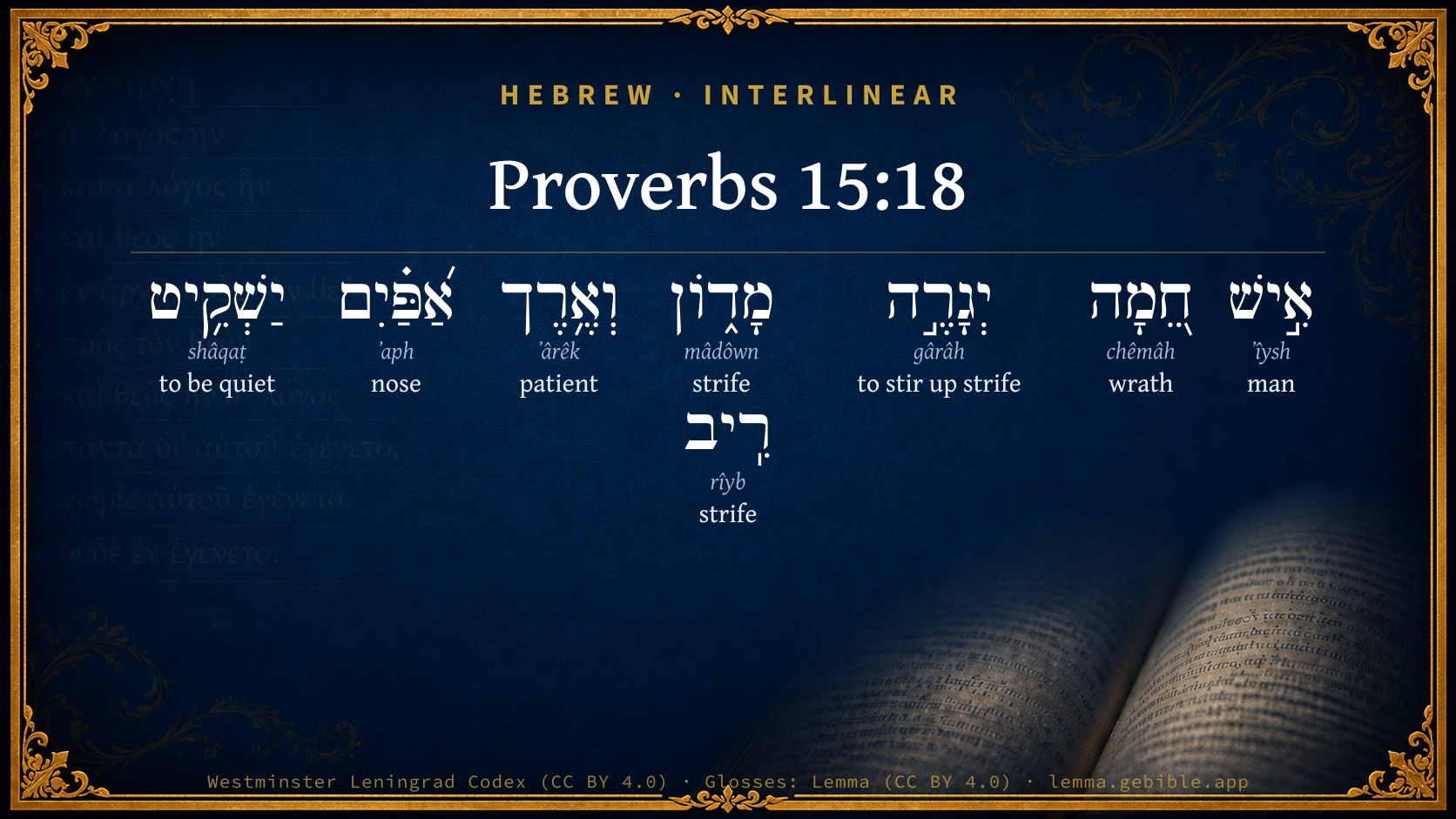
Hebrew (Westminster Leningrad Codex) Proverbs 15:18 appears in the Hebrew Old Testament. The text above is from the Westminster Leningrad Codex. Each word links to its Strong’s number, a concise gloss, and parsing drawn from the Open Scriptures Hebrew Bible morphology. Click any word for its full Brown-Driver-Briggs (BDB) entry.
Download image
Cite this verse

Proverbs 15:18 (World English Bible). Public Domain. Lemma interlinear Bible study tool, https://lemma.gebible.app/v/proverbs/15/18.

Show BibTeX & RIS
BibTeX
RIS
English Translation
A wrathful man stirs up contention, But one who is slow to anger appeases strife.
World English Bible · Public Domain
Download a study sheet

One document with this verse’s original text, its word-by-word gloss line, the meaning frame, cross-references with their text, attributed commentary, and full source and license credits — printable, and it pastes into notes with its structure intact.

This verse Autodidact and up

Study sheet (.html) Plain text (.txt)

A passage Seminary Student

Up to 50 verses in one chapter. A passage sheet keeps up to 6 commentary sources and 12 cross-references per verse, in the order this page ranks them, and says so on the sheet whenever that leaves anything out. Ask for a single verse and you get the Autodidact verse sheet above.

Everything on this page stays free to read, with no account — the sheet is a download of what is already on screen, not access to it.

Want to remove ads? Support Godless Engineer
Compare translations 3

The same verse in 3 English versions, stacked beneath the original-language interlinear above. Click any original word for its lexicon entry.

Each is an independent rendering of the whole verse — the interlinear is not word-aligned to these translations.

Highlighted words mark where these versions differ — a whole-verse word diff, not a word-by-word alignment.

  • World English Bible Public Domain
    A wrathful man stirs up contention, But one who is slow to anger appeases strife.
  • King James Version Public Domain
    A wrathful man stirreth up strife: but he that is slow to anger appeaseth strife.
  • unfoldingWord Literal Text CC BY-SA 4.0
    A man of heat stirs up a quarrel, but one long of nostrils will quiet a dispute.

unfoldingWord Literal Text — © unfoldingWord, licensed CC BY-SA 4.0. Word-aligned USFM3 via Door43 (git.door43.org/unfoldingWord/en_ult).

Versions to compare (up to 4)

3 of 4 selected

Show all 18 translations

Every available English version of this verse, each an independent rendering of the whole verse.

  • World English Bible Public Domain
    A wrathful man stirs up contention, But one who is slow to anger appeases strife.
  • Berean Standard Bible Public Domain
    A hot-tempered man stirs up strife, but he who is slow to anger calms dispute.
  • Majority Standard Bible Public Domain
    A hot-tempered man stirs up strife, but he who is slow to anger calms dispute.
  • King James Version Public Domain
    A wrathful man stirreth up strife: but he that is slow to anger appeaseth strife.
  • American Standard Version (1901) Public Domain
    A wrathful man stirreth up contention; But he that is slow to anger appeaseth strife.
  • Revised Version (1885) Public Domain
    A wrathful man stirreth up contention: but he that is slow to anger appeaseth strife.
  • Geneva Bible (1599) Public Domain
    An angrie man stirreth vp strife: but hee that is slowe to wrath, appeaseth strife.
  • Douay-Rheims (1899) Public Domain
    A passionate man stirreth up strifes: he that is patient appeaseth those that are stirred up.
  • Young's Literal Translation Public Domain
    A man of fury stirreth up contention, And the slow to anger appeaseth strife.
  • Literal Standard Version CC BY-SA 4.0
    A man of fury stirs up contention, || And the slow to anger appeases strife.
  • Unlocked Literal Bible CC BY-SA 4.0
    An angry man stirs up arguments, but a person who is slow to anger quiets a quarrel.
  • unfoldingWord Literal Text CC BY-SA 4.0
    A man of heat stirs up a quarrel, but one long of nostrils will quiet a dispute.
  • Darby Bible Public Domain
    A furious man stirreth up contention; but he that is slow to anger appeaseth strife.
  • World Messianic Bible Public Domain
    A wrathful man stirs up contention, but one who is slow to anger appeases strife.
  • Webster's Bible Public Domain
    A wrathful man stirreth up strife: but he that is slow to anger appeaseth strife.
  • Free Bible Version CC BY-SA 4.0
    Short-tempered people stir up trouble, but those slow to anger calm things down.
  • Bible in Basic English Public Domain
    An angry man makes men come to blows, but he who is slow to get angry puts an end to fighting.
  • JPS Tanakh (1917) Public Domain
    A wrathful man stirreth up discord; but he that is slow to anger appeaseth strife.

Literal Standard Version (2020), Covenant Press — licensed CC BY-SA 4.0. Text via the HelloAO Bible API (eBible.org). Unlocked Literal Bible (unfoldingWord) — licensed CC BY-SA 4.0. Text via the HelloAO Bible API (eBible.org). unfoldingWord Literal Text — © unfoldingWord, licensed CC BY-SA 4.0. Word-aligned USFM3 via Door43 (git.door43.org/unfoldingWord/en_ult). Free Bible Version, Dr. Jonathan Gallagher — licensed CC BY-SA 4.0. Text via the HelloAO Bible API (eBible.org).

Word by word

More ways to search: Search by grammar → Find every occurrence → Compare this word →

Practice this passage: Drill this verse → Learn its vocabulary →

About this verse

These counts appear in no published source. They are computed here, from the morphology-tagged text and Lemma’s own curated glosses. What Lemma adds →

8
words
8
distinct lemmas
Wisdom
section

Notable vocabulary

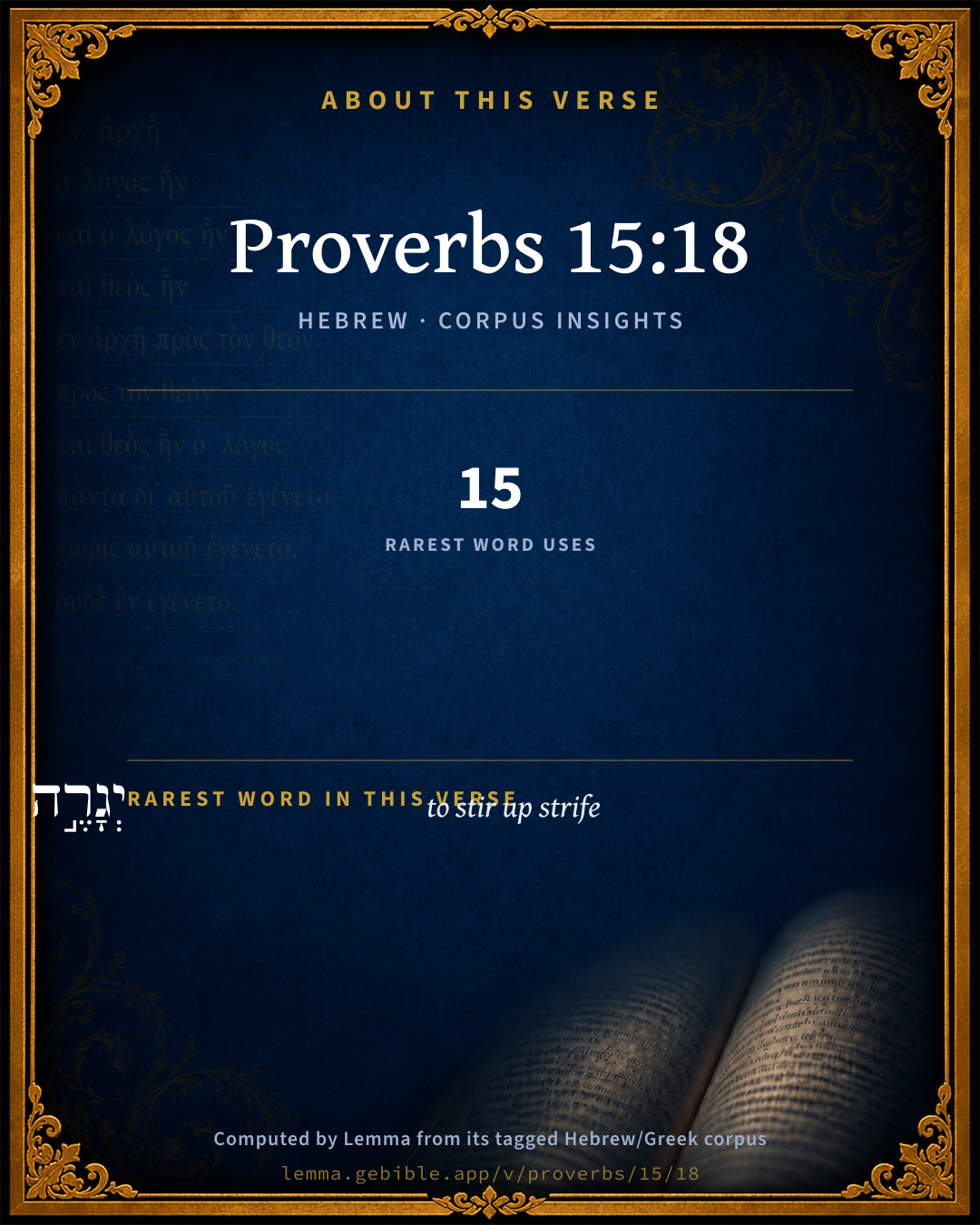
The rarest word here is יְגָרֶ֣ה to stir up strife H1624 — appearing just 15 times in the whole Hebrew Bible.

Shared distinctive vocabulary

יְגָרֶ֣ה to stir up strife H1624 occurs in 13 verses of the Hebrew Bible. Also found in:

Grammatical profile

  • 2 verbs
  • 5 nouns
  • 1 adjective

Verb forms

  • יְגָרֶ֣ה Piel · Imperfect
  • יַשְׁקִ֥יט Hiphil · Imperfect

Hebrew & Septuagint length

In English translation the verse runs 15 words from the Hebrew and 34 from the Septuagint (LXX English) — the Septuagint runs noticeably longer here. See the side-by-side →

A rough comparison of the two English renderings, which tokenize alike — not a word-level alignment.

Word counts can differ between the Hebrew and the Greek without any difference in meaning — e.g. the Hebrew direct-object marker אֵת has no separate Greek word, and Greek often adds the article ὁ.

Cross-references

17

Topical passages linked to Proverbs 15:18 in the Treasury of Scripture Knowledge — connected by theme and wording, ordered by reader-vote popularity; previews shown in the World English Bible.

  • Proverbs 15:1 A gentle answer turns away wrath, But a harsh word stirs up anger.
  • Proverbs 26:21 As coals are to hot embers, And wood to fire, So is a contentious man to kindling strife.
  • Proverbs 29:22 An angry man stirs up strife, And a wrathful man abounds in sin.
  • Matthew 5:9 Blessed are the peacemakers, For they shall be called children of God.
  • Proverbs 14:29 He who is slow to anger has great understanding, But he who has a quick temper displays folly.
  • Ecclesiastes 10:4 If the spirit of the ruler rises up against you, don't leave your place; for gentleness lays great offenses to rest.
  • James 1:19–20 So, then, my beloved brothers, let every man be swift to hear, slow to speak, and slow to anger;
  • Proverbs 10:12 Hatred stirs up strife, But love covers all wrongs.
  • Proverbs 16:28 A perverse man stirs up strife. A whisperer separates close friends.
  • Proverbs 28:25 One who is greedy stirs up strife; But one who trusts in Yahweh will prosper.
  • James 3:14–16 But if you have bitter jealousy and selfish ambition in your heart, don't boast and don't lie against the truth.
  • Genesis 13:8–9 Abram said to Lot, "Please, let there be no strife between me and you, and between my herdsmen and your herdsmen; for we are relatives.
  • Judges 8:1–3 The men of Ephraim said to him, Why have you served us thus, that you didn't call us, when you went to fight with Midian? They did chide with him sharply.
  • 1 Samuel 25:24–44 She fell at his feet, and said, On me, my lord, on me be the iniquity; and please let your handmaid speak in your ears. Hear the words of your handmaid.
  • 2 Samuel 19:43–20:1 The men of Israel answered the men of Judah, and said, We have ten parts in the king, and we have also more [right] in David than you: why then did you despise us, that our advice should not be first had in bringing back our king? The words of the men of Judah were fiercer than the words of the men of Israel.
  • Proverbs 25:15 By patience a ruler is persuaded. A soft tongue breaks the bone.
  • Acts 6:1–5 Now in those days, when the number of the disciples was multiplying, a complaint arose from the Grecian Jews against the Hebrews because their widows were neglected in the daily service.

Cross-references courtesy of OpenBible.info (CC BY 4.0).

Hebrew and Greek witnesses Masoretic Hebrew ↔ Greek Septuagint

The same verse in the two great witnesses to the Old Testament, shown verse-for-verse.

Here the Septuagint runs noticeably longer than the Hebrew — LXX2012 (modern English Septuagint) 34 words vs World English Bible 15. A rough length comparison of the two English translations, not a word-level alignment — read both below.

These are two independent witnesses, not word-aligned to each other, and the Septuagint is shown in lemma (dictionary) form.

Hebrew Proverbs 15:18 Masoretic · Westminster Leningrad Codex

אִ֣ישׁ חֵ֭מָה יְגָרֶ֣ה מָד֑וֹן וְאֶ֥רֶך אַ֝פַּ֗יִם יַשְׁקִ֥יט רִֽיב

A wrathful man stirs up contention, But one who is slow to anger appeases strife.

World English Bible · Public Domain

Greek LXX Proverbs 15:18 Septuagint · lemma form

ἀνήρ θυμώδης παρασκευάζω μάχη μακρόθυμος δέ καί ὁ μέλλω καταπραΰνω μακρόθυμος ἀνήρ κατασβέννυμι κρίσις ὁ δέ ἀσεβής ἐγείρω μᾶλλον

A passionate man stirs up strife; but he that is slow to anger appeases even a rising one. A man slow to anger will extinguish quarrels; but an ungodly man rather stirs them up.

LXX2012 (modern English Septuagint) · Public Domain

On this verse, The Pulpit Commentary discusses the Septuagint’s reading. Read the note in Commentary ↓

Hebrew: Westminster Leningrad Codex (CC BY 4.0). Greek: Septuagint (public domain); English from LXX2012 (modern English Septuagint) (Public Domain). How the Septuagint differs from the Hebrew →

Commentary

Notes on Proverbs 15:18 from classic Christian and Jewish commentators (each source and its license shown beneath its notes). The classic Christian expositions comment on the surrounding passage and are grouped to its opening verse, so a note may address several verses; the Jewish commentaries on the Tanakh (Rashi and others) are per-verse, so they appear only where the commentator wrote on this verse.

Lemma curates 59 commentaries, every one of them public domain or Creative Commons licensed, each selected and text-cleaned for this edition rather than reprinted as found. About our sources →

Trapp's Complete Commentary

John Trapp

Pro 15:18 A wrathful man stirreth up strife: but [he that is] slow to anger appeaseth strife.

Ver. 18. A wrathful man stirreth up strife.] Miscet lites, he mingleth strife with his meat, and feeds upon chafing dishes. Such troublesome guests Augustine forbade his table by these two verses written round about it -

“Quisquis amat dictis aliorum rodere famam,

Hanc mensam vetitam noverit esse sibi.” {a}

This is the worst music at meat that may be. But some men maledictis aluntur, ut venenis capreae. David met with such "hypocritical mockers in feasts," that most uncivilly "gnashed upon him with their teeth." {Psa 35:16} Hence much mischief many times ariseth. For, as Basil noteth, ira excitat rixam, vixa parit convicia, convicia ictus, ictus vulnera, et saepe vulnera mors consequitur: Wrath stirs up strife, strife causeth ill words, ill words draw on blows, bloodshed, and loss of life sometimes.

But he that is slow to anger appeaseth strife.] Is as busy to stint strife, as the other to stir it; brings his buckets to quench this unnatural fire between others, and puts up injuries done to himself, as Jonathan did when his father flung a javelin at him - he rose from table and walked into the field. David also, though provoked, yet he "as a deaf man heard not, and was as one dumb, in whose mouth there was no reproof." Such peaceable and peacemaking men are blessed of God and highly esteemed of men, when wranglers are to be shunned as perilous persons. "Make no friendship with an angry man," saith Solomon. {Pro 22:24} And they are not much to be regarded that with every little offensive breath, or disgraceful word, are blown up into rage, that will not be laid down without revenge or reparation to cure their credits.

{a} Possid. in vit.

John Trapp, A Commentary or Exposition upon All the Books of the Old and New Testament (1647–1656) — public domain. Text from a community e-Sword module.

Tyndale Open Study Notes

Tyndale Open Resources

15:18 Controlling one’s anger is a sign of wisdom (see also Jas 1:19-20).

Tyndale Open Study Notes — © Tyndale Open Resources, licensed CC BY-SA 4.0. Text via the HelloAO Bible API.

Matthew Henry's Commentary

Here is, 1. Passion the great make-bate. Thence come wars and fightings. Anger strikes the fire which sets cities and churches into a flame: A wrathful man, with his peevish passionate reflections, stirs up strife, and sets people together by the ears; he gives occasion to others to quarrel, and takes the occasion that others give, though ever so trifling. When men carry their resentments too far, one quarrel still produces another. 2. Meekness the great peace-maker: He that is slow to anger not only prevents strife, that it be not kindled, but appeases it if it be already kindled, brings water to the flame, unites those again that have fallen out, and by gentle methods brings them to mutual concessions for peace-sake.

Matthew Henry's Commentary on the Whole Bible (1708–1710) — public domain (CC PDM 1.0). Text via the HelloAO Bible API.

Jamieson, Fausset & Brown

Robert Jamieson, A. R. Fausset & David Brown

(Compare Pro 14:29; Pro 16:32).

Jamieson, Fausset & Brown — Commentary Critical and Explanatory on the Whole Bible (1871) — public domain (CC PDM 1.0). Text via the HelloAO Bible API.

The Cambridge Bible for Schools and Colleges

gen. ed. J. J. S. Perowne

18. strife … strife] Contention … strife, R.V., to indicate that the Heb. words are different.

The Cambridge Bible for Schools and Colleges (gen. ed. J. J. S. Perowne; Cambridge University Press, 1878–1918) — public domain. Text from a community e-Sword module.

John Gill's Exposition

A wrathful man stirreth up strife,.... A man of a wrathful disposition, of a furious spirit, of an angry temper; that is under the power and dominion of such a passion, and indulges it, and takes all opportunities to gratify it; he stirs up strife and contention where there was none, or where it was laid; as a man stirs up coals of fire and raises a flame; see Pro 26:21. He stirs up strife in families, sets one relation against another, and the house in an uproar; he stirs up contentions in neighbourhoods, and sets one friend and neighbour against another, whence proceed quarrels and lawsuits: he stirs up strife in churches, breaks brotherly love, and causes animosities and divisions; he stirs up strife in kingdoms and states, whence come wars and fightings, confusion, and every evil work;

but he that is slow to anger appeaseth strife: a man of a quiet and peaceable disposition, possessed of the true grace of charity; who is not easily provoked, longsuffering, bears and endures all things; he allays the heat of anger; he quenches the coals of contention; he calms the storm and makes it quiet, as the word (o) signifies; he

"mitigates strifes raised,''

as the Vulgate Latin version renders it; he composes differences, reconciles the parties at variance, and makes all hush and still; and so prevents the ill consequences of contention and strife.

(o) "faciet quiescere", Pagninus, Montanus; "sedat", Mercerus, Michaelis; so Junius & Tremellius, Piscator, Gejerus; "sedabit", Schultens.

John Gill's Exposition of the Whole Bible (1746–1763) — public domain (CC PDM 1.0). Text via the HelloAO Bible API.

Matthew Poole's English Annotations

Stirreth up strife, because he is very apt both to give and to take all occasions of contention.

Matthew Poole's English Annotations on the Holy Bible (1683–1685) — public domain. Text from a community e-Sword/MySword module.

Whedon's Commentary on the Bible

Daniel D. Whedon

18. A wrathful man — Hebrew, a man of wrath.

Slow to anger — Long of nostril. (See note on Pro_14:17.) Anger makes quarrels; good nature quells them. Compare Pro_15:1; Pro_26:21; Pro_28:25; Pro_29:22.

Daniel D. Whedon (gen. ed.), Commentary on the Old and New Testaments (1874–1909) — public domain. Text from a community e-Sword module.

The Pulpit Commentary

A wrathful man stirreth up strife (contention). This clause recurs almost identically in Pro_29:22. (comp. also Pro_26:21 and Pro_28:25) He that is slow to anger appeaseth strife. (Pro_14:29) In the former clause the word for "contention" is madon, in the latter "strife" is rib, which often means "law dispute." It requires two to make a quarrel, and where one keeps his temper and will not be provoked, anger must subside. Vulgate, "He who is patient soothes aroused quarrels (suscitatas)." Septuagint, "A long suffering man appeases even a coming battle." "Regina rerum omnium patientia.

The LXX here introduces a second rendering of the verse: "A long suffering man will quench suits; but the impious rather awaketh them.

Vers. 18-23. Facets of moral truth.

Again flashing upon us, mostly in the light of contrast. As, indeed, from precious stones and false paste, up to the highest truths of the spirit, we can know nothing truly except by the comparison of its opposite.

I HASTE OF TEMPER AND LONG SUFFERING. (Ver. 18) Quarrelsomeness, irritable words (would that we could recall them!), a thousand stabs and wounds to the heart of our friend and to our own, the result of the former. For the latter, read the exquisite descriptions of the New Testament wherever the word "long suffering" occurs, and see the matchless beauty, and learn to covet the possession of that character the impress of God in human nature and those best gifts which belong to "the more excellent way.

II IDLENESS AND HONESTY. (Ver. 19) The way of the former beset with difficulty. Lazy people take the most trouble, in the affairs of the soul as in everything. The honest path is the only easy path in the long run. We must remember that it is a long run we have to pass over, and must make our choice accordingly. Life is no mere picnic or excursion. For amusement of the leisure hour we may strike into a by-path, but never lose sight of the high road of faith.

III PARENTAL JOY AND SORROW. (Ver. 20) On the whole, these are one of the best indices of a man"s character. A truly good parent may not understand his child, as Mary misunderstood Jesus; but at the bottom of the heart, when there is filial goodness there is parental sympathy and approval.

IV SPURIOUS JOY AND QUIET PERSISTENCE IN RIGHT. (Ver. 21) This is a good contrast. The fool is not content with saying or doing the foolish thing; he must needs chuckle over it and make a boast of it, often gaining applause for his mere audacity. But the man of true sense is content to forego the momentary triumph, and goes on his way. Ever to forsake the way we know to be right, even in momentary hilarity, brings its after sting.

V FAILURE AND SUCCESS IN COUNSELS. (Ver. 22) Wild tumultuous passion causes the former; and calm deliberation, the comparison and collision of many minds, brings about sound and stable policy. To lean upon one"s own weak will, to act in haste or under impulse, how seldom can a prosperous issue come of this! See how individuals rush into lawsuits, nations into war, speculators into bankruptcy, all for want of consultation and good advice. We need the impetus of enthusiasm, not less the direction of cool prudence; if one or the other factor be omitted, disaster must ensue.

VI SEASONABLE WORDS. (Ver. 23) We must consider not only the matter, but the manner, of our utterances. This requires "a mind at leisure from itself" to seize the happy opportunity, to refrain from introducing the jarring note, to turn the conversation when it threatens to strike on breakers. Oh, happy art! admirable and enviable in those that possess it, but cultivable by all who have the gentle heart. We cannot conceive that the conversations of Christ were ever other than thus seasonable. J.

The Pulpit Commentary (1880–1919), ed. H.D.M. Spence-Jones & Joseph S. Exell — public domain. Text from a community e-Sword module.

Keil & Delitzsch

C. F. Keil & F. Delitzsch

Two proverbs of two different classes of men, each second line of which terminates with a catchword having a similar sound (וארך, וארח).

18 A passionate man stirreth up strife,

And one who is slow to anger allayeth contention.

Pro 28:25 and Pro 29:22 are variations of the first line of this proverb. The Pih. גּרה occurs only these three times in the phrase גּרה מדון, R. גר, to grind, thus to strike, to irritate, cogn. to (but of a different root from) the verb עורר, to excite, Pro 10:12, and חרחר, to set on fire, Pro 26:21, cf. שׁלּח, Pro 6:14. Regarding חמה, vid., Pro 15:1; we call such a man a "hot-head;" but the biblical conception nowhere (except in the Book of Daniel) places the head in connection with spiritual-psychical events (Psychologie, p. 254). Regarding ארך אפּים, vid., Pro 14:29; the lxx (which contains a translation of this proverb, and after it of a variation) translates μακρόθυμος δὲ καὶ τὴν μέλλουσαν καταπρᾳύνει, i.e., (as the Syr. render it) he suppresses the strife in its origin, so that it does not break out. But both are true: that he who is slow to anger, who does not thus easily permit himself to become angry, allayeth the strife which one enters into with him, or into which he is drawn, and that he prevents the strife, for he places over against provoking, injurious conduct, patient gentleness (מרפּא, Ecc 10:4).

Keil & Delitzsch — Biblical Commentary on the Old Testament (1861–1891) — public domain (CC PDM 1.0). Text via the HelloAO Bible API. (Old Testament only.)

Bridges on Proverbs

Charles Bridges

18 A wrathful man†a stirreth up strife: but he that is slow to anger appeaseth strife.

This Proverb requires no explanation. But observe the principles of hatred and love, contrasted in active exercise. Some persons make it their occupation to sit by the fire, to feed and fan the flame, lest it be extinguished. An useful and friendly employment, were it a fire to warm. But when it is an injurious, consuming, and destructive element, it would seem difficult to discover the motive of these incendiaries (Pro 10:12 ; Pro 16:27-28 ; Pro 26:21 ), did we not read, that "out of the heart proceed evil thoughts, murders, wickedness, an evil eye, pride, foolishness." (Mar 7:21-22 .)

What then is the Christian’s exercise? Instead of stirring up, to appease, strife; to bring water, not fuel, to the fire; by "a soft answer to turn away wrath;"† by a yielding spirit to melt, subdue, and bring peace. (Gen 13:7-9 . Ecc 10:4 .) Let me remember, that I owe my very salvation to this attribute, slow to anger. (Psa 103:8 . 2Pe 3:15 .) And shall I not endeavour to imbue my profession with this lovely adorning, and to "be a follower of God, as his dear child, walking in love"? (Eph 5:1-2 .) Will not this temper of the gospel secure my earthly enjoyment of godliness? (Mat 5:5 .) Will it not also seal my title as a child of God? (Mat 5:9 .)

Footnotes:

†a ’A man of wrath. Heb. constantly indulging it; unwilling to put it away; a firebrand, Vir flagrantiæ.’ — Schultens. Compare Pro 29:22 .

†1 Pro 15:1. References.

Charles Bridges, An Exposition of the Book of Proverbs (1846) — public domain. Text from a community e-Sword module.

Kretzmann's Popular Commentary

Paul E. Kretzmann

v. 18. A wrathful man, one unable to keep his temper, stirreth up strife, his way of acting is bound to result in quarrels; but he that is slow to anger appeaseth strife, himself refusing to become excited and always making use of conciliatory speeches.

Paul E. Kretzmann, Popular Commentary of the Bible (1921–1924) — public domain. Text from a community e-Sword module.

Rashi

Rabbi Shlomo Yitzchaki (Rashi)

A man of wrath stirs up quarrel A man who has no control over his anger, to be slow to anger, stirs up quarrels.

but he who is slow to anger Who does not hasten to take revenge and to quarrel.

abates strife It ends and abates by itself.

Rashi on the Tanakh — English translations: “The Judaica Press complete Tanach with Rashi, translated by A. J. Rosenberg” (CC BY 4.0); “Pentateuch with Rashi's commentary by M. Rosenbaum and A.M. Silbermann, 1929-1934” (public domain); “The Metsudah Tanach series, Lakewood, N.J” (CC BY 4.0); and “The Book of Joshua, Metsudah Publications, 1997” (CC BY 4.0). Text via Sefaria.

Lesson kit

Teaching starters — assembled from the data on this page, not authored interpretation. Every prompt links to the verse data it draws on. Edit before teaching.

Proverbs, in the Wisdom, opens this verse with 8 words (8 distinct Hebrew lemmas). Its most distinctive word is gârâh (“to stir up strife”). The Greek Septuagint runs longer here. A historical commentator’s framing appears above. Read the whole chapter for the surrounding context.

Discussion questions

  1. What does “to stir up strife” (gârâh) contribute to the verse as a whole?
  2. Deuteronomy 2:5 shares the word «to stir up strife» with this verse. How do the two illuminate each other?
  3. Compared with the Hebrew, the Septuagint runs longer here. What questions does that raise?
  4. These translations render this verse differently; the difference is in the English rendering, not the original. What questions does that raise?
  5. The verb «יְגָרֶ֣ה» is Piel Imperfect. How does its form color the action?
  6. Reading how Trapp's Complete Commentary and Tyndale Open Study Notes read this verse, where do the two commentators agree and where do they part?

Things to notice

Reading settings

Reading text

Shown beneath each verse's original-language words.

Old Testament
Old Testament edition

Read the OT as the Masoretic Hebrew (MT) or the Greek Septuagint (LXX).

English shown for the Greek Septuagint (in the Hebrew ↔ Greek comparison).

Comparing translations? Open the Compare panel on any verse page to stack up to four side by side.