
1 Corinthians 14:18

Greek (Tischendorf 8th ed.) 1 Corinthians 14:18 appears in the Greek New Testament. The text above is from the Tischendorf 8th edition. Each word links to its Strong’s number and a concise gloss. Click any word for its full Thayer’s Greek Lexicon entry.
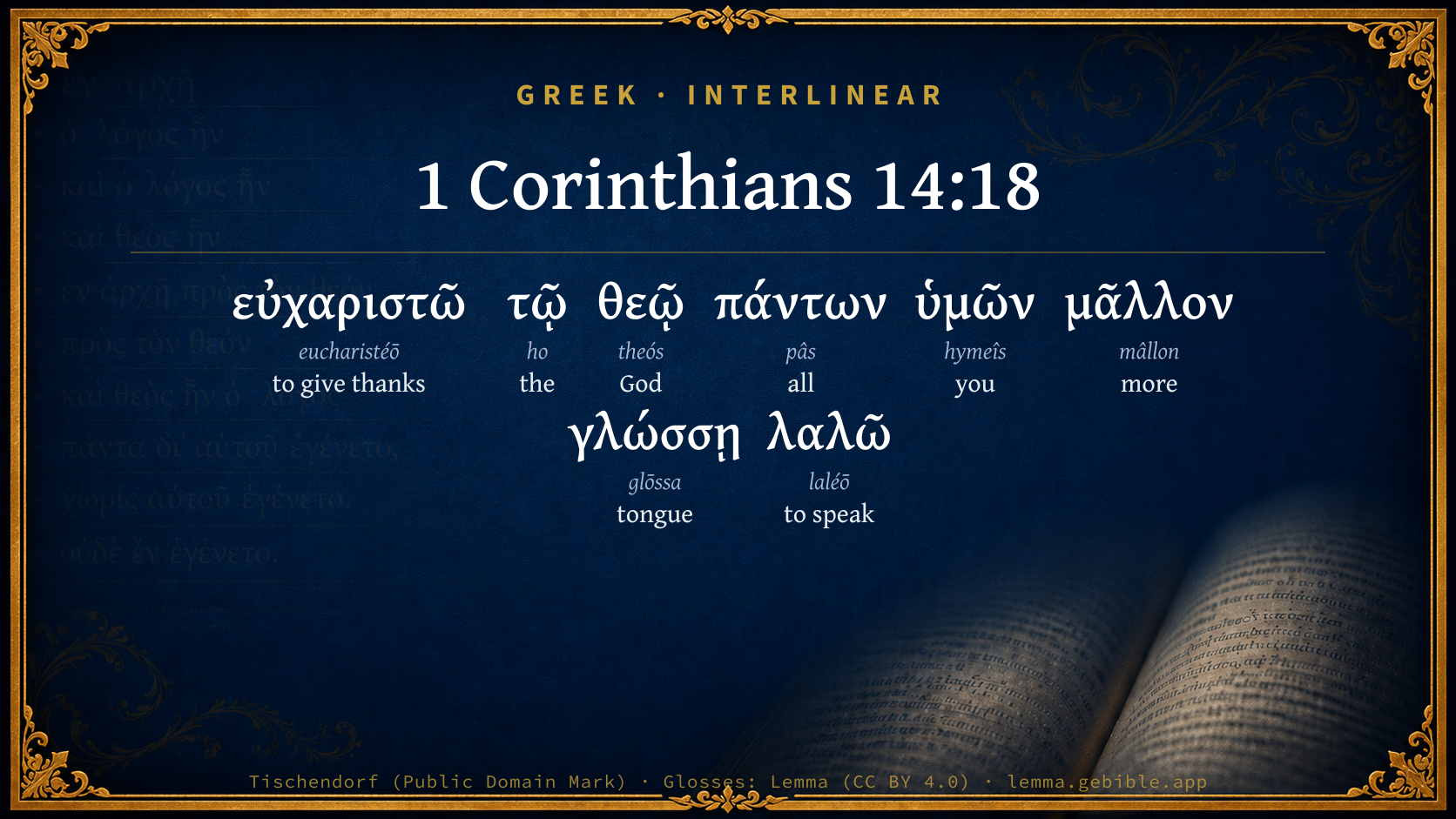
Download image
Cite this verse

1 Corinthians 14:18 (World English Bible). Public Domain. Lemma interlinear Bible study tool, https://lemma.gebible.app/v/1-corinthians/14/18.

Show BibTeX & RIS
BibTeX
RIS
English Translation
I thank my God, I speak with other languages more than you all.
World English Bible · Public Domain
Download a study sheet

One document with this verse’s original text, its word-by-word gloss line, the meaning frame, cross-references with their text, attributed commentary, and full source and license credits — printable, and it pastes into notes with its structure intact.

This verse Autodidact and up

Study sheet (.html) Plain text (.txt)

A passage Seminary Student

Up to 50 verses in one chapter. A passage sheet keeps up to 6 commentary sources and 12 cross-references per verse, in the order this page ranks them, and says so on the sheet whenever that leaves anything out. Ask for a single verse and you get the Autodidact verse sheet above.

Everything on this page stays free to read, with no account — the sheet is a download of what is already on screen, not access to it.

Want to remove ads? Support Godless Engineer
Compare translations 3

The same verse in 3 English versions, stacked beneath the original-language interlinear above. Click any original word for its lexicon entry.

Each is an independent rendering of the whole verse — the interlinear is not word-aligned to these translations.

Highlighted words mark where these versions differ — a whole-verse word diff, not a word-by-word alignment.

  • World English Bible Public Domain
    I thank my God, I speak with other languages more than you all.
  • King James Version Public Domain
    I thank my God, I speak with tongues more than ye all:
  • unfoldingWord Literal Text CC BY-SA 4.0
    I thank God that I speak in tongues more than all of you;

unfoldingWord Literal Text — © unfoldingWord, licensed CC BY-SA 4.0. Word-aligned USFM3 via Door43 (git.door43.org/unfoldingWord/en_ult).

Versions to compare (up to 4)

3 of 4 selected

Show all 19 translations

Every available English version of this verse, each an independent rendering of the whole verse.

  • World English Bible Public Domain
    I thank my God, I speak with other languages more than you all.
  • Berean Standard Bible Public Domain
    I thank God that I speak in tongues more than all of you.
  • Majority Standard Bible Public Domain
    I thank my God that I speak in tongues more than all of you.
  • King James Version Public Domain
    I thank my God, I speak with tongues more than ye all:
  • American Standard Version (1901) Public Domain
    I thank God, I speak with tongues more than you all:
  • Revised Version (1885) Public Domain
    I thank God, I speak with tongues more than you all:
  • Geneva Bible (1599) Public Domain
    I thanke my God, I speake languages more then ye all.
  • Douay-Rheims (1899) Public Domain
    I thank my God I speak with all your tongues.
  • Young's Literal Translation Public Domain
    I give thanks to my God -- more than you all with tongues speaking --
  • Literal Standard Version CC BY-SA 4.0
    I give thanks to my God—more than you all with tongues speaking—
  • Unlocked Literal Bible CC BY-SA 4.0
    I thank God that I speak in tongues more than all of you.
  • unfoldingWord Literal Text CC BY-SA 4.0
    I thank God that I speak in tongues more than all of you;
  • Darby Bible Public Domain
    I thank God I speak in a tongue more than all of you:
  • World Messianic Bible Public Domain
    I thank my God, I speak with other languages more than you all.
  • Webster's Bible Public Domain
    I thank my God, I speak in languages more than ye all:
  • Free Bible Version CC BY-SA 4.0
    I thank God that I can speak in tongues more than all of you.
  • Bible in Basic English Public Domain
    I give praise to God that I am able to make use of tongues more than you all:
  • Text-Critical English NT CC BY 4.0
    I give thanks to my God speaking in tongues more than you all.
  • Tyndale New Testament (1534) Public Domain
    I thanke my god I speake with toges moare then ye all.

Literal Standard Version (2020), Covenant Press — licensed CC BY-SA 4.0. Text via the HelloAO Bible API (eBible.org). Unlocked Literal Bible (unfoldingWord) — licensed CC BY-SA 4.0. Text via the HelloAO Bible API (eBible.org). unfoldingWord Literal Text — © unfoldingWord, licensed CC BY-SA 4.0. Word-aligned USFM3 via Door43 (git.door43.org/unfoldingWord/en_ult). Free Bible Version, Dr. Jonathan Gallagher — licensed CC BY-SA 4.0. Text via the HelloAO Bible API (eBible.org).

Word by word

More ways to search: Search by grammar → Find every occurrence → Compare this word →

Practice this passage: Drill this verse → Learn its vocabulary →

About this verse

These counts appear in no published source. They are computed here, from the morphology-tagged text and Lemma’s own curated glosses. What Lemma adds →

8
words
8
distinct lemmas
Pauline Epistles
section

Shared distinctive vocabulary

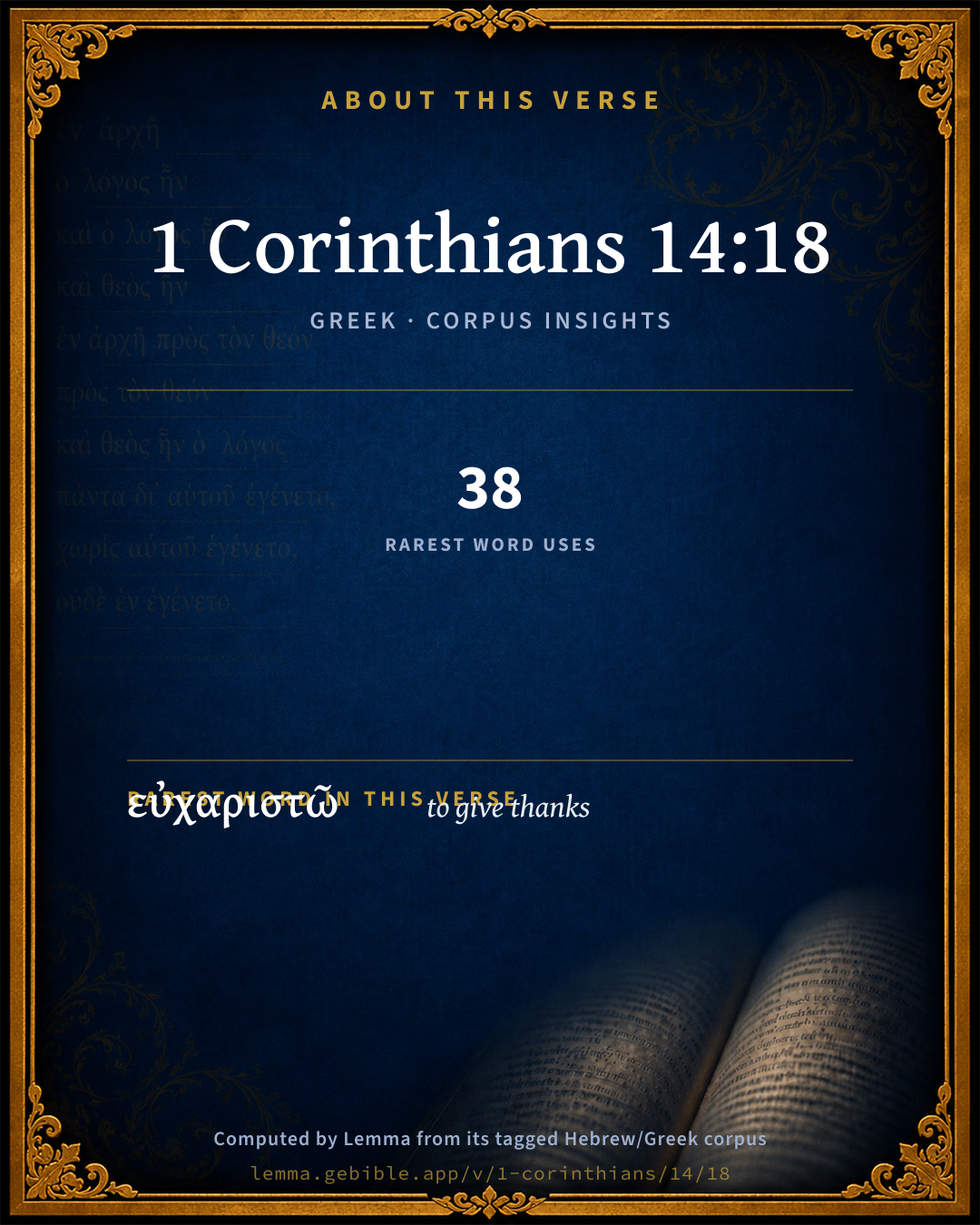
εὐχαριστῶ to give thanks G2168 occurs in 37 verses of the Greek New Testament. Also found in:
Cross-references

2

Topical passages linked to 1 Corinthians 14:18 in the Treasury of Scripture Knowledge — connected by theme and wording, ordered by reader-vote popularity; previews shown in the World English Bible.

  • 1 Corinthians 1:4–6 I always thank my God concerning you, for the grace of God which was given you in Christ Jesus;
  • 1 Corinthians 4:7 For who makes you different? And what do you have that you didn't receive? But if you did receive it, why do you boast as if you had not received it?

Cross-references courtesy of OpenBible.info (CC BY 4.0).

Where the printed editions differ

1 variant

Places in this verse where the major printed Greek editions disagree on the wording in a way that affects the translation — a comparison of editions, not a manuscript-by-manuscript collation. The editions are the modern critical texts (Nestlé-Aland 28/27, SBL, Westcott-Hort, Tregelles, Tyndale House) and the traditional texts behind the KJV (the Textus Receptus and the Byzantine/Majority text). It is not a claim about which reading is original.

  1. Different wording
    γλώσσαις

    “in tongues”

    In NA28NA27TynSBLWHTRByz Not in Treg

    γλώσσῃ (glōssē) 'a tongue' occurs in a few manuscripts (Treg) instead of γλώσσαις (glōssais) 'in tongues' in older manuscripts (NA28+NA27+Tyn+SBL+WH+TR+Byz)

Textual data: Translators Amalgamated Greek New Testament (STEPBible TAGNT) · CC BY 4.0.

Commentary

Notes on 1 Corinthians 14:18 from classic Christian and Jewish commentators (each source and its license shown beneath its notes). The classic Christian expositions comment on the surrounding passage and are grouped to its opening verse, so a note may address several verses; the Jewish commentaries on the Tanakh (Rashi and others) are per-verse, so they appear only where the commentator wrote on this verse.

Lemma curates 59 commentaries, every one of them public domain or Creative Commons licensed, each selected and text-cleaned for this edition rather than reprinted as found. About our sources →

Joseph Benson's Commentary

1Co 14:18-19. I thank my God, &c. — As if he had said, I do not speak thus of foreign languages because I myself am deficient in them, for I must say, to the glory of that Being from whom all my gifts and talents are derived, I speak with tongues more than you all — More than the whole society taken together. “The apostle had this great variety of languages given him by inspiration, that he might be able immediately to preach the gospel to all nations, without spending time in learning their languages. But it must be remembered that the knowledge of so many languages miraculously communicated, was a knowledge for common use, such as enabled the apostle to deliver the doctrines of the gospel clearly and properly; and not such a knowledge of these languages as prevented him in speaking and writing from mixing foreign idioms with them, especially the idioms of his mother tongue. An attention to such trifles was below the grandeur and importance of the work in which the apostle was engaged, and tended to no solid use; these foreign idioms being often more expressive and emphatical than the correspondent classical phrases.” — Macknight. Yet in the church, &c. — Yet so far am I from being vain of this gift, that in the church I had rather speak were it only five plain words with my understanding — In a rational manner, so as not only to understand myself, but to be understood by others; than ten thousand words in an unknown tongue — However sublime and elegant that discourse might be: yea, I had rather be entirely silent in an assembly, than take up their time, and prostitute the extraordinary gifts of God to such a vain and foolish purpose.

Joseph Benson's Commentary on the Old and New Testaments (1811–1818) — public domain. Text from a community e-Sword module.

Tyndale Open Study Notes

Tyndale Open Resources

14:18-19 Paul affirmed the personal value of speaking in tongues, but speaking in a church meeting should help others, not only the speaker.

Tyndale Open Study Notes — © Tyndale Open Resources, licensed CC BY-SA 4.0. Text via the HelloAO Bible API.

Bengel's Gnomon

Johann Albrecht Bengel

1Co 14:18. Εὐχαριστῶ, I give thanks) Paul uses thanksgiving and προθεραπείαν,[125] anticipatory precaution against the charge of egotism, when he is to speak his own praises.—ΠΆΝΤΩΝ, more than you all) more than you individually or even collectively.—ὑμῶν, than you) Frequently, those, who are less accomplished are more proud and act with greater insolence.

[125] See Append.

Bengel's Gnomon of the New Testament — English translation (T&T Clark, Edinburgh, 1860) — public domain. Text from a community e-Sword module.

Meyer's Critical & Exegetical Commentary

Heinrich August Wilhelm Meyer

1Co_14:18-19. Confirmation by the apostles own example of what has been said against the public speaking with tongues.

I thank God, more than you all speak I with the tongue, in a higher degree than you all I have this charisma. Such direct modes of expression, instead of a connecting ὅτι, occur likewise in Greek writers; see Stallbaum, ad Gorg. p. 460 A; Hartung, Partikell. II. p. 134; Kühner, § 760 a. Even the Recepta λαλῶν would have to be taken as stating the ground of the εὐχαρ. τῷ Θεῷ (comp. 1Co_11:29; Act_4:21, al.), not, with Reiche (whom Hofmann follows in his explanation of this reading, which, however, he rightly rejects), as referring to the manner of it (I make more frequently and more fervently than any of you thanksgiving-prayers in glossolalia to God). There would thus result a declaration, the tenor of which hardly suits the character of the apostle, as indeed such an unconditionally expressed assertion could not be upheld by him. Μᾶλλον can only denote the greater measure of the endowment; see already in Chrysosto.

ἐν ἐκκλ.] in the assembled church, opposite of private devotio.

θέλω ἤ] The preferential will (malle) is implied in the logical relation of the relative verbal notion to the particle, without there being any need of supplying μᾶλλον. See Hartung, II. p. 72; Klotz, ad Devar. p. 589 f.; Baeumlein, Partik. p. 136.

Meyer — Critical and Exegetical Commentary on the New Testament — English translation by Peter Christie, edited by Frederick Crombie (T&T Clark, 1880) — public domain. Text from a community e-Sword module.

Expositor's Greek Testament

ed. W. Robertson Nicoll

1Co 14:18-19 . Again ( cf. 6, 1Co 4:6 ; 1Co 4:9 ) the Ap. uses himself for an instance in point. Even at Cor [2105] , where this charism was abundant, no one “speaks with tongues” (mark the pl [2106] γλώσσαις ) so largely as P. does on occasion; far from thinking lightly of the gift, he “thanks God” that he excels in it. 2Co 5:13 ; 2Co 12:1-4 show that P. was rich in ecstatic experiences; cf. Gal 2:2 , Act 9:12 ; Act 16:9 ; Act 22:17 ; Act 27:23 f., etc. The omission of ὅτι after εὐχαριστῶ is exceptional, but scarcely irregular; it belongs to conversational liveliness, and occurs occasionally after a number of the verba declarandi in cl [2107] Gr [2108] : cf. note on δοκῶ κ . τ . λ ., 1Co 4:9 ; and see Wr [2109] , p. 683. The Vg [2110] , omitting μᾶλλον , reads omnium vestrum lingua loquor , making P. thank God that he could speak in every tongue used at Cor [2111] ; Jerome, in his Notes, refers the μᾶλλον to the other App ., as though P. exulted in being a better linguist than any of the Twelve! ἀλλὰ ἐν ἐκκλησίᾳ κ . τ . λ .: “but in church-assembly ( cf. note on 1Co 14:4 ) I would (rather) utter five words with my understanding, that I might indeed instruct others, than ten thousand words in a tongue!” ἀλλὰ contradicts the seeming implication of 1Co 14:18 “but for all that”: one might have supposed that P. would make much of a power in which he excels; on the contrary, he puts it aside and prefers to use every-day speech, as being the more serviceable ; cf. for the sentiment, 1Co 9:19-23 , 2Co 1:24 ; 2Co 4:5 ; 2Co 4:12 ; 2Co 4:15 ; 2Co 11:7 ; 2Co 13:9 , 1Th 2:6 ff. With his Tongue P. might speak in solitude, “to himself and to God” ( 1Co 14:2 ; 1Co 14:28 , 2Co 5:13 ); amongst his brethren, his one thought is, how best to help and benefit them . For νοῦς in contrast with πνεῦμα , see note on 1Co 14:14 ; for its declension, cf. 1Co 1:10 . κατηχέω (see parls.) differs from διδάσκω as it connotes, usually at least, oral impartation (“ut alios voce instituam ,” Bz [2112] ), including here prophecy or doctrine (1Co 14:6 ). On θέλω … ἤ , dispensing with μᾶλλον , see parls.; malim … quam , Bz [2113] For the rhetorical μυρίους , cf. 1Co 4:15 .

[2105] Corinth, Corinthian or Corinthians.

[2106] plural.

[2107] classical.

[2108] Greek, or Grotius’ Annotationes in N.T.

[2109] Winer-Moulton’s Grammar of N.T. Greek (8th ed., 1877).

[2110] Latin Vulgate Translation.

[2111] Corinth, Corinthian or Corinthians.

[2112] Beza’s Nov. Testamentum: Interpretatio et Annotationes (Cantab., 1642).

[2113] Beza’s Nov. Testamentum: Interpretatio et Annotationes (Cantab., 1642).

The Expositor's Greek Testament, edited by W. Robertson Nicoll (1897–1910) — public domain. Text from a community e-Sword module.

Godet's Commentaries

Frédéric Louis Godet

Vv. 18, 19. “I thank God, I speak in tongues more than ye all; 19. yet in the Church I had rather speak five words with my understanding, that I might teach others also, than ten thousand words in tongues.”

The apostle means by 1Co 14:18 that he by no means disdains the gift of tongues, so highly prized at Corinth; he even thanks God for having bestowed it on him richly. These words have been understood in two ways; by some: “I give thanks, I bless, I adore, in the form of discoursing in tongues, more than you all.” In this sense, we should have to prefer the reading λαλῶν, speaking, of the T. R. or that of the Alexandrinus, which simply rejects the word λαλῶ or λαλῶν: “I give thanks in tongues, more than you all.” But I think it probable that these two poorly supported readings are corrections whereby it has been sought to give the word εὐχαριστεῖν the same meaning as it had in 1Co 14:17: to thank God in an ecstatic discourse. The true reading is undoubtedly λαλῶ, I speak. This verb would require in strictness to be connected with the foregoing εὐχαριστῶ, I give thanks, by the conjunction ὅτι, for the fact that (as is the case in the reading of F G); but very often in classical Greek this conjunction is omitted, and the two verbs are simply put in juxtaposition: “I give thanks, I speak...” for: “I give thanks for the fact that I speak.” This is probably the true reading. Moreover, this meaning might also be that of the reading λαλῶν.

We must, with the Alex. and Greco-Lats., reject the μου after θεῷ, for which there is no sufficient ground in the context.

There is room for hesitation between the plural (tongues) and the singular. Both readings are admissible. But what is inconceivable is, how Meyer in such a passage can still apply the term tongue to the material organ: Paul giving thanks to God because he speaks more than all the Corinthians by means of his tongue! And if we read the plural, then this meaning becomes altogether absurd (comp. 1Co 14:5).

It should be remarked that he does not say: “Because I speak in more tongues than you all;” as he would require to do if he was thinking of actually existing foreign tongues; but: “Because I speak in tongues more than you all.” It is a mode of speaking in which he surpasses them all.

Vv. 19. After paying this homage to glossolalia, the apostle consigns this gift to its place. This place is the domain of private edification, not public worship. The emphasis is on the word ἐν ἐκκλησίᾳ, in the assembly. The contents of the verse are explained by 1Co 14:4: He that speaks in tongues edifies himself; but he gives nothing to the Church.

In the reading τῷ νοΐ μου, the words denote the mental state of the speaker (of sober sense). In the received reading (διὰ τοῦ νοός μου), the νοῦς, the understanding, comes in as the instrument of assimilation by means of which the intuitions of the prophet and the thoughts suggested to the teacher are conveyed to the Church. The also before ἄλλους signifies: “Not only myself, as would be the case with the gift of tongues, but others also.”

In the form θέλω ἤ, the ἤ, than, depends on the idea of comparison contained in θέλω. Classic Greek thus uses ἤ with θέλω and βούλομαι (see Edwards). The verb κατηχεῖν, to make a sound penetrate to the ears of any one, comes thus to signify to instruct, catechise. The term includes the two gifts of prophecy and teaching. The apostle concludes this whole development with a saying intended to lead the imprudent and frivolous Corinthians to serious reflection.

Frédéric Louis Godet — Commentaries on Luke, John, Romans, and 1 Corinthians — English translation (T&T Clark, Edinburgh, 1870s–1890s) — public domain. Text from a community e-Sword module.

Hodge's Commentary on Romans, Ephesians & First Corinthians

Charles Hodge

1Co_14:18, 1Co_14:19

I thank my God, I speak with tongues more than ye all: yet in the church I had rather speak live words with my understanding, that (by my voice) I might teach others also, than ten thousand words in an (unknown) tongue.

That Paul should give thanks to God that he was more abundantly endowed with the gift of tongues, if that gift consisted in the ability to speak in languages which he himself did not understand, and the use of which, on that assumption, could according to his principle benefit neither himself nor others, is not to be believed. Equally clear is it from this verse that to speak with tongues was not to speak in a state of mental unconsciousness. The common doctrine as to the nature of the gift, is the only one consistent with this passage. Paul says that although he could speak in foreign languages more than the Corinthians, he would rather speak five words with his understanding, i.e. so as to be intelligible, than ten thousand words in an unknown tongue. In the church, i.e. in the assembly. That I might teach others also, (κατηχέω) to instruct orally, Gal_6:6. This shows what is meant by speaking with the understanding. It is speaking in such a way as to convey instruction.

Charles Hodge — Commentary on Romans (1835), First Corinthians (1857), and Ephesians (1856) — public domain. Text from a community e-Sword module.

Geneva Bible (1599)

Geneva Bible translators

He propoundeth himself for an example, both that they may be ashamed of their foolish ambition, and also that he may eschew all suspicion of envy.

Geneva Bible (1599) marginal notes — public domain. Text via Bolls.life.

Jamieson, Fausset & Brown

Robert Jamieson, A. R. Fausset & David Brown

tongues--The oldest manuscripts have the singular, "in a tongue [foreign]."

Jamieson, Fausset & Brown — Commentary Critical and Explanatory on the Whole Bible (1871) — public domain (CC PDM 1.0). Text via the HelloAO Bible API.

Adam Clarke's Commentary

Verse 18. I speak with tongues more than ye all] He understood more languages than any of them did: and this was indispensably necessary, as he was the apostle of the Gentiles in general, and had to preach to different provinces where different dialects, if not languages, were used. In the Hebrew, Syriac, Greek, and Latin, he was undoubtedly well skilled from his education; and how many he might understand by miraculous gift we cannot tell. But, even literally understood, it is very probable that he knew more languages than any man in the Church of Corinth.

Adam Clarke's Commentary on the Bible (1810–1826) — public domain. Text from a community e-Sword/MySword module.

John Calvin's Commentaries

18. I thank, etc. As there are many that detract from another’s excellencies, in which they cannot themselves have distinction, Paul, that he might not seem to depreciate, through malignity or envy, the gift of tongues, anticipates that suspicion, by showing that he is, in this respect, superior to them all. “See,” says he, “how little occasion you have to suspect the design of my discourse, as if I depreciated what I myself lacked; for if we were to contend as to tongues, there is not one of you that could bear comparison with me. While, however, I might display myself to advantage in this department., I am more concerned for edification.” Paul’s doctrine derives no small weight from the circumstance, that he has not an eye to himself. Lest, however, he should appear excessively arrogant, in preferring himself before all others, he ascribes it all to God. Thus he tempers his boasting with modesty.

John Calvin's Commentaries (1540-1563) — public domain. Text from the Calvin Translation Society English edition (1840s-50s) via the Christian Classics Ethereal Library (ccel.org). Calvin's coverage is partial (roughly two-thirds of the Bible); uncommented books and verses are honest gaps, never fabricated. The 19th-century editor's footnotes and remarks are omitted so the notes are faithfully Calvin's own voice.

Ellicott's Commentary for English Readers

(18, 19) I thank my God.—Here the Apostle resumes in the first person, coming back, after the parenthesis, to the continuation of his own desire and example. He does not undervalue that gift the misuse and exaggeration of which he is censuring; he possesses it himself in a remarkable degree; yet in the Church (i.e., in any assembly of Christians for prayer or instruction) he would prefer to speak five words with his mind rather than ten thousand with a tongue only; for the object of such assemblies is not private prayer or private ecstatic communion with God, but the edification of others. The word used for “teach” in this verse is literally our word catechise.

A Bible Commentary for English Readers, edited by Charles John Ellicott (1878–1897) — public domain. Text from a community e-Sword module.

The Cambridge Bible for Schools and Colleges

gen. ed. J. J. S. Perowne

18. I thank my God, I speak with tongues more than you all] St Paul, no doubt, had the gift of interpretation. Yet apparently he did not often exercise in public, whatever he may have done in private, the gift of speaking with tongues unknown to his hearers. See next verse.

The Cambridge Bible for Schools and Colleges (gen. ed. J. J. S. Perowne; Cambridge University Press, 1878–1918) — public domain. Text from a community e-Sword module.

John Gill's Exposition

I thank my God, I speak with tongues more than you all. This the apostle says, to observe to them that he did not despise speaking with tongues: nor did he endeavour to beat them off, and dissuade them from desiring them, or envied their having them, because he was destitute of them himself; for he had this gift in a very eminent manner, and oftentimes made use of it, and was frequently under a necessity of so doing; he could speak with more tongues than any of those that had them, and spoke them oftener than they did; having occasion for them through his travelling into different countries, and preaching the Gospel to people of divers languages; and this he mentions also not in a boasting manner, but in great humility, giving thanks to God, and acknowledging him to be the author of this gift.

I thank my God, I speak with tongues more than you all. This the apostle says, to observe to them that he did not despise speaking with tongues: nor did he endeavour to beat them off, and dissuade them from desiring them, or envied their having them, because he was destitute of them himself; for he had this gift in a very eminent manner, and oftentimes made use of it, and was frequently under a necessity of so doing; he could speak with more tongues than any of those that had them, and spoke them oftener than they did; having occasion for them through his travelling into different countries, and preaching the Gospel to people of divers languages; and this he mentions also not in a boasting manner, but in great humility, giving thanks to God, and acknowledging him to be the author of this gift.

1 Corinthians 14:19

co1 14:19

co1 14:19

co1 14:19Yet in the church I had rather speak five words,.... Referring not to the five books of Moses, as Jerom suggests, and much less, as the Papists say, to the five words, "for this is my body"; by the muttering of which they suppose the bread in the Lord's supper to be transubtantiated into the body of Christ; but meaning a very few words, which he chose to speak in the church before the congregation, when and where saints were met together for public worship, for their edification and comfort, and the glory of God; for though at other times, and to other people, he might think fit to make use of his gift in speaking with divers tongues, yet at such a time and place he thought it much more eligible to say ever so few words

with understanding: so as to be understood by others, as well as himself:

that by my voice I might teach others also; the doctrines of the Gospel, the mysteries of grace, the duty of men towards God and men, and one another:

than ten thousand words in an unknown tongue; than to deliver ever so long an oration in a language not understood by them, which could be of no use unto them; for though they might hear his voice, the sound of his words, yet thereby he could not teach and instruct them to their profit, unless they understood the language which he spoke; and therefore five words understood were more likely to be of use than ten thousand spoken in a strange language.

John Gill's Exposition of the Whole Bible (1746–1763) — public domain (CC PDM 1.0). Text via the HelloAO Bible API.

Trapp's Complete Commentary

John Trapp

18 I thank my God, I speak with tongues more than ye all:

Ver. 18. I thank my God, &c.] Skill in tongues is, as now, a great blessing. Indeed at first when men began θεομαχειν, to fight against God, they were compelled λογομαχειν, to babble in divers languages, 72, as Epiphanius affirmeth. But God hath turned this curse into a blessing unto his people, Act 2:4-13, and as in the first plantation of the gospel, so in the late reformation; God sent it before, as his munition to batter the forts of Antichrist, who had banished arts and languages, overspreading all with barbarism and atheism. Graece nosse suspectum erat. Hebraice fere haereticum.

John Trapp, A Commentary or Exposition upon All the Books of the Old and New Testament (1647–1656) — public domain. Text from a community e-Sword module.

Albert Barnes' Notes on the Bible

I thank my God - Paul here shows that he did not undervalue or despise the power of speaking foreign languages. It was with him a subject of thanksgiving that he could speak so many; but he felt that there were more valuable endowments than this; see the next verse.

With tongues more than ye all - I am able to speak more foreign languages than all of you. “How many” languages Paul could speak, he has no where told us. It is reasonable, however, to presume that he was able to speak the language of any people to whom God in his providence, and by his Spirit, called him to preach. He had been commissioned to preach to the “Gentiles,” and it is probable that he was able to speak the languages of all the nations among whom he ever traveled. There is no account of his being under a necessity of employing an interpreter wherever he preached.

Albert Barnes' Notes on the Bible (1834–1885) — public domain. Text from a community e-Sword/MySword module.

Matthew Poole's English Annotations

Our Saviour, in the parable of the good shepherd, gives us this as his character, that the sheep hear his voice, and follow him, Joh 10:4; and we shall observe this great apostle every where propounding himself for imitation to them. They are bad shepherds over God’s flock, that must only be heard, but not followed. The apostle lets them know, that God had not left him without the gift of speaking with divers tongues, nay, he had it in a more eminent manner than them all; put them all together, they could not speak with so many tongues as he did.

Matthew Poole's English Annotations on the Holy Bible (1683–1685) — public domain. Text from a community e-Sword/MySword module.

Whedon's Commentary on the Bible

Daniel D. Whedon

18. Thank… God—Paul here indicates, 1. That the charism of tongues was a gift to be thankful for; 2. Calls to mind, in a manner implying that the Corinthians would not deny, the affluence of his gifts; 3. Implies that he not only possessed, but used, the power in actual exercise; 4. That, therefore, he assigned tongues a subordinate place from no envy to those displaying them; and, 5. Prepares by all this for his decisive sentence next to be uttered against the use of tongues uninterpreted.

Daniel D. Whedon (gen. ed.), Commentary on the Old and New Testaments (1874–1909) — public domain. Text from a community e-Sword module.

The Pulpit Commentary

I speak with tongues; rather, with a tongue. More than ye all. This is exactly what we should expect of the emotional, impassioned nature of St. Paul, who was so wholly under the influence of the Spirit of God. But it is clear from all that he has been saying that, while the personal and evidential value of this gift of yielding his whole being to the spiritual impulse, which expressed and relieved itself by inarticulate utterance, was such as to make him "thank God" that he possessed it, he must either have exercised it only in private gatherings or must have always accompanied it by interpretation.

The Pulpit Commentary (1880–1919), ed. H.D.M. Spence-Jones & Joseph S. Exell — public domain. Text from a community e-Sword module.

McGarvey & Pendleton's Commentaries

J. W. McGarvey

I thank God, I speak with tongues more than you all:

J. W. McGarvey (with Philip Y. Pendleton), Commentaries on the New Testament (The Fourfold Gospel, 1914; Acts; and the epistles) — public domain. Text from a community e-Sword/MySword module.

The People's New Testament

B. W. Johnson

18–22. I had rather speak five words, etc. All must be done to edification. Hence, all must be understood. There is a lesson here to preachers who are so learned in their utterances that the people cannot understand them.

B. W. Johnson's The People's New Testament with Notes (1889–1891) — public domain. Electronic text from the Christian Classics Ethereal Library (CCEL) ThML edition.

Cambridge Greek Testament for Schools and Colleges

18. γλώσσῃ λαλῶ. So אDEFG, Vetus Lat. Vulg. B and Peshito have γλώσσαις λαλῶ. A has γλώσσῃ, and omits λαλῶ. Rec. γλώσσαις λαλῶν.

18. πάντων ὑμῶν μᾶλλον. St Paul, no doubt, had the gift of interpretation. Yet apparently he did not often exercise in public, whatever he may have done in private, the gift of speaking with tongues unknown to his hearers. See next verse.

Cambridge Greek Testament for Schools and Colleges (Cambridge University Press, 1896; 21 vols, various authors incl. Carr, Maclear, Plummer, Farrar, Lumby, Moule, M. R. James, Simcox) — public domain. Text from a community e-Sword module.

International Critical Commentary

18. Third argument, from his own case; comp. v. 6, 4:6, 9:1 f., 13:1-3. He, if any one, has a right to speak with Tongues in the congregation, yet he will not. He knows what he is talking about; he is not depreciating a gift of which he has no experience. In 13:1 he spoke hypothetically of possessing this gift. Here he says plainly that he possesses it with greater intensity than all of them, which perhaps implies that the fact was not generally known, because he exercised the gift in private. Here we have strong evidence that Tongues are not foreign languages. He does not say that he speaks ‘in more tongues’; and he could use his understanding in speaking Latin or Syriac just as much as in speaking Greek. In saying that the man who was most richly endowed with this gift was one who abstained from using it in public, he perhaps hints that those who were not greatly endowed were the people who gave themselves most airs about it.

εὐχαριστῶ τῷ Θεῷ. This cannot refer to the Eucharist, and to some extent confirms the view that vv. 16, 17 do not.

πάντων ὑμῶν μᾶλλον. The emphatic position of πάντων perhaps means ‘more than all of you put together’: but ‘more than any of you’ is sufficient for the argument. The omission of ὅτι before πάντων raises the second sentence in importance, making it co-ordinate instead of dependent. How “perfectly sane and sober” the Apostle is in all this is well pointed out by Weinel, St Paul, pp. 142 f.

The AV. inserts ‘my’ before ‘God,’ with K L, Vulg. But nearly all other authorities omit. It is more difficult to decide between γλώσσῃ (א A D E F G 17, Latt. Arm.) and γλώσσαις (B K L P, Syrr. Copt. Aeth. Chrys. Thdrt.). But λαλῶ (אB D E P 17, Latt. Syrr. Copt. Arm.) is to be preferred to λαλῶν (KL, Chrys. Thdrt.), which is a correction arising from the absence of ὅτι. The omission of μᾶλλον is curious; omnium vestrum lingua loquor (Vulg. d f). A omits λαλῶ; ‘I give thanks in a Tongue.’

International Critical Commentary — older volumes (1896–1929), various authors — public domain. Text from a community e-Sword module.

Lesson kit

Teaching starters — assembled from the data on this page, not authored interpretation. Every prompt links to the verse data it draws on. Edit before teaching.

1 Corinthians, in the Pauline Epistles, opens this verse with 8 words (8 distinct Greek lemmas). Its most distinctive word is eucharistéō (“to give thanks”). A historical commentator’s framing appears above. Read the whole chapter for the surrounding context.

Discussion questions

  1. What does “to give thanks” (eucharistéō) contribute to the verse as a whole?
  2. How does Matthew 15:36, which shares the word «to give thanks», read alongside this verse?
  3. The translations on this page render this verse differently — a whole-verse word diff, not a word-by-word alignment. What might account for the different wordings?
  4. Compare how Joseph Benson's Commentary and Tyndale Open Study Notes read this verse. Where do they agree or differ?

Things to notice

Reading settings

Reading text

Shown beneath each verse's original-language words.

Old Testament
Old Testament edition

Read the OT as the Masoretic Hebrew (MT) or the Greek Septuagint (LXX).

English shown for the Greek Septuagint (in the Hebrew ↔ Greek comparison).

Comparing translations? Open the Compare panel on any verse page to stack up to four side by side.