Ephesians 5:4

Greek (Tischendorf 8th ed.) Ephesians 5:4 appears in the Greek New Testament. The text above is from the Tischendorf 8th edition. Each word links to its Strong’s number and a concise gloss. Click any word for its full Thayer’s Greek Lexicon entry.
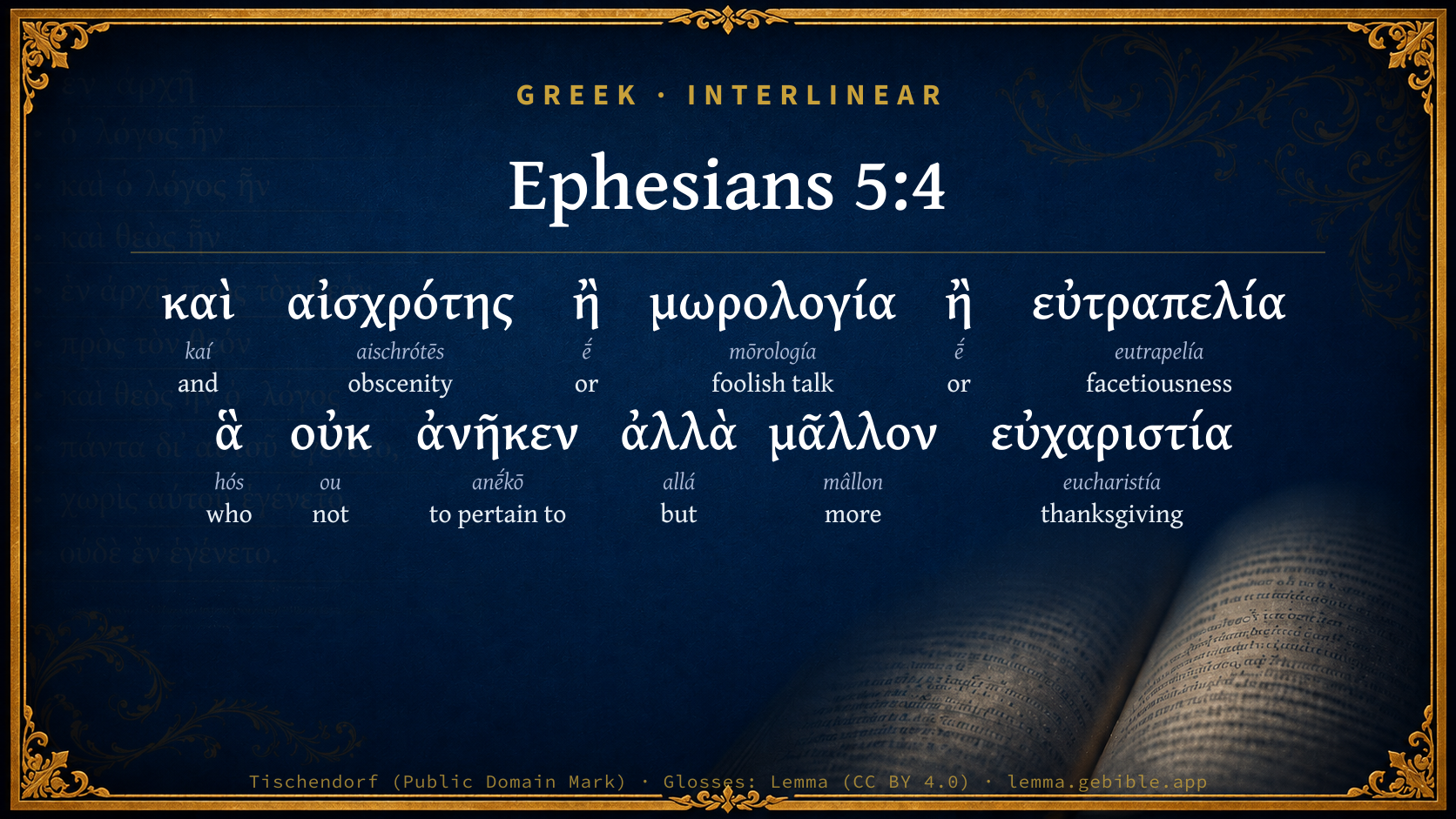
Download image
Cite this verse

Ephesians 5:4 (World English Bible). Public Domain. Lemma interlinear Bible study tool, https://lemma.gebible.app/v/ephesians/5/4.

Show BibTeX & RIS
BibTeX
RIS
English Translation
nor filthiness, nor foolish talking, nor jesting, which are not appropriate; but rather giving of thanks.
World English Bible · Public Domain
Highlights
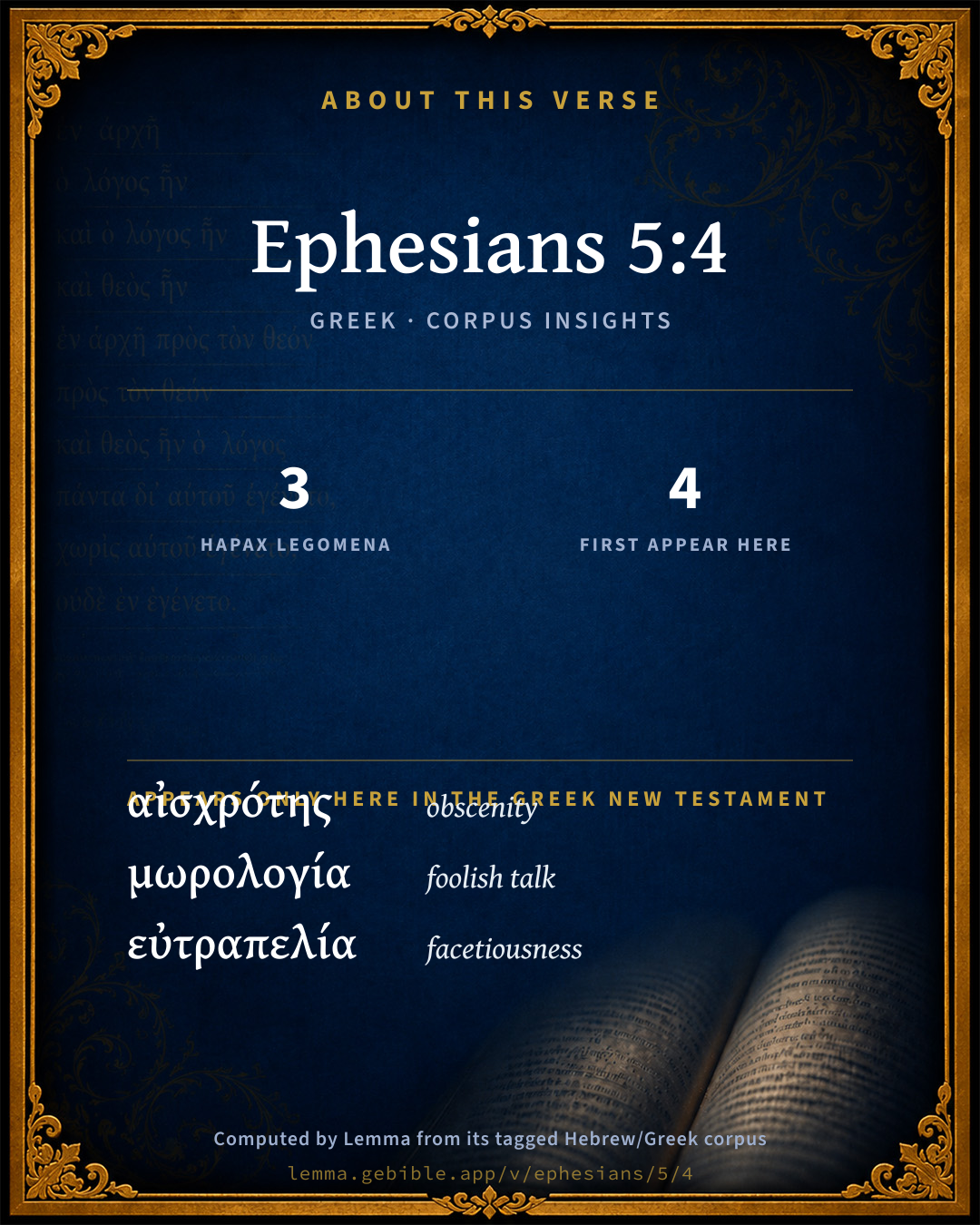
  • 3 hapax legomena — only here in the Greek New Testament
  • 4 first appearances in the Greek New Testament
Full analysis ↓
Download a study sheet

One document with this verse’s original text, its word-by-word gloss line, the meaning frame, cross-references with their text, attributed commentary, and full source and license credits — printable, and it pastes into notes with its structure intact.

This verse Autodidact and up

Study sheet (.html) Plain text (.txt)

A passage Seminary Student

Up to 50 verses in one chapter. A passage sheet keeps up to 6 commentary sources and 12 cross-references per verse, in the order this page ranks them, and says so on the sheet whenever that leaves anything out. Ask for a single verse and you get the Autodidact verse sheet above.

Everything on this page stays free to read, with no account — the sheet is a download of what is already on screen, not access to it.

Want to remove ads? Support Godless Engineer
Compare translations 3

The same verse in 3 English versions, stacked beneath the original-language interlinear above. Click any original word for its lexicon entry.

Each is an independent rendering of the whole verse — the interlinear is not word-aligned to these translations.

Highlighted words mark where these versions differ — a whole-verse word diff, not a word-by-word alignment.

  • World English Bible Public Domain
    nor filthiness, nor foolish talking, nor jesting, which are not appropriate; but rather giving of thanks.
  • King James Version Public Domain
    Neither filthiness, nor foolish talking, nor jesting, which are not convenient: but rather giving of thanks.
  • unfoldingWord Literal Text CC BY-SA 4.0
    and filthiness and foolish talk or crude jokes—which are not fitting—but instead, thanksgiving.

unfoldingWord Literal Text — © unfoldingWord, licensed CC BY-SA 4.0. Word-aligned USFM3 via Door43 (git.door43.org/unfoldingWord/en_ult).

Versions to compare (up to 4)

3 of 4 selected

Show all 19 translations

Every available English version of this verse, each an independent rendering of the whole verse.

  • World English Bible Public Domain
    nor filthiness, nor foolish talking, nor jesting, which are not appropriate; but rather giving of thanks.
  • Berean Standard Bible Public Domain
    Nor should there be obscenity, foolish talk, or crude joking, which are out of character, but rather thanksgiving.
  • Majority Standard Bible Public Domain
    Nor should there be obscenity, foolish talk, or crude joking, which are out of character, but rather thanksgiving.
  • King James Version Public Domain
    Neither filthiness, nor foolish talking, nor jesting, which are not convenient: but rather giving of thanks.
  • American Standard Version (1901) Public Domain
    nor filthiness, nor foolish talking, or jesting, which are not befitting: but rather giving of thanks.
  • Revised Version (1885) Public Domain
    nor filthiness, nor foolish talking, or jesting, which are not befitting: but rather giving of thanks.
  • Geneva Bible (1599) Public Domain
    Neither filthinesse, neither foolish talking, neither iesting, which are things not comely, but rather giuing of thankes.
  • Douay-Rheims (1899) Public Domain
    Or obscenity, or foolish talking, or scurrility, which is to no purpose; but rather giving of thanks.
  • Young's Literal Translation Public Domain
    also filthiness, and foolish talking, or jesting, -- the things not fit -- but rather thanksgiving;
  • Literal Standard Version CC BY-SA 4.0
    also filthiness, and foolish talking, or jesting—the things not fit—but rather thanksgiving;
  • Unlocked Literal Bible CC BY-SA 4.0
    Let there be no filthiness, no foolish talk, and no crude jokes—all of which are improper. Instead there should be thanksgiving.
  • unfoldingWord Literal Text CC BY-SA 4.0
    and filthiness and foolish talk or crude jokes—which are not fitting—but instead, thanksgiving.
  • Darby Bible Public Domain
    and filthiness and foolish talking, or jesting, which are not convenient; but rather thanksgiving.
  • World Messianic Bible Public Domain
    nor filthiness, nor foolish talking, nor jesting, which are not appropriate, but rather giving of thanks.
  • Webster's Bible Public Domain
    Neither filthiness, nor foolish talking, nor jesting, which are not convenient: but rather giving of thanks.
  • Free Bible Version CC BY-SA 4.0
    Obscene talk, stupid chatter, and coarse jokes are totally inappropriate—instead you should be thanking God.
  • Bible in Basic English Public Domain
    And let there be no low behaviour, or foolish talk, or words said in sport, which are not right, but in place of them the giving of praise.
  • Text-Critical English NT CC BY 4.0
    Nor should there be any obscenity, foolish talk, or coarse joking, which are not fitting, but there should be thanksgiving instead.
  • Tyndale New Testament (1534) Public Domain
    nether filthynes nether folishe talkyng nether gestinge which are not comly: but rather gevynge of thankes

Literal Standard Version (2020), Covenant Press — licensed CC BY-SA 4.0. Text via the HelloAO Bible API (eBible.org). Unlocked Literal Bible (unfoldingWord) — licensed CC BY-SA 4.0. Text via the HelloAO Bible API (eBible.org). unfoldingWord Literal Text — © unfoldingWord, licensed CC BY-SA 4.0. Word-aligned USFM3 via Door43 (git.door43.org/unfoldingWord/en_ult). Free Bible Version, Dr. Jonathan Gallagher — licensed CC BY-SA 4.0. Text via the HelloAO Bible API (eBible.org).

Word by word

More ways to search: Search by grammar → Find every occurrence → Compare this word →

Practice this passage: Drill this verse → Learn its vocabulary →

About this verse

These counts appear in no published source. They are computed here, from the morphology-tagged text and Lemma’s own curated glosses. What Lemma adds →

12
words
11
distinct lemmas
Pauline Epistles
section

Notable vocabulary

3 hapax legomena — words that appear only here in the entire Greek New Testament:

  • αἰσχρότης obscenity G151
  • μωρολογία foolish talk G3473
  • εὐτραπελία facetiousness G2160

First appearance in Scripture

These words make their first canonical appearance in the Greek New Testament here:

  • αἰσχρότης obscenity G151
  • μωρολογία foolish talk G3473
  • εὐτραπελία facetiousness G2160
  • ἀνῆκεν to pertain to G433

Shared distinctive vocabulary

ἀνῆκεν to pertain to G433 occurs in 3 verses of the Greek New Testament. Also found in:

Repetition

A word recurs within this verse:

Cross-references

22

Topical passages linked to Ephesians 5:4 in the Treasury of Scripture Knowledge — connected by theme and wording, ordered by reader-vote popularity; previews shown in the World English Bible.

  • Colossians 3:8 but now you also put them all away: anger, wrath, malice, slander, and shameful speaking out of your mouth.
  • Ephesians 4:29 Let no corrupt speech proceed out of your mouth, but such as is good for building up as the need may be, that it may give grace to those who hear.
  • 1 Thessalonians 5:18 In everything give thanks, for this is the will of God in Christ Jesus toward you.
  • Proverbs 15:2 The tongue of the wise commends knowledge, But the mouth of fools gush out folly.
  • Matthew 12:34–37 You offspring of vipers, how can you, being evil, speak good things? For out of the abundance of the heart, the mouth speaks.
  • James 3:4–8 Behold, the ships also, though they are so big and are driven by fierce winds, are yet guided by a very small rudder, wherever the pilot desires.
  • Ecclesiastes 10:13 The beginning of the words of his mouth is foolishness; and the end of his talk is mischievous madness.
  • Colossians 3:15–17 And let the peace of God rule in your hearts, to which also you were called in one body; and be thankful.
  • Mark 7:22 covetings, wickedness, deceit, lustful desires, an evil eye, blasphemy, pride, and foolishness.
  • Ephesians 5:19–20 speaking to one another in psalms, hymns, and spiritual songs; singing, and singing praises in your heart to the Lord;
  • Hebrews 13:15 Through him, then, let us offer up a sacrifice of praise to God continually, that is, the fruit of lips which make confession to his name.
  • 2 Peter 2:18 For, uttering great swelling words of emptiness, they entice in the lusts of the flesh, by licentiousness, those who are indeed escaping from those who live in error;
  • Psalms 107:21–22 Let them praise Yahweh for his loving kindness, For his wonderful works to the children of men!
  • Philippians 4:6 In nothing be anxious, but in everything, by prayer and petition with thanksgiving, let your requests be made known to God.
  • Psalms 92:1 It is a good thing to give thanks to Yahweh, To sing praises to your name, Most High;
  • 2 Corinthians 9:15 Now thanks be to God for his unspeakable gift!
  • Jude 1:10 But these speak evil of whatever things they don't know. What they understand naturally, like the creatures without reason, in these things are they destroyed.
  • Psalms 33:1 Rejoice in Yahweh, you righteous! Praise is fitting for the upright.
  • Proverbs 12:23 A prudent man keeps his knowledge, But the hearts of fools proclaim foolishness.
  • Romans 1:28 Even as they refused to have God in their knowledge, God gave them up to a reprobate mind, to do those things which are not fitting;
  • 2 Corinthians 1:11 you also helping together on our behalf by your supplication; that, for the gift bestowed on us by means of many, thanks may be given by many persons on your behalf.
  • Jude 1:13 wild waves of the sea, foaming out their own shame; wandering stars, for whom the blackness of darkness has been reserved forever.

Cross-references courtesy of OpenBible.info (CC BY 4.0).

Commentary

Notes on Ephesians 5:4 from classic Christian and Jewish commentators (each source and its license shown beneath its notes). The classic Christian expositions comment on the surrounding passage and are grouped to its opening verse, so a note may address several verses; the Jewish commentaries on the Tanakh (Rashi and others) are per-verse, so they appear only where the commentator wrote on this verse.

Lemma curates 59 commentaries, every one of them public domain or Creative Commons licensed, each selected and text-cleaned for this edition rather than reprinted as found. About our sources →

The Biblical Illustrator

Joseph S. Exell

Eph_5:4

Neither filthiness, nor foolish talking, nor jesting, which are not convenient: but rather giving of thanks.

Unseemly conversation

Filthiness--impurity of act or speech, foolish talking, and jesting, are to disappear as completely as covetousness and the grosser vices. They are not befitting; they do not harmonize with the character, the prerogatives, and the destiny of saints. Foolish talking is the talk of a fool, of a man that is insensible to the graver aspects of human life. The great discoveries of God and of eternity, of our own present relations to God and of our future glory, which have come to us through. Christ, exert their power on the mind as well as on the heart and on outward conduct. They give a certain intellectual nobleness even to uncultivated and simple men. They inspire self-respect and dignity. As the pride of the Roman people was justly offended when they saw an emperor descend into the arena with charioteers and gladiators, so the finer feeling of the Christian Church is justly offended when Christian men indulge in buffoonery and play the fool. This is not befitting. It should have no place among Christian people, and to find pleasure in such folly is also below the dignity of those who live near to the throne of God. In condemning jesting Paul does not mean to insist that the conversation of Christian men should be always grave and serious. The mind needs rest as well as the body. There is a time to play as well as to work. Amusement has its legitimate place in the intellectual life; and if the mind is subjected to an incessant strain its strength will be broken down. The bright flashes of wit and the pleasant gleams of a kindly humour may be as beautiful and as harmless as the play of the sunlight among the trees or on the ripples of a mountain stream. The jesting which Paul describes as not befitting is the kind of conversation that reaches its perfection in a civilized, luxurious, and brilliant society which has no faith in God, no reverence for moral law, no sense of the grandeur of human life, no awe in the presence of the mystery of death. In such a society, to which the world is the scene of a pleasant comedy in which all men are actors, a polished insincerity and a versatility which is never arrested by strong and immovable convictions are the objects of universal admiration. The foulest indecencies are applauded, if they are conveyed under the thin disguise of a graceful phrase, a remote allusion, an ingenious ambiguity. There is a refinement to which, not vice itself, but the coarseness of vice, is distasteful, and which regards with equal resentment the ruggedness of virtue. This is the kind of jesting that Paul so sternly condemns. It is destructive both of faith and morality. The tongue was made for nobler uses. (R. W. Dale, LL. D.)

Against foolish talking and jesting

It may be demanded then, what the thing we speak of is, or what this facetiousness doth import? To which question I might reply as Democritus did to him that asked the definition of a man, It is that which we all see and know; anyone better apprehends what it is by acquaintance, than I can inform him by description. It is indeed a thing so versatile and multiform, appearing in so many shapes, so many postures, so many garbs, so variously apprehended by several eyes and judgments, that it seemeth no less hard to settle a clear and certain notion thereof, than to make a portrait of Proteus, or to define the figure of the fleeting air. Sometimes it lieth in pat allusion to a known story, or in seasonable application of a trivial saying, or in forging an apposite tale: sometimes it playeth in words and phrases, taking advantage from the ambiguity of their sense, or the affinity of their sound; sometimes it is wrapped in a dress of humorous expression; sometimes it lurketh under an odd similitude; sometimes it is lodged in a sly question, in a smart answer, in a quirkish reason, in a shrewd intimation, in cunningly diverting, or cleverly retorting an objection; sometimes it is couched in a bold scheme of speech, in a tart irony, in a lusty hyperbole, in a startling metaphor, in a plausible reconciling of contradictions, or in acute nonsense; sometimes a scenical representation of persons or things, a counterfeit speech, a mimical look or gesture passeth for it; sometimes an affected simplicity, sometimes a presumptuous bluntness giveth it being; sometimes it riseth from a lucky hitting on what is strange, sometimes from a crafty wresting obvious matter to the purpose; often it consisteth in one knows not what, and springeth up one can hardly tell how. Its ways are unaccountable and inexplicable, being answerable to the numberless rovings of fancy and windings of language. It is, in short, a manner of speaking out of the simple and plain way (such as reason teacheth and proveth things by), which by a pretty surprising uncouthness in conceit or expression doth affect and amuse the fancy, stirring in it some wonder, and breeding some delight thereto.

I. 1. Such facetiousness is not absolutely unreasonable or unlawful, which ministereth harmless divertisement and delight to conversation. For Christianity is not so harsh, so envious, as to bar us continually from innocent, much less from wholesome and useful pleasure, such as human life doth need or require.

2. Facetiousness is allowable when it is the most proper instrument of exposing things apparently base and vile to due contempt. When sarcastical twitches are needful to pierce the thick skins of men, to correct their lethargic stupidity, to rouse them out of their drowsy negligence; then may they well be applied.

3. Facetious discourse particularly may be commodious for reproving some vices and reclaiming some persons (as salt for cleansing and curing some sores). It commonly procureth a more easy access to the ears of men, and worketh a stronger impression on their hearts, than other discourse could do. Many whose foreheads are brazed and hearts are steeled against all blame, are yet not proof against derision.

4. Some errors likewise in this way may be most properly and most successfully confuted; such as deserve not, and hardly can bear a serious and solid confutation.

5. This way is also commonly the best way of defence against unjust reproach and obloquy. To yield to a slanderous reviler a serious reply, or to make a formal plea against his charge, doth seem to imply that we much consider or deeply resent it; whereas by pleasant reflection On it we signify the matter only deserves contempt, and that we take ourselves unconcerned therein.

6. So easily without care or trouble may the brunts of malice be declined or repelled. This way may be allowed in way of counterbalancing and in compliance to the fashion of others. It would be a disadvantage unto truth and virtue if their defenders were barred from the use of this weapon; since it is that especially whereby the patrons of error and vice do maintain and propagate them.

7. Furthermore, the warrantableness of this practice in some cases may be inferred from a parity of reason, in this manner: if it be lawful (as by the best authorities it plainly doth appear to be), in using rhetorical schemes, poetical strains, involutions of sense in allegories, fables, parables, and riddles, to discoast from the plain and simple way of speech; why may not facetiousness, issuing from the same principles, directed to the same ends, serving to like purposes, be likewise used blamelessly?

8. I shall only add, that of old even the sagest and gravest persons (persons of most rigid and severe virtue) did much affect this kind of discourse, and did apply it to noble purposes.

9. In fine, since it cannot be shown that such a sportfulness of wit and fancy doth contain an intrinsic and inseparable turpitude; since it may be so cleanly, handsomely, and innocently used, as not to defile or discompose the mind of the speaker, not to wrong or harm the hearer, not to derogate from any worthy subject of discourse, it cannot well absolutely and universally be condemned; and when not used on improper matter, in an unfit manner, with excessive measure, at undue season, to evil purpose, it may be allowed. It is bad objects, or bad adjuncts, which do spoil its indifference and innocence.

II. 1. All profane jesting, all speaking loosely and wantonly about holy things (things nearly related to God and religion), making such things the matters of sport and mockery, playing and trifling with them, is certainly prohibited, as an intolerably vain and wicked practice. All injurious, abusive, scurrilous jesting, which causelessly or needlessly tendeth to the disgrace, damage, vexation, or prejudice in any kind of our neighbour (provoking his displeasure, grating on his modesty, stirring passion in him), is also prohibited.

3. I pass by that it is very culpable to be facetious in obscene and smutty matters.

4. All unseasonable jesting is blamable.

5. To affect, admire, or highly to value this way of speaking, either absolutely in itself, or in comparison to the serious and plain way of speech, and thence to be drawn into an immoderate use thereof, is blamable.

6. Vain-glorious ostentation this way is very blamable.

7. Lastly, it is our duty never so far to engage ourselves in this way, as thereby to lose or to impair that habitual seriousness, modesty, and sobriety of mind, that steady composedness, gravity and constancy of demeanour, which become Christians. We should continually keep our minds intent on our high calling, and grand interest; ever well tuned, and ready for the performance of holy devotions. (I. Barrow, D. D.)

Impurity in speech

I. That Christians should make great conscience, not only of their actions, but their words also; for after the apostle had dissuaded them from all uncleanness and filthiness in practice, he addeth, Neither filthiness, nor foolish talking, nor jesting, which are not convenient. We must make conscience of our words for these reasons.

1. We are not absolute proprietors and possessors of our own selves; our tongues are not our own to speak what we please. Exempt any one faculty or member from the jurisdiction of God, and you disown His authority and interest in you, and open a floodgate to let in sin and wickedness into the world. We are not left to run at random in our ordinary discourse, to say and utter what we think good.

2. As we had our tongues from God, so we are accountable to Him for the use of them; and therefore will our actions not only be brought into the judgment, but our words and speeches also (Mat_12:36-37).

3. Words do much discover the temper of a mans heart.

4. Because our tongue is our glory: Awake, my glory; awake, psaltery and harp (Psa_57:8), My heart is glad, and my glory rejoiceth (Psa_16:9). Compare Act_2:26 : My heart is glad, and my tongue rejoiceth. So Psa_30:12 : That my glory may sing praise to Thee, and not be silent; that is, my tongue. But why is our tongue called our glory? For a double reason, both which are pertinent to the case in hand.

(1) Because thereby we can express the conceptions of our minds for the good of mankind. It was not given to us for that use for which the tongues of the brute beasts serve them, to taste meats and drinks only, or to taste our food. No; but to converse with each other. Speech is the excellency of man above the beasts.

(2) The other reason why it is called our glory is because thereby we may express the conceptions of our minds, to the glory of God as well as the good of others, Therewith we bless God, even the Father (Jam_3:9).

5. Because our speeches are regarded by God, and therefore you must consider, not only what is fit for you to utter and others to hear, but what is fit for God to hear.

6. Because the well ordering of our words is a great point of Christianity, and argueth a good degree of grace (Jam_3:2).

II. In making conscience of our words, we should specially take heed of filthiness, foolish talking, and jesting.

1. Filthiness is when we speak of obscene things in an obscene manner without any respect to modesty and Christian gravity or sobriety.

(1) It is a sin most inconsistent with any reverence and fear of God: The fear of the Lord is clean (Psa_19:9).

(2) It is a grief to the Holy Spirit, as it obstructs that purity and cleanness of heart which He would work in us (Eph_4:29-30).

(3) You infect others, and corrupt them by filthy discourse.

2. The next word is foolish speaking. This hath so many branches, that it is hard to reckon them up; as--

(1) when they speak of foolish things;

(2) when men speak of serious things in a ludicrous and vain manner, and design it for jest;

(3) lavish, superfluous speech to no end;

(4) rash speech;

(5) personal boasting. Now, I shall prove that it is a sin that should be made conscience of.

(a) Because it suiteth not with the seriousness of religion, which is the wisdom of God;

(b) it suiteth not with the mortified estate of sincere Christians;

(c) because it shutteth out better discourse, and so converse with others is rendered unprofitable. Omission of good is caused by it.

(d) Because it argueth great emptiness, that we have not a good treasure within us (Mat_12:35), or have not hid the Word in our hearts (Psa_119:11), or not taken care that it might dwell in us richly (Col_3:16).

3. We come now to the third sin enumerated, and jesting. Here we must state this matter. Is all jesting unlawful and misbecoming Christians?

In the use of it all due circumstances must be observed; as--

1. In the matter. It is a dunghill mirth that must have somewhat unclean to feed it.

2. For the manner. It must be harmless to others, not making sport with their sins or miseries (1Co_13:6).

3. For the measure. Not excessive wasting the time in vain, especially not habituating the mind to levity; that is scurrility when men accustom themselves so to vain jesting that they cannot possibly be serious; they can as well be immortal as serious.

4. For the time. Not when God calleth us to mourning or more serious employments should it be taken in hand.

5. The end and use must not be forgotten. Our great end is to serve and glorify God, and everything that we do must have respect to it, and be proportioned by it.

III. One special means of checking such sins is to consider how much they misbecome Christians; for the apostle saith no more but they are not convenient, or do not agree with that state of grace into which we profess to be called. For three reasons this will hold good.

1. Because there are four affections which serve to draw us from and guard us against sin--fear, shame, grief, and indignation. The guilt of sin causeth fear; the stain, shame; the unkindness, sorrow; unsuitableness, indignation. Awaken this, and sin cannot have long entertainment in the heart. Therefore it is enough to a serious Christian: It is not convenient.

2. The unsuitableness mindeth us of our dignity, as being admitted to communion with God. Therefore to talk of filthiness with that tongue which is to be employed in speaking of God, and to God, is a most indecorous thing.

3. This striketh at the root of the temptation. Many think filthiness, foolish speaking, and jesting to be a great grace to them, and affect the reputation of wit at such a rate that they forget honesty. No; these are not an honour and a grace, but a blemish and a blot.

IV. That a Christian cannot want mirth as long as he hath such abundant cause to give thanks. (T. Manton, D. D.)

Foolish talking and jesting

Foolish talking and jesting, than which nothing is more common in the world, are to be held in disesteem by all Christians. They should look upon themselves as a new order among men. Christ redeems us from the shallow mirth of the world, which is the mirth of folly, to the joy of wisdom, which is the joy of God, and which fills heaven, and will fill eternity, with delight and song. (J. Pulsford.)

Dangers of jesting

It is dangerous to jest with God, death, or the devil; for the first neither can nor will be mocked: the second mocks all men at one time or another; and the third puts an eternal sarcasm on those who are too familiar with him. (J. Beaumont.)

Tart jests

Jests too tart are not good; bitter potions are not for health. An offensive man is the devils bellows to blow up contention. (J. Beaumont.)

Personal jesting

Whosoever will jest will be like him that flourishes at a show--he may turn his weapon every way, but not aim more at one than another. It is very unsafe to sling about this wormwood: some noses are too delicate to bear the smell. Some are like tiled houses, that can admit a falling spark; yet others are like dry straw, that with the least touch will kindle about your ears. (J. Beaumont.)

A sting in the jest

A jest should be such that all shall be able to join in the laugh which it occasions; but if it bears hard upon one of the company, like the crack era string, it makes a stop in the music. (Owen Felltham.)

Evil of jesting

Solon, who was always willing to hear and to learn, and in his old age more inclined to anything that might divert and entertain, particularly to music and good fellowship, went to see Thespis himself exhibit, as the custom of the ancient poets was. When the play was done, he called to Thespis, and asked him if he was not ashamed to tell so many lies before so great an assembly. Thespis answered, it was no great matter if he spoke or acted so in jest. To which Solon replied, striking the ground violently with his staff, If we encourage such jesting as this, we shall quickly find it in our contracts and agreements. (Plutarch.)

Foolish talking to be accounted for

The story is well known of the person who invited a company of his friends that were accustomed to take the Lords name in vain, and contrived to have all their discourse taken down and read to them. Now, if they could not endure to hear the words repeated which they had spoken during a few hours, how shall they bear to have all that they have uttered through a long course of years brought forth as evidence against them at the tribunal of God? (Scott.)

The Biblical Illustrator, edited by Joseph S. Exell (c. 1880s–1900s) — public domain. Text from a community e-Sword module.

Tyndale Open Study Notes

Tyndale Open Resources

5:4 The speech of God’s people is to be characterized by thankfulness to God (see 4:29; 5:3, 12).

Tyndale Open Study Notes — © Tyndale Open Resources, licensed CC BY-SA 4.0. Text via the HelloAO Bible API.

Bengel's Gnomon

Johann Albrecht Bengel

Eph 5:4. Αἰσχρότης, filthiness) in word, or even in gesture, etc.—μωρολογία, foolish talking) wherein a mere laugh is aimed at even without wit [the salt of profitable discourse, Col 4:6].—ἤ εὐτραπελία) or jesting.[77] This is more refined than filthiness or foolish talking; for it depends on the understanding. The Asiatics delighted much in it: and in former times jesting prevailed for some ages, even among the learned. Why so? (Because) Aristotle considered jesting to be a virtue; and they made much use of Plautus. Olympiodorus observes, that Paul rebuked εὐτραπελία, jesting, in such a way that ὥστε οὐδὲ τὰ ἀστεῖα δεκτέον, there is not even a place for urbane conversation (pleasantry).—τὰ οὐκ ἀνήκοντα, the things which are not befitting [convenient]) An epithet [not the predicate]. Supply the predicate, let them be kept out of the way.[78]—εὐχαριστία, thanksgiving) Supply ἀνήκει, is convenient. The holy and yet joyful use of the tongue is opposed to its abuse, Eph 5:18-19. The abuse and the use are not compatible with one another.—εὐτραπελία and εὐχαριστία are an elegant Paranomasia:[79] the former disturbs (and indeed the refined jest and subtile humour sometimes offend the tender feelings of grace), the latter exhilarates the mind.

[77] Wahl translates this word, which is found here only in the New Testament, Scurrilitas. Its classic use conveys no idea of censure; Th. εὐ and τρέπω, one who happily accommodates himself to his company: pleasantry, urbanity. In μωρολογία, the foolishness, in αἰσχρολογία, the foulness, in εὐτραπελία, the false refinement of discourse, not seasoned with the salt of grace, are noted.—Trench, Syn. Gr. T.—ED.

[78] Taken by Zeugma out of μηδὲ ὀνομαζέσθω, Eph 5:3.—ED.

[79] See Append. A similar sound and form in two nouns, producing a pleasant antithesis.—ED.

Bengel's Gnomon of the New Testament — English translation (T&T Clark, Edinburgh, 1860) — public domain. Text from a community e-Sword module.

Meyer's Critical & Exegetical Commentary

Heinrich August Wilhelm Meyer

Eph_5:4. Αἰσχρότης] abomination, disgraceful conduct, Plat. Gorg. p. 525 A. Most expositors, including Rückert, Meier, Holzhausen, Olshausen (not Matthies and Harless), limit it to disgraceful utterances, but without warrant of linguistic usage (this would be αἰσχρολογία, see Col_3:8; Xen. de rep. Lac. v. 6; Aristot. de rep. vii. 17; Polyb. viii. 13. 8, xii. 13. 3); or in the context, in which it is only the following elements that contain the unchristian speaking.

μωρολογία] is the carrying on of insipid, foolish talk. Antig. de Mirab. 126: μωρολωγίας καὶ ἀδολεσχίας, Arist. H. A. i. 11; Plut. Mor. 504 A.

εὐτραπελία] signifies properly ready versatility (from τρέπω and εὖ), urbanity; then specially a witty, jesting manner; and in a bad sense, as here, the witticism of frivolity, scurrilitas. See in general, Wetstein ad loc.; Dissen, ad Pind. p. 180; Krüger on Thuc. ii. 41. 1.

τὰ οὐκ ἀνήκοντα] as that which is unseemly. Comp. Winer, pp. 221, 338 f. [E. T. 610]. It refers only to μωρολογία and εὐτραπελία, since for αἰσχρότης such a characteristic description would be entirely superfluous, and ἀλλὰ μᾶλλον εὐχαριστία points back merely to those peccata oris.

ἀλλὰ μᾶλλον εὐχαριστία] From the preceding μηδὲ ὀνομαζέσθω ἐν ὑμῖν we have here to supply ἔστω or γινέσθω ἐν ὑμῖν, which is contained therein, in accordance with a well-known brachylogy, Kühner, II. p. 604. εὐχαριστία is, according to standing usage (comp. also Loesner, Obss. p. 345 f.), not gracefulness of speech, as Jerome, Calvin,[255] Salmasius, Cajetanus, Hammond, Semler, Michaelis, Wahl, Meier, and others would take it, which would be εὔχαρι, but giving of thanks, in which case there results a contrast far more in keeping with the Christian character and the profoundly vivid piety of the apostle (comp. Col_2:7; Col_3:15; Col_3:17; 1Th_5:18). Gratitude towards God (for the salvation in Christ), expressing itself in their discourse, is to supersede among Christians the two faults before mentioned, and to sanctify their oral intercourse. Linguae abusui opponitur sanctus et tamen laetus usus, Bengel. Morus erroneously refers it to thanksgiving towards others; the language of courtesy.

[255] Sermones nostros vera suavitate et gratia perfusos esse debere, quod fiet, si miscebimus utile dulci.

Meyer — Critical and Exegetical Commentary on the New Testament — English translation by Peter Christie, edited by Frederick Crombie (T&T Clark, 1880) — public domain. Text from a community e-Sword module.

Expositor's Greek Testament

ed. W. Robertson Nicoll

Eph 5:4 . καὶ αἰσχρότης : and filthiness . This is taken by many (Eth., Theophyl., Oec., Rück., Harl., etc.) to refer to indecent talk , which, however, would be expressed by αἰσχρολογία (Col 3:8 ). The context shows it to refer to sins of the flesh, but there is nothing to limit it to sinful speech . It denotes shameless, immoral conduct in general. καὶ μωρολογία ἢ εὐτραπελία : and foolish talking or [ and ] jesting . The readings here are somewhat uncertain as regards the particles. The TR has the support of such authorities as [504] [505] [506] , Syr.-Harcl., Arm. for καί … ἤ ; [507] [508] * [509] , Vulg., Sah., etc., give ἤ … ἤ ; [510] [511] 1 [512] 3 [513] , Boh., Eth., etc., have καί … καί . The first is accepted by TRV; the second by [514] ; the third by WH. The choice is between the first and third, and the balance of evidence is on the whole, although not very decidedly, on the side of καί … καί . The noun μωρολογία is of very rare occurrence. In common Greek it is found only a very few times (Arist., Hist. An. , i., 11; Plut., Mor. , 504 A); in the NT only this once. Its sense, however, is sufficiently clear. καὶ εὐτραπελία : and jesting . This is the solitary occurrence of the noun in the NT. It is found, however, in Aristotle (who defines it as πεπαιδευμένη ὕβρις , Eth. Nic. , iv., 14), Pindar ( Pyth. , i., 178), etc. It appears to have meant originally versatility, facetiousness , and to have acquired the evil sense of frivolity or scurrility . Here it is taken by some ( e.g. , Trench, Ell.) to be distinguished from μωρολογία and to denote, therefore, not the sin of the tongue merely, but the “evil ‘urbanitas’ (in manners or words) of the witty, godless man of the world” (Ell.). This depends so far on the acceptance of the disjunctive ἤ as the proper reading, but may be essentially correct. AV and other old English Versions give jesting , except Wicl., who has harlotry , and the Rhem. which gives scurrility . τὰ οὐκ ἀνήκοντα : things which are not seemly . The article has the pred. force = “ as things which are not seemly” (Mey.; cf. Win.-Moult., p. 610). The reading, however, varies. The TR is supported by the great mass of MSS [515] [516] [517] [518] , etc.; but [519] [520] [521] [522] , etc., give ἃ οὐκ ἀνῆκεν , which is to be preferred. The clause is in apposition to the preceding; but probably only to the latter two nouns, μωρολογία and εὐτραπελία , as these form the direct contrast to the following εὐχαριστία . cf. τὰ μὴ καθήκοντα of Rom 1:28 . ἀλλὰ μᾶλλον εὐχαριστία : but rather giving of thanks . The brachylogy ( cf. Jelf, Greek Gram. , § 705, 3) requires ἔστω or rather γίνεσθω to be supplied. The εὐχαριστία is understood by some to mean gracious speech (Clem. Al.; also Jer., with a perhaps ), or pious, edifying discourse generally (Calv., on the analogy of Col 4:6 ; Pro 11:6 ). Others give it the sense of courteous speech (Mor.). But the idea of gracious speech would be expressed rather by εὔχαρι , and, as Meyer points out, the contrast which would thus result would be less in keeping with “the Christian character and the profoundly vivid piety of the Apostle”. On nothing does he more insist than on the grace of thankfulness, and the expression of it, to God for the gifts of His love to sinful men.

[504] Autograph of the original scribe of א .

[505] Autograph of the original scribe of א .

[506] Codex Porphyrianus (sæc. ix.), at St. Petersburg, collated by Tischendorf. Its text is deficient for chap. Eph 2:13-16 .

[507] Codex Alexandrinus (sæc. v.), at the British Museum, published in photographic facsimile by Sir E. M. Thompson (1879).

[508] Codex Claromontanus (sæc. vi.), a Græco-Latin MS. at Paris, edited by Tischendorf in 1852.

[509] Codex Boernerianus (sæc. ix.), a Græco-Latin MS., at Dresden, edited by Matthæi in 1791. Written by an Irish scribe, it once formed part of the same volume as Codex Sangallensis ( δ ) of the Gospels. The Latin text, g, is based on the O.L. translation.

[510] Codex Sinaiticus (sæc. iv.), now at St. Petersburg, published in facsimile type by its discoverer, Tischendorf, in 1862.

[511] Codex Vaticanus (sæc. iv.), published in photographic facsimile in 1889 under the care of the Abbate Cozza-Luzi.

[512] Codex Claromontanus (sæc. vi.), a Græco-Latin MS. at Paris, edited by Tischendorf in 1852.

[513] Codex Mosquensis (sæc. ix.), edited by Matthæi in 1782.

[514] Codex Angelicus (sæc. ix.), at Rome, collated by Tischendorf and others.

[515] Codex Claromontanus (sæc. vi.), a Græco-Latin MS. at Paris, edited by Tischendorf in 1852.

[516] Codex Boernerianus (sæc. ix.), a Græco-Latin MS., at Dresden, edited by Matthæi in 1791. Written by an Irish scribe, it once formed part of the same volume as Codex Sangallensis ( δ ) of the Gospels. The Latin text, g, is based on the O.L. translation.

[517] Codex Mosquensis (sæc. ix.), edited by Matthæi in 1782.

[518] Codex Angelicus (sæc. ix.), at Rome, collated by Tischendorf and others.

[519] Codex Vaticanus (sæc. iv.), published in photographic facsimile in 1889 under the care of the Abbate Cozza-Luzi.

[520] Codex Sinaiticus (sæc. iv.), now at St. Petersburg, published in facsimile type by its discoverer, Tischendorf, in 1862.

[521] Codex Alexandrinus (sæc. v.), at the British Museum, published in photographic facsimile by Sir E. M. Thompson (1879).

[522] Codex Porphyrianus (sæc. ix.), at St. Petersburg, collated by Tischendorf. Its text is deficient for chap. Eph 2:13-16 .

The Expositor's Greek Testament, edited by W. Robertson Nicoll (1897–1910) — public domain. Text from a community e-Sword module.

Hodge's Commentary on Romans, Ephesians & First Corinthians

Charles Hodge

Eph_5:4

Neither filthiness. The word αἰσχρότης, is not simply obscenity, but whatever is morally hateful. The adjective αἰσχρός means deformed, revolting, what excites disgust, physical or moral. It is the opposite of καλός, which means both beautiful and good; and hence τὸ καλόν καὶ τὸ αἰσχρός, means virtue and vice. The substantive is equally comprehensive, and includes whatever is vile or disgusting in speech or conduct. Lesser evils are expressed by the words μωρολογία and εὐτραπελία, foolish talking and jesting. The former means such talk as is characteristic of fools, i.e. frivolous and senseless. The latter, according to its etymology and early usage, means urbanity, politeness. Naturally enough however the word came to have a bad sense, as the adjective εὐτράπελος, what turns easily, as the wind, when applied to language or speech, means not only adroit, skillful, agreeable, witty, but also flippant, satirical, scurrilous. Hence the substantive is used for jesting and scurrility. The former sense is best suited to this passage, because it is connected with foolish talking, and because the apostle says of both simply that they are not convenient, not becoming or suitable. This is too mild a form of expression to be used either of αἰσχρότης (filthiness) or of εὐτραπελία in the worse sense of those terms. Paul says, these things (foolish talking and jesting) do not become Christians; οὐκ ἀνήκοντρα, what does not pertain to anyone, or, to his office. Foolish talking and jesting are not the ways in which Christian cheerfulness should express itself, but rather giving of thanks. Religion is the source of joy and gladness, but its joy is expressed in a religious way, in thanksgiving and praise.

Charles Hodge — Commentary on Romans (1835), First Corinthians (1857), and Ephesians (1856) — public domain. Text from a community e-Sword module.

Geneva Bible (1599)

Geneva Bible translators

Jests which men cast one at another: that no lightness be seen, nor evil example given, nor any offense moved by evil words or backbiting.

Geneva Bible (1599) marginal notes — public domain. Text via Bolls.life.

Jamieson, Fausset & Brown

Robert Jamieson, A. R. Fausset & David Brown

filthiness--obscenity in act or gesture.

foolish talking--the talk of fools, which is folly and sin together. The Greek of it, and of "filthiness," occurs nowhere else in the New Testament.

nor--rather, "or" (compare Eph 5:3).

jesting--Greek, "eutrapelia"; found nowhere else in the New Testament: implying strictly that versatility which turns about and adapts itself, without regard to principle, to the shifting circumstances of the moment, and to the varying moods of those with whom it may deal. Not scurrile buffoonery, but refined "persiflage" and "badinage," for which Ephesus was famed [PLAUTUS, A Boastful Soldier, 3.1,42-52], and which, so far from being censured, was and is thought by the world a pleasant accomplishment. In Col 3:8, "filthy communication" refers to the foulness; "foolish talking," to the folly; "jesting," to the false refinement (and trifling witticism [TITTMANN]) Of discourse unseasoned with the salt of grace [TRENCH].

not convenient--"unseemly"; not such "as become saints" (Eph 5:3).

rather giving of thanks--a happy play on sounds in Greek, "eucharistia" contrasted with "eutrapelia"; refined "jesting" and subtle humor sometimes offend the tender feelings of grace; "giving of thanks" gives that real cheerfulness of spirit to believers which the worldly try to get from "jesting" (Eph 5:19-20; Jam 5:13).

Jamieson, Fausset & Brown — Commentary Critical and Explanatory on the Whole Bible (1871) — public domain (CC PDM 1.0). Text via the HelloAO Bible API.

Adam Clarke's Commentary

Verse 4. Neither filthiness] αισχροτης. Any thing base or vile in words or acts.

Foolish talking] μωρολογια. Scurrility, buffoonery, ridicule, or what tends to expose another to contempt.

Nor jesting] ευτραπελια. Artfully turned discourses or words, from ευ, well or easily, and τρεπω, I turn; words that can be easily turned to other meanings; double entendres; chaste words which, from their connection, and the manner in which they are used, convey an obscene or offensive meaning. It also means jests, puns, witty sayings, and mountebank repartees of all kinds.

Which are not convenient] ουκ ανηκοντα. They do not come up to the proper standard; they are utterly improper in themselves, and highly unbecoming in those who profess Christianity.

But rather giving of thanks.] ευχαριστια. Decent and edifying discourse or thanksgiving to God. Prayer or praise is the most suitable language for man; and he who is of a trifling, light disposition, is ill fitted for either. How can a man, who has been talking foolishly or jestingly in company, go in private to magnify God for the use of his tongue which he has abused, or his rational faculties which he has degraded?

Adam Clarke's Commentary on the Bible (1810–1826) — public domain. Text from a community e-Sword/MySword module.

John Calvin's Commentaries

4. Neither filthiness. To those three — other three are now added. By filthiness I understand all that is indecent or inconsistent with the modesty of the godly. By foolish talking I understand conversations that are either unprofitably or wickedly foolish; and as it frequently happens that idle talk is concealed under the garb of jesting or wit, he expressly mentions pleasantry, — which is so agreeable as to seem worthy of commendation, — and condemns it as a part of foolish talking The Greek word εὐτραπελία is often used by heathen writers, in a good sense, for that ready and ingenious pleasantry in which able and intelligent men may properly indulge. But as it is exceedingly difficult to be witty without becoming satirical, and as jesting itself carries in it a portion of conceit not at all in keeping with the character of a godly man, Paul very properly dissuades from this practice. Of all the three offenses now mentioned, Paul declares that they are not convenient, or, in other words, that they are inconsistent with Christian duty.

But rather grace. Others render it giving of thanks; but I prefer Jerome’s interpretation. With the vices which had been formerly mentioned it was proper that Paul should contrast something of a general character, displaying itself in all our communications with each other. If he had said, “While they take pleasure in idle or abusive talk, do you give thanks to God,” the exhortation would have been too limited. The Greek word, εὐχαριστία, though it usually signifies Thanksgiving, admits of being translated Grace. “All our conversations ought to be, in the true sense of the words, sweet and graceful; and this end will be gained if the useful and the agreeable are properly mingled.”

John Calvin's Commentaries (1540-1563) — public domain. Text from the Calvin Translation Society English edition (1840s-50s) via the Christian Classics Ethereal Library (ccel.org). Calvin's coverage is partial (roughly two-thirds of the Bible); uncommented books and verses are honest gaps, never fabricated. The 19th-century editor's footnotes and remarks are omitted so the notes are faithfully Calvin's own voice.

Ellicott's Commentary for English Readers

(4) Neither filthiness, nor foolish talking, nor jesting.—The word “filthiness” (unlike the “filthy communication” of the parallel passage in Col_3:8) is in itself a general word. But the connection with the words following, and the distinction from those going before, appear to show that St. Paul here uses it for “filthy talking.” He is passing from impurity of the inward soul to impurity in outward expression. Of such foul speaking he appears to distinguish two forms. There is, first of all, “foolish talking,” or the talk of “the fool,” in the worst sense in which that word is used in Scripture (Mat_5:22; Mat_23:17), as implying something worse than mere emptiness or blindness—describing the condition of the soul which has “lost its savour” (Mat_5:13), i.e., has ceased to distinguish what is right or wrong, wise or foolish, noble or base. There is then “jesting,” i.e., properly, the more polished “versatility,” which will find occasion for wit or levity in anything, however sacred, fearing nothing so much as to be dull, and mistaking all seriousness and reserve for dulness. It is notable that in classical Greek the word is sometimes used in a good sense, as a mean between “churlishness” and “obsequiousness,” but yet hovers on the border of that condemnation which Christian gravity here pronounces unhesitatingly. The former kind of foul talking is coarse and brutal; the latter refined and deadly. Of both kinds Greek and Roman literature furnish specimens only too many and too striking.

Which are not convenient.—That is, “which are out of character” in a Christian—a milder repetition (perhaps suggested by the ambiguous meaning of “jesting” noted above) of the indignant declaration in Eph_5:3, that it “becomes not saints that these foul things should be even named among them.” They pollute the Christian mind and tongue even in condemning them.

But rather giving of thanks.—The opposition is striking. “The foolish talking and jesting” aim at mirth and play of mind; St. Paul will not austerely condemn, such light-heartedness, but he finds a wholesome and spiritual vent for it in the habitual expression of thankfulness to God, which proceeds from a natural and childlike cheerfulness. Exactly in the same spirit below (Eph_5:18-20) he contrasts the excitement of drunkenness with the being “filled with the Spirit . . . giving thanks always for all things.”

A Bible Commentary for English Readers, edited by Charles John Ellicott (1878–1897) — public domain. Text from a community e-Sword module.

The Cambridge Bible for Schools and Colleges

gen. ed. J. J. S. Perowne

4. filthiness] Lit. “ugliness, deformity”; vice in its aspect as morally hideous. The Gr. word occurs here only in N.T. In the classics some cognate words bear a special connexion with forms of gross sensuality.

foolish talking] Talk about sin, in the spirit of the “fool” who gloats and jests over his own or his neighbour’s undoing. The word occurs here only in N.T. It and its cognates occur in the classics, but not in grave moral connexions.

jesting] Obviously, by context, in the sense of immoral pleasantry, such as defiles some of the most brilliant pages of pagan literature, not to speak of Christian, so called; and such as terribly impregnates common talk in many strata and circles of society now. It must have been everywhere the fashion at Ephesus. The passage does not deal with the play of humour and wit in general. This is not forbidden in Scripture, and so far as it is the outcome of vigour, gladness, or (in the case of humour) tenderness, it may be quite in harmony with the strict piety of the Gospel. But to remain so it must be watched; and see next note but one.—The Gr. word denotes specially the versatility of clever repartee; but it is wider by usage.

convenient] Better, as R.V., befitting; the French convenable. In older English “convenient” could bear this meaning; but it has lost it. Rom_1:28 and Phm_1:8 are parallel cases in the A.V.

giving of thanks] as the far more “befitting” expression of the buoyancy of the believing spirit. See Col_3:16; Jas_5:13. Such precepts, out of Scripture, have often been stigmatized as “puritanic,” or the like; but they are nevertheless apostolic. And the nearer the conduct of inner life is brought to apostolic lines of principle the more natural will such precepts be felt to be.

The Cambridge Bible for Schools and Colleges (gen. ed. J. J. S. Perowne; Cambridge University Press, 1878–1918) — public domain. Text from a community e-Sword module.

John Gill's Exposition

Neither filthiness, nor foolish talking, nor jesting,.... The former of these may include all filthy gestures and behaviour, every indecent habit and attire, and all actions which have a tendency to excite lust; and also all impure words, these discover an impure heart, and are the means of corrupting men's minds and manners; filthy speaking, is a verbal commission of the things that are spoken of; and it may include all impure songs and books, and the reading or hearing of them; this is what the Jews call , "filthiness of the mouth", obscene words; which they say they do not use on feast days, as the Gentiles do (i): "foolish talking" does not so much design every imprudent thing that is said, as that which is wicked, corrupt, unsavoury, light, vain, idle, and unprofitable; and takes in all fabulous stories, and mimicking of fools in words and gestures: and "jesting", when it is with wantonness, and excites unto it, and is inconsistent with truth, and when the Scriptures are abused by it, and not our neighbour's edification, but hurt, is promoted by it, ought not to be used:

which are not convenient; are disagreeable to the will of God, and unsuitable to the characters of the saints, and are very unbecoming them to practise:

but rather giving of thanks; instead of these, as the Syriac version renders it; it is much more suitable and becoming to give thanks to God for temporal and spiritual mercies, and to speak those things which are grateful to good men; this is to use the tongue to much better purpose, than in an obscene, foolish, or jocose way: one of Stephens's copies read, "but only of giving of thanks".

(i) Jarchi in Psal. lxxv. 3. Vid. Vajikra Rabba, sect. 24. fol. 165. 3.

John Gill's Exposition of the Whole Bible (1746–1763) — public domain (CC PDM 1.0). Text via the HelloAO Bible API.

Trapp's Complete Commentary

John Trapp

4 Neither filthiness, nor foolish talking, nor jesting, which are not convenient: but rather giving of thanks.

Ver. 4. Neither filthiness] Borborology (rumblings?), ribaldry, {a} the language of hell. Some men as ducks have their noses always guzzling in the gutter of obscene talk. Of Eckius’ last book concerning priests’ marriages, Melancthon saith, Non fuit Cygnea cantio, sed ultimus crepitus: Et sicut felis fugiens pedit, sic ille moriens hunc crepitum cecinit. Legi librum, subinde accipiens partem ad cloacam; alioqui non legissem. These filthy speakers make podicem ex ore, excrement from their mouth, as one phraseth it.

Nor jesting] Salt jests, scurrility, jocularity, dicacity, to the just grief or offence of another. This consists not with piety and Christian gravity. Aristotle useth the word ευτραπελια, here found in a good sense, for urbanity, facility, and facetiousness of speecb, in a harmless way. But Jason in Pindarus saith, that he lived twenty years with his tutor Chiron, and never in all that time heard him speaking or acting ουτ εργον ουτ επος ευτραπελον, anything scurrilous or abusive to another. On the contrary, our Sir Thomas Moore never thought anything to be well spoken, except he had ministered some mock in the communication, saith Edward Hall the chronicler, who therefore seemeth to doubt whether to call him a foolish wise man or a wise foolish man. Quid nobis cum fabulis, cum risu? non solum profulos, sed etiam omnes iocos arbitror declinandos, saith Bernard. What have we to do with tales and jests? Tertullian saith he was Nulli rei natus nisi poenitentiae, born for nothing else but for repentance. Crede mihi, res severa est gaudium verum, saith Seneca, True mirth is a severe business.

Which are not convenient] τα μη ανηκοντα. As not conducing to the main end of our lives.

But rather giving of thanks] A special preservative against the former evils, the filth and power of those base vices. And the word rather imports an extraordinary earnestness to be used in giving thanks to God.

{a} Debauchery, lasciviousness, vice. Obs. ŒD

John Trapp, A Commentary or Exposition upon All the Books of the Old and New Testament (1647–1656) — public domain. Text from a community e-Sword module.

Albert Barnes' Notes on the Bible

Neither filthiness - That is, obscene, or indecent conversation. Literally, that which is shameful, or deformed - αἰσχρότης aischrotēs. The word does not elsewhere occur in the New Testament.

Nor foolish talking - This word - μωρολογία mōrologia - does not occur elsewhere in the New Testament. It means that kind of talk which is insipid, senseless, stupid, foolish; which is not suited to instruct, edify, profit - the idle “chitchat” which is so common in the world. The meaning is, that Christians should aim to have their conversation sensible, serious, sincere - remembering the words of the Lord Jesus, “that every idle word that men shall speak, they shall give account thereof in the day of judgment;” Mat 12:36.

Nor jesting - εὐτραπελία eutrapelia. This word occurs also nowhere else in the New Testament. It properly means, that which is “well-turned” εὐ eu - well, and τρεπω trepō - to turn); and then that which is sportive, refined, courteous; and then “urbanity, humor, wit; and then jesting, levity” - which is evidently the meaning here. The apostle would not forbid courteousness, or refinement of manners (compare 1Pe 3:8), and the reference, therefore, must be to that which is light and trifling in conversation; to that which is known among us as jesting. It may be observed:

(1) That “courteousness” is not forbidden in the Scriptures, but is positively required; 1Pe 3:8.

(2) “Cheerfulness” is not forbidden - for if anything can make cheerful, it is the hope of heaven.

(3) “Pleasantry” cannot be forbidden. I mean that quiet and gentle humor that arises from good-nature, and that makes one good-natured in spite of himself.

Such are many of the poems of Cowper, and many of the essays of Addison in the “Spectator” - a benevolent humor which disposes us to smile, but not to be malignant; to be good-natured, but not to inspire levity. But levity and jesting, though often manifested by ministers and other Christians, are as inconsistent with true dignity as with the gospel. Where were they seen in the conversation of the Redeemer? Where in the writings of Paul?

Which are not convenient - That is, which are not fit or proper; which do not become the character of Christians; notes, Rom 1:28. Christians should be grave and serious - though cheerful and pleasant. They should feel that they have great interests at stake, and that the world has too. They are redeemed - not to make sport; purchased with precious blood - for other purposes than to make people laugh. They are soon to be in heaven - and a man who has any impressive sense of that will habitually feel that he has much else to do than to make people laugh. The true course of life is midway between moroseness and levity; sourness and lightness; harshness and jesting. Be benevolent, kind, cheerful, bland, courteous, but serious. Be solemn, thoughtful, deeply impressed with the presence of God and with eternal things, but pleasant, affable, and benignant. Think not a smile sinful; but think not levity and jesting harmless.

But rather giving of thanks - Thanks to God, or praises are more becoming Christians than jesting. The idea here seems to be, that such employment would be far more appropriate to the character of Christians, than idle, trifling, and indelicate conversation. Instead, therefore, of meeting together for low wit and jesting; for singing songs, and for the common discourse which often attends such “gatherings” of friends, Paul would have them come together for the purpose of praising God, and engaging in his service. Human beings are social in their nature; and it they do not assemble for good purposes, they will for bad ones. It is much more appropriate to the character of Christians to come together to sing praises to God, than to sing songs; to pray than to jest; to converse of the things of redemption than to tell anecdotes, and to devote the time to a contemplation of the world to come, than to trifles and nonsense.

Albert Barnes' Notes on the Bible (1834–1885) — public domain. Text from a community e-Sword/MySword module.

Haydock's Catholic Bible Commentary

Nor obscenity.[2] What is here meant by this word, St. John Chrysostom tells us at large in the moral exhortation after his 17th homily; to wit, jests with immodest suggestions or a double meaning, and raillery or buffoonery against the rules of good conversation, scarce made use of by any but by men of low condition and a mean genius, which is not to the purpose of a Christian, who must give an account to God of all his words. (Witham)

===============================

[BIBLIOGRAPHY]

Scurrilitas, quæ ad rem non pertinet, Greek: eutrapelia ta oukanekonta. St. John Chrysostom, Greek: log. ig. p. 848 and 849, describes the vice of Greek: eutrapelia in these words: Greek: entha aichrotes, ekei e eutrapelia....e eutrapelia malaken poiei psuchen, &c. ...porro touto christianou, to komodein....ei kalon to pragma, ti tois mimois aphietai; ...parasiton to pragma, mimon, orcheston, gunaikon, pornon, porro psuches eleutheras, porro eugenous....ei tis aichros, outos kai eutrapelos. Where there is filthiness, there is eutrapelia. It is this that makes the mind effeminate....Far be it from a Christian to play the comedian. If this were commendable, why is it left to buffoons? It is the business of flattering hangers-on, or trencher friends, of fools in a play, of debauched women, but far be it from persons of a higher rank, well born, and of good breeding. If any man be void of honour, void of shame, such a one is given to eutrapelia. A man will scarce find it worth his while to consult the Latin translation in Fronto-Ducæus, which in this and many other places is far from being exact. I know that Aristotle, (lib. iv. de moribus. chap. 14, p. 42. Ed. Aurel. Allobrog.) and St. Thomas Aquinas, the doctor of the schools, (lib. ii. Q. 60. a. 5. and 22.; Q. 168. a. 2.) takes eutrapelia in a different sense, when it is a facetious innocent way of jesting, containing rather instructive admonitions; and so, St. Thomas Aquinas tells us, it may be reckoned among the moral virtues; but then, even as Aristotle tells us, it must be without all words of immodesty and buffoonery, which is against good manners: otherwise it degenerates into scurrility.

George Leo Haydock (1774–1849), Haydock's Catholic Family Bible and Commentary, 1859 edition — public domain. Excludes Psalms (Douay-Rheims chapter numbering differs from Protestant) and Deuterocanonical books (Catholic canon only).

Matthew Poole's English Annotations

Neither filthiness; obscenity in discourse, filthy communication, Col 3:8.

Nor foolish talking; affectation of foolish, vain speech, (whether jocose or serious), unprofitable, to the hearers.

Nor jesting; either the same as the former, as may seem by the disjunctive particle nor, which may be by way of explication; or (which is of kin to it) scurrility in discourse, which is many times, by them that are addicted to it, called by the name of urbanity, or jesting: for all that jesting is not here condemned appears by 1Ki 18:27; Isa 14:11.

Which are not convenient; viz. for saints.

But rather giving of thanks; i.e. to God for mercies received, which will better cheer up and recreate the mind than foolish talking and jesting can.

Matthew Poole's English Annotations on the Holy Bible (1683–1685) — public domain. Text from a community e-Sword/MySword module.

Whedon's Commentary on the Bible

Daniel D. Whedon

4. Filthiness—Indecency of word or action.

Foolish talking—In which sin and folly blend.

Not convenient—Not suitable for your character or profession.

Giving of thanks—A truer mode of cheerfulness, and suitable to a body who have so much reason for gratitude as Christians.

Daniel D. Whedon (gen. ed.), Commentary on the Old and New Testaments (1874–1909) — public domain. Text from a community e-Sword module.

The Pulpit Commentary

And filthiness; aijscrothv, implying that such things are disgraceful, ugly, revolting, the opposite of kalov, fair, comely, attractive. And foolish talking or jesting, which are not becoming. This would be well understood in sensual, frivolous Ephesus; a light, bantering, jesting kind of talk, seasoned with double entendres and obscene allusions, very pernicious in its moral effect. There is no reason to suppose that the apostle meant to condemn all play of humor, which is a Divine gift, and which in moderation has its own useful place as a means of refreshing and invigorating the spirit; it was the jesting associated with ribaldry that drew his reproof. But rather giving of thanks. Eujcaristia is somewhat similar in sound to eujtrapelia, jesting: the reason for putting the one in opposition to the other is not very apparent; the meaning seems to be that, in place of giving vent to lively feelings in frivolous talk and jesting, it is better for Christians to do so by pouring out their hearts in thanksgivings to God for all his goodness.

Warning against unbecoming speech.

filthiness, nor foolish talking, nor jesting, which are not convenient: but rather giving of thanks.

I THERE ARE THREE VARIETIES OF UNEDIFYING SPEECH.

1. "Filthiness." This term, though referring to acts as much as words, points especially to that obscenity of speech which is so disgusting to the moral sense of man. It is proof of a corrupt heart for "out of the abundance of the heart the mouth speaketh and, more than anything else, makes the tongue "a fire, a world of iniquity," even "set on fire of hell.

2. Foolish talking." This is the talking that will have many idle words to answer for at the day of judgment. (Mat_12:36) It is more than mere random gossip; it is the talk of fools which is folly and sin; it includes corrupt speech". (Eph_4:29) It is aimless, senseless, frivolous talk. Our talk ought to be full of reason and purpose, and bright with happy suggestion.

3. Jesting." The apostle does not condemn the pleasantry which lends such a grace and joy to conversation, but the wit that is allied to lewdness, brimming over in double entendres, and tending to demoralization.

II THE APOSTLE"S JUDGMENT UPON THESE KINDS OF SPEECH. "Which are not convenient.

1. They are not so in themselves, for the character of impropriety essentially attaches to each of them.

2. They are not so in the speakers, who incur a still deeper reproach and prepare for themselves a graver judgment.

3. They are not so for the hearers, who, though they may be amused for the moment, are not profited, but rather debased by such conversation.

III THE RIGHT USE OF THE TONGUE. "Giving of thanks." Christian cheerfulness ought to express itself, not in buffoonery or levity, but in thanksgiving and praise. We have much to be thankful for in our daily lot, and the thought of the indulgent kindness which supplies all our need ought to repress anything like foolish or scurrilous discourse. The language of thankfulness will minister grace to the hearers. T.C.

The Pulpit Commentary (1880–1919), ed. H.D.M. Spence-Jones & Joseph S. Exell — public domain. Text from a community e-Sword module.

John Wesley's Explanatory Notes

Nor foolish talking - Tittle tattle, talking of nothing, the weather, fashions, meat and drink. Or jesting - The word properly means, wittiness, facetiousness, esteemed by the heathens an half- virtue. But how frequently even this quenches the Spirit, those who are tender of conscience know. Which are not convenient - For a Christian; as neither increasing his faith nor holiness.

John Wesley, Explanatory Notes Upon the Whole Bible (1754–1765) — public domain. Text via the GEBible commentary corpus.

Burkitt's Expository Notes on the New Testament

William Burkitt

Here our apostle advises Christians to guard against the sins of the tongue, to avoid all filthy discourse, and all foolish discourse, all scurrilous and obscene jesting, all excess in drollery, which is nothing but the foam of a frothy wit. Moderate mirth, by innocent and inoffensive jesting, is not here forbidden: but when we jest by tart reflections upon the way, gesture, or natural imperfections of others, especially when we furnish out a jest in scripture attire, and in a jovular humour make light and irreverent application of scripture phrases!

Lord! what an impious liberty do some men take, to bring forth scripture, as the Philistines brought forth Samson, only to make them sport. These men ere long will find Almighty God in earnest, though they were in jest when they played the buffoon with the most serious things in the world.

Observe farther, Our apostle’s argument to dissuade from such talk is this, They are not convenient: not convenient in themselves, not convenient for the speaker, not convenient for the hearers, for they poison instead of profiting the company, and pollute both the minds and manners of the hearers.

O! what a great and common instrument of sin is the mouth or tongue of man! The tongue of a good man is his glory, the tongue of a sinner is his shame; there is no member of the body that doth so much service for the devil as the tongue, especially in common conversation; them it is that men let their tongues run riot, then they utter oaths and blasphemies against God, censorious, opprobrious, slanderous words against their neighbours; to prevent all which, the apostle exhorts, in the last words of the verse, that when we meet together, we should rather recount the favours received from God, and bless him for them: But rather giving of thanks.

As there is at all times, and in all places, cause of thanksgiving administered to us by God, so it is our duty to take all occasions and fit opportunities to excite both ourselves and others to the practice of it, who are naturally very averse and backward to it.

From the whole note, That so quick and easy is the passage from what is lawful and allowed, to what is sinful and forbidden, that it is a task of no small difficulty to keep within the bounds of lawful and allowed mirth, especially by recreating our spirits by pleasant and delightful discourse, so that we exceed not either in matter, manner, or measure.

Well might St. James say, If any man offend not in word, he is a perfect man Jas 3:2; intimating, that there are many, very many, that do thus offend; and such as do not, are Christians of no common attainment, but great proficients in grace; persons of extraordinay measures both of piety and prudence.

William Burkitt's Expository Notes on the New Testament (1700–1703) — public domain. Text from a community e-Sword module.

The People's New Testament

B. W. Johnson

4. Neither filthiness. All kinds of indecency. Foolish talking. Buffoonery. Jesting. Wit of doubtful morality, words and suggestions of doubtful and double meaning. Are not convenient. Are not becoming. It is more becoming to Christians to engage in thanksgiving.

B. W. Johnson's The People's New Testament with Notes (1889–1891) — public domain. Electronic text from the Christian Classics Ethereal Library (CCEL) ThML edition.

Cambridge Greek Testament for Schools and Colleges

4. St Paul is still thinking of topics of conversation.

αἰσχρότης is any discreditable action belonging to either of the excluded classes. Notice e.g. αἰοχροῦ κέρδους χάριν Tit 1:11.

μωρολογία ἢ εὐτραπελία. This pair of words describes contrasted forms of wrong conversation, that which is coarse and outwardly repulsive, and that in which the foulness is delicately veiled in innuendo or double entendre. Both alike St Paul brands as ‘in bad taste,’ οὐκ ἀνῆκεν; cf. Rom 1:28; Col 3:18. μωρολογία in Plutarch is the kind of talk that comes from a man when he is drunk. It is possible that it may not be worse than inane, cf. Mat 7:26. But ‘the fool’ in the Wisdom literature has a darker side, εὐτραπελία. This word started with a good sense. In Aristotle the mean between the boor (ἄγροικος) the man who has no manners, and the unctuous person (βωμολόχος) who has too much manners, is εὐτράπελος, the well-bred gentleman. It came to describe the tone of ‘good society,’ and was used to glose over all manner of evil. Cf. Minucius Felix, c. 20, tota impudicitia vocatur urbanitas.

ἀλλὰ μᾶλλον εὐχαριστία, ‘let the grace of wit be superseded by the grace of thanksgiving’ Robinson Here, as elsewhere, St Paul ‘empties by filling,’ cf. Php 4:8. He helps us to consecrate our lips by reminding us of the highest use of language; cf. Heb 13:15; 1Pe 4:11. So St James checks the violence of theological invective, Eph 3:9. St Paul suggests at the same time that if we look out for them we need never be at a loss for material for thanksgiving in benefits received and good observed; cf. on Eph 5:20. In view of St Paul’s uniform usage εὐχαριστία can hardly be anything but ‘thanksgiving to God.’ The word is not found in LXX. outside the Apocrypha. It is common in Papyri. See Milligan on 1Th 1:2. Robinson however is no doubt right in pointing out that the associations of εὐχάριστος (= gracious) must have made the word suggest ‘grace of speech’ which would help out the antithesis to εὐτραπελία.

Cambridge Greek Testament for Schools and Colleges (Cambridge University Press, 1896; 21 vols, various authors incl. Carr, Maclear, Plummer, Farrar, Lumby, Moule, M. R. James, Simcox) — public domain. Text from a community e-Sword module.

International Critical Commentary

4. καὶ αἰσχρότης καὶ μωρολογία ἢ εὐτραπελία.

The MSS. and Vss. vary between καί and ἤ in the first and second places.

AD* G,It, Vulg., Sah. have ἤ … ἤ

אa B Dc K, Boh., Eth. have teal καί … καί.

א* P, Syr-Harcl., Arm. have Καί … ἤ.

Lachmann writes ἤ … ἤ, Tischendorf, RV. καί … ἤ, WH. καί … καί.

αἰσχρότης is not merely “foolish talking,” which would be αἰσχρολογία, but “shameful conduct.” Plato has (of Rhadamanthus inspecting the souls of the dead): ἀσυμμετρίας τε καὶ αἰσχρότητος γέμουσαν τὴν ψυχὴν εἶδεν (Gorg. 525 A); but there the word means the hideousness stamped on the soul by the vices of the living man.

μωρολογία, “stultiloquium,” only here in bibl. Grk. It is a rare word also in classical writers, but occurs in Arist. (Hist. An. i. 11) and Plutarch (Mor. 504 B). Plautus uses “morologus,” “Amoris vitio non meo nunc tibi morologus flo” (Pers i. 1. 50).

εὐτραπελία. Aristotle defines εὐτρ. as πεπαιδευμένη ὔβρις. οἱ ἐμμελῷ παίζοντεͅ εὐτράπελοι προσαγορεύονται. But he adds that, since most persons are pleased with excessive jesting, οἱ βωμολόχοι εὐτράπελοι προσαγορεύονται (Eth. Nic. 414), i.e., as in many other cases, the extreme usurps the name of the near. This would justify St. Paul’s usage, were there nothing else. But for the adjective compare also Pindar, Pyth. 1178, μὴ δολωθῇς εὐτραπέλοιͅκέρδεσσʼ and 4:104, where Jason boasts that he has never spoken ἒποͅ εὐτράπελον. According to Dissen, the word was used “cum levitatis et assentationis, simulationis notatione”; but this does not seem to be the meaning here, where the context clearly points to licentious speech; see ver. 5. Trench compares the history of the Latin “urbanitas” and the English “facetious.” He notes that in the Miles Gloriosus of Plautus, the old man who describes himself as “cavillator facetus” says: “Ephesi sum natus; non enim in Apulis, non Animulae.”

ἄ οὐκ ἀνῆ. So א A B P. Rec. has τὰ οὐκ ἀνήκοντα, with D G K L and most.

ἀλλὰ μᾶλλον εὐχαριστία. Clement of Alex. understands εὐχ. here of “gracious speech”; and so Jerome (but with a “foisitan”): “juxta quam grati save gratiosi et salsi apud homines appellamur,” —an opinion followed by Calvin, Hammond, and many others, “gracious, pious, religious discourse in general,” Hammond; who points to the ἵνα δῷ χάριν τοῖͅ ἀκ. in 4:29, and “let your speech be always ἐν χάριτι” in Col 4:6. In Pro 11:16 we have γυνὴ εὐχαριστόͅ, “a gracious, pious woman.” The adjective is sometimes so used in classical authors: εὐχαριστότατοι λόγοι, Xen. Cyr. ii. 2. 1. This would suit the context very well; but as it only against St. Paul’s use of the word elsewhere, but, moreover, there is no example of the substantive in this sense, it would be too bold to adopt it. We have to understand a suitable verb from ὀνομαζέσθω, both for this and the preceding substantives. The sense is not: “let not foolish speech be mentioned but thanksgiving,” but: “let there not be,” etc. Bengel understands ἀνήκει to εὐχαριστία; and so Braune; which with the reading ἃ οὐκ ἀνῆκεν is not unnatural, but more harsh. In these cases of brachylogy there is really no need to look for a verb, the sense is obvious to the reader.

International Critical Commentary — older volumes (1896–1929), various authors — public domain. Text from a community e-Sword module.

Vincent's Word Studies in the New Testament

Marvin R. Vincent

Filthiness [αισχροτης] . Obscenity.

Foolish talking [μωρολογια] . Only here in the New Testament. Talk which is both foolish and sinful. Compare corrupt communication, ch. 4 29. It is more than random or idle talk. "Words obtain a new earnestness when assumed into the ethical terminology of Christ 's school. Nor, in seeking to enter fully into the meaning of this one, ought we to leave out of sight the greater emphasis which the words fool, foolish, folly obtain in Scripture than elsewhere they have or can have" (Trench).

Jesting [ευτραπελια] . Only here in the New Testament. From euj well or easily, prepw to turn. That which easily turns and adapts itself to the moods and conditions of those with whom it may be dealing at the moment. From this original sense of versatility it came to be applied to morals, as timeserving, and to speech with the accompanying notion of dissimulation. Aristotle calls it chastened insolence. The sense of the word here is polished and witty speech as the instrument of sin; refinement and versatility without the flavor of Christian grace. "Sometimes it is lodged in a sly question, in a smart answer, in a quirkish reason, in shrewd intimation, in cunningly diverting or cleverly retorting an objection : sometimes it is couched in a bold scheme of speech, in a tart irony, in a lusty hyperbole, in a startling metaphor, in a plausible reconciling of contradictions, or in acute nonsense.... Sometimes an affected simplicity, sometimes a presumptuous bluntness giveth it being.... Its ways are unaccountable and inexplicable, being answerable to the numberless rovings of fancy and windings of language" (Barrow, Sermon 14, "Against Foolish Talking and Jesting." The whole passage is well worth reading).

Marvin R. Vincent, Word Studies in the New Testament (1887–1900) — public domain. Text from a community e-Sword/MySword module.

Lesson kit

Teaching starters — assembled from the data on this page, not authored interpretation. Every prompt links to the verse data it draws on. Edit before teaching.

Ephesians, in the Pauline Epistles, opens this verse with 12 words (11 distinct Greek lemmas). Its most distinctive word is aischrótēs (“obscenity”). A historical commentator’s framing appears above. Read the whole chapter for the surrounding context.

Discussion questions

  1. The word aischrótēs carries the sense “obscenity.” How does it shape the verse?
  2. 3 words here appear nowhere else in the Greek New Testament. Why might the author reach for such rare wording?
  3. 4 words make their first appearance in Scripture here. What does this debut establish?
  4. How does Colossians 3:18, which shares the word «to pertain to», read alongside this verse?
  5. What does the repetition of “or” (2× in this one verse) do in this verse?
  6. These translations render this verse differently. What is at stake in choosing one wording over another?
  7. Compare how The Biblical Illustrator and Tyndale Open Study Notes read this verse. Where do they agree or differ?

Things to notice

  • 3 words in this verse appear nowhere else in the Greek New Testament.
  • 4 words make their first canonical appearance in Scripture here.
  • These translations choose different wording for 15 words in this verse.
  • “or” occurs 2× in this single verse.
  • 11 distinct Greek lemmas span 12 words in this verse.

Reading settings

Reading text

Shown beneath each verse's original-language words.

Old Testament
Old Testament edition

Read the OT as the Masoretic Hebrew (MT) or the Greek Septuagint (LXX).

English shown for the Greek Septuagint (in the Hebrew ↔ Greek comparison).

Comparing translations? Open the Compare panel on any verse page to stack up to four side by side.