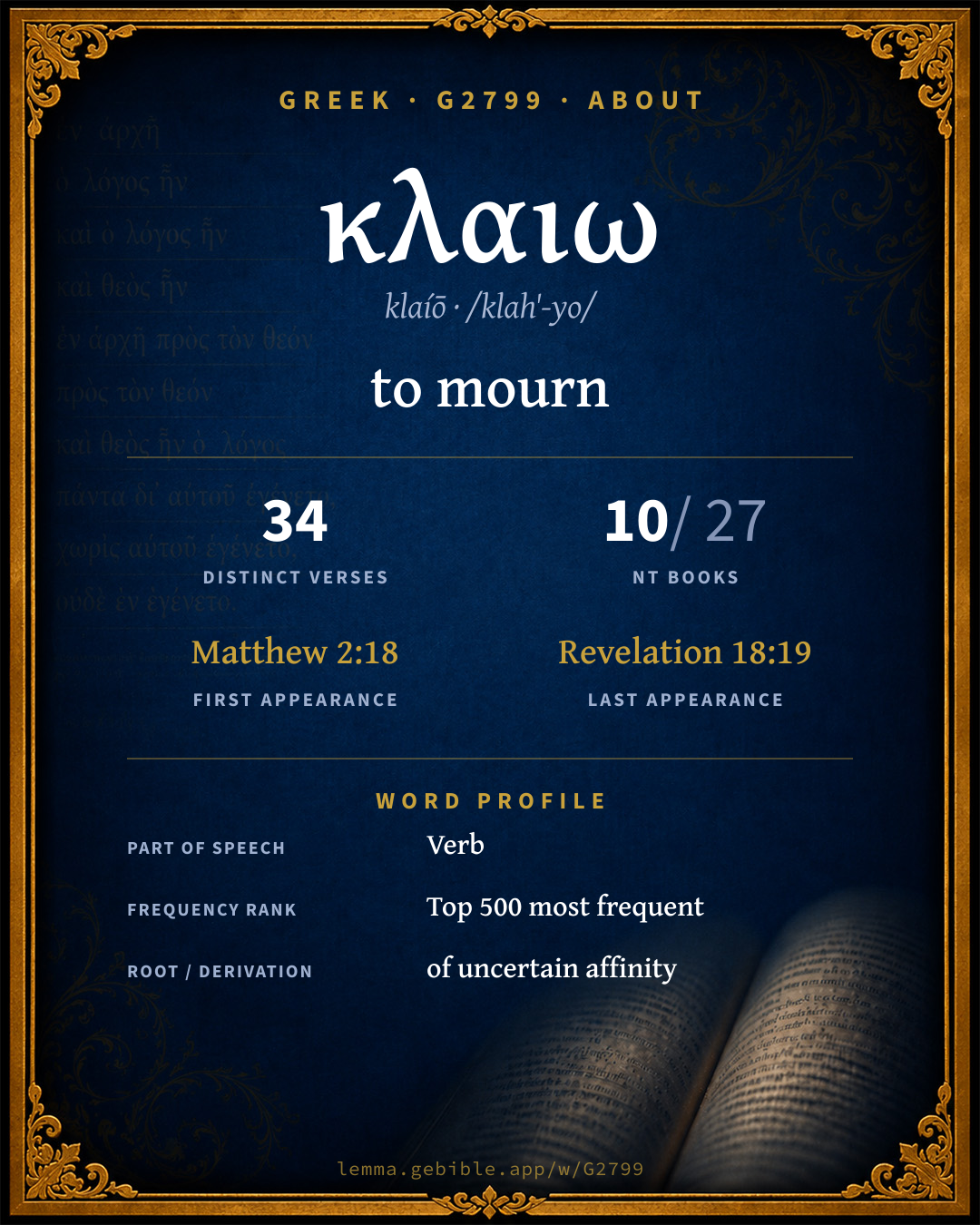
κλαίω
to mourn
‘to mourn’ is one of 3 main senses fuller range ↓
Full lexicon entry — Thayer's Greek Lexicon
From Thayer's Greek Lexicon
Where this word appears
See every Present-tense verb in the Greek New Testament →
Grammar key — what these labels mean
Part of speech
- Verb
- An action or state-of-being word.
Tense
- Present
- Ongoing or general action in present time (imperfective aspect).
- Aorist
- Action viewed as a simple whole, without regard to duration — often past (perfective aspect).
- Future
- Action expected in future time.
- Imperfect
- Continuous or repeated action in past time (“was writing”).
Voice
- Active
- The subject performs the action.
Mood
- Participle
- A verbal adjective (“writing,” “having written”).
- Indicative
- States a fact or asks a factual question (the mood of reality).
- Imperative
- Expresses a command or request.
- Subjunctive
- Expresses probability, purpose, or possibility (the mood of contingency).
- Infinitive
- A verbal noun (“to write”), unmarked for person or number.
Case
- Nominative
- The case of the subject (and the predicate nominative).
- Accusative
- The case of the direct object and of extent.
- Dative
- The case of the indirect object, means, or location — “to / for / with / in.”
- Genitive
- The case of source, possession, or “of” — answers “whose / from what.”
Person
- 3rd person
- The one spoken about (“he / she / it / they”).
- 2nd person
- The one addressed (“you”).
- 1st person
- The speaker (“I / we”).
Gender
- Masculine
- Grammatically masculine.
- Feminine
- Grammatically feminine.
Number
- Plural
- More than one.
- Singular
- One.
Every verse where G2799 appears in the Book of Revelation — 6 distinct verses. Click any verse to open its interlinear word-by-word view. Verse text shown in the World English Bible for context — . Each verse’s Greek form is shown with its reference; the English is not keyword-highlighted, since the data carries no word-level English alignment. Use “Compare translations” on any verse to read it across multiple English versions. This concordance covers the Greek New Testament; Septuagint (Greek Old Testament) occurrences of this word are not indexed here.
Revelation
- Revelation 5:4 ἔκλαιον impf act ind 1sg And I wept much, because no one was found worthy to open the book, or to look in it.
- Revelation 5:5 κλαῖε pres act impv 2sg One of the elders said to me, "Don't weep. Behold, the Lion who is of the tribe of Judah, the Root of David, has overcome; he who opens the book and its seven seals."
- Revelation 18:9 κλαύσουσιν fut act ind 3pl The kings of the earth, who committed sexual immorality and lived wantonly with her, will weep and wail over her, when they look at the smoke of her burning,
- Revelation 18:11 κλαίουσιν pres act ind 3pl The merchants of the earth weep and mourn over her, for no one buys their merchandise any more;
- Revelation 18:15 κλαίοντες pres act ptcp nom pl masc The merchants of these things, who were made rich by her, will stand far away for the fear of her torment, weeping and mourning;
- Revelation 18:19 κλαίοντες pres act ptcp nom pl masc They cast dust on their heads, and cried, weeping and mourning, saying, 'Woe, woe, the great city, in which all who had their ships in the sea were made rich by reason of her great wealth!' For in one hour is she made desolate.
About this entry
At a glance — auto-summarized from this page’s data, not written by a person. Every figure links to its source below. This summary describes the numbers; it doesn’t interpret them.
κλαιω — transliterated klaíō — is a Greek verb carrying the sense “to mourn.” Debuting at Matthew 2:18, it then recurs through the corpus. Spanning 34 verses in 10 books, it ranks among the moderately common words of the Greek New Testament. Its uses concentrate in Luke (26% of all occurrences). Its lexical range runs to 3 senses. The sections below give every sense, occurrence, and version rendering.
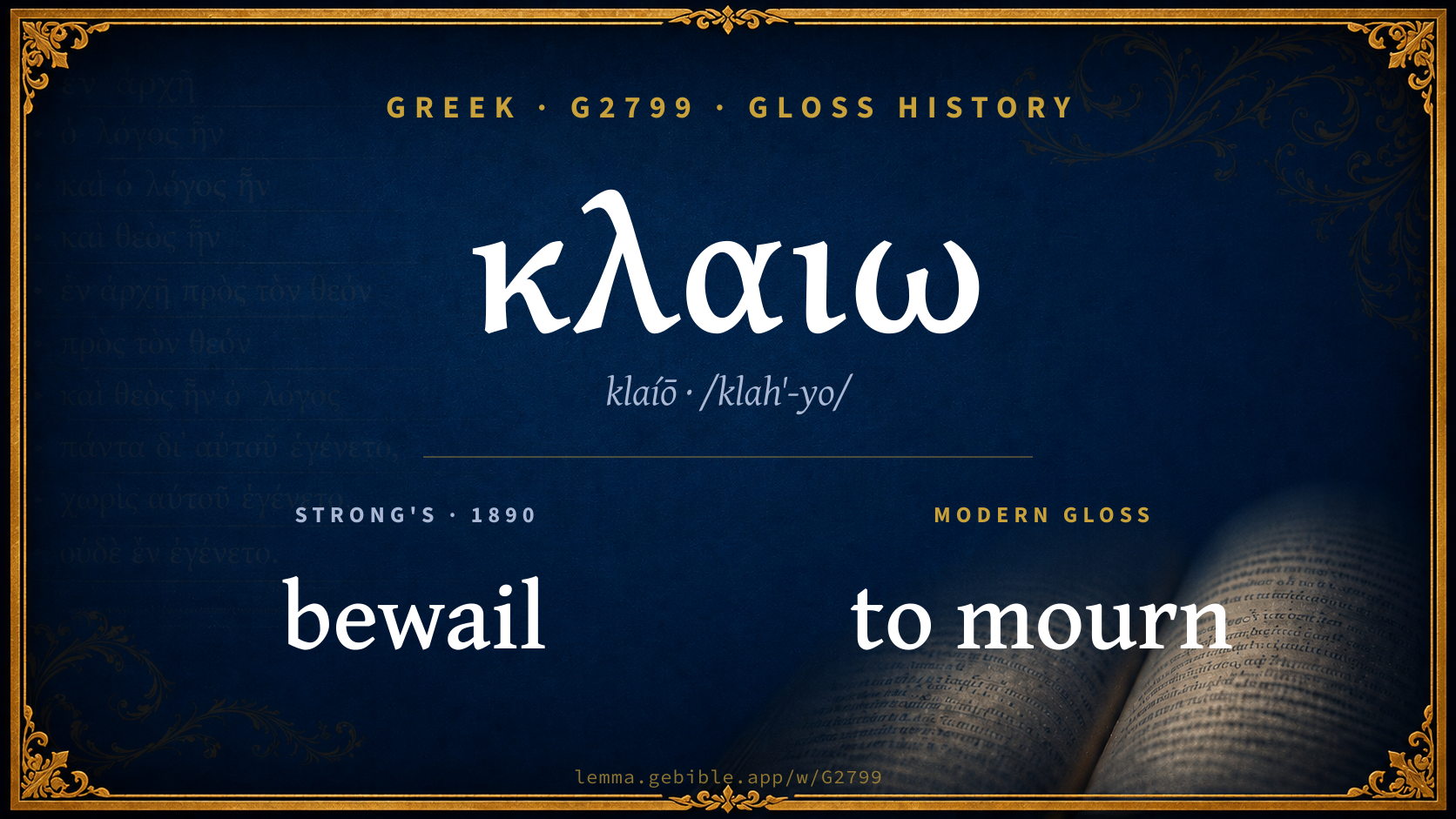
Gloss history
Strong's 1890 vs modern scholarship
About this word
Strong's G2799 catalogs a Greek word from the Greek New Testament.
These counts are not copied from any lexicon or concordance. They are computed here, from the morphology-tagged Greek New Testament. What Lemma adds →
- 34
- distinct verses
- The word appears in 34 distinct verses.
- 10 / 27
- NT books
- The word appears in 10 of 27 New Testament books.
- #380
- by frequency
- Top 500 most frequent Greek words (rank 380 of 5,347 Greek words by occurrence).
View all 34 occurrences in the concordance →
Most concentrated in
- Luke 9 verses 26%
- John 6 verses 18%
- Revelation 6 verses 18%
By section of the New Testament
By traditional corpus
Conventional, traditional groupings — biblical authorship is debated, so this is a traditional corpus grouping, not an authorship claim. Some books belong to more than one corpus (Luke is in both the Gospels and the Lukan corpus, and so on), so these shares overlap and need not total 100%. Each figure is a share of the word’s 34 distinct verses.
- Gospels 21 verses · 62%
- Johannine 12 verses · 35%
- Lukan (Luke–Acts) 11 verses · 32%
- Revelation 6 verses · 18%
- Pauline corpus 3 verses · 9%
- General (Catholic) Epistles 2 verses · 6%
How translations render this word
Counts come from each version’s own published word-to-Strong’s tagging or interlinear alignment — an approximate guide to how each version renders this word, not a word-level alignment the data otherwise carries. Because each total is that version’s own tagged count, the per-version totals vary from one another and need not match the appearance or distinct-verse counts above. These counts may also differ from a printed concordance because Lemma counts each distinctly tagged rendering and does not collapse phrase taggings into a single head-word total. This is a fixed set of word-tagged versions (KJV, ASV, BSB, ULT) and does not change with the reading translation you choose elsewhere. Each version’s license is shown beside its name below (and on Sources).
- King James Version: Weep 13×, Weeping 9×, Wept 8×
- American Standard Version: Weep 15×, Weeping 10×, Wept 6×
- Berean Standard Bible: Weep 11×, Weeping 10×, Wept 3×
- unfoldingWord Literal Text: Weeping 17×, Weep 9×, Do 4×
King James Version Public Domain
Renders G2799 across 41 tagged occurrences — most commonly:
Plus 7 renderings that appear only once — usually multi-word phrases or single function words the recovered tagging swept in, not distinct renderings.
American Standard Version Public Domain
Renders G2799 across 40 tagged occurrences — most commonly:
Plus 7 renderings that appear only once — usually multi-word phrases or single function words the recovered tagging swept in, not distinct renderings.
Berean Standard Bible Public Domain
Renders G2799 across 40 tagged occurrences — most commonly:
Plus 11 renderings that appear only once — usually multi-word phrases or single function words the recovered tagging swept in, not distinct renderings.
unfoldingWord Literal Text CC BY-SA 4.0
Renders G2799 across 46 tagged occurrences — most commonly:
Plus 7 renderings that appear only once — usually multi-word phrases or single function words the recovered tagging swept in, not distinct renderings.
Senses in Thayer's
The 3 senses Thayer's distinguishes for this word, in lexicon order (not ranked by frequency or importance). The full entry — with sub-senses — is in the Lexicon Entry tab.
- weeping as the sign of pain and grief for the thing signified (i.e. for the pain and grief)
- of those who mourn for the dead
- to weep for, mourn for, bewail, one
Word origin
Origin: of uncertain affinity
Of uncertain affinity; to sob that is wail aloud (whereas G1145 is rather to cry silently): - bewail. weep.
— Strong’s Exhaustive Concordance (1890), public domain.
Forms in the corpus
The 20 distinct written forms G2799 takes in the Greek New Testament, most frequent first — each parse links to that tense’s occurrences in the concordance.
Same root — word family
Other Thayer's entries built from the same root as G2799, grouped by Strong’s listed origin. These share a root / origin per the lexicon — not necessarily a shared meaning. Each links to that word’s own entry.
Derived from this word
Compare all same-root words → They share a root, not necessarily a meaning.
Septuagint usage
The same Greek word κλαιω appears 117 times in the Greek Old Testament (Septuagint), across 104 verses in 23 books.
- 117
- LXX occurrences
- Tagged occurrences of this Greek word in the Septuagint.
- 104
- verses
- Distinct Septuagint verses containing this word.
- 23 / 39
- OT books
- The word appears in 23 of the 39 Old Testament books.
Sample Septuagint occurrences
- Genesis 21:16 κλαίω
- Exodus 2:6 κλαίω
- Leviticus 10:6 κλαίω
- Numbers 11:4 κλαίω
- Deuteronomy 1:45 κλαίω
- Judges 2:4 κλαίω
- Ruth 1:9 κλαίω
- 1 Samuel 1:7 κλαίω
- 2 Samuel 1:12 κλαίω
- 1 Kings 18:45 κλαίω
- 2 Kings 8:11 κλαίω
- 2 Chronicles 34:27 κλαίω
Septuagint occurrences (same lexeme)
Every verse where the same Strong’s number (G2799) appears in the Greek Septuagint — showing the first 50 of 104. Verse text shown in the World English Bible for context; the Greek form is the matched word — the English is not keyword-highlighted.
- Genesis 21:16 κλαίω She went and sat down opposite him, a good way off, about a bow shot away. For she said, "Don't let me see the death of the child." She sat over against him, and lifted up her voice, and wept.
- Genesis 27:38 κλαίω Esau said to his father, "Have you but one blessing, my father? Bless me, even me also, my father." Esau lifted up his voice, and wept.
- Genesis 29:11 κλαίω Jacob kissed Rachel, and lifted up his voice, and wept.
- Genesis 33:4 κλαίω Esau ran to meet him, embraced him, fell on his neck, kissed him, and they wept.
- Genesis 37:35 κλαίω All his sons and all his daughters rose up to comfort him; but he refused to be comforted. He said, "For I will go down to Sheol to my son mourning." His father wept for him.
- Genesis 42:24 κλαίω He turned himself about from them, and wept, and he returned to them, and spoke to them, and took Simeon from among them, and bound him before their eyes.
- Genesis 43:30 κλαίω Joseph made haste; for his heart yearned over his brother: and he sought a place to weep; and he entered into his room, and wept there.
- Genesis 45:14 κλαίω He fell on his brother Benjamin's neck, and wept, and Benjamin wept on his neck.
- Genesis 45:15 κλαίω He kissed all his brothers, and wept on them. After that his brothers talked with him.
- Genesis 46:29 κλαίω Joseph made ready his chariot, and went up to meet Israel, his father, in Goshen. He presented himself to him, and fell on his neck, and wept on his neck a good while.
- Genesis 50:1 κλαίω Joseph fell on his father's face, wept on him, and kissed him.
- Genesis 50:17 κλαίω "So you shall tell Joseph, 'Now please forgive the disobedience of your brothers, and their sin, because they did evil to you.' Now, please forgive the disobedience of the servants of the God of your father." Joseph wept when they spoke to him.
- Exodus 2:6 κλαίω She opened it, and saw the child, and, behold, the baby cried. She had compassion on him, and said, "This is one of the Hebrews' children."
- Leviticus 10:6 κλαίω Moses said to Aaron, and to Eleazar and to Ithamar, his sons, "Don't let the hair of your heads go loose, neither tear your clothes; that you don't die, and that he not be angry with all the congregation: but let your brothers, the whole house of Israel, bewail the burning which Yahweh has kindled.
- Numbers 11:4 κλαίω The mixed multitude that was among them lusted exceedingly: and the children of Israel also wept again, and said, Who shall give us flesh to eat?
- Numbers 11:10 κλαίω Moses heard the people weeping throughout their families, every man at the door of his tent: and the anger of Yahweh was kindled greatly; and Moses was displeased.
- Numbers 11:13 κλαίω Whence should I have flesh to give to all this people? for they weep to me, saying, Give us flesh, that we may eat.
- Numbers 11:18 κλαίω Say you to the people, Sanctify yourselves against tomorrow, and you shall eat flesh; for you have wept in the ears of Yahweh, saying, Who shall give us flesh to eat? for it was well with us in Egypt: therefore Yahweh will give you flesh, and you shall eat.
- Numbers 11:20 κλαίω but a whole month, until it come out at your nostrils, and it be loathsome to you; because that you have rejected Yahweh who is among you, and have wept before him, saying, Why came we forth out of Egypt?
- Numbers 14:1 κλαίω All the congregation lifted up their voice, and cried; and the people wept that night.
- Numbers 20:29 κλαίω When all the congregation saw that Aaron was dead, they wept for Aaron thirty days, even all the house of Israel.
- Numbers 25:6 κλαίω Behold, one of the children of Israel came and brought to his brothers a Midianite woman in the sight of Moses, and in the sight of all the congregation of the children of Israel, while they were weeping at the door of the tent of meeting.
- Deuteronomy 1:45 κλαίω You returned and wept before Yahweh; but Yahweh didn't listen to your voice, nor gave ear to you.
- Deuteronomy 21:13 κλαίω and she shall put the clothing of her captivity from off her, and shall remain in your house, and bewail her father and her mother a full month: and after that you shall go in to her, and be her husband, and she shall be your wife.
- Deuteronomy 34:8 κλαίω The children of Israel wept for Moses in the plains of Moab thirty days: so the days of weeping in the mourning for Moses were ended.
- Judges 2:4 κλαίω It happened, when the angel of Yahweh spoke these words to all the children of Israel, that the people lifted up their voice, and wept.
- Judges 9:7 κλαίω When they told it to Jotham, he went and stood on the top of Mount Gerizim, and lifted up his voice, and cried, and said to them, Listen to me, you men of Shechem, that God may listen to you.
- Judges 9:53 κλαίω A certain woman cast an upper millstone on Abimelech's head, and broke his skull.
- Judges 11:37 κλαίω She said to her father, Let this thing be done for me: let me alone two months, that I may depart and go down on the mountains, and bewail my virginity, I and my companions.
- Judges 11:38 κλαίω He said, Go. He sent her away for two months: and she departed, she and her companions, and mourned her virginity on the mountains.
- Judges 14:16 κλαίω Samson's wife wept before him, and said, You do but hate me, and don't love me: you have put forth a riddle to the children of my people, and haven't told it me. He said to her, Behold, I haven't told it my father nor my mother, and shall I tell you?
- Judges 14:17 κλαίω She wept before him the seven days, while their feast lasted: and it happened on the seventh day, that he told her, because she pressed him sore; and she told the riddle to the children of her people.
- Judges 15:18 κλαίω He was very thirsty, and called on Yahweh, and said, You have given this great deliverance by the hand of your servant; and now shall I die for thirst, and fall into the hand of the uncircumcised.
- Judges 16:28 κλαίω Samson called to Yahweh, and said, Lord Yahweh, remember me, Please, and strengthen me, Please, only this once, God, that I may be at once avenged of the Philistines for my two eyes.
- Judges 20:23 κλαίω The children of Israel went up and wept before Yahweh until even; and they asked of Yahweh, saying, Shall I again draw near to battle against the children of Benjamin my brother? Yahweh said, Go up against him.
- Judges 20:26 κλαίω Then all the children of Israel, and all the people, went up, and came to Bethel, and wept, and sat there before Yahweh, and fasted that day until even; and they offered burnt-offerings and peace-offerings before Yahweh.
- Judges 21:2 κλαίω The people came to Bethel, and sat there until evening before God, and lifted up their voices, and wept sore.
- Ruth 1:9 κλαίω Yahweh grant you that you may find rest, each of you in the house of her husband. Then she kissed them, and they lifted up their voice, and wept.
- Ruth 1:14 κλαίω They lifted up their voice, and wept again: and Orpah kissed her mother-in-law, but Ruth joined with her.
- 1 Samuel 1:7 κλαίω [as] he did so year by year, when she went up to the house of Yahweh, so she provoked her; therefore she wept, and did not eat.
- 1 Samuel 1:8 κλαίω Elkanah her husband said to her, Hannah, why weep you? and why don't you eat? and why is your heart grieved? am I not better to you than ten sons?
- 1 Samuel 1:10 κλαίω She was in bitterness of soul, and prayed to Yahweh, and wept sore.
- 1 Samuel 11:4 κλαίω Then came the messengers to Gibeah of Saul, and spoke these words in the ears of the people: and all the people lifted up their voice, and wept.
- 1 Samuel 11:5 κλαίω Behold, Saul came following the oxen out of the field; and Saul said, What ails the people that they weep? They told him the words of the men of Jabesh.
- 1 Samuel 13:16 κλαίω Saul, and Jonathan his son, and the people who were present with them, abode in Geba of Benjamin: but the Philistines encamped in Michmash.
- 1 Samuel 20:41 κλαίω As soon as the boy was gone, David arose out of [a place] toward the South, and fell on his face to the ground, and bowed himself three times: and they kissed one another, and wept one with another, until David exceeded.
- 1 Samuel 24:17 κλαίω He said to David, You are more righteous than I; for you have rendered to me good, whereas I have rendered to you evil.
- 1 Samuel 30:4 κλαίω Then David and the people who were with him lifted up their voice and wept, until they had no more power to weep.
- 2 Samuel 1:12 κλαίω and they mourned, and wept, and fasted until even, for Saul, and for Jonathan his son, and for the people of Yahweh, and for the house of Israel; because they were fallen by the sword.
- 2 Samuel 1:24 κλαίω You daughters of Israel, weep over Saul, Who clothed you in scarlet delicately, Who put ornaments of gold on your clothing.
These are occurrences of the same Greek lexeme (G2799) in the Septuagint — not a translation of any one Hebrew word. The store carries no word-level Hebrew↔Greek alignment, so no Hebrew original is asserted here. Counts come from the recovered LXX Strong's tagging — high-frequency vocabulary is well covered, while rare or late forms may be untagged — so they reflect tagged occurrences and may slightly undercount.