
Judges 20:26

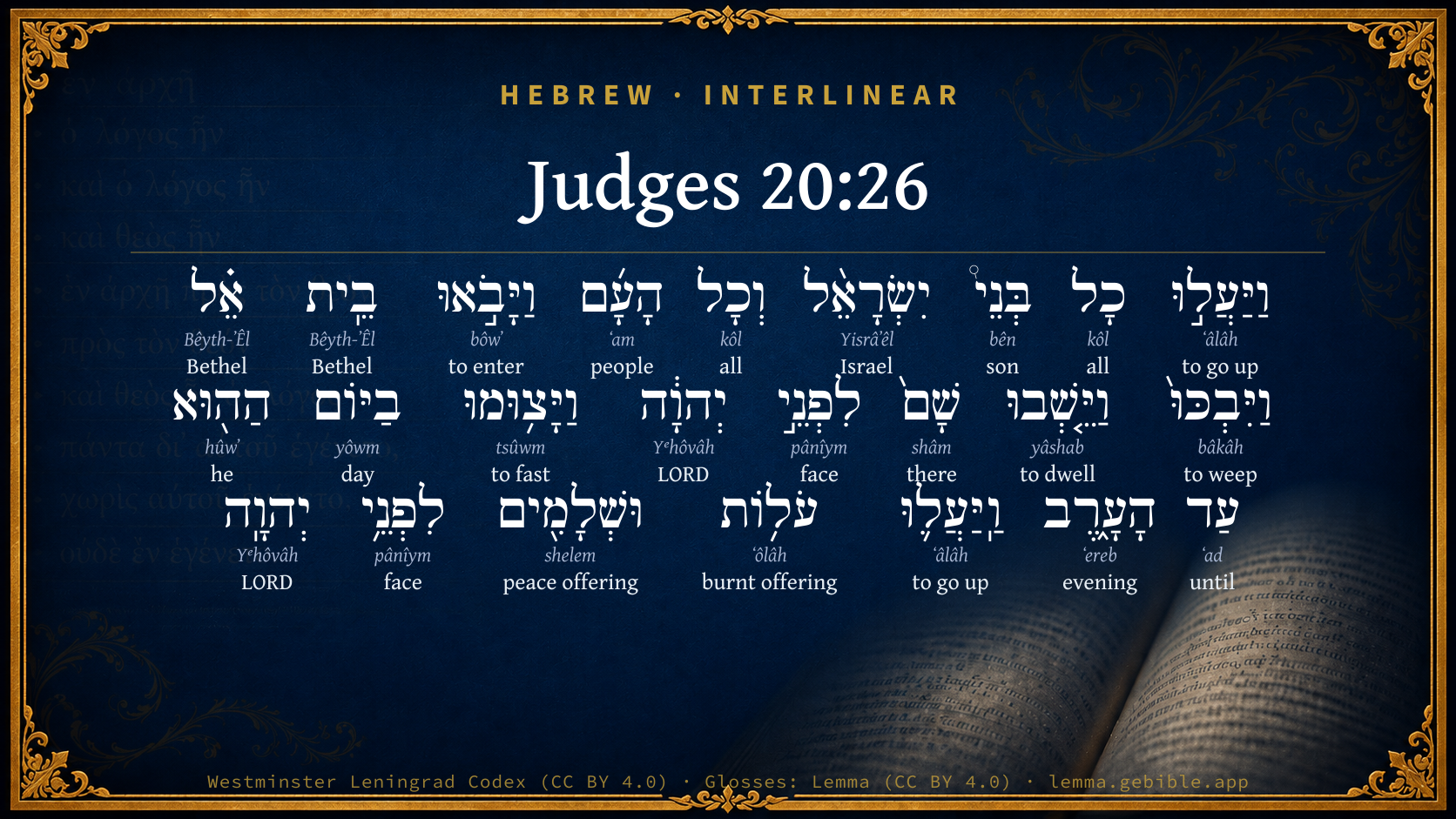
Hebrew (Westminster Leningrad Codex) Judges 20:26 appears in the Hebrew Old Testament. The text above is from the Westminster Leningrad Codex. Each word links to its Strong’s number, a concise gloss, and parsing drawn from the Open Scriptures Hebrew Bible morphology. Click any word for its full Brown-Driver-Briggs (BDB) entry.
Download image
Cite this verse

Judges 20:26 (World English Bible). Public Domain. Lemma interlinear Bible study tool, https://lemma.gebible.app/v/judges/20/26.

Show BibTeX & RIS
BibTeX
RIS
English Translation
Then all the children of Israel, and all the people, went up, and came to Bethel, and wept, and sat there before Yahweh, and fasted that day until even; and they offered burnt-offerings and peace-offerings before Yahweh.
World English Bible · Public Domain
Highlights
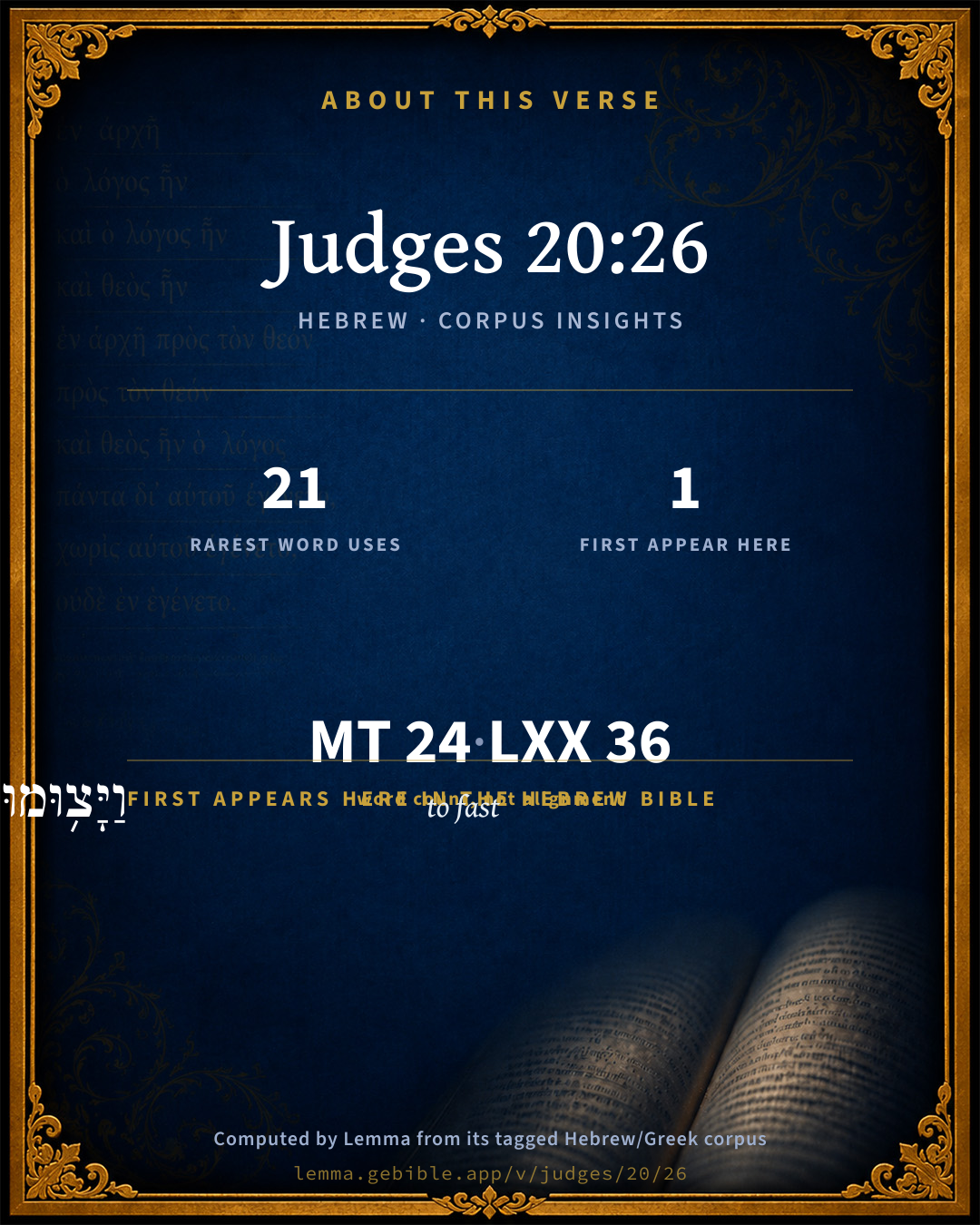
  • 1 first appearance in the Hebrew Bible
Full analysis ↓
Download a study sheet

One document with this verse’s original text, its word-by-word gloss line, the meaning frame, cross-references with their text, attributed commentary, and full source and license credits — printable, and it pastes into notes with its structure intact.

This verse Autodidact and up

Study sheet (.html) Plain text (.txt)

A passage Seminary Student

Up to 50 verses in one chapter. A passage sheet keeps up to 6 commentary sources and 12 cross-references per verse, in the order this page ranks them, and says so on the sheet whenever that leaves anything out. Ask for a single verse and you get the Autodidact verse sheet above.

Everything on this page stays free to read, with no account — the sheet is a download of what is already on screen, not access to it.

Want to remove ads? Support Godless Engineer
Compare translations 3

The same verse in 3 English versions, stacked beneath the original-language interlinear above. Click any original word for its lexicon entry.

Each is an independent rendering of the whole verse — the interlinear is not word-aligned to these translations.

Highlighted words mark where these versions differ — a whole-verse word diff, not a word-by-word alignment.

  • World English Bible Public Domain
    Then all the children of Israel, and all the people, went up, and came to Bethel, and wept, and sat there before Yahweh, and fasted that day until even; and they offered burnt-offerings and peace-offerings before Yahweh.
  • King James Version Public Domain
    Then all the children of Israel, and all the people, went up, and came unto the house of God, and wept, and sat there before the LORD, and fasted that day until even, and offered burnt offerings and peace offerings before the LORD.
  • unfoldingWord Literal Text CC BY-SA 4.0
    Then all of the sons of Israel went up, and all of the people, and they came Bethel. And they wept, and they sat there to the face of Yahweh, and they fasted on that day until the evening, and they offered burnt offerings and peace offerings to the face of Yahweh.

unfoldingWord Literal Text — © unfoldingWord, licensed CC BY-SA 4.0. Word-aligned USFM3 via Door43 (git.door43.org/unfoldingWord/en_ult).

Versions to compare (up to 4)

3 of 4 selected

Show all 18 translations

Every available English version of this verse, each an independent rendering of the whole verse.

  • World English Bible Public Domain
    Then all the children of Israel, and all the people, went up, and came to Bethel, and wept, and sat there before Yahweh, and fasted that day until even; and they offered burnt-offerings and peace-offerings before Yahweh.
  • Berean Standard Bible Public Domain
    Then the Israelites, all the people, went up to Bethel, where they sat weeping before the LORD. That day they fasted until evening and presented burnt offerings and peace offerings to the LORD.
  • Majority Standard Bible Public Domain
    Then the Israelites, all the people, went up to Bethel, where they sat weeping before the LORD. That day they fasted until evening and presented burnt offerings and peace offerings to the LORD.
  • King James Version Public Domain
    Then all the children of Israel, and all the people, went up, and came unto the house of God, and wept, and sat there before the LORD, and fasted that day until even, and offered burnt offerings and peace offerings before the LORD.
  • American Standard Version (1901) Public Domain
    Then all the children of Israel, and all the people, went up, and came unto Beth-el, and wept, and sat there before Jehovah, and fasted that day until even; and they offered burnt-offerings and peace-offerings before Jehovah.
  • Revised Version (1885) Public Domain
    Then all the children of Israel, and all the people, went up, and came unto Beth-el, and wept, and sat there before the LORD, and fasted that day until even; and they offered burnt offerings and peace offerings before the LORD.
  • Geneva Bible (1599) Public Domain
    Then al the children of Israel went vp and all the people came also vnto the house of God, and wept and sate there before the Lord and fasted that day vnto the euening, and offred burnt offrings and peace offrings before the Lord.
  • Douay-Rheims (1899) Public Domain
    Wherefore all the children of Israel came to the house of God, and sat and wept before the Lord: and they fasted that day till the evening, and offered to him holocausts, and victims of peace offerings,
  • Young's Literal Translation Public Domain
    And all the sons of Israel go up, even all the people, and come in to Beth-El, and weep, and sit there before Jehovah, and fast on that day till the evening, and cause to ascend burnt-offerings and peace-offerings before Jehovah.
  • Literal Standard Version CC BY-SA 4.0
    And all the sons of Israel go up, even all the people, and come to Beth-El, and weep, and sit there before YHWH, and fast on that day until the evening, and cause burnt-offerings and peace-offerings to ascend before YHWH.
  • Unlocked Literal Bible CC BY-SA 4.0
    Then all the soldiers of Israel and all the people went up to Bethel and wept, and there they sat before Yahweh and they fasted that day until the evening and offered burnt offerings and peace offerings before Yahweh.
  • unfoldingWord Literal Text CC BY-SA 4.0
    Then all of the sons of Israel went up, and all of the people, and they came Bethel. And they wept, and they sat there to the face of Yahweh, and they fasted on that day until the evening, and they offered burnt offerings and peace offerings to the face of Yahweh.
  • Darby Bible Public Domain
    Then all the people of Israel, the whole army, went up and came to Bethel and wept; they sat there before the LORD, and fasted that day until evening, and offered burnt offerings and peace offerings before the LORD.
  • World Messianic Bible Public Domain
    Then all the children of Israel and all the people went up, and came to Bethel, and wept, and sat there before the LORD, and fasted that day until evening; then they offered burnt offerings and peace offerings before the LORD.
  • Webster's Bible Public Domain
    Then all the children of Israel, and all the people, went up, and came to the house of God, and wept, and sat there before the LORD, and fasted that day until evening, and offered burnt-offerings and peace-offerings before the LORD.
  • Free Bible Version CC BY-SA 4.0
    Then all the Israelites and all their army went to Bethel, and sat crying there before the Lord. That day they fasted until evening and gave burnt offerings and friendship offerings to the Lord.
  • Bible in Basic English Public Domain
    Then all the children of Israel, and all the people, went up to Beth-el, weeping and waiting there before the Lord, going without food all day till evening, and offering burned offerings and peace-offerings before the Lord.
  • JPS Tanakh (1917) Public Domain
    Then all the children of Israel, and all the people, went up, and came unto Beth-el, and wept, and sat there before the LORD, and fasted that day until even; and they offered burnt-offerings and peace-offerings before the LORD.

Literal Standard Version (2020), Covenant Press — licensed CC BY-SA 4.0. Text via the HelloAO Bible API (eBible.org). Unlocked Literal Bible (unfoldingWord) — licensed CC BY-SA 4.0. Text via the HelloAO Bible API (eBible.org). unfoldingWord Literal Text — © unfoldingWord, licensed CC BY-SA 4.0. Word-aligned USFM3 via Door43 (git.door43.org/unfoldingWord/en_ult). Free Bible Version, Dr. Jonathan Gallagher — licensed CC BY-SA 4.0. Text via the HelloAO Bible API (eBible.org).

Word by word

More ways to search: Search by grammar → Find every occurrence → Compare this word →

Practice this passage: Drill this verse → Learn its vocabulary →

וַיָּצ֥וּמוּ
tsûwm
H6684
“and · to fast”
Conjunction + Verb, Qal, Sequential Imperfect, 3rd Person, Masculine, Plural
Part of Speech
Conjunction + Verb
Stem
Qal
Form
Sequential Imperfect
Person
3rd Person
Gender
Masculine
Number
Plural
Full BDB Definition

Origin: a primitive root

TWOT: 1890

(Qal) to abstain from food, fast
  1. וַיַּעֲל֣וּ ʻâlâh H5927 “and · to go up” Conjunction + Verb, Qal, Sequential Imperfect, 3rd Person, Masculine, Plural
  2. כָל kôl H3605 “all of” Noun, Common, Masculine, Singular, Construct
  3. בְּנֵי֩ bên H1121 “sons of” Noun, Common, Masculine, Plural, Construct
  4. יִשְׂרָאֵ֨ל Yisrâʼêl H3478 “Israel” Noun, Proper
  5. וְכָל kôl H3605 “and · all of” Conjunction + Noun, Common, Masculine, Singular, Construct
  6. הָעָ֜ם ʻam H5971 “the · people” Particle, Definite Article + Noun, Common, Masculine, Singular, Absolute
  7. וַיָּבֹ֣אוּ bôwʼ H935 “and · to enter” Conjunction + Verb, Qal, Sequential Imperfect, 3rd Person, Masculine, Plural
  8. בֵֽית Bêyth-ʼÊl H1008 “Bethel” Noun, Proper
  9. אֵ֗ל Bêyth-ʼÊl H1008 “Bethel” Noun, Proper
  10. וַיִּבְכּוּ֙ bâkâh H1058 “and · to weep” Conjunction + Verb, Qal, Sequential Imperfect, 3rd Person, Masculine, Plural
  11. וַיֵּ֤שְׁבוּ yâshab H3427 “and · to dwell” Conjunction + Verb, Qal, Sequential Imperfect, 3rd Person, Masculine, Plural
  12. שָׁם֙ shâm H8033 “there” Adverb
  13. לִפְנֵ֣י pânîym H6440 “to/for · face(s) of” Preposition + Noun, Common, Both, Plural, Construct
  14. יְהוָ֔ה Yᵉhôvâh H3068 “LORD” Noun, Proper
  15. בַיּוֹם yôwm H3117 “in/at the · day” Preposition, Determined + Noun, Common, Masculine, Singular, Absolute
  16. הַה֖וּא hûwʼ H1931 “the · he” Particle, Definite Article + Pronoun, Personal, 3rd Person, Masculine, Singular
  17. עַד ʻad H5704 “until” Preposition
  18. הָעָ֑רֶב ʻereb H6153 “the · evening” Particle, Definite Article + Noun, Common, Masculine, Singular, Absolute
  19. וַֽיַּעֲל֛וּ ʻâlâh H5927 “and · to go up” Conjunction + Verb, Hiphil, Sequential Imperfect, 3rd Person, Masculine, Plural
  20. עֹל֥וֹת ʻôlâh H5930 “burnt offerings” Noun, Common, Feminine, Plural, Absolute
  21. וּשְׁלָמִ֖ים shelem H8002 “and · peace offerings” Conjunction + Noun, Common, Masculine, Plural, Absolute
  22. לִפְנֵ֥י pânîym H6440 “to/for · face(s) of” Preposition + Noun, Common, Both, Plural, Construct
  23. יְהוָֽה Yᵉhôvâh H3068 “LORD” Noun, Proper

About this verse

These counts appear in no published source. They are computed here, from the morphology-tagged text and Lemma’s own curated glosses. What Lemma adds →

24
words
19
distinct lemmas
Historical
section

Notable vocabulary

The rarest word here is וַיָּצ֥וּמוּ to fast H6684 — appearing just 21 times in the whole Hebrew Bible.

First appearance in Scripture

This word makes its first canonical appearance in the Hebrew Bible here:

  • וַיָּצ֥וּמוּ to fast H6684

Shared distinctive vocabulary

וַיָּצ֥וּמוּ to fast H6684 occurs in 17 verses of the Hebrew Bible. Also found in:

Grammatical profile

  • 6 verbs
  • 15 nouns
  • 1 pronoun
  • 1 preposition
  • 1 adverb

Verb forms

  • וַיַּעֲל֣וּ Qal · Sequential Imperfect
  • וַיָּבֹ֣אוּ Qal · Sequential Imperfect
  • וַיִּבְכּוּ֙ Qal · Sequential Imperfect
  • וַיֵּ֤שְׁבוּ Qal · Sequential Imperfect
  • וַיָּצ֥וּמוּ Qal · Sequential Imperfect
  • וַֽיַּעֲל֛וּ Hiphil · Sequential Imperfect

Repetition

Words recur within this verse — often emphatic in Hebrew:

  • וַיַּעֲל֣וּ to go up H5927 ×2
  • כָל all H3605 ×2
  • בֵֽית Bethel H1008 ×2
  • לִפְנֵ֣י face H6440 ×2
  • יְהוָ֔ה LORD H3068 ×2

Hebrew & Septuagint length

In English translation the verse runs 37 words from the Hebrew and 43 from the Septuagint (LXX English) — closely comparable.

A rough comparison of the two English renderings, which tokenize alike — not a word-level alignment.

Word counts can differ between the Hebrew and the Greek without any difference in meaning — e.g. the Hebrew direct-object marker אֵת has no separate Greek word, and Greek often adds the article ὁ.

In the original languages it is 24 Hebrew tokens and 36 Greek tokens — but the two are counted differently (Hebrew bundles its prefixes and suffixes into one token; the Greek is in lemma form), so that isn’t a like-for-like length.

Cross-references

9

Topical passages linked to Judges 20:26 in the Treasury of Scripture Knowledge — connected by theme and wording, ordered by reader-vote popularity; previews shown in the World English Bible.

  • Judges 20:23 The children of Israel went up and wept before Yahweh until even; and they asked of Yahweh, saying, Shall I again draw near to battle against the children of Benjamin my brother? Yahweh said, Go up against him.
  • Joel 2:12–18 "Yet even now," says Yahweh, "turn to me with all your heart, And with fasting, and with weeping, and with mourning."
  • Judges 20:18 The children of Israel arose, and went up to Bethel, and asked counsel of God; and they said, Who shall go up for us first to battle against the children of Benjamin? Yahweh said, Judah [shall go up] first.
  • Ezra 8:21 Then I proclaimed a fast there, at the river Ahava, that we might humble ourselves before our God, to seek of him a straight way for us, and for our little ones, and for all our substance.
  • Ezra 9:4–5 Then were assembled to me everyone who trembled at the words of the God of Israel, because of the trespass of them of the captivity; and I sat confounded until the evening offering.
  • 1 Samuel 7:6 They gathered together to Mizpah, and drew water, and poured it out before Yahweh, and fasted on that day, and said there, We have sinned against Yahweh. Samuel judged the children of Israel in Mizpah.
  • 2 Chronicles 20:3 Jehoshaphat feared, and set himself to seek to Yahweh; and he proclaimed a fast throughout all Judah.
  • Joel 1:14 Sanctify a fast. Call a solemn assembly. Gather the elders, And all the inhabitants of the land, to the house of Yahweh, your God, And cry to Yahweh.
  • Jonah 3:5–10 The people of Nineveh believed God; and they proclaimed a fast, and put on sackcloth, from the greatest of them even to the least of them.

Cross-references courtesy of OpenBible.info (CC BY 4.0).

Hebrew and Greek witnesses Masoretic Hebrew ↔ Greek Septuagint

The same verse in the two great witnesses to the Old Testament, shown verse-for-verse.

These are two independent witnesses, not word-aligned to each other, and the Septuagint is shown in lemma (dictionary) form.

Hebrew Judges 20:26 Masoretic · Westminster Leningrad Codex

וַיַּעֲל֣וּ כָל בְּנֵי֩ יִשְׂרָאֵ֨ל וְכָל הָעָ֜ם וַיָּבֹ֣אוּ בֵֽית אֵ֗ל וַיִּבְכּוּ֙ וַיֵּ֤שְׁבוּ שָׁם֙ לִפְנֵ֣י יְהוָ֔ה וַיָּצ֥וּמוּ בַיּוֹם הַה֖וּא עַד הָעָ֑רֶב וַֽיַּעֲל֛וּ עֹל֥וֹת וּשְׁלָמִ֖ים לִפְנֵ֥י יְהוָֽה

Then all the children of Israel, and all the people, went up, and came to Bethel, and wept, and sat there before Yahweh, and fasted that day until even; and they offered burnt-offerings and peace-offerings before Yahweh.

World English Bible · Public Domain

Greek LXX Judges 20:26 Septuagint · lemma form

καί ἀναβαίνω πᾶς ὁ υἱός ἰσραήλ καί πᾶς ὁ λαός καί ἔρχομαι εἰς βαιθηλ καί κλαίω καί καταἵζω ἐκεῖ ἐνώπιον κύριος καί νηστεύω ἐν ὁ ἡμέρα ἐκεῖνος ἕως ἑσπέρα καί ἀναφέρω ὁλοκαύτωσις καί τέλειος ἐνώπιον κύριος

And the children of Israel and all the people went up, and came to Baethel; and they wept, and sat there before the Lord; and they fasted on that day until evening, and offered whole burnt offerings and perfect sacrifices, before the Lord,

LXX2012 (modern English Septuagint) · Public Domain

Hebrew: Westminster Leningrad Codex (CC BY 4.0). Greek: Septuagint (public domain); English from LXX2012 (modern English Septuagint) (Public Domain). How the Septuagint differs from the Hebrew →

Targum (Aramaic paraphrase)

1

The Targum is the ancient Jewish Aramaic paraphrase of the Hebrew Scriptures — an interpretive translation, not the Hebrew text itself. Onkelos (literal) and Pseudo-Jonathan (expansive) render the Torah, and Jonathan the Prophets. Coverage is partial: where no permissively-licensed English translation exists for a verse, only the Aramaic is shown. This is verse-level text, not a word-by-word alignment to the Hebrew.

  1. Targum Jonathan Prophets (Joshua–Malachi)
    וּסְלִיקוּ כָּל בְּנֵי יִשְׂרָאֵל וְכָל עַמָא וַאֲתוֹ לְבֵית אֵל וּבְכוֹ וִיתִיבוּ תַמָן קֳדָם יְיָ וְצָמוּ בְּיוֹמָא הַהוּא עַד רַמְשָׁא וַאֲסִיקוּ עֲלַוָן וְנִכְסַת קוּדְשִׁין קֳדָם יְיָ:

    (no public-domain English translation for this verse)

    Targum Jonathan — Aramaic: “Mikraot Gedolot” (public domain). English: “Sefaria Community Translation” (CC0 1.0 (public-domain dedication)); “London "Chaldee Paraphrase," 1871” (public domain). Text via Sefaria.

Commentary

Notes on Judges 20:26 from classic Christian and Jewish commentators (each source and its license shown beneath its notes). The classic Christian expositions comment on the surrounding passage and are grouped to its opening verse, so a note may address several verses; the Jewish commentaries on the Tanakh (Rashi and others) are per-verse, so they appear only where the commentator wrote on this verse.

Lemma curates 59 commentaries, every one of them public domain or Creative Commons licensed, each selected and text-cleaned for this edition rather than reprinted as found. About our sources →

Matthew Henry's Commentary

We have here a full account of the complete victory which the Israelites obtained over the Benjamites in the third engagement: the righteous cause was victorious at last, when the managers of it amended what had been amiss; for, when a good cause suffers, it is for want of good management. Observe then how the victory was obtained, and how it was pursued.

I. How the victory was obtained. Two things they had trusted too much to in the former engagements - the goodness of their cause and the superiority of their numbers. It was true that they had both right and strength on their side, which were great advantages; but they depended too much upon them, to the neglect of those duties to which now, this third time, when they see their error, they apply themselves.

1. They were previously so confident of the goodness of their cause that they thought it needless to address themselves to God for his presence and blessing. They took it for granted that God would bless them, nay, perhaps they concluded that he owed them his favour, and could not in justice withhold it, since it was in defence of virtue that they appeared and took up arms. But God having shown them that he was under no obligation to prosper their enterprise, that he neither needed them nor was tied to them, that they were more indebted to him for the honour of being ministers of his justice than he to them for the service, now they became humble petitioners for success. Before they only consulted God's oracle, Who shall go up first? And, Shall we go up? But now they implored his favour, fasted and prayed, and offered burnt-offerings and peace-offerings (Jdg 20:26), to make an atonement for sin and an acknowledgment of their dependence upon God, and as an expression of their desire towards him. We cannot expect the presence of God with us, unless we thus seek it in the way he has appointed. And when they were in this frame, and thus sought the Lord, then he not only ordered them to go up against the Benjamites the third time, but gave them a promise of victory: Tomorrow I will deliver them into thy hand, Jdg 20:28.

2. They were previously so confident of the greatness of their strength that they thought it needless to use any art, to lay any ambush, or form a stratagem, not doubting but to conquer purely by a strong hand; but now they saw it was requisite to use some policy, as if they had an enemy to deal with them that had been superior in number; accordingly, they set liers in wait (Jdg 20:29), and gained their point, as their fathers did before Ai (Jos. 8), stratagems of that kind being most likely to take effect after a previous defeat, which has flushed the enemy, and made the pretended flight the less suspected. The management of this artifice is here very largely described. The assurance God had given them of success in this day's action, instead of making them remiss and presumptuous, set all heads and hands on work for the effecting of what God had promised.

(1.) Observe the method they took. The body of the army faced the city of Gibeah, as they had done before, advancing towards the gates, Jdg 20:30. The Benjamites, the body of whose army was now quartered at Gibeah, sallied out upon them, and charged them with great bravery. The besiegers gave back. retired with precipitation, as if their hearts failed them upon the sight of the Benjamites, which they were willing to believe, proudly imagining that by their former success they had made themselves very formidable. Some loss the Israelites sustained in this counterfeit flight, about thirty men being cut off in their rear, Jdg 20:31, Jdg 20:39. But, when the Benjamites were all drawn out of the city, the ambush seized the city (Jdg 20:37), gave a signal to the body of the army (Jdg 20:38, Jdg 20:40), which immediately turned upon them (Jdg 20:41), and, it should seem, another considerable party that was posted at Baal-tamar came upon them at the same time (Jdg 20:33); so that the Benjamites were quite surrounded, which put them into the greatest consternation that could be. A sense of guilt now disheartened them, and the higher their hopes had been raised the more grievous was this confusion. At first the battle was sore (Jdg 20:34), the Benjamites fought with fury; but, when they saw what a snare they were drawn into, they thought one pair of heels (as we say) was worth two pair of hands, and they made the best of their way towards the wilderness (Jdg 20:42); but in vain: the battle overtook them, and, to complete their distress, those who came out of the cities of Israel, that waited to see the event of the battle, joined with their pursuers, and helped to cut them off. Every man's hand was against them.

(2.) Observe in this story, [1.] That the Benjamites, in the beginning of the battle, were confident that the day was their own: They are smitten down before us, Jdg 20:32, Jdg 20:39. Sometimes God suffers wicked men to be lifted up in successes and hopes, that their fall may be the sorer. See how short their joy is, and their triumphing but for a moment. Let not him that girdeth on the harness boast, except he has reason to boast in God. [2.] Evil was near them and they did not know it, Jdg 20:34. But (Jdg 20:41) they saw, when it was too late to prevent it, that evil had come upon them. What evils may at any time be near us we cannot tell, but the less they are feared the heavier they fall. Sinners will not be persuaded to see evil near them, but how dreadful will it be when it comes and there is no escaping! Th1 5:3. [3.] Though the men of Israel played their parts so well in this engagement, yet the victory is ascribed to God (Jdg 20:35): The Lord smote Benjamin before Israel. The battle was his, and so was the success. [4.] They trode down the men of Benjamin with ease when God fought against them, Jdg 20:43. It is an easy thing to trample upon those who have made God their enemy. See Mal 4:3.

II. How the victory was prosecuted and improved in a military execution done upon these sinners against their own souls. 1. Gibeah itself, that nest of lewdness, was destroyed in the first place. The ambush that entered the city by surprise drew themselves along, that is, dispersed themselves into the several parts of it, which they might easily do, now that all the men of war had sallied out and very presumptuously left it defenceless; and they smote all they found, even women and children, with the sword (Jdg 20:37), and set fire to the city, Jdg 20:40. Sin brings ruin upon cities. 2. The army in the field was quite routed and cut off: 18,000 men of valour lay dead upon the spot, Jdg 20:44. 3. Those that escaped from the field were pursued, and cut off in their flight, to the number of 7000, Jdg 20:45. It is to no purpose to think of out-running divine vengeance. Evil pursues sinners, and it will overtake them. 4. Even those that tarried at home were involved in the ruin. They let their sword devour for ever, not considering that it would be bitterness in the latter end, as Abner pleads long after, when he was at the head of an army of Benjamites, probably with an eye to this very story, Sa2 2:25, Sa2 2:26. They put to the sword all that breathed, and set fire to all the cities, Jdg 20:48. So that of all the tribe of Benjamin, for aught that appears, there remained none alive but 600 men that took shelter in the rock Rimmon, and lay close there four months, Jdg 20:47. Now, (1.) It is difficult to justify this severity as it was Israel's act. The whole tribe of Benjamin was culpable; but must they therefore be treated as devoted Canaanites? That it was done in the heat of war, that this was the way of prosecuting victories which the sword of Israel had been accustomed to, that the Israelites were extremely exasperated against the Benjamites for the slaughter they had made among them in the two former engagements, will go but a little way to excuse the cruelty of this execution. It is true they had sworn that whosoever did not come up to Mizpeh should be put to death, Jdg 21:5. But that, if it was a justifiable oath, yet extended only to the men of war; the rest were not expected to come. Yet, (2.) It is easy to justify the hand of God in it. Benjamin had sinner against him, and God had threatened that, if they forgot him, they should perish as the nations that were before them perished (Deu 8:20), who were all in this manner cut off. (3.) It is easy likewise to improve it for warning against the beginnings of sin: they are like the letting forth of water, therefore leave it off before it be meddled with, for we know not what will be in the end thereof. The eternal ruin of souls will be worse, and more fearful, than all these desolations of a tribe. This affair of Gibeah is twice spoken of by the prophet Hosea as the beginning of the corruption of Israel and a pattern to all that followed (Hos 9:9): They have deeply corrupted themselves as in the days of Gibeah; and (Hos 10:9), Thou hast sinned from the days of Gibeah; and it is added that the battle in Gibeah against the children of iniquity did not (that is, did not at first) overtake them.

Matthew Henry's Commentary on the Whole Bible (1708–1710) — public domain (CC PDM 1.0). Text via the HelloAO Bible API.

The Cambridge Bible for Schools and Colleges

gen. ed. J. J. S. Perowne

26. and all the people] Either transl. even all the people, or omit as a doublet of all the children of Israel. Cf. Jdg_20:22.

offered burnt offerings and peace offerings] Similarly under circumstances of distress Jdg_21:4, 1Sa_7:9; 1Sa_13:9. The significance of the burnt offering lay in its being wholly made over to the Deity upon the altar; the special feature of the peace (or safety, or thank) offering was the sacred meal, shared by the Deity and the worshippers.

27b, 28a. The words in brackets give an interesting specimen of the theoretical treatment of history. To some later editor or scribe it seemed highly irregular that all Israel should offer sacrifices in any other place than the sanctuary of the ark. Accordingly the parenthesis explains that the ark in these days was at Beth-el! i.e. it must have been temporarily removed from Shiloh (Joshua 18 :1 P, 1 Samuel 4): and the sanctuary of the ark must have been served by the only legitimate priesthood (cf. Num_25:7; Num_31:6 P). For a similar adaptation of ancient practice to later theory cf. 2Ch_1:3-6 with 1Ki_3:4. If the present passage had come from the author of A, it would have stood earlier in the narrative, when the first enquiry of the oracle is mentioned.

the ark of the covenant of God] So 1Sa_4:4, 2Sa_15:24, 1Ch_16:6 (all). The phrase ark of the covenant is common in D and Dtc. passages, though occasionally found in J and JE.

stood before it] The usual expression is stood before Him, Jehovah: Deu_10:8; Deu_18:7, Eze_44:15, 2Ch_29:11.

to-morrow etc.] Not until the Israelites have made their peace with God (Jdg_20:23; Jdg_20:26) are they to be allowed to win a victory.

The Cambridge Bible for Schools and Colleges (gen. ed. J. J. S. Perowne; Cambridge University Press, 1878–1918) — public domain. Text from a community e-Sword module.

Trapp's Complete Commentary

John Trapp

Jdg 20:26 Then all the children of Israel, and all the people, went up, and came unto the house of God, and wept, and sat there before the LORD, and fasted that day until even, and offered burnt offerings and peace offerings before the LORD.

Ver. 26. And wept, and sat there before the Lord, and fasted, … and offered, &c.] This was a sorrow according to God - these were tears of a right nature. Lachrymas angustiae exprimit crux; lachrymas paenitentiae peccatum. This was the "fast that God had chosen"; for "he saw their works," as once at Nineveh, "that they turned from their evil way." {Jon 3:10} Here was that best of sacririces, "a broken spirit," {Psa 51:17} and peace offerings, to testify their faith and assurance of victory.

John Trapp, A Commentary or Exposition upon All the Books of the Old and New Testament (1647–1656) — public domain. Text from a community e-Sword module.

Joseph Benson's Commentary

Jdg 20:26. All the people went up — Not only all the warriors, but other people. And wept, and sat before the Lord — Sensible of their not having been before truly humbled for their sins, which they seem now to discover to have been the cause of their ill success. And fasted that day until even — That they might afflict their souls, and become truly penitent. This they had not done before, at least not with such seriousness as they now did. And offered burnt-offerings — To make atonement to God for their own sins, and to offer to him solemn supplications for the pardon of them. Which things also they had neglected before. And peace-offerings — To bless God for sparing so many of them, whereas he might justly have cut them all off when their brethren were slain: to implore his assistance, yea, and to give thanks for the victory which now they were confident he would give them.

Joseph Benson's Commentary on the Old and New Testaments (1811–1818) — public domain. Text from a community e-Sword module.

Adam Clarke's Commentary

Verse 26. And wept] Had they humbled themselves, fasted, and prayed, and offered sacrifices at first, they had not been discomfited.

And fasted that day until even] This is the first place where fasting is mentioned as a religious ceremony, or as a means of obtaining help from God. And in this case, and many since, it has been powerfully effectual. At present it is but little used; a strong proof that self-denial is wearing out of fashion.

Adam Clarke's Commentary on the Bible (1810–1826) — public domain. Text from a community e-Sword/MySword module.

Ellicott's Commentary for English Readers

(26) And all the people—i.e., the non-combatants as well as the fighting men.

Unto the house of God.—Rather, to Bethel, as in Jdg_20:18.

And wept.—These two battles must have caused an almost universal bereavement. (Comp. Lam_2:10; Psa_137:1; Joe_1:8-14; Joe_2:12-17, &c.)

Fasted . . . until even.—As is still common in the East. (Comp. 1Sa_14:24, &c.)

Burnt offerings and peace offerings.—The former were burnt entire, and therefore could not be used for food; of the latter, only a part was consumed, and the rest might be eaten by the worshippers. The distinction between the two was that the burnt offerings typified absolute self-dedication, whereas the peace offerings were mainly eucharistic.

A Bible Commentary for English Readers, edited by Charles John Ellicott (1878–1897) — public domain. Text from a community e-Sword module.

John Gill's Exposition

Then all the children of Israel and all the people went up, and came unto the house of God,.... This looks as if the whole body of the army, with other people from parts adjacent, went up to the tabernacle of God in Shiloh:

and wept and sat there before the Lord; not only wept, but continued weeping, and that not merely for their defeat, but for their sins, since it follows:

and fasted that day until even; afflicted their bodies with fasting, which was a token of the humiliation of their souls for their sins:

and offered burnt offering's and peace offerings before the Lord, to make atonement for their sins, and to implore success on their arms.

John Gill's Exposition of the Whole Bible (1746–1763) — public domain (CC PDM 1.0). Text via the HelloAO Bible API.

Albert Barnes' Notes on the Bible

Fasted until even - The regular time for ending a fast among the Hebrews was sunset (compare 1Sa 14:24; 2Sa 1:12). Such national fasts are called by the rabbis “fasts of the congregation,” and were enjoined in times of great affliction.

On the offerings, see Lev. i., 3.

Albert Barnes' Notes on the Bible (1834–1885) — public domain. Text from a community e-Sword/MySword module.

Haydock's Catholic Bible Commentary

Evening. Till then the Jews never eat on fasting days. The Turks still do the like: but they only change day into night, as they sleep till sunset, and then begin to feast and to make merry. (Calmet)

George Leo Haydock (1774–1849), Haydock's Catholic Family Bible and Commentary, 1859 edition — public domain. Excludes Psalms (Douay-Rheims chapter numbering differs from Protestant) and Deuterocanonical books (Catholic canon only).

Matthew Poole's English Annotations

Sat there before the Lord, and fasted; being now sensible of their former slightness, and now being truly humbled for their sins, which now they discover to be the true cause of their ill success.

Offered burnt-offerings, to make atonement to God for their own sins.

Peace-offerings; partly to bless God for sparing so many of them, whereas he might justly have cut off all of them when their brethren were slain; and partly to implore his assistance for the future, and to give him thanks for the victory, which now they were confident he would give them.

Matthew Poole's English Annotations on the Holy Bible (1683–1685) — public domain. Text from a community e-Sword/MySword module.

Whedon's Commentary on the Bible

Daniel D. Whedon

26. And all the people — These, as distinguished from the children of Israel, were those not capable of bearing arms — old men and women — who nevertheless assembled with the warriors to weep and fast and pray before the Lord.

Came unto the house of God — Rather, came unto Beth-el, as in Jdg_20:18.

Sat there before the Lord — Their object in going to Beth-el was a religious one, and their assembling was in the name of the Lord, as had been the case at Mizpeh. Jdg_20:1, note. But the solemnity of this meeting at Beth-el was increased by the presence of the ark. See next verse.

Fasted — This was an additional and very significant way of expressing their profound humiliation and heart penitence before the Lord.

Offered burnt offerings and peace offerings — They had become deeply convinced that they had offended God, and they sought by burnt offerings to propitiate him, and by peace offerings to renew their covenant, and realize again his fellowship and love.

Daniel D. Whedon (gen. ed.), Commentary on the Old and New Testaments (1874–1909) — public domain. Text from a community e-Sword module.

The Pulpit Commentary

Then all the children of Israel, and all the people, etc. Observe the word all, twice repeated, as showing how the whole congregation was roused and stirred to a man by this second reverse. The people, as distinguished from the men of Israel, the army, probably means the non-fighting people, the aged, the infirm, women, etc. The house of God. Render, as in ver. 18 (see note), Bethel. Sat there. Sitting with the Jews, especially on the ground, was the attitude of grief and mourning. (Job_2:13 Isa_47:1, 5 Lam_2:10, etc.) The Jews at the present day often sit on the ground at the place of wailing in Jerusalem. Before the Lord, i.e. before the tabernacle, (see Jud_1:11:11, note) Fasted until evening. The usual time for terminating a fast among the Jews, as at the present day among Mahomedans. For similar fasts on solemn occasions of national guilt or grief, see 1Sa_7:6 2Sa_1:12 Jer_36:9 Neh 9:1Jo Neh 1:14, etc. Peace offerings. Usually thank offerings, (Le 3 Lev_7:11, Lev_7:12) but applicable to any voluntary sacrifice of which the flesh might be eaten the same day, or the day following, by the offerer. (Lev_7:15, Lev_7:16) Doubtless the people at the close of their fast ate the flesh of these peace offerings.

Vers. 26-28. The difficulty of punishing evil-doers.

It is a desperate strife. The avengers are at first punished more thorn the guilty. Yet they continue steadfast, and humiliate themselves before God.

I PRIVATE WRONGS ARE PUBLIC MISFORTUNES AND DANGERS, It was a peril to all peace-loving citizens that one of their number should suffer outrage. Yet also was it a further trouble and loss to punish such transgressors. How many will rather suffer wrong than take the trouble to bring it to justice! This is treason to the commonwealth.

II How HARD IT IS TO ROOT OUT AN INDIVIDUAL OR NATIONAL SIN. How many are found to sympathise with or condone the deed, and to shield the transgressor! What ties connect the transgressor with ourselves!

III THE SIN OF ONE IS OFTEN DUE TO THE GENERAL SPIRIT AND CONDITION OF THOSE AROUND HIM; THEY ALSO ARE GUILTY WITH HIM. Benjamin is but an exaggeration of the prevalent tone and manners of the time. Many crimes and sins of individuals may be traced up to wider influences. The sin or the righteousness of our brother is, in a measure, our own. Vicarious suffering and atonement.

IV THE DUTY OF RIGHTING WRONG MUST BE CARRIED OUT AT WHATEVER EXPENSE OF TROUBLE AND LOSS. The humiliation of Israel. Defeat only nerves them to a higher and more heroic struggle. Religious principle and feeling are more influentially present. The absolute claim of God"s righteousness. Like Israel the Church has to right a great wrong; but in a different way. Frequent discomfiture. The difficulty of evangelising one"s own neighbourhood; far less the world! Yet it has to be done, and it can be done; but not in our own strength. Only as we submit ourselves wholly to God and his Son can we fulfil the mighty task. Let us too wait upon God, and p. luck wisdom and heroism from defeat. The Spirit of God is with us, and the promise of Christ is ours. M.

The Pulpit Commentary (1880–1919), ed. H.D.M. Spence-Jones & Joseph S. Exell — public domain. Text from a community e-Sword module.

John Wesley's Explanatory Notes

Fasted - Sensible of their not being truly humbled for their sins, which now they discover to be the cause of their ill success. Burnt, &c. - To make atonement to God for their own sins. Peace- offerings - To bless God for sparing so many of them, whereas he might justly have cut off all of them when their brethren were slain: to implore his assistance, yea and to give thanks for the victory, which now they were confident he would give them.

John Wesley, Explanatory Notes Upon the Whole Bible (1754–1765) — public domain. Text via the GEBible commentary corpus.

Keil & Delitzsch

C. F. Keil & F. Delitzsch

After this second terrible overthrow, "the children of Israel" (k.e. those who were engaged in the war), and "all the people," i.e., the rest of the people, those members of the congregation who were not capable of bearing arms, old men and women, came to Bethel, to complain to the Lord of their misfortune, and secure His favour by fasting and sacrifices. The congregation now discovered, from this repeated defeat, that the Lord had withdrawn His grace, and was punishing them. Their sin, however, did not consist in the fact that they had begun the war itself-for the law in Deu 22:22, to which they themselves had referred in Jdg 20:13, really required this - but rather in the state of mind with which they had entered upon the war, their strong self-consciousness, and great confidence in their own might and power. They had indeed inquired of God (Elohim) who should open the conflict; but they had neglect to humble themselves before Jehovah the covenant God, in the consciousness not only of their own weakness and sinfulness, but also of grief at the moral corruption of their brother-tribe. It is certainly not without significance, that in Jdg 20:18 it is stated that "they asked God" (בּאלהים ישׁאלוּ), i.e., they simply desired a supreme or divine decision as to the question who should lead the van in the war; whereas, after the first defeat, they wept before Jehovah, and inquired of Jehovah (Jdg 20:23), the covenant God, for whose law and right they were about to contend. But even then there were still wanting the humility and penitence, without which the congregation of the Lord could not successfully carry on the conflict against the ungodly. The remark in Jdg 20:22, "The people felt (showed) themselves strong, and added (continued) to set in array the war," is thoroughly expressive of the feeling of the congregation. They resolved upon the continuance of the war, in the full consciousness of their superior power and numerical strength; and it was not till afterwards that they complained to the Lord of their misfortune, and inquired whether they should renew the conflict. The question was followed by a corresponding answer on the part of God, "Go up against him," which certainly sanctioned the continuance of the war, but gave no promise as to the result, because the people, thinking that they might be certain of success, had not inquired about that at all. It was not till after the second severe defeat, when 22,000 and 18,000, the tenth part of the whole army, had fallen, that they humbled themselves before the Lord. They not only wept because of the calamity which had befallen them, but fasted the same day before the Lord, - the fasting being the manifest expression of the bending of the heart before God, - and offered burnt-offerings and peace-offerings. The shelamim here are not thank-offerings, but supplicatory offerings, presented to implore the gracious assistance of God, and to commemorate the enjoyment of fellowship with the Lord, through the sacrificial meal associated with this sacrifice (as in Jdg 21:4; Sa1 13:9; Sa2 24:25).

Keil & Delitzsch — Biblical Commentary on the Old Testament (1861–1891) — public domain (CC PDM 1.0). Text via the HelloAO Bible API. (Old Testament only.)

unfoldingWord translationNotes

Door43 World Missions Community

before Yahweh

"in Yahweh's presence" or "to Yahweh"

translationWords

Israel

Bethel

Yahweh

fast

burnt offering

peace offering

unfoldingWord translationNotes — © Distant Shores Media and the Door43 World Missions Community, licensed CC BY-SA 4.0. Source: git.door43.org/Door43/en_tn.

Lesson kit

Teaching starters — assembled from the data on this page, not authored interpretation. Every prompt links to the verse data it draws on. Edit before teaching.

Judges, in the Historical, opens this verse with 24 words (19 distinct Hebrew lemmas). Its most distinctive word is tsûwm (“to fast”). A historical commentator’s framing appears above. Read the whole chapter for the surrounding context.

Discussion questions

  1. The word tsûwm carries the sense “to fast.” How does it shape the verse?
  2. The word “to fast” first appears here in Scripture. What is being introduced at this debut?
  3. 1 Samuel 7:6 shares the word «to fast» with this verse. How do the two illuminate each other?
  4. “to go up” occurs 2× in this one verse. What is the effect of the repetition?
  5. These translations render this verse differently. What is at stake in choosing one wording over another?
  6. The verb «וַיַּעֲל֣וּ» is Qal Sequential Imperfect. How does its form color the action?
  7. Reading how Matthew Henry's Commentary and The Cambridge Bible for Schools and Colleges read this verse, where do the two commentators agree and where do they part?

Things to notice

Reading settings

Reading text

Shown beneath each verse's original-language words.

Old Testament
Old Testament edition

Read the OT as the Masoretic Hebrew (MT) or the Greek Septuagint (LXX).

English shown for the Greek Septuagint (in the Hebrew ↔ Greek comparison).

Comparing translations? Open the Compare panel on any verse page to stack up to four side by side.