Numbers 20:29

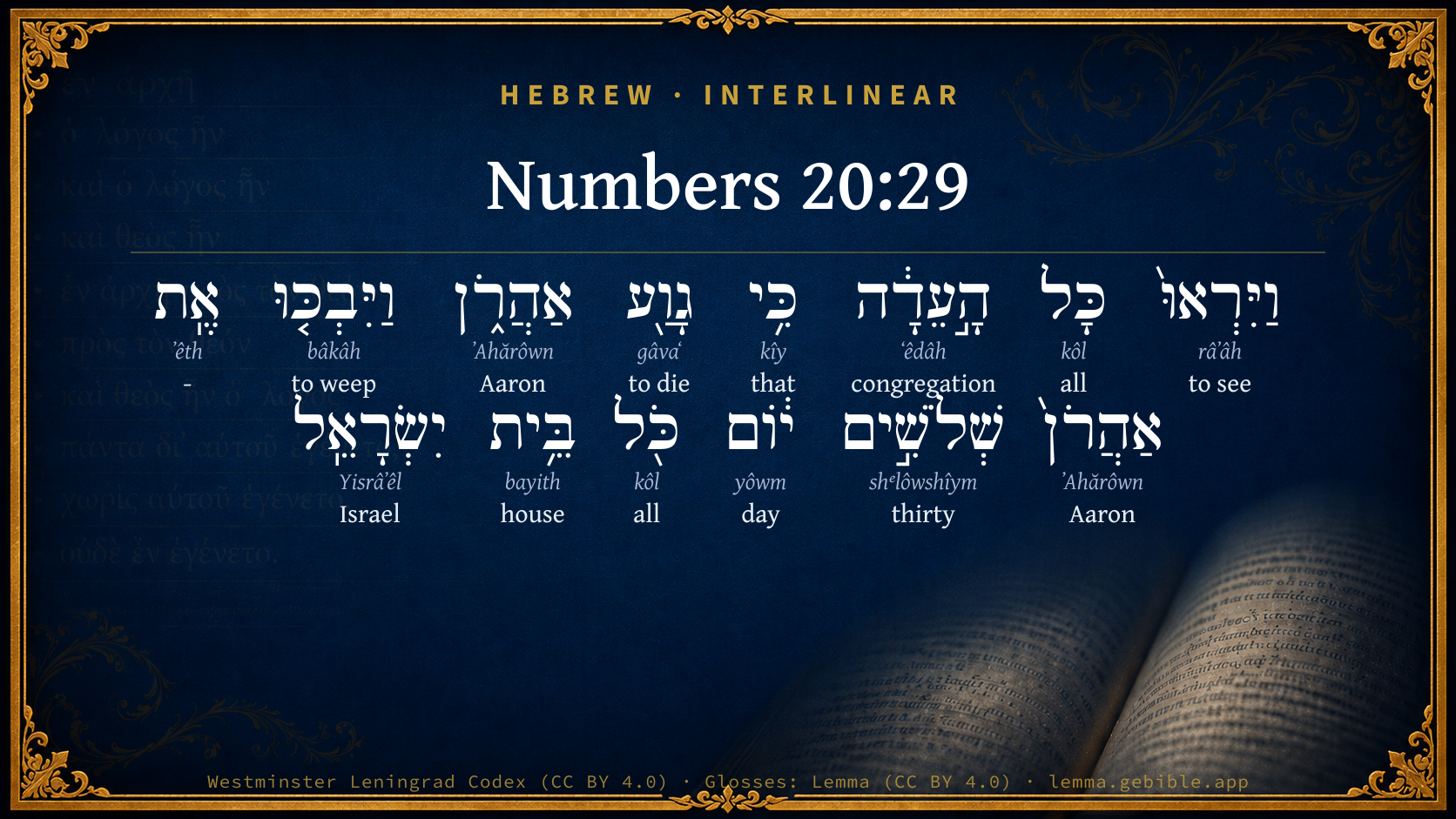
Hebrew (Westminster Leningrad Codex) Numbers 20:29 appears in the Hebrew Old Testament. The text above is from the Westminster Leningrad Codex. Each word links to its Strong’s number, a concise gloss, and parsing drawn from the Open Scriptures Hebrew Bible morphology. Click any word for its full Brown-Driver-Briggs (BDB) entry.
Download image
Cite this verse

Numbers 20:29 (World English Bible). Public Domain. Lemma interlinear Bible study tool, https://lemma.gebible.app/v/numbers/20/29.

Show BibTeX & RIS
BibTeX
RIS
English Translation
When all the congregation saw that Aaron was dead, they wept for Aaron thirty days, even all the house of Israel.
World English Bible · Public Domain
Download a study sheet

One document with this verse’s original text, its word-by-word gloss line, the meaning frame, cross-references with their text, attributed commentary, and full source and license credits — printable, and it pastes into notes with its structure intact.

This verse Autodidact and up

Study sheet (.html) Plain text (.txt)

A passage Seminary Student

Up to 50 verses in one chapter. A passage sheet keeps up to 6 commentary sources and 12 cross-references per verse, in the order this page ranks them, and says so on the sheet whenever that leaves anything out. Ask for a single verse and you get the Autodidact verse sheet above.

Everything on this page stays free to read, with no account — the sheet is a download of what is already on screen, not access to it.

Want to remove ads? Support Godless Engineer
Compare translations 3

The same verse in 3 English versions, stacked beneath the original-language interlinear above. Click any original word for its lexicon entry.

Each is an independent rendering of the whole verse — the interlinear is not word-aligned to these translations.

Highlighted words mark where these versions differ — a whole-verse word diff, not a word-by-word alignment.

  • World English Bible Public Domain
    When all the congregation saw that Aaron was dead, they wept for Aaron thirty days, even all the house of Israel.
  • King James Version Public Domain
    And when all the congregation saw that Aaron was dead, they mourned for Aaron thirty days, even all the house of Israel.
  • unfoldingWord Literal Text CC BY-SA 4.0
    And all the congregation saw that Aaron expired. And all the house of Israel wept for Aaron 30 days.

unfoldingWord Literal Text — © unfoldingWord, licensed CC BY-SA 4.0. Word-aligned USFM3 via Door43 (git.door43.org/unfoldingWord/en_ult).

Versions to compare (up to 4)

3 of 4 selected

Show all 18 translations

Every available English version of this verse, each an independent rendering of the whole verse.

  • World English Bible Public Domain
    When all the congregation saw that Aaron was dead, they wept for Aaron thirty days, even all the house of Israel.
  • Berean Standard Bible Public Domain
    When the whole congregation saw that Aaron had died, the entire house of Israel mourned for him thirty days.
  • Majority Standard Bible Public Domain
    When the whole congregation saw that Aaron had died, the entire house of Israel mourned for him thirty days.
  • King James Version Public Domain
    And when all the congregation saw that Aaron was dead, they mourned for Aaron thirty days, even all the house of Israel.
  • American Standard Version (1901) Public Domain
    And when all the congregation saw that Aaron was dead, they wept for Aaron thirty days, even all the house of Israel.
  • Revised Version (1885) Public Domain
    And when all the congregation saw that Aaron was dead, they wept for Aaron thirty days, even all the house of Israel.
  • Geneva Bible (1599) Public Domain
    When al the Congregation sawe that Aaron was dead, al the house of Israel wept for Aaron thirtie dayes.
  • Douay-Rheims (1899) Public Domain
    And Aaron being dead in the top of the mountain, he came down with Eleazar.
  • Young's Literal Translation Public Domain
    and all the company see that Aaron hath expired, and they bewail Aaron thirty days -- all the house of Israel.
  • Literal Standard Version CC BY-SA 4.0
    and all the congregation sees that Aaron has expired, and all the house of Israel laments Aaron [for] thirty days.
  • Unlocked Literal Bible CC BY-SA 4.0
    When all the community saw that Aaron was dead, the entire nation wept for Aaron for thirty days.
  • unfoldingWord Literal Text CC BY-SA 4.0
    And all the congregation saw that Aaron expired. And all the house of Israel wept for Aaron 30 days.
  • Darby Bible Public Domain
    And the whole assembly saw that Aaron was dead, and they mourned for Aaron thirty days, [even] the whole house of Israel.
  • World Messianic Bible Public Domain
    When all the congregation saw that Aaron was dead, they wept for Aaron thirty days, even all the house of Israel.
  • Webster's Bible Public Domain
    And when all the congregation saw that Aaron was dead, they mourned for Aaron thirty days, even all the house of Israel.
  • Free Bible Version CC BY-SA 4.0
    When the people realized that Aaron had died, they all mourned for him for thirty days.
  • Bible in Basic English Public Domain
    And when the people saw that Aaron was dead, all the children of Israel gave themselves up to weeping for him for thirty days.
  • JPS Tanakh (1917) Public Domain
    And when all the congregation saw that Aaron was dead, they wept for Aaron thirty days, even all the house of Israel.

Literal Standard Version (2020), Covenant Press — licensed CC BY-SA 4.0. Text via the HelloAO Bible API (eBible.org). Unlocked Literal Bible (unfoldingWord) — licensed CC BY-SA 4.0. Text via the HelloAO Bible API (eBible.org). unfoldingWord Literal Text — © unfoldingWord, licensed CC BY-SA 4.0. Word-aligned USFM3 via Door43 (git.door43.org/unfoldingWord/en_ult). Free Bible Version, Dr. Jonathan Gallagher — licensed CC BY-SA 4.0. Text via the HelloAO Bible API (eBible.org).

Word by word

More ways to search: Search by grammar → Find every occurrence → Compare this word →

Practice this passage: Drill this verse → Learn its vocabulary →

גָוַ֖ע
gâvaʻ
H1478
“to die”
Verb, Qal, Perfect, 3rd Person, Masculine, Singular
Part of Speech
Verb
Stem
Qal
Form
Perfect
Person
3rd Person
Gender
Masculine
Number
Singular
Full BDB Definition

Origin: a primitive root

TWOT: 328

to expire, die, perish, give up the ghost, yield up the ghost, be dead, be ready to die - (Qal) to expire, die, be about to die
  1. וַיִּרְאוּ֙ râʼâh H7200 “and · to see” Conjunction + Verb, Qal, Sequential Imperfect, 3rd Person, Masculine, Plural
  2. כָּל kôl H3605 “all of” Noun, Common, Masculine, Singular, Construct
  3. הָ֣עֵדָ֔ה ʻêdâh H5712 “the · congregation” Particle, Definite Article + Noun, Common, Feminine, Singular, Absolute
  4. כִּ֥י kîy H3588 “that” Conjunction
  5. אַהֲרֹ֑ן ʼAhărôwn H175 “Aaron” Noun, Proper
  6. וַיִּבְכּ֤וּ bâkâh H1058 “and · to weep” Conjunction + Verb, Qal, Sequential Imperfect, 3rd Person, Masculine, Plural
  7. אֶֽת ʼêth H853 “-” Particle, Direct Object
  8. אַהֲרֹן֙ ʼAhărôwn H175 “Aaron” Noun, Proper
  9. שְׁלֹשִׁ֣ים shᵉlôwshîym H7970 “thirty” Adjective, Cardinal number, Both, Plural, Absolute
  10. י֔וֹם yôwm H3117 “day” Noun, Common, Masculine, Singular, Absolute
  11. כֹּ֖ל kôl H3605 “all of” Noun, Common, Masculine, Singular, Construct
  12. בֵּ֥ית bayith H1004 “house of” Noun, Common, Masculine, Singular, Construct
  13. יִשְׂרָאֵֽל Yisrâʼêl H3478 “Israel” Noun, Proper

About this verse

These counts appear in no published source. They are computed here, from the morphology-tagged text and Lemma’s own curated glosses. What Lemma adds →

14
words
12
distinct lemmas
Pentateuch
section

Notable vocabulary

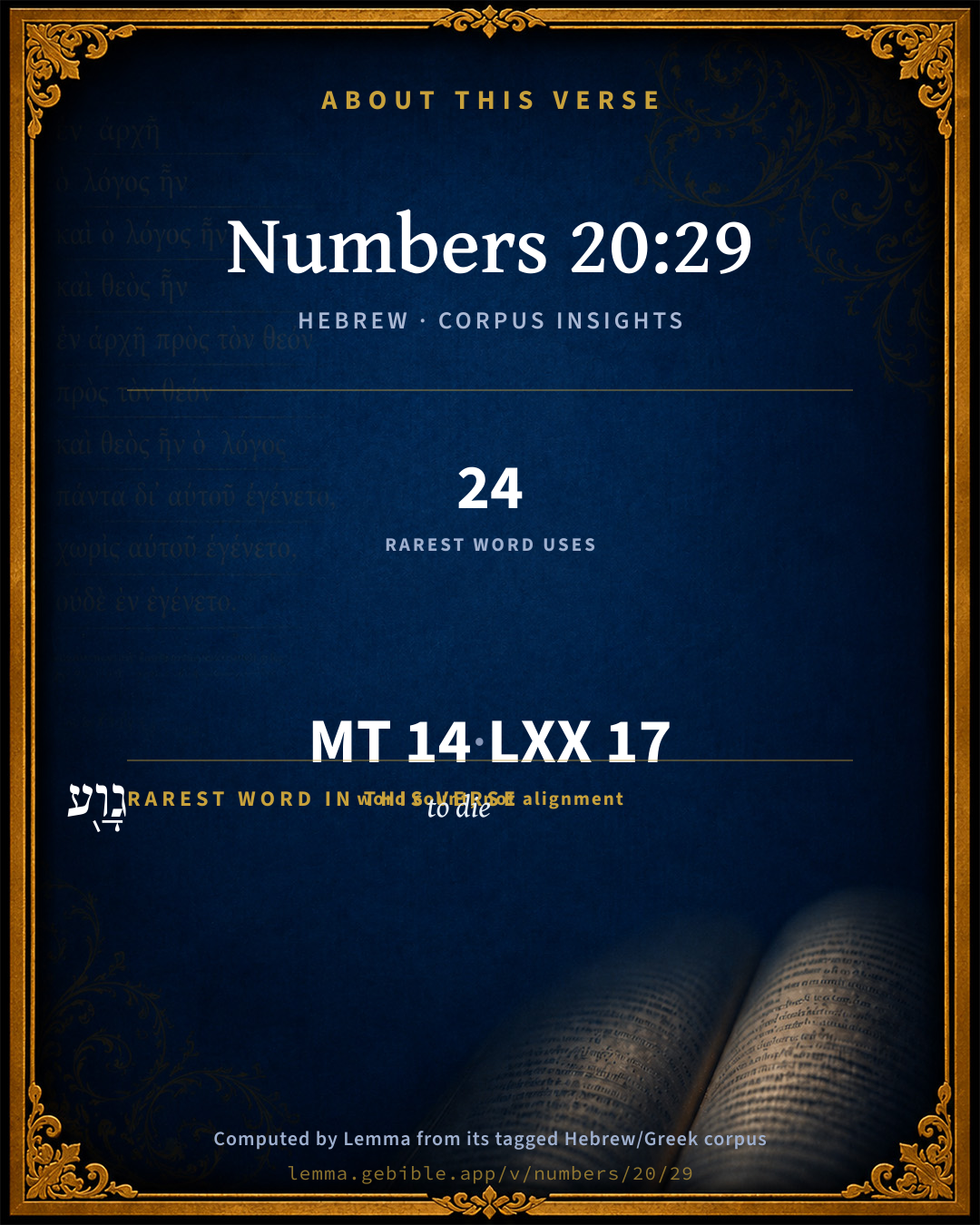
The rarest word here is גָוַ֖ע to die H1478 — appearing just 24 times in the whole Hebrew Bible.

Shared distinctive vocabulary

גָוַ֖ע to die H1478 occurs in 23 verses of the Hebrew Bible. Also found in:

Grammatical profile

  • 3 verbs
  • 8 nouns
  • 1 adjective
  • 1 conjunction
  • 1 particle

Verb forms

  • וַיִּרְאוּ֙ Qal · Sequential Imperfect
  • גָוַ֖ע Qal · Perfect
  • וַיִּבְכּ֤וּ Qal · Sequential Imperfect

Repetition

Words recur within this verse — often emphatic in Hebrew:

  • כָּל all H3605 ×2
  • אַהֲרֹ֑ן Aaron H175 ×2

Hebrew & Septuagint length

In English translation the verse runs 21 words from the Hebrew and 22 from the Septuagint (LXX English) — closely comparable.

A rough comparison of the two English renderings, which tokenize alike — not a word-level alignment.

Word counts can differ between the Hebrew and the Greek without any difference in meaning — e.g. the Hebrew direct-object marker אֵת has no separate Greek word, and Greek often adds the article ὁ.

In the original languages it is 14 Hebrew tokens and 17 Greek tokens — but the two are counted differently (Hebrew bundles its prefixes and suffixes into one token; the Greek is in lemma form), so that isn’t a like-for-like length.

Cross-references

4

Topical passages linked to Numbers 20:29 in the Treasury of Scripture Knowledge — connected by theme and wording, ordered by reader-vote popularity; previews shown in the World English Bible.

  • Deuteronomy 34:8 The children of Israel wept for Moses in the plains of Moab thirty days: so the days of weeping in the mourning for Moses were ended.
  • Genesis 1:10 God called the dry land Earth, and the gathering together of the waters he called Seas. God saw that it was good.
  • 2 Chronicles 35:24–25 So his servants took him out of the chariot, and put him in the second chariot that he had, and brought him to Jerusalem; and he died, and was buried in the tombs of his fathers. All Judah and Jerusalem mourned for Josiah.
  • Acts 8:2 Devout men buried Stephen, and lamented greatly over him.

Cross-references courtesy of OpenBible.info (CC BY 4.0).

Hebrew and Greek witnesses Masoretic Hebrew ↔ Greek Septuagint

The same verse in the two great witnesses to the Old Testament, shown verse-for-verse.

These are two independent witnesses, not word-aligned to each other, and the Septuagint is shown in lemma (dictionary) form.

Hebrew Numbers 20:29 Masoretic · Westminster Leningrad Codex

וַיִּרְאוּ֙ כָּל הָ֣עֵדָ֔ה כִּ֥י גָוַ֖ע אַהֲרֹ֑ן וַיִּבְכּ֤וּ אֶֽת אַהֲרֹן֙ שְׁלֹשִׁ֣ים י֔וֹם כֹּ֖ל בֵּ֥ית יִשְׂרָאֵֽל

When all the congregation saw that Aaron was dead, they wept for Aaron thirty days, even all the house of Israel.

World English Bible · Public Domain

Greek LXX Numbers 20:29 Septuagint · lemma form

καί ὁράω πᾶς ὁ συναγωγή ὅτι ἀπολύω ἀαρών καί κλαίω ὁ ἀαρών τριάκοντα ἡμέρα πᾶς οἶκος ἰσραήλ

And all the congregation saw that Aaron was dead: and they wept for Aaron thirty days, even all the house of Israel.

LXX2012 (modern English Septuagint) · Public Domain

Hebrew: Westminster Leningrad Codex (CC BY 4.0). Greek: Septuagint (public domain); English from LXX2012 (modern English Septuagint) (Public Domain). How the Septuagint differs from the Hebrew →

Targum (Aramaic paraphrase)

2

The Targum is the ancient Jewish Aramaic paraphrase of the Hebrew Scriptures — an interpretive translation, not the Hebrew text itself. Onkelos (literal) and Pseudo-Jonathan (expansive) render the Torah, and Jonathan the Prophets. Coverage is partial: where no permissively-licensed English translation exists for a verse, only the Aramaic is shown. This is verse-level text, not a word-by-word alignment to the Hebrew.

  1. Targum Onkelos Torah (Genesis–Deuteronomy)
    וַחֲזוֹ כָּל כְּנִשְׁתָּא אֲרֵי מִית אַהֲרֹן וּבְכוֹ יָת אַהֲרֹן תְּלָתִין יוֹמִין כֹּל בֵּית יִשְׂרָאֵל

    (no public-domain English translation for this verse)

    Targum Onkelos — Aramaic: “Onkelos Genesis” (public domain); “Onkelos Exodus” (public domain); “Onkelos Leviticus” (public domain); “Onkelos Numbers” (public domain); “Onkelos Deuteronomy” (public domain). English: “Sefaria Community Translation” (CC0 1.0 (public-domain dedication)); “J.W. Etheridge. The Targums of Onkelos and Jonathan Ben Uzziel on the Pentateuch. London: Longmans, Green, 1862” (public domain). Text via Sefaria.

  2. Targum Pseudo-Jonathan Torah (Genesis–Deuteronomy)
    וְכֵיוַן דְנַח נַפְשֵׁיהּ דְאַהֲרן אִסְתַּלָקוּ עֲנָנָא יְקָרָא בְּחַד לְיַרְחָא דְאָב וְחָמוּן כָּל כְּנִשְׁתָּא דְאָתָא משֶׁה נָחִית מִן טַוְורָא מָנוֹי בְּזִיעִין וַהֲוָה בָּכֵי וַאֲמַר וַוי לִי עֲלָךְ אַהֲרן אָחִי עַמוּד צְלוֹתְהוֹן דְיִשְרָאֵל אוּף הִינוּן בָּכוֹן יַת אַהֲרן תְּלָתִין יוֹמִין גוּבְרַיָא וּנְשַׁיָא דְיִשְרָאֵל

    And when the soul of Aharon was at rest, the Cloud of Glory was lifted up on the first day of the month Ab; and all the congregation beheld Mosheh come down from the mountain with rent garments; and he wept and said, Woe unto me, for thee, my brother Aharon, the pillar of Israel's prayers! And they too wept for Aharon thirty days, the men and the women of Israel.

    Targum Pseudo-Jonathan — Aramaic: “Targum Jonathan on Genesis” (public domain); “Targum Jonathan on Exodus” (public domain); “Targum Jonathan on Leviticus” (public domain); “Targum Jonathan on Numbers” (public domain); “Targum Jonathan on Deuteronomy” (public domain). English: “The Targum of Jonathan ben Uzziel, trans. J. W. Etheridge, London, 1862” (public domain). Text via Sefaria.

Commentary

Notes on Numbers 20:29 from classic Christian and Jewish commentators (each source and its license shown beneath its notes). The classic Christian expositions comment on the surrounding passage and are grouped to its opening verse, so a note may address several verses; the Jewish commentaries on the Tanakh (Rashi and others) are per-verse, so they appear only where the commentator wrote on this verse.

Lemma curates 59 commentaries, every one of them public domain or Creative Commons licensed, each selected and text-cleaned for this edition rather than reprinted as found. About our sources →

Joseph Benson's Commentary

Num 20:29. Saw — Understood by the relation of Moses and Eleazar, and by other signs. Thirty days — The time of public and solemn mourning for great persons.

Joseph Benson's Commentary on the Old and New Testaments (1811–1818) — public domain. Text from a community e-Sword module.

Geneva Bible (1599)

Geneva Bible translators

Or, mourned.

Geneva Bible (1599) marginal notes — public domain. Text via Bolls.life.

Jamieson, Fausset & Brown

Robert Jamieson, A. R. Fausset & David Brown

When all the congregation saw that Aaron was dead--Moses and Eleazar were the sole witnesses of his departure (Num 20:28). According to the established law, the new high priest could not have been present at the funeral of his father without contracting ceremonial defilement (Lev 21:11). But that law was dispensed with in the extraordinary circumstances. The people learned the event not only from the recital of the two witnesses, but from their visible signs of grief and change; and this event betokened the imperfection of the Levitical priesthood (Heb 7:12).

they mourned for Aaron thirty days--the usual period of public and solemn mourning. (See on Deu 34:8).

Next: Numbers Chapter 21

Jamieson, Fausset & Brown — Commentary Critical and Explanatory on the Whole Bible (1871) — public domain (CC PDM 1.0). Text via the HelloAO Bible API.

Haydock's Catholic Bible Commentary

Dead, in the 123d year of his age. (Menochius) --- Neither Moses, Aaron, nor Mary, representing the Law, the priests, and the prophets of the Old Testament, could introduce the people into the promised land. This honour was reserved for Josue, the illustrious figure of Jesus Christ, and of his Church. (Calmet)

George Leo Haydock (1774–1849), Haydock's Catholic Family Bible and Commentary, 1859 edition — public domain. Excludes Psalms (Douay-Rheims chapter numbering differs from Protestant) and Deuterocanonical books (Catholic canon only).

Matthew Poole's English Annotations

i.e.

When the congregation understood by the relation of Moses and Eleazar, and by other signs. So seeing is used Gen 42:1; Act 7:12.

Thirty days; the time of public and solemn mourning for great persons. See Deu 34:8.

Matthew Poole's English Annotations on the Holy Bible (1683–1685) — public domain. Text from a community e-Sword/MySword module.

Whedon's Commentary on the Bible

Daniel D. Whedon

29. They mourned — Literally, wept. The same verb is thus translated in Deu_34:8. The Hebrew tongue is exceedingly copious in words expressing the various actions characteristic of mourning, such as beating the breast, weeping, screaming loudly, wearing sad-coloured garments, singing dirges, funeral feasting, rending the clothes, sprinkling ashes or earth on the person, removal of ornaments, neglect of the body, fasting, shaving the head, plucking out the beard or hair, laying bare some part of the person, covering the upper lip, cutting the flesh, and sitting or lying in silence. One marked feature of Oriental mourning is what may be called its studied publicity, and the careful observance of the prescribed ceremonies. Gen_23:2; 1Sa_11:4; 1Sa_30:4; 2Sa_15:30; Job_1:20; Job_2:8-13; Isa_15:3; Jer_3:21.

Thirty days — The customary period of mourning varied. In the case of Jacob it was seventy days in Egypt and seven in Canaan, (Gen_50:3; Gen_50:10, notes;) of Moses thirty, and of Saul seven, days.

Daniel D. Whedon (gen. ed.), Commentary on the Old and New Testaments (1874–1909) — public domain. Text from a community e-Sword module.

The Pulpit Commentary

They mourned for Aaron thirty days. The Egyptians prolonged their mourning for seventy days, (Gen_1:3) but thirty days seems to have been the longest period allowed among the Israelites. (cf. Deu_34:8)

The Pulpit Commentary (1880–1919), ed. H.D.M. Spence-Jones & Joseph S. Exell — public domain. Text from a community e-Sword module.

John Wesley's Explanatory Notes

Saw - Understood by the relation of Moses and Eleazar, and by other signs. Thirty days - The time of publick and solemn mourning for great persons.

John Wesley, Explanatory Notes Upon the Whole Bible (1754–1765) — public domain. Text via the GEBible commentary corpus.

Rashi

Rabbi Shlomo Yitzchaki (Rashi)

ויראו כל העדה AND ALL THE CONGREGATION SAW [THAT AARON HAD DIED] — When they saw Moses and Eleazar descending and that Aaron was not descending with them, they said, “Where, then, is Aaron?” — He replied to them, “He is dead!” They thereupon said, “Is it possible that a man who stood up against the Angel and stayed the plague, — that over him the Angel of Death should have power?!” — Moses at once offered prayer and the ministering angels showed him (Aaron) to them lying upon the bier. They saw and believed (cf. Midrash Tanchuma, Chukat 17).

כל בית ישראל [THEY WEPT FOR AARON …] EVEN ALL THE HOUSE OF ISRAEL — all: both men and women, because Aaron used to pursue peace and promoted love between contending parties, and between man and wife (cf. The Fathers According to Rabbi Nathan 12).

כי גוע THAT (or because) HE HAD DIED — I say that he who translates these words in the Targum (i.e., anyone who holds that this is the correct rendering) by דהא מית, “because he had died”, is in error unless he also translates in the Targum the word ויראו by ואתחזיאו “they were seen (exposed)”, for our Rabbis stated that this word כי is used here in the sense of “because” only in accordance with a Midrash which relates that the clouds of glory which hitherto enveloped Israel disappeared at Aaron's death, (so that all the congregation were now exposed to the sight of their enemies), and in accordance with what R. Abuhu said (Rosh Hashanah 3a), “Read here not וַיִּרְאוּ but וַיֵּרָאוּ, “they were seen”. It is to this sense of the verb that the meaning of “because” is applicable to the word כי, since that gives the reason for what precedes it: Why were they seen? Because, behold, Aaron had died, and the clouds disappeared. But to the translation in the Targum, וחזו כל כנשתא (“and all the congregation saw”), the meaning of “because” (for the word כי) is not applicable, but only the meaning אשר, “that”, which is one of the usages of the word אי (the Aramaic equivalent of אם, which itself is one of the four classifications of the usage of כי; see ibid). For we find אם used in the sense of אשר “that”, as e.g., (Job 21:4) “so that (ואם) why should I not be impatient?” And many passages where אם occurs may be explained in this sense, as (Job 14:5), “that (אם) his days are determined”.

Rashi on the Tanakh — English translations: “The Judaica Press complete Tanach with Rashi, translated by A. J. Rosenberg” (CC BY 4.0); “Pentateuch with Rashi's commentary by M. Rosenbaum and A.M. Silbermann, 1929-1934” (public domain); “The Metsudah Tanach series, Lakewood, N.J” (CC BY 4.0); and “The Book of Joshua, Metsudah Publications, 1997” (CC BY 4.0). Text via Sefaria.

Lesson kit

Teaching starters — assembled from the data on this page, not authored interpretation. Every prompt links to the verse data it draws on. Edit before teaching.

Numbers, in the Pentateuch, opens this verse with 14 words (12 distinct Hebrew lemmas). Its most distinctive word is gâvaʻ (“to die”). A historical commentator’s framing appears above. Read the whole chapter for the surrounding context.

Discussion questions

  1. The word gâvaʻ carries the sense “to die.” How does it shape the verse?
  2. How does Genesis 6:17, which shares the word «to die», read alongside this verse?
  3. What does the repetition of “all” (2× in this one verse) do in this verse?
  4. These translations render this verse differently. What is at stake in choosing one wording over another?
  5. «וַיִּרְאוּ֙» is a Qal Sequential Imperfect verb. How does that grammatical form shape the action described?
  6. Compare how Joseph Benson's Commentary and Geneva Bible (1599) read this verse. Where do they agree or differ?

Things to notice

Reading settings

Reading text

Shown beneath each verse's original-language words.

Old Testament
Old Testament edition

Read the OT as the Masoretic Hebrew (MT) or the Greek Septuagint (LXX).

English shown for the Greek Septuagint (in the Hebrew ↔ Greek comparison).

Comparing translations? Open the Compare panel on any verse page to stack up to four side by side.